
The Study of the Stepwise Hydroxyl Radical- Mediated Oxidation of Alkyl Surfactants at the
Air-Water Interface
Thesis by
Kevin M. Barraza
In Partial Fulfillment of the Requirements for the degree of
Doctor of Philosophy
CALIFORNIA INSTITUTE OF TECHNOLOGY Pasadena, California
2018
(Defended September 19, 2017)
2017 Kevin M. Barraza ORCID: 0000-0003-1849-5219
ACKNOWLEDGEMENTS
First, I’d like to thank Jack for being a supportive advisor. Words cannot express how much I appreciate the mentorship Jack has provided me. Thank you so much for the opportunity you’ve given me at Caltech. I’d like to thank all the past and current members of the Beauchamp group. Kate Upton has always been there to lend an ear about our respective projects, or to talk about non-science things.
Daniel Thomas was a great help. When I first joined he was the person who taught me how to use and troubleshoot the FIDI apparatus. I am also appreciative of the postdocs in our lab, Jinshan Gao, Josh Wiley, and Xinxing Zhang, who have each been a source of perspective about science and academia.
There also some important members of the Caltech community who were very important in my development in graduate school. Rick Gerhart is an amazing glassblower. He is responsible for the fabrication of the dielectric barrier discharge source exactly to my specifications. Without his glassblowing expertise, I could never perform hydroxyl radical oxidation, and for that I am very thankful. I’d also like to thank Nathan Dalleska for participating in our group meetings and giving me helpful advice on the data I presented. I can’t express how much I appreciate Priscilla Boon for her help on the administrative aspects of the group.
Caltech’s CTLO and CPET have been an invaluable resource for my development as an educator.
I am thankful for the opportunity to participate in the certificate programs that allowed me to expand my teaching strategies. Mitch Aiken and Kitty Cahalan are incredible at providing the educational resources necessary to go into the community and spread a love of science.
My family has been a source of constant emotional support throughout my life, and that couldn’t be truer during my experience in graduate school. I can never thank my mother and father enough for being supportive of me, always being a phone call away whenever I need them. My sister Diana has had a front row seat to my journey as a graduate student, and is always ready to listen to my stories, often over delicious Mexican food. My Aunt Rose and Uncle John are like a second set of parents to me and I can always count on them. Likewise my cousin Tiffany is a second sister, and I always have felt so much support from her. My partner in crime Favian has witnessed my final year of graduate school and has helped me push through the finish line. Finally, I have to voice my appreciation to my cat Marceline, who is ready to jump on my head or meow softly when I need to smile. Thank you to everyone who has helped me reach this point in my life.
ABSTRACT
This thesis presents work on the heterogeneous chemistry of surfactant monolayers adsorbed at the air-water interface with gas phase hydroxyl radicals (OH). A novel hydroxyl radical source utilizing a low-temperature plasma known as the dielectric barrier discharge source (DBDS) is designed, characterized, and implemented as a high concentration OH generator (approximately 1000 fold higher than ambient conditions) in these experiments.
Millimeter-sized water droplets containing a monolayer of surface-adsorbed species are exposed to this OH source until a designated level of oxidation. Field-induced droplet ionization mass spectrometry (FIDI-MS), which has been previously proven to be a surface- selective ionization technique, is used as an analytical method to determine the identity and relative quantity of oxidation products at the interface by sampling progeny droplets expelled upon the application of a pulsed electric field. Chapter 2 establishes the utility of the DBDS and FIDI-MS setup by oxidizing the 12-carbon n-alkyl surfactant dodecyltrimethylammonium (DTA+). Mechanistic details can be determined through the evolution of high mass oxidation products through a nearly complete conversion of the parent monolayer. Carbonyl, hydroxyl, peroxyl, and small amounts of fragmentation products can be discerned from the collision-induced dissociation mass spectra and through hydrogen- deuterium exchange experiments. Psuedo-first order kinetics can also be observed in this system, suggesting a Langmuir-Hinshelwood mechanism of OH-initiated oxidation. Chapter 3 extends the study of oxidation of hydrocarbon surfactants by looking at neighbor chain competition among a bis-quaternary ammonium gemini surfactants, a species that contains two long alkyl chains. Specifically, the experiment assesses the ability of two non-identical
alkyl chains to compete with each other for the impinging gas phase hydroxyl radical. The increased reactivity of singly oxidized chains is evaluated by the oxidation of a gemini surfactant parent with identical alkyl chains. Chapter 4 investigates the oxidation of α,ω- surfactants, those that contain polar functional group separated by methylene spacers, discussing deviations of this class of surfactants with those that contain only one head group (i.e. DTA+). Chapter 5 demonstrates the DBDS and FIDI-MS system for use as a peptide footprinting technique for the amphiphilic species substance P. Localization of the site of oxidation can be done through FIDI-MS/MS analysis.
PUBLISHED CONTENT AND CONTRIBUTIONS
Chapter 2 is based on the manuscript in preparation:
Barraza, K. M. and Beauchamp, J.L. (2017). “Hydroxyl radical-mediated stepwise Oxidation of the hydrocarbon surfactant dodecyltrimethylammonium ion at the air-water interface.”
[under preparation]
K. M. B. was the lead researcher and main author of the manuscript.
Chapter 3 is based on:
Barraza, K. M.; Lee, H.; Kim, H.; and Beauchamp, J. L. (2017). “Elucidation of chain competition effects in the hydroxyl radical-mediated oxidation of gemini surfactants at the air-water interface.” [under preparation]
K. M. B. was the lead experimental researcher and main author of the manuscript.
Chapter 4 is based on:
Barraza, K. M. and Beauchamp, J. L. (2017). “Heterogeneous OH-mediated oxidation is constrained by restricted motion of looped hydrocarbon chains formed by α, ω-diionic surfactants at the air-water interface.” [under preparation]
K. M. B was the lead researcher and main author of the manuscript.
Chapter 5 is based on:
Barraza, K. M. and Beauchamp, J. L. (2017). “Heterogeneous hydroxyl radical-mediated oxidation of the amphiphilic peptide substance P as a footprinting technique.” [under preparation]
K. M. B. was the lead researcher and main author of the manuscript.
TABLE OF CONTENTS
Acknowledgements ... iii
Abstract ... iv
Published Content and Contributions ... vi
Table of Contents ... vii
List of Figures ... x
List of Schemes ... xiii
Nomenclature ... xiv
1 Introduction ... 1
1.1 Background ... 1
1.1.1 Air-Water Interfaces – A Frontier in Atmospheric Heterogeneous Chemistry ... 1
1.1.2 Overview of Previous Methods for Generating Gas Phase Hydroxyl Radicals ... 2
1.1.3 Dielectric Barrier Discharge as a Useful Means to Generate Hydroxyl Radicals under Ambient Conditions ... 5
1.2 Contents of Thesis ... 9
1.2.1 Stepwise Oxidation of a Linear Alkyl Surfactant at the Air-Water Interface ... 9
1.2.2 Comparative Hydroxyl Radical-Mediated Oxidation of Fraternal and Identical Hydrocarbon Groups in Gemini Surfactants ... 10
1.2.3 The Heterogeneous Oxidation of α,ω-Surfactants: The Influence of Hydrocarbon Conformation at the Air-Water Interface ... 11
1.2.4 Heterogeneous Hydroxyl Radical-Mediated Oxidation of the Amphiphilic Peptide Substance P as a Footprinting Technique ... 11
2 Hydroxyl Radical-Mediated Stepwise Oxidation of the Hydrocarbon Surfactant Dodecyltrimethylammonium Ion at the Air-Water Interface ... 13
2.1 Abstract ... 13
2.2 Introduction ... 14
2.3 Materials and Methods ... 21
2.3.1 Materials ... 21
2.3.2 Field-Induced Droplet Ionization Mass Spectrometry (FIDI-MS) ... 21
2.3.3 Production of Hydroxyl Radicals through the Dielectric Barrier Discharge Source (DBDS) ... 23
2.4 Results and Discussion ... 24
2.4.1 Kinetics of Heterogeneous Oxidation of DTA+ at the Air-Water Interface at Ambient Conditions ... 24
2.4.2 Mechanistic Details of the Oxidation ... 32
2.4.3 Observed Replenishment of DTA+ in an Oxidized Monolayer via Exchange Processes with the Subphase... 36 2.4.4 Confirmation of Product Identities through Hydrogen-Deuterium
(H/D) Exchange Experiments ... 37
2.4.5 Identification of Low Mass DTA+ Oxidation Products ... 39
2.5 Conclusions ... 40
3 Comparative Hydroxyl Radical-Mediated Oxidation of Fraternal and Identical Hydrocarbon Groups in Gemini Surfactants ... 43
3.1 Abstract ... 43
3.2 Introduction ... 44
3.3 Materials and Methods ... 53
3.3.1 Materials ... 53
3.3.2 Synthesis of Gemini Surfactants ... 53
3.3.3 Field-Induced Droplet Ionization Mass Spectrometry (FIDI-MS) ... 55
3.3.4 Production of Hydroxyl Radicals ... 56
3.3.5 Molecular Dynamic Simulations of the Gemini Surfactant at the Air-Water Interface ... 57
3.4 Results and Discussion ... 57
3.4.1 Oxidation of 16-4-12: Effect of Neighbor Alkyl Chain Length on Relative Reactivity of Alkyl Chains ... 57
3.4.2 Oxidation of 16-4-16: Effect of Prior Oxidation on the Relative Reactivity of Alkyl Chains ... 60
3.4.3 Molecular Dynamic Simulations ... 67
3.5 Conclusions ... 70
4 The Heterogeneous Oxidation of α,ω-Surfactants: The Influence of Hydrocarbon Conformation at the Air-Water Interface on Oxidation Pathways ... 72
4.1 Abstract ... 72
4.2 Introduction ... 73
4.3 Experimental Methods ... 76
4.3.1 Materials ... 76
4.3.2 Field-Induced Droplet Ionization Mass Spectrometry (FIDI-MS) ... 76
4.3.3 Production of Hydroxyl Radicals ... 77
4.4 Results and Discussion ... 78
4.4.1 Oxidation of Decamethonium Ion (DM2+) ... 78
4.4.2 Direct Comparison of the Pathway Preference of a Mixture of the Looped Surfactant Decamethonium and the Free Surfactant Dodecyltrimethylammonium ... 86
4.4.3 Testing the Influence of the Head Group Interactions on Directing the Oxidation of α,ω-Surfactants at the Air-Water Interface ... 88
4.5 Conclusions ... 92
5 Heterogeneous Hydroxyl Radical-Mediated Oxidation of the Amphiphilic Peptide Substance P as a Footprinting Technique ... 93
5.1 Abstract ... 93
5.2 Introduction ... 94
5.3 Methods ... 99
5.3.1 Materials ... 99
5.3.2 Footprinting via Heterogeneous Hydroxyl Radical Oxidation at the
Air-Water Interface and Mass Spectrometry Analysis ... 99
5.4 Results and Discussion ... 101
5.4.1 Gas Phase OH-Initiated Footprinting of Substance P at the Air-Water Interface ... 101
5.5 Conclusions ... 105
Appendix A: Supplemental Information for Chapter 2 ... 106
A.1 Calculation of a Monolayer Concentration of DTA+ for FIDI Experiments ... 106
A.2 Calculation of the Diffusion Length of DTA+ over a 1 Minute Equilibration Period in the FIDI Droplet ... 106
A.3 Calculations of Relative Intensity Changes due to Hydrogen/Deuterium Exchange ... 107
A.4 Comparison of the CID Spectrum of m/z 228 after a 30 s DBDS Exposure ... 109
A.5 Estimation of OH Concentration Based on Kinetics Data ... 110
A.6 Mathematical Fits for Kinetics Data ... 112
Appendix B: Characterization of the Dielectric Barrier Discharge Source ... 113
Appendix C: Supplemental Information for Chapter 3 ... 118
C.1 Characterization of Gemini Synthesis Intermediate and Products ... 118
C.2 CID Spectrum of First Generation Oxidation Product [DG + Hy]2+ ... 120
C.3 CID Spectra of the First Generation Oxidation Products of Symmetric Gemini 16-4-16... 120
Appendix D: Supplemental Information for Chapter 4 ... 122
D.1 Spectra of the Decamethonium Ion and Dodecyltrimethylammonium Ion in an Equimolar Solution ... 122
Bibliography ... 124
LIST OF FIGURES
2.1 The FIDI-MS setup for surfactant oxidation experiments ... 23 2.2 The hydroxyl radical-mediated oxidation of DTA+ at the air-water interface
monitored over 60s ... 25 2.3 FIDI-MS collision-induced dissociation (CID) spectra of the first and second
generation DTA+ oxidation products after 20 s DBDS exposure ... 27 2.4 Kinetics data for the oxidation of DTA+ by the hydroxyl radical at the air-water
interface ... 32 2.5 Comparison of FIDI mass spectra of the DTA+ monolayer immediately after a
60 s OH exposure and after a 60 s delay prior to sampling ... 37 2.6 Comparison of relative intensities of the first two generations of oxidation
products the DTA+ at the air-water interface in H2O solvent (black) and 90%
D2O solvent (red). ... 38 2.7 FIDI spectrum of DTA+ at a 50 s DBDS exposure ... 40 3.1 FIDI mass spectrum of dissymmetric gemini (DG) 16-4-12 after a 30 s OH
exposure ... 58 3.2 FIDI collision-induced dissociation spectrum of m/z 276, the [DG + Cb]2+
product of DG after a 30 s OH exposure ... 60 3.3 FIDI spectrum of symmetric gemini (SG)16-4-16 after a 30 s OH exposure ... 61 3.4 FIDI collision-induced dissociation (CID) spectra of second generation
oxidation products of symmetric gemini (SG) 16-4-16 after a 30 s exposure... 65 3.5 The collision-induced dissociation spectrum of m/z 313, the [SG + Px]2+
product ... 67
3.6 Molecular simulations for the dissymmetric gemini (DG) and symmetric gemini
(SG) ... 69
4.1 FIDI mass spectra over a nearly complete conversion of decamethonium (DM2+) to oxidized products over an exposure of hydroxyl radicals via the DBDS ... 79
4.2 The FIDI-CID spectra for the two major initial products of OH-initiated oxidation of DM2+ ... 83
4.3 Representative FIDI mass spectrum of an aqueous 1.6 mm droplet containing 75 μM DTA+ and 75 μM DM2+ after a 60 s DBDS exposure ... 88
4.4 FIDI mass spectra of basic and acidic α,ω-surfactants after exposure to the DBDS ... 91
5.1 Diagram of the heterogeneous OH footprinting setup ... 101
5.2 Positive mode FIDI mass spectrum of the surface of a 150 μM droplet of substance P (SP) after a 30 s exposure to the DBDS ... 102
5.3 Collision-induced dissociation (CID) analysis of the singly oxidized substance P at m/z 682 ... 104
A.1 Comparison of the FIDI-CID spectrum of m/z 228 ... 110
B.1 Schematic of dielectric barrier discharge source for hydroxyl radical ... 113
B.2 Spectroscopic Analysis of DBDS ... 114
B.3 Oxidation of caffeine using the DBDS ... 116
B.4 Mass spectra of the caffeine oxidation product region for various DBDS settings ... 117
C.1 ESI-MS spectrum of intermediate 1 in acetonitrile ... 118
C.2 ESI-MS spectrum of product 16-4-12 ... 119
C.3 ESI-MS spectrum of product 16-4-16 ... 119
C.4 The CID spectrum of [DG + Hy]2+ ... 120 C.5 The CID spectrum of m/z 304, the [SG + Cb]2+ product ... 120 C.6 The CID spectrum of m/z 305, the [SG + Hy]2+ product ... 121 D.1 ESI-MS positive mode spectrum of an equimolar aqueous solution of
decamethonium ion (DM2+) and dodecyltrimethylammonium ion (DTA+), each at 75 μM concentration ... 122 D.2 FIDI-MS positive mode spectrum of an aqueous solution of 75μM
decamethonium ion (DM2+) and 75μM dodecyltrimethylammonium ion (DTA+) ... 123
LIST OF SCHEMES
2.1 Known mechanisms of hydroxyl radical-mediated oxidation of a hydrocarbon ... 19 2.2 Possible mechanisms for observed fragmentation products in CID analysis of
DTA+ oxidation products ... 29 2.3 Possible branching mechanism for the formation of m/z 256, the dicarbonyl
product, and m/z 258, the α-hydroxyketone product from the precursor carbonyl m/z 242 ... 34 3.1 The reaction mechanism of hydroxyl radical-mediated oxidation of a generic
gemini surfactant leading to the formation of dicarbonyl and hydroxycarbonyl products ... 50 3.2 Possible mechanisms of fragmentation for oxidized gemini surfactants during
collision-induced dissociation ... 52 3.3 Synthesis of gemini surfactants ... 55 3.4 Possible mechanisms for the formation of fragmentation products found in the
spectra of the second generation oxidation products of SG ... 66 4.1 Possible Pathways for the OH-mediated oxidation of decamethonium (DM2+)
at the air-water interface based on known OH reactions under ambient atmospheric conditions ... 80 5.1 Chemistry pertinent to footprinting experiments of a peptide ... 98 5.2 Proposed mechanism for the formation of m/z 650 in the collision-induced
dissociation of singly oxidized substance P ([SPH2 + O]2+) during FIDI-MS/MS analysis by the loss of methanesulfonic acid (CH3SOH) from oxidized methionine ... 104
NOMENCLATURE
OH: Hydroxyl Radical
VOC: Volatile Organic Compound
FIDI-MS: Field-Induced Droplet Ionization Mass Spectrometry CID: Collision-Induced Dissociation
DBDS: Dielectric Barrier Discharge Source SOA: Secondary Organic Aerosol
DTA+: Dodecyltrimethylammonium DM2+: Decamethonium
DAD: 1,12-diaminododecane H2TD: Tetradecanedioic Acid SP: Substance P
C h a p t e r 1
INTRODUCTION
1.1 Background
1.1.1 Air-Water Interfaces – A Frontier in Atmospheric Heterogeneous Chemistry
The atmosphere provides the perfect backdrop for complex chemistry to occur, particularly because volatile organic compounds (VOCs) are continuously emitted from biogenic and anthropogenic sources.1-12 One of the most important processes that govern the lifetime of VOCs is the oxidative processing of organic species by gas phase oxidants.
Reactions between oxidants and VOCs producing highly functionalized and fragmented products of sufficiently low volatility can associate to form nanometer to micrometer-sized solid and semi-liquid particulates known as secondary organic aerosols, which have a large- scale impact on the global climate and human health.9, 11, 13-16 The hydroxyl radical (OH) represents a dominant oxidant in daytime atmospheric chemistry, and can initiate degradation of a wide variety of compounds to produce the precursors to secondary organic aerosols.13, 15, 17-30 Present in the troposphere at concentrations of approximately 106 molecules/cm3, 31 OH is produced in two-steps by the photolysis of ozone at wavelengths near 300 nm by solar radiation to produce singlet oxygen O(1D), followed by a reaction with water (O(1D) + H2O → 2OH).18, 32 These hydroxyl radicals represent a major gas phase VOC sink. 11, 13-16 In addition, SOAs are a major source of potential reactivity for the hydroxyl radicals, as their surfaces are rich in hydrocarbon groups vulnerable to hydrogen abstraction
by the OH, initiating the process to age them (i.e. functionalize them with oxygen groups).16,
33-43 In the case of OH-initiated oxidation of aerosols, heterogeneous chemistry, that is, chemistry occurring at the interphase of two distinct phases, has a remarkable impact on observed chemical changes.44-47 The hydroxyl radical has a high affinity for accommodating on both particulate and aqueous surfaces.48-51 Heterogeneous OH oxidation experiments have long been found to illuminate the chemical changes of organic particulates and aerosols.24,
40-41, 50, 52-64 This includes the identification of ketone, alcohol, carboxylic acid, and even transient radical products in numerous low-volatility organic systems.22, 41, 45, 47, 56-57, 60-61, 65
This thesis presents work meant to compliment what is already known about the heterogeneous chemistry of OH at the air-water interface with hydrocarbon surfactants by utilizing field-induced droplet ionization mass spectrometry (FIDI-MS) coupled with a novel dielectric barrier discharge source for producing hydroxyl radicals at ambient atmospheric conditions. The system is designed to form millimeter-sized droplets containing a monolayer of surfactant and can be coupled to reactive gas sources for controlled gas-liquid heterogeneous chemistry, elucidating mechanistic, kinetic, and structural details on several systems.24, 66-70 Here the FIDI-MS/DBDS technique has provided a similar breadth of detail on several pertinent atmospherically-relevant hydrocarbon surfactant system. A potential protein footprinting application of setup is also presented.
1.1.2 Overview of Previous Methods for Generating Gas Phase Hydroxyl Radicals
One of the challenges in studying hydroxyl radical (OH) chemistry under ambient atmospheric conditions is the generation of such a reactive short-lived species. However, reactions of hydroxyl radicals span important topics in biology, industry, and atmospheric
science. Because of these diverse systems in which the hydroxyl radical have played a role, numerous methods to generate hydroxyl radicals have been developed.
The transient nature of the OH radical requires that its production occur in situ from a reactive precursor. Ozone is a commonly employed in OH oxidation studies by reacting it with a low molecular weight alkene (e.g. 2,3-dimethylbut-2-ene).35, 53-54 Such methods have been used to study the degradation of pesticides54 and the aging of secondary organic aerosols (SOAs)35, 53 in the absence of UV irradiation, which may convolute the results. Such methods can produce OH at 106 molecules/cm–3.53 Coproducts can also be produced through this method, which can include CO, CO2, and formaldehyde. The detriment of producing such species in the experimental setup may preclude the use of this generation method.
Photolytic gas phase OH production methods allow precise control of the exposure concentrations. Pulse-photolysis particularly allows for controlled gas phase reaction.
Methods can either produce OH directly or indirectly. Direct OH production can be achieved by the photolysis low concentration (5 – 20 ppmv) hydrogen peroxide at 254 nm.21 Indirect methods involve the photolytic production of a precursor that then reacts to form OH. For example, ozone is photolyzed by 185 nm light to produce singlet oxygen O(1D), which then reacts with water to form OH.34, 40, 45 Nitrous oxide (N2O) has been used as a similar reagent, where photolysis at 193 nm produces O(1D) and N2.25 The organic precursor methyl nitrite (CH3ONO) has also been used as an OH precursor in atmospheric systems.26 Irradiation using 360 nm light produces the methoxyl radical (CH3O) and nitric oxide (NO). The methoxyl radical reacts with oxygen to produce formaldehyde and HO2, while NO reacts with the HO2 to produce NO2 and OH. While these photolytic methods provide an efficient
means to produce gas phase OH, depending on the reactive target of the OH, the UV light may prove to be a competitive source of reactive initiation, or cause uncertainty in the results by the introduction of byproducts and highly reactive intermediates.
Plasma discharges are another method for producing gas phase OH radicals. Similar to photolytic methods, the process requires first energizing a reagent species by exposing it to the plasma, after which it proceeds through one or more subsequent gas phase reactions. For example, passing a flow of H2/He through a high frequency plasma produces H atoms. The H atoms are carried into a tube filled with O2 to produce HO2, which then reacts with another H atom to form two hydroxyl radcials.50 Radical probe mass spectrometry71 modifies the electrospray ionization (ESI) technique to produce hydroxyl radicals. A sheath gas of oxygen is used and the voltage bias on the high voltage needle of the ESI source is increased such that a discharge is produced during operation. Within this discharge oxygen is ionized to produce O2+ and then reacts with water through a series of reactions to produce OH. In non- ambient studies beams of hydroxyl radicals are produced by passing a mixture of hydrogen peroxide/water through a corona discharge.64 The resulting beam of OH, unreacted species, and other ions pass through a hexapole filter, which then selects for OH radicals as it passes through the setup. However, hydroxyl radicals produced through discharge methods may produce unwanted excited state species which may be different from the ground state hydroxyl radical chemistry.
We have developed a new electrical discharge methodology that produces hydroxyl radicals under ambient conditions using solely water as the reagent. While aqueous OH radical has been produced by the radiolysis hydrogen peroxide72-77 and water,78-81 the content
of this thesis displays the development and utilization of producing OH radicals in the gas phase directly from water vapor. This method not only benefits from simple reagents (a humid helium gas flow), but also limits the amount of byproducts produced or possible contamination of unreacted reagents that may complicate the chemistry of heterogeneous systems.
1.1.3 Dielectric Barrier Discharge as a Useful Means to Generate Hydroxyl Radicals under Ambient Conditions
Electrical discharges have long been used as a means to generate high energy gas phase species such as electrons, metastable excited state species, and radicals.82-85 Dielectric barrier discharge (DBD) differentiates itself from other discharge methods as it is considered a cold, non-equilibrium plasma. The designation originates from the property of DBD to produce high energy electrons, while keeping the energy of the bulk carrier gas relatively unchanged, evidenced by the low temperature of the plasma. In this regard a DBD is capable of converting more than 99% of the electrical energy into the production of high energy electrons, rather than heating the bulk gas.86
While the exact geometry of a setup can vary, the DBD plasma is achieved by placing a dielectric material between two electrodes.87-88 During operation, one of the electrodes is grounded while a high voltage AC bias is applied to the other. The dielectric material placed between the electrode surface acts as a current limiter, preventing typical equilibrium plasma generation. In order to sustain DBD the applied high voltage to the electrodes must be vary with time so as to prevent charges to accumulate on the dielectric material’s surface. For this reason, unlike typical plasma generators, common DBDs require AC power supplies.86, 89
The DBD produces as a series of microdischarges typically of 0.1mm in radius in the discharge gap. Electron avalanches produced by the voltage reach a critical point via space charging in the fronts and allow for the microdischarge formation. Only existing for 1 to 10ns, these discharges create a peak current of 100 mA and currents densities of 106 to 107 A-m-2 in a 1mm discharge gap. The total charge ranges between 10-10 and 10-9 C with electron densities of 1020 to 1021 m3. While electrons produced via DBD have energies from 1 – 10 eV the temperature remains unchanged (For comparison, thermal energy at room temperature is roughly 0.03eV).89
Mechanistically, the dielectric barrier discharge (DBD) proceeds via four phases. The first is the Townsend phase – a breakdown in the discharge gap occurs when the electric field between electrodes is high enough to sustain an avalanche event. This causes streamers to form conducting channels (i.e. filaments). Charges flow through the channel and deposit on a dielectric surface. Finally, once the voltage across the filament is equalized the discharge dies out. The entire process occurs on the order of nanoseconds. Though the voltage across the gap is close to zero when the discharge extinguishes, the residual conduction channels become sites of preferred initiation of new microdischarges so long as the applied voltage varies with time. Thus with an AC power source, the DBD can be sustained.
The elementary collision processes in plasmas involve the neutral gas molecules in excited and ground states, electrons, positive ions, and negative ions. The electric field directly accelerates electrons rather than atoms, due to their low mass and high mobility.
Because of this, it is the electron-impact excitation and ionization processes that are key in understanding the changes in the plasma. Inelastic collisions are the main source of reducing
the mean energy of these electrons. The electron-impact event is crucial because it can produce all excited states of an atom via optically allowed, optically forbidden, and spin- forbidden processes; it can also populate long-lived metastable atomic states, which can further take part in secondary collision processes.86
Recently, a relatively new ambient ionization source harnessing dielectric barrier discharge has been studied. Known as Dielectric Barrier Discharge Ionization (DBDI), this processes involves producing low-temperature plasma between two electrodes separated by a dielectric material. When an alternating voltage is applied between the electrodes the electrical discharge is created, capable of ionizing material on the surface of the dielectric material. The product ions can then be directed into a mass spectrometer, suggesting a new class of ambient ionization. This method of ionization was characterized by Na et. al.90 They conclude that this method of ambient ionization has the advantage of being relatively simplistic in terms of both design and reagents relative to alternative methods such as Direct Analysis in Real Time (DART) and Desorption Electrospray Ionization (DESI). The same group also showed DBDI is capable of detecting explosives at otherwise undetectable levels.91 The low-temperature plasma ionization techniques have been found to be useful in ionizing analytes of human skin samples in vivo,87 as well as detecting drugs in urine, saliva, and hair,91 and to image ink pigments from works of art.92
The DBD technique has been adapted to produce hydroxyl radicals under ambient conditions for various applications.93-95 Because the discharge generated produces high- energy electrons at low temperature, the proposed mechanism of producing radicals occurs via electron capture reaction directly (e– + H2O → H– + OH), or a two-step reaction initiated
by an electron-impact ionization reaction (e– + H2O → H2O+ + 2e–) followed by a reaction of the H2O+ cation with water (H2O+ + H2O → H3O+ + OH).
Studies of radical oxidation have used corona discharges in a similar manner to DBD to generate hydroxyl radicals.64 The method of electrical discharge may create vibrationally excited products, and examination of the LIF spectra of corona discharge-generated OH revealed a high vibrational temperature Tvib of 3400 ± 100 K. Other measurements determined the vibrational temperature to be 1700 K.96 The relative quantities of OH radicals in the υ = 1 and υ =0 in the limits of 1700 K ≤ Tvib ≤ 3400 K are calculated using the formula:64
n(1)
n(0) exp 3566cm1 kBTvib
(1.1) The subsequent amounts are 5 – 22% OH radicals in the υ = 1 state, and 95 – 78% in the υ = 0 state.
However, the above was calculated assuming there are no collisions among molecules.
In the case of the DBD discharge, ambient pressures are used and it can be estimated that the mean-free path under these conditions is approximately 300nm. Probabilistically, a collision with a non-reactive buffer gas (e.g. helium) will stabilize the hydroxyl radical before it reaches the outlet of the glass DBD chamber.
1.2 Content of Thesis
1.2.1 Stepwise Oxidation of a Linear Alkyl Surfactant at the Air-Water Interface
A surge of interest in hydroxyl radical (OH) chemistry has arisen in the field of atmospheric science over the decades as OH-mediated oxidation has been identified as the primary sink of hydrocarbons in the atmosphere. Gas phase studies have shed light on the details of the oxidation process for various organic compounds. However, organics and the hydroxyl radical have a significant affinity to accommodate to air-water interfaces. While such interfaces are prevalent in the atmosphere in the form of cloud droplets, fog, mist, and aerosols, the challenge of creating OH at ambient conditions and sampling the air-water interface effectively while excluding components of the bulk aqueous phase has precluded the same level of analysis that has been seen for gas phase systems. In Chapter 2 we implement field-induced droplet ionization mass spectrometry (FIDI-MS) to sample from millimeter-sized water droplets with adsorbed dodecyltrimethylammonium (DTA+) as a charged, surface-active species with a long hydrocarbon chain. Gas phase hydroxyl radicals are generated within a dielectric barrier discharge source (DBDS) and are flowed over the droplet, allowing for controlled oxidation of the DTA+ present on the droplet’s surface.
Sampling the water droplet after OH exposure via FIDI-MS provides a means to characterize the initial products of the heterogeneous oxidation of DTA+. Varying exposure lengths elucidates the product evolution over the course of oxidation, and can be traced to known mechanisms of OH chemistry. The time-resolved data is used to deduce the kinetics of the system.
1.2.2 Comparative Hydroxyl Radical-Mediated Oxidation of Fraternal and Identical Hydrocarbon Groups in Gemini Surfactants
Hydrocarbon surfactant monolayers formed at air-water interfaces are ubiquitous in aerosols and lipid membrane systems. The hydrocarbon moieties present themselves into the gas phase and are therefore the first targets for oxidants such as OH. The heterogeneous chemistry of monolayers of hydrocarbon surfactants has subsequently been the focus of much study. However, questions still remain on how relatively closely spaced neighbor alkyl chains (as are found in lipid systems where they are tethered together by the head group) impact each other’s relative reactivity with the hydroxyl radical. Chapter 3 investigates neighbor chain competition in the heterogeneous oxidation of bis-quaternary ammonium gemini surfactants (general formula: (CnH[2n – 1])N+(CH3)2(CsH2s)N+(CH3)2(CmH[2m – 1]), abbreviated n-s-m), at the air-water interface using the DBDS for OH generation and FIDI- MS for interface sampling. Two gemini surfactants were designed and synthesized to address two important questions concerning inter-chain competition. First, a monolayer of dissymmetric gemini (DG) with chain lengths 16-4-12 is oxidized by gas phase OH to determine to what extent a longer alkyl group at the air-water interface outcompete its shorter chain neighbor. Second, a symmetric gemini (SG) system of chain lengths 16-4-16 is heterogeneously oxidized until a considerable amount of oxidation product containing two oxygen atoms is present. FIDI-MS/MS analysis is used to determine to what extent the first functionalization on one of the chains of the SG changes the susceptibility of this chain to oxidation relative to its neighbor. The results are then compared to molecular simulations describing each surfactant system.
1.2.3 The Heterogeneous Oxidation of α,ω-Surfactants: The Influence of Hydrocarbon Conformation at the Air-Water Interface on Oxidation Pathways
Secondary organic aerosols (SOAs) are often composed of α,ω-surfactants, those that carry polar head groups separated by a hydrophobic interior of methylene units. For example, unsaturated fatty acids are an important precursor to dicarboxylic acids found in SOAs.
Similarly, amines are commonly found in boreal forest and marine environments, with diamine species being suggested as an important part of particulate formation in those climates. Chapter 4 discusses the oxidative fate of a model α,ω-surfactant, the decamethonium ion at the air-water interface via hydroxyl radical-mediated oxidation. Field induced-droplet ionization mass spectrometry (FIDI-MS) coupled with the dielectric barrier discharge source (DBDS) is utilized to analyze the oxidative pathways of the decamethonium system, based on known OH chemistry. The observed chemistry of decamethonium is directly compared to the DTA+ system studied in Chapter 2 by exposing a droplet containing an equimolar mixture of the two species to OH. To assess the possibility that head group interactions are responsible for the observed chemistry, α,ω-surfactants containing carboxylic acid head groups and amine head groups are also oxidized.
1.2.4 Heterogeneous Hydroxyl Radical-Mediated Oxidation of the Amphiphilic Peptide Substance P as a Footprinting Technique
The need to characterize the properties of both natural and synthetic proteins and peptides has become crucial as this class of biomolecules is seriously considered for novel materials or biomedical applications. Oxidative footprinting represents one technique used to determine structural information of a protein by chemically modifying the protein’s residues
and determining the locations of the chemical changes by mass spectrometry. Several radiolysis or catalytic methodologies have been developed to generate a controlled amount of oxidant in solution, and residues in contact with the aqueous phase are modified.
Conventional oxidative footprinting elucidates the sites of the most solvent-accessible residues. Chapter 5 presents the application of the coupled DBDS and FIDI-MS setup as a novel peptide footprinting technique to determine the gas phase-accessible residues of a surface active peptide substance P. Heterogeneous reaction of OH with a monolayer of substance P determines gas-accessible residues of peptides and acts as a complimentary footprinting technique for systems in which a surface active peptide adopts a unique conformation at the air-water interface.
C h a p t e r 2
Hydroxyl Radical-Mediated Stepwise Oxidation of the Hydrocarbon Surfactant Dodecyltrimethylammonium Ion
at the Air-Water Interface
2.1 Abstract
A dielectric barrier discharge source (DBDS) producing a concentration of hydroxyl radicals of 2 x 10⁹ molecules/cm3 coupled with Field-Induced Droplet Ionization Mass Spectrometry (FIDI-MS) has been developed to monitor the stepwise hydroxyl radical- mediated oxidation of a hydrocarbon surfactant dodecyltrimethylammonium (DTA+) ion at the air-water interface of a 1.6 mm diameter droplet under ambient atmospheric temperature and pressure. The step-wise conversion of 92% of the nascent DTA+ to oxidation products occurs in 60 sec, resulting in the formation of carbonyl, hydroxyl, and peroxyl-containing species. Structural assignments are supported by collision-induced dissociation (CID) and H/D exchange experiments, the latter conducted with D2O droplets. The low ratio of hydroxyl to carbonyl functionalization in the alkyl chain suggests the Russell mechanism commonly described in the hydroxyl radical-mediated oxidation of other systems is not operative. Rather, the carbonyl and peroxyl-forming pathways, as well as radical site migration pathways, play an important role in the evolution of products. Low mass products were identified as a series of aldehydes produced from beta cleavage of a C–C bond, and their relative intensities suggest that the hydroxyl radicals react preferentially with the methylene groups near the methyl terminus of the alkyl chain. Detailed analysis of the kinetics of oxidation suggests the hydroxyl radical is accommodated on and has a significant
diffusion period in the interfacial layer, rather than reacting with the most accessible and previously oxidized species first, implicating Langmuir-Hinshelwood reaction kinetics.
Exchange of unreacted subsurface excess surfactant products occurs on a 1 minute timescale.
2.2 Introduction
Volatile organic compounds (VOCs) are released into the atmosphere from both biogenic sources10, 12 as well as anthropogenic sources such as the burning of fossil fuels.1-2 The organic aerosols formed from VOCs in the atmosphere have far-reaching effects on visibility, health, cloud formation, and reactive pathways of atmospheric species.11, 13-14 Of all the degradation processes for saturated VOCs (e.g. alkanes) in the atmosphere, hydroxyl radical (OH)-mediated oxidation reactions account for greater than 90% of their loss in the troposphere, and constitute their major loss pathway in the stratosphere, forming secondary organic aerosols (SOAs).11, 13-16 The reactivity of OH toward VOCs is dominant over other gas phase radical species such as ozone (O3) and nitrate radical (NO3), even in the presence of NOx.9 In both rural and urban locations oxidized organic aerosols are found to constitute the majority oxidized aerosol composition, comprising 64% to 95% of total organic aerosols.38 Furthermore, the properties of oxidized organic aerosols (such as volatility, oxidation state, density, and cloud droplet nucleation activity) can vary widely based on oxygen-carbon ratios over the course of oxidative aging.37-38, 40, 53
The majority of VOCs are hydrophobic or slightly amphiphilic, either as nascent VOCs (e.g. oleic acid) or as partially oxidized species containing heteroatoms (O, N, S functionalities),4, 47 and show a thermodynamic drive to adsorb and remain on air-water interfaces (e.g. fog, rain, and cloud droplets) rather than diffuse into to a bulk aqueous
environment.97 In addition, the OH radical has been shown to have an affinity for adsorbing to air-water interfaces where it can react with other adsorbed organic species.48-49 In collected droplets in polluted urban environments, oxidized hydrocarbons and OH are found in substantially higher concentrations in atmospheric water droplets,98 indicating that OH-mediated oxidation of VOCs is facilitated in aqueous droplet systems. Thus, a major question in atmospheric chemistry is understanding the initial heterogeneous OH-mediated oxidation pathways occurring for surface active hydrocarbon species, particularly at air- water interfaces.
Several reactor flow tube studies have investigated the heterogeneous reactions of OH and organic solid particulates under conditions mimicking atmospheric conditions.20, 22, 41, 50- 52, 54, 56-58, 65 From these studies it was found that the heterogeneous reaction of OH radicals with particulates occurs efficiently, quantified with uptake coefficients ranging from 0.51±
0.10 to values as high as 1.3 ± 0.4.51, 65 However, the uptake coefficient is dependent on the surface, with organic coatings of varying thickness increasing the uptake coefficient.56 The subsequent heterogeneous chemistry between the adsorbed VOCs and gas phase OH radical can be slowed drastically relative to the homogeneous gas phase chemistry,52 implicating the air-water interface as a chemically unique system.
Mass spectrometry analysis of OH-oxidized VOC solid particulates show that higher mass species comprise multi-functionalized oxygenated species, which include ketones, aldehydes, alcohols, and carboxylic acids for the gas-particulate interface.22, 41, 45, 47, 56-57, 65
Under highly oxidizing conditions evidence of fragmentation of VOCs is seen via the detection of lower molecular weight species including carboxylic acids of varying chain
length, methanol, acetaldehyde, formic acid, and acetic acid.22, 36, 47, 50, 62, 65 Furthermore, structural features of the surface species impact the exact nature of the observed products, with fragmentation and alcohol products favored for particles coated with branched alkanes and carbonyl products in higher abundance for linear alkane precursor species.22 Physical properties of the solid particulates and liquid microdroplets, such as hygroscopicity, surface tension, cloud condensation nucleation activity, and particle size have been found to be impacted by OH exposure.40, 58, 65
For heterogeneous chemistry occurring at air-liquid interfaces, theoretical studies have found that the local solvent environment has a tremendous impact on the hydrogen abstraction event with an organic species, with aprotic environments inhibiting hydrogen abstraction from the hydrocarbon by OH due to their inability to stabilize the transition state via hydrogen bonding.99 Studies at the air-water interfaces with OH radicals have shown that short exposures produce an array of oxygenated products and fragmentation products including carbonyls, alcohols, peroxides, and carboxylic acids.60-61 These studies used aqueous microjets containing an organic species and exposure to OH produced via laser flash photolysis of O3/O2/H2O mixtures over an exposure time of nanoseconds, monitoring the composition changes using electrospray ionization mass spectrometry (ESI-MS). By limiting the OH exposure period of these microdroplets to that of the electrospray ionization event, transient peroxyl radical species were detected.61 While the initial products of heterogeneous OH chemistry were detected with this method, the sequential reactions of a monolayer of a hydrocarbon surfactant have not been monitored over the course of nearly complete oxidative processing. While the controlled exposure of surfactant monolayers to gas phase
OH at ambient conditions in combination with temporally well-defined product sampling and analysis has been viewed as a challenge to atmospheric chemists, it remains an important goal in the understanding of reactions of OH with amphiphilic species at the air-water interface.
The general mechanism of the hydroxyl radical-mediated oxidation of alkyl-containing organic compounds in ambient air is shown in Scheme 2.1 and is based on known gas phase and known heterogeneous OH oxidation pathways.13, 17, 25, 39, 60-61, 100-104 The process is initiated via abstraction of a hydrogen atom from the hydrocarbon by OH (reaction [1]), followed by the addition of oxygen to form the peroxyl radical (reaction [2]). This peroxyl radical can convert to the subsequent peroxide according to reaction [3] by ambient HO2, which is 100 times more abundant than ambient OH.31 However, the formation of the tetroxide intermediate by the reaction of two alkyl peroxyl radicasl via reaction [4] presents an alternative pathway, and is found to be nearly diffusion-limited in solution.100 This intermediate can decompose in a number of ways. According to the Russell mechanism, decomposition of the intermediate to an alcohol, carbonyl, and oxygen occurs via a six- membered intermediate (reaction [5]).102 The Bennett-Summers mechanism (reaction [6]) converts the tetroxide intermediate to two carbonyls and hydrogen peroxide via a bicyclic intermediate, and is often invoked in low-temperature systems.100-101 Finally, the loss of oxygen from the tetroxide intermediate produces two alkoxyl radicals (reaction [7]).
However, in the presence of NO, which is present at concentrations around 10 ppbv in ambient city air,105 the alkoxyl radical can be formed from the addition of NO to the peroxyl radical, followed by the loss of NO2 (reaction [8]). In aqueous environments, water catalyzed
a 1,2-hydrogen shift produces the more stable α-hydroxyalkyl radical on the microsecond timescale, which then reacts with oxygen to form the carbonyl (reaction [9a]).60, 106-107 In the gas phase, unimolecular rearrangement to form the α -hydroxylalkyl radical is considered less favorable under atmospheric conditions,108 and formation of the carbonyl likely occurs by direct reaction of O2 to form a trioxy intermediate, followed by the release of HO2 to form the carbonyl (reaction [9b]).27 For primary and secondary alkoxyl radicals, this process occurs quickly relative to the scission of the β C–C bond13 (reaction [10]) to generate an aldehyde and a new alkyl radical. Reaction [11] generates an alcohol via a hydrogen abstraction event. Radical termination may occur via the dimerization of two alkoxyl radicals to form an organic peroxide (reaction [12]). Finally, alkoxyl radicals formed from long chain alkyl species undergo not only the intramolecular 1,2-hydrogen shift, but also the 1,5- hydrogen shift via a six-membered transition state (reaction [13]), forming an alcohol and a new radical site capable of further reaction.103 This radical site migration gains importance as the number of carbon atoms in the alkyl chain increases.19 In the present study the reaction pathways illustrated in Scheme 1 form the basis for interpreting the OH-mediated oxidation of the dodecyltrimethylammonium ion at the air-water interface.
Scheme 2.1. Known mechanisms of hydroxyl radical-mediated oxidation of a hydrocarbon.
The air-water interface presents a unique and relatively unexplored environment of heterogeneous OH chemistry. In the gas phase all interactions are sequential, binary encounters. Activated intermediates retain excitation, leading to further unimolecular
rearrangement and dissociation. In aqueous environments, intermediates are thermalized by collisions with the solvent, removing internal energy that would favor unimolecular rearrangement and dissociation. Because reactants are solvated, the aqueous phase reactions are diffusion-controlled. The air-water interface exemplifies a hybrid of the two regimes. The surfactant’s hydrophobic domain protrudes into the gas phase, where it interacts with incident OH. However, the hydrophilic head group extends into the aqueous phase, providing a means to thermalize species during the oxidative processing.
In the present study we use the technique of Field-Induced Droplet Ionization-Mass Spectrometry (FIDI-MS) coupled with a dielectric barrier discharge hydroxyl radical generator that operates at ambient atmospheric conditions. FIDI-MS is a surface selective technique to sample from aqueous droplets,24, 66-70 while the ambient OH generator passes water-saturated helium through a dielectric barrier plasma discharge to produce OH. In the present study these combined experimental methodologies are employed to examine the stepwise heterogeneous reactions of OH with the hydrocarbon surfactant dodecyltrimethylammonium ion (DTA+) at an aqueous surface. The temporal evolution of the various oxidation products are monitored over time until depletion of the parent species at the surface is nearly complete. Despite the simplicity of a single unbranched saturated alkyl chain, over 100 oxidation products are observed in less than one minute of OH exposure.
2.3 Materials and Methods 2.3.1 Materials
Dodecyltrimethylammonium bromide (DTA+ bromide) was purchased from Aldrich Chemical Company, Inc. and used as is. Solutions were made using HPLC grade water (OmniSolv). Deuterium oxide (D2O) was purchased from Cambridge Isotope Laboratories (99.9% purity) and used as is. Stock solutions were prepared at 1 mM concentrations and stored at 25 °C and diluted to a final concentration of 150 μM for experiments.
2.3.2 Field-Induced Droplet Ionization Mass Spectrometry (FIDI-MS)
FIDI-MS has been developed as an effective means to probe the air-water interface of hanging millimeter-sized droplets,66-68 and has been applied to the real-time monitoring of heterogeneous chemistry of air-water interfaces.24, 68-70 Figure 2.1a-b depict the important components of the FIDI apparatus in a side and top view, respectively, and all FIDI experiments are conducted with ambient conditions in laboratory air. The FIDI apparatus is mounted to an LTQ-XL mass spectrometer (Thermo-Fischer, Waltham, MA). The mass spectrometer syringe pump delivers 150 μM solution of DTA+ bromide to a stainless steel capillary in the FIDI apparatus, forming approximately 1.6 mm diameter droplets (2.5 μL volume) exactly between two plate electrodes spaced 6.3 mm apart. This concentration ensures an excess of one monolayer for a droplet of this size, while being well below its critical micelle concentration.109 Upon formation of the droplet, a 1 min equilibration period allows the surface active species to diffuse to the surface (See Appendix A for relevant calculations for a monolayer concentration and the diffusion timescale.). After this period the droplet is exposed to a flow of hydroxyl radicals in a helium carrier gas for up to 60 s.
When sampling, the front plate electrode is kept at ground and a high voltage (3-5 kV) pulse
is sent to the back plate electrode. A voltage divider applies half the back plate voltage to the capillary, establishing a homogeneous electric field. This electric field induces a dipole in the droplet aligned with the electric field that culminates in the formation of two Taylor cones from opposite ends of the stretched droplet, ejecting charged progeny microdroplets of opposite polarity. One stream of the progeny droplets passes through an aperture in the grounded plate electrode where it enters the atmospheric pressure inlet of the mass spectrometer (Figure 2.1c). Mass spectra are collected with the settings tuned to the DTA+ peak at m/z 228, and only one FIDI-MS spectrum is taken for the droplet at each exposure time. Since FIDI sampling causes significant fluid flow within the distorted droplet, each measurement proceeds with a fresh droplet. A total of 8 repetitions per DBDS exposure condition are performed by removing the previous droplet and forming a fresh droplet.
Collision-induced dissociation (CID) spectra are obtained for the products containing 1 to 2 oxygen functional groups by adjusting the mass spectrometer settings prior to the FIDI sampling. The parameters for spectrum collection are adjusted from their default settings to an isolation width of 0.8 m/z and a collision excitation parameter of 25%. Product CID spectrum collection is repeated 5 times per isolated product.
Figure 2.1. The FIDI-MS setup for surfactant oxidation experiments. a) Depiction of setup during droplet equilibration phase. 1) Stainless steel capillary; 2) Aqueous 1.6 mm diameter droplet containing surfactant; 3) Grounded plate electrode; 4) High voltage plate electrode; 5) Mass spectrometer; 6) hydroxyl radical source. b) Top view of experimental setup. c) Depiction of setup during FIDI-MS sampling. Progeny droplets containing analytes are ejected from Taylor cones and sent through the atmospheric pressure inlet of the mass spectrometer.
2.3.3 Production of Hydroxyl Radicals through the Dielectric Barrier Discharge Source (DBDS)
The dielectric barrier discharge source (DBDS) comprises a 38 mm borosilicate tube (6.45 mm O.D., 3.91 mm I.D.) with a tungsten rod (1.02 mm diameter) inner electrode, and a conductive silver epoxy outer electrode. A bubbler provides water-saturated helium through the DBDS with flow monitored by a Type πMFC Digital Mass Flow Controller (model PFC-50, MKS Instruments). A high voltage AC power supply (Trek PM04015; Trek, Inc, NY) biases the inner electrode during experiments, while the outer electrode remains grounded. A low temperature plasma is generated inside the tube, producing hydroxyl
radicals in the gas stream. Confirmation of hydroxyl radical production was evidenced two ways: 1) identification of excited state OH fluorescence (A2Σ → X2Π transition) in the plasma emission spectrum and 2) observing the oxidation product of a solid caffeine sample, a known hydroxyl radical scavenger,110-112 upon desorption by the DBDS gas flow into the inlet of the mass spectrometer. From these diagnostic procedures the DBDS was optimized and installed in the FIDI apparatus with its OH outlet 5 mm from the droplet and operated at 12 kVpp, 1 kHz sine waveform, 1.414 mA current, and 1000 cm3/min He/H2O flow. For details on the construction, characterization, and optimization of the DBDS see Appendix B.
2.4 Results and Discussion
2.4.1 Kinetics of Heterogeneous Oxidation of DTA
+at the Air-Water Interface at Ambient Conditions
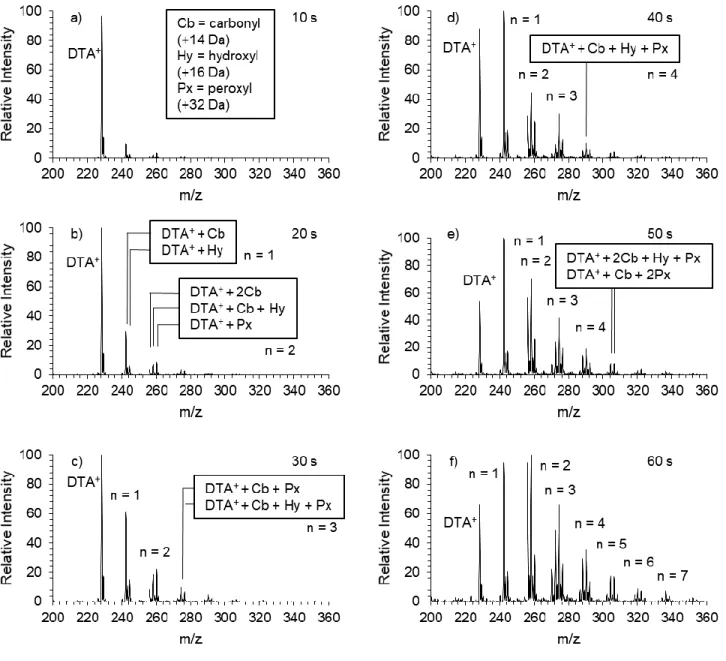
The FIDI mass spectra for the hydroxyl radical-mediated oxidation of DTA+ at the air- water interface for DBDS exposures of 10 – 60 s is shown in Figure 2.2. Over the course of the 60 s exposure to OH, oxidized products accumulate combinations of carbonyl, hydroxyl, and peroxyl functionalizations evidenced by m/z shifts of +14, +16, and +32, respectively.
Assignment of oxidation generations is based on the number of oxygen atoms incorporated into the alkyl chain, where the nth generation contains n oxygen atoms. At least seven generations of DTA+ oxidation products are observed over the course of approximately 90%
conversion of the monolayer. The first generation is dominated by the m/z 242 carbonyl product, with only minor contributions from the hydroxyl product at m/z 244. This bias in
the first generation distribution toward the carbonyl functionalization remains throughout the course of the 60 s oxidation.
Figure 2.2. The hydroxyl radical-mediated oxidation of DTA+ at the air-water interface monitored over 60 s. The 1st generation oxidation products are represented by the label n = 1, the 2nd by n = 2, and so forth. N = 8. a) 10 s DBDS exposure. b) 20 s DBDS exposure. c) 30 s DBDS exposure. d) 40 s DBDS exposure. e) 50 s DBDS exposure. f) 60 s DBDS exposure.
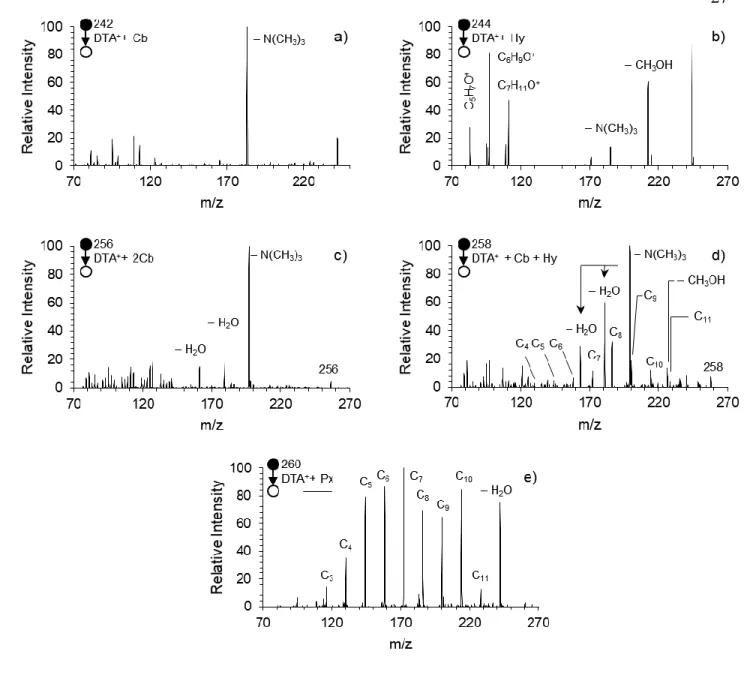
The second generation consists of m/z 256, 258, and 260, the dicarbonyl, hydroxycarbonyl, and the peroxy product, respectively. The identity of these species’
functional groups is confirmed by collision-induced dissociation (CID) analysis shown in Figure 2.3. The CID of the first generation products (Figure 2.3a-b) undergo cyclization and head group loss by nucleophilic attack of the oxygen atom, resulting in the [M – 59]+ species (Scheme 2.2a). However, the numerous distinct products in the CID spectrum of m/z 244 are attributed to the hydroxyl chemistry, including the product formed from the loss of methanol (For mechanistic details see Scheme 2.2b).
Figure 2.3. FIDI-MS collision-induced dissociation (CID) spectra of the first and second generation DTA+ oxidation products after a 20 s DBDS exposure. N = 5. a) CID spectrum of m/z 242, the DTA+ + Cb species. b) CID spectrum of m/z 244, the DTA+ + Hy species. c) CID spectrum of m/z 256, the DTA+ + 2Cb species. d) CID spectrum of m/z 258, the DTA+ + Cb + Hy species. e) CID spectrum of m/z 260, the DTA+ + Px species.
These spectra provided the basis for identifying the bifunctionalized second generation products. The CID spectrum of m/z 256 (Figure 2.3c) shows head group-loss indicative of the nucleophilic displacement caused by carbonyl groups. The CID spectrum of m/z 258 (Figure 2.3d) shows a combination of products found in the CID spectra of m/z 242 and 244, signifying the presence of both the carbonyl and hydroxyl functional groups, namely the cyclization process and methanol loss pathway. However, the series of products spaced by 14 mass units – m/z 228, 214, 200, 186, 172, 158, 144, and 130 – indicate a C–C bond breakage pathway not observed in the CID spectra of the singly functionalized species. The series conforms to aldehydes with chain lengths of 11 to 4 carbon atoms. While aldehyde formation is possible for the first generation products, no such series of products is observed in Figure 2.3a or Figure 2.3b, indicating that the interaction of neighboring hydroxyl and carbonyl groups is important in the generation of this aldehyde series. A proposed mechanism is shown in Scheme 2.2c, in which aldehyde formation occurs for the α- hydroxyketone species. Assuming this mechanism, the aldehyde product occurs at a carbon that has previously been functionalized. Therefore, for a given Cn aldehyde species it can be deduced that carbon n is the site of the carbonyl. Because the other functionalized site is lost after fragmentation, the hydroxyl group resides at the n + 1 carbon.
Scheme 2.2. Possible mechanisms for observed fragmentation products in CID analysis of DTA+ oxidation products. a) Mechanism of head group loss to produce the [M – N(CH3)3]+ product. b) Mechanism of methanol loss to produce the [M – CH3OH]+. c) Mechanism for aldehyde series formation from an α-hydroxyketone product m/z 258. d) Mechanism for aldehyde series formation from peroxide m/z 260.
It should be noted that m/z 258 also conforms to a carboxylic acid. However, the absence of characteristic water and/or decarboxylation losses suggests these species are not carboxylic acids.113 Furthermore, gas phase rate constants suggest the terminal methyl group of DTA+ is not likely to be the site of oxidation (the only site on the chain that can produce a carboxylic acid) in the presence of numerous more reactive methylene groups.28, 30
Figure 2.3e shows the CID spectrum of m/z 260, and elucidates the structural information of the species. This species, representing a mass increase of 32 Da, suggests either the incorporation of two hydroxyl groups or one peroxyl group, both of which can be formed via pathways in Scheme 2.1. The spectrum is dominated by the series of previously mentioned aldehyde Cn peaks, indicating that bond scission is not only favorable, but outcompetes head group loss as a fragmentation pathway in the spectrum. This type of fragmentation is commonly seen in organic peroxides,114-115 and so suggests that the intensity of m/z 260 is dominated by the peroxide species. The weak O–O bond fragments via the mechanism in Scheme 2.2d. The cleavage of the peroxide O–O bond generates an alkoxyl radical. In the absence of ambient oxygen, the radical undergoes β cleavage, forming an aldehyde species. Like the CID spectrum of m/z 258 (Figure 2.3d), there is a significant decrease in relative intensity for Cn aldehydes with fewer than five carbon atoms.
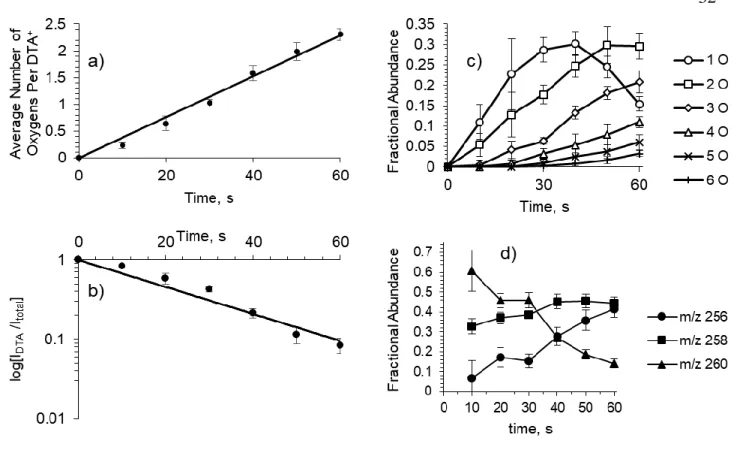
The kinetics for the average incorporation of oxygen into the DTA+ monolayer is shown in Figure 2.4a, showing significant linearity (R2 = 0.987). Furthermore, the timescale for an average of one oxygen incorporated into the DTA+ alkyl chain can be used to estimate an effective OH concentration of 2 × 10⁹ molecules/cm3 (See Appendix A). Extraction of a pseudo first-order rate constant from a fit to the decay of parent DTA+ relative intensity (R2
= 0.954), as shown in Figure 2.4b gives a value of k = 0.0169 s–1. The observed kinetic behavior implicates the oxidation of the DTA+ monolayer occurs in a stepwise fashion:
Figure 2.4c shows the relative fractions of each generation of products over the 60 s oxidation. The population of each generation on the interface experiences a period at which
they constitute a majority on the droplet surface. Fitting the data for generation 1 to a polynomial function (R2 = 0.9991), these species experience maximum rate of formation at 9.25 s. This population experiences a shift from net production to net degradation at 36.1 s.
The data for the second generation also fits to a polynomial regression (R2 = 0.998174), with a maximum production rate of [DTA+ +2O] species at 31.6, and a turning point to net degradation occurring at 55.3 s.
The relative abundances of the


![Figure 3.2. FIDI collision-induced dissociation spectrum of m/z 276, the [DG + Cb] 2+ product of DG after a 30 s OH exposure](https://thumb-ap.123doks.com/thumbv2/123dok/12199695.0/74.918.208.710.263.563/figure-fidi-collision-induced-dissociation-spectrum-product-exposure.webp)
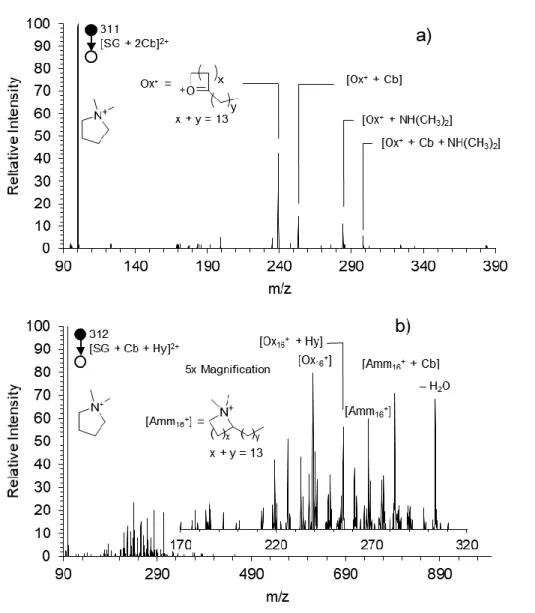
![Figure 3.5 shows the CID spectrum of m/z 313 the [SG + Px] 2+ species. Much like the analogous product for DTA + + Px species discussed in Chapter 2, this species has a unique fragmentation pattern not observed in the spectra in Figure 3.4](https://thumb-ap.123doks.com/thumbv2/123dok/12199695.0/80.918.107.813.121.630/figure-spectrum-species-analogous-discussed-chapter-fragmentation-observed.webp)
![Figure 3.5. The collision-induced dissociation spectrum of m/z 313, the [SG + Px] 2+ product](https://thumb-ap.123doks.com/thumbv2/123dok/12199695.0/81.918.196.724.374.684/figure-collision-induced-dissociation-spectrum-313-sg-product.webp)
