36 TAX E-FILING AND TAX COMPLIANCE IN TEN YEARS:
A BIBLIOGRAPHY APPROACH
E-FILING PAJAK DAN KEPATUHAN PAJAK DALAM SEPULUH TAHUN
Diana Airawaty1, Wahyu Widarjo2
1Universitas Mercu Buana Yogyakarta, 2PDIEUNS [email protected]1
Abstract
The purpose of this study is to examine the research on electronic tax filing that have effects on tax compliance in accredited scientific journals for 10 years. The study is conducted on 95 papers related to e- filing and tax compliance in various countries. Observations are carried out from 2010 – 2019 with Charting the field andanalyzing the community-citation. The first stepis mapping the areaby selecting articles; Classification of articles based on topic, method and discipline; Journal characteristics; and the characteristics of the article. Next step is analyzing the tax scientist community in accounting through the number of citations. Mendeley and Google Scholar are used as supporting application in this study. The topic of e-Filing tax research revolves around information technology in taxation systems and tax compliance. Interestingly, this study find that mostlyobserved research used quantitative research methods and regression analysis tools and Structural Equation Modeling (SEM). Survey method is dominant in this study, followed by a literature study. Highly variables are taken from the Technology Acceptance Model and the UTAUT model, while journal sources come from various journals.
Keywords: Tax Filing (e-Filing), Tax Compliance, Bibliography
Abstrak
Studi ini bertujuan untuk mengkaji penelitian tentang electronic tax filing yang berpengaruh terhadap kepatuhan pajak pada jurnal ilmiah terakreditasi selama 10 tahun. Peninjauan tersebut dilakukan terhadap 95 artikel yang berkaitan dengan e-filing dan kepatuhan pajak di berbagai negara. Periode observasi dimulai dari tahun 2010 - 2019. Ujian ini menggunakan metode "Charting the field" dan "analyzing the community- citation". Pendekatan pertama, pemetaan area meliputi pemilihan artikel; Klasifikasi artikel berdasarkan topik, Metode dan disiplin; Karakteristik jurnal dan karakteristik artikel. Pendekatan kedua, yaitu analisis komunitas ilmuwan pajak di bidang akuntansi melalui jumlah kutipan. Mendeley dan Google Scholar digunakan untuk mendukung penelitian ini. Topik penelitian perpajakan e-Filing berkisar pada teknologi informasi di system perpajakan dan kepatuhan perpajakan. Sebagian besar penelitian menggunakan metode penelitian kuantitatif dan alat analisis regresi dan Structural Equation Modeling (SEM). Metode survey dominan diikuti dengan penelitian studi pustaka. Variabel yang paling banyak adalah Technology Acceptance Model dan Model UTAUT sedangkan sumber jurnal berasal dari berbagai jurnal dan konferensi.
Kata Kunci: PajakElectronik Tax Filing (e-Filing), Tax Compliance, Bibliography.
INTRODUCTION
The Research related to Tax Compliance and e-Filing has grown rapidly along with the advancement of information technology that also continues to develop rapidly. In United Stated for instance, The United Stated Congress has set ambitious target in year 2007 to be filled electronically 80% of tax return ((Schaupp and Carter 2010). In 2010 Malaysia has investigated the factors influencing citizens’ intention to use e-filing in the Malaysian context. Meanwhile in South Africa the study to quantify the maximum potential revenue loss, to National Treasury has been done (van Wyk 2010). Clear look of tax software study has been done by (Survey, York, and
37
Tax 2011) in New York. Meanwhile in Malaysia investigate about the factors that influencing E- filing usage among Malaysian Taxpayers (Tallaha, Shukor, and Hassan 2014).
In Indonesia, research by (Farah Devi Andriani, Napitupulu, and Haryaningsih 2017) has captured factors that influence user acceptance of the e-Filing system. Many researches related to tax e-filing and compliance have been done, hence we do believe this bibliography approach will be beneficial to provide field analysis in terms of topics learned, research methods used, and reliable sources of discipline in 95 articles relating to tax compliance and e-filing in the last decade from 2010 to 2019. As from the best of our knowledge, we have not seen yet the bibliography research in e-filing at the accredited international journal. We obtain this examination in twofold, which are charting the field and analysing the community (Hesford et al. 2006).
It is interesting to review further in terms of the purpose of the paper such as variables of tax compliance, tax e-filing systems information used. The extent of the development of research in this theme such as location of research, how many citation and which journal provide will be very useful to enrich the literature related in tax e-filing and compliance to know the research development in this field and knowing how far the research has been carried out in order to improve tax e-filing and enhance tax compliance in the future. Due to examine this matter, this paper will conduct a literature review based on previous empirical studies that have been published in international accredited journals. This paper is divided in five section. The first one is introduction as above, and the second explain literature review on e-filing and tax compliance. The following part present the research method. Four section will describe the result and discussion that will offer many information to scholar in finding further literature in e-filing and tax compliance, then the last section provide the conclusion of this study.
LITERATURE REVIEW Tax Compliance
The Compliance does not mean that taxpayers have reported their tax obligations using e- filing and then the obligations are completed and are considered compliant. However, tax compliance has many meanings, namely that it has submitted its tax reports properly and correctly, does not reduce obligations, timely and in accordance with applicable laws and regulations (Chebusit et al. 2014). On the other hand, an individual or company is not compliant if the individual or company fails to send tax returns within the specified period, understates its income, exaggerates the reduction and fails to pay taxes assessed at the due date (Night and Bananuka 2019).
Tax E-filing
In the Directorate General of Taxes Regulation No. 47 / PJ / 2008 stated that, e-Filing is a way to submit Annual Tax Reports (SPT) and delivery of Annual SPT Extension Notification which is done electronically online and in real time through the application service provider.
Taxpayers fill out tax returns in their e-filing via the internet. Throughout this process, the system gives taxpayers some guidance on the correct information to be included in their tax returns. The system also calculates the amount of tax assessed based on information provided in the tax return.
RESEARCH METHODS
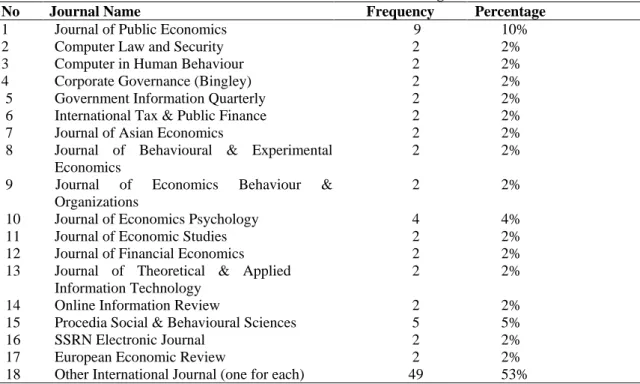
This study uses a bibliography approach through selecting and tabulating data. After data were selected and tabulated, we classified the data as in table 1 that describe the selected papers for sample of this research. Appendix 1 describes the title, author, year of the research publish and how many citations that have been taken by other researcher. There were 99 paper have been selected and will be assessed. The citation shows these researches have been supported and become a reference in the field of research and development of e-filing and tax compliance in the future. In table 1 the source of journal and the percentage of journal from 98 papers selected.
38
Table 1. Source of Journal and Percentage
No Journal Name Frequency Percentage
1 Journal of Public Economics 9 10%
2 Computer Law and Security 2 2%
3 Computer in Human Behaviour 2 2%
4 Corporate Governance (Bingley) 2 2%
5 Government Information Quarterly 2 2%
6 International Tax & Public Finance 2 2%
7 Journal of Asian Economics 2 2%
8 Journal of Behavioural & Experimental Economics
2 2%
9 Journal of Economics Behaviour &
Organizations
2 2%
10 Journal of Economics Psychology 4 4%
11 Journal of Economic Studies 2 2%
12 Journal of Financial Economics 2 2%
13 Journal of Theoretical & Applied Information Technology
2 2%
14 Online Information Review 2 2%
15 Procedia Social & Behavioural Sciences 5 5%
16 SSRN Electronic Journal 2 2%
17 European Economic Review 2 2%
18 Other International Journal (one for each) 49 53%
ANALYSIS AND DISCUSSION
Based on data from table 1 can be seen that the Journal of Public Economics dominates in the presentation of the journal related to tax compliance and e-Filing which is 9% when compared to other journals. Meanwhile, the next sequence is Procedia Social and Behavioral Sciences and Journal of Economics Psychology. Other journals only range from 1 to 2 paper.
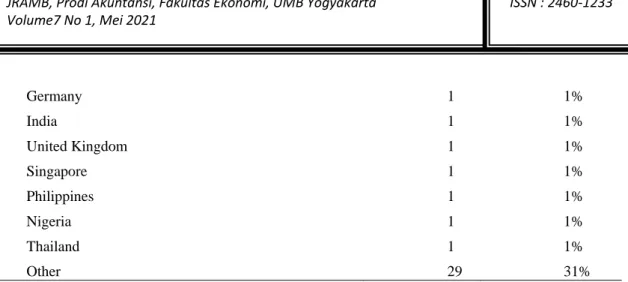
Further classification is presented in table 2 and 3 that will present the location and tool analysis which have been done by 98 papers selected. Tax Compliance and E-filing research is most performed in the US. For the next rank is the Malaysian, 15%. Other countries do not have more than 3 paper for each. Although the country's taxpayer amount is only around 10% of Indonesia but Malaysia is very vigorous in conducting tax compliance research and the electronic system of tax that they have. Meanwhile, the Indonesian state is still very rarely a journal related to this topic which is accredited in international journals.
U.S. as a developed country is the only country that is very dominant in conducting research in the field of electronic tax and tax compliance. For advanced countries U.S. is the highest conducting a review whereas Malaysia is the most dominant developing country in conducting research in this field.
Table 2. Research Location Percentage
Country (Object Research) Frequency Percentage
US 26 27%
Malaysia 17 18%
Indonesia 4 4%
Taiwan 3 3%
Pakistan 3 3%
Switzerland 2 2%
Netherland 2 2%
Japan 1 1%
Australia 1 1%
39
Germany 1 1%
India 1 1%
United Kingdom 1 1%
Singapore 1 1%
Philippines 1 1%
Nigeria 1 1%
Thailand 1 1%
Other 29 31%
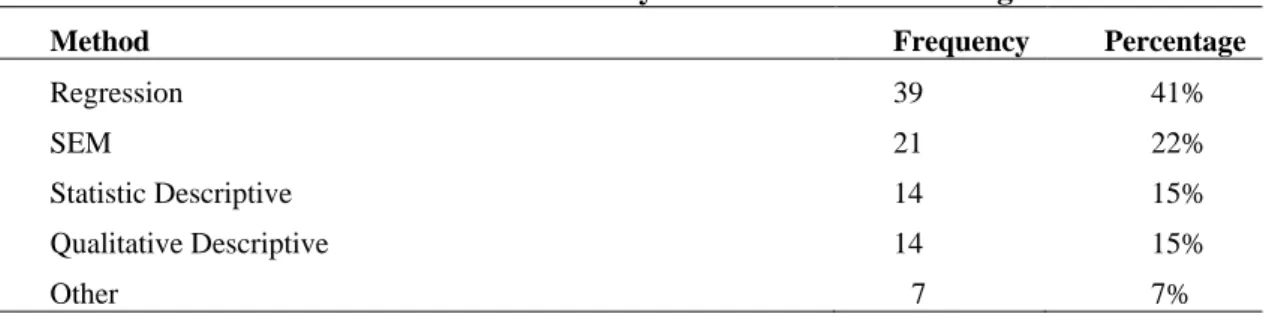
The largest analyst tool used is regression then Structural Equation Modelling (SEM) then regression. After that, followed by qualitative and statistic descriptive and other.
Table 3. Tool Analysis of Research Percentage
Method Frequency Percentage
Regression 39 41%
SEM 21 22%
Statistic Descriptive 14 15%
Qualitative Descriptive 14 15%
Other 7 7%
Table 4. The Big Five Research Location Research Finding Research
Location
No Article Title Finding
US 1 E-file adoption: A study of U.S. taxpayers’ intentions.
Not only the three factors in UTAUT which are performance expectations, social influence, facilitating conditions, have a significant influence on the intention to use e-file but also optimism bias and trust factor.
2 Taxpayer information
assistance services and tax compliance behavior.
Uncertainty of information influenced tax compliance and e-files intention.
3 The impact of trust, risk and optimism bias on E-file adoption
Optimism bias can influence the application of electronic services even though for remote services there are still risks.
4 The role of security and trust in the adoption of online tax filing.
Factors from UTAUT Model unless Facilitating Condition plays an important role in predicting the intention of e-filing taxpayers. Other factors along with the UTAUT factors , namely efficacy and security control which are felt also have a significant effect.
5 A clear look of tax software:
2011 Survey of New York State Professional.
The majority of respondents indicated that they had no problems with the 2011 tax season mandatory e- filing requirements, modernized e-file procedures, or the separation of federal and state e-filing;
however, more than one-third reported minor to significant problems with these changes.
6 Importing corruption culture from overseas: Evidence
Cultural norms have an influence on the tax compliance.
40
from corporate tax evasion in the United States.
7 A comprehensive review of survey-based research in MIS
The most dominant SIM research conducted data analysis and SEM, Lisrel, Pls statistics tools are the common tools used.
8 A meta-analysis of existing research on citizen adoption of e-government
There arethree best factors from 36 relationships carried out in this meta-analysis study. They are subjective norms and behavioral control on behavior intention and behavior intention on actual use. Meanwhile the 14 predictors are perceived usefulness, trust, attitude, subjective norm, performance expectancy, effort expectancy, social influence, and perceived behavioral control on behavioral intention, perceived ease of use on perceived usefulness, service quality on satisfaction, perceived usefulness, perceived ease of use, compatibility on attitude, and behavioral intention on actual use
9 US voluntary disclosure and expatriation: trusts and escaping the US tax net.
People who will be subject to tax cuts in the US for their lives are expatriates because they receive the distribution from the guardian.
10 How Taxing Is Tax Filing?
Leaving Money on the Table Because of Compliance Costs.
The costs incurred to achieve the tax compliance turned out to be more than the estimation.
11 IRS Proposes Form 5472 Filing Duty for Foreign- Owned Disregarded Entities.
All taxpayers potentially subject to Tax Form 5472 duties should retain specialized U.S. tax professionals to advise on these complex, dynamic issues.
12 Changes in corporate effective tax rates over the past 25 years.
It has been clearly a decrease in effective tax ratesthroughout the US company sample. The cumulative decrease that occurs is about 10 percent in 25 years observed.
13 To amend or not to amend:
A tax consulting case.
Mostlyrespondent do amend in their tax report.
14 Tax professionals at work in Silicon Valley
Principal personin any position have an influence on the understanding of taxation and regulations of corporations.
15 Tax avoidance, value creation and CSR – a European perspective
Scientific test shown a positive relationship between the creation of effective value and tax rates for the company. This value has proven not obtained from tax avoidance.
16 Optimal tax administration Empirical evidence shows the influence of taxpayer's behavior on administrative intervention such as changes in tax rates.
17 User-Friendly Taxpaying The more complicated a taxation system will increase a dishonesty in reporting the tax.
18 Improving the Effectiveness of E-Government Policies:
The Example of Federal e- Filing and Underprivileged Taxpayer Groups
In urban areas, the level of e-filing usage is higher than in the countryside. In urban areas the number of women in a population and unemployment rate has a positive effect on the level of e-filing tax.
Meanwhile in rural areas, the population, education level, unemployment and income have no effect on the level of e-filing usage.
19 The effect of tax position and personal norms: An analysis of taxpayer compliance decisions using paper and software
Personal norms are very influential in the decision of tax reporting.
41
20 Public tax-return disclosure Consumers react to disclosures carried out by large companies. There was a slight increase and decreased tax payment on disclosure in obedient companies while investors react negatively.
21 Will destination-based taxes be fully exploited when available? An application to the U.S. commodity tax system
Tax avoidance and tax evasion are two different things.This study found that in the state that has a high tax rate found increased cross-border shopping. While the opposite of the state with low taxes does not occur. This can explain the phenomenon of online shopping and cross-border shopping.
22 Your Biggest Refund, Guaranteed? Internet Access, Tax Filing Method, and Reported Tax Liability
The tax archiving method is influenced by computer use and internet access. Taxpayers are provided with the ease of identifying the amount of tax that must be reported.
23 The impact of state taxes on pass-through businesses:
Evidence from the 2012 Kansas income tax reform
Kansas reform is not proven to have an effect on rising real economic activities.
24 Distributing the Green (Cards): Permanent residency and personal income taxes after the Immigration Reform and Control Act of 1986
Green Cards affects those who have not yet received authority to submit a tax return at rates that are comparable to applicable rates in California.
25 Does credit-card information reporting improve small- business tax compliance?
Form 1099-K as a business receipt that is processed through a third-party payment and payment card.
But it does not apply to cash transactions so that third parties are not reported. This could have caused a leak at tax revenue.
26 Advancement and Forecasting of Electronic
Tax Return and Informational Filing in the US
Personal tax e-file reportinghas reached the target since 2012, which is 80 percent. Trend of tax reporting both personal and business continues to increase. Personal tax reporting of 84 percent with e-file while businesses do not reach 12 percent.
Malaysia 1 E-Government Application:
An Integrated Model on G2C Adoption of Online Tax.
Intention in using tax e-filingare strongly influenced by the ease of use and usability that is felt, government trust, image, compatibility and service quality
2 User Acceptance of the E- Government Services in Malaysia: Structural Equation Modelling Approach
Perception usefulness, ease of use, compatibility, interpersonal influence, external influence, self- efficacy, facilitation conditions, attitudes, subjective norms, perceived behavior control, and intention to use a significant effect on the acceptance of e-government.
3 Integrating ICT skills and tax software in tax education. A survey of Malaysian tax practitioners’
Perspectives
Electronic tax applications have not been used extensively in taxation practices. ICT skills owned by new graduates of accounting are still "on average".
4 A conceptual framework for information technology governance effectiveness in private organizations
There are 14 propositions that are grouped into five factors as a recommended determinant namely demographics of the organization, information intensity, organizational culture, external environmental characteristics, and the characteristics of IT functions.
5 Continued Usage Intention of E-Filing System in Malaysia: The Role of Optimism Bias.
Bias optimism in the reporting of the Malaysian taxpayer e-filing system, creating awareness of privacy and security of violations of personal information. This can encourage taxpayers to
42
increase caution in reporting the tax online.
6 Factors influencing E-filing usage among Malaysian Taxpayers: Does Tax Knowledge Matters?
Statistically tests found that the intention of using e-fling taxes has positive relation with perceptions of uses, perceptions of ease of use, and the perception of subjective norms is positive, but not with perceptions about behavioral control and tax knowledge.
7 Does Design Matter in Tax E-filing Acceptance
The design has a very important role for each technology introduced. Technology application in Malaysia always pays attention to design in practice.
8 Tax Knowledge, Tax
Complexity and Tax Compliance: Taxpayers’
View
Thetaxation complexity and tax-payers knowledge have a role on compliance.
9 The impact of threat of punishment on tax compliance and non- compliance attitudes in Malaysia
The tax audit and fine have more influence at the level of taxpayer compliance compared to the threat of punishment. The threat of punishment actually causes the desire to not comply.
10 The compliance time costs of Malaysian personal income tax system: E-filers vs. manual-filers
E-filing is just a tool to facilitate the archiving process to be faster. But it does not reduce the tax burden that is required to personal taxpayers.
11 The impact of incentive alignment in behavioral acceptance
Incentives did not moderate Behavior Intention but BI directly affected by Performance Expectation, Effort Expectancy, and Social Influence.
12 SMEs Tax Compliance Cost and IT Adoption : the case of VAT
Adherence in adopting the VAT system increases the level of tax compliance.
13 Improving tax compliance via tax education - Malaysian experience
This study found that brochures, advertisements and websites were very effective in helping taxpayers to comply.Meanwhile, to sacrifice time and money studying taxes is something they do not pay attention to.
14 The Effect of Volume of Transaction on The Intention Towards Tax E-filing
The volume of transactions is proven to have a significant effect on tax e-filing system acceptance.
15 Corporate governance and tax disclosure phenomenon in the Malaysian listed companies
Incentives and managerial do not significantly affect tax disclosures. Meanwhile, the size of the company and industry has an effect on tax disclosure.
16 Public governance quality and tax compliance behavior in tax compliance behavior in developing countries .The mediating role of socioeconomic conditions
Developing countries are faced with non- compliance of their taxpayers. Taxpayers in developing countries are generally dissatisfied with government performance and hence affect tax compliance. Meanwhile, developed countries get the largest income from the taxes paid by their citizens. Developing countries must be able to overcome this challenge so as not to be left behind in their economic development.
17 Structural effects of trust in e-filing software on e-filing acceptance in services sector
Three factors of UTAUT except performance expectancy affect trust in e-filing. Trust is successful as a mediating variable in the UTAUT model in this study.
Indonesia 1 The User Acceptance Factors of E-Filing System in Pontianak
In Pontianak Indonesia, acceptance of e-Filing system users is influenced by Information Quality (IQ), Service Quality (SQ) and System Quality (SYQ), Use Behavior (UB), User Satisfaction (US) and Behavior Intention.
43
2 Analysis of factor Affecting the Admission of E-filing system in Jakarta
All variables in the TAM model have an influence on the taxpayers' interest in using e-Filing in Jakarta. However, ease of use is the most significant factor influencing interest in using tax e- fling
3 Effect of Perception of Facilities, Intensity of Conduct, and Satisfaction of Taxpayers to Submission of Letter by E-Filing Notice on Tax Service
Factors that have a significant effect on the use of e-fling in this study are the ease of use and user satisfaction.
4 Exploring government
internet financial reporting in Indonesia
This study did not find any influence of political competition, local assets and population density on Internet Financial Reporting (IFR) in Indonesia.
Taiwan 1 Impact of quality
antecedents on taxpayer satisfaction with online tax- filing systems—An empirical study
Quality services that increase taxpayer satisfaction greatly affect the intention to use the tax system.
2 Adoption of E-Government Service: An Empirical Study of The Online Tax Filing System in Taiwan
Perceived attributes of trialability and observability have valuable affect for users who are late in using the systems. But have no effects on previous user.
Social norms are the only factor that have affect for all the adopter’s intention in using tax e-filing system.
3 Study of Tax E-Filing Acceptance Model A SEM Approach.
This study finds that the combination of factors on TAM and TPB have an influence on the intention to use e-government.
Pakistan 1 Taxes, informality and income shifting: Evidence from a recent Pakistani tax reform
The new tax rate error has no effect on any social preferences.
2 Exploring the
interrelationships between technological predictors and behavioral mediators in online tax filing: The moderating role of perceived risk
Perceived Functional Benefit (PFB) is proven to be a very important predictor in the sustainability of the tax e-filing system.
3 3 The Impact of Media
Campaign on Tax Filling:
quasi-experimental evidence from Pakistan
Campaign in media such as TV ads moral and newspaper ads can increase tax filling rates
CONCLUSION, LIMITATION AND RECOMMENDATION
The results of this literature review show that a country with a high level of research in the system of taxation information and tax compliance has creative and various topics in their research investigation. Table 4 describe the researches title and finding from the big five of research location in this study. It can be seen that US and Malaysia have had many cases and idea to be explored. Compared with other countries with lower research such as Indonesia, the topics are still very narrow.
Pakistan and Taiwan almost have the same amounts of researches with Indonesia. Taiwan has implemented tax e-filing system earlier than Indonesia. Taiwan is one of the pioneer countries in adopt tax filing system since 1998 (Fu, Chao, and Farn 2004). Based on previous research,
44
Taiwan is a country with the best e-government facilities in the world (Fu et al. 2004). Even though Pakistan has less in researches, but they raised newest issue to investigate.The implementation of tax e-filing in Indonesia started in 2005 (Muammar Khaddafi;
Henry Aspan; Mohd. Heikal, Wahyuddin 2017). Recent research in a city in Indonesia, Pontianak (F.D. Andriani, Napitupulu, and Haryaningsih 2017) found there was only about 60% taxpayers using tax e-filing in 2016. There is a needed for researcher in Indonesia to do further research and study to support the implementation of the tax system. This bibliography research can be an additional reference for researcher to map as far as the research has been conducted. Different methodological approaches can be applied to produce more objective data and research findings.
REFERENCES
Andriani, F.D., T. A. Napitupulu, and S. Haryaningsih. 2017. “The User Acceptance Factors of E- Filing System in Pontianak.” Journal of Theoretical and Applied Information Technology 95(17):4265–72.
Andriani, Farah Devi, Togar Alam Napitupulu, and Sri Haryaningsih. 2017. “The User Acceptance Factors of E-Filing System in Pontianak.” Journal of Theoretical and Applied Information Technology.
Chebusit, Chepkurui, G. S. Namusonge, Oteki Evans Biraori, and Ezekiel Chirchir Kipkoech.
2014. “Factors Affecting Tax Compliance Among Small And Medium Enterprises In Kitale Town Trans-Nzoia County, Kenya.” International Journal of Recent Research in Commerce Economics and Management (IJRRCEM).
Fu, Jen Ruei, Wen Pin Chao, and Cheng Kiang Farn. 2004. “Determinants of Taxpayers’ Adoption of Electronic Filing Methods in Taiwan: An Exploratory Study.” Journal of Government Information 30(5–6):658–83.
Hesford, James W., Sung Han (Sam) Lee, Wim A. Van der Stede, and S. Mark Young. 2006.
“Management Accounting: A Bibliographic Study.” Handbooks of Management Accounting Research.
Muammar Khaddafi; Henry Aspan; Mohd. Heikal, Wahyuddin, Falahuddin and ZatinHumaira.
2017. “Effect of Perception of Facilities, Intensity of Conduct, and Satisfaction of Tax Payers to Submission of Letter by E-Filing Notice on Tax Service.”
Night, Sadress and Juma Bananuka. 2019. “The Mediating Role of Adoption of an Electronic Tax System in the Relationship between Attitude towards Electronic Tax System and Tax Compliance.” Journal of Economics, Finance and Administrative Science.
Schaupp, Ludwig Christian and Lemuria Carter. 2010. “The Impact of Trust, Risk and Optimism Bias on e-File Adoption.” Information Systems Frontiers 12(3):299–309.
Survey, Annual, New York, and State Tax. 2011. “2011 Annual Survey of New York State Tax Professionals A Clear Look at Tax Software.” (November):17–25.
Tallaha, Affiza Mohd, Zaleha Abdul Shukor, and Norul Syuhada Abu Hassan. 2014. “Factors Influencing E-Filing Usage among Malaysian Taxpayers: Does Tax Knowledge Matters?”
Jurnal Pengurusan 40:91–101.
van Wyk, E. 2010. “Tax Incentives for Biodiversity Conservation in the Western Cape.” Meditari Accountancy Research 18(1):58–75.
45
Andriani, F.D., T. A. Napitupulu, and S. Haryaningsih. 2017. “The User Acceptance Factors of E- Filing System in Pontianak.” Journal of Theoretical and Applied Information Technology 95(17):4265–72.
Andriani, Farah Devi, Togar Alam Napitupulu, and Sri Haryaningsih. 2017. “The User Acceptance Factors of E-Filing System in Pontianak.” Journal of Theoretical and Applied Information Technology.
Chebusit, Chepkurui, G. S. Namusonge, Oteki Evans Biraori, and Ezekiel Chirchir Kipkoech.
2014. “Factors Affecting Tax Compliance Among Small And Medium Enterprises In Kitale Town Trans-Nzoia County, Kenya.” International Journal of Recent Research in Commerce Economics and Management (IJRRCEM).
Fu, Jen Ruei, Wen Pin Chao, and Cheng Kiang Farn. 2004. “Determinants of Taxpayers’ Adoption of Electronic Filing Methods in Taiwan: An Exploratory Study.” Journal of Government Information 30(5–6):658–83.
Hesford, James W., Sung Han (Sam) Lee, Wim A. Van der Stede, and S. Mark Young. 2006.
“Management Accounting: A Bibliographic Study.” Handbooks of Management Accounting Research.
Muammar Khaddafi; Henry Aspan; Mohd. Heikal, Wahyuddin, Falahuddin and ZatinHumaira.
2017. “Effect of Perception of Facilities, Intensity of Conduct, and Satisfaction of Tax Payers to Submission of Letter by E-Filing Notice on Tax Service.”
Night, Sadress and Juma Bananuka. 2019. “The Mediating Role of Adoption of an Electronic Tax System in the Relationship between Attitude towards Electronic Tax System and Tax Compliance.” Journal of Economics, Finance and Administrative Science.
Schaupp, Ludwig Christian and Lemuria Carter. 2010. “The Impact of Trust, Risk and Optimism Bias on e-File Adoption.” Information Systems Frontiers 12(3):299–309.
Survey, Annual, New York, and State Tax. 2011. “2011 Annual Survey of New York State Tax Professionals A Clear Look at Tax Software.” (November):17–25.
Tallaha, Affiza Mohd, Zaleha Abdul Shukor, and Norul Syuhada Abu Hassan. 2014. “Factors Influencing E-Filing Usage among Malaysian Taxpayers: Does Tax Knowledge Matters?”
Jurnal Pengurusan 40:91–101.
van Wyk, E. 2010. “Tax Incentives for Biodiversity Conservation in the Western Cape.” Meditari Accountancy Research 18(1):58–75.
46
AppendixAppendix 1. Paper Sample Selected
No Title Author Year Research Location Citation
1
E-file adoption: A study of U.S.
taxpayers’
intentions Schaupp et al, 2010 2010
US 289
2
E-Government Application: an Integrated Model on G2C Adoption
of Online Tax. Hussein et al 2010
Malaysia
104
3
Taxpayer information assistance services and tax compliance behaviour
James Alm, Todd Cherry , Michael Jones ,
Michael McKee 2010
US
250
4
Impact of quality antecedents on taxpayer satisfaction with online tax-filing systems—An
empirical study Ching-Wen Chen 2010
Taiwan
142
5
User Acceptance of the E-
Government Services in Malaysia:
Structural Equation Modelling
Approach NorazahMohdSuki, T. Ramayah 2010
Malaysia
161
6
Tax incentives for biodiversity conservation in
the Western Cape E. van Wyk 2010
South Africa
5
7
Integrating ICT skills and tax software in tax education. A survey of Malaysian tax practitioners’
Perspectives
Lai Ming Ling,
NurulHidayahAhamadNawawi 2010
Malaysia
18
47
8
The impact of trust, risk and optimism bias on
E-file adoption Ludwig Christian Schaupp&Lemuria Carter 2010 US 113
9
The role of security and trust in the adoption of
online tax filing. Carter et al 2011
US
119
10
Evaluation of Government E- Tax Websites: an Information Quality and System Quality
Approach Saha et al 2011
Switzerland
56
11
A conceptual framework for information technology governance effectiveness in private
organizations Mohamed & Singh 2011
Malaysia
68
12
A clear look of tax software:
2011 Survey of New York State
Professional By Susan B. Anders and Carol M Fischer 2011 US
-
13
Continued Usage Intention of E- Filing System in Malaysia: The Role of Optimism
Bias. Santhanamary&Ramayah 2012
Malaysia
14
14
Developments in tax e-filing:
practical views
from the coalface. Lymer et al 2012
UK
14
15
Adoption of E- Government Service: An Empirical Study of The Online Tax Filing
System in Taiwan Liang & Lu 2012
Taiwan
43
16
User evaluations of tax filing web sites: A
comparative study of South
Korea and Turkey Lee et al 2012
South Korea &
Turkey
31
48
17
Understanding Taxpayer Behaviour – New Opportunities for Tax
Administration Keith Walsh 2012
Ireland
-
18
Importing corruption culture from overseas:
Evidence from corporate tax evasion in the
United States Jason DeBacker,Bradley T. Heim, Anh Tran 2012 US
124
19
Study of Tax E- Filing Acceptance Model A SEM
Approach. Lu & Ting 2013
Taiwan
2
20
Review on IT adoption: insights from recent
technologies Gangwar et al 2013
India
103
21
A comprehensive review of survey- based research in
MIS Karanja & Zaveri 2013
US
5
22
Can E-Filing Reduce Tax Compliance Costs in Developing
Countries? FatihYılmaz Jacqueline Coolidge 2013
South Africa, Nepal and Ukraine
16
23
A meta-analysis of existing research on citizen adoption of e-government
Nripendra P. Rana & Yogesh K. Dwivedi &
Michael D. Williams 2013 US
128
24
Personal taxpayer compliance costs:
Recent evidence
from Australia Binh Tran-Nam, Chris Evans, Phil Lignier 2013
Australia
14
25
US voluntary disclosure and expatriation:
trusts and escaping the US
tax net Suzanne M. Reisman 2013
US
-
26
Factors influencing E- filing usage among Malaysian Taxpayers: Does Tax Knowledge
Matters? Talaha et al, 2014 2014
Malaysia
15
49
27
Does Design Matter in Tax E-
filing Acceptance Azis&Idris 2014 Malaysia 10
28
Tax Service Quality: The Mediating Effect of Perceived Ease of Use of The Online Tax
System Musthapa&Obid 2014
Nigeria
37
29
Implementing Electronic Filing of Tax Returns:
Insights from the Singapore
Experience Theo & Wong 2014
Singapore
11
30
Tax Knowledge, Tax Complexity and Tax Compliance:
Taxpayers’ View NatrahSaad 2014
Malaysia
152
31
The impact of threat of punishment on tax compliance and non- compliance attitudes in Malaysia
RaihanaMohdalia, Khadijah Isa, Salwa Hana
Yusoff 2014
Malaysia
30
32
The compliance time costs of Malaysian personal income tax system: E- filers vs. manual-
filers Idawati Ibrahim (2014) 2014
Malaysia
9
33
How Taxing Is Tax Filing?
Leaving Money on the Table Because of
Compliance Costs Youssef Benzarti 2014
US
14
34
Factors effecting online tax filing- An application of the IS Success Model.
Chen et al, 2015 2015
Philiphine
107
35
The moderating effect of culture on e-filing taxes:
Evidence from
India. in Zaidi et al 2015
India
19
50
Emerging Economies
36
Corporate governance and initial compliance with IFRS in emerging
markets: The case of income tax accounting in
Egypt Ahmed Ebrahima,Tarek Abdel Fattah 2015
Egypt
29
37
Effects of Online Tax System On Tax Compliance Among Small Taxpayers in Meru County,
Kenya Harrison MwangiMuturi,NahashonKiarie 2015
Kenya
17
38
Tax professionals at work in Silicon
Valley Emer Mulligan, Lynne Oats 2016 US 29
39
Understanding citizens' adoption of e-filing in developing countries: An empirical
investigation. Chaouali et al, 2016 2016
Tunisia
18
40
Changes in corporate effective tax rates over the past 25 years
Scott D. Dyrenga, Michelle Hanlon, Edward
L. Maydew, Jacob R. Thornock 2017 US
189
41
The impact of incentive alignment in behavioral
acceptance Saliza Abdul Aziz, Kamil Md Idris 2016
Malaysia
2
42
Do students behave like real taxpayers in the lab? Evidence from a real effort tax compliance experiment
C.Y. Lawrence Chooa, Miguel A.
Fonsecab,Gareth D. Mylesc 2016
Netherland
44
43
User Acceptance of e-government Services:
Examining an e- tax Filing and Payment System in Thailand
WannasiriBhuasiri, HangjungZo, Hwansoo
Lee and Andrew P. Ciganek 2016
Thailand
29
51
44
Tax compliance costs: Cost burden and cost
reliability Sebastian Eichfelder, Frank Hechtner (2016) 2016
Belgia
4
45
SMEs Tax Compliance Cost and IT Adoption : the case of VAT
Anna Azmi, Noor SharojaSapiei,
MohdZulkhairi Mustapha, Mazni Abdullah
(2016) 2016 Malaysia 15
46
Improving tax compliance via tax education - malaysian experience
Norzilah Hassan,
AnuarNawawi,AhmadSaifulAzlinPutehSalin,
2016 2016
Malaysia
9
47
IRS Proposes Form 5472 Filing Duty for Foreign- Owned
Disregarded
Entities Hale E. Sheppard 2016
US
1
48
Doctoring the ball: The political economy of tax incentives for investment in the Dominican Republic
Christian Daude, Hamlet Gutierrez, Angel
Melguizo 2016
DominicianRepublic
7
49
To amend or not to amend: A tax consulting case
Marcus J. Burke, Megan M. Burke,Sandra
Gates 2017 US 1
50
Does E- Government Improve Government Capacity?
Evidence from Tax Compliance Costs, Tax Revenue, and Public Procurement Competitiveness
Anna Kochanova, ZahidHasnain, and
Bradley Larson 2017
Cross countries
5
51
The User Acceptance Factors of E- Filing System in
Pontianak Andriani et al 2017
Indonesia
10
52
Tax avoidance, value creation and CSR – a
European
perspective Dirk Kiesewetter and Johannes Manthey 2017 US
15 53 Optimal tax
admini Michael Keen, Joel Slemrod 2017 54
52
stration US
54
The Effect of Volume of Transaction On The Intention Towards Tax E-
filing Saliza Abdul Aziz &Kamil Md Idris 2017
Malaysia
5
55
Mitigating VAT compliance costs a developing country
perspective Sharon Smulders* and Chris Evans 2017
Brazil, China, India,Malaysia
1
56
User-Friendly Taxpay
ing Kathleen DeLaney Thomas 2017 US 15
57
The effect of moving to a territorial tax system on profit repatriation:
Evidence from
Japan Makoto Hasegawa, Kozo Kiyota 2017
Japan
34
58
Analysis of factor Affecting the Admission of E- filing system in
Jakarta Pratiwi et al, 2018 2018
Indonesia
-
59
Corporate governance and tax disclosure phenomenon in the Malaysian listed companies
Mahfoudh Hussein Mgammal,
BarjoyaiBardai and Ku Nor Izah Ku Ismail 2018
Malaysia
4
60
What determines success of an e- government service?
Validation of an integrative model of e-filing continuance
usage. Veeramootoo et al 2018
Mauritius
33
61
Improving The Effectiveness of E-Government Policies: The Example of FederaL e-Filing and
Underprivileged
Taxpayer Groups Pippin &Tosun 2018
US
1
53
62
Effect of Perception of Facilities, Intensity of Conduct, and Satisfaction of Tax Payers to Submission of Letter by E-Filing Notice on Tax
Service Khaddafi et al 2018
Indonesia
1
63
Advancement and Forecasting of Electronic Tax Return and Informational
Filing in The US Koong et al 2018
US
0
64
Technology, Taxation, and Corruption:
Evidence from the Introduction of Electronic Tax
Filing Okunogbe&Pouliquen 2018
Tajikistan
5
65
The Mediating Role of Adoption of an Electronic Tax System in The Relationship between Attitude towards
Electronic Tax System and Tax
Compliance Night &Bananuka 2018
Uganda
3
66
Exploring government internet financial reporting in
Indonesia Diptyanaa&Rokhmania 2018
Indonesia
1
67
The effect of tax position and personal norms:
An analysis of taxpayer compliance decisions using paper and
software Nicholas C. Hunta, Govind S. Iyer, 2018 2018 US
1
68
Taxes, informality and income shifting: Evidence from a recent Pakistani tax
reform Mazhar Waseem 2018
Pakistan
47
54
69
Attitude behaviour consistency in tax compliance: A cross-national
comparison Alice Guerraa,∗, Brooke Harrington, 2018 2018
Italy dan Denmark
3
70
Public tax-return disclos ure
Jeffrey L. Hoopesa, Leslie Robinsonb,⁎,
Joel Slemrodc,2018 2018 US 28
71
CT-Model: An Explanation Of Corporate Taxpayers
Attitude BhavishJugurnathMootooganagen Ramen 2018
Mauritius
-
72
Technological innovation within the Spanish tax administration and data subjects’
right to access:
An opportunity
knocks Bernardo D. Olivares Olivares 2018
Spain
2
73
Will destination- based taxes be fully exploited when available?
An application to the U.S.
commodity tax
system David R. Agrawal, Mohammed Mardan 2018 US
3
74
Public governance quality and tax compliance behaviour in tax compliance behaviour in developing countries .The mediating role of socioeconomic conditions
Mohammed Abdullahi Umar, ChekDerashid, Idawati Ibrahim and ZainolBidin 2018
Malaysia
25
75
Your Biggest Refund, Guaranteed?
Internet Access, Tax Filing Method, and Reported Tax
Liability Gunter R. Samara 2019
US
1
76
Structural effects of trust in e-filing software on e-
filing acceptance Umar A. Mohammed 2019 Malaysia
-
55
in services sector
77
Size-dependent tax enforcement and compliance:
Global evidence and aggregate implications
Pierre Bachas,Roberto N. FattalJaef,Anders
Jensen 2019
Cross countries
7
78
Catch Me If You Can:Testing the reduction of compound lotteries axiom in a tax compliance
experiment Michele Bernasconi, Juliana Bernhofer 2019 Italy
-
79
Commitment to pay taxes: Results from field and laboratory experiments
Ann-Kathrin Koessler, BennoTorgler, Lars
P. Feld,Bruno S. Frey 2019
Switzerland
3
80
Paying taxes is losing money’: A qualitative study on institutional logics in the tax consultancy field
in Romania OanaApostol,Alina Pop 2019
Rumania
1
81
Exploring the interrelationships between
technological predictors and behavioural mediators in online tax filing:
The moderating role of perceived risk
Muhammad ShakaibAkram,Aneela Malik, Mahmud Akhter Shareef, M.
AwaisShakirGorayad 2019
Pakistan
2
82
Framing and salience effects in tax evasion decisions – An experiment on underreporting and over-
deducting Martin Fochmann, Nadja Wolf 2019
Germany
1
83
Comparative Web Accessibility Evaluation of Saudi Government Websites for Compliance with
WCAG 1.0 and Muhammad Akram, RosnafisahBtSulaiman 2019
Saudi Arabia
-
56
WCAG 2.0 using Automatic Web Accesibility Tools
84
The impact of state taxes on pass-through businesses:
Evidence from the 2012 Kansas income tax reform
Jason DeBacker, Bradley T. Heim, Shanthi
P. Ramnath, Justin M. Ross 2019 US
1
85 Tax
administrative challenges of the digital economy:
the Croatian
experience Sabina Hodzic 2019
Kroasia
0
86
The Impact of Media Campaign on Tax Filling : quasi-
experimental evidence from Pakistan
Antonios M. Kompias, Jorge Martinez-
vasquez 2019
Pakistan
-
87
Trust and Power as Determinants of Tax
Compliance Across 44
Nations Larissa Batrancea et al 2019
Cross Countries
2
88
Ethnicity and tax filing behavi or
Spencer Bastani, Thomas Giebe, Chizheng
Miao,2019 2019
Netherland
-
89
Profiling tax and financial behaviour with big data under the GDPR
Eugenia Politou, EfthimiosAlepis,
ConstantinosPatsakis 2019
Greece
-
90
The quality of tax administration and firm performance:
evidence from developing countries
Era Dabla-Norris · Florian Misch · Duncan
Cleary · MunawerKhwaja 2019
Cross Countries -
91
Distributing the Green (Cards):
Permanent residency and personal income taxes after the Immigration
Reform and Elizabeth U. Cascio, Ethan G. Lewis 2019 US
4
57
Control Act of 1986
92
Compliance Cost vs Tax Incentives:
Why small firms respond to size- based regulation
JarkkoHarju, TuomasMatikka,
TimoRauhanen 2019
Finland
4
93
The role of emotions in tax compliance behaviour: A mixed-methods approach
JaninaEnachescua, Jerome Olsena, ChristophKogler, Marcel Zeelenberg,Seger
M. Breugelmans, Erich Kirchler 2019 Austria 2
94
The effect of the variables of tax justice perception and trust in government on tax compliance:
The case of Turkey
SonnurAktaş Güzel, GökhanÖzer, Murat
Özcan 2019
Turkey
4
95
Does credit-card information reporting improve small-business tax compliance?
Joel Slemrod, Brett Collins, Jeffrey L.
Hoopes, Daniel Reck, Michael Sebastiani 2017 US
72