In the construction phase, the reader creates a messy and somewhat incoherent representation of the text based on a. For example, Pollard-Durodola et al. 2011) provided usage models following a brief definition of the target word: "Water is a liquid. A limitation in our understanding of the role of active processing is the lack of attention to children's involvement in the activities.
Of equal importance is a better understanding of the types of experiences with words that promote breadth and depth of knowledge. The primary purpose of the current study was to examine specific features of children's involvement and teacher instruction during guided play that supported the breadth and depth of preschoolers' vocabulary knowledge. Children randomly placed in playgroups remained in the same playgroup for the duration of the intervention.
The pictures of the target words used in the test were different from the pictures used during the intervention. Meaningful context included responses that indicated knowledge of the target word in a typical, meaningful context, along with semantics. In contrast, the teacher's use of questions about the target words was not significantly related to the rest of the instructional features.
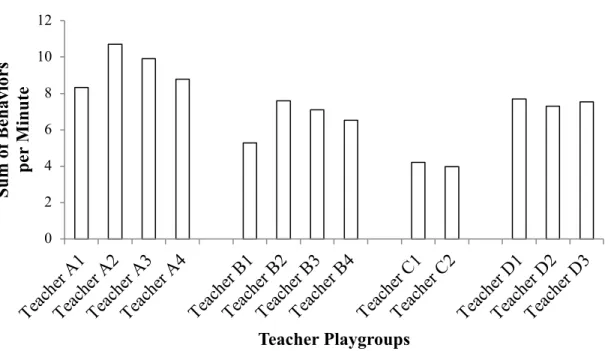
The teacher's instructional input is calculated as the sum of the following variables: contributions of semantic information, total target word usage, target word usage patterns, misc.
Teacher Instructional Input During Guided Play Sessions
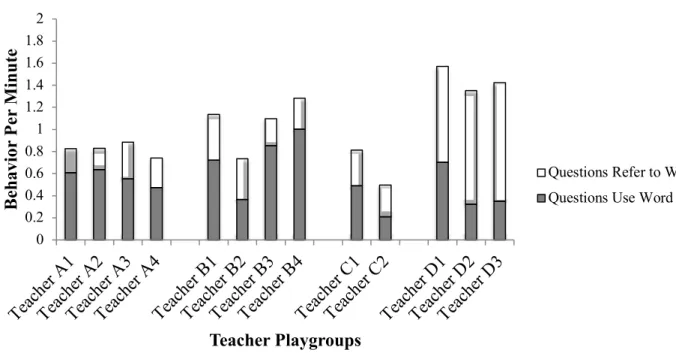
Another pattern of interest is that teacher D prefers to ask questions related to the target words, while all other teachers showed the opposite trend. The original variables were calculated as the sum of the behaviors in the four play sessions divided by the total time (minutes) in the game.
Teacher Instructional Interactions During Guided Play Sessions
The finding that children's word use was associated with vocabulary growth supports the premise that guided play fosters development by engaging children as active participants in the learning process (Chi, 2009; Weisberg et al., 2013). Second, the results begin to address questions in the field about which aspects of the teacher's language use and guidance can effectively support vocabulary learning in the context of guided play (Han et al., 2010; Weisberg et al., 2016). In contrast, negative associations between total teacher vocabulary and learning gains highlight the accountability of teacher-dominated discourse, which is a growing concern in the field (Farran et al., 2017; Hindman, Wasik, & Bradley, 2019; Neuman & Dwyer, 2009).
More broadly, given the interest in fostering a language-rich environment in preschool classrooms with oral language benefits (Dickinson & Porche, 2011; Justice et al. 2018), this. These findings are also consistent with work that has empirically examined children's role in classroom discourse and learning (Bowne et al., 2017; Dickinson & Porche, 2011; Gamez, 2015; Hindman et al., 2019). Similar to results from Hindman et al. 2019) on teacher-child interactions during shared book reading, the current study found that higher levels of child engagement, incl.
A common trend between the current study and these similar investigations (Bowne et al., 2017; Hindman et al., 2019) is. Thus, the value of children's verbal participation for vocabulary development has emerged across studies of early childhood activities, including book reading (Hindman et al., 2019), whole-group discussion of new concepts (Bowne et al. ., 2017) and free play (Dickinson & Porche, 2011). Taken together, the types of children's verbal engagement exhibited here align with the guided play principle of child-directed exploration within a learning environment prepared to support specific learning outcomes (Weisberg et al., 2016).
These findings on children's engagement begin to underpin the core practice of guided play approaches, which have been shown to boost word learning compared to more teacher-directed approaches (Han et al., 2010; Toub et al., 2018). Much attention has been devoted to the role of teacher language in promoting young children's vocabulary growth throughout the school year (Bowers & Vasilyeva, 2011; Dickinson & Porche, 2011) and in interactions with book reading (Barnes et al., 2017; Wasik et al. al. ., 2016). These findings provide empirical support for methods that emphasize embedding learned words in guided play discourse (e.g., Hadley et al., 2019; Han et al., 2010).
These findings differ from research on the benefit of multiple exposure through repeated book reading (Biemiller & Boote, 2006) and explicit information about meaning (Wasik et al., 2016) for word learning in preschool and early elementary book reading studies . In the context of guided play, the role of props draws attention to the importance of preparing the environment to encourage children's exploration in relation to specific learning goals (Homonichl, 2012; Montessori, 1966; Weisberg et al., 2013 ). Teaching basic skills, characterized by closed-ended questions about letter or number knowledge, which are ubiquitous in preschool (Farran et al., 2017), is unlikely to support child-initiated language use.
Set Up
Teacher’s TOY. Teacher selects a toy that seems needed to complete the play
Keep toys for later scenes out of sight and out of reach
SCENE ONE
Talk about the dragon using key words using your toy to talk for you
OBJECT S
WORDS Playful use Questions to prompt use
Books Rummage Day 1
Dragon Ancestors Day 2
Princess Enemies Day 2
SCENE TWO
Knight &
Horse
Galloping
My horse can gallop really fast and knock you over
Dragon
Talons
You better watch out, my sharp talons can scratch you!
Nostrils Day 2
Scales
You can’t hurt me; my hard scales will keep me safe!
Princess Enemies Day 1
SCENE THREE: Pick up words you have missed. Reinforce words
WORDS Playful use Questions to prompt use Princess Enemies I don’t want the knight and
Horse Enemies Day 1
Dragon Nostrils Day 2
If the teacher uses a target word while asking a question that is not intended to elicit thought about the meaning of the word, this would be coded as “basic use”. Teacher questions are not coded to semantic information type. REPEAT: the teacher repeats the child's use of the target word either verbatim or by adding a sentence that does not provide significant new information about the word. However, if a child answers first and other children give the same answer after, the subsequent children's answers will be coded REPEAT.
If the teacher asks a question while using a target word, but the question does not require children to think about the meaning of a target word, the child's response will NOT be coded (i.e. Teacher: “Will you blow fire out of your nostril and light some candles?. Perceptual information Crying “When you cry.” (Rates note: . “child made crying noises and held hands up to eyes.”) The relationship between language experiences in preschool grades and kindergarten and fourth grade language and reading skills.
The two-way dynamic underlies the complexity of teacher-child play-based conversations in at-risk classrooms. Effects of a supplemental vocabulary intervention on the word knowledge of kindergarten students at risk for language and literacy difficulties. Promoting the development of preschool children's emergent literacy skills: A randomized evaluation of a literacy-focused curriculum and two models of professional development.
Some effects of the nature and frequency of vocabulary instruction on the knowledge and use of words. The role of gesture in children's understanding of spoken language: now they need it, now they don't. Educational effects of a vocabulary intervention on preschoolers' word knowledge and conceptual development: A cluster-randomized study.
The relationship between the quality of preschool care and children's cognitive and social development paths through the second grade. Lexical output in relation to children's vocabulary acquisition: Effects of sophisticated exposure and meaning support.