AN UNDERGRADUATE THESIS
THE USE OF ROUNDTABLE TECHNIQUE TO INCREASE THE DESCRIPTIVE WRITING SKILL AMONG THE EIGHTH GRADE STUDENTS’ OF THE SMP N 02 PURBOLINGGO EAST LAMPUNG
By : PUJI ASTUTI STUDENT ID. 14121987
Tarbiyah and Teacher Training Faculty English Education Department
STATE ISTITUTE FOR ISLAMIC STUDIES OF METRO 1440 H / 2018 M
THE USE OF ROUNDTABLE TECHNIQUE TO INCREASE THE DESCRIPTIVE WRITING SKILL AMONG THE EIGHTH GRADE STUDENTS’ OF THE SMP N 02 PURBOLINGGO EAST LAMPUNG
Presented as a Partial Fulfillment of the Requirements for the Degree of SarjanaPendidikan (S.Pd.)
in English Education Department
By:
PUJI ASTUTI Student Number: 14121987
Sponsor :Dr. Mahrus As’ad, M.Ag.
Co-Sponsor :Trisna Dinillah Harya, M.Pd.
The Tarbiyah and Teacher TrainingFaculty The English Education Department
STATE INSTITUTE FOR ISLAMIC STUDIES OF METRO
1440 H / 2018 M
ABSTRACT
THE USE OF ROUNDTABLE TECHNIQUE TO INCREASE THE DESCRIPTIVE WRITING SKILL AMONG THE EIGHTH GRADE
STUDENTS OF SMP N 02 PURBOLINGGO EAST LAMPUNG By:
PUJI ASTUTI
Writing is one of the most difficult language skills that should be mastered by students in learning English. In writing there are several kinds of text such as narrative, descriptive, argumentative, and persuasive. Descriptive text is one of text which has to be mastered by the eighth grade students of the Junior High School. But, there are some problems that faced by the eighth grade students of the Junior High School 2 Purbolinggo Lampung Timur in writing descriptive text.
So it caused the result of learning is low. Therefore, to increase the descriptive writing skill among the students, the writer used Roundtable Technique in learning process. Roundtable Technique is one of techniques that used in teaching writing by means to stimulate students’ ideas. The goal of this research is to know whether Roundtable Technique can increase the descriptive writing skill among the eighth grade students of the state Junior High School 2 Purbolinggo Lampung Timur.
This research was classroom action research (CAR) which involved 25 students in class VIII C and was conducted in two cycles. Each cycle consisted of planning, acting, observing and reflecting. The data were taken from writing test to figure out the students’ knowledge in writing descriptive text. Furthermore, the writer used observation technique to get the data about students’ learning activities. The writer also used the documentation method to support the information concerning on the learning English. This research was conducted with an English teacher of State Junior High School 2 Purbolinggo Lampung Timur.
The result of this research shows that Roundtable Technique has positive role in increasing the descriptive writing skill among the eighth grade students of the State Junior High School 2 Purbolinggo Lampung Timur. It can be proved by the students’ average score from pre test post test. The average score in pre test was 41, in post test 1 was 65 and the post test 2 was 75. It can be inferred that Roundtable Technique can increase the descriptive writing skill among the eighth students of the State Junior High School 2 Purbolinggo Lampung Timur.
Keywords: Descriptive writing, Roundtable Technique, Writing Skill.
ABSTRAK
PENGGUNAAN ROUNDTABLE TECHNIQUE UNTUK MENINGKATKAN KETERAMPILAN MENULIS SISWA KELAS VIII C SMP N 02 PURBOLINGGO LAMPUNG TIMUR
Oleh:
PUJI ASTUTI
Menulis adalah keterampilan berbahasa tersulit yang harus dikuasai oleh siswa didalam pembelajaran bahasa inggris. Di dalam menulis terdapat beberapa jenis teks, salah satunya adalah narasi, deskripsi, argumentasi dan persuasi. Teks deskripsi merupakan teks yang harus di kuasai oleh siwa kelas delapan sekolah menengah pertama. Namun, terdapat beberapa masalah yang dihadapi oleh siswa kelas delapan SMP N 2 Purbolinggo Lampung Timur didalam menulis teks deskripsi. Sehingga itu menyebabkan hasil belajar mereka rendah. Oleh karean itu, untuk meningkatkan keterampilan menulis deskripsi pada siswa, penulis menggunkan teknik meja bundar dalam proses pembelajaran. Teknik meja bundar adalah salah satu teknik yang digunakan dalam pembelajaran menulis yang bertujuan untuk merangsang ide- ide siswa. Tujuan penelitian ini adalah untuk mengetahui apakah teknik meja bundar dapat meningkatkan keterampilan menulis deskripsi siswa kelas delapan SMP N 2 Purbolinggo Lampung Timur.
Penelitian ini adalah penelitian tidakan kelas yang melibatkan 25 siswa kelas VIII C dan telah dilaksanakan dalam dua siklus. Setiap siklus terdiri dari perencanaan, tindakan, pengamatan dan refleksi. Data di ambil dari tes menulis untuk mengetahui pengetahuan siswa dalam menulis teks deskripsi. Selain itu, penulis menggunakan teknik observasi untuk memperoleh data tentang aktifitas pembelajaran siswa. Penulis juga menggunakan metode dokumentasi untuk mendukung informasi yang berkaitan dalam pembelajaran bahasa inggris.
Penelitian ini dilaksakan dengan guru mata pembelajaran bahasa inggris SMP N 2 Purbolinggo Lampung Timur.
Hasil dari penelitian ini menunjukan bahwa teknik meja bundar memiliki peran positif dalam meningkatkan kemampuan menulis siswa kelas delapan SMP N 2 PPurbolinggo Lampung Timur. Hal ini dapat di buktikan berdasarkan nilai rata- rata siswa dari pre test menuju post test. Nilai rata – rata siswa pada saat pre test adalah 41, post test 1 adalah 65 dan post test 2 adalah 75. Ini dapat disimpulkan bahwa teknik meja bundar dapat meningkatkan keterampilan menulis deskripsi siswa kelas delapan SMP N 2 Purbolinggo Lampung Timur.
Kata Kunci: Karangan Deskriptif, RoundtableTechnique, Keterampilan Menulis
MOTTO
“Verily, with every difficulty there is relief.”
(Q.S. Al-Insyirah: 6)
“You have to endure caterpillars if you want to see butterflies.”
(Evan D. Saint)
DEDICATION PAGE
I highly dedicated this undergraduate thesis to my gorgeous parents, Mr.
Tugino and Mrs. Misinah, to my truly understanding friends, to those who love me and those whom i love.
ACKNOWLEDGEMENT
Thanks to Allah SWT, the Most Gracious, the Most Merciful, who always teach human being what we didn’t know before and has given us mercies and blessing especially to the writer so that she able to accomplish this undergraduate thesis. Shalawat and salaam be always given to our holy world leader Muhammad SAW, the man of true goodness of everything.
This undergraduate thesis is entitled “The use of Rountable Technique to increase the descriptive writing skill among the eight grade students of SMP N 02 Purbolinggo East Lampung.
The researcher cannot stay alone, there are many people who contribute their meaningful hands in accomplishing this an undergraduate thesis, so the researcher would like to express her gratitude thanks to :
1. Mrs. Dr. Akla, M.Pd., as the Dean of Tarbiyah and Teacher Training Faculty IAIN Metro.
2. Mr. Ahmad Subhan Roza., M.Pd as the Head of English Education Department.
3. Mr. Dr. Mahrus As’ad, M.Ag., as the first advisor,thank you so much for your kindness and valuable knowledge and for your support in finishing this undergeaduate thesis.
4. Mrs. Trisna Dinillah Harya,M.Pd., as the second advisor, thank you so much for your kindness and valuable knowledge and for your guidance in finishing this undergeaduate thesis.
5. Lectures and Administration Staff of English Education Department.
6. Headmaster, Teacher, staff and students of the SMP Negeri 2 Purbolinggo East Lampung, who gives permission to the writer to conduct the research in this school.
7. All of her friends in IAIN Metro, thanks for everything in helping to finish this undergraduate thesis.
8. Mr. Tugino and Mrs. Misinah, as my parent and all of family, thank you so much for your best support, financial and your pray in finishing this undergraduate thesis.
Hopefully, this undergraduate thesis can be a meaningful benefit for the writer especially and for our campus and all readers generally.
Metro, 2018 The Writer,
PUJI ASTUTI 14121987
TABLE OF CONTENTS
COVER ... i
TITLE... ii
ABSTRACT ... iii
ABSTRAK ... iv
NOTIFICATION PAGE ... v
NOTA DINAS ... vi
APPROVAL PAGE ... vii
STATEMENT OF RESEARCH ORIGINAL ... viii
ORISINALITAS PENELITIAN ... ix
MOTTO ... x
DEDICATION PAGE ... xi
ACKNOWLEDGEMENT ... xii
TABLE OF CONTENTS ... xiv
LIST OF TABLES ... xvii
LIST OF FIGURES ... xviii
LIST OF APPENDICES... xix
CHAPTER I INTRODUCTION ... 1
A. Background of Study ... 1
B. Problem Identification ... 3
C. Problem Limitation ... 3
D. Problem Formulation ... 3
E. Objective and Benefits of the Study ... 4
CHAPTER II REVIEW OF THE RELATED THEORIES ... 5
A. Theoretical Review ... 5
1. The Concept of Descriptive Writing Skill ... 5
a. The Definition of Descriptive Writing Skill ... 5
b. The Characteristics of Descriptive Writing ... 7
c. The Skills to write Descriptive Writing ... 9
d. The Assessment to Evaluate the Descriptive Writing Score ... 12
2. The Concept of Rountable Technique... 13
a. The Definition of of Rountable Technique ... 13
b. The Principles of Rountable Technique ... 15
c. The Advantages of Rountable Technique ... 16
d. The Procedures of Roundtable Technique ... 17
3. The Use of Rountable Technique to Increase the Descriptive Writing Skill ... 17
B. Action Hypothesis ... 18
CHAPTER III RESEARCH METHOD ... 19
A. Research Setting ... 19
B. Research Subjects ... 19
C. Research Procedures ... 19
D. Data Collection ... 25
E. Data Analysis ... 26
F. Indicator of Success ... 27
CHAPTER IV RESULT OF THE RESEARCH ... 28
A. Result of the Research ... 28
1. Description of Research Result ... 28
a. Pre Test ... 28
b. Cycle 1 ... 31
c. Cycle 2 ... 40
B. Interpretation ... 50
1. Result of Students Learning ... 51
2. The Comparison of Score in Pre Test, Post Test I and Post Test II... 52
3. The Result Of Students Learning Activities in Cycle I
and Cycle II ... 55
C. Discussion ... 58
CHAPTER V CONCLUSION AND SUGGESTION ... 60
A. Conclusion... 60
B. Suggestion ... 61 BIBLIOGRAPHY
APPENDICES
CURRICULUM VITAE
LIST OF TABLES
Table 1 The pre-survey data of students’ daily test ... 2
Table 2 The Result of Pre-Test Score ... 29
Table 3 Percentage of students pre-test score ... 30
Table 4 The schedule of action in cycle 1 ... 32
Table 5 The Result of Post-Test 1 Score ... 34
Table 6 Percentage of students post-test 1 score ... 35
Table 7 The students activities in cycle 1 ... 36
Table 8 The comparison score pre-test and post test 1 ... 38
Table 9 The comparison student pre-test and post test 1 ... 39
Table 10The schedule of action in cycle 2 ... 41
Table 11 The Result of Post-Test 2 Score ... 43
Table 12 Percentage of students post-test 2 score ... 44
Table 13The students activities in cycle 2 ... 46
Table 14 The comparison score post-test 1 and post test 2 ... 48
Table 15 The comparison students’ post-test 1 and post test 2 ... 49
Table 16 The comparison score pre-tes, post-test 1 and post test 2 ... 53
Table 17 The comparison students pre-tes, post-test 1 and post test 2 ... 54
Table 18 The table of students activities in cycle 1 and cycle 2 ... 55
LIST OF FIGURES
Figure 1 The cycle of the classroom action research (CAR) ... 20
Figure 2 The percentage score of pre test in cycle 1 ... 30
Figure 3 The percentage score of post test in cycle 1 ... 35
Figure 4 The percentage of students’ activities in cycle 1 ... 37
Figure 5 The comparison score of students’ pre- test and post - test 1 ... 39
Figure 6 The percentage score of post test 2 in cycle 2 ... 45
Figure 7 The percentage of students’ activities in cycle 2 ... 47
Figure 8 The comparison score of post test 1 and post test 2 ... 49
Figure 9 The comparison score of pre- test, post – test 1, and post- test 2 ... 54
Figure 10 The students’ result of learning activity in cycle 1 and cycle 2 ... 56
LIST OF APPENDICES
Appendix 1 Syllabus Appendix 2 Lesson Plan Appendix 3 Instruments
Appendix 4 Documentation Picture Appendix 5 Students’ Observation Sheet Appendix 6 Curriculum Vitae
CHAPTER I INTRODUCTION A. Background of the Study
Writing is one of difficult language skills that should be mastered in learning English, because it needs hard thinking to express the ideas, creativities, opinions, experiences and knowledges in written form and producing words and sentences at the same time. Morevore, when writing a text the students should know the generic structure and make the correct sentences grammatically and structurally.
In the English subject of the junior high school, many kinds of text which are learnt such as argumentative text, narrative text, persuasive text, and descriptive text. Descriptive text is the paragraph that describe the features of someone, something, or a certain place based on a process through the stages, features or characteristics. Description is conveyed based on a result research by looking, listening, feeling or reading. It is expected to make the readers feel, hear, see, smell, and taste the object that is explained by writer.
In addition, there are primary components in the process of teaching and learning in order to develop education quality, such as teachers, students, methods, techniques and course materials. Teaching English in writing class is not enough using the teachers’ instruction only. The teacher should choose a technique that can attract the students’ interest their involvement. By implementing the technique, the students will not bored during the lesson so it can increase their writing skill. There are many techniques that can be applied
in teaching writing especially Rountable Technique. Rountable Technique is considered effective in improving writing skill of the students.
Students of Junior High 02 Purbolinggo have learned the descriptive text. In writing the descriptive text the students often find some difficulties.
The students feel difficult to organize their ideas, students have low vocabulary mastery, students find difficulties in using grammar, the students find difficulties in using grammar, students find difficulties in using punctuation, and the students find difficulties in constructing the descriptive text.
Table 1
The pre-survey data of daily test of State Junior High School 2 Purbolinggo Lampung Timur
No Score Descriptive Writing Category Frequency Percentage
1. ≥ 70 8 32 % Complete
2. < 70 17 68 % Incomplete
Total 25 100%
Source : The English teacher archive at Eighth Grade of State Junior 2 Purbolinggo East Lampung, taken on April , 15th 2017.
The writer held the data of pre-survey on April 15, 2017 among the eighth-grade students of the State Junior High School 02 Purbolinggo Lampung Timurto know the students’ writing skill especially in descriptive text. It can be seen from the table above that the total subject of this research is 25 students,
while only 8 students who reach or pass score 70 with percentage 32 %. It shows that many students who still have difficulties in writing descriptive text
because the students’ minimum mastery criteria (MMC) for English of the State Junior High School 02 Purbolinggo Lampung Timur is 70.
From this explanation, it showed that the students’ writing skill at the eighth grades of the State Junior High School 02 Purbolinggo Lampung Timur are classified poor. Based on these conditions, the writer conducted a research
“The Use of Rountable Technique to Increase The Descriptive Writing Skill among The Eight Grade Students’ of the State Junior High School 02 Purbolinggo Lampung Timur”.
B. Problem Identification
Regarding to the background of the study, the writer identifies the problem as follow:
1. The students found difficulties in developing their ideas.
2. Students have lack of vocabulary.
3. Students found difficulties in using grammar 4. Students found difficulties in using punctuation.
5. The students found difficulties in constructing the descriptive text.
C. Problem Limitation
Based on the problem above, the writer will focus on students’
difficulties in developing the ideas and constructing the descriptive text faced by the students eight grade students of the State Junior High School 02 Purbolinggo East Lampung.
D. Problem Formulation
Based on the background of study and problems identification above, the writer formulates the problem in this research are:
1. Can the roundtable technique improve the students’ descriptive writing result at the eighth grade of the State Junior High School 02 Purbolinggo East Lampung?
2. Can roundtable technique improve the learning activity at the State Junior High School 02 Purbolinggo East Lampung?
E. Objectives and Benefits of the Study 1. Objectives of the Study
The main goal of this research as follow:
a. To show whether roundtable technique can improve the students’
descriptive writing skill at the eighth grade of the State Junior High School 02 Purbolinggo East Lampung
b. To show whether roundtable technique can increase the students’
learning activity at the State Junior High School 02 Purbolinggo East Lampung
2. Benefits of the Study
The significances of this research are supposed to go to:
a. The students
For the students, this research is expected to increase their skill in developing the ideas and constructing the descriptive text.
b. The english teacher
Hopefully, the result of this research can be useful for English teachers at the State Junior High School level to get information about teaching descriptive writing using Rountable Technique.
CHAPTER II
REVIEW OF THE RELATED THEORY A. Theoretical Review
This chapter contains the theories which support the research. It includes the concept of descriptive writing, the concept of roundtable technique, principles, and procedures about how to apply roundtable technique to increase the students’ descriptive writing skill.
1. Concept of Descriptive Writing Skill
a. The Definition of Descriptive Writing Skill
According to Byrne writing is the ability to show ideas and to transfer the information for the reader. Besides, Byrne declares that writing is arranging the words to be sentences.1 Writing is a process of composing multiple drafts in order to make an effective product. It can be organized a thought, idea, and feeling. In composing process, the draft is crucially needed as a first step to develop ideas.2
Moreover Lodge argued that writing is a peculiar activity, both easy and difficult. You have an idea, you express it as a series of words and you write them down on a piece of paper.3 Writing is an important form of communication in day to day life. Writing is also one of the most difficult skills to master in both a first language and a second
1 Donn Byrne, Teaching Writing Skills, (New York: Longman, 1993), p.1
2H. Douglas Brown, Teaching by Principles Second Editions: An Interactive Approach to Language Pedagogy, (New York: Addison Wesley Longman. Inc, 2001), p. 335.
3 Lodge David, How we write: Writing as Creative Design, (London: Routledge, 1999), p.3
language.4 On the other hand, Gayle and Lawrence states that writing is important for the students. The reason is that the students being able to write well and express their thought.5 As we know that, writing has important role in education field. It causes that the students can develop and explore their knowledge.
Therefore, it can be inferred that writing is one of language skills that conveys meaningful information from the writer to the reader in written form. By writing, learners can express their feelings, ideas, thoughts, emotions, attitudes, etc. In writing we have to produce words, phrase, sentences, and paragraphs at the same time.
According to Alice and Ann, descriptive writing appeals to the senses, so it tells how something looks, feels, smells, tastes, and/or sounds. A good descriptive text can make the readers imagine the object in their mind.6 Anker Susan said that descriptive text is a writing that creates a clear and vivid impression of the topic.7 Meanwhile George and Julia stated that description is presenting a verbal portrait of a person, place, or thing. It means that in a description type, the writer tries to make the readers to image or to visualize the object that the writer described about.
4Zemach Dorothy E, and Carlos Islam, Writing in Paragraph, (Oxford: Macmillan,2006), p.4
5 Gayle Feng & Lawrence, The Write Start Sentences to Paragraphs (4th Edition), (USA:
Wadsworth, 2010), p.1
6Alice Oshima and Ann Hoguep, Introduction to Academic Writing:Third Edition, (Pearson:Longman, 20017) p. 61
7Susan Anker, Real Writing: Paragraphs and Essays for College, Work, and everyday life, (New York: Bedford/St. Martin’s, 2010), p. 159
Moreover, Descriptive writing describes a person, place, or thing in a way that enables the reader to visualize it.8 in a descriptive text the writer tries to analyze and explain an object with a purpose to reveal out its aspects and their interrelationship vividly. It means that the writer tries to describe an object which contains the relevant and details information so it can make the readers image the object clearly.
b. Characteristics of Descriptive Writing 1. Language features
There are some language futures of a descriptive text as follows9:
a) Having specific or clear word thing like my dog, my car, my new house, etc. furthermore, all of the things have some unique characteristics. For example: My bag is expensive.
b) Using simple present tense. For example: I live in a simple house; the house is very beautiful; it has a wonderful park.
c) Using noun phrase for imaging the things specifically. For example: I have a white skinned girl-friend.
d) Using some adjective for describing the things.
For example: two strong legs.
e) Using action verb. For example: my cat eats a mouse.
8 John Schacter, Ph.D. The Master Teacher Series Descriptive Writing.
http:www.teachingdoctors.com/resources/pdf/descriptive writing sample.pdf accessed Thursday, December 21,2017.
9 britishcourse.com accessed on November, 26th 2017
2. Generic structures
Descriptive writing has two elements or generic structure, are identification and description.10
a. Identification : it identifies a particular person, place, or thing to be described. The identification can be in the form of definition. As usual, it is written at the beginning of teaxt or paragraph
b. Description : it contains subtopics. It describes parts, qualities, and characteristics of something.
Related to the explanation of the generic structure above, the researcher has the example of the descriptive text, as follows:
My Best Friend
John is one of my friends in the classroom.
His full name is John Marcell . He has tall body. His high is about 170 cm. He has black hair. He has oval face. He has small eyes and pointed nose. He is kind smart, generous, dilligent, and he always wears black shirt.
10 Ibid, Accessed on November, 26th 2017
Identification
Description
Based on the explanation of the descriptive text above, the organization of the text consists of two parts; they are general classification and descriptions. General classification or sometimes called as identification, introduces the topic being described (my besfriend). In the other hand, descriptions tell the topics more clearly (such as parts and its characteristics).
c. Skills to Write Descriptive Writing
In the process to produce the good descriptive writing, Wigle elaborates based on the Jacobs’s scoring profile that there are some skills which should be concerned as follows:11
1) Content
A content includes the topic and its explanation, discussion, evaluation, and conclusion. It should be clear, specific, and relevant. The good content had to fulfill the criteria such as full of information, substantive make a clear thesis development and relevant with the problem.
Related to this point, students are expected to have some abilities as follows:
a) Students should be able to write and relate the ideas.
b) Students should be able to develop the ideas.
11 Weigle. S. Cushing, Assessing Writing, (Cambridge: Cambridge University Press, 2002),p.
116
c) Students should be able to use the appropriate description, to explain the topic.
2) Organization
An organization is also important skill which should be mastered to write the descriptive text. Organization means that how the students organize their ideas.The students are expected to have some skills as follows in order to organize the descriptive writing:
a) Students should be able to write an effective introduction.
b) Students should be able to write an effective description of the topic.
c) Students should be able to draw the conclusion.
3) Vocabulary
Vocabulary is the most important thing that forms a phrase, sentence, and paragraph. In writing, a writer should use the appropriate vocabulary to express what they want to write.
Vocabulary mastery is needed in order to create an understandable descriptive writing. The detail skills about vocabulary to write descriptive writing are mentioned as follows:
a) Students should be able to mastery the list of noun, adjective, verb, and adverb.
b) Students should be able to use the plural and singular noun in sentences.
4) Language Use
Language Use refers to the communicative meaning of language. In writing process refers to the rules for making sentences or paragraph grammatically. Grammar is the study of words and the ways word work together to form a sentence.
Tenses and structure mastery really important to have paragraph constructed. It is difficult for students to arrange a good paragraph if the students do not understand well about tenses and structure mastery.
They are expected to have abilities about language use as follows:
a) Students should be able to understand the word order.
b) Students should be able to mastery the subject-verb agreement.
c) Students should be able to understand the tenses that used in descriptive writing.
5) Mechanics
Mechanics is also the significant part of writing. The skills which should be comprehended by students about mechanics are mentioned as follows:
a) Students should be able to write the correct spelling.
b) Students should be able to use the correct punctuation.
c) Students should be able to write the neatly.
Therefore, there are many skills which should be comprehended by the students to write descriptive writing. All the skills should be mastered and applied well during the writing process in order to write a good descriptive writing.
d. The Assessment to Evaluate the Descriptive Writing Score
Based on the Jacobs’s scoring profile that individual writing score can be evaluated by counting up the scale from each writing aspect, such as content, organization, vocabulary, language use, and mechanics. The writing scoring profile is presented as scoring rubric as follow:12
Table 2
The writing scoring rubric by Jacobs et.al
Aspects Score Performance Description Weighting Content
(O) 30%
- Topic - Details
4 The topic is complete and clear and the details are relating to the topic.
3 x
3 The topic is complete and clear but the details are almost relating to the topic.
2 The topic is complete and clear but the details are not relating to the topic.
1 The topic is not clear and the details are not relating to the topic.
Organization (O) 20%
- Identification - Description
4 Identification is complete and descriptions are arranged with proper connectives.
3 Identification is almost is complete and descriptions 2 x are arranged with almost proper connectives.
2 Identification is not complete and descriptions are arranged with few misuse of connectives.
12 Ibid.,
1 Identification is not complete and descriptions are arranged with misuse of connectives.
Grammar (G) 20%
- Use Present Tense - Agreement
4 Very few grammatical is not complete or agreement inaccuracies
2 x 3 Few grammatical or agreement inaccuracies but not
effect on meaning.
2 Numerous grammatical or agreement inaccuracies.
1 Frequent grammatical or agreement inaccuracies.
Vocabulary (V) 15%
4 Effective choice of words and word forms.
1.5 x 3 Few misuse of vocabularies, word forms, but not
change the meaning.
2 Limited range confusing words and word forms.
1 Very poor knowledge of words, word forms, and not understandable.
Mechanics (M) 15%
- Spelling - Punctuation - Capitalizatio
n
4 It uses correct spelling, punctuation, and capitalization.
1.5 x 3 It has occasional errors of spelling, punctuation, and
capitalization.
2 It has frequent errors of spelling, punctuation, and capitalization.
1 It is dominated by errors of spelling, punctuation, and capitalization.
Score = 3C+2O+2G+1.5V+1.5M x10 40
2. Concept of Rountable Technique a. Definition of Rountable Technique
Roundtable is designed to create a positive team identity and a willingness to work in team. Barkley said that one of the best techniques for stimulating ideas and finding a direction for a piece of writing is roundtable. Students take turns responding to a prompt by
writing one or two words or phrases before passing the paper along to others who do the same. 13
Roundtable structure is one of cooperative learning techniques in which each student in a group takes turn to write answers. This structure divides students into groups of four-five members and allows using only a pen and paper to compile answers.14
In general, the format of roundtable technique requires student groups to respond a question. The first student begins the response with a written. The student describes these out loud and then passes the question to the next student who repeats the process. After all students have responded, the group evaluates responses, reorders, and refines, until their listing is complete.15 One of the strengths in Round Table is that, each learner in a group has an equal chance to participate in the creation of ideas.16
It can be concluded that roundtable technique is one of technique of cooperative learning method that used in teaching writing by means to stimulate student’s ideas in writing a paragraph. Besides Roundtable is a technique which is emphasize son students group work
13 Barkley,Elizabeth F,Collaborative Learning Technique. San Fransisco: John Wiley and Sons Inc.2003.p. 72
14Norzang, “Use of Roundtable Structure Supplemented By Peer Editing Technique to Enhancing Students’ Essay Writing Skills: An Action Research”,Imperial Journal of Interdisciplinary Research (IJIR), (Sarpang, Bhutan: Norbuling Central School), vol 3/ Issue-2, 2017,p. 1655.
15 Gail M. Hoyt and KimMarie McGoldrick, International Handbook on Teaching and Learning Economic,( USA: Edward Elgar,2012), p. 59.
16 Hassan Alrayah, “The Effectiveness of Cooperative Learning Activities in Enhancing EFL Learners’ Fluency”, English Language Teaching, (Canada: Canadian Center of Science and Education), Vol. 11, No. 4/ 2018,p. 26.
in a team that can produce positive dependence, so that it is able to be responsible members in a group.
b. Principles of Roundtable Technique
There are some basic principles of Roundtable Technique in eaching descriptive writing as follow17:
1. Submission of objective
Submission of objective is one of the common ways that used by teacher to get students attention in learning process. The submission of objectives should make the students interested or feel that what is going to be delivered by the teachers is important.
2. Explanation of the task to be discussed
In this principle, the teacher explains the task to be discussed in the learning process. Such as the division of topics to be described by each team of students.
3. Giving worksheet
Each team have one peace of paper that rotate around team.
Each student write one answer on the list, if any student is having difficulty thinking of what to write, the teammates can make suggestion.
17 Gail M. Hoyt and KimMarie McGoldrick, International Handbook.,p.62.
4. Feedback and evaluation by the teacher
Teacher provides feed back to students who have presented their work. Besides, the teacher also gives an evaluation so that the next meeting can be better.
c. Advantages of Roundtable Technique
Every technique of teaching learning has advantages. There are advantages of roundtable technique discussion as follow18:
1. Enhancing the individual participation, it is because all of the students have to participate in the discussion.
2. Training to regard the opinion of each other, students have to receive the opinion from other students.
3. Pooling ideas and experiences from group, students have concentrated all of the idea to make conclusion.
4. Enhancing the participation in an active process, the students are active in the discussion.
In short, the application of Roundtable technique is important for students in order that the students can enjoy in teaching learning english and the students will be active in teaching and learning process.
18 Robert slavin et.al, Learning to., p. 442.
d. Procedures of Roundtable Technique
Kagan state that the procedures of Roundtable Technique in teaching writing are19:
1. The teacher make some groups, each group consists of 3 - 4 students.
2. The teacher ask students to take a place in their own group in rountable discussion.
3. The teacher gives a topic to be discussed by the students in rountable discussion.
4. The teacher asks the students to give their ideas and to write 5. The paper moves from the first student until the last student in a
group. In this activity, each group will play two until three rounds.
3. The Use of Rountable Technique to Increase the Descriptive Writing Skill.
The conceptual framework shows the process of the research to increase the students’ descriptive writing skill by using rountable tecnique that students will be more interested in writing when they are given certain topics. Through Rountable tecnique they will be able to express their ideas, vocabularies, and sentences easily to write. In applying that technique, firstly the teacher makes planning, action, and observation and
19 Kagan, Dr. Spencer., Kagan, Miguel. Kagan Cooperative Learning,(Kagan. Publishing.
2009). P. 155.
prepares teaching material. In the action, the teacher will apply steps of rountable technique to increase the students’ learning activities and the students’ score in descriptive writing skill.
B. Action Hypothesis
Based on the above theoretical framework, the writer formulates the action hypothesis that using rountable technique can increase the descriptive writing skill among the eighth grade students of the State Junior High School 02 Purbolinggo East Lampung.
CHAPTER III RESEARCH METHOD
A. Research Setting
This research, writer used the Classroom Action Research (CAR) which is focused to improve students’ descriptive writing skill. This research was conducted in the State Junior High School 02 Purbolinggo which is located in Taman Asri Purbolinggo East Lampung.
B. Research Subjects
The subject of this research is students of eighth grade of the State Junior High School 02 Purbolinggo East Lampung. Total of the eighth grade students of the Junior High School 02 Purbolinggo East Lampung are 120.
There are four classes of the eighth grade of the State Junior High School 02 Purbolinggo East Lampung, but the writer chose one of these classes. In conducting this research, the writer chose class VIII C that consists of 25 students. In this research, the writer increased the students’ writing skill in descriptive text as an object of this research.
C. Research Procedures
In this research, the writer used Classroom Action Research (CAR).
According to Anne Burns, action research is research that is carried out in the classroom by the teacher that has the purpose of solving the problem or improving the teaching or learning process20.Therefore, classroom action research is the research that has main goals to solve the problems faced by the
20Anne Burns, Doing Action Research in English Language Teaching, (New York:
Routledge, 2010),p.5
students and which involves a group of students with the purpose of improving teaching learning process so that the result of the students improve as well.
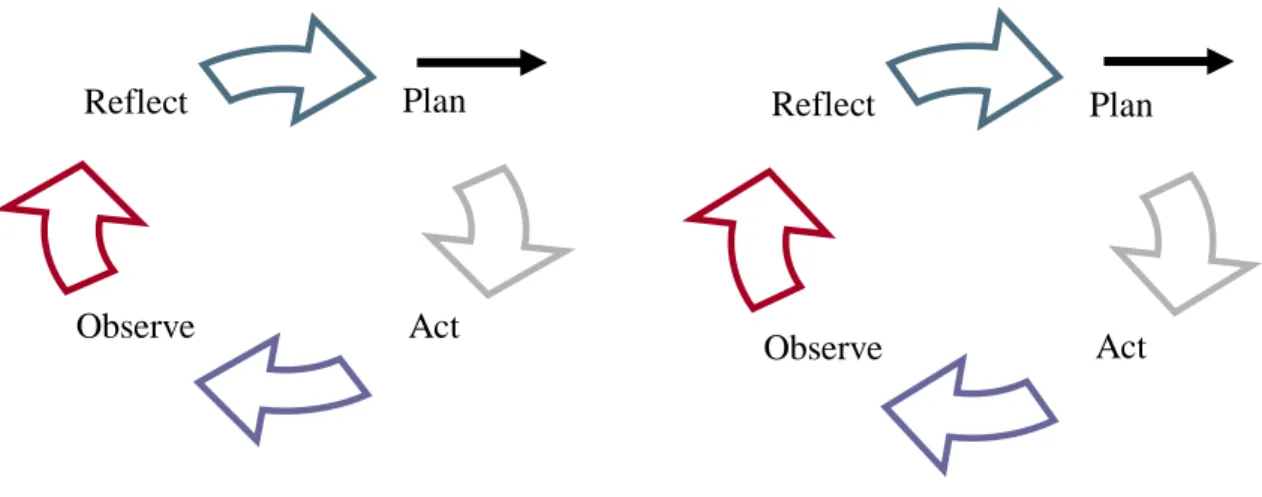
In this research, the writer conducted in 2 cycles. If the first cycle is failed, it will be continued in the second cycle. It was conducted until there were an increasing on the students’ writing skill. According to Mills, “A cycle consisted of four phases, they are planning, acting, observing, and reflecting”21. The cyclical classroom action research is presented as follow
Figure 1: Cyclical Classroom Action Research by Jean McNiff’s Model22 1. Cycle I
a. Planning
Planning is the first steps in each activity. It was conducted before the writer starts her action research. This plan is used during the
21 Mills, G.E, Action Research: A Guide for the Teacher Researcher, (New Jersey:
Prentice Hall, Inc. 2000), p.35
22Jean, McNiff, et.al.You and Your Action Research Project.(USA and Canada: Taylor &
Francis e-Library, 2002), p. 41.
Plan
Observe Reflect
Act Plan
Observe Reflect
Act
research in every cycle and revised based on the improvement of the students. The activity as follow:
1) Prepared lesson plan, media of learning, and material 2) Prepared the type of the learning.
3) Prepared the instrument of observation.
b. Acting
The second step in this research is acting. In this step, the writer implemented the planning and was conducted in some meetings. The activity as follows:
1) Pre Teaching Activities
a) Prayed and greeted the students.
b) Checked the attendance list.
c) The writer chose the material going to be taught.
2) While Teaching Process a) Applied the lesson plan..
b) The writer explained about descriptive writing.
c) The writer explained about what is Roundtable Technique in descriptive writing
d) The writer gave an example about Roundtable Technique for descriptive writing.
e) The writer made some groups, each group consists of 3 - 4 students.
f) The writer asked students to take a place in their own group in roundtable discussion.
g) The writer gave a topic to be discussed by the students in roundtable discussion.
h) The writer asked the students to give their ideas and to write down in a paper.
i) The paper move from the first student until the last student in a group. In this activity, each group will play two until three rounds.
3) Post Teaching Activities
a) The writer asked students to discuss the diffculties of the lesson.
b) The writer and students concluded the material together.
c) The writer gave the score for students.
d) Closed the lesson by praying.
c. Observing
The third step is observing. In observing the writer must be able to analyzed the learning process, the students’ activities, the material and the result of acting based on observation paper that has been arranged.The important things in teaching learning process are noted by observer
d. Reflecting
The last step in this process is reflecting. The writer analyzed and discussed the observation result during teaching and learning process in order to know the weakness and strength of the action in this steps. the
writer uses data from evaluation to make improvement for the second cycle.
2. Cycle II a. Planning
Planning is the first steps in each activity. In cycle II, the writer focused on repairing the weakness in the cycle 1. Here are the steps that the researcher was done in planning:
1) The writer continued the activities that have done in the first cycle.
2) The writer prepared lesson plan, media of learning, and material.
3) The writer prepared the instrument of observation.
4) The writer determined the evaluation instrument of the test (pre-test and post-test).
b. Acting
This is like in the first cycle where there are 3 activities in teaching and learning process, pre teaching, while teaching and post teaching.
1) Pre Teaching Activities
a) Prayed and greeted the students.
b) Checked the attendance list.
c) The writer chose the material that would be taught.
2) While Teaching Process a) Applied the lesson plan.
b) The writer explained about descriptive writing.
c) The writer explained about what is Roundtable Technique in descriptive writing.
d) The writer gave an example about Roundtable Technique for descriptive writing.
e) The writer made some groups, each group consists of 3 - 4 students.
f) The writer asked students to take a place in their own group in roundtable discussion.
g) The writer gave a topic to be discussed by the students in roundtable discussion.
h) The writer asked the students to give their ideas and to write down in a paper.
i) The paper move from the first student until the last student in a group. In this activity, each group will play two until three rounds.
3) Post Teaching Activities
a) The writer asked students to discuss the diffculties of the lesson.
b) The writer and students was concluded the material together c) The writer gave the score for students.
d) The writer close the lesson by praying.
c. Observing
The observing at the cycle II is almost the same with the observing at the cycle I.
d. Reflecting
The writer corrected and analyzed the result of the action. In the step, the writer will compare the score distribution of pre test and post test, the writer reviews and reflects on the student’s attitude whether it is positive or negative, enough in the second cycle or need for next cycle.
D. Data Collection
In collecting the data, the writer used the following technique:
1. Observation
The writer used the method to get the data about students’
activities such as students’ writing activity, and students’ good participation. The lecturer and students’ activities was observed and noted by the observer.
2. Test
The writer used pre-test and post-test form to see their ability before and after given treatment.
a. Pre Test
Pre-test gave in the first meeting before implementing the technique, in order to know the level of students’ writing skill before doing the action research.
b. Post Test
Post-test gave in the last meeting after implementing the technique, in order to know whether the technique gives good
contribution to the students’ descriptive writing skill at the eighth grade of the State Junior High School 02 Purbolinggo East Lampung.
The improvement could be known if the score of post-test is higher than pre-test and the score could achieve the passing grade.
3. Documentation
Documentation was needed to get the information from written source or documents such as book, magazines, and daily report. The writer uses this method to get the data about the history of the school, the sum of teachers and students at the State Junior High School 02 Purbolinggo East Lampung.
E. Data Analysis
In this research, the writer conducted the data analysis by taking the average score from the result of the pre test and post test. Furthermore to know the improvement, the writer compared between pre test and post test after giving treatment. Then, the result was matched by the minimum standard in this school at least 70. From cycle 1 there were some students not successful, so the writer was conducted cycle 2. The minimum cycle in CAR (Classroom Action Research) is two cycles. If in the cycle 2 all of the students were successful, the cycles were able to be stopped. Furthermore, to find out the mean score, the following formula is applied23:
=
23 Donald Ary, Introduction to Research in Education, (USA: Wadsword. 2010). p. 108- 109.
Where:
: The mean score Σx: the sum of all scores N: the number of students
To calculate the percentage of the students’ score, the formula which is used is as follows:
Notation: P : Rate Percentage
F : Frequency of the Correct Answer N : The Total Number of Students
F. Indicator of Success
The indicator of success in needed to know the successful of the process and learning result. In this research, students are called successful if the students are active in learning process and get the 70 score or more, so this research could be stopped.
CHAPTER IV
RESULT OF THE RESEARCH AND INTERPRETATION
A. Result of The Research
1. Description of the Research
This research was clasroom action research, and it was conducted at the Eighth Grade of State Junior High School 02 Purbolinggo East Lampung in the academic years of 2017/2018. This research was conducted in two cycles. Each cycle consisted of four steps that were planning, acting, observing, and reflecting which accomplished in two meeting. The students result of writing descriptive text was gained through test which consisted of pre test and post test that was given to the students in the beginning research and in the end of each cycle, while the students’ activity were gained from the observation of the students’
learning activities.
a. Pre Test
Pre-test was presented to students which was aimed to find out students’ ability before the treatment was implemented. It was conducted on Friday, July 13rd , 2018 at 08:00 - 09:30 a.m and it took about 90 minutes. In this meeting the writer was an observer and the collaborator was a teacher.
Firstly, the collabolator opened the class by greeting, praying, checking the attendance list, and asking the students’ condition. Then, the collabolator gave the explanation to the students about descriptive
text for 40 minutes. Afterwards, to measure their skill before giving the treatment, the writer gave them pre-test. The researcher used essay test which consisted of one topic which had to be completed for 40 minutes. Then, the result of pre-test can be seen on the table below :
Table 7
The Result of Pre-Test Score of Descriptive Text in Cycle I
N O
Students Code
Criteria of The Score
TOTAL (Total:4x10)
Note
>70 Cont
(Scrx 3)
Org (Scr x 2)
Gram (Scr x 2)
Voc (Scr x 1.5)
Mech (Scr x 1.5)
1 AFN 6 2 2 3 3 40 Failed
2 ALF 6 4 2 3 1.5 41 Failed
3 ALR 6 2 2 3 1.5 36 Failed
4 ANS 6 4 6 4.5 3 58 Failed
5 AND 3 2 2 1.5 1.5 25 Failed
6 ALD 6 4 2 3 1.5 41 Failed
7 CHN 6 2 2 1.5 1.5 33 Failed
8 CHD 9 4 2 3 1.5 49 Failed
9 DMS 6 4 2 3 1.5 41 Failed
10 DME 6 2 2 3 1.5 36 Failed
11 DLN 6 4 2 3 1.5 41 Failed
12 DSL 3 2 2 1.5 1.5 25 Failed
13 ELA 3 2 2 3 1.5 29 Failed
14 FMC 6 4 2 3 1.5 41 Failed
15 HLP 6 4 2 3 3 45 Failed
16 ICL 9 6 4 4.5 4.5 70 Passed
17 KFN 6 4 2 3 1.5 41 Failed
18 KTW 3 2 2 1.5 1.5 25 Failed
19 MNR 6 4 2 3 3 45 Failed
20 NNF 3 2 2 1.5 1.5 25 Failed
21 NAT 6 4 4 3 4.5 54 Failed
22 RAN 3 2 2 1.5 1.5 25 Failed
23 SLA 6 4 2 3 1.5 46 Failed
24 SHN 9 6 4 4.5 4.5 70 Passed
25 SLT 6 2 2 3 4.5 44 Failed
High Score 70
Lowest Score 25
Average 41
Note :
Cont : Content Org : Organization Voc : Vocabulary Lang : Language Mech: Mechanic Scr : Score
Table 8
Percentage of Students Writing Descriptive Text Pre-Test Score in Cycle I
Interval Frequency Percentage Explanation
>70 2 8% Complete
<70 23 92% Incomplete
Total 25 100%
Then the graph of percentage students Descriptive text writing pre-test score could be seen as follow:
Figure 4
Percentage of Students Writing Descriptive Text Pre-Test Score in Cycle I
0%
20%
40%
60%
80%
100%
Complete Incomplete
Based on the result of students’ Descriptive text pre-test score, it could be inferred that there was only 8% or 2 students for the score among the interval of > 70 who passed the Minimum Standart Criteria (MSC) at least 70 while 92% or 23 students for the score among the interval of < 70 did not pass the Minimum Standart Criteria (MSC) of less than 70. It indicated that the result of students descriptive text in writing was still low. It was the reason why the writer used Roundtable Technique to increase students descriptivewriting skill. Therefore, the writer and collaborator made a plan to implement the action or treatment that consisted of planning, action, observation, and reflection to repair the weaknesses which faced by the students.
b. Cycle I
Cycle 1 was divided into planning, acting, observing and reflecting 1) Planning
In this step, the writer prepared the lesson plan, material and media that would be used in teaching learning process. The material was descriptive text. The material included the definition, the generic structure, the language features and the example of descriptive text.
Moreover, the writer made an observation sheet that consists of list of students’ name and list of the students’ activities that will be observed during teaching learning process.
2) Acting
The action is the second step in this research. The writer conducted this cycle in two meetings. The schedule of action in this cycle is as follows:
Table 9
The Schedule of Action in Cycle 1
Meeting Day/Date Time
1st Thursday, July 19th2018 11.30 – 13.00 a.m 2nd Friday, July 20th 2018 08.00 – 09.30 a.m
a.) First meeting
The first meeting was conduct on Thrusday, July 19th 2018 at 11.30 – 13.00 p.m, and it took about 2x45 minutes or 90 minutes. In this meeting the writer was a teacher and Mr.
Kartubi, S.Pd was the collaborator as well as an observer.
At the beginning of teaching learning process, the writer greeted students by saying “salam and good morning”
and all of students answered by saying “salam and good morning miss” friendly. Then, the writer asked about their condition first before checked attendance list. Before giving the material, the writer gave some question, for example
“what do you know about text?” Some students could answer it but they used Indonesian language. It could happen because they usually discussed it in Indonesian language. Therefore,
the writer explained about what is text in English first before she explained about descriptive text.
Then, the writer explained about the characteristics of text and how to make a good text. After that, the explanation continued about descriptive text. Most of students still did not understand about it. Next, the writer invited the students to play a picture. The writer gave some pictures in white board and the students had to describe what it is.
After 2 x 45 minutes the bell rang and the writer closed the lesson and reminded the students that it would be discussed in the next meeting.
b.) Second Meeting
The second meeting was conducted on Friday, July 20th, 2018 at 08.00-09.30 a.m. this meeting used to post-test I, for 2x45 minutes after the students given the action. The writer greeted the students and they answered it friendly.
Then, the researcher checked the attendance list. The activity continued by giving some explanation more about descriptive text and how to create it. Then, at the end of this meeting the writer gave post-test cycle 1 with the similar task on pre-test before. The students had to create a descriptive text based on the themes given in 40 minutes. The students did it seriously.
It seemed that the students’ score will be improved. The score of post-test cycle 1 can be seen on the table below:
Table 10
The Result of Students Descriptive Text Post-Test I Score in Cycle I
N O
Students Code
Criteria of The Score
TOTAL (Total:4x10)
Note
>70 Cont
(Scrx 3)
Org (Scr x 2)
Gram (Scr x 2)
Voc (Scr x 1.5)
Mech (Scr x 1.5)
1 AFN 9 6 4 3 3 63 Failed
2 ALF 9 6 2 4.5 1.5 58 Failed
3 ALR 6 6 6 3 6 68 Failed
4 ANS 9 6 6 4.5 6 79 Passed
5 AND 6 4 4 3 3 50 Failed
6 ALD 9 6 4 4.5 1.5 63 Failed
7 CHN 9 6 6 4.5 3 71 Passed
8 CHD 9 6 6 4.5 3 71 Passed
9 DMS 9 6 4 4.5 4.5 70 Passed
10 DME 6 6 6 4.5 3 64 Failed
11 DLN 9 6 4 3 3 63 Failed
12 DSL 6 4 4 3 3 50 Failed
13 ELA 6 4 4 3 3 50 Failed
14 FMC 9 6 4 3 4.5 66 Failed
15 HLP 9 6 6 3 6 68 Failed
16 ICL 9 6 6 3 4.5 71 Passed
17 KFN 6 6 2 4.5 1.5 50 Failed
18 KTW 9 6 6 4.5 4.5 75 Passed
19 MNR 9 6 4 4.5 3 66 Failed
20 NNF 9 6 6 3 4.5 71 Passed
21 NAT 6 6 4 3 6 63 Failed
22 RAN 6 6 4 3 4.5 59 Failed
23 SLA 9 6 6 3 4.5 71 Passed
24 SHN 9 6 4 4.5 4.5 70 Passed
25 SLT 9 6 6 3 4.5 71 Passed
High Score 79
Lowest Score 50
Average 65
Note :
Cont : Content Org : Organization Voc : Vocabulary