
VOL.
S2Smithsonian
Miscellaneous Collections
VOL. V Quarterly
issuePart
iTHE CRETACEOUS FISHES OF CEARA, BRAZIL
By DAVID STARR JORDAN
andJOHN CASPER BRANNER
(With
Eight Plates)The
first part of this paper deals with the general geologyand geography
of the regionfrom which
the Cretaceous fishes ofCeara
come, while the second part is a systematic description of the fishes themselves.The
collection is especially important because it con- tains all of the species hitherto describedfrom
Ceara, besides threenew
generaand
fournew
species.The
largenumber
of duplicates hasmade
it possible to restore several of these fishes almost entirely.The
collection belongs toSenhor
Francisco Dias daRocha,
pro- prietor of theMuseo Rocha
in Ceara, towhom
it has been returned, but Sr.Rocha
has generously presented several important counter- partsand
duplicates to the junior author.These
counterpartsand
duplicates are deposited with the geological collections of Stanford University, in California,and
of these several specimenshave
been given to the Smithsonian Institution, atWashington.
A.
Notes on the Geology
ofthe Cretaceous Fish-bearing Beds
oeCeara, Brazil
The
collection of fossil fishes described in this paperwas made
by Sr. Francisco L^ias daRocha,
of theRocha ^Museum,
at Fortaleza, Ceara, Brazil.They come from
several places about the baseof the Serrado
Araripe, in theextreme
southernend
of the State of Ceara, but the precise localities are not given.The
region is one that has been so rarely visited by scientificmen
that but little isknown
of the details of its geology.By
far themost
extensiveand most
valuable noteson
the geology ofCeara
are thosemade by Banlo
deCapa-
I
2
SMITHSONIAN MISCELLANEOUS COLLECTIONS
N"OL. 52nema
in 1859. Unfortunateh'theresultsobtainedbythat writerwere
never published in full,and
the paper giving a general outline of his explorations is disconnectedand
containsmuch
irrelevant matter.However,
the generalgeology of the Serrado
Araripe itself is quite simpleand
its relations to the surrounding regionsseem
to be clear.The
following facts aregleanedfrom
the scanty notes ofGardner and Capanema, and from
those of afew
otherswho have
crossed adjacentportions of Alaranhao, Piauhy, Parahyba,and Pernambuco.
Spix and
Martinsreferto fossilfishesbeingfound
atBarra
do Jar-FiG. I.
—
Hypothetical section across northeastern Brazil, showing the struc- tural and geographical relations of the fish-bearing beds of the Serra do Araripe tothe coast sediments ofMaranhao and Sergipe.dim, but it is not clear
from
their note (Reise in Brasilien, 11, 799) thatthe placewas
visitedby
eitherof the authors.The
lithographed figureof a fish,Rhacolepis huccalis,published in one of the plates of the atlasaccompanying
their work, is reproduced here. It is the first one of the fossil fishes ever figuredfrom
that region (pi. vi, fig. 2).The
water-shedsbetween
the State ofCeara and
the 'States that adjoin iton
the southand
west are mostly flat-topped table-lands or plateaus.These
plateaus arecomposed
for themost
part of hori- zontal sedimentary beds.They
restunconformably upon
schists, gneisses,and
granites,and
atsome
placesupon what seem
to be folded but unaltered Paleozoic sediments.The
position, distribu-Fic. 2.
—
East-west section throughthe Serrado Araripe, constructed fnin the notes of Gardner and Capanema.tion,
and
character of the bedsshow
thatthe sedimentsforming
the plateaus formerlyhad
awide
distribution over northeastern Brazil,and
that theyhave
been graduallyremoved
by the ordinary processes of denudation.On
the west these beds extend across Piauhy, probably withsome
interruptions, into the State ofGoyaz
;on
the north they extend acrossPiauhy and
intoMaranhao
; on the south they extend into Bahiaand Pernambuco,
approaching theRio Sao
Francisco:on
theFISHES OF CEARA, BRAZIL
JORDAX AND BRANNER
3east they form, in part at least, the flat-topped
mountains
of the westernand
southern boundariesof the State of Ceara.The
section across the Serrado
Araripe given herewith has been constructedfrom
the notes ofGardner and Capanema
:
Sandstone forming the top of the mountain, 140 feet(Capanema).
Sandstone series, yellow, white, and red, 600 feet (Gardner) ; (this includes the top bedof Capanema).
Thin-bedded limestone (thickness not stated).
Lignite, 2 feet(Gardner) ; bituminous shale (Capanema).
Blue clayand gray sandstone at base (Capanema).
The
sequence, character,and
relations of the rocks in the Serrado
Araripe are sufficiently clearfrom
this section to render further ver- bal description unnecessary.The
fisheshave
only beenfound
in concretions,and
are said tocome from
the sandstonebed
above the limestone layer.They have
neverbeenfound
in place,butoccur inthe talusand
soilon
slopes at the base of the sandstone ridges.The
ijiatrix inwhich
the fossils occur is mostly the buff or cream-colored limestone inwhich
these fossilshave
hitherto been found.The
rock matrix suggests that w^hilesome
of the specimens arefrom
sandstone beds,most
ofthem
arefrom
beds, or at leastfrom
lenses, of limestone.
Slides
were made
of the matrix oftwo
ofthe concretions.Under
the microscope it is seen that the bulk of the rock is
composed
of microscopiccrystals ofcalcitesomewhat
stained with iron.The
cal- cite crystals, however, are so small that they are scarcely distin- guishable, evenunder
an enlargement of 90 diameters.Between
5
and
10per cent of the rock ismade up
of clearround
calcite bodies evidently of organic origin..
Fragments were broken from
specimens in theRocha
Collectionand
chemical analyseswere made
ofthem
with the following re- sults.Care was
taken not to include parts of the fossil fishes in the pieces analyzed.Analysis ofpieces ofa fossil-bearing concretion from Ccard, Brazil L. R. Lenox, Analyst
(Record
Book
779)Silica (SiOs) 3.64
Oxides of iron and alumina (AI2O3 FcsOa) i.46
Lime (CaO) 52.23
Magnesia
(MgO)
0.56Loss inignition (CO2, H2O, etc.) 42.28
Total 100. 17
4 SMITHSOXIAX MISCELLANEOUS COLLECTIONS
VOL. 52 Equivalent to—
Carbonate of lime (
CaCOs
j 93-26Carbonate of magnesia (
MgCOs)
1.16Analysis of part of a concretion containing a so])icii'liat telescoped fossil fish {Rhacolepis buccalis)
(Record
Book
;Si)Silica (SiOs) 4-3i
Iron and alumina (Fe-Os and AI2O5) 3.05
Lime (CaO) 50.39
Magnesia (
MgO)
0.66Loss (CO2 and water) 41-53
Total 99-94
Equivalentto
—
Carbonate of lime (CaCOs) 89.98
Carbonate of magnesia (
MgCOs)
i.38Analysis of part ofaconcretioncontaininga fossilfish,Calainoplcuriis vestitus, Specimen N'o. 13
(Record
Book
782)Carbonate of lime(CaCOs) 90.64
Carbonate ofmagnesia
(MgCO^)
i.27Analysis of part of the concretion containing the large speciuicn of Calamo- plcurus cylindricus received from Dr. Paula Pessoa, of Rio de Janeiro
(Record
Book
783)Carbonate of lime (CaCOs) 92.57
Carbonateof magnesia
(MgCOa)
i.25Many
of the specimens of fossilfishes have been crushed together lengthwise or telescoped, so that the scales are thrust farther over than they should be. This peculiarity of these fishes has been noted beforeby
Dr. A.Smith Woodward
in his paper published in the Proceedingsof the Zoological Society ofLondon,
1887.The chem-
ical analyses suggest that this telescoping
may
bedue
to the partial dolomitizationand
consequent shrinking of the original limestone caused by the substitution ofmagnesium
carbonate for the calcium carbonate.The
appearance of the rockand
the analyses givenabove
lead one to supposethatthe composition of the concretions is fairly uniform.Some
of them, however, aremuch more
sandy than others,and
the specimens in the sandy rocks are not so well perserved as those inFISHES OF CEARA. BRAZIL
JORDAN AXD BRANNER
5 the limestone concretions. Possibl>' the sandy concretions are notfrom
thesame
localities as themore
calcareous ones.The
fossil fishesfrom Ceara
are generally spoken of ascoming from Barra do
Jardim, but theyhave beenfound
atmany
other local- ities,though
always about the base of the Serrado
Araripe.Gard-
ner's collections
came from Barra do
Jardim,from
a sugar planta- tion calledMassape
(orMaqape,
as he spells it), five leagues east ofBarra do Jardim
;from Mundo Novo,
three leagues west ofBarra do
Jardim,and from
Brejo Grande, a plantation west of the Serrado
Araripeand
about 35 miles west of Crato.Capanema found them
also at Breijinho, a locality notmentioned
by Gardner, but in thesame
neighborhood.A few
other fossils occur in the rocks containing the fossil fishes, butno
effortseems
tohave
beenmade
to collect these other fossilson
the ground.The
only onesmentioned by
the collectors are noted here.Gardner found
a single valve of aVenus
half an inch long, the cast of a cephalopodan
inchand
a half longand
supposedby him
to be a Turrilites.Both
of thesecame from
loose pieces of sandstone.He was
told of a small snake having beenfound
rolledup
in one of the concretions, but he thinks itwas
probably a species of cephalopod.^Judging from
theRocha
Collection, it seemsmore
likely that it
was
a specimen ofBelonostomus
coiiiptoiii,which
isoccasionally
found
thus coiled up.The
specimensintheRocha
Collection contain afewentomostracan
remains, butnone
ofthem have
been specifically idenitfied. Dr. A.Smith Woodward
notes that entomostracansfound
in the BritishMuseum
specimenswere examined by
Prof. T.Rupert
Jonesand Mr.
C. D. Sherborn,who
referthem
withsome
doubt toCythcridea.-Barao
deCapanema, who
visited the Serrado
Araripe in 1859, reports finding associated with the fossil fishes coprolites "the bones probably of saurians. the teeth of fishes,and
anunknown
plant with imbricated leaves. I heard of fossil shellsand
zoophyteson
thePiauhy
frontier.""Gardner
says that flints arecommon on
the side of themountain
northwest of Crato,and
he speaks of chalk beingfound
in themountains
near Crato.Gardner found
limestoneand
marl beneath the fossiliferous sandstone,and
beneath the limestone a bed of lignite abouttwo
feet thick.Capanema
thinks that the'Geologia Elementar, por N. Boubee, p. 55; Rio, 1846; Trans. Brit. Assoc, 1840, 120.
^Proc. Zo51. Soc, London, 1887, 541.
^Trabalhos de Commissao Scientifica de Exploraqao, i, Introducgao, p. 130.
Rio de Janeiro, 1862.
6 SMITHSONIAN MISCELLANEOUS COLLECTIONS
VOL. 52 material reported to be chalk is only a white clay, but he confirms the existence of a thin-bedded limestone beneath the fossiliferous sandstone,and
"beneath this limestone is a bed of very bituminous laminated shale. It is a kind of lignitechanged
to coal, only afew
inches in thickness."He
says that fossilwood was found
by Dr.Gongalves Dias near
Sao
Pedro,two
leaguesfrom
the Villa de Mila- gres.The
existence of the limestoneand
lignite induce one tohope
that a careful searchmay
yet lead to the discovery of considerable additional paleontologic material,though Gardner
distinctly states thatno
fossils could befound
in the limestones.^In the
Rocha
Collection the rock inclosing the fossil fishescontainsmanv
fish scalesand
the remains of microscopic shells that have notbeen
studied.One
of the concretions is rather darkerand more marly
than the others,and
in this arefound many
smallrounded
bodies evidently of organic origin.Some
of thesewere
submitted to Dr. E. O. Ulrich, paleontologist of theU.
S. Geological Survey,who
kindly reports as followsupon them
:
The ostracod seemsto be one of the simple types of Cyfheridea, apparently closely allied to the Miocene C. suhovata U.
&
B. It resembles an Eocene species alsoveryclosely, and Iknow
of alate Cretaceous form that is not far removed. However, with specimens in rock like yours it is difficult to satis- factorily determine even the genus of the host of smooth and subovate ostracods.Referring to the broader features of the Cretaceous geology of northeastern Brazil, the area covered
by
the Cretaceous rocks is notknown
wathany
certainty.Even where
they are bestknown
theyhave
been identified at only afew
placeson and
nearthe coast.On
the coast, however, they
form
only anarrow
belt approximately parallel with the present shoreline,toward which
theyhave
a generaland
gentle dip, excepton
theimmediate
shores,where
the dip isoften landward. Thiscoastbelt of Cretaceous sediments is in places
from
twenty-fivetofiftymiles ormore
in width, while atother places the bedshave
been entirelyremoved and
the old underlying rocks of the interior areexposed on
the seashore.On
the land side of the Crfetaceous belt the surface rocks are usually granites, gneisses, schists,and
othermctamorphics
of uncertain age or ages.In the region drained
by
theRio Paranahyba above
Theresina,and
lying mostly in the State of Piauhy, there is a series of hori- zontal sedimentary bedswhich
appear to be the inlandremnants
of the seriesexposed alongthecoast.But
little isknown
of thegeology'Trans. Brit. Assoc, 1840, itq.
FISHES OF CEARA, BRAZIL
JORDAN AND BRANNER
7of these inland sediments, however.
What
is here given has been collectedfrom
the notes of Spixand
Martinsand
ofGardner.While
the structural relations of these highland beds is not cer- tainlyknown
at present, such information aswe have
suggests the relations indicatedby
theaccompanying
theoretic section across northeastern Brazil, sayfrom
aboutMaranhao on
the north to Sergipeon
the south,and
passingthrough the Serrado
Araripe. Itshould be added, however, that the slates reported near
Lavras
in Ceara are probably Paleozoic.No
attempt ismade
to represent those slates in this section.There
are probably local variations in the dipsand
relations of the Cretaceous bedswhich
are not sug- gested in this hypothetical section.Barao
deCapanema
says that the beds of the Serra da Ibiapaba along the northwesternboundary
ofCeara
diptoward
the west,and
he appears tothinkthat therocks of thatrange are thesame
as those of the Serrado
Araripe. This attempted correlation is not basedupon
paleontologic evidence,and may
be altogether erroneous.The
table-lands so characteristic of the Serrado
Araripe follow the water-shedstoward
the southand
west.Mr.
J.W. Wells
de- scribeswhat seems
to be a similartopography and
similar rocks about the southern ends of the states ofPiauhy and Maranhao.^
It is not to be inferred, however, that these sedimentsform
the Serra\'ermelha
and
Serra DoisIrmaos
in the intermediate region, for the notes ofSpix and
Martinsshow
thatwhere
they crossed the Serra DoisIrmaos
the rocks are granitesand
schists," a fact that lends support to the theory that this regionwas
an archipelago during Cretaceous time.The
junior author's acquaintance with the geology of the sur-rounding
regionand
thefew
published notes of travelers suggest that this northeast corner of Brazilwas
an archipelago at the time of the depositionof theseCretaceous sediments,and
that themechan-
ical portions of these sediments
were
derivedfrom
islands of gran-ites, gneisses,
and
schists.Bibliography
J. B. VON Spix imd C. F. P. von Martius: Reise in Brasilien, 1817-1820, 11,
799; Atlas, pi. 22, fig-. 5; iNIunchen, 1828.
GeorgeGardner:
On
the geologyandfossil fishesof North Brazil. Rep. Brit.Assoc. Adv. Sci. for 1840, Transactions, 118-120. London, 1841. Abstract L'Institut. 9^Annee, No. 586, i.\, 173-174. Paris, 1841.
^James \V. Wells: Exploring and traveling three thousand miles through Brazil. London, 1886, 11, 144.
'Reise in Brasilien, 11, 768.
8 SMITHSOXIAX MISCELLANEOUS COLLECTIOXS
VOL. 52G. Gardner: Geological notes made during a jouriley from the coast into the interior of the Province of Ceara, etc. Edinburgh
New
Philosophical Journal, xxx, 1841, 75-82. Edinburgh, 1841.George Gardner:
On
the existence of an immense deposit of chalk in the northern provinces of Brazil. Proc. Philosophical Society of Glasgow, i,146-153. Glasgow, 1844.
George Gardner: Peixes petrificados que se-achao na provincia do Ceara.
Journal do Commercio, Riode Janeiro, 9 de Abril de 1842; also appendix to Bouee's "Geologia Elementar," pp. 54-55. Rio de Janeiro, 1846.
George Gardner: Travels in the interior of Brazil, 1836-1841. London, 1846.
L. Agassis:
On
the fossil fishes found by Air. Gardner. EdinburghNew
Philosophical Journal, xxx, 1841,83.
L. Agassiz: Recherches sur les poissons fossiles. Neuchatel, 1833-1843, 11, 40, 139, 303-304;IV, 293;V, 103, 122, 134.
L.Agassiz: Sur quelques poissons fossiles duBresil. Comptes Rendus, xviii, 1007-1015. Paris, 1844.
F. Chabrillac: Sur quelques poissons fossiles de la province de Ceara au Bresil. Comptes Rendus, xviii, 1007. Paris, 1844.
GuiLHERME S. DE
CapanEma:
Trabalhos da Commissao Scientifica de Ex- ploragao. Introducgao. Rio de Janeiro, 1862. Sec(;aa Geologica, pp. 120- 143-E. D. Cope:
On
two extinct forms of Physostomi of the neotropical region.Proc.
Am.
Phil. Soc, xir, 53-55. Philadelphia, 1871.A.
Smith Woodward
:On
the fossil Teleostean genus, Rhacolepis Agass.Proc. Zool. Soc. London for 1887,535-542.
J. C. Branner: Geologia Elementar preparada
com
referenda especial aos estudantes Brazileiros. Rio de Janeiro, 1906, pp. 273-274.B.
Notes ox the
FossilFishes
ofCeara
Analytical
Key
tothe Cretaceous FishesKnown
fromCeara
a.
—
GanoidEi: Scales large, diamond-shaped or plate-like; tail strongly hete- rocercal; dorsal inserted behind theventrals.b.
—
(Aspidorhynchid.^) : Scales plate-like, those on the sides of the bodymuch
deeper than the others; both jawsmuch
elongate,pointed Belonostomuscomptoni, i
bb.
—
(Semionotid.e) : Scales large, firm, diamond-shaped; a series of spine-like scales alongmiddle of back; jaws not greatly elongate.Lepidotes tcmnurus, 2 aa.
—
Isospondyli: Scales thin, cycloid or rhombic; no spines in fins; tailhomocercal or slightly heterocercal; snout (in Brazilian Cretaceous species) not produced.
d.
—
(LEPTOLEPiD.ii) : Scales small, thin, more or less diamond- shaped,at least alongback; tail somewhat heterocercal, the last vertebra reduced in size and turned upward; ventral fins inserted under front of dorsal; subopercle small, itssuture horizontal; cheek and postorbital region with three large plates (gularplateunknown) ; distancefromgill open- ing to dorsal not greater than depth of body.
Tharrhias araripis. 3
FISHES OF CEARA, BRAZIL
JORDAN AND BRANNER
9dd.
—
(Elopid^): Gular plate present ventrals (in Cretaceous species from Brazil) inserted under last rays of dorsal;temporal region with a bony plate or sheath; two parallel bony plates behind eye, with a third, usually larger, one sheathing the cheek.
f.
—
Teeth subequal, without large canines.g.
—
Lateralline well developed; teeth small(less than one-tenth diameter of eye).It.
—
Scales small, 30 to ;};^ in a cross-series from dorsal to ventral; suborbital broad, itssuture oblique.Calamopleuruscylindricus, 4 hh.
—
Scales large, about 20 in a cross-series from dorsal to ventral; suborbital very narrow;
its suture nearly horizontal
Calamopleurus vestitus, 5 gg.
—
Lateral line obsolete or nearly so; teeth ratherlarge.
i.
—
Scales cycloid, entire; teeth strong, morethan one-tenth diameter of eye.
Notelopsbrariia, 6
ii.
—
Scalescrenate;teeth probably small.y.
—
Body subcylindical, the depth notmuch
greater than length of head.Rhacolepis buccalis, 7
/;'.
—
Body compressed, the depthmuch
greater than length of head.
Rhacolepis latus, 8
if.
—
Teeth very strong, unequal,many
of those in each jawcanine-like (scalesunknown). .Ennelesaudax, 9e.
—
Chirocentrid,e(?): Gular plate wanting; scales large, the surface pustulose (no lateral line).Cladocychis gardncri, 10 cc.
—
Osteoglossid.e(?): Opercle large, without suture, the subopercle wanting; scales firm, with concentric striae; dorsal inserted over ventral, at a distance behind head greater than depth of body.C
carana rochcc. 11Family ASPIDORHYNCHID/E
Genus
BELONOSTOMUS
AgassizBelonostomusAgassiz,NeuesJahrbuch, 1834, p.388;type.Jspidorhynchus teniiirostris Agassiz.
Ophirhachis Costa, Ittiol, Fossil, Ital., 1856, p. 13; type, Opliirliaclns de- perditus Costa.
?Platycerhynchus Costa, Atti Acad. Pontan,viii, 1864, p. 98; type, Platy- ccrhynch us rh oinb'Cus.
This
genus
containsnumerous
species of large, gar-like fishes,having
rhombic
scales, those of the lateral line deeper than the others,and
having bothjaws
produced, subequal in length. Accord-lO
SMITHSONIAN MISCELLANEOUS COLLECTIONS
VOL. 52 ing toWoodward,
the suborbitals lie in contact with the cheek-bone, Avithout separate cheek-plate, such as exists in AspidorhyncJins. In both these genera the vertebrse are double-concave, not concave- convex, as in the true gar-fishes or Lepisosteidse.According
toWoodward,
the vertebrae inBdonostounis
are "well ossified,smooth and
constricted, about as long as deep,and
piercedby
a small thread of persistent notochord."Fig. 3.
—
B'clonosioiniis coiiiptoni (Agassiz).
Barra do Jardim, Brazil. (Restoration.)
The
Brazilian speciesof BcIoiiosto)inis differsfrom
thetype of thegenus
in the verymuch
greater depth of the scalescomposing
the lateral line.These
are anteriorly about five times as deep as long.The jaws
are alsomore
robust than in the typical species.I.
BELONOSTOMUS COMPTONI
(Agassiz)Aspidorhyncliiis coiiiptoni Agassiz, Edinburgh Pliil. Journal, xxx, p. 83.
1841; Ceara.
Agassiz, Comptes Rendus, xviii, p. 1009, 1844; Ceara.
Bclonostomns comptoni Woodward, Proc. Z06I. Soc. London, p. 629, pi.
Liv, LV, figs, i-io; Ceara.
Woodward, Cat. Fossil Fishes, iii, p. 435, 1895; Ceara.
Of
this specieswe have
fragments of dififerent sizesfrom
5 or 6 dift'erent fishes (Xos. 6, 7, 10, 23, 24, 27, 28, 29,and
31,Rocha
Col-iiSsyai-aaife£;;;;;-v.j,-^-,v-:Tr-,^.^
Fig. 4.—Bclonostoiiiiis coiiiptoni Agassiz. Top of head.
lection, the largest fish
(No.
7) being about 20 inches long if re- storedand
nearly 2^^ to 3 inches in depth, the depth about 7 in length.Length
ofhead
about twice greatest depth, about4
in length.Jaws
apparently equal, both pointed, the tips of both brokenin all our specimens.
Snout
half head, or perhaps less, the tip beinglost.
Eve
about 2 in snout, nearlv ; in head: maxillary broadFISHES OF CEARA, P.RAZII.
JOKDAX AND BRANNER
II behind, almost fan-shaped, extending to a Httle behind middle of eye; opercle large, with concentric stride, provided with small pustu- lations along the ridges; top ofhead
flat, narrow, the interorbital space about width of eye; lowerjaw
withwhat seem
to be traces of long, slender, unequal teeth, but this is not certain.Scalesganoid, those of the
median
series verymuch
enlarged,with parallel edges, the depth of each scale anteriorily 4to nearly 5 times its length, each scale with vertical strife; about 4
rows
of small scales above these, the small scales about as long as deep, impricated. Be- low the large scales are about threerows
of smaller ones, those of the upperlow
largest. Posteriorly the large scales are progressively less deep,and
at base of caudal they are scarcely deeper than those of the lowest of the upperrows
or the highest of the lowerrow;
18 scales in a lengthwise series back-ward from
the front of dorsal, about 33 anteriorly Fit'-5-—Scalesoffrom
the front of ventral; the scales in all probablyabout 60.
Bands
ofscales anteriorlynearly vertical, those posteriorly extendingdownward and backward
enameled, their surface rugose.Pectorals placed low, the
upper
ray broad (the fin broken) ; ven- trals inserted at a distance behindhead
equal to ij4 length of head.Body
taperingbackward,
subterete, but distinctly compressed,much
deeper than broad; depth at dorsal fin 2^4 in distance
from
front of dorsal tobase ofcaudal; dorsaland
anal opposite each other, each of about 10 rays; both fins higherand
long, the posterior rays rapidly shortened, caudal broken, evidently strongly heterocercal, with rudi- mentar}' rays at base of each lobe.Vertebrae distinctly biconcave, apparently well ossified.
Two
of the specimens are partly coiledwithin nodules of stone, their positionand armature
suggesting millipedes, or even snakes.From
our excellent materialwe have
venturedon
a restoration of this species (fig.3).Of
thesespecimensnumbers
7, 10,and
27 are in the United States NationalMuseum.
comptoni.
Scales all
12
smithsonian miscellaneous collections
vol. 52Family SEMIONOTID.E
Genus
LEPIDOTES
AgassizLepidotes Agassiz, Neues Jahrbuch, 1832, p. 145; type, Lepidotes gigas Agassiz.
Lepidotus Agassiz, Poissons Fossiles, 11, pt. i, 1833, pp. 8, 233 (altered spelling).
Lepidosaurus von Meyer, Palseologica, 1832, p. 208; type, Lepidotus tin- guiculatusAgassiz.
ScrobodusVONMvNSTBit.,Neues Jahrb., 1842, p. 38; type, Scrobodussubo- vatus.
Plesiodus Wagner,Abh.Bay.Akad.Wiss., ix, 1863, p. 632; typ&,Plesiodus pustulosusWagner.
Prolepidotiis Michael, Zeitschr. Deutscb. Geol. Ges. xiv, 1893, p. 729;
type, Prolepidotiis gallincki Michael.
This large
genus
is distinguishedamong
the Semionotidseby
the deeply fusiform body, the presence of grinding teethon
the inner part of the jaws,and by
the relativelylow
dorsaland
analfins.The
teeth
have
not been preserved inany
specimen of the Brazilian species.2.
LEPIDOTES TEMNURUS
Agassiz-ijj
Fig. 6.
—
Lepidotes temnurus Agassiz.
Barra do Jardim, Serra do Araripe, Brazil.
Lepidotus temnurus Agassiz, Edinburgb Phil. Journ., xxx, 1841, p. 83
;
Serra doAraripe, Ceara.
Agassiz, Comptes Rendus, xviii, 1844. p. loio; Ceara(misprinted lemnurus).
Woodward, Cat. Fossil Fishes, in, p. 123, 1895; Ceara.
?Lepidotus >iuncsoni Woodward, Ann. Mag. Nat. Hist., vi, p. 135, 1888;
Cretaceous at Bahia, Brazil.
Woodward. Cat. Fossil Fishes, in, p. 120, 1859; Bahia, Platafornia.
Itacaranha, Pedra Furada, Brazil.
Of
this specieswe
have one specimen within a concretion (No. 2,Rocha
Collection), preserved also in counterpart. It includes the greater part of thebody
of the fish; issomewhat
distorted by beingFISHES OF CEARA, BRAZTI,
JORDAN AND BRAXXEK
13Lcpidotes tcmnnrus.
bent
downward
in the middle, thehead
is entirely crushed,and
the dorsal, anal,and
tail are absentand
the pectoral fin broken (fig-. 6).The head was
about 35^ times in length to base of caudal, the greatest depth over the ventral fins about 3§.The
scales arerhom-
bic, entire, deeply overlapping,
most
ofthem
deeper than long.The
surface of the scale is not smooth, butmarked
with about three coarse ridges, parallel with the anterior margins.The
distance of the ventralfrom
thehead
isapparentlya littlemore
than length of head.The
ridge scaleson
the back are very distinct, spine-like,more
elevated than usual in Lcpidotes.Three
are distinct behind the nuchal region,and
there are traces of others farther back.In the description of Lepidotiis maivsoiii it is pxc.. 7. Scale of stated that the principal flank scales are "with fre-
quently discontinuous enamel
marked
with afew
broad ridges
and
furrows radiatingfrom
the center to the hinder border,where
theyform
feeble indentations."The markings on
L.tcmnurus
do notanswer
to this description.Family LEPTOLEPID.E
This family stands almost intermediate
between
theGanoids and
the Isospondyli. It has the general finarrangement
of the latter,but the scales are
more
or lessdiamond-shaped and
ganoidon
their exposed parts,and
thelast vertebrae aremore
or lessturnedupward,
although the tail is usually or always forked.The
orbital plates cover the cheek as in the Elopidae, but there isno
gular plate, so far asknown.
Genus
THARRHIAS
Jordan and Branner,new
genusA
speciesfrom Ceara
is referredby
us to the family of Lepto-lepidse,
and
itisveryclosely allied to thetypical genus, Leptolepis, of the Triassicand
Cretaceous of Europe. Itis, however, distinguish- ableby
themuch
larger opercle,which
ismore
than four times as deep as the subopercleand
separatedfrom
itby
a horizontal suture.The
vertebrae are 50 to 55 innumber,
while the type of Leptolepis^^Leptolepis Agassiz, Neues Jahrbucli 1832, p. 146; type, Leptolepis bronni Agassiz (1832),Cyprinus corypcenoides
Bkonn
(1830).Ascalabos von MtJNSTER, Beitr. Petrsfakt, i, 1839, p. 112; tj-pe, Ascalabos voithiiVONMunster.
Tharsis GiEbEL, Fauna der Vorwelt, Fische, 1848, p. 145; type, Tharsis radiatus Giebel.
Sarginites Costa, Alte. Acoad. Pontan. v. 1850. p. 285; type, Sarginites pygmccus Costa.
Megastoma Costa, 1. c, 1850, p. 287; type. Megastoma apenninnm Costa.
14
SMITHSONIAN MISCELLANEOUS COLLECTIONS
VOL. 52 (Leptolepis coryphcenoides Bronn, L. broiini Agassiz) has but 40.In Leptolepis dnhius
(subgenus
Tharsis) thenumber
is 50.The name
Tharrhias, equivalent to Tharsis (ddpa-o^, 6a.ppo<;, cour- age, boldness), is suggested for the Brazilian fish.In Tharrhias, as in Leptolepis, the dorsal is inserted slightly before the ventrals.
3.
THARRHIAS ARARIPIS
Jordan and Branner,new
species Type No. 4, Rocha Collection, in Counterpart. PtATE IIHead
about 3f in length to base of caudal; opercle large, with radiating striae; nearly ^ deeper than long; subopercle small, itsdepth not
more
than one- fourth that of the opercle, the suture hori- zontal; depth of opercle i§ in distancefrom
gill opening to dorsal;Fig. 8.
—
Tharrhias araripis Jordan
&
Branner.Barra do Jardini, Brazil. Restored.
preopercle with its upright limb nearly vertical;
two
bones behind eyeand bone on
cheektraceable, but theform
not clearlymade
out(jaws
and
front ofhead
destroyed).Dorsal fin with strong interneural bones, its insertion behind gill
opening
nearly equal to length ofhead and
greater than depth of body,which
is about 43- times in length to base of caudal; dorsal short, higher than long, about 12 rays traceable; ventrals aboutunder
middle of dorsal; anal inserted behind dorsal at a distance greater than depthofbody and
aboutequal tolength ofhead
; the fin smaller than the dorsal, of about 9 rays, the first longest, as in the dorsal. A^ertebrse about 55, the last five smalland
turnedupward;
caudal apparently forked, the
upper
lobe perhaps the longer.Scales rather small, very thin, even,
diamond-shaped
along back, thosebelow
obscurely shown, but apparentlyrounded
;no enamel on
scales or ganoin;
no
trace oflateral line or of scaly sheaths. Scales about 56-19, 18 in a longitudinalrow
before dorsal; those at base of upper lobe of caudal smallerand more
distinctly rhombic.FISHES OF CEARA, BRAZIL
JORDAN AND BRANNER
I5The
tvpe(No.
4,Rocha
Collection) is 85^ inches long, fairly well preservedfrom
the preopercle backward,and
represented in counter- part in a nodule of coarse sandstone.The
speciesmay
beknown from
the Elopidsefound
at Ceara,by
thenarrow
scales,by
the subheterocercal tail,and
by the large opercle,which
ismany
times larger than the horizontal subopercle.This small subopercle separates this
from
other species of Lepto-lepida^.
From
the Cretaceous species of Elopidse it is distinguishedby
the insertion of the ventralsunder
or slightly before the front of the dorsal. This is seen also inthegenus
Ccaraiia, butin thatgenus
both dorsaland
ventrals are inserted farther back.A
second specimen(No.
3,Rocha
Collection), also in counterpart, 9^/^ inches long,shows
the thinrhomboid
scalesand
the fins fairly well, but thehead
is entirely crushed.Another
nodule(No.
i,Rocha
Collection) is referred provision- ally to Tharrhias araripis, withwhich
it agrees in general form, in the insertion of the ventrals directlybelow
the dorsal,and
in having the distancefrom
dorsal togillopening aboutequal todepth ofbody.The
bones of thehead
are all crushed,and
the thin scales, about equal innumber
to those of Tiiarrliias araripis. are notany
ofthem enameled
norrhombic
inform
; but,on
the other hand,none
ofthem
are well preserved.The
vertebrae are well preservedand
compactly inserted.There
isno
trace of lateral line.We do
notmuch
doubt the identity ofthis specimen with the type of Tharrhias araripis, but the difference in the scales suggests that possibly therhombic form
in the latter case
may
be due in part to shrivelling of the specimen before itwas
encased in clay.Of
these specimens. No. 3 is in theU.
S. NationalMuseum and
the counterpart ofNo.
i in the geo- logical collection of Stanford University.Family ELOPID.E
The
family of Elopidse is characterizedamong
the soft-rayed fishesby
the presence of a triangular bone, or gular plate,between
the rami of the lower jaw. This plate is present in the Amiatidaeand
insome
other ganoids,and
it furnishes strong evidence that the Elopidse are descendedfrom
extinctforms
resembling Amiatus. Inany
event, the Elopidseareamong
the oldestand most
generalized ofall the
bony
fishes. Their occurrence at Ceara incompany
with extinct ganoids like Bclonostouiusand
Lepidolepis is significant.Another
character of the Elopidse is the enlargement of three bones of the suborbital ringbelow and
behind the eye, a characterwhich
appears in others of the lower Isospondyliand
points to theirganoid origin.l6
SMITHSOXTAN MISCELLAXEOUS COLLECTTOXS
VOL. 52 GenusCALAMOPLEURUS
AgassizCahnnuplcurus Agassiz, Edinburgli Joiirn. xxx. 1S41, p. 84; type, Cala- niflplcitrus cylindricus Ac.assiz.
Agassiz characterizes the fragments
on which
this genns is based by the following characters:*'
"he
long tube etroit des ecailles de la ligne laterale, et par I'uni- formite de ses ecailles arrondies."To
thisWoodward
(499) adds the following, basedon
a specimen in the British ]\Iuseum:"The
scales are cycloidal, very
much
imbricated,and
ap])arently longer than deep; thefin-raysare widely spacedand much
divided distally."A
fine, large specimen in counterpart,from
Ceara,shows
the lat- eral line with well-developed tubes,and
the scales equal, cycloid,and
closely imbricated.
As
the species isone
not specifically recognized byWoodward and
as it isfrom
Agassiz's original locality,we
ven- ture to identify it with Agassiz's unrecognizedCalamoplcurns
cylin- driciis.The genus
Calamoplcurus, as understoodby
us, belongs to the Elopidse, differingfrom
Notelops in the well-developed lateral lineand
inthe smallteeth,and from Blops
in themore
posterior insertion of the ventralsand
in theless elongate form.Mouth
large, thejaws
subequal, thegape
oblique, extendingbeyond
the eye; teeth even, pointed, small, less than one-fifteenth the diameter of the eye;two
large, oblong, parallel postorbital bones;
below
these a large trape- zoidal cheek-plate, broadest posteriorly;two
parallel postorbital bonesabove
this; subopercle very broad, its depth rathermore
than half that of the opercle. Scales cycloid, closely imbricated, the indi- vidual scales a little longer than deep; a sheath of scales at base of dorsal, as in Blops; a sheathing projectionon
occiputand
oneabove
opercle; lateral line well developed, nearly straightand
median, its tubes simpleand
straight; dorsal short, median, inserted ata distance behind gill opening about equal to depth ofbody
ventrals; insertedunder
or perhaps behind last ray of dorsal;moderate
; caudal well forked, its baseclosely scalynearly to thetips of themedian
rays.4.
CALAMOPLEURUS CYLINDRICUS
AgassizPl.\tes TII,
IV
Cahnnopleiiriis cylindriciis Agassiz, Edinburgh Journ. xxx. 1841; Ceara.
Agassiz,ComptesRendus, xviii,1844, p. 1012; Ceara.
Woodward, Cat. Fossil Fishes, iii, p. 499, 1894.
Jordan, Bull. Cal. Univ., 1907, p. 139,pi. 12; Ceara.
We
refer to this species the large specimen above mentioned. It is about 15 inches long. Itwas
presented by Dr. Paula Pes.soa, ofFISHES OF CEARA, BRAZIL
JORDAN AND BRANNER
I7 Rio cle Janeiro, to Dr. Branner. Itwas found
in the Barrado
Jardim, Serrado
Araripe, State of Ceara. This specimen in a con- cretion, represented in counterpart, is one of themost
perfect of fossil fishes,showing most
distinctly the eye-balland
the dark pig-ment which
lies in streaks alongtherows
of scales. Itwas
at first identified by us with Notelops brama, butthe distinctness of the lat- eral lineand
the small size of the teeth render this identification un- tenable.The genus Calamopleurus
is very close to Elops, having thesame
general structure of thehead and
thesame
extension of the scaleson
the tail.The
firmer character of the suborbital bonesand
the insertion of the ventrals furnish the only tangible difference, unlesswe
consider the greater elongation of thebody
in Elops.^
Fig. 9.
—
Calamopleurus cylindriciis Agassiz.
Cretaceous of Ceara, Brazil. Partial restoration of type.
Head
3|- in length to base of caudal; depth about 4 in body, i\ in head.Eye
5 in head, ly^ in snout, snout 3! in head,head
as long asfrom
gill opening tolast ray of dorsal (bones ofhead
allmore
or less crushed). Scales about 13-120-18.Mouth
large, oblique, the maxillaryextendingwellbeyond
eye, i}^ in head; tee-l^'small, sharp, even, not one-fifteenth diameter of eye; opercle broadly triangular, withthe broad base anterior, the lower suture separatingitfrom
the subopercle, distinctand
very oblique;upper
part of opercle coveringmore
than one-third of thebone
separatedfrom
the restby
a hori- zontalmark
indicating a ridge or suture, this perhaps due to crush- ing; subopercle nearly twice as long as deep, nearly half as large as opercle; preoperclebroadly rounded, the upright limb directed some-what forward
; a large trapezoidal plateon
cheek extendingfrom
level of lower part of eye to angle of
mouth;
this is a little longer than highand
deepest posteriorly;two
parallel horizontally elongate suborbitalbonesbehind eye;these-about equalin sizeand
each about twice as long as high; rest of orbital chain obscurely shown.The
i8
SMITHSONIAN MISCELLANEOUS COLLECTIONS
VOL. 52 cheek-plate evidently belongs to this suborbital series.A
trace of an occipital sheathingbone, as seen in BIops.Scales
on body
small, cycloid, those along base of dorsal enlarged,forming
a distinct sheath; lateral line well defined, slightly curved dov^nward, anteriorly about 15rows
of scalesbetween
dorsaland
lateral line; the tubes straight
and
simple, scales extending over mid- dlepart of caudal fin nearly toits posterior edge. Dorsal rays about 12 (all the finsmore
or less broken) ; ventrals insertedunder
last rays of dorsal (or a little fartherbackward)
; caudal deeply forked, the vertebras of the caudal peduncle strong.Each
scale ofupper
anteriorand
middle part ofbody
with a dis- tinct black spot of pigment, these spotsforming
distinct lines alongFig. 10.
— Head
of Elops saiirus Lin- naeus. Honolulu.Fig. II.
—
Scales ofthe lateral line of Calamopleurus cyUndricus. Show-
ing pigment.
the
rows
of scales.No
fossil fishknown
to the writersshows
itsoriginal coloration so clearly as this.
Of
this specimenwe have
attempted to give a restoration.The pigment
stripes doubtless ex- tended thewhole
length of the body.Besides this specimen,
we have
another smaller one with its coun- terpart(Xo.
14,Rocha
Collection). Thisshows
the lateral scales veryperfectly,!.Jutthe lateral lineisobliterated, beingcrushedagainst the vertebral column.Specimen
No. 14 alsoshows
blackpigment
underneathsome
of the scales.Specimen
No. 23,Rocha
Collection,is a crushed head,
showing
the opercular bones.Another
nodule(No.
20,Rocha
Collection)shows
the side of thehead and
the anterior part of thebody
; the lateral line is traceable,though
obscuredby
the telescoping of the scales,which
are abnor- mallycrowded
together.Another
fine specimen(No.
21,Rocha
Collection) has theanterior part of thehead
crushed, but the anterior part of thebody
is very well shown.The
bones of thehead
arc as in the larger specimen.The
distancefrom
gill opening to dorsal is a little less than greatest depth ofbody and
considerably less than length of head.There
are 25 scales along the lateral line before dorsaland
about 30FISHES
OF
CEARA, BRAZILJORDAN AND BRANNER
I9 (i^-\- I -f- 15)between
dorsaland
ventrals.The
lateral line isvery distinct.The
well-preserved ventral isunder
the very last rays of the dorsal, a characterwhich
at once distinguishesCalamopleurus from
the livinggenus
Elops, inwhich
the dorsal is inserted directly over the ventrals.Another
specimen(No.
12,Rocha
Collection)shows much
thesame
parts, but notnearly so well preserved.The head
issomewhat
crushedand
telescoped; the teeth are obliterated.The
gular plate isapparentlypresent.
The
lateral lineis evident,but its positionis dis- torted.There
are 25 scales before the dorsal along the course of the lateral line.The
ventrals areunder
the last rays of the dorsal, ata distancefrom
baseofcaudal butlittlemore
than thelength of the head. Vertebras about 50.Another
nodule(No.
13,Rocha
Collection) is a badly telescoped individual ofCalamopleurus
cylindricusshowing
the scales of the sides.5.
CALAMOPLEURUS VESTITUS
Jordan and Branner,new
species PlateV
A
nodule contains the outline of thebody and
of part of the side of thehead
of a fish with cycloid scales, similar to those ofCalamo-
pleuruscylindricus,but verymuch
larger.The
specimenwhen com-
plete
would
be about a foot in length.We
here describe this specimen(No.
ii,Rocha
Collection) as anew
species of Calamopleurus. It differsfrom
the type species, however, in the verymuch
smaller sizeof the subopercle, acharacterwhich may
distinguish it generally.We
call the speciesCalamo-
pleurusvestitus, as thebody
is well clothed with scales.Head
about 3^^ in length to baseof caudal. Greatest depth about equalto length of head. Distancefrom
gillopening todorsal a littlemore
than greatest depth. Anterior part ofhead
destroyed; traces of three plates behindand below
eye, as in other Elopidae.Upright
limb of preopercle directedforward
above. Opercle large, convex, withsome
blackpigment
within thebone
as long as deep.Sub-
opercle with concentric striae, its depth about 33^ times in depth of opercle. Suturebetween
opercleand
subopercle very obliqueand somewhat
curved.Scales cycloid, deeper than long,
much
larger than inany
other of the Cretaceous Elopidaefrom
Brazil, about 28 along lateral line to front of dorsal; 8 in a vertical seriesfrom
front of dorsal to lateral line, 10 to 12between
lateral lineand
ventrals. InCalamopleurus
cylindricus there are about 32 scales before dorsalon
lateral line,about 15
above
itand
18 to 20 below.20 SMITHSONIAN MISCELLANEOUS COLLECTIONS
VOL. $2 Lateral line very distinct, nearly median, slightly decurved ante- riorly. Dorsal mostly obliterated,and
pectoralsalso. Ventralsand
anal wholly wanting, as is thewhole
caudal peduncle. Gular plate obliterated.This fish is undoubtedly one of the Elopidse. It is near Calarno- plcurus; distinguished
from
C. cylindricusby
the large scalesand
(perhaps generically)
by
thenarrow
subopercle.A
second nodule(No.
15,Rocha
Collection)shows
a portion of the posterior part of thebody
of a large example.The
ventral fins, as inCalamopleunis
cylindricus, are insertedunder
the last rays of the dorsal,both finsbeing apparentlyrather small.Between
the dor- saland
ventralsthere are apparently only about 20 scales.The
lat- eral line, although abraded, is readily traceable. Opercleand
sub- opercle separate, separatedby
a distinct suture.The
relativelylargesizeof thescalesleadsusto referthisexample
to
Calamopleunis
vestilus.The
counterpart ofNo.
11 is in the geological collections at Stan- ford University.Genus
NOTELOPS Woodward
Notelops Woodward, Cat. Fossil Fishes, iv, p. 27, 1901; type, Rhacolcpis braina Agassiz.
This
genus
is close to Calamoplcurus,from which
it differs in themuch
stronger teethand
in the absence of a distinct lateral line.From
Rhacolcpis it differs in the entire scales, and, according toWoodward,
inhaving
the parietal bones not separatedby
a supra- occipital. This characterwe have
been unable to verify.6.
NOTELOPS BRAMA
(Agassiz)Plate VI, Fig. i
?Amblypterus olfcrsi Agassiz, Poissons Fossiles, 11, pt. i, p. 40, 1833;
Ceara, Brazil (fragment; said tobe unidentifiable).
Agassiz, Poissons Fossiles, iv, p. 293, 1844; Ceara.
(Not Rhacolcpis olfersi Agassiz, Comptes Rendus, xviii, p. 1012, 1844, which isbased expresslyonafigureof Rh. buccalis.^)
Phacolepis hrama Agassiz, Edinburgh Phil. Journ., xxx, p. 83, 1841.
Barra doJardim,based ona better specimen (misprintiorRhacolcpis).
Rhacolcpis brama Woodward, Proc. Z06I. Soc. London, p. 539, pi. xlvi, fig. i; pi. XLVii, fig.4; Ceara.
Notelops brama Woodward, Cat. Fossil Fishes, iv, p. 27, 1901; Ceara.
*In the Comptes Rendus, Agassiz thus refers to "Rhacolcpis olfcrsi:"
"C'est au genre Rhacolcpis qu' appartient I'espece figuree par Spix; elle est plus largequelavotre (R. buccalis), ses ecailles sontplusgrandes,etlesecond sous-orbitaire estplus etroit queles autres. Je I'ai appellee R. olfcrsi."
FISHES OF CEARA, BRAZIL
JORDAN AND BRANNFR
21Of
this Species, well describedand
figuredbyWoodward, we have
one head (No. 25,Rocha
Collection),more
or less crushedand
splitthrough the middle, but
showing
the longjaws armed
with long, sharp, slender, even teeth, each^
to ^ the diameter of the eye.Maxillary
more
than half head, extending farbehind eye; subopercle about half size of opercleand
nearly f its depth; the suture hori- zontal, the lowerbone
with radiating ridges; orbital bones obscurely shown.This
head
corresponds fairly well toWoodward's
figure of thehead
of Notclops brama, but the postorbital bones arewanting and no
scales are preserved.Whether
thisis thesame
as the Rhacolepisbrama
of Agassizwe
are not certain.The name brama
should apparently stand forthisspecies, thename
olfcrsi being rather a
synonym
of buccalis.Genus
RHACOLEPIS
AgassizPhacolcpis Agassiz, Edinburgh Phil. Journ., xxx, p. 83, 1841; type, Phacolepis buccalis; misprint for Rhacolepis.
Rhacolepis Agassiz, Comptes Rendus, xviii, 1844, p. loii (buccalis).
This
genus
isvery close toNotelops, the onlydifference evident in our specimens being the subcylindricalform
of the body, themore
pointed head,and
the crenate edges of the scales.According
toWoodward,
thegenus
dififers inhaving
the parietals separatedby
the intervention of the supraoccipital.The
lateral line is obsolete,though
afew
traces of tubes can be seenon
the anterior region.7.
RHACOLEPIS BUCCALIS
(Agassiz)PivATE VI, Fig. 2
Spix and Martins, Reise Brasilien, pi. xxii, fig. 5; Ceara.
Rhacolepis buccalis Agassiz, Edinburgh Phil. Journ., xxx, p. 83; Cre- taceous of Ceara.
Rhacolepis buccalisAgassiz,Comptes Rendus,xviii,p.loii,1844; Agassiz, Poiss. Fossiles, iv, p.293, 1844; Ceara.
Woodward, Proc. Z06I. Soc. London, 1887, p. 539, pi. xlvi, figs. 2-7;
pi. XLVii, figs. I to 3; Ceara.
Woodward,
Cat. Fossil Fishes,iv, 1901, p. 30; Ceara.?Amblypterus olfersi Agassiz, Poissons Fossiles, 11, pt. i, p. 40, 1833;
Ceara; a fragmentsaid tobeunidentifiable.
Rhacolepis olfersi Agassiz, Comptes Rendus, xviii, p. 1012, 1844; based expressly onthe figure of Spix and Martins.
Body
subcylindrical, a little compressed,more
slender than inC alamo
pleurus. Scales small, with crenate edges, about 12above
and
12below
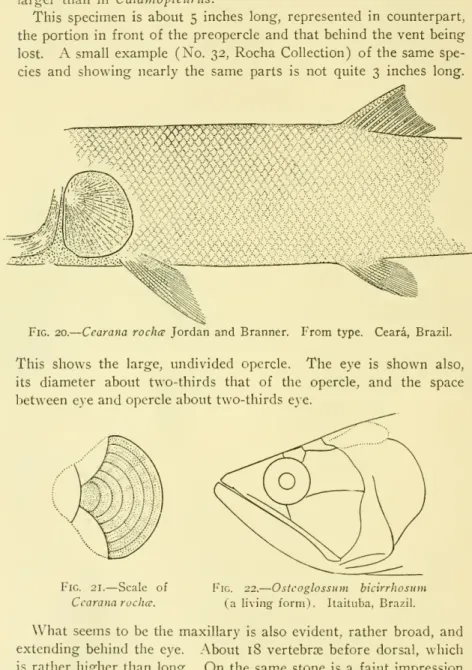
lateral line. Lateral line inconspicuous or obsolete,Gambar


Dokumen terkait
Spyraena jello Cuvier,1829 Lateral line scales 130-140; eye not large; conner of preopercle rounded, without a membra- nous flap; opercle with two flexible flat spines; no pointed
Brueggemann could thus rightly argue, “Although the lamentations present deep problems for interpretation, there is little doubt that they evidence a theological confrontation of
Anterior margin of the clypeus with a deep U-shaped emargination; the lobes very broad, rounded; front coarsely, closely punctured; vertex with punctures separated and slightly larger
Immediately posterior to the fourth supralabial, dorsal pigmentation extends ventrally as a band of pigmented scales, three to five transverse scale rows in width, around the head to
Antennae inserted distinctly above lowermargins of eyes; first funicular joint obviously a little longer than broad, distinctly thicker than pedicel; second to sixth joints of funicle
Face very weakly indistinctly punc- tate and shining; antennae very slender," a little longer than the body;vertex,temples, andcheeksindistinctly punctateandshining ;
Eighth tergite of female with four slender elongate lobes, themedian pair a little longer, all separated by acute incisures; eighth sternite with six lobes, the me- dian
130 PROCEEDINGS OF THE NATIONAL MUSEUM vol.96 terior profilefrom dorsal originto between eyes nearly straight, or a very little convex; ventral profile curves to pelvic insertions, then
