Chapter 19
The “Digitalisation” of Youth:
How Do They Manage and Integrate Digital Technologies?
Pedro Quelhas Brito Universidade do Porto, Portugal
WHy Focus on youtH?
Babies, children, adolescents and young adults are all relatively dependent on their parents.
Nevertheless, they are consumers and potential or active consumers. There is consensus recognising children’s influence on family decision-making.
This influence varies according to the mother’s attitudinal dimensions (Roberts, Wortzel, &
Berkeley, 1981) and the children’s influence on family purchases. Moreover, the likelihood of
any given purchase being achieved depends on the collaborative interaction between parent and child (Darian, 1998). The relative influence of each family member varies by product, by stage of the decision-making process, and by various judgment criteria, such as point-of-purchase decisions, the brand, or style in durable goods (Belch, Ceresino, & Belch, 1985). More recently, the increasing expertise of youth with comput- ing and digital media-related tasks turns many parents into becoming learners from their own children (Ekström, 2007). However, such a “new media-savvy” profile expresses a construction of AbstrAct
The digitalization of youth signifies their complete immersion, active participation and involvement in the production, consumption and sharing of digital content using various interconnected/interfaced digital devices in their social network interactions. A prerequisite to successful commercial commu- nication with young people is having a good understanding of new media, along with their social and psychological framework. The behaviour, motivation and emotions of youth in general and in relation to digital technologies, especially the meaning attached to mobile phones, the Internet (mainly social network sites) and games (computer-based and portable) should also be addressed if advertisers aim to reach this target group.
DOI: 10.4018/978-1-60566-792-8.ch019
competence to counteract the discourse made by adults under which kids are permanently exposed to the risk of digital media (MacKeogh, 2001).
Compared with previous generations the consumer status of today’s youth occurs at an early age. The statement, “kids grow older younger” sums up that process of becoming the decider and consumer quicker and sooner (Mitchell & Reid-Wash, 2005;
Siegel, Coffey, & Livingstone, 2001).
Moreover, the youth represent an interesting research area because:
• they are a “market”–relevant by its size (over 200 million citizens are under 16 years-old in the EU and North America) and economic power;
• they can provide indications of trends of how digital technologies may be exploit- ed in the future (e.g.: Lenhart, Madden, Macgill, & Smith, 2007);
• they are generally (and traditionally) con- sidered a difficult target to access and com- municate with (e.g.: Oates & Gunter, 2002;
Mangleburg & Bristol, 1998);
• they are a truly global segment since they share similar tastes and preferenc- es in terms of brands, sites and gizmos worldwide (eg.: Larson & Wilson, 2004;
Lindstr∅m & Seybold, 2004; Tsai, 2006);
• they are used to getting what they want–
in this materialistic world their wishes become mandatory (Bee-Gates, 2006;
Lindstrom & Seybold, 2003);
• they are challengers and pioneers, ear- ly adopters of technology and eager to change/re-invent the rules (e.g.: Drotner, 2005; Kim, 2008; Lenhart, Madden, &
Hitlin, 2005);
• the current Net-generations will be the future leaders/deciders/buyers–e.g. the young Japanese adults who grew up in the digital era maintain their digital tech- nological habits and use patterns (Miyata, Boase, & Wellman, 2008);
• although evocative the term net genera- tion or digital natives is too simplistic to describe youth - it is more realistic to con- sider many minorities with distinct and specific relation with new technologies rather than an homogeneous group (Jones, Ramanau, Cross & Healing, 2010).
nAturE oF dIGItAL MEdIA
The attraction for digital media among young people derives from intrinsic characteristics of digital technology. Before looking at the “digital”
aspect, the ideological debate concerning the dia- lectic nature of media should be considered. The
“new” media can be understood by contrasting it with the former format and then exploring the specifics of new media technology.
Ideological debate
Although the growing influence of the Internet became particularly evident during the nineties, the ideological roots of the new media lay in the debate between two media theorists during the sixties. Williams (1961, 1976) stressed the complex role of social, cultural and economic dimensions in shaping technologies. Here, hu- man affairs ascertain the pace and scale of how a specific technology is mobilized. Depending on the social use of technology it may be converted into a medium (of communication). To reach this status, it may provide information, express an idea or represent some content or form of the world. Far from considering the development of the media as a human agency, McLuhan (1964, 1969) held that technology is an extension of hu- man capacity. In his conception, (media) technol- ogy structures peoples’ lives in the manner they pursue their activities, and in particular it affects and changes social arrangements and relation- ships. The (new) media technology (electronic broadcasting) aesthetically mediates our relation-
ship with the world since it is multidirectional in all senses–physical and mental. Insisting on the power of (media) technologies, McLuhan envis- aged networked communication systems and anticipated the “coupling” of people and machines with an interweaving of technology into peoples’
lives. Radically, he stood for the notion that new media is more than a simple tool; it becomes an environment in itself. Thus, it quantitatively and qualitatively impacts our everyday life of work and entertainment, our human relationships, as well as human-machine interactions.
For those who were born at the end of eight- ies and later, Williams/McLuhan’s discussion is, at best, too intellectual, distant, or not even relevant. Since they never (fully) experienced the
“old media”, they are unable to draw a distinction between “the before” and “the new”. Besides, what is labelled as “old media” is very likely to be viewed by tweens as museum-like stuff, and seen through the lens of their only available media, the new one (Brito, 2008). Before turning back to the world of today’s youth, the characteristics of the new media in contrast with the old media should be considered.
Analogue vs. digital World
Based on Thompson’s (1995) contribution, Lister, Dovey, Giddings, Grant, & Kelly (2003) defined communication media as “the institutions and organizations in which people work (the press, cinema, broadcasting, publishing, and so on) and the cultural and material products of those institutions (the forms and genres of news, road movies, soap operas which take material form in newspapers, paperback books, films, tapes and disks)” (p. 9). Clearly this definition points to an institution where media production takes place.
The model under which a few “institutions” framed by law, politics, culture, financial/corporation and educational systems convey their control and exert their influence over the “mass” of the public still epitomizes the hegemonic configuration of mass
media (Watson, 2008). The glue that cements such a powerful structure is ideology–the public dimensions of beliefs/values and manifestation of an ideal through cultural, social and political discourses (Watson, 2008). The audience’s atten- tion continues to be selective but simultaneously depends upon media for (Rokeach & DeFleur, 1976): guidance, clarification of values, attitude formation, ambiguity/uncertainty reduction, agenda-setting and opening up of people’s be- lief systems. Access to world-wide information transforms the local citizen into a cosmopolite engaged in a constant process of self-formation (Thompson, 1995).
Those audiences are not passive receivers of media messages. They use, exchange and modify the message, not necessarily in a linear or top-down direction but also with some degree of social mediation. Their significant others–rela- tives, friends and colleagues–and opinion leaders reprocess and retransmit the message, undergoing further mediation (McQuail & Windahl, 1993).
The mass media model depicted earlier did not disappear at once. Mergers and acquisitions have made production centres more concentrated but also vulnerable to global competition. Still, the technological ease of producing or capturing (not necessarily editing) allows users to distribution information, and thus, creating non-professionals to have an uncontrolled role (Thurman, 2008). For example, in a dictatorial regime a human-rights demonstration activist can witness and record the police using excessive force for repression, then send a short digital movie to someone or upload it to YouTube.com, making the incident instantly accessible to a worldwide audience.
There is no purely technological revolution (Toffler, 1980). Regardless of how big the change is, it always includes and involves an ideo- logical, social and experiential range of different phenomena. As we consider the technological determinism advocated by McLuhan (1964) it is more effective to look firstly at the characteris- tics of new media, then explore the “uses” and
the social implications. The term “new media”
may include both the Internet and any computer- mediated communication such as TiVo or digital games, which makes it quite general and abstract (Lister, Kelly, Dovey, Giddings, & Grant, 2003).
That is, the word “media” suggests a continuity and connection with the past industry devoted to broadcast news, whereas “new” implies progress, novelty, or at least a difference and in some way a break with the past.
new Media dimensions
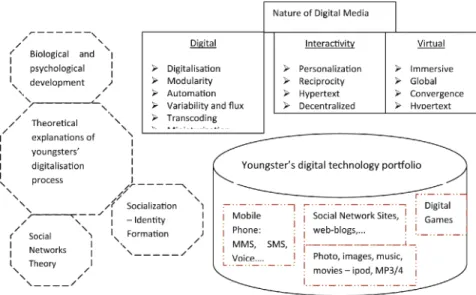
‘New media’ includes Digital, Interactive and Virtual media.
Digital Media
First, digital is a mathematical problem. In the late thirties Alan Turing developed it conceptu- ally. In order for his binary machine concept to be workable, three attributes had to be present:
complete, consistent and decidable (Gere, 2002).
The simple numerical representation of data into discrete elements of 0’s and 1’s in computing (and programming) and storage capabilities gave rise to the following benefits (Manovich, 2001;
Negroponte, 1995):
(1) Digitalisation–this is the most distinct fea- ture, as opposed to analogue: the physical properties of the input data are not converted into a similar/analogous object but into ab- stract symbols which are available whenever and wherever the user wants, in a seemingly perfect replica.
(2) Modularity–Data or media elements (such as sounds, images and video) can be re- assembled in different scales without losing their separate identities;
(3) Automation–The combination of computer programs, numerical coding and modular structures allows for automatic operation;
(4) Variability and flux–Contrary to analogue media where any change implies having to deal with the entire physical object, digital media makes it easy to produce an almost infinite number of variations with only partial editing;
(5) Transcoding–is better understood under the logic of computing than under the perspec- tive of new media. This is about translating a code into another format. It requires both database management to organize and access data, and interfaces designed for easy con- nections between web-sites, games, virtual spaces and software.
(6) Miniaturization–Since these technology in- puts large quantities of data, the access speed as well as rate of exchange (or conversion) has to be also very high.
Interactivity
Interactivity is perhaps the one most widely as- sociated with digital (new) media. To fully map out its distinguishing features several dimensions should be taken into consideration (Huhtamo, 1999; Jensen, 1999; Lister et al., 2003; Shultz, 2000):
(1) Ideological level–Interactivity represents a value-added quality since it maximises con- sumer choices in relation to media sources/
outputs. The neo-liberal idea of personaliza- tion is now made real.
(2) Instrumental level–The audience intervenes.
They become active media users instead of just “reading” or “viewing”. Their engagement goes beyond the text-based experiences. They play, experiment and explore. Ultimately, they communicate with others under a certain base of relationship reciprocity;
(3) Hypertext–This lexical computing term is especially relevant to understanding new media. Thanks to this dynamic method of
data retrieval any user can access successive nodes (of text/data) within a multilinear mode, linked together according to an organi- zation of database knowledge-management logic.
(4) Decentralization - Standardization and uniformity characterize the content, pro- duction, distribution and consumption of cinema, radio programmes and newspapers of mass media. The digital technologies or computer-mediated communications estab- lished a network-based distribution, blurring the consumer and production tasks. Today anybody, depending on their skills, may publish and broadcast their own “news,” or simply, thoughts. There are many forms of user-generated content and citizen-produced media including blogs, vlogs, podcasts, digi- tal storytelling, participatory video, wikis, etc.
Virtual Reality
This is the most emblematic, science-fiction driven and utopian (Flichy, 1999) concept of the digital world. Basically, reality is simulated to generate fantasy under an immersive computer-generated environment. Virtual reality aims to produce a scenario/community (cyberspace) where we are independent of spatial location, transcending geographic and social frontiers. This process also involves our identity. Who is to stop us from inventing another persona? (e.g. Secondlife.com)
The logical consequences of this new era are twofold:
• Globalization - Access to digital media is available almost anywhere and anytime, as long as economic/financial, social/politi- cal (e.g. censure) and Internet access con- straints permit;
• Convergence–Two technological evolu- tionary steps occurred almost simultane- ously: (1) technological convergence be-
tween media, telecommunications and the Internet; (2) the World Wide Web gradual- ly took over the Internet. Originally a net- work of computers globally linked togeth- er based on a common language protocol (IP) and also supporting communications using the Transmission Control Protocol (TCP) and the Internet Protocol (IP), the Internet embraced email services, Usenet, IRLs or chat rooms, and MUD (multi-user domains). Now the Internet is synonymous with www.
Activities such as shopping, banking, gaming, inter-personal communication and entertainment can be performed with the same platform. The user benefits from having more channels (TV, radio and newspapers) to choose from, and from having full control over the media menu. Further- more, portability and personalization have made multimedia and personal communications readily available everywhere.
the ‘Web’ of theories and digitalisation of youth
In order to understand to what extent digital technologies are so attractive to the young and to explain the specific meaning they attach to them, an overview of some relevant theories is a use- ful step before considering their integration and management of these technologies. Good starting points are the biological (physical and cognitive) and social development of youngsters. Although social network theories are not specifically suited to any age group, they are strongly endorsed as a way of framing people’s online relationships.
Finally in this section, the question of why the Internet is so attractive (even seductive) is ad- dressed and tentatively tackled.
biological and Psychological development
Pre-teens gradually comprehend the world’s com- plexities thanks to the progressive use of concrete operational thought, expressed in their ability to apply logical principles such as identification, reversibility and reciprocity (Piaget, 1952). How- ever, such processes do not occur in a vacuum.
The socio-cultural context can enhance or hinder children’s learning (Vygotsky, 1978). Parallel with this, neurological maturation takes place, increas- ing their memory capacity, processing speed (Kail, 2000) and knowledge base (Berger, 2006).
The latter mechanism makes further learning and remembering easier. Iteratively reinforcing previ- ous knowledge acquisition allows some degree of mental automatization, which saves processing time and cognitive resources (Demetriou, Chris- tou, Spanoudis, & Platsidou, 2002). Following Berger (2006), the systematization and integration of memory, processing speed and knowledge forms the control process. Under selective attention this mechanism regulates emotion and internal cogni- tive monitoring (metacognition) of information flow within the system. Age and culture influence the control process, its accuracy and efficiency.
Teenagers undergo deep transformations, some of which are visible in their physical growth (height and weight) and hormone production, which induces changes in body rhythms and biological stress (Belsky, Steinberg, & Draper, 1991). We can summarise puberty changes by their relevance to the use of digital technologies:
• Sexual maturation–beyond biology, girls and boys invest more in their appearance (e.g. hairstyles, cloths and cosmetics) and become more interested in each other (flirting, hand-holding, dating,…romance) (Berger, 2006);
• Thrill seeking–emotions overcome reason.
Teens tend to rush and perform according to their immediate feelings and excitement
instead of planning or reflecting. While al- most ready to control the limbic system, the pre-frontal cortex lags behind to off- set strong and immediate sensations. They strive for intensity, excitement and arousal and are drawn by music, movies and other high-stimulation experiences (Dahl, 2004;
Steinberg, 2004);
• Intuitive versus deductive thinking–by the age of 14, teens can easily engage in hypothetical-deductive reasoning. That is, they are able to analyse and think logi- cally. However, the intuitive cognition, also referred to as heuristic or experiential thoughts driven by feelings and memo- ries, and counterbalances analytic thought.
(Keating, 2004; Moshman, 1999);
• Adolescent egocentrism–teens tend to re- gard themselves as unique, special and more socially significant to others. They may experience three characteristic be- liefs/myths: invincibility (being immune to harm or defeat), personal fable (fated to be heroic and endowed with a legendary life) and public self-centred position (ab- solutely admired by an imaginary audience where they are at centre stage) (Elkind, 1979).
socialization theories–
Identity Formation
Being social is not an innate state, it is a human product. Socialization is the process through which people learn to be social beings and acquire specific rules, skills and cultural knowledge by interact- ing and communicating with others (Fulcher and Scott, 2007). The self-consciousness of themselves as an autonomous independent reflective entity represents one of the most remarkable psychoso- cial achievements resulting from the adolescent crisis (Erikson, 1968). The central process of self-conception or awareness of self as a person/
individual is called social identity, and it is likely
one of the most meaningful outcomes of socializa- tion. Who am I? We are a blend of what we want to be, what we make, and what we feel about how others describe us, which includes a sort of a label indicating social positions and occupational roles, real and imagined. Primary socialization takes place at home, led by parents or caregivers, where children learn the basic paradigms of our society encapsulated by language, gender and culture.
In the second step of (secondary) socialization, a child has to face the outside world along with his/
her formal education (Fulcher and Scott, 2007).
The teenager seeks to keep a stable personality immune to changing circumstances, in which their behaviour remains consistent over time (Chandler, Lalonde, Sokol, Bryan, & Hallet, 2003). However, the need for a sense of continuity with the past as claimed by Chandler et al, (2003) does not imply the development of unique identity. Teens may try out different possible selves and test them realistically or imaginatively (Markus & Nurius, 1986). Even when we stop questioning almost everything, we end up accepting multiple identities because we simultaneously share several social types: gender, ethnicity, family role, worker/job and religion Fulcher & Scott, 2007). Therefore, far from being pathological, such identity flex- ibility expresses an adaptation to our contemporary society. We simply explore different narratives by selectively drawing on the reconstruction of our own biographies in response to the varying and complex situations of our life (Bauman, 1995).
Three theories are in accord explaining the same phenomena of socialization and identity formation: the Role–learning theory, rooted in sociology traditions associated with the structural- functionalist approach; the Symbolic Interac- tionism theory, offering a social psychological perspective and focus on cognitive meanings; the Psychoanalytical theory, which as the designation suggests is ingrained in psychological traditions and stresses emotional meaning (Fulcher & Scott, 2007). Although conceptually distinct, each theory proposes a complementary contribution that is
particularly helpful to interpreting the way youth live with digital technologies.
Role-Learning Theory
Role-learning theory (Bales, 1950; Johnson, 1961; Parsons, 1951) suggests people are con- strained to learn social roles, which is seen as an institutionalized form of social relations. The formal means of training, as well as the rewards of conformity and punishment of deviation, are not enough to guarantee and perform such social roles, people have to internalize them. That is to say, they make socially approved expectations part of their self. They automatically act according to and completely committed to social roles. Their own social identity becomes a natural and normal corollary of the basic ingrained social scripts that structure their society/culture. The over-socialized standpoint was criticized and replaced by a more social/cultural institutional relativistic approach:
instead of being socially programmed, people analyze the existing social frameworks and take up roles, sometimes conflicting ones, and assume those that with some degree of freedom partially fit their social expectations (Giddens, 1976; Turner, 1962; Wrong, 1961).
Symbolic Interactionism
Symbolic interactionism (Goffman, 1959; Mead, 1934) holds that everything is a social construc- tion. An objects’ (social) existence depends on the attribution of meaning. That process is in itself a social construction, built up through commu- nication and negotiation between groups sharing similar goals. Children don’t learn about material objects, but the manipulation of symbols, and rep- resentations of objects. The best way to discover the cognitive meaning of an interaction partner is to imitate. Playing other roles and observing their reactions favours children’s understanding of social roles. Their social identity results from the interplay of two conceptions of self: the “I”
is the source of action for the authentic self, but what everybody witnesses and reacts against is the “me”. The latter is the social self. It reflects others’ attitudes. Playing or pretending to be someone else is an instrumental activity even for adults. Whatever our job, position or social role, in our process of self-presentation we may chose to perform as a “person” who is more of an imputation of that self or product of the social interaction performance than the exact “I”. We can act out multiple identities but whether the final outcome conforms or not, the social expectations depend on the audiences.
Psychoanalitical Theory
Psychoanalitical theory (Freud, 1962) - Following Freudian tradition, the “true self” is hidden and submitted to the pleasure-seeking/sexual forces of “id”. What arises on the surface of the social arena is the “ego,” previously domesticated by the “super-ego”. The construction of the social identity is the tension process of morality, social conventions and parental prohibitions aimed at controlling the irrational “beast”. Youth’s experi- ence of satisfaction and frustration help to define the limits of what can be culturally appropriate within an expression of their biological nature. To avoid anxiety, youth try to balance their deeply emotional energy with the drive for group accep- tance, sense of belonging and social recognition (Sullivan, 1947). Their particular self-conception or identity is a permanent motivational weight scale.
social network theory
Cooley (1998) characterized two principal types of groups: primary and secondary. The former is composed of persons who know one another well, seek one another’s company, and are emotionally closed. Their members have a “we” feeling and enjoy being together (Shepard, 2007). The second- ary group is instrumental, impersonal and goal
oriented (Cooley, 1998). Both types of groups require some degree of social interaction. The process of mutual influence (Turner, 2002) may be expressed through five possible modalities: co- operation, conformity, social exchange, coercion and conflict (Nisbet, 1970). The first three basic social interaction modes are more typical of the primary group scenario than the remaining two.
The social network concept goes beyond social interaction and group development dynamics. It embraces, at a broad level, an ecological environ- ment dimension adding up to the social relationship web (Cotterell, 2007). To better understand the functions of social networks, especially if applied to an adolescent context, another theoretical insight is particularly useful: Attachment theory. Although conceptualized to describe a child’s relationship with significant others, the four features of attach- ment expression (Bowlby, 1969) remain relevant even into adulthood (Thomson, 2005): proximity seeking, separation distress, safe haven and secure base. These attachment representations provide a structure that shapes peoples’ attitudes, regulates their behaviour and moderates their emotional expectations toward their peer relations (Carlson, Sroufe, & Byron, 2004). Ultimately, adolescent friendships under a social network paradigm partly extend the psychological process that regulates personal feelings and behaviours to the actions and feelings that similarly regulate it within groups (Nickerson & Nagle, 2005; Smith, Murphy, &
Coats, 1999).
Technically, a social network does not overlap the primary and even the secondary group. It also does not necessarily involve close or continuous social interaction. The total set of a web of social relationships covers links of all kinds among individuals (Mitchell, 1973). Moreover, each individual can be connected to others through direct or indirect social ties with varying levels of strength, reciprocity and order linking several so- cial environments (Cotterell, 2007). Socialization implies social interaction, and that is built upon social networks. In childhood the first extended
(beyond family and relatives) social network experience arises from peer relationships. Social acceptance is instrumental to social cognition (Haselager, Cillessen, Lieshout, Riksen-Walraven,
& Hartup, 2002). More than peer acceptance and popularity, children value friendship. The effect of friends teaching social skills and the effective contribution to emotional regulation lasts until adulthood (Bagwell, Schmidt, Michelle, New- comb, & Bukowski, 2001). As children grow older friendships become more selective, intense, stable, intimate and also hurtful (Erwin, 1998).
Close friendships among youth means the sharing of common interests, values and emotional needs, which involves choosing and being chosen by others having similar socioeconomic status and demographical characteristics (age and ethnicity) (Aboud & Mendelson, 1996, Reynolds, 2007).
In general, social and psychological influences exerted by peers and friends can be summarized as follows (Berndt and Murphy, 2002; Dishion &
Owen, 2002; Erwin, 1998; Lahelma, 2002; Pahl, 2000; Tarrant, MacKenzie & Hewitt, 2006):
• Participation and social companionship–
“we are not alone”;
• Reciprocity, trust, confident (“we share our secrets”) and mutual acceptance without being (too) judgmental;
• Emotionally supportive. Validates feelings and reinforces self-esteem;
• Counterculture - against adult standards;
• Group pressure–membership implies rule conformity–sometimes they induce collec- tive deviancy and even destructive behav- iours: e.g. drug use initiation, alienation from school, aggressive behaviour, and sexual activity.
young People and digital technology
Finally, assuming these characteristics and most of those theories existed during the old media
age, why are digital technologies so attractive (even seductive) to youth? We not only borrow that question from Rosen’s (2007) book, but also part of the answer.
1) Happiness: Valkenburg and Peter (2007) found that Instant Messaging usage is positively associated with adolescents’
well-being, provided that the moderating influence of the time spent with friends and quality of this friendship were also present.
2) Control: the ‘buzz’ of exploring without direct adult supervision makes youth quite active in deciding what, when and how they use the Internet. For young people the huge amount of possibilities/content/interfaces (e.g. gaming, surfing, IMing, e-mailing and blogging) stimulates their interaction with others and with the machine (e.g.Turkle, 1995 and 2004);
3) Freedom: it allows anonymity and favours disinhibition and intimacy;
4) Psychological absorption: expressed by a sense of escape from reality and disruption of time perception (Csikszentmihalyi, 1998, Young, 2001);
5) Psychological gratification: Song, Larose, Eastin, & Lin (2004) described seven Internet gratification factors–virtual community, information seeking, aesthetic experience, monetary compensation, diversion, per- sonal status and relationship maintenance.
Although it was applied to analyzing Internet addiction tendency components, it is still valid in other contexts.
Integration and Management of digital technologies
There are no reasons to believe the social and psychological development processes of youth radically suffer from their involvement with digital technologies. Similarly, most theories should still be valid. However, new problems may require
additional intellectual investment to theorize.
Today’s teens and children were born in the digital age. Therefore, at least for the affluent part of the world, since most of the technology is no longer analogue they are by default digi- tally interactive. Today’s youngsters are digital natives; they do not know any other language than the digital language of the Internet, com- puters and video games (Prensky, 2001). They are totally wired (Goodstein, 2007). They are so virtually exposed that they live online (Rosen, 2007). As was defined previously, digitalisation of youth represents a complete emersion, active participation and involvement in production, consumption and sharing of digital content by using various interconnected/interfaced digital tools in their social network interaction process.
Through digitalisation, the scope goes beyond the status of being online, but also encompasses the creation/manipulation of data off-line (using appropriate software and other digital technolo- gies) to be used online, or to “copy” data online to be transformed and consumed off-line. For example, taking a digital picture, digitally enhanc- ing it, posting it online in a social network site, or downloading podcasts, music and videos and sharing them online too.
It is well known that adolescents can easily integrate the following digital technologies and underlying activities:
• capturing images–digital cameras;
• listening to, watching and sharing music and videos - MP3/4 and iPod players;
• connecting to their social network–e.g. IM/
Messenger, Myspace, Facebook, Twitter, or Hi5;
• editing, participating and forecasting news/
opinions/comments–web-blogs;
• designing and updating their own web-pages;
• entertaining–alone or with the communi- ty–e.g., PSP, Gameboy, Playstation, Xbox, MMUOG
• imagining and creating virtual realities–
e.g. Secondlife;
• publishing and “broadcasting” personal relevant “news” using mobile phones–
SMS, MMS.
The process of integration digital technologies to an adolescent’s daily life implies: the planning of activities, interconnectedness among devices, functional specialization, coordination of tasks among peers, and expertise. Regardless of the purpose, whether mostly hedonic (having fun) or somewhat utilitarian (e.g. academic tasks) for that integration to succeed requires management skills, and management purports decision-making.
Young people have to decide what, where, when, how and for how long they use such technolo- gies/devices. Some of the variables taken into consideration in this management task can be summarized as follows: (e.g. Andersen, Tufte, Rasmussen & Chan, 2007; Buckingham, 2007;
Boneva, Quinn, Kraut, Kiesler, & Shklovski, 2006; Haythornthwaite, 2000; Ishii, 2006; Kim, Kim, Park, & Rice, 2007; Lenhart, Rainie &
Lewis, 2001; Licope & Smoreda, 2005; Oksman
& Turtianen, 2004):
• Social network dimensions and diversity;
• Social network quality (nature of the ties: strong/weak);
• Size of the message–length of text;
• Degree of intimacy, closeness of acquaintances;
• Type/format of file to transmit;
• Physical distance;
• Nature of the content and publicizing implications for both the sender and receiver;
• Urgency;
• Cost;
• Locale of transmission: home, street or travelling/commuting;
• Purpose: educational or non-educational/
entertainment;
• Cultural setting: e.g. Asian youth tend to devote more time to educational use of digital media than Europeans;
• Type and number of receivers/audience willing to reach–private/public
All the variables presented in the previous list may not be enough to accurately predict the likeli- hood of a youth’s use of a given digital technology in a specific context. An iPod or mobile phone carries an intrinsic symbolic dimension relevant only to the one who possesses it (Belk, 1988).
Symbolic Interactionism theory indicates that what really matters to users is not necessarily the nature of the object but the meaning they attach to it. In the remainder of this section we look at the meaning of three specific digital technologies among youth: mobile phones, the Internet (mainly social network sites) and games (portable devices and on/off-line computer based).
Mobile Phone
When we presented several groups of tweens and teens with a hypothetical scenario forbidding the use of mobile phones at school they almost panicked, exhibiting emotional opposition to such an infringement of their constitutional rights of communicating (Brito, 2008). Such reactions showed the extent to which, for them, the mobile phone is absolutely essential communication tool.
Apparently (Brito, 2008), many children want to own a cell phone. However, their knowledge about the product’s attributes and their awareness of benefits and values differ. Martensen (2007) identified four segments of tweens (8 to12 years old) crossing over gender and age. Two different segments share the same age range: “Segment 2 –the identity making freaks–use mobile phone as a signal of value and as a means of achieving social status among friends, and Segment 4–the passive–mobile phones don’t have any functional or psycho-social consequence nor any influence on social recogni- tion and self-esteem” (pp.119 and122).
Several authors characterized the motivations, gratifications and purposes sought through owner- ship of mobile phones:
• Aoki and Downes (2003)–to feel safe, to man- age time efficiently, to keep in touch with friends and family, image, dependency and for financial benefits;
• Leung & Wei (2000)–fashion/status, affection/
sociability, relaxation, mobility, immediate access, instrumentality and reassurance;
• Martensen (2007)–to make children reachable;
it is a flexible way to contact them since they are busy in many different activities and constantly on the move; it promotes social recognition, ego- actualization and self-image;
One of the salient features of cell phones is their portability. Kakihara & Sorensen (2002) proposed three interrelated mobility dimensions: spatial, temporal and contextual. From the contextual dimension, portable media/telecommunication enables access free from constraints such as situ- ation, mutual recognition and mood. Teenagers develop their personal space, defining the bound- aries for or against the relationship with friends and relatives (Oksman & Turtiainen, 2004), hence the mobile phone clearly has an instrumental role in their lives.
Youngsters may pursue private conversations without the direct interference of their parents, regardless of whether they are present or not. And that represents freedom. Freedom to contact any- one, anywhere, anytime they choose, and freedom to control incoming calls. Often for the first time they feel the power of being in control. The ritual of emancipation (Wilska, 2003) is influential in the process of socialization. In addition, not owning a mobile phone could be a prerequisite for social exclusion (Charlton, Panting, & Hannan., 2002;
Ling, 2000). There are several types of institu- tionalized social discourses concerning cellular phones: the parental discourse highlights danger and safety, whereas the youth discourse stresses
self-determination and sociability. The media dis- course focuses on image and independence fed by advertising messages portraying friendship, style and individuality (Campbell, 2006). Parental and ado- lescent discourses collide at the contradictory needs of teen autonomy and the parents’ need to maintain contact with them. Therefore the control is bidirec- tional. Turkle (2008) points to the other side of the coin: “Just as always-on/always-on-you connectivity enables teens to independently postpone managing their emotions, it can also make it difficult to assess children’s level of maturity, conventionality defined in terms of autonomy and responsibility. Tethered children know that they have a backup” (p.128).
The symbolic nature of mobile phones is better captured by analyzing the unambiguous meaning youngsters attach to some specific (technical) characteristics/features.
The following Figure 1 provides an overview on mobile phone functionality and meaning.
digital Games
We use the term “digital games” irrespective of the platform: on a PC, the Internet, handheld, video console or specialized game console. They can be played alone or in-group, against virtual players or in a co-presence community. The game interaction Figure 1. Mobile phone functionality and meaning
can also be managed online or off-line. Games can also be categorized as strategy/problem solving;
racing; fighting (Walkerdine, 20007). Ultimately games are also framed within the concept of con- trol, thus power (McLeod & Lin, 2010). Digital and Video Games are surrounded by controversy;
their influence on behaviour and values; the real or virtual nature of digital games; and contradic- tory evidence which feeds and promotes divisive/
hot positions. We now look at the digital games through scrutinizing these dichotomies.
Internet
The focus of this section is on social network sites (SNSs). Their growth indicates increasing attrac-
tiveness, especially amongst youth. Furthermore, those sites integrate several technical features/
interfaces which stimulate the users’ creative participation and control. Boyd & Ellison (2007) defined SNSs as “web-based services that allow individuals to (1) construct a public or semi-public profile within a bounded system, (2) articulate a list of other users with whom they share a connection, and (3) view and traverse their list of connections and those made by others within the system”(p.
211). According to Boyd and Ellison, two char- acteristics make SNSs unique: the public display of connections and (the volunteer) visibility of the users’ profile. This concept is not consensual;
Beer (2008) categorizes most of SNSs under an umbrella type: Web2.0. Not all SNSs are alike.
Figure 2.
Some requires bi-directional confirmation, others just one-directional definition of proposed ties.
Some are anonymous; others favour an implicit self-presentation (Boyd & Ellison, 2007; Zhao, Grasmuck, & Martin, 2008). None of the more than 35 SNSs available were universally popular.
They were regionally adopted, suggesting SNS membership mirrors the users’ social network background (Hargittai, 2008).
Before looking at the components of SNSs and how they work, it is worthwhile to briefly consider two separate Internet “products” which were later conceptually integrated into SNS configuration:
personal home-pages and chat rooms. How do we want the world to see us? What aspects of ourselves would we like to communicate? Those two ques-
tions could be answered by developing a personal home page. Dominick (1999) found that in more than 94% of personal pages’ the content includes a feedback mechanism and links to other sites. Lists of preferences such as likes/dislikes and personal data account for 72% of situations, and 55% post their personal photos. Chat rooms are wide open, public, anonymous, informational settings orga- nized by topics, without any traditional frames or regulations and basically reflecting the long- established anarchy of the Net. The term “chat” is misleading, since conversation assumes a writing mode with an oral style. Quickness, redundancy and linguistic flexibility characterize this medium (Tingstad, 2003). Formally, a codified pattern of pragmatic communication tactics idiosyncrati- Figure 3.
cally conveys a group-specific meaning (Baym, 1998). In particular, two moments/situations seem intensely relevant in the chat process (Tingstad, 2003): (1) introducing themselves–greeting rituals loaded with meaning, where the nickname plays a structural role; (2) maintaining the talk going on–fast replies, no pauses, humour and irony are valuable resources. In Tingstad’s (2003) ethno- graphic research, kids described chat rooms as
“places to meet people and talk”. The definition along with the insider knowledge approach (i.e, proposed by Baym, 1998), calls for a sense of community. Community is essentially a dynamic setting focus on what people do rather than what people are, thus boundaries are developed through social relationships representing structural mark- ers (e.g. Cohen, 2000; Rheingold, 2000; Tingstad, 2003). In the context of chat rooms, the community boundary markers are: language, status, hostility
topics, friendliness, greeting rituals, interests, humour and teaching (Tingstad, 2003).
The following schema depicts the intercon- nection among three topics regarding SNSs: (1) components (how does it work?); (2) effects and consequences of those technical/social elements;
(3) players and their goals (members’ character- istics and motivation to join):
Finally, when looking at the predictors of Internet use patterns–informational, social and entertainment - in teens’ demographics, Eastin (2005) demonstrated is “that people use the In- ternet differently, for different reasons, and with different influences” (p. 72). In this section we only stress the social use.
Figure 4. Social network sites
concLusIon
youth and the new Media
To understand how youngsters use, live with, inte- grate and manage digital technologies the concept of digital media had to be analyzed as well as the underlying theoretical explanations rooted in the spheres of psychology and sociology. Ultimately it is about technology, thus the specificities of digital intermediaries (the devices) should be addressed.
The scope and limits of youth’s relationship with the world, with their peers and with themselves are also determined by the technological features of various digital devices/platforms such as the Internet, mobile phone and digital games.
In this section we schematically depict a synthe- sis of the analysis of the various topics scrutinized previously. However, a practical and managerial dissection of that analysis is still missing.
It is not accurate to ascribe the association of digital media use with its instrumental (utilitar- ian view) and emotional (attachment, symbolic meaning and dependency) attributes exclusively to youngsters. In fact, other age groups share similar relationships with digital technology and completely assume both of these attributes.
What makes youth special in regard to this new media?
1. Their limited or lack of experience with the analogue world. For them the “new” (media) is already “old” media;
2. The ‘others’ (Friends & friends) are always with “me”. That omnipresence or state of
“perpetual contact” (Katz & Aakhus, 2002) is made possible by portable digital devices;
3. Intensity of usage expressed by time length, frequency and diversity of contacts, all as- sociated with multitasking. Notwithstanding multitasking reduces performance and affects the quality of learning process (Bowman, Levine, Waite & Gendron, 2010).
4. Expertise and sophistication. Some of them are better equipped than their parents.
Nevertheless, they are far more capable than the past generation to live with, deal with and manage life under an overwhelmingly digital future environment.
communication vs. Advertising The information processing of advertising is age- dependent, and even among youngsters it is not uniform. Like adults, young ad viewers do not en- gage both central and peripheral routes for chang- ing attitudes. Their attitudes are similar regardless of their involvement level (Harari, Lampert &
Wilzig, 2007). Children’s rudimentary and simple Table 1.
Why Here?
“Behind the screen” is a very powerful metaphor used to illustrate the anonymous, distant and safe presence of others who facilitate – make easier and faster – personal self-disclosure (Joinson, 2001; Turkle, 1995). Self-disclosure does not necessarily mean that people reveal their
“true self”; it is rather a consequence of online disinhibition effect. Suler (2004) explored the conjoint factors underlying the creation of the online disinhibition effect: anonymity, invisibility, asynchronicity, solipsistic introjections (in a participant’s mind their feelings merge with others), dissociative imagination, minimization of status and authority. As the SNSs designation suggests, the users’ goals is to interact, whether locating old friends or making new ones (Raacke & Raacke, 2008). Bryant, Jackson, & Smallwood, (2006) showed that adolescents create quantitatively and qualitatively similar ties on/offline. That does not imply that they are indifferent to the tone of feedback from their exhibited profiles. Positive reactions enhance teens’ social self-esteem and psychological well-being (Valkenburg, Peter & Schouten, 2006) especially among those experiencing low life-satisfaction (Ellison, Steinfield & Lampe, 2007). Youth’s offline life, in terms of trouble and parental communication, affects the likelihood of a close online relationship (Wolak, Mitchell, & Finkelhor, 2003). Online dating develops quicker than off-line (Rosen, Cheever, Cummings & Felt, 2008). Nevertheless, the effect of self-disclosure on the romance process was moderated by age, education and ethnicity. However, the authors concluded that lower levels of self-disclosure were preferred when choosing a date partner…, some degree of mystery was welcome. Finally, McKenna, Green & Gleason’s (2002) experiments proved that participants’
ties intensified more following an initial Internet interaction compared with an initial face-to-face meeting.
cognitive elaboration style hinders distinguishing between advertising and surrounding program content. They have difficulty understanding the underlying sales, persuasion, stereotypical and even deceptive intentions of advertising (Bakir, Blodgett & Rose, 2008; Moses & Baldwin, 2005).
At age 12 they have not yet acquired an adult-like understanding of advertising (Rozendaal, Buijzen,
& Valkenburg, 2008). With further experience coping with ads older children recognize and frame the interpretation of subsequent brand us- age and evaluate the brand positively if the ad is appreciated (Moore and Lutz, 2000; Wright, Friestad, & Boush, 2005). As children develop, their susceptibility to advertising in terms of liking, desire and intention to request advertised products can be mediated by adult commentary during the exposure to commercials (Buijzen &
Mens, 2007). Along with household purchasing participation, shopping skills, and product and brand knowledge enhancement, children also develop an understanding of advertising tactics and appeals. The latter indicates that mature kids become less trustful and entertained concerning ads, and more skeptical and discerning (John, 1999). In this transition the way socialization agents interact with youngsters–family communi-
cation orientation, susceptibility to peer influence and advertising exposure - determines the degree of skepticism toward advertising (Mangleburg &
Bristol, 1998).
Transposing the topic of adolescent consumer socialization to online advertising and e-marketing practices, Youn (2008) studied the role of family communication patterns (concept-oriented versus socio-oriented) on persuasive online practices.
Here, Youn found pluralistic (low socio and high concept oriented) and consensual teens (high on both orientations) tended to be more concerned with privacy issues and exhibited more negative attitudes toward online advertising than laissez- faire (low on both orientations) and protective teens (high socio- and low concept-oriented). In spite of typically being very analytical and voicing negative opinions toward advertising in general, adolescents also enjoy discussing and sharing their savvy positions with peers about some of the more creative advertisement approaches (Ritson
& Elliott, 1999). Advertising is a resource for youngsters–for diversion, inspiration and as a pretext to enter dialogues–a vehicle for recogni- tion and success, a tactic for overcoming shyness and to showing parents evidence of their expertise (Lawlor, 2008).
Figure 5. Schema: aspects and context of youngsters’ digitalisation process
From a managerial perspective what really mat- ters is how we can make things work effectively.
At first glance, there are some obvious formulas when using new media:
• Don’t act only according to the rules of old media.
• Thinking and acting fast was always a competitive advantage, but now speed is a survival issue.
• Be humble and keep learning, since what was sure and true yesterday is often use- less today.
Putting together the dimensions of digital tech- nology, young people’s socio-psychological char- acteristics and companies’ goals (e.g. expansion, profit, youth segment penetration), the following reflect thoughts about the how to communicate with young people:
• Apparently nonconformity advertising has worked well among teens (Bao & Shao, 2002). However, it is not wise to delib- erately be cool. Ultimately it is the youth who will label it as cool or not. Otherwise it will be classified as pretentious or ridicu- lous. Product endorsement with celebri- ties or characters who are popular among children is equally as effective as using un- known and inexpressive characters due to the status of cognitive information elabora- tion process (Harari, et al., 2007).
• Lindgaard, Fernandes, Dukek, & Brown (2006) found that university students were able to make an impression of a web page within 50 milliseconds before deciding to stay. This impressive record challenges web designers to conceive sites with high visual appeal, as well as showing the users’
expertise in judging what is worthwhile, or not. Furthermore, they are a merciless demographic. Once irritated, they simply ignore and avoid a web page, or worse,
they spread negative information through word-of-mouth. Therefore, it is worth test- ing ideas and concepts and constantly up- dating these analyses.
• Rappaport (2007) outlined three new mod- els centred on relevance to consumers. The
“on demand model” (e.g. TiVo) allows a person to decide, filter, and schedule what they wish to watch or listen to. In the ‘en- gagement model’ instead of focusing on transactional relationships, a brand’s emo- tional connection with the consumer is emphasized. Finally, the notion of “adver- tising as a service” refocuses a managers’
approach to consumers on identifying the information and the types of services con- sumers really need by using ads as a ve- hicle. In this view, the best way to attract youth is by giving them power:
• Allow them to share some control over the brand and give some branding elements away.
• Invite them to participate in adjusting, modifying or building communicational tools.
• Stimulate them to discuss and dissemi- nate creative/imaginative solutions among their peers by promoting viral marketing networks. Traditionally sports and mu- sic sponsorships provided endless op- portunities to link sport or music “stars”
with their fans through a specific popular brand. Furthermore, the Internet makes those “stars” even more and permanently accessible.
• Online advertising can build brand equity in similar ways as traditional media (Hollis, 2005). However, if the brand managers’ in- tention is to entail a relationship–hopefully loyalty–with their young customers, the appropriate approach is not to concentrate exclusively on advertising but on commu- nication (in a broad sense). The examples above call for sales promotion–e.g. con-
tests–and public relations–e.g. sponsorship along with advertisements. To strategically manage the relationship with your custom- ers the integrated marketing communica- tion (e.g. Lee & Park, 2007) allows not only efficiently articulating online/offline investments but also reaching that diffi- cult target pragmatically. Finally, online business models inspired by SNSs do not wait for academic considerations. For in- stance, fast food companies successfully developed prepaid credit cards and instant store credit (virtual cards) delivered online and which were very handy/convenient to youth lifestyles (Macsai, 2008).
Kids and teens always will be kids and teens!
Their structural (biological nature) and funda- mental psychological features under a maturation process have been and will be (fairly) explained by the theories presented here. Regardless of the technologies available, it is very likely that kids and teens will keep playing, sharing their feel- ing and thoughts with their peers, learning and interacting with each other and with machines in the future as their parents and grand-parents did in the past. What have been changing are those (technological) intermediaries and those tools.
Such endless process set “new” problems and challenges to researchers and managers as well as to parents and educators. As always, the win- ners in this game will be those who understand the appetites and aspirations of the current digital generation, and who are able to lead the market with ever-evolving products and services.
rEFErEncEs
Aarsand, P. A. (2007). Children’s consumption of computer games. In Katz, J. E. (Ed.), Handbook of Mobile Communication Studies (pp. 47–62).
Cambridge, MA: MIT Press.
Aboud, F. E., & Mendelson, M. J. (1998). De- terminants of friendship selection and quality:
developmental perspective. In W. M. Bukowski, A. F. Newcomb & W. W. Hartup (Eds.), The company they keep: Friendship in Childhood and adolescence (pp. 87-112). NY: New York:
Cambridge University Press.
Acar, A. (2007). Testing the effects of incidental advertising exposure in online gaming environ- ment. Journal of Interactive Advertising, 8(1), 1–36.
Andersen, L. P., Tufte, B., Rasmussen, J., & Chan, K. (2007). Tweens and new media in Denmark and Hong Kong. Journal of Consumer Marketing, 24(6), 340–350. doi:10.1108/07363760710822927 Aoki, K., & Downes, E. J. (2003). An analysis of young people’s use of and attitudes toward cell phones. Telematics and Informatics, 20(4), 349–364. doi:10.1016/S0736-5853(03)00018-2 Bagwell, C. L. Schmidt, Michelle. E., Newcomb, A. F. &., & Bukowski, W. M. (2001). Friendship and peer rejection as predictors of adult adjust- ment, In. In W. Damon, (series Ed.) and D. W.
Nangle & C. A. Erdley (vol.Eds.)., New directions for child and adolescent development: no.91. The role of friendship in psychology adjustment (pp.
25-49). SF: San Francisco: Jossey-Bass.
Bakir, A., Blodgett, J. G., & Rose, G. M. (2008, June). Children’s responses to gender-role ste- reotyped advertisements. Journal of Advertis- ing Research, (June): 255–266. doi:10.2501/
S002184990808029X
Bales, R. F. (1950). Interaction process analysis.
MA. Reading, MA: Addison-Wesley.
Bao, Y., & Shao, A. T. (2002, June). Nonconfor- mity advertising to teens. Journal of Advertising Research, (June): 56–65.
Bauman, Z. (1995). Life in fragments: essays in postmodern morality. Oxford, UK: Basil Black- well.
Baym, N. (1998). The emergency of online com- munity. In Jobes, S. G. (Ed.), Cybersociety 2.0.
Thousand Oaks, CA: Sage.
Baym, N. K., Zhang, Y. B., & Lin, M.
C. (2004). Social interactions across me- dia. New Media & Society, 6(3), 299–318.
doi:10.1177/1461444804041438
Bee-Gates, D. (2006). “I want it”: navigating childhood in a materialistic world. London:
Palgrave-MacMillan.
Beer, D. (2008). Social Network(ing) sites…re- visiting the story so far: a response to danah boyd
& Nicole Ellison. Journal of Computer-Mediated Communication, 13, 252–275. doi:10.1111/j.1083- 6101.2008.00408.x
Belch, G. E., Ceresino, G., & Belch, M. A. (1985).
Parental and teenage child influences in family decision making. Journal of Business Research, 13, 163–176. doi:10.1016/0148-2963(85)90038-4 Belk, R. W. (1988, September). Possessions and extended self. The Journal of Consumer Research, 15(September), 139–168. doi:10.1086/209154 Belsky, J., Steinberg, L., & Draper, P. (1991).
Childhood experience, interpersonal development, and reproductive strategy: an evolutionary theory of socialization. Child Development, 62, 647–670.
doi:10.2307/1131166
Berger, K. S. (2006). The developing person:
through childhood and adolescence (7th ed.). N.Y.:
New York: Worth Publishers., 7th ed.
Berndt, T. J., & Murphy, L. M. (2002). Influences of friends and friendships: myths, truths, and research recommendations. In R. V. Kail (Ed.), Advances in child development and behavior, (vVol. 30, (pp. pp. 275-310). San Diego, CA:
Academic Press.
Boneva, B., Quinn, A., Kraut, R., Kiesler, S., &
Shklovski, I. (2006). Teenage communication in instant messaging era, In. In R. Kraut, M. Brynin and & S. Kiesler (Eds.). Computers, Phones and the Internet: domesticating information Tech- nology (pp. 201-218). NY: New York: Oxford University Press.
Bowlby, J. (1969). Attachment and loss: Attach- ment. (vVol. 1). Harmondsworth, UK: Penguin.
Bowman, L. L., Levine, L. E., Waite, B. M., &
Gendron, M. (2010). Can students really multi- task? An experimental study of instant messag- ing while reading. Computers & Education, 54, 927–931. doi:10.1016/j.compedu.2009.09.024 boyd, d. m. and ., & Ellison, N.B. (2007). Social network sites: definition, history, and scholarship., Journal of Computer-Mediated Communication, 13, 210-230.
Brito, P. Q. (2008). Conceptualizing and illustrat- ing the digital lifestyle of youth. Working Paper no. 300. Faculdade de Economia - Universidade do Porto. Portugal.
Bryant, J. A., Jackson, A. S., & Smallwood, A. M.
K. (2006). IMing, text messaging, and adolescent social networks. Journal of Computer-Mediated Communication, 11, 577–592. doi:10.1111/j.1083- 6101.2006.00028.x
Buckingham, D. (2007). That’s edutainment. New media, marketing and education in the home, In. In K. M. Ekström and & B. Tufte. (Eds.), Children, media and consumption (pp. 33-46). Gothenburg, Sweden: Nordicom.
Buijzen, M., & Mens, C. (2007). Adult mediation of television advertising effects: a comparison of factual, evaluative, and combined strategies.
Journal of Children and Media, 1(2), 177–191.
doi:10.1080/17482790701339233
Campbell, R. (2006). Teenage girls and cellular phones: discourse of independence, safety and ‘re- bellion.’. Journal of Youth Studies, 9(2), 195–212.
doi:10.1080/13676260600635649
Campbell, S. (2008). Mobile technology and the body: apparatgeist, fashion, and function. In Katz, J. E. (Ed.), Handbook of Mobile Communication Studies (pp. 153–164). Cambridge, MA: MIT Press.
Carlson, E. A., Sroufe, L. A., & Byron, E. (2004).
The construction of experience: a longitudinal study of representation and behavior. Child Development, 75, 66–83. doi:10.1111/j.1467- 8624.2004.00654.x
Chandler, M. J., Lalonde, C. E., Sokol, B. W., Bryan, W. & ., & Hallet, D. (2003). Personal persistence, identity development and suicide: a study of native and non-native North American adolescents. Monographs of the Society for re- search. Child Development, 68(2), serial nº273.
Charlton, T., Panting, C., & Hannan, A. (2002).
Mobile telephone ownership and usage among 10- and 11 year-olds: participation and exclu- sion. Emotional & Behavioural Difficulties, 7(3), 152–163.
Cole, H., & Griffiths, M. D. (2007). Social interac- tions in massively multiplayer online role-playing gamers. Cyberpsychology & Behavior, 7(1), 575–583. doi:10.1089/cpb.2007.9988
Cooley, C. H., & Schubert, H. J. (1998). On self and the social organization. Chicago: University of Chicago Press.
Cottrell, J. (2007). Social Networks in youth and Adolescence (2nd ed.). London: Routledge.
Critcher, C. (2006). Critical readings: moral pan- ics and the media. London: Open University Press.
Csíkszentmihályi, M. (1998). Finding flow: the psychology of engagement with everyday life.
New York: Basic Books.
Dahl, R. E. (2004). Adolescent brain develop- ment: a period of vulnerabilities and opportuni- ties, Keynote address. Annals of the New York Academy of Sciences, 1021, 1–22. doi:10.1196/
annals.1308.001
Darian, J. C. (1998). Parent-child decision making in children’s clothing stores. International Journal of Retail and Distribution Management, 26(11), 421–428. doi:10.1108/09590559810246377 Demetriou, A., Christou, C., Spanoudis, G. & ., &
Platsidou, M. (2002). The development of mental processing: efficiency, working memory, and thinking. Monographs of the Society for research in Child Development, 67(1), serial nº268.
Dietmar, C. (2005). Mobile communication in couple relationship. In Nyiri, K. (Ed.), A sense of place: the global and local in mobile communi- cation (pp. 201–208). Vienna, Austria: Passagen Verlag.
Dishion, T. J., & Owen, L. D. (2002). A longitu- dinal analysis of friendship and substance use:
bidirectional influence from adolescence to adult- hood. Developmental Psychology, 38, 480–491.
doi:10.1037/0012-1649.38.4.480
Dominick, J. R. (1999). Who do you think you are? Personal home pages and self-presentation on the World Wide Web. Journalism & Mass Com- munication Quarterly, 76(4), 646–658.
Drotner, K. (2005). Mediatized childhoods: dis- courses, dilemmas and directions. In Qvortrup, J.
(Ed.), Studies in Modern Childhood (pp. 39–58).
London: Palgrave-MacMillan.
Eastin, M. S. (2005). Teen Internet use: relating social perception and cognitive models to behav- ior. Cyberpsychology & Behavior, 8(1), 62–75.
doi:10.1089/cpb.2005.8.62
Ekind, D. (1979). The child and society: essays in applied child development. NY. New York:
Oxford University Press.
Ekström, K. M. (2007, July). Parental consumer learning or ‘keeping up with the children.’.
Journal of Consumer Behaviour, 6(July-August), 203–217. doi:10.1002/cb.215
Ellison, N., Steinfield, C., & Lampe, C. (2007).
The Benefits of Facebook “Friends:” Social Capi- tal and College Students’ Use of Online Social Network Sites. Journal of Computer-Mediated Communication, 12, 1143–1168. doi:10.1111/
j.1083-6101.2007.00367.x
Erikson, E. H. (1968). Identity: youth and crisis.
NY. New York: Norton.
Erwin, P. (1998). Friendship in childhood and adolescence. London: Routledge.
Flichy, P. (1999). The construction of new digi- tal media. New Media & Society, 1(1), 33–38.
doi:10.1177/1461444899001001006
Freud, S. (1962, original 1923). The ego and Id., London: Hogarth Press. (Original manuscript published in 1923).
Fu, F. L., Su, R. C., & Yu, S. C. (2010). EGame- Flow: A scale to measure learners’ enjoyment of e-learning games. Computers & Education, 52, 101–112. doi:10.1016/j.compedu.2008.07.004 Fulcher, J., & Scott, J. (2007). Sociology, (3rd ed.), NY: New York: Oxford University Press.
Gee, J. P. (2003). What video games have to teach us about learning and literacy. NY. New York:
Palgrave MacMillan.
Gentile, D. A., & Gentile, J. R. (2008). Violent video games as exemplary teachers: a conceptual analysis. Journal of Youth and Adolescence, 37, 127–141. doi:10.1007/s10964-007-9206-2 Gere, C. (2002). Digital Culture. London: Reak- tion Books.
Giddens, A. (1976). New rules of the sociological methods. London: Hutchinson.
Goffman, E. (1959). The presentation of self in everyday life. Harmondsworth, UK: Penguin.
Goodman, D., Bradley, N. L., Paras, B., William- son, I. J., & Bizzochi, J. (2006). Video gaming promotes concussion knowledge acquisition in youth hockey players. Journal of Adolescence, 29, 351–360. doi:10.1016/j.adolescence.2005.07.004 Goodstein, A. (2007). Totally wired: what teen and tweens are really doing online. NY. New York: St.Martin’s Press.
Grüter, B., Mielke, A., & Oks, M. (. (2005). Mobile gaming–experience design. In Proceedings from pervasive: The 3rd International Conference on Pervasive Computing, Munich.
Harai, T. T., Lampert, S. I., & Wilzig, S. L.
(2007). Information processing of advertising among young people: The elaboration likelihood model as applied to youth. Journal of Advertis- ing Research, 47(3), 326–340. doi:10.2501/
S0021849907070341
Hargittai, E. (2008). Whose space? Differences among users and non-users of social network sites. Journal of Computer-Mediated Com- munication, 13, 276–297. doi:10.1111/j.1083- 6101.2007.00396.x
Haselager, G. J. T., Cillessen, A. H. N., Van Lieshout, C. F. M., Riksen-Walraven, J. M. A.,
& Hartup, W. W. (2002). Heterogeneity among peer-rejected boys across middle childhood:
developmental pathways of social behaviour.
Developmental Psychology, 38, 446–456.
doi:10.1037/0012-1649.38.3.446
Hayles, N. K. (1999). How we became posthu- man: virtual bodies in cybernetics, literature, and informatics. Chicago: University of Chicago Press.
Haythornthwaite, C. (2000). Online personal networks. New Media & Society, 2(2), 195–226.
doi:10.1177/14614440022225779