by
Billie Jean Collins
Society of Biblical Literature
Atlanta
Copyright © 2007 by the Society of Biblical Literature
All rights reserved. No part of this work may be reproduced or transmitted in any form or by any means, electronic or mechanical, including photocopying and recording, or by means of any information storage or retrieval system, except as may be expressly permit- ted by the 1976 Copyright Act or in writing from the publisher. Requests for permission should be addressed in writing to the Rights and Permissions Office, Society of Biblical Literature, 825 Houston Mill Road, Atlanta, GA 30329 USA.
Library of Congress Cataloging-in-Publication Data Collins, Billie Jean.
The Hittites and their world / by Billie Jean Collins.
p. cm. — (Society of Biblical literature archaeology and Biblical studies ; no. 7) Includes bibliographical references and index.
ISBN 978-1-58983-296-1 (paper binding : alk. paper) 1. Hittites. I. Title.
DS66.C65 2007b 939’.3—dc22
2007038041
Printed in the United States of America on acid-free, recycled paper conforming to ANSI/NISO Z39.48-1992 (R1997) and ISO 9706:1994
standards for paper permanence.
Preface ix
List of Figures xi
Abbreviations and Keys xiii
1. A Brief History of Hittite Studies 1
2. A Political History of the Hittites 21
3. Society 91
4. Religion 157
5. Hittites in the Bible 197
Afterword 219
Further Reading 225
Subject Index 229
Index of Ancient Texts 246
Index of Modern Authors 251
-vii -
THE HITTITESRULEDAMAJOREMPIRE during one of the most exceptional peri- ods of human history, the Late Bronze Age. Yet, when they disappeared from history’s radar, they did so completely. No direct memory of them survived outside of a handful of references in the Hebrew Bible; classical sources are entirely silent about them. Although rediscovered in dramatic fashion over the past century, as described in chapter 1, the Hittites are still known to few people. This is understandable given that their contribution to world culture has been difficult to pin down, let alone to package and market to a waiting public, particularly in the face of competition from other great civilizations of the ancient Mediterranean world like Egypt, Mesopotamia, Greece, and Rome. Happily, a new interest in the Hittites has arisen in recent years. This is due, first, to the recent availability of excellent popular books, museum exhibits, and documentaries about the Hittites. Also key to their resurgence is the long-overdue recognition within the academy of the value of Hittite stud- ies for understanding the background of classical and biblical—and hence, of Western—traditions.
Only a decade ago, a book such as this would scarcely have been possible.
Major new finds have allowed Hittitologists to fill in major gaps in the his- torical events of the Late Bronze Age in Anatolia. Although much remains to be learned, so much progress has been made in recent years in reconstructing Hittite history that Bryce’s Kingdom of the Hittites published in 1998 was reissued in significantly updated form only a few years later. Without his extraordinary efforts and those of Horst Klengel in his Geschichte des hethi- tischen Reiches, my task here would have been considerably more difficult.
The Hittite kingdom lasted for approximately four hundred years (ca.
1650 to 1180 B.C.E.) but the story hardly begins or ends with these dates.
Any history of the Hittites that does not include the formative centuries of the Middle Bronze Age (1800–1650 B.C.E.) and the subsequent Iron Age (1180–
717 B.C.E.) is incomplete at best. Hence, chapter 2 covers all one thousand years of “Hittite” history. This history is presented in brief and is designed for those wanting an overview of political events unencumbered by minutia.
Readers requiring a more detailed history are directed to the list of “Further -ix -
Reading” for excellent detailed histories of the Hittites of the Late Bronze Age, including those just cited.
For decades, biblical scholars and Hittitologists alike have eagerly mined the Hittite documents for nuggets of information that could illuminate bibli- cal passages. These excursions have proved overhwelmingly fruitful, and the literature documenting the resulting parallels between the Hittite and bib- lical worlds is considerable. Nowhere, however, have these findings been collected together in one place. This volume is an attempt to fill the need for a comprehensive and up-to-date survey of the contributions of Hittite studies to biblical interpretation. It is directed at anyone interested in viewing the cumulative work on this subject as well as those seeking a succinct introduc- tion to the history, society, and religion of the Hittites.
All quotes of biblical passages are taken from the New Revised Stan- dard Version (NRSV). Translations of Hittite and Akkadian passages are acknowledged in the footnotes unless they are my own. For the sake of consistency and simplicity, in this volume I follow the so-called Middle Chronology and the sequence and lengths of reigns of the Hittite kings estab- lished by Bryce in Kingdom of the Hittites.
It remains only to thank those who kindly read drafts of chapters and offered helpful comments, namely Trevor Bryce, Gary Beckman, and Brian Schmidt. I am indebted to Itamar Singer for graciously making his paper
“The Hittites and the Bible Revisited” available to me in advance of its pub- lication, to Susanne Wilhelm for her excellent maps, and to Katie Chaple for her editorial advice. Thanks also to Andrew Vaughn for inviting me to contribute a volume to the SBLABS series and to my colleagues at SBL, and most especially Bob Buller, for their support and encouragement. Finally, I am beholden to Chris Madell for supporting, cajoling, tolerating, and encour- aging me at all the right times.
-xi - CHAPTER 1
Fig. 1.1 Drawing of the central vignette carved onto the face of the rock sanctuary at Yazılıkaya.
Fig. 1.2 A section of hieroglyphs from Karkamis containing a dedi- catory inscription by Katuwa (tenth or early-ninth century).
Fig. 1.3 The Tarkondemos seal.
Chapter 2
Fig. 2.1 Anatolia during the period of the Assyrian colonies.
Fig. 2.2 Plan of Hattusa.
Fig. 2.3 One of the lions flanking Hattusa’s Lion Gate.
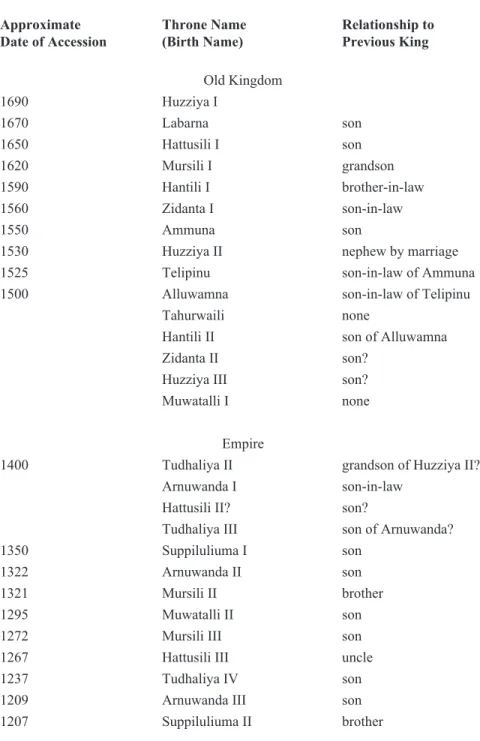
Fig. 2.4 The kings of the Hittites.
Fig. 2.5 Hatti and its vassals in the Late Bronze Age.
Fig. 2.6 A relief carved into a rock face at Firaktin.
Fig. 2.7 The Karabel relief with the figure Tarkasnawa, king of Mira.
Fig. 2.8 The relief of the Sun-God on the “Südburg” monument of Suppiluliuma II.
Fig. 2.9 The Neo-Hittite kingdoms.
Fig. 2.10 Warpalawa king of Tuwana with his personal deity, the Storm-God of the Vineyard.
CHAPTER 3
Fig. 3.1 Tudhaliya IV in the main chamber of the rock sanctuary at Yazılıkaya.
Fig. 3.2 A reconstruction of the citadel at Hattusa.
Fig. 3.3 The extensive storerooms attached to the Great Temple.
Fig. 3.4 A fragment of the Bitik vase showing newlyweds in a bridal chamber.
Fig. 3.5 Orthostat reliefs along the left-hand side of the gate entrance at Alaca Höyük showing a festival procession.
2 10 11
27 34 36 38 47 63 67 74 79 84
96 99 115 125 130
Fig. 3.6 Vase from the vicinity of Inandik depicting a festival cel- ebration.
Fig. 3.7 Ceremonial silver vessel in the form of a fist dating to Tud- haliya II or III.
Fig. 3.8 The “dagger-god” in the small chamber at Yazılıkaya.
Fig. 3.9 Pendant of a womon or goddess wearing a solar headdress.
Fig. 3.10 The Hittite ivory from Megiddo bears a distinctively Hittite composition with cosmic scenes. Courtesy of the Oriental Institute of the University of Chicago.
Fig. 3.11 Hittite clay towers upon which certain Israelite cult stands may have been modeled.
Fig. 3.12 General view of Yazılıkaya’s main chamber.
Fig. 3.13 The central scene of the reliefs at Yazılıkaya, depicting Teshub and Hebat with their entourage.
Fig. 3.14 A Neo-Hittite orthostat relief from Malatya depicting the cosmic battle between the Storm-God and the dragon Illuyanka.
CHAPTER 4
Fig. 4.1 Plans of some of the temples in Hattusa.
Fig. 4.2 A silver stag rhyton with a relief depicting the tutelary deity of the field.
CHAPTER 5
Fig. 5.1 Hittite seal from Megiddo.
132 133 134 135
136 138 139 140
150
161 176
217
AA Archäologischer Anzeiger
AASOR Annual of the American Schools of Oriental Research AB Anchor Bible
ABD Anchor Bible Dictionary
ÄHK Elmar Edel, Die ägyptisch-hethitische Korrespondenz aus Boghazköi in babylonischer und hethitischer Sprache II. 2 vols.
Opladen: Westdeutscher Verlag, 1994.
AJA American Journal of Archaeology ANES Ancient Near Eastern Studies AOAT Alter Orient und Altes Testament AoF Altorientalische Forschungen ArOr Archiv Orientální
AT Alalakh Text
BA Biblical Archaeologist BagMitt Bagdader Mitteilungen BAR Biblical Archaeology Review
BASOR Bulletin of the American Schools of Oriental Research
B.C.E. before the common era
BCSMS Bulletin of the Canadian Society for Mesopotamian Studies BiOr Bibliotheca Orientalis
BN Biblische Notizen
ca. circa
CANE Civilizations of the Ancient Near East. Edited by Jack M. Sasson.
4 vols. New York: Scribner’s Sons, 1995.
CBQ Catholic Biblical Quarterly
CHD The Hittite Dictionary of the Oriental Institute of the University of Chicago. Chicago: The Oriental Institute of the University of Chicago, 1980–.
CHLI I Corpus of Hieroglyphic Luwian Inscriptions, Vol. I: Inscriptions of the Iron Age. 3 vols. Berlin: de Gruyter, 2000.
CHLI II Halet Çambel, Corpus of Hieroglyphic Luwian Inscriptions, Vol.
II: Karatepe-Aslantaş. Berlin: de Gruyter, 1999.
-xiii -
CHM Cahiers d’histoire mondiale
ChS Corpus der hurritischen Sprachdenkmäler CM Cuneiform Monographs
CoS Context of Scripture. Edited by William W. Hallo. 3 vols. Leiden:
Brill, 1997–.
CTH Emmanuel Laroche, Catalogue des textes hittites. Paris: Klincks- ieck, 1971.
d a determinative preceding the name of a Hittite divinity DBH Dresdner Beiträge zur Hethitologie
DMOA Documenta et monumenta Orientis Antiqui
EA El Amarna
ELO Elementa Linguarum Orientis HdO Handbuch der Orientalistik
HED Jaan Puhvel, Hittite Etymological Dictionary. 6 vols. Berlin: de Gruyter, 1984–.
HKM Sedat Alp, Hethitische Keilschrifttafeln aus Maşat. TTKY VI/34.
Ankara: Turk Tarih Kurumu Basımevi, 1991.
IBoT İstanbul Arkeoloji Müzelerinde bulunan Boğazköy Tabletleri. 4 vols. İstanbul: Maarif, 1944, 1947, 1954; Ankara: Türk Tarih Kurumu Basımevi, 1988.
IBS Innsbrucker Beiträge zur Sprachwissenschaft IEJ Israel Exploration Journal
IOS Israel Oriental Studies IstMitt Istanbuler Mitteilungen
JANER Journal of Ancient Near Eastern Religion JAOS Journal of the American Oriental Society JBL Journal of Biblical Literature
JCS Journal of Cuneiform Studies JIES Journal of Indo-European Studies JNES Journal of Near Eastern Studies
JSOT Journal for the Study of the Old Testament
KBo Keilschrifttexte aus Boghazköi. Berlin, Gebr. Mann, 1916–.
KUB Keilschrifturkunden aus Boghazköi. 60 vols. Berlin, Akademie Verlag, 1921–1990.
MAOG Mitteilungen der Altorientalischen Gesellschaft MARI Mari Annales de Recherches Interdisciplinaires MDOG Mitteilungen der Deutschen Orient Gesellschaft
MVAeG Mitteilungen der Vorderasiatisch-ägyptischen Gesellschaft NEA Near Eastern Archaeology
NINO Nederlands Instituut voor het Nabije Oosten NRSV New Revised Standard Version
obv. obverse
OLZ Orientalistische Literaturzeitung Or Orientalia
PEQ Palestine Exploration Quarterly
PIHANS Publication de l’Institut Historique et Archéologique Néerlandais de Stamboul
r. ruled
RA Revue Assyriologique rev. reverse
RGTC VI Giuseppe F. del Monte and Johann Tischler, Repertoire Geographique des Textes Cuneiformes, Band 6: Die Orts- und Gewassernamen der hethitischen Texte. Wiesbaden: Reichert, 1978.
RHA Revue hittite et asianique RlA Reallexikon der Assyriologie
RS Ras Shamra
RSO Ras Shamra-Ougarit
SAOC Studies in Ancient Oriental Civilization SMEA Studi Micenei ed Egeo-Anatolici StBoT Studien zu den Boğazköy-Texten StMed Studia Mediterranea
s.v. sub voce
THeth Texte der Hethiter
TUAT Texte aus der Umwelt des Alten Testaments UF Ugarit-Forschungen
VT Vetus Testamentum WO Die Welt des Orients ZA Zeitschrift für Assyriologie
ZAW Zeitschrift für alttestamentliche Wissenschaft ZDPV Zeitschrift des Deutschen Palästina-vereins
KEYTO TRANSLITERATED WORDS
handandatar Hittite words are indicated by italics.
HAZANNU Akkadian words in a Hittite context are indicated by itali- cized capitals Otherwise, Akkadian words are indicated by lowercase italics
SANGA Sumerian word signs are indicated by capital letters
KEYTO PRONUNCIATIONOF TURKISH LETTERS
c = j ç = ch ı = uh ö = oe ü = ue ş = sh
ExPLANATIONOF SYMBOLS
Single brackets [ ] enclose restorations.
Angle brackets < > enclose words omitted by the original scribe.
Parentheses ( ) enclose additions in the English translation.
A row of dots . . . indicates gaps in the text or untranslatable words.
-1 -
A Brief History of Hittite Studies
WHENARCHITECTANDExPLORER Charles Texier first rode on donkey-back up the rutted road to the ancient ruins near the village of Boghazköy on the high plateau of central Anatolia, Queen Victoria was four years away from ascending the throne of England, Charles Darwin was sailing home on the Beagle, Architect Leo Klenze was beginning restoration of the temples of the Acropolis in Athens, and Sultan Mehmet II was ruling the great Ottoman Empire from his palace in Constantinople. The year was 1834, and at the time no one had heard of a people called the Hittites except through a handful of references in the Hebrew Bible. Texier’s discovery was the first in a series of events that would change all that. On that July day, however, the French- man was not thinking about the biblical Hittites. He was looking for ancient Pteria, a Roman city thought to be located in the vicinity.
DISCOVERY
What he found instead were the ruins of a great city that was not at all Roman.
Texier could not know it at the time, but the great blocks of stone laid out in long, straight rows were the ruins of a monumental temple complex; the miles-long fortification wall interrupted by great carved gates once protected the captial of an empire, and the mysterious and utterly inexplicable reliefs carved into the walls of a broad, rocky outcropping (called Yazılıkaya
“inscribed rock” in Turkish) northeast of the ruins held the key to the religious beliefs of an entire civilization.1 No Roman ruins these, but what and who could account for them? Their like had never been seen before.
1. Texier thought that the scene portrayed a meeting between Amazons and Paphla- gonians. William J. Hamilton, who visited the site a year after Texier, suggested that they portrayed a peace treaty between the Lydians and Persians. See Johan de Roos, “Early Travellers to Boğazköy,” in Studio Historiae Ardens (ed. Theo P. J. van den Hout and
Other travelers followed after Texier, adding to and improving on his observations and rather idealized sketches of the ruins (fig. 1.1).2 One of these was Karl Humann, a trained civil engineer, who in 1882 took casts of some of the Yazılıkaya reliefs, which he sent to the Royal Museum in Berlin, and who produced the first plans of the architectural remains at the site. At the time, Humann was in the middle of his excavations at Roman Pergamon on the west coast of Anatolia, and he would soon travel east to excavate a place called Zincirli (ancient Samal).
But the next major event in this story of rediscovery had already come twelve years earlier, in 1870, when two Americans, Consul J. A. Johnson and Rev. S. Jessup spotted four stones inscribed “with a number of small figures and signs” while strolling through the bazaar at Hama in northern Syria. In fact, one of these stones had already been sighted in 1812 by the legendary
Johan de Roos; Leiden: Nederlands Historisch-Archaeologisch Instituut te Istanbul, 1995), 264.
2. For the story of some of the less-celebrated participants in the rediscovery of the Hittites, see ibid., 261–69. Henry J. van Lennep’s drawings following a visit in 1864 were considerably more accurate.
Fig. 1.1. Charles Texier made extensive, if not entirely true-to-life, drawings of the ruins at Boghazköy. This drawing is of the central vignette carved onto the face of the rock sanctuary called Yazılıkaya today. From Charles Texier, Description de l’Asie Mineure (3 vols.; Paris: Didot, 1839–49). Photo courtesy Pitts Theology Library, Emory Univer- sity, Atlanta, Georgia.
Johann Ludwig (John Lewis) Burckhardt, who spent his short life studying and traveling throughout the Near East as Sheik Ibrahim. His posthumously published Travels in Syria and the Holy Land made mention of a stone embedded in the corner of a building in the Hama bazaar, and he was able to identify the “figures and signs” on the stone as a kind of hieroglyphic writing.3 A year after the two Americans discovered the stones in Hama, another inscribed stone was found in the wall of a mosque in Aleppo. In neither case could the Westerners make a cast or drawing of them, for the locals appeared to revere the stones, attributing to them the power to cure illnesses such as eye disease and rheumatism, and would not let any Westerners approach them. In 1872, an Irish missionary, William Wright, with the support of a more liberal local pasha (governor), had somewhat more success. Wright was able to chisel the stones out of the walls of the buildings, although the effort was plagued by demonstrations on the part of the local population. The stones were shipped to a museum in Constantinople, where Wright took impressions of them and sent the casts to the British Museum.4
Suddenly the hieroglyphic symbols were turning up everywhere, not just in northern Syria, but throughout Anatolia, and it was becoming clear that the inscriptions that Texier and others had encountered at Yazılıkaya were a part of this same script tradition. Comparison of these reliefs with the Hama stones and those that had been found at Karkamis (also spelled Carchem- ish), where excavations had begun in 1878, made it clear that one continuous cultural tradition covered an area from western Anatolia to northern Syria.
In 1879, the English Assyriologist Archibald Henry Sayce visited two reliefs carved into the rock in the region around Smyrna (now Izmir) in western Anatolia (at Akpınar and Karabel). Pausanias had referred to the former as “a petrified mourning Niobe” (Descr. Greece 1.21), in reference to the Greek daughter of Tantalus, who became a symbol of eternal mourning after Apollo and Artemis slew her fourteen children. Herodotus identified the latter as a representation of the Egyptian king Sesostris (Hist. 2.106).
The following year Sayce delivered a lecture before the Society for Biblical Archaeology in London in which he made a connection that seemed at the time as unlikely as it was daring. He announced that the various monuments and inscriptions found scattered throughout Anatolia and northern Syria should be attributed to the “Hittites” mentioned in the Bible.
3. John Lewis [Johann Ludwig] Burckhardt, Travels in Syria and the Holy Land (London: Murray, 1822), 146–47.
4. As of 1953, one set of these casts was in the possession of the Palestine Explo- ration Fund and the other in the hands of the Royal Asiatic Society (R. D. Barnett,
“Karatepe, the Key to the Hittite Hieroglyphs,” AnSt 3 [1953]: 55).
In fact, William Wright had already made this claim two years earlier in a small article, but it was Sayce’s public and provocative announcement that put the Hittites in the headlines throughout England. Wright’s publication in 1884 of the book The Empire of the Hittites, however, was a watershed event because it asserted that the Hittites had ruled an empire and because it established the point at which the field of Hittitology may be said to have begun.
Fortunately, the Egyptian and Akkadian (Assyrian) languages had both by now been deciphered, and the texts written in them provided immediate corroboration for this new theory. The Assyrian texts made repeated mention of a land called “Hatti” (ḫatti), and the Egyptian texts referred to the Ḫt (arbitrarily vocalized Ḫeta by Egyptologists). The identification of the biblical term (ḥittîm, rendered “Hittites” in English) with either the Akkadian or Egyptian forms would not have been obvious to anyone prior to 1880. These Akkadian and Egyptian sources provided a historical context for the Hittites from the fifteenth century B.C.E. through the end of the eighth. Yet they also presented a bit of a problem, for in these accounts the Hittites seemed always to be on the losing side of one battle or another. This simply did not make sense for a kingdom that apparently had ruled such a large area for such a long period of time. Moreover, no one at this time thought to question the assumption that the Hittites’ political center was at Karkamis in northern Syria.
The world did not have to wait long for the next twist in the plot. In 1887, a great diplomatic archive dating to the reign of the heretic king, Akhenaton, was discovered at El Amarna in Egypt. It contained hundreds of diplomatic letters, including one from Suppiluliuma, king of Hatti, which was written in the now-understandable Akkadian language. In addition, there were two letters, also in cuneiform script but in an unknown language, between Tarhundaradu king of Arzawa and Pharaoh Amenhotep III.5 To this language scholars naturally applied the name “Arzawan.” When in 1893 French archaeologist Ernest Chantre made test diggings at Boghazköy and turned up tablets that were also found to be written in this “Arzawan” language, the
“Arzawa problem” became all the more acute.
In 1902, J. A. Knudtzon, a Norwegian scholar who had been working independently on the two “Arzawan” letters from El Amarna as part of his
5. The two letters were an exchange regarding a diplomatic marriage between the pharoah and the daughter of Tarhundaradu. The Egyptian scribe was required to compose the letter in Hittite, presumably because the scribes in Tarhuntaradu’s court were not educated in Akkadian, the diplomatic language of the major powers of the time. Notably, the Egyptian scribe’s knowledge of Hittite was not perfect either (see Frank Starke, “Zur Deutung der Arzaua-Briefstelle VBoT 1, 25–27,” ZA 71 (1982): 221–31).
larger study of the Amarna archive, concluded that the language probably belonged to the Indo-European family of languages.6 The Indo-European family includes most of the major languages spoken in the West today (including the Germanic and Romance languages), as well as the Slavic and Indo-Iranian languages. Knudtzon’s was a remarkable accomplishment, given that his conclusions were based on so little material.7 Owing to this and also to the fact that the syllabic cuneiform script distorted the Indo-European elements of the language almost beyond recognition, his announcement failed to find acceptance among his colleagues. Moreover, the idea that an Indo-European language should have been spoken in the ancient Near East, where Semitic languages clearly dominated, seemed too improbable, and Knudtzon’s announcement was met with such skepticism that he subsequently retracted his claim.
Excavations finally began at Boghazköy in 1906 under the auspices of the German Oriental Society (Deutsche Orient-Gesellschaft [DOG]). It was the capriciousness of politics that gave the concession to dig the site to the Germans rather than the British, who were also set to go. The Deutsche Bank had financed the Berlin-to-Baghdad railroad in 1899, and the Boghazköy concession was a gesture of friendship to the Kaiser, with whose government the Turks were on better terms than they were with the British. This one decision would forever shape the field of Hittite studies, as we will see.
The expedition, conducted under the direction of Hugo Winckler, a German Assyriologist, in collaboration with the seasoned Turkish excavator and government official Theodor Makridi, was focused entirely on the retrieval of tablets. It is fortunate, therefore, that in 1907 the German Archaeological Institute (Deutsches Archäologisches Institut [DAI]) sent Otto Puchstein to map and partially excavate the monumental buildings, especially the fortifications and temples. The young British archaeologist John Garstang stopped at Boghazköy that same year during his travels through Turkey. Although little archaeological work had actually been carried out in Anatolia up to that time, he was able to publish an exhaustive survey of the landscape and visible material remains in The Land of the Hittites:
An Account of Recent Explorations and Discoveries in Asia Minor (London:
6. EA 31 and 32. J. A. Knudtzon, Die Zwei Arzawa Briefe: Die ältesten Urkunden in Indogermanischer Sprache (Leipzig: Hinrichs, 1902). His conclusions were enthusiastically supported by two prominent linguists and colleagues, Alf Torp and Sophus Bugge, who contributed commentaries to the 1902 publication. Knudtzon also correctly concluded that Arzawa must have been located in Anatolia (p. 28).
7. Petr Vavroušek, “Zur Geschichte der Lösung des hethitischen Problems,” ArOr 47 (1979): 69.
Constable, 1910). This volume represents the first attempt to synthesize the documents and monuments in a comprehensive picture of the Hittite Empire.
By the same token, before the language of the tablets had been deciphered, prominent historian Eduard Meyer was able to write his Reich und Kultur der Chetiter (Berlin: Curtius, 1914), based purely on the evidence of the Akkadian documents from Boghazköy.
Winckler was by all accounts a disagreeable character whose approach to excavation would not redeem him in the eyes of posterity.8 His interest in excavating Boghazköy was to find tablets, and this he did in the very first year, extracting from the ground some 10,400 clay fragments. It was an incredible discovery and achievement, but it came at great cost to subsequent scholarship. No notes were taken of the find spots of the tablets, information that might have been used to learn about the organization of the libraries and the relationship of the various documents with one another.9 Worse, since little care was taken in the retrieval of the tablets from the ground, many were broken into pieces, and many more that were deemed too fragmentary to be of interest were dumped into a heap. Even by the standards of the day, these techniques were dubious.
This assault on scholarship was nevertheless overshadowed by the significance of the finds. Among the tablets recovered in that first year was an Akkadian-language clay copy of the very treaty between the Egyptians and the Hittites that was inscribed on the walls at Karnak in Egypt. The presence of so many texts in the diplomatic language of the period led Winckler to the correct conclusion that Boghazköy, not Karkamis, was the captial of the Hittite civilization.10 Although Winckler could read these Akkadian texts, the majority of the tablets were inscribed in the still-unknown Hittite language.
Although Winckler was making important strides toward its decipherment at the time of his death in April 1913, he did not live to see either the excavations at Boghazköy brought to an abrupt halt in 1914 or the announcement in 1915 of the definitive decipherment of the language of the Hittites.11
8. For Winckler’s own account of these events, see the posthumously published Nach Boghazköi! (Leipzig: Hinrichs, 1914).
9. On the possibility that the find spots were recorded only to be lost later, see Theo van den Hout, “Another View of Hittite Literature,” in Anatolia Antica: Studi in Memoria di Fiorella Imparati (ed. Stefano De Martino and Franca Pecchioli Daddi; 2 vols.; Eothen 11; Firenze: LoGisma, 2002), 2:859 n. 5.
10. In fact, credit for the identification of the capital of the Hittites rightfully belongs to Georges Perrot, who expressed his preference for Boghazköy over Karkamis in an article in 1886. See de Roos, “Early Travellers,” 269.
11. Winckler’s papers contained references to years of work on the deciphering
DECIPHERMENT
The important contributions of Wright, Sayce, and Winkler notwithstanding, the honor of the title “father of Hittitology” must go to the Czech Assyriologist Friedrich Hrozný, who finally deciphered the language of the Hittites.12 For his research, Hrozný, a young professor at the University of Vienna, was able to utilize the wealth of tablets that Winckler had uncovered at Boghazköy, which the German Oriental Society had now made available for study. Although drafted into the Austro-Hungarian army, he had the good fortune to have an understanding superior officer who allowed him to continue his work, and he was even given the opportunity to travel to Constantinople to study the Hittite tablets there. In a 1915 article entitled
“The Solution to the Hittite Problem,” which he wrote and published while in the service, Hrozný vindicated Knudtzon by asserting that the language of the Hittite Empire was, after all, Indo-European.13 The centerpiece of Hrozný’s lecture before the German Oriental Society that year was the Hittite sentence + |( ÕBvŸ’ *j‚` Õ^)¸’ (nu NINDA-an ēzzatteni wātar-ma ekutteni). The sign NINDA was an ideogram for bread; this much Hrozný knew from Akkadian cuneiform. Hrozný guessed that the following word, ezzatteni, might be a form of the verb “eat,” and so he looked, and found, cognates for it in other Indo-European languages (compare, for example, German essen and Latin edō). The next word, watar, bore an undeniable resemblance to English water, German Wasser, and so on. Recognizing that the suffix -teni at the end of both verbs suggested a second-person plural form, Hrozný was able to offer a translation: “Then you will eat bread and
of “cuneiform Hittite.” In a postcard dated 26 December 1907, Winckler was already aware that the language of the Boghazköy tablets must be Indo-European (Horst Klengel, Geschichte des hethitischen Reiches [HdO 34; Leiden: Brill, 1999], 8 n. 20). According to Hrozný’s main rival, Ernst Weidner, in his review of Hrozný’s work (OLZ [1920]:
114–20), Winckler destroyed his notes before he died.
12. The story of the decipherment is recounted in various useful sources. See in particular Gary Beckman, “The Hittite Language and Its Decipherment,” BCSMS 31 (1996): 23–30; C. W. Ceram, The Secret of the Hittites: The Discovery of an Ancient Empire (New York: Knopf, 1956; repr., London: Phoenix, 2001); Johannes Friedrich,
“Die bisherigen Ergebnisse der hethitischen Sprachforschung,” in Stand und Aufgaben der Sprachwissenschaft (Heidelberg: Winter, 1924), 304–18; Petr Vavroušek, “Zur Geschichte der Lösung des hethitischen Problems,” 67–77.
13. Hrozný was motivated to publish the article because he was not the only one working on the problem. His main competitor, Ernst Weidner, however, was on the wrong track. In his Studien zur hethitischen Sprachwissenschaft (Leipzig: Hinrichs, 1917), he concluded that Hittite was a Caucasian language.
you will drink water.”14 C. W. Ceram summed up this momentous discovery with his characteristic expressiveness: “How staggering it is to realize that with three thousand years intervening, a Frisian living on the North Sea coast of Germany and a Pennsylvania Dutchman of eastern North America would understand a Hittite’s cry of thirst!”15
Hrozný followed his preliminary article with a book in 1917 that served as the first systematic study of Hittite grammar and remained the standard work on the subject for years.16 Despite the conclusiveness of his decipherment, the old preconceptions that did not allow for the possibility of an Indo-European presence in biblical lands stayed alive for another decade.17 It simply did not fit the picture that historians had drawn up to that point. Moreover, the identification of the Hittites as Indo-Europeans forced upon the scientific community a revision of the racial assumptions that had settled in on the basis of the rock reliefs. Viewed through some eyes, the reliefs had provided visual evidence that the Hittites were an “ugly” people
“with yellow skins and ‘Mongoloid’ features,” with “receding foreheads, oblique eyes, and protruding upper jaws.”18 Still, the incontrovertable nature of the evidence soon silenced critics, and progress on the language from that point was swift.
Hittite studies in this period were carried by five scholars in Germany:
Hans Ehelolf (Berlin), Emil Forrer (Berlin), Johannes Friedrich (Leipzig), Albrecht Goetze (Heidelberg and Marburg), and Ferdinand Sommer (Munich). The United States had Edgar Sturtevant (Yale University), and France had Louis Delaporte, editor of Revue hittite et asianique, who, tragically, would later die in a German concentration camp. By 1930, many historical texts had been translated in German editions that were accurate enough that they are still referenced today. These publications also set a
14. Hrozný wrote his own retrospective on the decipherment in 1931: “Le Hittite:
Histoire et progrès du déchiffrement des textes,” ArOr 3 (1931): 272–95.
15. Ceram, Secret of the Hittites, 86.
16. Friedrich Hrozný, “Die Lösung des hethitischen Problems,” MDOG 56 (1915): 17–50; idem, Die Sprache der Hethiter: Ihr Bau und ihre Zugehörigkeit zum indogermanischen Sprachstamm (Leipzig: Hinrichs, 1917). Hrozný also concluded that Hittite belonged to the western (centum) branch of Indo-European and thus was more closely related to Greek and Latin, for example, than to Sanskrit and Old Persian.
17. E. O. Forrer, “The Hittites in Palestine I,” PEQ (1936): 191–92. Hrozný’s work would also come under fire from linguists, since he had made many errors in individual examples of word relations (Vavroušek, “Zur Geschichte der Lösung des hethitischen Problems,” 72).
18. Archibald Henry Sayce, The Hittites: The Story of a Forgotten Empire (2nd ed.;
London: Religious Tract Society, 1890), 15.
standard for scholarly rigor against which all subsequent philological studies have been measured.
Even while understanding of the Hittite cuneiform texts was advancing in leaps and bounds, the struggle to unravel the mystery of the hieroglyphs dragged on with painful slowness. Hrozný had been aided by his ability to apply phonological values to the cuneiform signs in which the Hittite texts were written. This allowed philologists to look for familiar word formations and grammatical usage. It also helped that the Hittite scribes divided words and paragraphs, something that we take for granted today but that was by no means typical in ancient scribal traditions. Although most assumed the language behind the hieroglyphs was Hittite or a language closely related to it, the values of the signs were at first completely unknown. As a result, the process of decipherment, which had begun with Sayce thirty years before the decipherment of cuneiform Hittite, continued for decades and required the input of many of the best minds in the field.
Before decipherment could even begin, it was necessary first to establish the direction of the writing, whether the script was logographic, syllabic, or alphabetic, and whether it used determinatives (word signs that classify the following word, e.g., man, woman, city, stone, god). Investigators correctly determined that the direction of the writing alternated from line to line, that is, it was meant to be read bustrophedon (“as the ox plows”), a conclusion that was arrived at on the assumption that the signs must face the direction from which the particular line was to be read (fig. 1.2). The identification of about one hundred distinct signs (at the time) pointed to a syllabary, as an alphabet would require many fewer signs and a purely logographic script would have many more. In addition to syllabic signs, the script also used logograms and determinatives.
Beyond these insights, decades would pass with little progress. Not even the so-called Tarkondemos seal, which was inscribed both with cuneiform and hieroglyphs and thus was a possible bilingual, had offered additional insights into the script (fig. 1.3).19 At the beginning of the century, Leopold Messerschmidt had published a corpus of hieroglyphic inscriptions that comprised a total of sixty-one texts as well as a number of seals and epigraphs.20 The British Museum excavations at Karkamis from 1911 to
19. J. David Hawkins and Anna Morpurgo-Davies, “Of Donkeys, Mules and Tarkondemos,” in Mír Curad: Studies in Honor of Calvert Watkins (ed. Jay Jasanoff, H. Craig Melchert and Lisi Oliver; IBS 92; Innsbruck: Institut für Sprachwissenschaft der Universität Innsbruck, 1998), 243–60.
20. Leopold Messerschmidt, Corpus Inscriptionum Hettiticarum (4 parts; MVAeG 5/4–5, 7/3, 11/5; Berlin: Peiser, 1900–1906): see parts 1–2:113–60 and parts 3 and 4.
1914 under the direction of D. G. Hogarth, Sir Leonard Woolley, and T. E.
Lawrence (Lawrence of Arabia) increased the number of known inscriptions considerably. Nevertheless, by the 1920s, the field could not boast of making significant inroads into the decipherment of the hieroglyphs, other than the identification of a few place names made possible with the help of Assyrian records.
Fig. 1.2. A section of hieroglyphs from Karkamis containing a dedicatory inscription by Katuwa (tenth or early-ninth century). KARKAMIS A13d.
From Sir Leonard Woolley, Carchemish II: The Town Defences (London:
British Museum, 1921).
Fortunately, the new generation of scholars was ready to tackle the problem of the hieroglyphs. In 1919, Swiss Assyriologist Emil Forrer had realized that there were more languages represented in the cuneiform texts from Boghazköy than just Hittite and Akkadian. Among the eight languages he identified was one that was introduced in the texts as luwili
“in Luwian.”21 In 1932 the Italian scholar Piero Meriggi observed that the
21. Emil Forrer, “Die acht Sprachen der Boghazköi Inschriften,” Sitzungsberichte Fig. 1.3. Archibald Sayce went to great pains to track down the so-called Tarkon- demos seal in the hopes that it would provide the key to the decipherment of the hieroglyphs. Unfortunately, the seal’s short inscription had until recently proved resistant to interpretation. Sayce had managed at least to identify the signs for
“god,” “king,” “city,” and “country.” He read the seal “Tar-rik-tim-me šar mat Er-me-e.” We now read the inscription on the seal as follows: TARKASNA-wa LUGAL KURURUMe-ra!-a! “Tarkasnawa, king of the land of Mira” (Hawkins and Morpurgo-Davies, “Of Donkeys, Mules and Tarkondemos,” 243–60). Photo courtesy of the Walters Art Gallery, Baltimore.
language of the Hittite hieroglyphs was more closely related to the Luwian of the cuneiform texts than to Hittite, and he applied the label “Luwian hieroglyphs” for the first time.22 Forrer and Ignace J. Gelb, the latter at The Oriental Institute of the University of Chicago, devoted considerable energy to their decipherment, and both presented their results in 1931 at a congress in Leiden. Even Hrozný attempted to repeat his past success, although with less spectacular results. Also dedicating himself to these efforts was Helmuth Theodor Bossert, the man who would eventually provide the critical piece in the decipherment.23 The combined efforts of these scholars resulted in basic agreement on the syllabic values of some fifty-five signs and on the meanings of many logograms and determinatives.24
The next break would come when excavations were resumed at the Hittite capital in 1931 under the auspices of the DAI and the DOG. Much had changed since World War I. Turkey was now a republic. The Oriental Institute of the University of Chicago had already begun excavations at Alişar Höyük in central Anatolia (1927–32), another site with Late Bronze Age remains, under the direction of the young German archaeologist Hans Henning von der Osten. The DAI chose Kurt Bittel to direct the renewed excavations at Boghazköy, his mission being to establish the stratigraphy of the site, something that had not been accomplished during Winckler’s excavations. When it soon became clear that the flow of tablets from the ground was destined to continue, Hans G. Güterbock, a student of Friedrich in Leipzig, was invited to join the staff as epigrapher in 1933.25 Güterbock, whose father was of Jewish heritage, had been denied a position at the Berlin Museum working under Hans Ehelolf but was allowed by the Istanbul branch of the DAI to participate in the German excavation. So in 1933, Güterbock began an exile that would eventually take him to The Oriental Institute of the University of Chicago.
der Preussischen Akademie der Wissenschaften, phil.-hist. Klasse 53 (1919): 1029–41.
This brief summary cannot do justice to the contributions of Emil Forrer to the field of Hittitology. For an entertaining account of Forrer’s insights, see Johannes Lehmann, The Hittites: People of a Thousand Gods (New York: Viking, 1975), 85–93.
22. Piero Meriggi, “Sur le déchiffrement et la langue des hiéroglyphes ‘hittites,’ ” RHA 9 (1932): 1–57.
23. His early contributions to the decipherment are summed up in Šantaš und Kupapa (MAOG 6.3; Leipzig: Harrassowitz, 1932).
24. J. D. Hawkins, Anna Morpurgo-Davies, and Günter Neumann, Hittite Hieroglyphs and Luwian: New Evidence for the Connection (Göttingen: Vandenhoeck &
Ruprecht, 1974), 148.
25. See Güterbock’s retrospective, “Resurrecting the Hittites,” in CANE, 2765–76.
In 1935, the excavations uncovered some two hundred bullae (lumps of clay stamped with a seal used to identify and secure consignments) from a storage room, many of them containing text in both hieroglyphs and cuneiform, others only in hieroglyphs. With the arrival of two new epigraphers on the scene, Hans Ehelolf and Heinrich Otten, Güterbock had to leave the excavation, and in 1936 he took a position at the new university in Ankara. As he no longer had access to the cuneiform tablets from the current excavation, he set to work cataloguing and analyzing the seals. These miniature bilinguals allowed him to identify the hieroglyphic names of kings, which could then be matched with the same names appearing on rock reliefs scattered about Anatolia.
Finally, in 1946, Bossert and Halet Çambel discovered the long-hoped- for bilingual at Karatepe in the mountainous Adana region of southeastern Anatolia. The text was written in Phoenician and Luwian hieroglyphic and was inscribed on the stone blocks that formed the monumental gateway of a late-eighth-century B.C.E. fortress.26 It remains the longest inscription in either language yet found27 and confirmed many of the readings and mean- ings of individual signs that had been proposed previously and allowed the assignment of values to many more. However, many signs to which incor- rect values had been applied slipped through the corrective net, and, despite the best efforts of three generations of scholars, the decipherment remained incomplete. Nevertheless, the new information obtained from the bilingual was utilized by the French scholar Emmanuel Laroche in 1960 in a new sys- tematic sign list.28 This was quickly followed by Piero Meriggi’s glossary and grammatical analysis,29 and both works remain fundamental resources to this day.
The final step in the decipherment came only in 1974 with the publication of an article by J. D. Hawkins, Anna Morpurgo Davies, and Günter Neumann that corrected a number of readings for some common syllabic signs.30 These new readings significantly revised the reconstruction of the language. It is now generally accepted that the language of the hieroglyphs, which were in use from the fifteenth century B.C.E. until the end of the eighth, is Luwian, but a form of Luwian distinct in certain respects from that which Forrer first
26. This is the same region (Cilicia) with which King Solomon had trade relations, according to 1 Kgs 10:29 and 2 Chr 1:17; see also R. D. Barnett, “Karatepe, the Key to the Hittite Hieroglyphs,” 88.
27. The definitive edition of the Karatepe bilingual is Halet Çambel, CHLI II.
28. Les hiéroglyphes hittites, Première partie, L’écriture (Paris: CNRS, 1960).
29. Hieroglyphisch-Hethitisches Glossar (Wiesbaden: Harrassowitz, 1962).
30. Hittite Hieroglyphs and Luwian, 145–97.
identified in the cuneiform documents. Exactly how these two “dialects,” as they are often referred to, relate to one another spatially and temporally is still far from clear.31 Nor can we yet answer satisfactorily the question why the Hittite Empire felt it needed two distinct scripts, although a new theory suggests that the Hittite monarchy, increasingly in competition with Egypt and Mesopotamia for political domination, may have been motivated by a desire to have a writing system that was uniquely Anatolian.32
THE STORY UNFOLDS
The Boghazköy archives have produced more than thirty thousand cuneiform tablet fragments, and the enormous task of publishing copies of these documents is only now coming to a conclusion. The more than ten thousand tablets excavated by Theodor Makridi and Hugo Winckler were sent to Berlin for conservation and study by agreement between Otto Weber, the director of the Near Eastern Department of the Berlin Museum, and Halil Edhem, the director of the Istanbul Museum. These tablets provided the contents for the first six volumes of Keilschrifttexte aus Boghazköi (Cuneiform Texts from Boghazköy), published by the German Oriental Society, but this series was discontinued when Hans Ehelolf, as curator of the tablets in the Berlin Museum, initiated a new series, Keilschrifturkunden aus Boghazköi (Cuneiform Documents from Boghazköy), which began publication in 1921.33 According to the agreement between Berlin and Istanbul, the tablets were to be returned to Turkey once published; however, by 1942, fewer than three thousand had been returned. More than seven hundred of those that were returned had not yet been published in KUB, and those make up the content of the Istanbul Arkeoloji Müzelerinde Bulunan Boghazköy Tabletleri (Boghazköy Tablets in the Archaeological Museums of Istanbul) published
31. H. Craig Melchert, “Language,” in The Luwians (ed. H. Craig Melchert; HdO 1/68; Leiden: Brill, 2004), 171.
32. Annick Payne, “Writing Systems and Identity,” in Anatolian Interfaces: Hittites, Greeks and Their Neighbors. Proceedings of an International Conference on Cross- Cultural Interaction, September 17–19, 2004, Emory University, Atlanta, GA (ed. Billie Jean Collins, Mary Bachvarova, and Ian C. Rutherford; Oxford: Oxbow, forthcoming).
33. Ehelolf himself published most of the early volumes in the series. For a personal account of his work, see Hans Gustav Güterbock, “Hans Ehelolf und das Berliner Boğazköy-Archiv,” Das Altertum 33 (1987): 114–20. For a history of the Berlin archive, see Horst Klengel, “Das Berliner Boğazköy-Archiv: Geschichte und Textedition,” in Ägypten, Vorderasien, Turfan: Probleme der Edition und Bearbeitung altorientalischer Handschriften (ed. Horst Klengel and Werner Sunderman; Berlin: Akademie, 1991), 73–81.
by Muazzez Çığ (1944, 1947, 1954) and Mustafa Eren (1988). The other approximately 7,400 Istanbul tablets remained in Berlin until 1989, when East Germany returned them, published or not, to Ankara. Some unpublished texts remain. The KUB series completed publication in 1990 with a total of sixty volumes.
The tablets found in the 1931–33 campaigns led by Bittel were also sent to Berlin and published in KUB. To accomodate the tablets found in the postwar excavations, the old series KBo was revived under the direction of Otten, epigrapher for the Boghazköy excavations. The first volume in this series had been published in 1916, while the most recent volume (57) appeared in 2007. Most of the published cuneiform texts have been translated and analyzed in one form or another, although few are published in a form or venue that is accessible to a nonspecialist audience. The entire Iron Age hieroglyphic corpus, on the other hand, is now available, thanks to the massive three-volume undertaking, The Corpus of Hieroglyphic Luwian Inscriptions, by J. David Hawkins of the School of Oriental and African Studies, University of London. Although Germany still leads the way in the study of cuneiform Hittite, the field today is truly international. Scholars not only in Germany, England, and the United States but also in the Netherlands, Italy, France, Israel, Japan, and, of course, Turkey are now engaged in this important work.
Much remains to be done, and the work of reconstructing the language, culture, and history of this fascinating people continues. The last few decades have seen significant new discoveries, and although they cannot match the excitement of those early revelations, they are nevertheless spectacular in their own right. While Hittitology continues to be a dynamic and evolving field of study, it is nevertheless still a relatively young and relatively small field, and it continues to struggle to gain a firm foothold in academe.
The story of the decipherment of the hieroglyphs provides a vivid testimonial to the importance of combining philology (the study of texts) and archaeology in reconstructing past languages, history, and culture.
Archaeology has provided some of the most important inroads in recent years. Not least significant have been new discoveries at the Hittite capital.
Political events had brought the excavations at Boghazköy to a halt in 1939, and they did not reopen until 1952. Archaeologists have been excavating continually ever since, initially under the direction of Kurt Bittel (1952–77), followed by Peter Neve (1978–93) and Jürgen Seeher (1994–present). To date, a total of thirty temples have been excavated in the Upper City (fig. 2.2), and it is becoming apparent that the Hittite capital was above all a religious and ceremonial center. The discovery of a sacred pool complex and the restoration of its two associated vaulted chambers, one with a well-preserved
hieroglyphic inscription that records a military campaigns of the last Hittite king, Suppiluliuma II, from whose reign few records survive, provide valuable information about both the history and the religion of the Hittites. Further, the 1990 season turned up more than three thousand bullae in a “seal archive”
located in the cellar of a building to the north of the rocky outcrop called Nişantaş, situated opposite the citadel. Typically stamped with the official seal of the Hittite kings or their officials, these bullae have provided valuable information about the genealogy of members of the Hittite ruling family.
Currently the excavations are focused on two goals. The discovery of a major food storage and redistribution center on the rock summit known as Büyükkaya in the lower town has encouraged investigators to focus on the economic basis of the city as one major goal. The second focus is the new excavations (since 2001) in the western part of the Upper City in the valley west of the rock of Sarıkale, which may provide evidence of the elusive residential quarter. One major challenge remaining for excavators is to find a royal tomb.
Outside of the Hittite capital, new excavations along the Aegean and Mediterranean coasts are yielding data relating to the Late Bronze Age;
even the Black Sea area, historically an archaeological “no man’s land,” is now being surveyed. Information from these “peripheral” areas should shed light on the relationship of the Hittites with their Anatolian neighbors. Sites in the Hittite heartland that had been subjected to “premodern” excavations have recently undergone new study. These include Alişar, Atchana (ancient Alalakh), and Karatepe (ancient Azatiwadaya). For other key sites, such as Karkamis (modern Jerablus) and Alaca Höyük,34 we must impatiently await future excavation. The rock monuments at Gavurkalesi,35 Sirkeli,36 and Eflatun Pinar have also recently been excavated, with surprising results.
Most dramatic has been the identification and excavation of several Hittite regional centers with cuneiform archives of their own: Maşat (ancient Tapikka), an administrative center northeast of Hattusa; Ortaköy
34. Excavated by the Turkish Historical Society in the 1930s under the direction of Hamit Z. Koşay, work is once again underway under the direction of Aykut Çınaroğlu.
35. See, e.g., Stephen Lumsden, “Gavurkalesi: Investigations at a Hittite Sacred Place,” in Recent Developments in Hittite Archaeology and History (ed. K. Aslihan Yener and Harry A. Hoffner Jr; Winona Lake, Ind.: Eisenbrauns, 2002), 111–25.
36. Barthel Hrouda, “Vorläufiger Bericht über die Ausgrabungsergebnisse auf dem Sirkelihöyük Südtürkei von 1992–1995,” Kazı Sonuçları Toplantısı 18 (1997): 291–312;
H. Ehringhaus, “Hethitisches Felsrelief der Grossreichszeit Entdeckt,” Antike Welt 26/1 (1995): 66; idem, “Ein neues hethitisches Felsrelief am Sirkeli Höyük in der Çukurova,”
Antike Welt 26/2 (1995) 118–19.
(ancient Sapinuwa), southeast of Hattusa; and Kuşaklı (ancient Sarissa), a religious center southeast of Hattusa. These archives stored letters, land grants, inventories of goods and personnel, and religious and cultic texts.37 Ortaköy, which once served as a royal residence, is the most substantial of these, having produced a cache of more than three thousand tablets.38 Their publication will provide valuable information about Hittite regional administration. Other sites with Hittite-period occupations that have recently undergone excavation are Çadır and Kaman-Kale in central Turkey, Kinet (Issos) in the Hatay, and Mersin and the mound at Sirkeli (adjacent to the rock reliefs mentioned above) in Cilicia. The excavators of Sirkeli propose an identification with Hittite Lawazantiya, the Kizzuwatnean city in which King Hattusili III took Puduhepa as his queen (see ch. 2).39 Finally, the recent discovery of a hieroglyphic inscription adjacent to a massive fortified Late Bronze Age site at Hatip near Konya has raised hopes of finding the Hittites’ second capital, Tarhuntassa, and the archives it no doubt possessed (see ch. 2).40
Although the quality of the style of art showcased on the Hittite rock reliefs is difficult to defend when set beside the magnificent works of art from Egypt and Mesopotamia, it has the advantage, at least, of being original.
The style of the reliefs cannot be attributed to poorly trained artists, as the Hittites also produced undeniably exquisite works of art, including rhyta (animal-shaped vessels) and other ceremonial vessels, but appears rather to have been a matter of taste. Hittite art has also revealed some surprises of its own. A vase that has recently come to light in the vicinity of Hüseyindede bears a relief decoration that points to an Anatolian origin for the “sport” of bull-leaping well known from Minoan Crete.41 In addition, the Boghazköy excavations recently revealed that the walls of at least one temple (Temple 9)
37. Trevor R. Bryce, “The Hittites—Discoveries and Ongoing Research,” History Compass (2004). Online (by subscription): http://www.blackwell-compass.com/subject/
history/article_view?highlight_query=Trevor+Bryce&type=std&slop=0&fuzzy=0.5&
last_results=query%3DTrevor%2BBryce%26submit%3DGo%26content_types%3Dcja&
parent=void&sortby=relevance&offset=0&article_id=hico_articles_bsl072.
38. Aygül Süel, “Ortaköy-Šapinuwa,” in Yener and Hoffner, Recent Developments in Hittite Archaeology and History, 157–65.
39. See http://www.sirkeli-project.info/en/index.html.
40. Ali M. Dinçol, “Die Entdeckung des Felsmonuments in Hatip und ihre Auswirkungen über die historischen und geographischen Fragen des Hethiterreiches,”
TÜBA-AR 1 (1998): 27–34.
41. Piotr Taracha, “Bull-Leaping on a Hittite Vase: New Light on Anatolian and Minoan Religion,” Archeologia 53 (2002): 7–20.
in the Upper City were covered with colorful paintings, which points either to unexpected versatility on the part of Hittite artists or to the presence of foreign (Mycenaean?) artists in the Hittite capital.42
In 1929, Garstang wrote, “no one can claim to the satisfaction of the others to have made much progress as regards the position, grouping, and organization of the central Hittite states.”43 Indeed, until recently, few historians held out hope that the complex geography of the Hittite Empire could be sorted out. Locating the geographical position of the Hittites’
political dependencies in Anatolia with any precision was daunting enough, but the cuneiform documents refer to hundreds of towns and villages under Hittite control, and locating them precisely seemed an impossible task. Nevertheless, significant progress has been made, again thanks to a combination of philological and archaeological detective work. For example, the discovery of an inscription of Tudhaliya IV in Yalburt allowed scholars to pinpoint towns in the southwest of Anatolia. In addition, the decipherment of the inscription of a local king at Karabel has led to the identification of Ephesos (Hittite Apasa, modern Selçuk) as the captial of ancient Arzawa, an identification that is now confirmed by an analysis of the composition of the clay of one of the Arzawa letters from the El Amarna archive.44
No less productive are the advances that have been made in archaeological techniques and data-handling methods. Geophysical prospecting, the use of computer-aided research, paleo-zoological and environmental research, improved dating methods, and analysis of exchange networks are improving the quality of our information about Anatolia’s past.
A NOTEON CHRONOLOGY
The greatest challenge still facing historians is to establish an absolute chronology for second-millennium Anatolia. The surviving records of the Hittite administration make no use of a formal system for reckoning the passing of the years. Royal annals track the annual campaigns of individual kings, but these are not assigned to a specific regnal year and do not provide the total length of a given reign.45 Nor do the Hittite “king lists” help, as these
42. The wall paintings are currently undergoing study, which hopefully will deter- mine whether Mycenaean or Anatolian artists were responsible for them.
43. John Garstang, The Hittite Empire: Being a Survey of the History, Geography and Monuments of Hittite Asia Minor and Syria (London: Constable, 1929), viii.
44. See Sanna Aro, “Art and Architecture,” in Melchert, The Luwians, 286.
45. For example, it has recently been proposed that the long forty-year reign of Sup- piluliuma I should be reduced to about half; see G. Wilhelm and J. Boese, “Absolute
were compiled for the purpose of recording the sacrificial rations for the royal ancestor cult and are inaccurate and unreliable as tools for reconstructing a workable chronology. We can only assume that a civilization as complex as that of the Hittites had such a system. Perhaps the wooden tablets used for economic documents employed a system of year reckoning, but if so, it is permanently lost to us.46
For Hittite history, absolute dates are few and are dependent primarily on synchronisms with events in Mesopotamia and Egypt. Thus, for example, following the so-called Middle Chronology favored by most Hittitologists, we know that Mursili I brought an end to the dynasty of Hammurabi in 1595
B.C.E., that the battle of Qadesh was fought in the fifth year of Ramesses II (1274 B.C.E.), and that Tudhaliya IV fought the battle of Nihriya in the first few years of the reign of Tukulti-ninurta (r. 1233–1197 B.C.E.). In addition to such synchronisms, a prayer of Mursili II reports a solar omen that occurred while the king was on campaign in the land of Azzi in his ninth or tenth year.
If this omen was a solar eclipse, then we are able to calculate that Mursili II celebrated his tenth year as king in 1311 B.C.E. It is important to remember that even these dates are provisional and will continue to shift as the abso- lute chronological framework for the entire ancient Near East continues to be refined. For example, an attempt has been made recently, based on pot- tery analysis, to lower the date of Mursili’s attack on Babylon to 1499.47 This would require compressing Hittite history by about one hundred years, a revision that the Hittite evidence does not easily support.48
Although the few absolute dates available to us provide some important anchors for Hittite history, the reconstruction of the sequence of Hittite kings and the length of their reigns is still mostly educated guesswork. As a result, for most of Hittite history we must be satisfied with a relative chronology, that is, the reconstruction of the sequence in which a particular set of events occurred. Analysis of the paleography of the cuneiform tablets—the changes over time in the style of expression, duktus (handwriting), grammar, and orthography—has allowed us to date particular compositions to within a
Chronologie und die hethitische Geschichte des 15. und 14. Jahrhunderts v. Chr.” in High, Middle or Low? Acts of an International Colloquium on Absolute Chronology Held at the University of Gothenburg, 20th–22nd August 1987 (ed. Paul Åström; Gothenberg:
Åströms, 1987), 74–117.
46. Gary Beckman, “Hittite Chronology,” Akkakdica 119–120 (2000): 20.
47. H. Gasche, J. A. Armstrong, S. W. Cole, and V. G. Gurzadyan, Dating the Fall of Babylon: A Reappraisal of Second-Millennium Chronology (Chicago: The Oriental Institute of the University of Chicago, 1998).
48. See Beckman, “Hittite Chronology,” 25.
fifty-year period, providing a relative chronology for most of Hittite history.
But only when absolute dates—the pinpointing of an event to a particular moment in time—are known are we able to anchor the tablets and the events they describe in a precise chronological and historical context.
New investigations at Boghazköy-Hattusa have provided an absolute chronological framework for the second half of the second millennium that will be important for applying absolute dates to future finds as well as allow- ing precise dating of the architecture of the Hittite capital.49 In addition, Cornell University’s dendrochronology project is on the verge of establishing an unbroken tree-ring sequence for central Anatolia. When the sequence is complete, the tables will turn and Anatolia will provide the master chronology according to which the historical chronologies of Mesopotamia and Egypt will be calibrated.50
49. Ulf-Dietrich Schoop and Jürgen Seeher, “Absolute Chronologie in Boğazköy- Ḫattuša: Das Potential der Radiokarbondaten,” in Strukturierung und Datierung in der hethitischen Archäologie (ed. D. P. Mielke, U.-D. Schoop, and J. Seeher; BYZAS 4;
Istanbul: Veröffentlichungen des Deutschen Archäologischen Instituts Istanbul, 2006), 53–75.
50. Colin Renfrew, “Kings, Tree Rings and the Old World,” Nature 381 (1996):
733–34.