A THESIS
Submitted to the faculty of training and education Muhammadiyah university of Makassar in partial fulfillment of the requirement for the degree of education in
English department
SRI AINUN MAWADDAH 105351100916
ENGLISH EDUCATION DEPARTMENT
TEACHER TRAINING AND EDUCATION FACULTY MUHAMMADIYAH UNIVERSITY OF MAKASSAR
2021
iii
iv
vii MOTTO
“THE BEST WORD THAT YOU HAVE IS A LIMITLESS PATIENCE.”
I dedicated this thesis:
to my beloved parents
My beloved family
And all the people who love me
viii ABSTRACT
SRI AINUN MAWADDAH 2021. A thesis “The Impact of Using Schoology to Improve Students Writing Skill ( A Pre-Experimental Research Design at The Eleventh Grade of MAN Selayar) supervised by Syamsiarna Nappu and Junaid.
The objective of this research is to find out the improvement of students’
writing skill in term of content and organization using Schoology. The research method was pre-experimental design which employed one class the subject was The XI grade students of MAN Selayar that was purposively chosen. To collect the data, .pre and post tests were used
The finding showed that students’ writing skill in term of content and organization got improvement. It was seen by the mean score of pre-test in content was 80.43 become 84.73 while the pre-test in Organization was 70.46 become 76.53 in the post test. This indicates that the use of Schoology improve students writing skill in term of content and organization.
Keywords: Schoology, Writing, Narrative Text
ix ABSTRACT
SRI AINUN MAWADDAH 2021. Skripsi “Dampak Penggunaan Schoology untuk Meningkatkan Keterampilan Menulis Siswa (Rancangan Penelitian Pra Eksperimen pada Kelas XI MAN Selayar) dibimbing oleh Syamsiarna Nappu. dan Junaid.
Tujuan dari penelitian ini adalah untuk mengetahui peningkatan keterampilan menulis siswa ditinjau dari isi dan pengorganisasian menggunakan Schoology.
Metode penelitian yang digunakan adalah pra-eksperimental design dengan satu kelas. Subjek penelitian ini adalah siswa kelas XI MAN Selayar yang dipilih secara purposive. Untuk mengumpulkan data digunakan .pre dan post test
Hasil penelitian menunjukkan bahwa keterampilan menulis siswa dalam hal isi dan pengorganisasian mengalami peningkatan. Hal ini terlihat dari nilai rata-rata pre-test isi 80,43 menjadi 84,73 sedangkan nilai rata-rata pada post-test 70,46 menjadi 76,53 pada post-test. Hal ini menunjukkan bahwa penggunaan Schoology meningkatkan keterampilan menulis siswa dalam hal isi dan pengorganisasian.
Kata Kunci : Schoology, Menulis, Teks Naratif
x
ACKNOWLEDGEMENT ميحرلانمحرلاهللامسب
Alhamdulillah Robbil Alamin. The researcher expresses her highest gratitude to the almighty Allah SWT, who has given guidance, blessing, and mercy to his in completing this thesis. Salam and Shalawat are addressed to the final, chosen, religious messenger, the prophet Muhammad S.A.W.
Further, the researcher also expresses sincerely deepest gratitude to her beloved parents; her father Mursalin Said and her lovely mother Syamsiah for their prayer, financial, motivation, and sacrifice for his success, and their love sincerely and purely without time.
The researcher realized that in carrying out the research and writing this proposal, many people have contributed their valuable suggestions, guidance, assistance, and advice for the completion of this proposal. Therefore the researcher would like to acknowledge them:
1. Prof.Dr. H. Ambo Asse, M.Ag, the Rector of Muhammadiyah University of Makassar.
2. Erwin Akib, M.Pd., Ph.D., the Dean of FKIP UNISMUH Makassar.
3. Ummi Khaerati Syam, S.Pd, M.Pd, the head of English Education Department of FKIP UNISMUH Makassar, who gave his valuable authorities and suggestion in doing this thesis.
xi
4. My biggest thanks to Dr Syamsiarna Nappu M.Pd as my first supervisor who has given their valuable time and patients, to support assistance and guidance to complete this thesis.
5. My biggest thanks to Junaid, S.Pd., M.Pd. as my second supervisor who has given their valuable time and patients, to support assistance and guidance to complete this thesis.
6. My greatest thanks to Parents as a supporting parents in all conditions.
7. My greatest thanks to Awesome class as a class who have given experiences in developing my character.
8. Finally, for everyone who has given the valuable suggestions, guidance, assistance, and advice to complete this thesis may Allah S.W.T. be with us now and happily ever after.
Amin.
Billahi Fi Sabillil Haq Fastabiqul Khaerat
February 2021, Makassar
The Researcher
SRI AINUN MAWADDAH
xii
TABLE OF CONTENTS
Title of Page ... i
Lembar Pengesahan ... ii
Approval Sheet ... iii
Counseling Sheet ... iv
Surat Pernyataan ... v
Surat Perjanjian ... vi
Motto ... vii
Abstract ... viii
Acknowledgment ... x
Table of Contents ... xii
Chapter I : Introduction A. Background ... 1
B. Problem Statement ... 6
C. Object of The Study ... 7
D. Significance of The Study ... 7
E. Scope of The Study ... 7
xiii Chapter II : Review of Related Literature
A. Definition of writing ... 9
B. Concept of writing ... 11
C. Narrative Text ... 19
D. Schoology ... 23
E. Benefit of Schoology ... 24
F. The Implementation of Schoology... 28
G. Conceptual Framework ... 28
H. Hypothesis ... 33
Chapter III : Research Method A. Research Design ... 35
B. Population and Sample ... 35
C. Research Variable ... 36
D. Research Instrument ... 36
E. Data Collection ... 37
F. Data Analysis ... 40
Chapter IV : Findings and Discussion A. Findings ... 44
B. Discussion ... 51
xiv Chapter V: Conclusion and Suggestion
A. Conclusion ... 54 B. Suggestion ... 54 Bibliography
Appendixes Curriculum vitae
1 CHAPTER I INTRODUCTION
A. Background
In today’s technological era, English plays as important role in information centers. We can note that important information provided on the internet presented in English. So People find that English is a passport for a better salary, advanced knowledge, and to communicate with the whole world with this understanding, the Indonesian government makes English a fundamental subject in our education system. English is taught as one of the main compulsory subjects in junior and senior high schools.
In learning English at school, teachers are expected to be able to teach four base skills, namely listening, speaking, reading, and writing. According to Alexander LG in Batubara (2016) in his book, he said that the most important of the four skills are writing and Speaking.
Writing is the most complex and Important language skill to teach students. Because the writing process involves thinking skills, creative skills and will be given support by the right components such as grammar structure, vocabulary, coherence, organization, and content. Writing teaches how to develop ideas into new ideas that will be give informed to readers. These
components are intertwined with each other to produce good Writing.
Absence will result in poor writing results (Schewelger in Fatmawaty 2009: 1).
In such circumstances, the researcher wants to teach English using a new method. Learning uses the Schoology application conform to researchers, current the students must be stimulated by new things So they can be interested in learning, especially in terms of writing. The current situation is because Covid-19 has obliged teachers and students to study online using the web so that the use of Schoology as the method of teaching English chosen by researchers will help facilitate the teaching and learning process in a pandemic. Schoology is a microblog educational website that can be give applied by teachers and students for collaborating about resources, assessment, and content on a secure and safe learning management platform. Schoology was founded by Jeremy Friedman, Ryan Hwang, Tim Trinidad, and Bill Kindler (2007) while still a student at one of the American colleges, namely, Washington University in St.Louis, MO.
Schoology is a web page that offers web-shaped social learning is the same as in the classroom for free and easy to use.
According to Aminoto and Pathoni (2014:21),”a website that blends e- learning thing Schoology has many advantages”. Building e-Learning with Schoology is more profitable than using Moodle because Schoology does not need hosting and management. Schoology is the way teachers in vast
communications opportunities open to attendants in the learning process to facilitate the discussion with the team and individual work.
Apriliani et al (2018) in their study entitled Schoology as E-learning Media Platform For Writing Skill Found that “Schoology can improve students’
learning because Schoology can be a creative and innovative learning method for help students write well. Students today prefer to use modern technology as a teaching method to create innovative, creative and fun”. Learning yuridis, based on UUD no 19 of 2005 concerning the national education standard Paragraph 19 states that “the learning process in educational units is held interactively, inspirational, fun, challenging, motivating students to actively participate, and providing sufficient space for initiatives, creativity, and independence in accordance with the talents, interest, and physical, and psychological development of students”. The authors use the Schoology application to improve students' writing skills because the Schoology application will provide learning that is fun, challenging, motivating, and creative. The difference between this study and previous research is the researcher used Schoology to improve students writing narrative text, focusing on content and organization. From some of the opinions described above, it can conclude that. Schoology as an E-learning web can help improve writing skills, provide motivation, and students will enjoy more in the process of learning English.
From some of the opinions described above, it can conclude that.
Schoology as an E-learning web can help improve writing skills, provide motivation, and students will enjoy more in the process of learning English So that researchers are interested in researching with the title The Impact Of Using Schoology to Improve Writing Skill (A pre-experimental Research Design at The Eleventh Grade Student at MAN Selayar) There have been many studies conducted using the Schoology application.
This research differs from some previous researchers because in this study researcher used Schoology to improve students' writing skills, especially focusing on content and organization of writing and as we know that the current situation of teachers is very need learning application that can help students' online learning processes to be more effective and Schoology is the best choice during this epidemic. From some of the opinions described above, it can conclude that. Schoology as an E-learning web can help improve writing skills, provide motivation, and students will enjoy more in the process of learning English So that researchers are interested in researching with the title The Impact Of Using Schoology to Improve Writing Skill (A pre-experimental Research Design at The Eleventh Grade Student at MAN Selayar).
The reason the researchers chose MAN Selayar as the object in this study was because from the results of interviews with the English teacher of
MAN Selayar it was found that students have low writing skills, students have difficulty expressing their ideas, but cannot compile them, they also experience difficulties in developing detailed selection proper sentences, and keep paragraphs united.
Therefore, researchers try to use good techniques to help students express themselves creatively through writing using Schoology, the use of applications for learning is also not an obstacle for researchers to conduct research in class XII MAN Selayar. The computer laboratory in this school can be used when online learning makes it easier for researchers to conduct research. but then the research found a problem. a student tested positive for covid 19 so that the school was closed. because the school has closed students until an undetermined time, many students have returned to their area, so researchers cannot use the computer laboratory as previously planned. The researcher then uses the WhatsApp application as a tool used to communicate as well as cell phones for students whose internet network in their area is not good and schoology as the object of this study.
B. Problem Statement
Based on the background above, the problem of the study as follows: Is the use of Schoology effective to improve students' achievement in writing in terms of Content and Organization?
C. Objective of the Study
Based on the problem statement above, the objective of the study is: To find out whether or not the Use of Schoology is effective to Improve students’
writing in terms of Content and Organization.
D. Significances of The research
The result in the research is generally expected to introduce an alternative media to improve teach writing at MAN Selayar. Also, the researcher hoped that the result of the research can increase the teachers' knowledge and teaching skills by using Schoology as media in teaching writing.
E. Scope of The Study
The scope of research is limited to the use of Schoology application in improving students' writing competence. In this case, the researcher focused on the content and organization of the narrative text.
The reason researchers chose content and organizations as the scope of the study is that stories cannot be said to be a story if no content will be read by readers so that content is the essence of a text, how a writer arranges their ideas into important information needed by readers and all of these things can only be found in the content of an article.Whereas organization is the second most important component in writing how a writer manages their writing with a structured organization. From this organization, the readers will better understand the characters in the story's characteristics, the intrigue in the story, the ending of
the story, and the moral messages are given. This is the reason the authors chose these two components to be examined at MAN Selayar.
8 CHAPTER II LITERATURE REVIEW A. Review of Related Literature
Several previous studies have similarities with this research on the Impact of Using Schoology to Improve Writing Skills.
Masyhudianti et al (2018) The Effectiveness of Schoology to Teach Writing Viewed from Students’ Creativity. In this research the researcher compared schoology and control class taught using a series of image from the results of experiments conducted by the researcher to conclude that (1)schoology is more effective than a series of images for teaching writing. (2) High creative students have better writing skill than low creative students and (3) There is an interaction between teaching media and students’ creativity in teaching writing.
Bich Nhu and Tan Tin (2019) Impacts of Online Formative Assessment on EFL Students’ Writing Achievement in this study the researcher took samples from Vietnamese students this study examined the impact of formative assessment on students' writing achievement in a writing course of Learning Management System Schoology. the internet-based course helps virtual learning environment in enhancing students save time to approach their friends 'students' achievements in their writing learning the result is The data analysis from the writing test scores suggested that there was a statistically significant difference
after using schoology the use of Schoology helps students EFL to improve their writing skills in English because they more easily have the time and space to write and discuss with teachers and other students anytime and anywhere.
Priyanto (2017) Promoting Learner Autonomy Through Schoology M- Learning Platform in an EAP Class at an Indonesian University. Mobile learning and Web 2.0 technology provide independent learning spaces that minimize the power structure between teachers and students in Indonesian EFL classes. The m- learning Schoology platform, a social networking learning management system, is one of the potential platforms that facilitates the implementation of autonomy in English language learning. Implementation of autonomy is because of the affordability of Schoology. First, the Schoology social networking interface facilitates interaction and communication between students. Second, the mobile application allows students to learn English with their speed, time and place.
Third, media-rich material encourages students to better explore other material online.
Based on the above opinion, the conclusion is that learning using media has a positive impact on students and increases student interest in learning, therefore researchers use Schoology online media. Researchers use Schoology because, according to Priyanto (2017) that 'the Schoology platform, a social network learning management system, is one of the potential platforms that facilitate the application of autonomy in English learning, learning using
Schoology can improve material understanding and expand teaching materials'.
Resources and improve learning activities as well as help teachers streamline class time, and can also improve student learning activities with Schoology media.
The similarity of the research that has been carried out with this research is that researchers also use Schoology as a medium in their research to improve students 'writing skills in second languages, while the difference in this study is that researchers want to know Schoology achievement to amend students' abilities. Writing skills, especially about how students will be able to create well- organized writing and content.
B. Concept of Writing 1. Definition of Writing
Writing is one of the four language skills that must be possessed, and writing has a crucial role in terms of conveying ideas, opinions, or opinions in written form. Writing is the work of the brain to process ideas organize them into paragraphs that can be easily understood (Fatmawati,2019).
Writing is communication that is conveyed with certain signs and patterns that are used to address the ideas, feelings, or experiences of an author, writing also functions as a private and non-personal information provider (Coal 2016). Gebhardt and Rodriguez (1989: 1) writing activities are something that is often done at school. Having the ability to write, processing
ideas into meaningful paragraphs can determine success because with the ability to write easily one can write great works such as novels, biographies, scientific papers, and theses.
From the definition above, I can conclude that writing is a person's ability to communicate their information, ideas, and feeling to someone in the form of commit to paper writing not, only an activity arranging words into the pattern of a sentence. Moreover, when people write something, they should organize sentences to become tweak and coherent.
2. Component of Writing
Writing has specific qualifications that must be used in the writing process an explanation of each element in writing is as follows:
a. Content
According to jacob (1980: 90) the contents of an article must be clear so that the reader can understand the message, information or ideas that are conveyed by the author. To have good writing content, its contents must be put together and resolved properly. This term is usually known as unity and completeness, which characterizes good writing. Whereas according to brown (2001: 357) content is the development of ideas from the results of personal experience, facts found, opinions of others or from illustrations obtained by the author.
From that explanation the content is the result of the development of
the author's ideas from various activities or events that are encountered at any time then the idea is developed into a writing that has a meaning that can provide motivation, lessons, new ideas or information that can help the reader, unity and, completeness is the part that must be considered by the writer so that the results of the writing have good content.
b. Organization
According to (Nurgiantoro 2001,307) The organizer means that how a writer organizes his ideas, whether those ideas are organized or not, good paragraphs of text are arranged well by using several conjunctions which can make a paragraph have an appropriate meaning with ideas that will be conveyed to the readers. In a Writing
@ CSU source, it is said that the organization in writing can influence the reader in interpreting an idea if the organization does not provide the information the reader needs, then it will lose interest in reading the writing, writing that is not well organized will make the reader look for the information they need at another source. So that the organization's role is to present ideas, choose words that fit into paragraphs that provide information needed by the reader. in the paragraph unity organization, coherence and cohesion are very important roles for presenting ideas into paragraphs that can present
the information needed by the reader. The teacher must be able to explain the organization clearly so that students can make good writing and can be accepted by readers.
c. Vocabulary
Vocabulary is related to the author's ability to use words that are true and correct in explaining writing. the more precise the lexicon used to express ideas will have a high chance for better results.
(Jacobs, 1981 as cited in Weigle, 2002: 116), In Scott's (2004) study (cited in Lee 2003), correct vocabulary selection will help writers produce quality writing. From the explanation above, choosing words that are good and weighty and precise will produce quality writing because the vocabulary used will explain the idea or information to be conveyed.
d. Language Use
In writing a good writer must follow correct grammar such as the use of verbs, nouns and agreements. by using correct grammar will make it easy to understand the intent to be conveyed by the author (Jacob 1981: 90). So the use of language in writing will always be related to the use of language structure and grammar in writing.
because structure and grammar not only help the writer to explain ideas and ideas but can also help the writer to explain the time, place,
when and where all of these things can be clearly expressed by the writer by following a good structure and grammar.
e. Mechanics
According to (Nurgiyantoro 2001: 307) Capitalization, correct spelling, and punctuation are written mechanics. This aspect plays an important role to help the reader understand the intent of the writer.
The use of mechanics makes it easy for readers to find ideas and help writers to be able to convey emotions in writing. From these explanations that it is crucial to regulate writing mechanics well because it can affect mechanical results. Mechanics is about using punctuation, whether the spelling capitalization is clear or not understood by the reader. The use of the well and correct mechanics will be easy to read and understand the meaning.
From the concept of writing components above, the writer is interested in discussing content and organization in writing According to (Jacobs et al 1981) 'content and organization are the most important things in writing because the topic, explanation, discussion, and the core of the main topics presented are the most important part that must exist in writing and students must be taught these sections to produce good content in writing while the organization is important because the process of how the authors arrange words into sentences and then
paragraphs according to how the idea was developed'. Writing is the process of conveying ideas and ideas in written form, therefore if the two components, namely content, and organization, cannot be understood by students, then to get good writing results will be more difficult to realize.
3. The Steps In Writing Process
The writing process is how a writer translates an idea into writing that has meaning, starting from the notion and then developed by writing it to be able to communicate the idea to the reader. Every writer who has been a writer for a long time or who has just started writing his ideas must have gone through the writing process before writing accordingly or has not been used as reading material for readers and the more often someone writes food later.
better able and through the writing process. (Freeman) explanation of the process of writing is as follows:
1. Prewriting
Pre-writing is also known as pre-writing practice at this stage.
The researcher makes preparations such as searching for sources, looking for evidence, examples, and speaking or exchanging ideas with people who can give opinions so that more ideas and ideas are generated to the writer so that the writing stage makes it easier for writers to processing all the new ideas that are good writing.
2. Drafting
In the drafting stage, the authors concentrate on writing their ideas and will focus on content rather than mechanics in making drafts not all concepts will be written only the important things that will be the core of the discussion on the writing. The next draft will be a reference that will be developed into an article that can be accepted by the reader.
3. Revising
The author re-read the contents of each section add or subtract words in each paragraph to further optimize the contents of the writing then delete or correct the mechanics, rearrange the material, this revising activity will help the writer find things that do not fit the criteria of good writing. Revision can also be done with the help of others to provide opinions or suggestions so that the writer can be more optimal and make revisions to the writing.
4. Editing
At this stage the writer checks the writing again by correcting the spelling, punctuation, and grammar of the final arrangement for publication, at this stage is the final examination stage regarding the mechanisms used in writing this activity can be carried out individually by the author or with the help of others is done to further convince the author that the article has been edited properly and is ready for publication.
5. Publish
Students who take writing through writing through the writing process to the publishing stage consider themselves writers. Parts shared publicly. Publishing can commit many forms: read a piece aloud, making a book, typing paper, and using digital tools.
Someone who has gone through the writing process then publishes the article then is called an author publishing can be done in several ways:
issue it in book form so that readers can find these books in bookstores both online and offline or in applications where there are many readers like on a blog, Wattpad, or web novel.
The teacher must help students in writing because some people have lots of ideas and extraordinary ideas but they are not able to make the writing of these ideas they think that writing is something complicated and less exciting so many students who have not been able to use mechanics that are not well, the use of correct language use or processing content into something interesting to read, writing is not a stranger, everyone must have written something even though it was only writing shopping lists, letters, writing song lyrics or maybe writing sweet memories in a daily book.
C. Narrative Text
'The narrative text is a type of text that tells of past activities or events intended to entertain or provide moral lessons to the reader' Pardyono (2007:94).
This is one of the reasons why researchers chose narrative text because by choosing this type of text the researcher not only provides an understanding of how to produce good content in the right organization or is able to increase students' English vocabulary but also teaches students about childhood stories.
Past or predecessor histories that have rarely been told in societies that have many moral messages, for example, about how to behave properly, please help, and cooperate. Because during this research, the writer found that many students of MAN Selayar had to rely on the stories on Google to read the stories and then retell them in their language. When researchers provide directions to write stories in their area without seeing Google, they are unable to because they have never heard a story that fits the topic of the narrative text so that this shows that our society today no longer provides stories of the past that are full of messages and good examples, even though this narrative text story can be used as one of the moral education of children or students.
In narrative text, there are several crucial points to produce splendid and correct narrative text. According to Siahaan, 'There are five of the generic structure of narrative text such as orientation, evaluation, complication, resolution, and re-orientation'.
According to Siahaan (2008:73) states that there are 3 the generic structure of narrative text such as :
a. Orientation: sets the scene and introduces the participants b. Complication: a crisis arises
c. Resolution: the crises is revolved, for better or for worse
The Language Features of Narrative Text According to Linda Gerrot and Peter (1994) that there are six language features of narrative text, such as:
a) Focus on the specific usually individualized participant. Example: Alladin and Kancil
b) Use of related process and mental process.example: Tiger was unhappy, and everything was so weird.
c) Use of past tense. Example: Lived, stayed, and was
d) Use of temporal conjunction and circumstances that describe time and place.
Example: Sometimes, once upon a time, and a few years ago.
e) Use of verbal process. Example: Said, told, and promised
f) Use of material process. The material process is defined as the process of doing or saying what happens and what someone does or what is done.
Example: The bomb exploded.
Text according to Mulkarto (2007), states that in narrative text, we can found kinds of narrative text such as :
a. Fable is a short allegorical narrative making a moral point, traditionally using animal characters who speak and act like human beings.
Examples: The Goose with the Golden Eggs, Mousedeer and Crocodile, The Smartest Parrot, etc.
b. Legend is a story that has a relation to a place, thing, or object. Though the story is debatable in the truth of the content, it keeps the richness of confident society culture. A legend could be a true story or something with uncertainty. Sometimes, it is included miracles and myths. Complication becomes the chief element of a narrative story.
Examples: Lake Toba, Malin Kundang, Sangkuriang, etc.
c. Fairy Tales Commonly, people call it a fantasy story. It is about witchcraft things, miracles, and other fabulous happenings. A fairy tale is a narrative story that involving fantasy characters in a fantasy world.
Examples: Beauty and the Beast, Trools, Mermaids, etc.
d. Myths tell about the events of the universe and the creatures that inhabit it, topographical forms, stories of supernatural beings, or so on. Myths appear as historical accounts that have been exaggerated.
Example: the story of the queen of the south coast, the weeping stone and the lake of color
According to Chatman (1993) that there are four primary elements of narrative text, such as:
a. Characters' nature is the single most crucial element in the narrative text.
It describes the physical characteristics of nature such as age, weight, height, even personality traits including strengths, and weaknesses. The author can also depict characters in dialogue. It tells a reader what nature says or thinks.
b. Settings The setting addresses the location (where) and the period (when) of the story whether the story tells a reader among realistic, historical fiction, or fantasy. At times, the author gives details in any imagination to tell where and when the story takes place.
c. Plot The plot includes a series of episodes or events written by the author to hold the reader’s attention and to build excitement as the story progresses. The plot contains an initiating event, starting the main character of the series of events toward problem-solving. The excitement builds until the climax or tension; the high point in the story where the problem is solved.
d. Conclusion At the end of the story, the writer ends the story by finding out all the important things that happened in the story that lead to the conclusion. This is the most interesting point in the whole story and tells how the event worked out for the characters.
D. Schoology 1. Definition
Schoology is an online learning system designed to be an online learning application to help improve student skills. this application has used to make it easier for teachers to deliver material easy and fun, monitor students, and assess student performance with, this application the teacher can also keep records of attendance, online textbooks, and quizzes.
Schoology's created by Jeremy Friedman, Ryan Hwang, Tim Trinidad and Bill Kindler in 01 May 2009. Schoology has a mission is to empower teachers by providing tools that will bring students and teachers closer so that teaching and learning activities are more efficient and able to increase the effectiveness of education. From some research results, it is said that the website design and features in Schoology can increase student effectiveness in writing because in the use of this application students will be free to explore their ideas without time constraints such as at school or it can be said that Schoology can provide encouragement for students to try their ability in writing achievement.
Based on the opinion above it can be concluded that schoology is one of the learning applications that is able to assist teachers in schools in providing creative and innovative learning to students, the more advanced the development there is especially teacher technology must be able to teach
students not only in terms of the formality of the theory available in books, evaluations, teaching in the classroom but also in terms of technology the teacher is able to guide students in understanding and using technology in terms of learning, in a BBC daily said the problem in developing countries is the lack of facilities provided to be able to access the internet and also on slow networks if we look at industrial countries such as America, Japan, South Korea in every place providing tools such as computers with fast internet access so that they are able to more easily access the significant information they need this motivates researchers to draw students closer to the use of the internet that is useful such as the use of schoology to help students express their ideas by writing them down and sharing them on courses so that other students can read and respond to the writing.
E. Benefit to Use Schology
Teachers can add students directly or by sharing code to join the class.
This application has been accessed so easily by using a link or downloading from the Play Store. This application has an audio feature to listen to the conversation, and if you Want to see the picture and, explanation then use audiovisual. Before the teaching and learning process, the teacher can send material on the assignment feature with a predetermined time for submitting assignments. There are also several features such as downloads, printing attendance lists, and tasks so that students and teachers can have files offline.
From Philip pulley teacher Fieldcrest CUSD 6, IL. That has of using Schoology for Three years. he said that Schoology makes it easy for students to work on assignments or get their material. The existence of Schoology helps students to find, organize and complete schoolwork.
Also, Lane Halterman Ed Teach coaches the city school of Westerville OH. He had to use Schoology for Six years. He said that Schoology is transparent. This is means that students can see the assignments and grades they received. Not only can view course content posted on their computers, tablets, or mobile phones, but they can also access the material they need By using Schoology. Students can still find out the materials, and assignments were given by the teacher even though these students have events that require them not to participate in class. Schoology can help students to manage their time more efficiently.
The most important thing is that the existence of Schoology. Make it easier for students to communicate with teachers compared by using email or groups in other applications, assignments, messages, and materials, calendars, and updates can be accessed by students at any time.
For teachers, many advantages of Schoology help them in the learning process. All learning materials, assignments, assessments, and applications that want to use are easy to store in Schoology for students to access. Communication with students is easy to use messages to individuals or through updates for
courses or groups. Assignments, tests or quizzes, assessments, and discussions are a set of tools that allow teachers to assess student learning and measure growth as well. Standards can be marked for assignments or used as criteria in rubrics. For teachers, make it easy for them to share material. The calendar available on Schoology makes it easy for teachers to include a schedule of material to be taught, the syllabus to be discussed, and the latest information needed by students.
The teacher can also communicate with students, parents, and colleagues.
the nature of 24/7 Schoology access makes it easy for teachers to assign, grade, and provide feedback without a stack of papers on the table and time to check and assess the stack of papers one by one. The teacher can choose the most comfortable time to work on the material and provide an assessment to students.
By used Schoology the teacher will be able to improve communication with students by using personal messages and course updates. In the Schoology application, parents of students can access the Schoology group that has been created by the teacher so that parents can find out about their child's development and make it easier for teachers to synergize with families.
Based on this statement, Schoology is a learning medium that can facilitate the teaching and learning process. This is an application that is integrated with all existing SIS, Google, Microsoft, and other technologies so that teachers can easily upload videos, audio, assignments, and provide comments and
suggestions on student writings that have been uploaded, and most importantly Schoology can help students organize learning activities.
With this application, the teacher can create a material planning calendar to be taught to students so that students will be able to learn on their own by looking for information about the material that has been scheduled. Teachers will find it easier to teach, provide assessments, and make materials and the most important thing is communication with parents is very easy to connect. So that teachers and parents can work together in educating children at school or home.
However, there are several weaknesses in this application which are some of these weaknesses which are the reason some people do not choose Schoology as an application for online learning.
1. Internet is needed to access schoology, so this causes some schools to not be ready to use this application in the learning process, remote schools that do not have internet access will be difficult if this application is used in these schools.
2. Home displays that are less interactive so that first-time users of schoology have difficulty recognizing features in schoology. and there are some who become bored because the home display is not attractive.
3. Language arrangement, this is one of the challenges for Indonesian students whose English language skills are still lacking so that teacher assistance is needed to explain schoology features in English
4. Lack of facilities for students compared to facilities for teachers and assistants.
F. The Implementation of Schoology
There are several ways to access schoology below. This is how students can join the schoology group created by the teacher as follows :
1. To open the schoology application, you can download it via the Play Store or you can directly access it via Google by opening Google and then writing Schoology in the search in Google column.
2. To continue click the menu on the three lines arranged on the left
3. After clicking the menu we will be directed to the next menu on this menu we will be given the option if you don't have an account then click the Sign up menu and the system will direct you to choose between student, lecture or parent but if you already have an account then you will immediately click log in to continue. enter the email and password that was registered in the previous sign up process
4. After logging in, it will be directly on the home menu in schoology, then click courses.
5. After clicking courses, the name of the courses tab has been created by the teacher, then click the course name.
6. After clicking the course name, the system will immediately show the discussion and questions that have been made by the teacher, then students get directions from the understanding teacher and what assignments will be given.
7. click pre-test to do the assignment and send it
8. click post-test to do the assignment and send it
9. Features function as follows :
a. Assignments : Use to collecting assignments (upload file) b. Tests/quizzes : Use to view existing quizzes
c. File/Link : Contains material in the form of a file or leading to a specific link
d. Discussions : a place of discussion together in one course e. Albums : Collection of photos that have been uploaded
G. Conceptual Framework
The conceptual framework of this research as follows :
The using of Schoology as media of learning writing narrative text
Content
Treatment
Pre-test
Post-test
Organiztion n
The Use of Schoology Effective
to Improve Students’ Writing
Narrative text
Figure 2.1 Conceptual Frame work
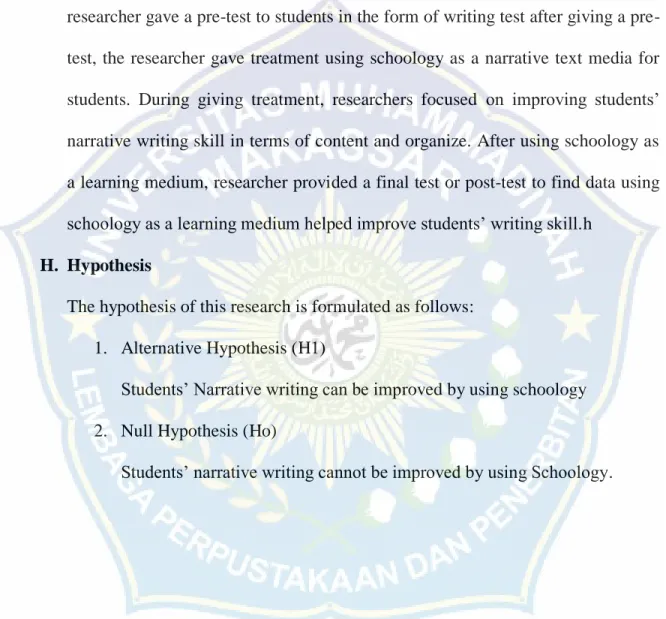
In this study, researcher analyzed the increase in the ability to write narrative text of students by using schoology as learning medium first, the researcher gave a pre-test to students in the form of writing test after giving a pre- test, the researcher gave treatment using schoology as a narrative text media for students. During giving treatment, researchers focused on improving students’
narrative writing skill in terms of content and organize. After using schoology as a learning medium, researcher provided a final test or post-test to find data using schoology as a learning medium helped improve students’ writing skill.h
H. Hypothesis
The hypothesis of this research is formulated as follows:
1. Alternative Hypothesis (H1)
Students’ Narrative writing can be improved by using schoology 2. Null Hypothesis (Ho)
Students’ narrative writing cannot be improved by using Schoology.
34 CHAPTER III RESEARCH METHOD A. Research Design
This research used pre-experimental research in which the researcher only use one class as a sample. The treatment was conduct after the pre-test will be intending to find out the students’ prior competence of English writing before giving the treatment, while the post-test will has to intended to find out the improvement of the students’ ability writing after the treatment have been given
Chart 3.1 Research Design
Source : Gay,2006:251 B. Population and Sample
1. Population
The population is a generalization area that consists of objects or subjects.
that have certain qualities characteristics determined by researchers to study and then draw conclusions. In this study, researchers used a population of science class XII students at MAN Selayar. In academic 2020/2021, science class XII consists of 2 class with a total number of students are 67 students.
01 PRE TEST
02 POST TEST
Treatment : teaching writing by using Schoology
Table 3.2 Number of population
(Tata Usaha MAN Selayar,2020) 2. Sample
In selecting the sample, the researcher used a purposive sampling technique, because the sample is chosen based on the results of an interview with an English teacher at MAN Selayar. Which stated that during the pandemic and schools were closed, class XI IPA 1 students were more active in online learning, so this research was conduct in XI IPA 1 MAN Selayar class consisting of 30 students.
C. Research Variable
There are two variables used in conduct the research. There is a Schoology application as an independent variable, and The dependent variable in this study is the students’ writing skills.
D. Research Instrument
In this research, the researcher used Schoology to make the writing test focus on content and organization. The pre-test was used to see the students’ ability in
Class Number Of Students XI IPA 1 30
XII IPA 2 37
TOTAL 67
writing before treatment by Schoology. Then the post-test to know the students’
writing ability to make paragraphs after treatment by used Schoology. The other research instrument is a laptop or mobile phone and internet connection.
E. Data Collection
The technique of collecting data in this research was used test instrument by pre-test, treatment and post-test.
1. Pre-Test
In the pre-test, the writer has given five topics. Students will choose from these topics by determining the content and organization. Tests to measure students' prior knowledge and to find out the problems students have before giving treatment.
2. Treatment
After doing the Pre-test, students had treated by using Schoology. It will be six meetings, and at every meeting, the students will giving writing materials. For detail information, the researcher explained the treatment in the form of teaching steps as follows :
a. The first meeting
1. Create a whatsapp group
2. The teacher explains the schoology application through the WhatsApp voice notes
3. Provide the application access code to students via the WhatsApp group.
4. After students log into the application the teacher provides an explanation of definition of narrative text, generic
structure in narrative text and Organization in narrative text.
5. Students provide feedback about the material in the
Schoology comment column and the teacher will respond to all questions or responses in the comments column.
c. The Second meeting
1. The teacher provides material to students about content especially plot and themes. submitted via schoology.
2. Students provide feedback about the material in the
Schoology comment column and the teacher will respond to all questions or responses in the comments column.
d. The Third meeting
1. The teacher sends content material about the character and point of view. Submitted via schoology.
2. Students provide feedback about the material in the
Schoology comment column and the teacher will respond to all questions or responses in the comments column.
e. The fourth meeting
1. The teacher sends Content material about unity and completes material to schoology.
2. Students provide feedback about the material in the
Schoology comment column and the teacher will respond to all questions or responses in the comments column.
f. The Fifth meeting
1. The teacher sends Organized material about the Chronological Order, Spatial Order, Climactic order material to schoology.
2. Students provide feedback about the material in the
Schoology comment column and the teacher will respond to all questions or responses in the comments column.
g. The sixth Meeting
1. The teacher sends organized material about the Orientation, Complication and Resolution material to schoology.
2. Students provide feedback about the material in the
Schoology comment column and the teacher will respond to all questions or responses in the comments column.
3. Post-Test
The author provides a Post-test test to measure the increase in students' knowledge after being given treatment. In the post-test, the researcher giving Five topics, and students will choose from these topics by making the correct content and grouping the story organization.
F. Data Analysis
Two components concern the researcher in this research to evaluate the students’ ability to write paragraphs. The researcher using the scale rubric guidance criteria by Glass and Tuchman (2005) the table below :
Content
Score Criteria
5 One idea that is clear, focused, and on topic. All concrete and specific details to support the idea. Lots of interesting and original details to support the idea. All the parts are integrated and fit.
4 One idea that is clear, focused, and on topic. There are concrete and specific details. Attractive details to support the idea. All parts are integrated and fit.
3 In general, fit the topic and develop a clear theme or message. Some of the details are concrete and some are general. Some of the supporting details are predictive and some are general. Maybe there are parts that are not quite suitable.
2 Much of the text is iterative and like a collection of unrelated ideas.
Lacking specific details and many general ones. Predictive and sketchy details.
1 Unfocused, totally out of idea, unidentifiable, long, and insufficiently developed Details inconsistent, vague, or nontrivial.
(Glass and Tuchman, 2005)
a. Organization
Score Criteria
5 The opening is clear and attracts the reader. Paragraph arrangement, topic sentence, clear, consistent, relevant support, and clear concluding sentences. Logical and effective sequence. Use of consistent, precise, and appropriate transitions.
4 The opening attracts the reader. Each paragraph is organized consistently. Most ideas relate logically. Effective ending. Use of appropriate transitions.
3 Opening that is effective but does not create a strong sense. All paragraphs are usually correct, except for one or two that do not fit.
Trying to use logical relationships. Trying to use an effective ending.
Some transitions still do not match.
2 Weak opening. Paragraph structure tends to be less appropriate like indents. Less logical links. Weak ends. Little use of correct transitions.
1 Unclear beginnings Lack of general organization. Irregular order and detail. Incorrect ends. Do not use transitions.
(Glass and Tuchman, 2005) 1. The students in two components tabulated and analyzed. To classify data,
(Glass and Tuchman, 2005).
No Classification Score
1 Excellent 91-100
2 Very Good 81- 90
3 Good 71 – 80
4 Fair 61-70
5 Poor 51 – 60
6 Very poor Less Than 50
2. Calculating the mean score and the standard deviation
The researcher calculated the mean score and standard deviation of the students’ speaking performance dealing with accuracy, flency, and comprehensibility by using SPSS Program Version 24 (IBM SPSS Statistic 24)
Comparison Hypothesis
H0 H1
t-test<t-table Accepted Rejected
t-test > t-table Rejected Accepetd
(Subana et,al,2005) Meant (1) the t-test value is smaller than the t-table value, the null hypothesis is accepted, and the alternative hypothesis is rejected.
(2) the t-test value is equal to Greater than the t-table value, the null hypothesis is rejected, while the alternative is accepted.
42
CHAPTER IV FINDINGS AND DISCUSSION A. Findings
This chapter consists of the findings of the research and its discussion.
Findings show description of result from the data that had been collected through writing test in pre-test and post-test which are described in graphic or table form.
Then, the discussion contains an explanation of findings that reflected the result of the data. In this discussion, the researcher uses their word to explain it.
1. The Improvement of students Narrative text in term of content
The findings of this study illustrate that there is a change in the writing ability of class XI IPA 1 students, the findings of this study are seen from the pre-test results, namely giving tests to students to test their abilities before being given treatment and to complement the results of students will be given post-tests. as a final test on these students as evidence that Schoology can be used in the learning process in the classroom. as in the classification table and diagram below which will describe the changes in student results before and after treatment.
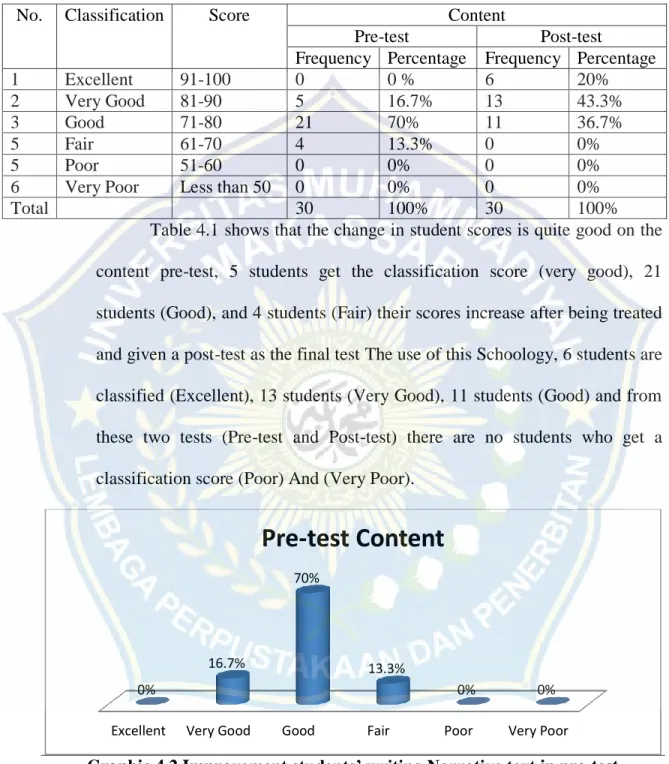
Table 4.1 Classification of Content (Pre-test and Post-test)
No. Classification Score Content
Pre-test Post-test
Frequency Percentage Frequency Percentage
1 Excellent 91-100 0 0 % 6 20%
2 Very Good 81-90 5 16.7% 13 43.3%
3 Good 71-80 21 70% 11 36.7%
5 Fair 61-70 4 13.3% 0 0%
5 Poor 51-60 0 0% 0 0%
6 Very Poor Less than 50 0 0% 0 0%
Total 30 100% 30 100%
Table 4.1 shows that the change in student scores is quite good on the content pre-test, 5 students get the classification score (very good), 21 students (Good), and 4 students (Fair) their scores increase after being treated and given a post-test as the final test The use of this Schoology, 6 students are classified (Excellent), 13 students (Very Good), 11 students (Good) and from these two tests (Pre-test and Post-test) there are no students who get a classification score (Poor) And (Very Poor).
Graphic 4.2 Improvement students’ writing Narrative text in pre-test (Content)
Excellent Very Good Good Fair Poor Very Poor
0%
16.7%
70%
13.3%
0% 0%
Pre-test Content
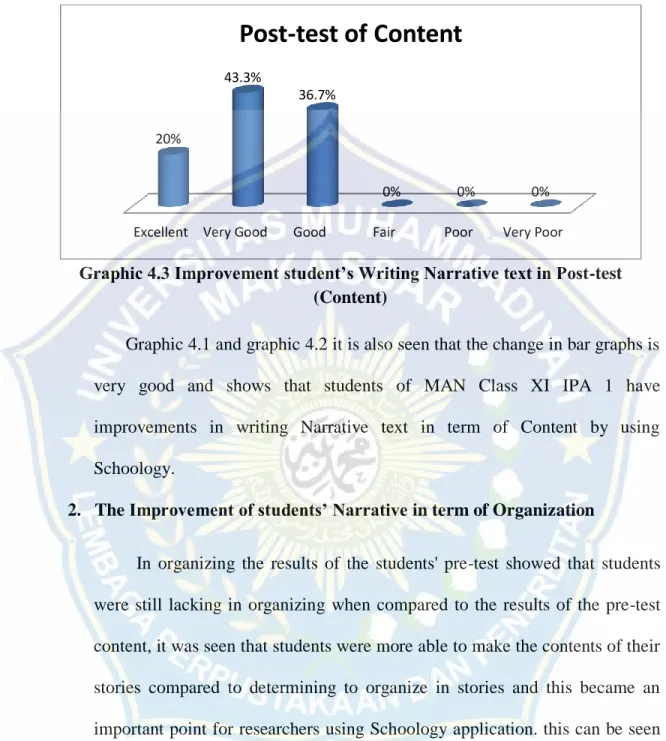
Graphic 4.3 Improvement student’s Writing Narrative text in Post-test (Content)
Graphic 4.1 and graphic 4.2 it is also seen that the change in bar graphs is very good and shows that students of MAN Class XI IPA 1 have improvements in writing Narrative text in term of Content by using Schoology.
2. The Improvement of students’ Narrative in term of Organization
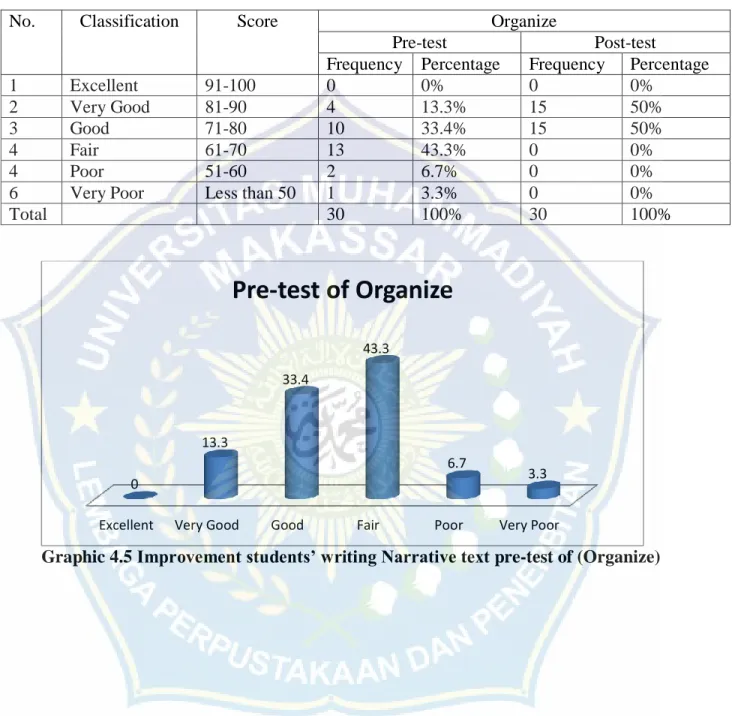
In organizing the results of the students' pre-test showed that students were still lacking in organizing when compared to the results of the pre-test content, it was seen that students were more able to make the contents of their stories compared to determining to organize in stories and this became an important point for researchers using Schoology application. this can be seen in the classification and graphic results below:
Excellent Very Good Good Fair Poor Very Poor 20%
43.3%
36.7%
0% 0% 0%
Post-test of Content
Table 4.4 the percentage of students’ writing skill term of organization
No. Classification Score Organize
Pre-test Post-test
Frequency Percentage Frequency Percentage
1 Excellent 91-100 0 0% 0 0%
2 Very Good 81-90 4 13.3% 15 50%
3 Good 71-80 10 33.4% 15 50%
4 Fair 61-70 13 43.3% 0 0%
4 Poor 51-60 2 6.7% 0 0%
6 Very Poor Less than 50 1 3.3% 0 0%
Total 30 100% 30 100%
Graphic 4.5 Improvement students’ writing Narrative text pre-test of (Organize)
Excellent Very Good Good Fair Poor Very Poor
0
13.3
33.4
43.3
6.7 3.3
Pre-test of Organize
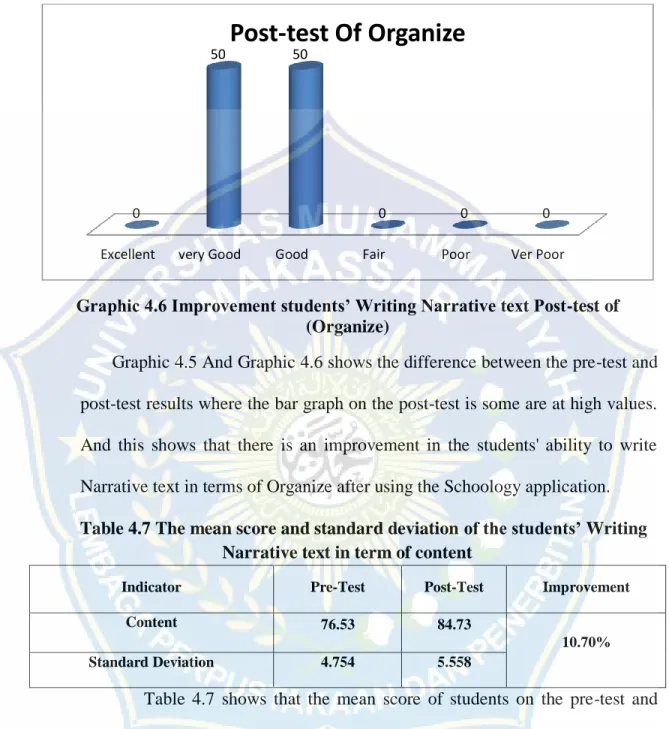
Graphic 4.6 Improvement students’ Writing Narrative text Post-test of (Organize)
Graphic 4.5 And Graphic 4.6 shows the difference between the pre-test and post-test results where the bar graph on the post-test is some are at high values.
And this shows that there is an improvement in the students' ability to write Narrative text in terms of Organize after using the Schoology application.
Table 4.7 The mean score and standard deviation of the students’ Writing Narrative text in term of content
Indicator Pre-Test Post-Test Improvement
Content 76.53 84.73
10.70%
Standard Deviation 4.754 5.558
Table 4.7 shows that the mean score of students on the pre-test and post-test has increased, the mean writing score was around (76.53) on the pre- test and (84.73) on the post-test with an increase in the post-test results.
improve students 'abilities in writing (content narrative text) and from these results, it can be seen that student outcomes have increased by (10.70%) and
Excellent very Good Good Fair Poor Ver Poor
0
50 50
0 0 0
Post-test Of Organize
this shows that the use of Schoology can improve students' abilities in writing narrative text (Content).
Table 4.8 The mean score and standard deviation of the students’ Writing Narrative text in term of Organize
Indicator Pre-Test Post-test Improvement
Organize 70.46 80.43
14.15%
Standard Deviation 7.389 3.390
Table 4.8 shows that there is a change in the mean score of students in the pre-test mean score of students (70.46) and in the post-test the mean score of students (80.43) there is an increase of (14.15%) and this shows that the increase in students in organizing is more than the increase. in Content. and this automatically shows that writing narrative text (organize) learning has been able to increase using Schoology.
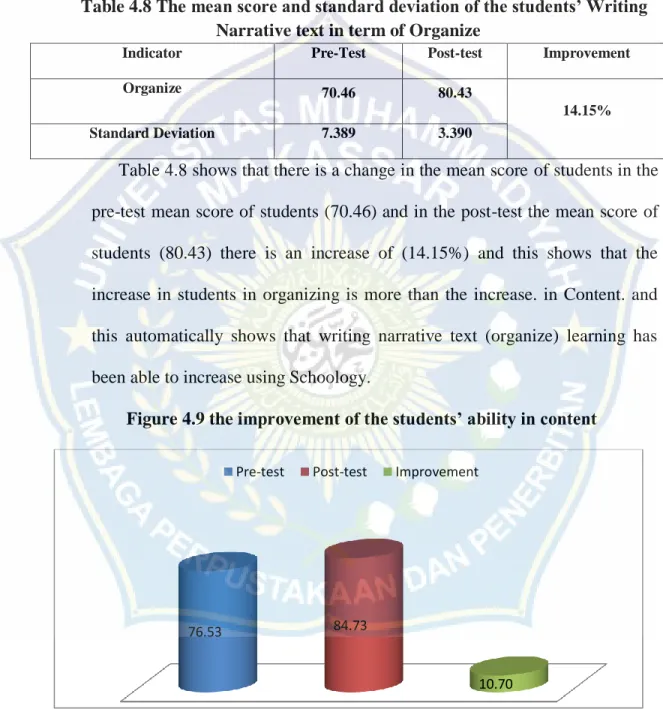
Figure 4.9 the improvement of the students’ ability in content
76.53 84.73
10.70 Pre-test Post-test Improvement
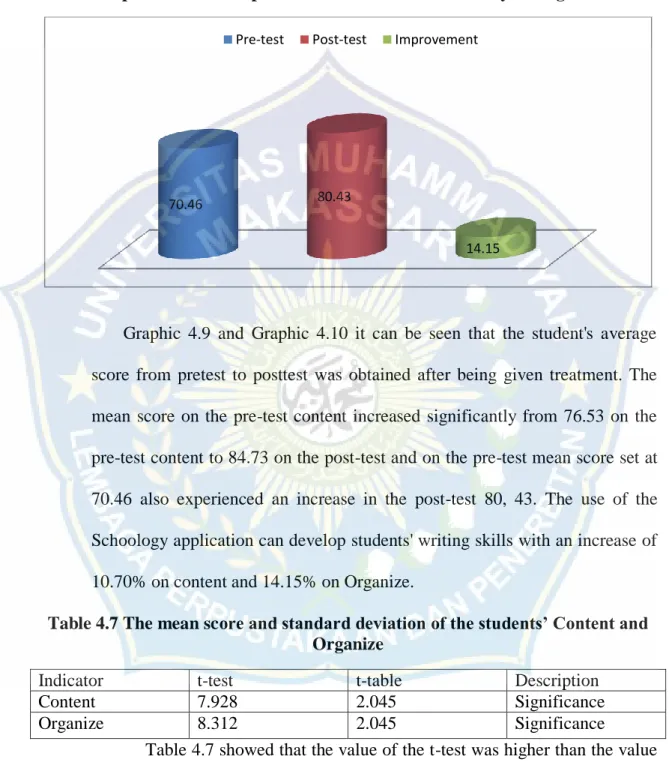
Graphic 4.10 The Improvement of The students ability in Organize
Graphic 4.9 and Graphic 4.10 it can be seen that the student's average score from pretest to posttest was obtained after being given treatment. The mean score on the pre-test content increased significantly from 76.53 on the pre-test content to 84.73 on the post-test and on the pre-test mean score set at 70.46 also experienced an increase in the post-test 80, 43. The use of the Schoology application can develop students' writing skills with an increase of 10.70% on content and 14.15% on Organize.
Table 4.7 The mean score and standard deviation of the students’ Content and Organize
Indicator t-test t-table Description
Content 7.928 2.045 Significance
Organize 8.312 2.045 Significance
Table 4.7 showed that the value of the t-test was higher than the value of the t-table The t-test value of content was greater than the t-table
70.46 80.43
14.15 Pre-test Post-test Improvement
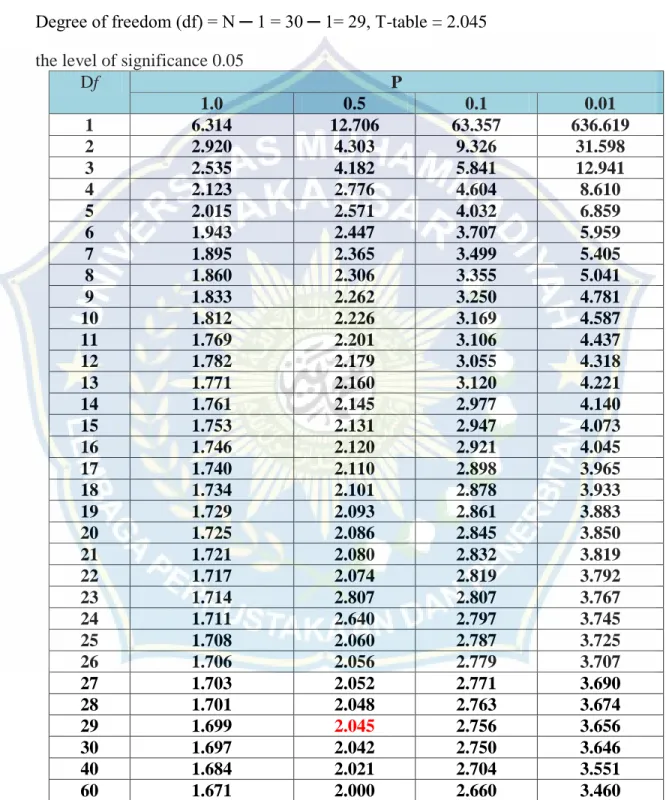
(7.928>2.045) and the t-test value of organizing was greater than the t-table (8.312>2.045). it was said that the null hypothesis (Ho) was rejected and the alternative hypothesis (H1) was accepted.it means that there was an improvement in the students' writing before and after used Schoology writing mastery of the eleventh-grade student of MAN Selayar.
If the test value was higher than the t-table at the level of significance 0.05 and degree freedom (df) 30 (N-1=30-1), thus the alternative hypothesis (H1) was accepted and the null hypothesis (Ho) was rejected. On contrary, if the value was lower than the t-table at the level of significance 0.05 and the degree freedom 29, thus the alternative hypothesis was rejected and the null hypothesis was accepted.
B. Discussion
In the discussion, the researcher would like to discuss the result of the findings. It aimed to describe the students' Narrative text writing skills in terms of content and organization by using Schoology and the benefits of Schoology for teachers and students in the learning process during a pandemic.
1. The improvement of students in the term of content.
The results of this study, especially regarding the content, the researcher found that the students of class XI IPA 1 Man Selayar were quite capable of composing their ideas on stories. However, the frailty of
the students' writing at the pre-test stage that the researchers found was that they were wrong to use pronouns in English or that there were several words in the story that contained Indonesian words so that they made a different meaning in the story. Then the researcher provides content material through Schoology by increasing students' understanding of make good content. In conclusion, MAN students need to increase focus and accuracy. So, they are do not make mistakes by choosing the wrong pronoun and using Indonesian words.
2. The improvement students' in terms of Organization.
In this study, the researcher found that students of class XI Ipa 1 MAN Selayar have weaknesses in identifying orientation, compliance, and resolution. The researcher provides treatment, namely material and video, using Schoology. Furthermore, the researchers discussed the Material and videos that have been provided in the Schoology comment column or via Whatsapp. From the learning results, the researchers found an increase in student scores, namely 14.15%. So, It can conclude that Schoology is Effective in improving students' abilities in class XI IPA 1 MAN Selayar.
Several previous researchers who also used Schoology with different objects found that Schoology was effective in improving students' learning abilities. Rahmadianto (2016), in his research, “found that the comparison of learning using Schoology and without Schoology found that
the use of Schoology as a learning medium can improve student learning outcomes compared to the use of conventional learning media”.
Aminoto et., al (2014), in their research, “found that the average score of students experienced an immense increase, but the attendance rate of students in online learning Schoology has decreased because students only carry out the online process or log in when the teacher provides material and assignments but does not give feedback in the comments column or chat session on the Schoology application this is due to technical factors”.
Researchers also found that Schoology was effective at improving students' ability to write text, but researchers also found that students experienced a decrease in attendance in the online learning process.