THE INFLUENCE OF USING COMPARE-DIAGNOSE-OPERATE (CDO) STRATEGY IN WRITING PERSUASIVE TEXT OF SECOND GRADE
STUDENTS AT SMAN 11 KOTA BENGKULU IN ACADEMIC YEAR 2019/2020
THESIS
Submitted as A Particular Requirement for “Sarjana Degree” (S.Pd) in Study Program of English Education
By
DIANA AGUSTINA SRN. 1516230090
STUDY PROGRAM OF ENGLISH EDUCATION FACULTY OF TARBIYAH AND TADRIS
STATE INSTITUTE FOR ISLAMIC STUDIES OF BENGKULU 2019
MOTTO
Always be yourself no matter what they say And never be anyone else
Even if they look better than you
i
DEDICATION
The researcher would like to dedicate this thesis to:
1. Allah Ta‟ala, as the Only One God, the researcher would like to say Alhamdulillahirobbil’alamin, there is no word which can describe how grateful I am for every mercy, healthy, and happiness on my way to finish this thesis.
2. My beloved parents, Alm. M. Yunus and Indo‟ Gallong. Thank you so much for your entire prays and support to fulfill all of my needs and stuff remind me to never give up. I love both of you from the moon and back.
3. My only one sister, Siti Marhana. Thank you for always support your older sister. My Sister In Law, Siti Romdhonah, thank you for talways take care of me, and all of my family that I can‟t mention one by one. I love all of you so much.
4. My best friends : Jeka, Yepa, and Marinda who are always complete my days, support, and encourage me. Love all of you, Anjarwati Fortuna, Ayuk Rin, Amel, Selvi my first college friends and forever. Melati Rosalia, my another bestie, Astri Riski, my partner go to Kajian, and my Kurcaci;
Ulfa and Silvi.
5. My best friend ever since High School, Lidia Silalahi, Okta Purnama Sari, Nurfatihah, Dwi Wahyuningtyas, Alya, Yulisti, Nisa Ulkhairah thank you so much for fulfill my high school life.
6. All of my classmates : Yosi boy, Yosi Pus, Pupe, Iam, Niak, Media, Ice, Tari, Madani, Sela, Hilmina, Juliansyah, Herdi, Ade, Cik Anton, Jek, Ibnu.
So much love for you.
7. All of my KKN squad Sumber Arum ; Weni, Isnaini, Indah, Ria, Maras, Aziz, Bang Surbein, Bang Topik, Bang Ridi, and Albet, and all of my PPL squad; Lusianti,Siska, Lidia, Dwi, Koko, and Lio
8. My Almamater IAIN Bengkulu
v
SPECIAL THANKS TO :
1. Prof. DR. H. Sirajuddin M, M.Ag., M.H. , as the Rector of IAIN Bengkulu
2. DR. Syamsul Rizal, M.Pd as my first advisor, and Fera Zasrianita, M.Pd as my second advisor, thank you so much for all of your advises, your kindness, and time until I can finish my thesis.
3. All of English Education Program lecturers. Thank you so much for all of the materials and knowledge. You all are amazing people.
ACKNOWLEDGEMENT
All praise and thanks to Allah Subhanahuawata’ala the Almighty who give me mercy and blessing, since His grace and guidance so that I can finish this thesis which entitled “The Influence of Using Compare-Diagnose-Operate (C-D- O) Strategy in Writing Persuasive Text at Second Grade Students In SMA N 11 Bengkulu in Academic year 2019/2020”. Unforgettable, Prophet Muhammad Sholallahu’alahiwasallam, who has guided us from the darkness to the brightness era. Thus, the researcher would like to express her deepest thanks to all of those who had helped, supported, and suggested me during the process of writing this thesis. This goes to:
1. Prof. Dr. H. Sirajuddin M, M.Ag., M.H., as the rector of IAIN Bengkulu.
2. Dr. Zubaedi, M.Ag., M.Pd., as the dean of Tarbiyah and Tadris Faculty.
3. Eva Dewi, M.Ag., as the head of Tadris.
4. Feny Martina, M.Pd., as the head of English Education Department.
5. Dr. Syamsul Rizal, M.Pd., as the first advisor, and Fera Zasrianita M.Pd., as the second advisor.
6. All of English lecturers and staff administration of IAIN Bengkulu.
7. Principal of SMA N 11 Bengkulu and students in SMA N 11 Bengkulu.
8. All of my family member.
9. My Almamater.
vii
The researcher relizes that this thesis would not completed without the help of various parties. The researcher would like to say thank to the lecturer, friends, and family for guidance, direction, correction, and suggestions.
Criticism and suggestions are expected by the researcher for the perfection of this thesis.
Bengkulu, August 2019 The researcher,
Diana Agustina SRN 1516230090
ix
PRONOUNCEMENT
Name : Diana Agustina
Place, Date of Birth : Bengkulu, 28 August 1996
NIM : 1516230090
Study Program : Tadris Bahasa Inggris
Faculty : Tarbiyah and Tadris
In hereby sincerely state that the thesis entitled “The Influence of Using Compare-Diagnose-Operate (C-D-O) Strategy in Writing Persuasive Text at Second Grade Students In SMA N 11 Bengkulu in Academic year 2019/2020”, is my real masterpiece. The things out of my masterpiece in this thesis are signed by citation and referred in the bibliography. If later proven that my thesis has discrepancies, I am willing to take academic in the form of repealing my thesis and academic degree.
Bengkulu, August 2019 Stated by,
Diana Agustina NIM 1516230090
x
ABSTRACT
Diana Agustina. August. 2019. “The Influence of Using Compare-Diagnose (CDO) Strategy in Writing Persuasive Text of Second Grade Students at SMA N 11 Bengkulu in Academic Year 2019/2020”. Thesis, Study Program of Tadris Bahasa Inggris, Faculty of Tarbiyah dan Tadris.
Pembimbing : 1. Dr. Syamsul Rizal, M.Pd 2. Fera Zasrianita, M.Pd This study aims to determine the differences in cognitive learning outcomes (in the form of pre-test and post-test scores) of students in class XI MIA 2 as a control class and class XI IPS 2 as experimental class at SMA N 11 Bengkulu, by providing treatment using the Compare -Diagnose-Operate (CDO) strategy. This type of research is Quasi Experiment. The population is eleventh grade students of SMA N 11 Bengkulu in the academic year 2019/2020 with 119 students. From this population, 57 students were taken as samples. Each class is 28 students XI MIA 2 and 29 students XI IPS 2. Research data were collected through writing tests and documentation. The results showed a significant change in the experimental class with an average value of 73.20 while in the control class an average value of 70.2. The post-test results show that the Compare-Diagnose- Operate (CDO) strategy can improve students' writing skills. Thus, the Compare- Diagnose-Operate (CDO) strategy can be one of effective strategy to increase students‟ writing ability.
Keywords: Compare-Diagnose-Operate (CDO) Strategy, Writing Persuasive Texts
xi
ABSTRAK
Diana Agustina.2019. “The Influence of Using Compare-Diagnose (CDO) Strategy in Writing Persuasive Text of Second Grade Students at SMA N 11 Bengkulu in Academic Year 2019/2020”. Skripsi, Program Studi Tadris Bahasa Inggris, Fakultas Tarbiyah dan Tadris.
Pembimbing : 1. Dr. Syamsul Rizal, M.Pd 2. Fera Zasrianita, M.Pd Penelitian ini bertujuan untuk mengetahui perbedaan hasil belajar kognitif ( berupa nilai pre-test dan post-test) siswa kelas XI MIA 2 sebagai kelas control dan kelas XI IPS 2 sebagai kelas eksperimen semester ganjil di SMA N 11 Bengkulu, dengan memberikan perlakuan menggunakan strategi Compare- Diagnose-Operate (CDO). Jenis penelitian ini adalah Quasi Eksperimen.
Populasinya adalah siswa kelas sebelas SMA N 11 Bengkulu pada tahun akademik 2019/2020 dengan jumlah siswa sebannyak 119 siswa. Dari populasi ini, 57 siswa diambil sebgai sampel. Masing-masing kelas adalah XI MIA 2 sebanyak 28 siswa dan XI IPS 2 sebanyak 29 siswa. Data penelitian dikumpulkan melalui test menulis dan dokumentasi. Hasil penelitian menunjukkan perubahan yang signifikan pada kelas eksperimen dengan rata-rata nilai 73,20 sedangkan pada kelas control rata-rata nilai 70,2. Hasil post-test menunjukkan bahwa strategi Compare-Diagnose-Operate (CDO) dapat meningkatkan kemampuan menulis siswa. Oleh karena itu, strategi ini dapat menjadi metode yang efektif untuk meningkatkan kemampuan menulis siswa.
Kata kunci : Strategi Compare-Diagnose-Operate (CDO), Menulis Teks Persuasif
xii
TABLE OF CONTENT TITLE
ADVISOR SHEET
ACKNOWLEDGEMENT ... i
MOTTO ... iii
DEDICATION ... iv
PRONOUCEMENT ... vi
ABSTRACT ... vii
TABLE OF CONTENT ... ix
LIST OF FIGURES ... xi
LIST OF TABLES ... xii
LIST OF APPENDICES ... xiii
CHAPTER I: INTRODUCTION ... 1
A. Background of The Problem ... 1
B. Identification of The Problem ... 5
C. Limitation of Problem ... 5
D. Research Question ... 6
E. Objective of The Research ... 6
F. Significance of The Research... 6
G. Definition of Key Terms ... 7
CHAPTER II: LITERATURE OF REVIEW ... 9
A. Review of Writing ... 9
a. Definition of Writing... 9
b. The Purpose of Writing ... 12
c. Writing Process ... 14
d. Writing Skill ... 19
e. Characteristic of an Effective Paragraph... 20
f. Assessment of Writing ... 21
B. The Concept of Persuasive Text ... 24
a. Definition of Persuasive Text... 24
b. The Structure of Persuasive Text ... 25
C. Compare-Diagnose-Operate (CDO) Strategy ... 26
a. Definition of Compare-Diagnose-Operate (CDO) Strategy 26 b. Procedure of Compare-Diagnose-Operate (CDO) Strategy 28 c. Advantages of Compare-Diagnose-Operate (CDO) Strategy 30 d. Previous Studies ... 30
e. Hypothesis ... 32
CHAPTER III: RESEARCH METHOD ... 33
A. Research Design ... 33
B. Population and Sample ... 34 xiii
C. Technique of Data Collection ... 36
D. Research Instrument ... 37
E. Research Procedures ... 37
F. Technique of Analysis Data ... 40
CHAPTER IV : RESULTS AND DISCUSSION ... 41
A. Results ... 41
1. The Result of Writing Persuasive Text ... 41
1.1 The Description of Pre-test and Post-test Score of Experimental Group ... 41
1.2 The Description of Pre-test and Post-test Score of Control Group ... 43
2. The Normality and Homogeneity of the Data ... 45
2.1 The Result of Normality Data Test of Pre-Test Scores 46 2.2 The Result of Normality Data Test of Post-Test Scores 49 2.3 The Result of Homogeneity of Variances Test ... 52
3. The Statistical Analysis Result ... 52
3.1 Paired Sample T-Test Analysis ... 56
3.2 Independent Sample T-Test Analysis of Students‟ Writing Persuasive Text ... 56
B. Discussion ... 56
CHAPTER V : CONCLUSION AND SUGGESTION ... 59
A. Conclusion ... 59
B. Suggestion ... 60 REFERENCES
APPENDICES
iv
LIST OF FIGURES
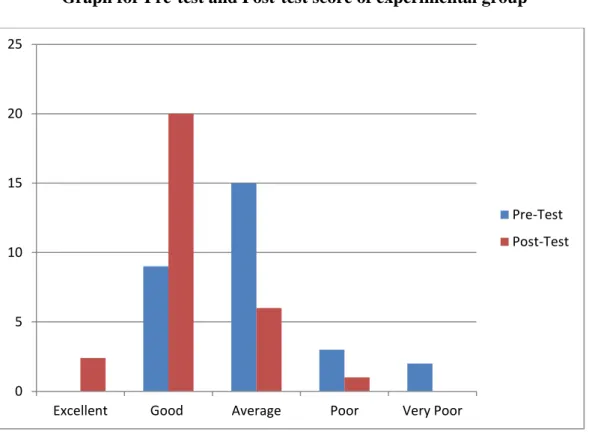
Figure 4.1 Graph for Pre-Test and Post-Test Score in Experimental Group ... 42 Figure 4.2 Graph for Pre-Test and Post-Test Score in Control Group... 45 Figure 4.3 The Histogram of the Students‟ Pre-Test of the Experimental
Group ... 47 Figure 4.4 The Histogram of the Students‟ Pre-Test of the Control group... 48 Figure 4.5 The Histogram of the Students‟ Post-Test of the Experimental
Group ... 51 Figure 4.6 The Histogram of the Students‟ Post-Test of the Control group ... 52
xv
LIST OF TABLES
Table 3.1 The Schematic of the Quasi Experimental Design ... 33
Table 3.2 Distribution of Population ... 35
Table 3.3 Sample of the Researcher ... 36
Table 4.1 The Score Distribution of Experimental Group ... 44
Table 4.2 The Score Distribution of Control Group ... 45
Table 4.3 The Normality of Pre-test Scores of Experimental Group ... 46
Table 4.4 The Normality of Pre-test Scores of Control Group ... 47
Table 4.5 The Normality of Post-test Scores of Experimental Group ... 49
Table 4.6 The Normality of Post-test Scores of Control Group ... 50
Table 4.7 test of Homogeneity of Variances ... 52
Table 4.8 Paired Samples Statistics of Experimental Group ... 53
Table 4.9 Paired Samples Test of Experimental Group ... 54
Table 4.10 Paired Samples Statistics of Control Group ... 55
Table 4.11 Paired Samples Test of Control Group ... 55
Table 4.12 Independent ... 56
xvi
LIST OF APPENDICES 1. Lesson plan for Experiment Class
2. Attendance List of Experiment Class 3. Attendance List of Control Class 4. Pre-test of Experiment Class 5. Pre-test of Control Class 6. Post-test of Experiment Class 7. Post-test of Control Class
8. Daftar Nilai Pre-test and Post-test Experimental Class 9. Daftar Nilai Pre-test and Post-test Control Class 10. Kartu Bimbingan
11. Surat Penunjukan 12. Surat Izin Penelitian
13. Surat Keterangan dari Sekolah 14. Documentation
xvii
CHAPTER 1 INTRODUCTION A. Background of The Problem
In modern era, English is one of the most important languages to learn. It is the most widely spoken language around the globe. There are around 400 million people using English as their first language. As a tool of communication, English should be learned actively whether in oral or written form. One of the reasons why English should be learned is because many scholarly written articles and research are written in English. To get the access academic sources of learning, we should comprehend the language well.
It is important to learn English because most people all over the world decide to study it as a second language. Some countries include English as a second language in their school syllabus and children start learning English at young age. However, here are the reasons why learning English is important; first, English is the most commonly spoken language in the world. Second, English is the language of science, computers, diplomacy, and tourism. Knowing English increases your chances of getting a good job in a multinational company or of finding work abroad.
Third, English is the language of the media industry. If you speak English, you do not need to translate and subtitles anymore to enjoy your favorite books, songs, films, and TV shows. That is why we should comprehend English well. By mastering English, you can improve yourself both in
1
academic and life skill. Once the students can comprehend it, he or she can be well-accepted by the society.
There are so many languages in this world which English as an international language. According to Crystal, more people use English today than have used any other language in the history of the world.1 Based on the number of speakers that are debatable, perhaps 380 million have English as a first language but more than a billion people use it as a second language, mostly to communicate with other second language users with whom they do not share a cultural and linguistic background. Now, English is very much tied to globalization and is profoundly affected by all of its associated processes.
As an International language, English is used both in a global sense for International communication between countries, and in a local sense as a language of wider communication within multilingual societies.2 English is mostly used in the world. Some country used English as the first language such United Kingdom and United States, as the second language such Singapore and Malaysia, and as the Foreign language for some countries such as Indonesia and Thailand. That is why student in Indonesia should learn and improve their English.
English is a language taught in our country and our government has taken several efforts, one of them is that English has been formally taught in all levels of schools starting from elementary school up to
1 Michael Clyne. 2008. English As a n International Language. Australia. Monash University Press. Vol. 31, No. 2. Page 282
2 Ibid, Page 283
university. It is of course as the consequent of the global era development where English is deeply needed as a means of communication. The government expects that by teaching English, Indonesian are able to acquire science and technology in order to develop our country.
Furthermore, nowadays, the government implements the Genre-based Approach to develop the nation‟s education quality
There are four skills in teaching and learning English. They are listening, speaking, reading, and writing. The essential four skills are the perceptive and productive skills.3 The perceptive skills are listening and reading. When the brain has an idea it encodes the idea and sends to the hand. Then the hand writes down or types in words. So writing skill can be considered as productive skills.
Writing is the final product of several separate acts that are largely challenging to learn simultaneously. Through writing, students are able to share their words, their ideas, their feelings in written text. A person needs a mastery of various elements to use the language to conveying thoughts, wishes, intentions, feeling, and information in a written form.4 When students master those skills, it is easier for students to master writing.
Both for native and non-native students, writing well is really a big challenge. In general, it is much bigger with the students of English as a foreign language. Based on observation that researcher has done, students
3 Ganesh B. Mundhe, Teaching Receptive and Productive Language Skills With The Help of Techniques. (Pune Research : India. 2015. Vol 1. Issue 2. Page 2
4 Muhammad Javed, Wu Xiao Juan, Salma Nazli. A Study of Students’ Assessment in Writing Skills of the English Language. Malaysia. International Journal of Instruction. Vol 6 No. 3 2013. Page 17
nowadays have very little interest in writing which is so important to fulfill the education requirements, especially for second grade at Senior High School (SMAN) 11 of Bengkulu in Academic year 2018/2019. As an EFL (English as a Foreign Language) students, writing in English is so difficult because they tended to have mistakes like; generic structure and language feature. The problems with the generic structure of persuasive including disability to put the introduction, thesis statement, body paragraph and conclusion in a good order and right position. The downsides with language feature they have including the lack of grammar understanding such as to be, tenses, vocabulary etc. Therefore, the students are difficult to understand English. In addition, the teaching process was not conducted interesting. Consequently, the students are bored in learning process. To solve those problems, the researcher is intended to apply the Compare, Diagnose, and Operate (CDO) strategy in order to find out if there is a different before and after applying the strategy.
The reason why the strategy is urgent to be applied is because it is the most effective one to increase the amount of time students devoted to writing. The more often students are motivated to do writing and correction, the better their skill will be. Based on the problem above, the researcher would like to conduct the research with the title “The Influence of Using Compare-Diagnose-Operate (CDO) Strategy on Students‟
Writing Persuasive Text”.
B. Identification of The Problem
Based on the background above, the researcher found some information about the problem in writing English persuasive text of Eleventh grade at SMA N 11 Bengkulu. The researcher identified the existing problem and classified many problems related to the students.
They are classified as follows:
1. Students difficult identified the generic structure of persuasive text. The problems with the generic structure of persuasive including disability to put the introduction, thesis statement, body paragraph and conclusion in a good order and right position.
2. Students did not understand the language feature of persuasive text. The downsides with language feature they have including the lack of grammar understanding such as to be, tenses, vocabulary etc., and students seldom using English in daily life whether it spoken or written form. Therefore, the students were difficult to understand English.
3. In addition, the teaching process is not conducted interesting.
Consequently, the students are bored in learning process.
C. Limitation of Problem
Limitation of the problem on this research was to find out the significant influence of Compare-Diagnose-Operate (CDO) strategy
towards students‟ writing persuasive text of the second grade students at SMAN 11 of Bengkulu in academic year 2018/2019.
D. Research Question
Based on the problems above that have been explained, the research question of this research is formulated as the following: “Is there any significant influence of using Compare, Diagnose, and Operate (CDO) strategy towards students‟ writing persuasive text? ”
E. Objective of The Research
Objective of this research was to find out whether there is significant influence of using Compare-Diagnose-Operate (CDO) strategy towards students‟ writing persuasive text.
F. Significance of the Research The significances of this research :
1. For the students :
The application of Compare-Diagnose-Operate (CDO) strategy will make students interest in teaching learning process.
Moreover, this strategy will motivate the students in learning English.
2. For the Teacher :
This strategy may help the teacher to give information about the appropriate method to improve the teaching and learning process.
3. For Institution
The results of the implementation of this method can be reference strategy to teach writing in the school.
G. Definition of Key Terms
1. Students‟ Writing Persuasive Text
According to Harmer, writing is a way to produce language and express idea, feeling, and opinion.5 Writing is an activity process of putting some words as a result of some activities, such as ideas, feeling that can be used to communicate to others. In expressing the ideas, a writer should explore their thought to make readers' interest in their writing. It makes the readers understand the messages clearly.
According to Becky, a persuasive text is any text where the main purpose is to present a point of view and seeks to persuade a reader.6 Persuasive text also known as the argument essay, uses logic and reason to show that one idea is more legitimate than another. It attempts to persuade a reader to adopt a certain point of view or to take a particular action.
2. Compare-Diagnose-Operate (CDO) Strategy
Compare-Diagnose-Operate (CDO) strategy is one of strategy that can be used in teaching writing. The student will able to revise their writing, and solve their problem by comparing, diagnosing, and operating their writing
5Jeremy Harmer, How to Teach Writing . (Longman : Pearson Education Limited, 2007) page 31
6Becky Matthews. Your Guide to Writing a Persuasive Text. 2015. Retrieved from internet www.3plearning.com/blog/persuasivewriting/ on Wednesday at 08.52 a.m
CHAPTER II LITERATURE REVIEW A. The Concept of Writing
a. Definition of Writing
Nowdays, language is used for many kinds of purposes.
Thus, it has many functions as well. Language, as the scientific concept, is whatever it is that linguists take as their primary object of study, and normatively whatever it is human should be studying.7 Language is the expression of ideas by means of speech-sounds combined into words. Words are combined into sentences, this combination answering to that of ideas into thoughts. Language is the instrument to communicate that need by human being. Through the language people could convey everything because the language is the way to express our feeling.
Furthermore, it had a structure such as the phonological, syntactic, and logical rules. 8 It could make people know each other.
Language has the biggest role for getting much knowledge and information. It also has an important role in our life as a media that can connect between one and the others.
So, the researcher concludes language is a means of communication between humans. Language as the way of people
7 Carlos Santana. 2016. What is Language. United States. Ergo : An Open Access Journal of Philosophy. Vol 3 No 19.
8 Jana, Sanderlane. Language and Gender and advanced Resource Book (New York : Routledge:2006) p 39
8
to express their opinion. Through language human can exchanged thoughts and understand the meaning of each other.
Writing is functional communication, making learners possible to create imagined worlds of their own design.9 Among the four skills, writing is considered as a difficult skill because the writer should make some aspects in writing such as content, organization, purpose, vocabulary, punctuation, and spelling in a balance way. Writing is a progressive activity. It means that when you write something down, you have already been thinking about what you are going to say and how you are going to say it. After you have finished your writing, you read over what you have written and make changes and corrections. Communication in writing aims to involve a thinking process because writing requires the process of selecting and organizing ideas into coherent and logical whole, so in this case writing is undeniably based in thought.
According to Ur, writing is an active process of conveying the ideas and sending a message to readers.10 It means that through writing, people can share and express the feeling and thought to others. Sokolik says that writing is both physical and mental act.
Writing as physical, it refers to communicate words or ideas to
9 Richard Kern, Literacy and Language Teaching, (New York: Oxford University Press, 2000) Page 172.
10 Irwan dkk. Teaching Writing Texts Through Compare-Diagnose-Operate Strategy for Senior High School Students. Bung Hatta University. Page 3
some medium.11 While as mental act, it means work of inventing ideas, thinking about how to express them, and organizing them in to readable statement or paragraph. Therefore, writing is a complex skill that involves physic and mental work in producing words into language.
Brown also claims that writing is a thinking process.12 It refers to a process of writing need some more time to finish and not produce immediately. Before start writing, the writer must think about the topic and find some information first. Writing requires some efforts such as trying, selecting, adding, revising, and rearranging the words or sentences that have been written.
Furthermore, Brown states that writing can be planned and given with an unlimited number of revisions before its release. In addition, Elbow also says that writing is a two-step process.13 The first process is figuring out the meaning and the second process is putting the meaning into languages. Writing represents what we think. It is because writing process reflects some things, which stay in the mind. Students who are unwilling to write things down often suffer for this activity. The students find difficulties when they start looking for some reasons to write and producing written sentences.
11 Ibid, Page 4
12 H. Douglas Brown. Teaching by Principles, an Interactive Approach to Language Pedagogy. 2001. 2ed. New York : Longman. Page 336
13 Ibid, Page 336
Based on the definitions above, the researcher concludes that writing is a productive process done by means of some stages.
Firstly, exploring and sending ideas, thought and feeling into written form. Secondly, conducting a number of revising process to organize a grammatically and orderly texts. The writing productions are in the forms of readable texts which should be meaningful to everyone who read the writing text.
b. The Purpose of Writing
There are many reasons to teach writing to the English foreign students. Harmer states that writing gives the students more
„thinking time‟ than they get when they try out spontaneous conversation.14 In addition, this allows them more chance for language processing, that is thinking about the language whether they are involved in study or activation.
There are six purposes of writing15. The first is writing to explain or inform. In this kind of writing, the writers should know concretely and clearly about what information they want to inform, for example, writing an announcement or an article. The second is writing to persuade. It is usually has related to an advertisement. In this kind of writing, the writer must use the interesting words to catch the customer‟s attention. The third is
14 Jeremy Harmer. The Practice of English Language Teaching. England: Longman.
2007. Page 112.
15 Nurhasanah, Skripsi: Improving Students’ Ability in Writing A Narrative Text By Using Round Table Strategy at Grade VII C of SMP Negeri 11 Kota Bengkulu. ( Bengkulu: UNIB, 2014) Page 21
writing at school. It means that the writing that used to answer the essay question from the test of their examination. The fourth is business writing. In the business writing, the writer should focus in formal language, for example, writing a formal letter. The fifth is social writing. It is a social relationship, for example the letter between friends and the content is informal. The last is artful writing. It is writing as one part of the art, for example, writing novels or short stories. Therefore, it can be concluded that the writers should know the purposes of their writing and the goal of the writing. The writers should also know who their readers will be.
Writing is one of the ways to communicate the writer‟s thought or ideas to the others. Writing is a tool for indirect communication between the writers with the readers. Indirect means the writers do not communicate with their readers directly, but they communicate with the readers through writing product, for examples, books, letters or newspapers.
c. Writing Process
The process of writing has roughly four steps. In the first step, create ideas, in the second step, organize the ideas. In the third step, write a rough draft. In the final step, polish your rough
draft by editing it and making revisions. 16 Writing is a never one- step action. Writing as productive skills needs a process. This process requires writer to write in sequence stages. The writing process is the stages that a writer goes through in order to produce something (a written text) before to be a final draft. There are four process of writing.17
1. Planning
At this stage, writers must think about three main issues, those are the purpose, the audience (the reader), and the content structure. The purpose of writing will affect not only the type of text which writers wants to produce the language which writers use, but also the information which writers choose to include. Secondly, the writer must think of the audience will influence not only the shape of the writing (how it is laid out or how the paragraph is structured). Thirdly, writers have to consider the content structure of the piece. It means that the writers have to consider how best to order the fact, ideas, or argument in their writing.
This stage is often called by pre-writing process which can be defined as a way of warming up the brain
16 Alice Oshlma and Ann Hogue, Introduction to Academic Writing. (USA : Person Education Inc, 2007) page 15
17 Jeremy harmer, How To Teach Writing ( England Person Education Limited, 2007) page 4
before write. There are two ways of warming up the brain; these are brainstorming and clustering.
Brainstorming is a quick ways to generate a lot of ideas on a subject.18 Brainstorming is a useful technique in writing because it consents you to approach a topic with an open mind. Because you do not judge your ideas as the emerge, you free yourself if come up with ideas that you might not even know you had. Brainstorming is one of several different ways to begin writing.19 So brainstorming is the way to get the ideas creation.
Clustering is a strategy which allows you to generate ideas you might to explore the relationships between those ideas.20 Clustering exposes your intuitive and creative or connective mind. There are five steps that must be done by writers to clustering:
a) Put the subject in the center of a fresh page.
b) Free associates and generates more ideas, writing them down as quickly as you think of them. Circle
18 Karen Blanchard and Christine Root, Ready to Write, (New York: Person Education Inc, 2003),p. 41
19 Douglas Brown, Teaching by Principles An Interactive Approach to Language Pedagogy, (New York :Addison Wesley Longman, Inc), 2001, p. 349
20 Fahmi Aulia Batubara,Skripsi” Improving Students’ Ability In Writing of
Announcement Through Gallery Walk Technique of Eight Grade At Mts Jam’iyatul Alwashliyah Tembung In Academic Year 2016/2017”( North Sumatra, IAIN Medan ) Page 17
each new idea and then connect it to your central circle with a line.
c) Keep going as you rapidly develop additional thoughts, write them down where they seem to belong, circle them, and link them with a new line to either the original central circle or whatever circle ides.
2. Drafting
The drafting stage is where you begin writing. The most important thing is to get words onto paper.21After you have finished in planning, you can continue to the next step that is drafting. The first draft on your paragraph, the students have to use the ideas from planning as a guide you write, remember to:
a. Begin with the topic sentence that states the main ideas, include several sentences that support the main idea.
b. Put out the topic does not include information that does not directly support the main idea.
c. Organize the sentences so that the other ideas make sense
21Ibid, Page 18
d. Use the signal words to help the reader understand how the ideas in your paragraph connected.
3. Revising
It is almost impossible to write a perfect paragraph on the first draft. Perhaps the structure of information is not clear or the discourse marker is wrong. The way to revise and correct the first draft is called editing. Writers edit their own or their peer‟s work for grammar or structure, spelling, punctuation, diction, sentence structure, and accuracy of supportive textual material such as questions, examples and the like in this case. The writer can consider some steps for editing, those are follows:
a. Add new ideas to support the topic.
b. Cross out sentence that do not support the topic.
c. Change the order of the sentences.
d. Using the following checklist to revise the paragraph;
1) Make sure you have a topic sentence
2) Cross out sentences that do not relate to the main
3) Check to see if the sentences are in right order
4) Add new ideas if the support the topic sentences
5) Make sure you have included signal words to help guide the reader, and check the punctuations, spelling and grammar.
4. Final Version
In this stage, they have produced the final version from their writing result to their teacher. The final step of the writing process is publishing. This means different things depending on the piece you are working on.
At the end of the writing process, the writer will produce a product of writing. It will be as the form of an essay, a paper or a story. Carino states that writing can be taught in two ways; as a thing and as an activity.22 A product is important because it can communicate the writer purposes and the message to the readers clearly. To have a good product of writing, the writer should have a good process of writing. The writer should have a good plan and a clear purpose to make the readers understand the message.
d. Writing Skills
It is believed that writing is important and frequently used in people‟s daily lives either as individual such as writing application letter, messages, and dissemination of the research
22 Nurhasanah, Skripsi: Improving Students’ Ability in Writing A Narrative Text By Using Round Table Strategy at Grade VII C of SMP Negeri 11 Kota Bengkulu. ( Bengkulu: UNIB, 2014) Page 22
result or member of society such in a workplace issues. Writing is also taught in formal education considering the importance of having ability and good skills of writing. Yet, it is not easy to define the ability of writing. there are various definitions of writing ability according to different approaches of the teaching of writing.
As mentioned in Yi, there are three approaches, namely Product/
Text Oriented Approach, Process/Cognitive-Oriented Approach , and Genre-based Approach.23
According to Text-Oriented Approach, writing ability is viewed as the capacity to produce “a contextually” correct forms of language; following prescribed patterns at either sentence or discourse level. Meanwhile, on the basis of Process/Cognitive Approach which is focused on what the writer does during the process of writing. Writing ability defines to initiate and evolve ideas and then use certain revising and editing practices to develop them to maturity in a given context.
Writing skills are specific abilities which help students or writers put their thoughts into words in a meaningful form. It helps the learner gain independence, comprehensibility, fluency and creativity in writing. independence is the ability to function in a given area without depending upon another‟s help.
e. Characteristic of an Effective Paragraph
23 Erna Iftanti. Improving Student’s Writing Skills Through Writing Journal Articles.(
Lingua Scientia. 2016. Vol 8. No.1 ) Page 3
A paragraph is a basic unit of organization in writing in which a group of related sentences develops one main idea.24 The numbers of sentences are unimportant; however, the paragraph should be long enough to develop the main idea clearly.
Paragraphs have three major structural parts: a topic sentence, supporting sentences, and a concluding sentence.25 Writing a paragraph is an complicated activity. Students often find difficulties especially when they want to write a good paragraph. In every sentence of paragraph, it should be cohesive to the unit of organization, the parallelism, and others.
According to Harmer, there are two characteristics of an effective paragraph. Those are coherence and cohesion.26
1. Coherence
Coherence means that the paragraph is easy to read and easy to understand. Then the sentence in the paragraph must be logically arranged and the movement from one sentence, the reader can understand at last two things.
a) The writer‟s purpose, a coherent text can make the reader understand what the writer‟s purpose. Is it for
24 Fahmi Aulia Batubara,Skripsi” Improving Students’ Ability In Writing of
Announcement Through Gallery Walk Technique of Eight Grade At Mts Jam’iyatul Alwashliyah Tembung In Academic Year 2016/2017”( North Sumatra, IAIN Medan ) Page 22
25 Alice Oshima and Ann Hogue, Introduction to Academic Writing. (USA : Person Education Inc, 2007) page 3
26 Jeremy harmer, How To Teach Writing ( England Person Education Limited, 2007) page 22-24
giving expressing, information, or entertaining to reader?
b) The writer‟s line of thought the reader should be able to follow the story and should not get confused with the content of the story.
2. Cohesion
A paragraph is called cohesion if all supporting sentences can support the topic sentence. Alice and Ann unity as a requirement of an effective paragraph. They are:
“Every good paragraph has unity, which means that in each paragraph only one main idea is discussed if the writers starts to discuss new idea, he must start a new paragraph.
Furthermore, every supporting sentence in the paragraph must be directly related to the main idea”27
f. Assessment of Writing
Scoring Guidance and The Explanation of Criterion28 Categories Score Criteria
Content 27-30
22-26
Very good to excellent
Knowledge-suitantive-through
development of topic sentence-relevant to assigned topic
Average to good
Some knowledge of subject adequate range, mostly relevant the topic sentence
27 Alice Oshima and Ann Hogue, Introduction to Academic Writing. (USA : Person Education Inc, 2007) page 17
28 Reid, (1993-236-237)
17-21
13-16
but lack details.
Fair to poor
Limited knowledge of subject, adequate range, title substance, inadequate development of topic.
Very poor
Doet not show knowledge of subject, not enough to evaluate.
Organization 18-20
14-17
10-13
7-9
Excellent to very good
Fluent expression, ideas clearly stated/supported, well organized, logical sequencing, cohesive.
Good to average
Somewhat choppy, loosely organized but main ideas stand out, limited support, logical but incomplete sequencing.
Fair to poor
Non-fluent, ideas confusedly disconnected, lack logical sequencing and development Very poor
Does not communicate, no organization
Vocabulary 18-20
14-17
10-13
7-9
Excellent to very good
Exact word, effective word/idiom, choice Good to average
Adequate range, occasional errors of words, usage meaning confused, or obsured.
Fair to poor
Limited range, frequent errors of word, choice, usage, meaning confused
Very poor
Essencially translation, little knowledge of English vocabulary, idioms, word form or not enough to evaluate
Language use/
grammar
22-25
18-21
11-17
Excellent to very good.
Effective complex construction, few errors of agreement, tense, number, word order/
function, articles, pronouns, and prepositions.
Good to average
Effective but simple construction, minor problems in complex construction, several errors of agreement, tense, number, word order, articles, pronouns, preposition, but meaning seldom obscured.
Fair to good
5-10
Major problem in simple/ complex construction, frequent errors of agreement, tense, and / or , number, word order, function, articles, pronouns, preposition, and obscured.
Very poor
Virtually no master of sentence constructions or rules dominated by errors , does not communicate, or not enough to evaluate.
Mechanics 5
4
3
2
Excellent to very good
Demonstrate mastery of conventions, few errors of spelling, punctuation, and capitalization, writing sentences.
Good to average
Occasional errors of spelling, punctuation, and capitalization, writing sentences but meaning not obscured.
Fair to good
Frequent errors of spelling, punctuation, capitalization, paragraphing, poor handwriting, meaning confused or obscured, and not enough to evaluate.
Very poor
No mastery of conventions, dominated by errors of spelling, punctuation, capitalization, paragraphing, handwriting illegible, or not enough to evaluate.
To get the mean score of students‟ writing score uses the formula : ∑
Mx : mean
X : Individual score B. The Concept of Persuasive text
a. Definition of Persuasive Text
According to Becky, a persuasive text is any text where the main purpose is to present a point of view and seeks to persuade a reader.29 A persuasive text can be an exposition, argument, discussion, review or even an advertisement. Persuasive writing, also known as the argument essay, uses logic and reason to show that one idea is more valid than another. It attempts to persuade a reader to adopt a certain point of view or take a particular action. The argument must always use sound reasoning and solid evidence by stating facts, giving logical reasons, using examples, and quoting experts. When you write a persuasive essay you must:
1) Introduce the topic of the paper and the thesis statement.(The thesis statement usually is almost always at the end of the introduction.) 2) State the facts of the cases.
3) Prove the thesis with arguments.
4) Disprove your opponent's arguments.
5) End the essay.
b. The Features of Persuasive Texts
Persuasive text referred to as argument or exposition, is defined here as a form of rhetorical production involving the identification of a thesis or claim, provision of supporting evidence, and an assessment of proofs that connect the thesis, evidence and subject matter of the argument.30 Persuasive texts can take a range of forms, such as letters, web
29Becky Matthews. Your Guide to Writing a Persuasive Text. 2015. Retrieved from internet www.3plearning.com/blog/persuasivewriting/ on Wednesday at 08.52 a.m
30 Kathy and Karen .Page 35
pages, formal speeches, essays, sermons, reports and testimonials. There are also a number of multimodal formats, including brochures, flyers, advertisements and pop-ups on websites.
The structure of formal persuasive texts taught in rhetorical studies and in many schools typically follows the Toulm in model, as outlined in Table 1. With the increase of multimodal textual formats in the 21st century, these linguistic features and their meanings also need to be considered in relation to images, audio, spatial layouts and digital sites of display (Kress & van Leeuwen).
Table 2.1.
Features of persuasive texts or arguments (Adapted from Derewianka, 2011; Droga & Humphrey, 2003; Toulmin, 2003)
Purpose To argue a case with appeal to evidence, sometimes with view to persuading the audience to take action.
Discernible features of textual structure
1. Background – provides a context for your argument by introducing the issue, particularly important in more developed compositions.
2. Thesis statement – statement of position or problem that is the focus of the argument.
3. Series of arguments – logical organization of arguments.
4. Reinforcement of position – reaffirms the writer‟s point of view in light of the arguments presented.
Discernible grammatical patterns
1. Use of nominalization (changing verbs or adverbs to nouns).
2. Use of technical nouns in supporting evidence.
3. Thinking verbs or processes to express opinion directly.
4. Interpersonal metaphor to express opinion indirectly.
5. Appropriate degrees of modality.
6. Appropriate use of hedging and intensification.
7. Text connectives to introduce and link arguments.
8. Evaluative vocabulary, including judgment and appropriation.
C. Compare-Diagnose-Operate (CDO) Strategy
a) Definition of Compare-Diagnose-Operate (CDO) Strategy
Compare-Diagnose-Operate (CDO) is a framework developed by Scardamalia and Bereiter.31 Compare includes identifying where a revision is needed, diagnose determines the problem, and operate specifies and executes the intended revision.32 This framework guides students through elements of the revision process that they may not be able to access on their own and structures the revision process so that the individual elements of revising are coordinated and occur in a regular way and at the right time.
Compare-Diagnose-Operate (CDO) strategy is a writing strategy persuasive text through three steps.33 First, Compare, that is writing a persuasive text based on what is in students‟ mind.
Second, Diagnose, that is students check whether there are mistakes in their persuasive text by themselves. Third, Operate, that is students revise and rewrite their text. By presenting Compare-Diagnose-Operate strategy which is adapted from
31 Cindy K. Sherman, The Effect of Strategy Instruction with a CDO Procedure in General Education Setting. University of Maryland 2011: Unpublished Dissertation. Page 15
32 Ibid
33 Kartini Siregar and Muh AlHafizh, Using CDO Strategy in Teaching Writing A Narrative Text. FBS Universitas Negeri Padang. Page 3-4
revision skill for use in writing class, teachers may be able to assist the students to write and improve their own persuasive text. By doing so, it is expected to give recommendations for English teachers of Senior High School so that they can have teaching practice better.
Barbara also states that the Compare-Diagnose-Operate (CDO) strategy is for individual revising reminds the students to compare, diagnose, and operate.34 This strategy is so useful that can remind students about their writing by comparing to another good concept one, diagnosing, and operating the writing revision.
Then, Richard (as cited in Irwan) explain that Compare-Diagnose- Operate (CDO) strategy is revising strategy that has additional steps to engage students in applying it directly. It is explained that this strategy is used for revising writing by doing several steps. The steps will change the writer‟s compose to be good because it will follow general concept of writing.
So, the researcher concludes that Compare-Diagnose- Operate strategy is a writing strategy that is useful as reminder by following its three main steps ; comparing writing with general concept, diagnosing the difference concept writing, and operating the new one as revision.
34 Irwan dkk. Teaching Writing Texts Through Compare-Diagnose-Operate Strategy for Senior High School Students. Bung Hatta University. Page 4
Through the use of evaluation cards, which function as procedural facilitators, students are prompted to consider each sentence in relation to the overall purpose of the paper, evaluate their sentences, then decide on and execute any needed changes.
The Compare-Diagnose-Operate (CDO) procedure has made a significant difference in the number and quality of revisions in students‟ stories and essays.35 Students also indicated that the Compare-Diagnose-Operate (CDO) strategy made revising easier for them.
b) Procedures of Compare-Diagnose-Operate (CDO) Strategy
Before the Researcher start using Compare-Diagnose- Operate (CDO), first the researcher prepared all the medias needed for the learning process, such as pre, whilst, and post teaching.
For pre-teaching activity, the researcher prepared attendance list to check students‟ attendance. For whilst-teaching activity, the researcher prepared a persuasive text to explore information about the topic or material of the persuasive text, and to facilitate interaction in the classroom. The researcher also prepared an appropriate model of the persuasive text. For post- teaching activity, the researcher evaluated the students learning progression and prepared plans to improve the students‟
weaknesses on the lesson taught whether the students need more
35 Cindy K. Sherman, The Effect of Strategy Instruction with a CDO Procedure in General Education Setting. University of Maryland 2011: Unpublished Dissertation. Page 16
remedial, assigments, or counseling. Next, the researcher started using the Compare-Diagnose, and Operate (CDO) strategy in the classroom. This strategy consists of three steps, those are Compare, Diagnose, and Operate.
1. The Researcher applied Compare, student write a persuasive text based on what is in their minds. The researcher orally asked the students how the text is about. After that, the researcher asks students to write it down in a form of persuasive text.
2. Diagnose, in this case, the researcher looked at that writing and gives a comment. When the researcher thought that the text was completed, then the researcher asked all students to look at the text and give comment. In this case, the researcher still used diagnose. Some students may find any mistakes on the text such as changing words, deleting or adding ideas, or the use of tenses.
3. Operate, the students revised and re-wrote their text. The researcher asked students which have written the text down on the board to improve the text and re-write it on a new persuasive text. The students were not allowed to delete the mistakes of the previous text, but they have to write the change on a new persuasive text.
c) Advantages of Compare-Diagnose-Operate (CDO) Strategy
According to Salatas there are three benefits of Compare- Diagnose-Operate (CDO) strategy36 , they are :
1. Increase the amount of time students devoted to writing.
2. The number of substantive changes that were made to their compositions.
D. Previous Studies
There are some researchers that had applied related to this strategy.
First, Irwan and Fitrina Harmaini which entitled Teaching Writing Texts Through Compare-Diagnose-Operate Strategy For Senior High School Students. Their research was applied at Senior High School 5 Balaibaru, Padang. The writers found the problems that some students were not able to write the texts in good order. Their purpose is to introduce a strategy that is expected to assist teachers in overcoming problems in teaching (writing) and increase student‟s ability.
Second, Titis Dewi Cakrawati already did a research related my research entitled The Effect of Using Communicative Cartoon Movies on The Teaching of Writing Skill at the second grade of SMPN I Arjosari, Pacitan, East Java. The result of her research is that there is a significant difference in writing skill between students who are taught using communicative cartoon movies and students taught without communicative cartoon movies.
36 Irwan dkk. Teaching Writing Texts Through Compare-Diagnose-Operate Strategy for Senior High School Students. Bung Hatta University. Page 6
Moreover, Cindy Sherman also conducted the research related CDO strategy with the title The Effects of Strategy Instruction with a CDO Procedure in General Education Settings. The purpose of this study was to evaluate a revision strategy for middle school. This study examined the effects of a Compare-Diagnose-Operate (CDO) procedure embedded within a self-regulation strategy (SRSD) to allow students the opportunity to internalize the elements of revising. The strategy emphasized the need for students to : examine their draft, focusing specifically on the essential elements or parts of an essay, identify problems in their essay between what they wanted to write versus what was actually written, and act on, or execute necessary changes to the draft in response to specific problems they had identified students in a three general education classrooms.
The differences of those researches are, first, the location of the research and the subject of the research. The second difference is different method used. In this research, the researcher use quasi experimental research.
E. Hypothesis
The following hypothesis will propose the null hypothesis (Ho) and the alternative hypothesis (Ha). If the null hypothesis (Ho) is rejected, the alternative hypothesis (Ha) is accepted.
(Ho) = There is no significant influence of using CDO (Compare- Diagnose-Operate) strategy towards students‟ writing persuasive text.
(Ha) = there is a significant influence of using CDO (Compare- Diagnose-Operate) strategy towards students‟ writing persuasive text.
CHAPTER III RESEARCH METHOD A. Research Design
The research employed quantitative approach in the form of quasi experimental method in order to collect the data. According to Sugiyono, the quasi experimental design is a study which is aimed to discovering the influence or particular treatment.37 This design covered quantitative data and statistical technique in analyzing the data. The researcher used quasi experimental because the researcher would compare two different class with the treatment and class without the treatment strategy. Schematically, the quasi experimental design can be drawn as follows :
Table 3.1
The Schematic of The Quasi-Experimental Design
Group Pre-Test Treatment Post-Test
Experimental O1 X O2
Control O2 - O2
Note:
- X represents the exposure of a group to an experimental variable - O refers to the process of observation or measurement
A variable is termed as an attribute of an object which varies from object to object.38 In research, variables can be classified as dependent and independent variables. The independent variable is the variable which is selected, manipulated, and measured by the researcher, while the
37 Sugiyono, Metode Penelitian Pendidikan Pendekatan Kuantitatif, Kualitatif dan R &
D. (Bandung : Alfabeta 2010) Page 77
38 Dany Muhammad. A.R,Skripsi, The Use of Think-Pair-Share Technique to Develop Students’ Reading Skills. Universitas Pendidikan Indonesia. Repository.upi.edu. 2013 page 19
32
dependent variable is the variable which researcher observes to determine the effect of the independent variable. The independent variable of this research is Compare-Diagnose-Operate strategy and the dependent variable is the writing score.
In this research, the researcher used experimental research with quantitative approach. The researcher wanted to know the influence of Compare-Diagnose-Operate (CDO) strategy towards writing ability of the second grade students at SMAN 11 Bengkulu.
B. Population and Sample 1. Population
Population is not only about the quantity of the subject/object that is going to be learnt, but also involves the whole characteristics of the subject or object.39 The research had been conducted at SMAN 11 Bengkulu. The school is located at Budi Utomo streat, Kelurahan Kandang, Bengkulu, where it was on the outskirt of the town. The location of this school was far from the main street. It made the situation of teaching and learning process run well because the situation is conducive and comfortable. Thus, in this research the population were all of the second grade students at SMAN 11 Bengkulu on second semester. The second grade of SMAN 11 Bengkulu consists of three (3) classes that were classified into two; XI IPS and XI IPA. XI IPS consists of two (2) classes, meanwhile XI IPA only one (1) class.
39 Sugiyono, Metode Penelitian Pendidikan Pendekatan Kuantitatif, Kualitatif dan R &
D. (Bandung : Alfabeta 2010) Page 89
Table 3.2
Distribution of Population
No Class Number
Male Female Total Mean Score
1 XI MIA 1 15 17 32 73,3
2 XI MIA 2 12 16 28 71,3
2 XI IPS 1 15 15 30 74,5
3 XI IPS 2 12 17 28 72,5
Total 54 65 119 291.6
Source: SMA N 11 Bengkulu (TA. 2019/2010) 2. Sample
Sample is part of population that is chosen as the representative.40 Since the design belongs to pre-experimental, the researcher used purposive sampling in determining the sample. In purposive sampling sample elements are judged to be typical and representative. The researcher must take sampling decision early in the overall planning to take sample of the research. In this case, the researcher took two classes of second grade students, first, XI IPS 2 class as the experimental class and second, XI MIA 2 as the control group. The researcher decided the two classes because the two classes have the same or almost the same capability in writing English. The influence is known after find out the significant difference between the students taught before using Compare- Diagnose-Operate (CDO) strategy and after Compare-Diagnose-Operate (CDO) strategy by comparing pre-test and post-test score.
Table 3.3
40 Sukardi, Metodologi Penelitian Pendidikan Kompetensi dan Prakteknya. Jakarta : Bumi Aksara. 2003) page 54
Sample of the Research
No Class Number
Male Female Total
1 XI IPS 2 12 17 29
2 XI MIA 2 12 16 28
C. Technique of Data Collection
In collecting the data, the researcher used test. The researcher did the pre-test and post-test for all of the samples. The pre-test was given to both control and experimental groups. The data was collected by giving the test to the students. Pre-test to find out the students ability before the students were given the treatment. In the treatment, the researcher taught the students in experimental class using Compare-Diagnose-Operate (CDO) strategy as media and control class without the treatment. Then, post-test to find out students achievement after the students treat by Compare-Diagnose-Operate strategy.
D. Research Instrument
Research instrument refers to any equipment used to collect the data.41As an experimental research, the instrument used in this research was writing test. Test is a set of stimuli presented to individual in order to elicit responses on the basis of which a numerical score can be assigned.
The test is used to find out the ability of students‟ writing persuasive text after learning by using Compare-Diagnose-Operate (CDO) strategy. The researcher asked the students to write persuasive text based on their mind.
41 Arikunto, Suharsimi, Metode Penelitian : Prosedur Penelitian Suatu Pendekatan Praktik. PT : Rineka Cipta, 2006. Page 262