THE CORRELATION BETWEEN INTENSITY IN LISTENING OF ENGLISH SONG AND VOCABULARY MASTERY AT THE
EIGHTH GRADE OF SMPN 1 SAMBIT PONOROGO IN ACADEMIC YEAR 2016/2017
THESIS
By
DEWI ZAKIYAH NIM. 210913020
ENGLISH EDUCATION DEPARTMENT TARBIYAH AND TEACHERS TRAINING FACULTY
THE STATE INSTITUTE OF ISLAMIC STUDIES (IAIN) PONOROGO
2017
ABSTRACT
Zakiyah, Dewi. 2017. The Correlation between Intensity in Listening of English Song and Vocabulary Mastery at the Eighth Grade of SMP N 1 Sambit in Academic Year 2016/2017. Thesis, English Education Department, Tarbiyah Faculty, State Islamic Institute of Ponorogo, Advisor: Drs. Dolar Yuwono M.Pd.
Key Word: Intensity in Listening of English Song, Students‟ Vocabulary Mastery
Learning language means learning its vocabularies. Students often find difficulties in learning language because they lack of vocabulary and they often forget it easily after getting the meaning from the dictionaries. In teaching vocabulary, the teacher needs to build good intensity in teaching English lesson because the students usually easy to get bored. In creating well teaching English lesson, the teacher can use many kinds of media. One of them is song, due to the fact that people consider song more for their entertainment than for their work or their study. Song can help increase the students‟ motivation in learning English especially vocabulary. The objective of this research was to find out whether there significant correlation between intensity in listening of English song and vocabulary mastery at eighth grade of SMPN 1 Sambit Ponorogo in academic year 2016/2017.
This research quantitative approach which applied a correlation research design.
There were two variables employed in this study: intensity in listening of English song and students‟ vocabulary mastery. The researcher took the eighth grade students of SMP N 1 Sambit in academic year 2016/2017 as the population. The total of population is 102 students taken from 5 classes at eighth grade students of SMP N 1 Sambit. The researcher took 22 students as sample of this research. The researcher uses convenience sampling as sampling technique. The data was gathered from questionnaire and documentation. Then it was analyzed by using Pearson product moment correlation.
The findings showed that students‟ intensity in listening English song has significant correlation with their vocabulary mastery. It was showed from the correlation coefficient at rxy= 0,592 with the level of significant at 5% (0,432). The eighth grade students of SMPN 1 Sambit had enough level of intensity in listening English song. It was showed dominantly by 63,63% reached the score among 48-71. The eighth grade students of SPMN 1 Sambit had sufficient level of students‟ vocabulary mastery. It showed by dominantly 63,63% reached the score among 66-94.
The researcher concludes that there is significant correlation between intensity in listening of English song and vocabulary mastery at the eighth grade of SMPN 1 Sambit in academic year 2016/2017.
CHAPTER I INTRODUCTION
A.Background of the Study
Learning English should cover some language components. They are structure, vocabulary, spelling, and pronunciation. As a part of language components, vocabulary has an important role in learning English. According to Jack C. Richard et al, vocabulary is a core component of language proficiency and provides much of the basis for how well learners speak, listen, write and read.1 Based on the statement above, it can be concluded that vocabulary must be mastered by students in order to learn English successfully. Without mastering adequate vocabulary, students cannot communicate effectively and express their ideas in both oral and written form and to discover the meaning of what others say.
So, vocabulary mastery must be developed by all students in order to improve language.
Vocabulary teaching however is developing greater importance in the English language classroom, although it has not reached the level of consistency and systematic that grammar teaching enjoys.2 Students will improve much if they learn more words and expressions. Since English is not our national language, it is
1 Jack C Richard, et al. Methodology in Language Teaching (UK: Cambridge University Press, 2002), 255
2 Tricia Hedge, Teaching and Learning in Language Classroom (China: Oxford University press, 2003), 138
not easy to learn it. Many students find problem in mastering English language.
One of the basic problems is lack of vocabularies.
In teaching a language, English is particularly very complicated. In the classroom, we will face dozens of techniques applied to students‟ under the expectation that they are able to or easy to understand the lesson. As a lecturer, it is necessary to find new teaching media to overcome the problems and not to forget in order to motivate the students. Some lecturers have used games, pictures, songs, real object, cartoons and movies as their teaching media to increase the students‟ creativity in learning process.
There are many kinds of media that can be used to improve students‟
vocabulary such us visual-based media and audio-visual. Visual-based media are books, charts, maps, figures/images, transparency, or slide films frame. The example of audio-visual media is song.
Song is a great language package that bundles culture, vocabulary, listening, grammar, and a host of other language skills in just a few rhymes.3 English song is very popular in the education and has a benefit as a tool in learning English. Many teachers take advantage of the popularity and repetitive structure of songs to practice the vocabulary key in an enjoyable way. Hence, language
3Edgar Alberto reina Arevalo, “Listening And Culture In ELF Classes”, Cuadernos de Linguistica Hispanica, 15, (2010) 124
teachers in Turkey have been using English language songs to help students pick up their English through enjoyable activities.4
But in fact, some of students at the eighth grade of SMPN 1 Sambit Ponorogo have less in ability vocabulary mastery. Some of them get difficult some outies in mastering vocabulary. They have difficulties in enriching their vocabulary and memorizing the new words. It can be seen from the students vocabulary score on the middle test result that mostly they got low grade in vocabulary. As a result of this case, they tend passively to communicate and difficult to express their ideas.
The teacher need to improve their teaching process, after knowing the importance of listening English song for students‟ vocabulary mastery. The teacher must involve listening of English song for students, so the students are able to receive the new words easily. By having listening of English song, some students tend to have high motivation in learning vocabulary. It is supported that, they are motivated personally to open dictionary or asking someone to get the meaning of song lyric. In doing so, this process helps the students improve the vocabularies and provides motivation to learn English regularly.
According to Murphy, songs can be useful tools in the learning of vocabulary, sentence structures, and sentence patterns, not to mention their
4Registrar. “Use of Songs, Rhymes And Games In Teaching English To Young Learners In Bangladesh”. The Dhaka University journal of linguistics: vol. 2 No.3 February, 2009, 167
reflectivity of mother tongue culture.5 So by listening English song, students can learn how word is pronounced correctly, understand the meaning of a word, know how to arrange word into a good sentence and they can also get more vocabulary from the song lyrics.
Based on the reason above, the researcher is interested to conduct a research in order to know the correlation in students‟ intensity in listening of English song and students‟ vocabulary mastery. So, the title of this research is
“The Correlation between Intensity in Listening of English Song and Vocabulary Mastery at Eight Grade of SMPN 1 Sambit Ponorogo in Academic Year 2016/2017”
B.Identification of the Problem
1. Students‟ vocabulary mastery is lack.
2. Students‟ interest for learning English is low.
3. Some students get bad grade in vocabulary.
C.Limitation of the Study
The researcher limits the research only about the correlation between intensity in listening of English song and vocabulary mastery at eight grade of SMPN 1 Sambit Ponorogo in academic year 2016/2017 focused in VIII A class.
5Neil T. Millington. “Using Song Effectively To Teach To Young Learners” Language Education in Asia, 2, (2011), 134
D.Statement of the Problem
Based on the opinion above, this study is conducted mainly to answer the following question: Is there any correlation between intensity in listening of English song and vocabulary mastery at eight grade of SMPN 1 Sambit Ponorogo in academic year 2016/2017?
E.Objective of the Study
This study is conducted to find the correlation between intensity in listening of English song and vocabulary mastery at eight grade of SMPN 1 Sambit Ponorogo in academic year 2016/2017.
F. Significance of the Study 1. Theoretical significance
The result of this research is expected to give benefits in educational practice. It is hope that can contribute as the reference in the effort of increasing the students‟ English achievement.
2. Practical significance
a. Institution of SMP N 1 Sambit Ponorogo
For SMP N 1 Sambit Ponorogo, this research is expected to give suggestion about the significance of intensity in listening of English song toward vocabulary mastery.
b. Teachers
By reading this research, the teachers know how much intensity in listening of English song that influence vocabulary mastery. They also can
anticipate any problem which can disturb students in learning process and help students to study maximally.
c. Readers
This study is expected to give a contribution to readers, particularly the students of SMPN 1 Sambit Ponorogo in enriching references concerned with the correlation between intensity in listening of English song and vocabulary mastery in English academic.
G.Organization of the Thesis
To make easier in writing this thesis, the discussion is grouped into five chapters and each chapter is closely related to each other which is a unified whole with systematic as follows:
Chapter I : Introduction consist of the background of the study, identification of the problem, limitation of the problem, Statement of the problem, Objectives of the study, Significance of the study, Organization of the thesis.
Chapter II : Review of related literature consist of theoretical analysis about intensity, consist of the definition of intensity, the indicator of intensity. English song consist of listening English song, characteristic of a good song, benefits of song. Previous study, theoretical framework, hypothesis.
Chapter III : Research methodology consists of research design, population and sample, technique of data collection, instrument of data collecting, and technique of data analysis.
Chapter IV : Research result consist of general data, data description, data analysis, interpretation, and discussion.
Chapter V : Conclusion. This chapter is intended to make it easier for readers who take the essence of the thesis that contains conclusions and suggestion.
CHAPTER II
REVIEW OF RELATED LITERATURE
A.Theoretical Study 1. Intensity
a. The definition of Intensity
John M. Echols defines the word intensity as the state of being intense.6 This state involves two things, namely, great and strong or a state of devotion, emotion, and energy to do something that one emotional likes. Another meaning of intensity is extreme; very strong heat of a person serious and very emotional.7 In this meaning, two things are implied, namely, the length of time, and the frequency of a certain activity.
The word comes from the intensity of the English language is intense, which means spirit, enterprising. According to Nurkholif Hazim says that: “intensity is determination of energy deployed for an enterprise”. So the intensity can simply be defined as the work done by a person with full spirit to achieve goals. Intensity is very closely related words with motivation, between the two components, they cannot be separated.
6 Jhon M. Echols, An English – Indonesia dictionary ( Jakarta : Gramedia Pustaka Utama : 2010), 326
7Victoria Bull, Oxford Learner’s pocket Dictionary (New York , Oxford University Press : 2008), 232
To conclude the explanation above, the writer can say that the intensity is the devotion of emotion and energy and the number of times used for doing something which one emotionally likes. The range of intensity can be indicted by the students‟ activities while following the programs.
b. The Indicator of Intensity
Nuraini states have some intensity indicators are as follows:8 1) Motivation
Understanding the basic motivation is the internal state of the organism (both humans and animals) that pushed for do something.
Motivation here means a supplier of power to act or behave directionally. Motivation can be divided into two kind of intrinsic motivation and extrinsic motivation. Intrinsic motivation is state that comes from within the individual that can perform action, including is feeling like material and need for such material. Whereas extrinsic motivation is a thing or situation that pushed for action due to the stimulation of outside individuals, praise and reward or school rules, role models of parent, teachers and so on, is a concrete example motivation to encourage students to learn.
8 Skripsi Haidir Ahmad, Hubungan Intensitas Menonton Tayangan Acara Memasak di Televisi Terhadap Pengetahuan Bidang Boga Pada Siswa Kelas XII Jasa Boga SMK Negeri 6 Yogyakarta (Universitas Negeri Yogyakarta, 2012), 11-12.
2) Duration of activity
Duration of the activity is how long the ability done to carry out activities.
3) Frequency of activity
Frequency is the frequency of activity is the carried out within a certain time period. For example, by the frequent students do learn both at school and outside school.
4) Presentation
A presentation is the process of presenting a topic to an audience. It is typically a demonstration, lecture, or speech meant to inform, persuade, or build good will.
5) Attitudes toward
Attitudes as a readiness in a person to act in particular to the things is positive or negative. I negative form there will be tendency for away, avoiding, hate, not even like a particular object. While positive trends in the form of action is approaching, please, and expect a certain object. For example, if the student enjoys certain material by itself students will learn well. If the students do not like the material, then they will not learn the different impression.
6) Interest
Interest is depending on personality and always contains elements of affective, cognitive, and willingness. This gives the sense
that individuals interested and trends in an object continuously, until the other psychic experience neglected.
2. Listening
a. Definition of listening
Listening is an active process in which the receiver assumes a responsibility. The psychological process of listening begin with someone‟s awareness or and attention and recognition of specific auditory signal and ends in comprehension.9 It means listening is a complex active mind process of paying attention to and trying to get the meaning from a stream of sounds. That is, it requires a person to receive and understand incoming information (input). Because listening is receptive, we can listen to and understand thing at a higher level than we can produce. Listening is very active. As people listen, the process not only what they hear but also connect it to other information they already know.
This importance of listening in language learning can hardly be overestimated.10 Listening for specific information and listening exist for gist are two important types of listening but of course, they don‟t exist in isolation.11 We move between the two. For example, many students have
9 Heinich, Molenda & Russell, Instructional Media: And The New Technologies Of Instruction Fourth Edition ( New York: Macmillan Publishing Company, 1995), 121.
10 H. Douglas Brown, Teaching by principles an interactive approach to language pedagogy, (San Francisco: Longman, 2001), 247
11 David Nunan, Practical English Language Teaching (The MCGRAWHILL: North America, 2003), 31
been subjected to long, less than exciting lectures. They listen globally to follow what the speaker is talking about. Then they hear something that seems important (this sounds like it will be on the lest) and focus in to get the specific information.
b. Principles of teaching listening
When teaching listening skills, the teacher have to know the principles. They are some principles of teaching listening skill, they are:12 1) Listening should receive primary attention in the early stage of ESL
instruction,
2) Maximize the use of material that is relevant to student‟s real life, 3) Maximize the use of authentic language,
4) Vary the materials in terms of speaker‟s gender, age, dialect, accent, topic, speed, noise, level, and genre
5) Always ask students to listen with a purpose and allow them to show their comprehension in to task,
6) Language material intended to be used for training listening comprehension should never be presented visually first.
So, we can help students listen more effectively if we spend some time teaching them about purposes for listening. One way to do that is to
12Morley, Teaching Listening, (1991), 82
http://www.auburn.edu/~nunnath/engl6240/tlisten.html (accessed on 31 march 2017 09:43)
use a simple dialogue in order to show how they might listen differently depending on their goals.
c. A good listeners
The students can be said they are good in listening, if they are active in learning listening process. The characteristic of active listener as bellow:13
1) Have a plan
2) Get comfortable with silence 3) Hear them out
4) Visualize the speaker‟s word
In summary, the students are said well in listening skill, if they are active when learning listening. The students who active in listening characterized they always focus on what they hear, they ask and answer the questions, and they can make a summary from the materials given in the post-listening.
d. Component of listening
There are fourth component of listening, they are:
1) Comprehension
Comprehension is referring to the students understanding in understanding the purpose and the responses given.
13Lindsay Lavine, 4 Habits of Good Listeners
https://www.fastcompany.com/3038222/4-habits-of-good-listeners
2) Lexical resource
Lexical resource is how much vocabulary is known meaning by students. This is including words variations used and the ability to obtain a complete vocabulary.
3) Grammatical range and accuracy
The assessment refers to the students in listening comprehension material.
4) Pronunciation
Pronunciation referring to the students‟ ability to listen speech is understanding.
3. English Song
a. Definition of English song
Song is a great language package that bundles culture, vocabulary, listening, grammar, and a host of other language skills in just a few rhymes.14 Song felt more interesting from the other activities, song can be used in the background to set the mood for a lesson; to energize, relax, inspire, cue transition, and focus attention. Music can influence students‟
mood and behavior.
By definition above, it can concluded that listening English song is a complex active mind process or activity of paying attention to and trying
14Edgar Alberto reina Arevalo, “Listening And Culture In ELF Classes”, Cuadernos de linguistica hispanica, 15, (2010) 124
to get the meaning of groups of English words performed in rhythms or music.
b. Characteristic of a good song
According to Larry M Lynch there are three principle song selection criteria as follows:15
1) Use songs that are popular with the students whenever possible.
Unfortunately, student frequency select songs for classroom use which are objectionable in some way making the song unusable.
2) Songs must have clear and understandable lyrics. Nothing is worse than a song almost nobody can understand. If you have trouble understanding the lyrics by listening, another song needs to be selected.
3) Songs should have an appropriate theme. There‟s enough bad news, negativity and violence in the world already. Songs with any type of negative theme should be avoided. There are plenty of positive, upbeat, even humorous songs available.
c. Benefits of Song
Singing is a popular activity throughout the world and EFL/ESL students often delight in learning english song. Dobson mentions the functions of song in language learning as follows:16
15 Larry M. Lynch, Music and Songs in Teaching English Education, (Ukessays, 2015) https://www.ukessays.com/essays/education/music-and-songs-in-teaching-english- education-essay.php accessed on 05 march 2017 10:07
1) As using or play a recording of an English song, the students are apt to listen attentively, thereby improving their aural comprehension.
2) The vocabulary, sentiments, and cultural background of the song can serve as discussion material.
3) Singing allows the students a chance to relax from the pressure of conversation.
4) Group spirit is forested through singing.
5) The students can carry the song beyond classroom doors and sing for family and friend.
6) Singing is suitable for small and large groups alike.
4. Vocabulary Mastery
a. The Definition of vocabulary
In oxford learner‟s pocket dictionary, vocabulary is all the words that a person knows or uses.17
According to Pieter Napa, he said that vocabulary is one of the components of language and that no language exists without words.
Words are signs or symbols for ideas. The more word we learn, the more ideas we should have so we can communicate the ideas more effectively.18
16 Julia M. Dobson, Effective Techniques for English Conversation Groups (Washington; Newbury House Publisher, 1997), 92
17 Victoria Bull, Oxford Learner’s Pocket Dictionary (New York: oxford university press, 2008), 495
18 Pieter Napa, Vocabulary Development Skill (Yogyakarta: Kanisius, 1990), 6
According Jack C. Richard and Willy also states, vocabulary is a core component of language proficiency and provider much of the basis for how well learners speak, listen, read, write.19
In vocabulary mastery, vocabulary is one of the elements of developing language skills, they have to master the vocabulary of English first, because without vocabulary mastery, they will not be able to grasp the meanings of what they listen to and they can‟t to comprehend what they read.
In conclude that the mastery is great skillfulness and power that must have by all of English learners. The skill that must them mastery are speaking, listening, reading, and writing. Therefore the mastery of vocabulary is important to develop listening skill of English learners.
b. The Important of Vocabulary
Vocabulary is important to students‟, it is more important than grammar for communication purpose, particularly, in the early stages when students are motivated to learn the basic words they need to get by in the language.20 Also, as the lexical system is „open, there‟s always something new to learn when students have‟ done‟ the grammar.
19 Jack Richard and Willy A. Renandya, Methodology In Language Teaching (USA:
Cambrige University Press, 2002), 255.
20 Roger Gower, and his Friends, Teaching Practice Handbook (Diane Philip : Macmillan Heinemann, 1995), 142
In foreign language teaching vocabulary has for a long time been a neglected area. Pride of place has been given to structures or literary, functions. There are many contexts in which we may wish to minimize structural content and spend the greater part our teaching time on texts.
For examples. Where students are learning the target language in the country in which that language is spoken, errors in syntax can be expected to disappear with time, and vocabulary enrichment. Another example would be an English for Specific Purpose (ESP) context where students are learning content through the target language. Finally vocabulary may have a special important for adult learners, since it is the one area of language learning when does not applies to be down by age.21
Nations argues for a systematic rather than an incidental approach to the teaching of vocabulary and argues that such a focus is an essential part of a teaching of a language course. He points out the limitation of incidental learning and fact that L2 learners are often unable to benefit from incidental vocabulary acquisition through reading because of limitation in their vocabulary knowledge. Nation illustrates a number of strategies for building in a focus on vocabulary as a part of the design of communicative tasks and argues that vocabulary instruction should be
21 Linda Taylor, Teaching And Learning Vocabulary (new York: University Press Cambridge, 1990), 1
integrated into the listening, speaking, reading, writing components of language program.22
Based on the statement above, the important thing done by the students is using the words more frequently. Drilling of vocabulary will help the learners to master the vocabulary easily fast as possible.
c. The Aspect of Vocabulary
Vocabulary has some aspect, it is useful to look at them under these headings:23
1) The form
a) What part of speech is the word – noun, verb, preposition, etc.
b) How is it spelled – is it regular or irregular?
c) Does it belong to a „family‟ of words. For example electricity, electrical, electrician.
d) How is the word, or combination of words, pronounced and, in word of more than one syllable?
e) How does the word collocate with surrounding words? It is part of a set expression.
2) The meaning
a) Many words have more than one meaning
22Jack Richard and Willy A. Renandya, Methodology In Language Teaching (USA:
Cambrige University Press, 2002) 256.
23 Roger Gower, and his Friends, Teaching Practice Handbook (Diane Philip : Macmillan Heinemann, 1995), 144
b) What is the connotation of the item?
c) Could the vocabulary item have different meanings for different people?
3) The use
a) How is vocabulary item use?
b) Does it have restricted use? Does it belong to a particular style or register?
5. The Correlation Between Intensity in Listening of English Song and Vocabulary Mastery
Intensity is extreme; very strong heat of a person serious and very emotional 24 According to Nurkholif Hazim says that: “intensity is determination of energy deployed for an enterprise”. So the intensity can simply be defined as the work done by a person with full spirit to achieve goals.
Listening is an active process in which the receiver assumes a responsibility. The psychological process of listening begin with someone‟s awareness or and attention and recognition of specific auditory signal and ends in comprehension.25
24Victoria Bull, Oxford Learner’s Pocket Dictionary (New York: oxford university press, 2008), 232
25 Heinich, Molenda & Russell, Instructional Media: And The New Technologies Of Instruction Fourth Edition ( New York: macmillan publishing company, 1995), 121.
Listen English song is felt more interesting from the other activates.
Song is a great language package that bundles culture, vocabulary, listening, grammar, and a host of other language skills in just a few rhymes.26 Songs can also provide a relaxed lesson on a hot boring day.
Vocabulary is one of the components of language and that no language exists without words. Words are signs or symbols for ideas. The more word we learn, the more ideas we should have so we can communicate the ideas more effectively.27
According to Hancock, songs can be used to focus on the form of the language, including grammar, vocabulary, and pronunciation.28 So songs are suitable authentic language material to develop vocabulary mastery.
Considering the explanation above, it can be predicted that the students‟ intensity in listening of English song can increase students‟
vocabulary mastery since by having intensity in listening of English song, students can learn how word is pronounced correctly, understand the meaning of a word how to arrange word into a good sentence and students can also get more vocabulary from the song lyrics.
26Edgar Alberto reina Arevalo, “Listening And Culture In ELF Classes”, Cuadernos de linguistica hispanica, 15, (2010) 124
27 Pieter Napa, Vocabulary Development Skill (Yogyakarta: Kanisius, 1990), 6
28Mohamad jafre zainol abiding, “The Effectivesness Of Using Songs In You Tube To Improve Vocabulary Competence Among Upper Secondary School Studies”, theory and practice in language studies, 1, 2011.
B.Previous Study
1. Siti Nurahfia. 2013. The Correlation Between Students‟ Habitual in Listening English Song and Listening Achievement At the fourth Semester Of English Department Of Stain Ponorogo In Academic Year 2012/2013.
Research result which analysis students‟ habitual in listening English song the fourth semester of English department of STAIN Ponorogo in academic year 2012/2013 namely, 20 students are in good category (22,75%), 53 students are in enough category (60,25%), 15 students are in less category (17,00%), so the category of students‟ habitual to listen English song is enough.
The second, based on the scores of listening category, the students at the fourth semester of english department class STAIN Ponorogo namely, 36 students are in good category (40%), 23 students are in enough category (27%), and 29 students are in less category (33%). So, the category of students‟ listening achievement is good. The third, based on the analysis of data, there is correlation between students‟ habitual in listening English song and listening achievement at the fourth semester of English department class STAIN Ponorogo. Based on the computation, it is known the value of rxy= 0,660. The correlation criteria are sufficient correlation because of rxy= 0,660 > r table.
With df= 86, the significant standard 5%= 0,205, 0,660>0,205, and the significant standard 1%= 0,267, 0,660>0,267. It means that null hypothesis (H0) is resufed and alternative hypothesis ( Ha) is accepted.
2. Dian Anggraini. The implementation of English song technique in teaching and learning pronunciation at tent grade students of al islam senior high school.
This research the use of English song technique, the students get news spirit in teaching learning process. English song gave some advantages, it was showed by the activeness of students in the class and they could learn enthusiastically.
3. Trismiwidarti. 2010. The use of song toward listening acquisition for eighth grade students of SMPN 1 Jetis in academic years 2009/2010.
Based on the research can be concluded that, a: the use of song toward listening acquisition for the eighth grade students of SMPN 1 Jetis. b: the advantages the use of song toward listening acquisition for eighth grade students of SMPN 1 Jetis the students are interest with learning process, they can memorize the vocabularies easily, and students can improve their scores in listening.
Based on the researches about it can be know both that researches gets positive correlation. So there are many things that influence vocabulary mastery.
Here the researcher will give some reasons that make difference between this research and the researches on previous study:
1. Listening English song become the best references for us to know the meaning and other grammatical information about word. So listening English song make more influence on vocabulary mastery.
2. SMPN 1 Sambit Ponorogo was applied about listening English song since the student in the seven grade, and researcher take the object of research from the eighth grade, so properly, students get advancement by using especially on vocabulary mastery.
C.Theoritical Framework
Song is a great language package that bundles culture, vocabulary, listening, grammar, and a host of other language skill in just a few rhymes.
Based on theory above so the result of frame work is associative. This section describes two variables:
X : Intensity in listening of English song Y : Vocabulary mastery
From expression above, it can be concludes that framework explain theoretically relation between independent variable and dependent variable. The researcher concluded framework in this research “ if the students have good in listening of English song, so the students‟ vocabulary mastery is high.”
D.Hipothesis
In this study we use two hypothesis. They are:
1. Alternative Hypothesis (Ha)
There is any correlation between intensity in listening of English song and students‟ vocabulary mastery at eighth grade of SMPN 1 Sambit Ponorogo In Academic Year 2016/2017.
2. Null Hypothesis (H0)
There is no any correlation between intensity in listening English song and students‟ vocabulary mastery at eighth grade of SMPN 1 Sambit Ponorogo In Academic Year 2016/2017.
CHAPTER III
RESEARCH METHODOLOGY
A.Research Design
This part applied a quantitative research by using correlation study of its method. The goal of this research is the correlation between intensity in listening of English song and vocabulary mastery for the eighth grade students of SMP N 1 Sambit Ponorogo.
This promotes “there is a significant correlation of intensity in listening of English song and vocabulary mastery for the eighth grade students of SMP N 1 Sambit Ponorogo. The hypothesis offers two variables: this research is simply the process of giving a dependable solution to a problem through the systematic planned of collection, analysis and interpretation.
Variable X = intensity of listening English song Variable Y = students‟ vocabulary mastery
Both the students‟ intensity of listening English song and their vocabulary mastery for the eigth grade students of SMP N 1 Sambit Ponorogo were measured through questionnair and documentation. The result of tests was used to identify whether there is a significant correlation between intensity in listening of English song and vocabulary mastery for the eight grade students of SMP N 1 Sambit Ponorogo.
B.Population and Sample 1. Population
“Population was all numbers of the research subject”.29 Based on above statement, this research took the eight grade students of SMP N 1 Sambit Ponorogo in academic year 2016/2017 as the population. The total number of population was 102 students taken from 5 classes of eighth grade students. They were 22 students of A class, 20 students of B class, 20 students of C class, 20 students of D class, 20 students of E class.
2. Sample
According to Suharsimi Arikunto, sample is part of population which researched, if the subject is less than 100, it better taken by all and it is research of population. But, if the subject very great, it can take between 10- 15% or 20-25% or more.30 From the population number of 102 students, the writer takes 22 students as the sample. They are on VIII A eighth grade students of SMP N 1 Sambit Ponorogo in academic year 2016/2017. It means 21,5% from the population.
C.Technique of Data Collection
In this study, the researcher uses the technique and the instrument of collecting data as follow:
29 Suharsimi Arikunto, Prosedur Penelitian Suatu Pendekatan Praktik, (Yogyakarta:
Rineka Cipta,2002),108.
30 Ibid, 134
1. Questionnaire
According Best J.W, Khan J.V questionnaire is a written instrument consisting of question to be answered or statement to be responded by respondent it is used to gather information about fact or about opinion/attitude. Some researchers use a separate instrument to gather information on opinion or attitude scale, some others use questionnaire to gather both information about fact as well as about opinion or attitude.31
In this research, researcher used a closed form or structured questionnaire. Structured questioner is also called closed questioner. It contains of several questions those are espoused alternative answers that is provided. Closed questionnaire will help to the respondent answers quickly and it will help researcher to analyze data against all questionnaire that is collected.32
The researcher uses Likert scale questionnaire that consist of 30 numbers of multiple choice item that provided with 4 answers. Likert scale is used to measure attitude, opinion, and statement by people about social phenomenon. By using Likert scale, the measured variable is developed into the indicator variables. Then those indicators are used as a starting point to
31 Adnan Latief, Research Method On Language Learning An Introduction, 193.
32 Sugiyono, Metode Penelitian Kuantitatif Dan Kualitatif Dan R&D, Bandung:
Alfabeta, 2013), 143.
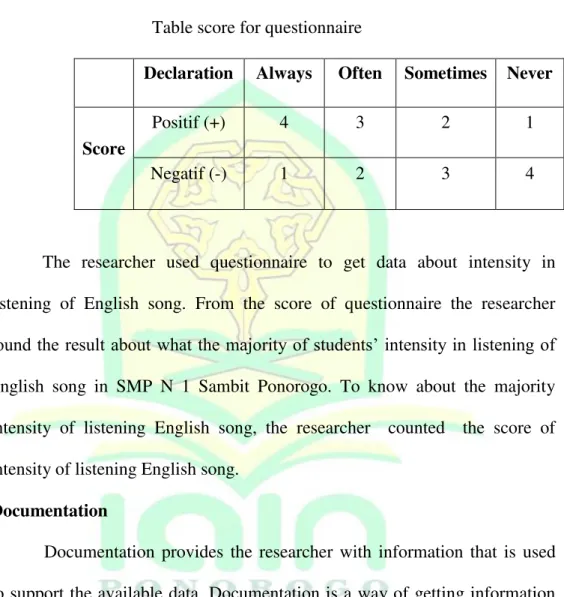
arrange the items of instrument which can be either a question or a statement.33 Scoring of multiple choice items related as the following:
Table 3.1 Table score for questionnaire
Declaration Always Often Sometimes Never
Score
Positif (+) 4 3 2 1
Negatif (-) 1 2 3 4
The researcher used questionnaire to get data about intensity in listening of English song. From the score of questionnaire the researcher found the result about what the majority of students‟ intensity in listening of English song in SMP N 1 Sambit Ponorogo. To know about the majority intensity of listening English song, the researcher counted the score of intensity of listening English song.
2. Documentation
Documentation provides the researcher with information that is used to support the available data. Documentation is a way of getting information or data through notes, transcript, books, newspaper, magazines, and agenda.34
33 Ibid, 93.
34 Suharsimi Arikunto, Prosedur Penelitian Suatu Pendekatan Praktik, (Yogyakarta:
Rineka Cipta,2002), 158
The material of document is about public records, textbooks, letter, films, tapes, diaries, theme, reports, and so on.35 In this research, the researcher used documentation to obtain data of students‟ vocabulary mastery that can be determined from the score of middle test at eighth grade of students SMPN 1 Sambit Ponorogo in Academic year 2016/2017.
D.Instrument of Data Collection
Instrument is an implement used for a particular purpose, especially for delicate or scientific work. Instrument of data collection is the way to get the data in this research by researcher. Data is an important factors because data is as the explanation which needs the truth of hypothesis. To get objectives data it is a good instrument.
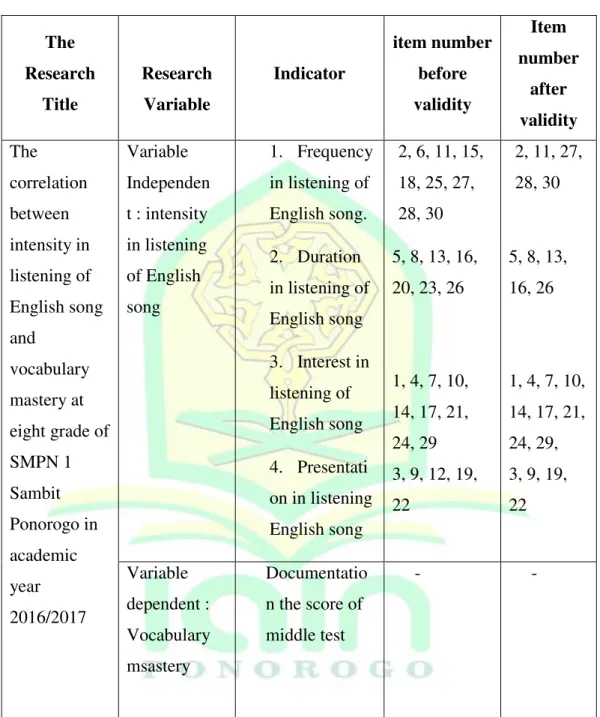
As the data collecting instrument in the research, it can be looked on the table as below:
35 Donald Ary, et al. Introduction to Research in Educational, 8th ed (Canada:
Wadsworth cencage learning. 2010), 29
Table 3.2 The
Research Title
Research Variable
Indicator
item number before validity
Item number
after validity The
correlation between intensity in listening of English song and
vocabulary mastery at eight grade of SMPN 1 Sambit Ponorogo in academic year 2016/2017
Variable Independen t : intensity in listening of English song
1. Frequency in listening of English song.
2. Duration in listening of English song 3. Interest in listening of English song 4. Presentati on in listening English song
2, 6, 11, 15, 18, 25, 27, 28, 30 5, 8, 13, 16, 20, 23, 26
1, 4, 7, 10, 14, 17, 21, 24, 29 3, 9, 12, 19, 22
2, 11, 27, 28, 30
5, 8, 13, 16, 26
1, 4, 7, 10, 14, 17, 21, 24, 29, 3, 9, 19, 22
Variable dependent : Vocabulary msastery
Documentatio n the score of middle test
- -
Before the questionnaire given to the respondents, it was tested first to know the its validity and reliability. The purpose of this test is to make the questions valid and reliable as an instrument research.
1. Validity
Validity is an important key to effective research. According to Karl person, validity is the correlation product moment technique.36 The formulation is as follow:
Rxy =
)(
)(N x2 x 2 N y2 y 2
y x xy N
Notes :
rxy = the correlation coefficient between X variable and Y variable.
∑xy = the total number of multiplication score of X variable (intensity in listening of English song)
Y = variable (students vocabulary mastery)
∑x = the total number of X variable score.
∑y = the total number of Y variable score.
∑x2 = the total number of square score of X variable.
∑y2 = the total number of square score of Y variable.37
The steps of the data analysis applied in this research are:
a. Determining ∑x, ∑y, ∑xy, ∑x2, ∑y2.
b. Computing by applying the formula of product moment correlation.
c. Determining of significant standard 5% and 1%.38
36 Retno Widyaningrum, Statistika, (Yogyakarta : Pustaka Felica, 2011), 105.
37 Ibid, 107
Each item of questionnaire was valid if the value or the coefficient of the validity rxy is higher than r table (rt) or it can be said that ri > rt where rt is 0.432 for n = 22 at the level of significant 5%. To the validity test in this instrument, the researcher took a sample of 22 respondent using 30 item instruments about students‟ intensity in listening of English song. The result of validity could be seen as the table below:
Table 3.3
The calculation result of data validity, as follow39:
Variable No. Instrument Calculated “r” table Explanation X variable:
intensity in listening of English song
1 0.569 0.432 Valid
2 0.526 0.432 Valid
3 0.581 0.432 Valid
4 0.555 0.432 Valid
5 0.495 0.432 Valid
6 0.421 0.432 Invalid
7 0.639 0.432 Valid
8 0.633 0.432 Valid
9 0.702 0.432 Valid
10 0.504 0.432 Valid
11 0.691 0.432 Valid
12 0.008 0.432 Invalid
13 0.501 0.432 Valid
14 0.656 0.432 Valid
15 0.249 0.432 Invalid
16 0.722 0.432 Valid
17 0.830 0.432 Valid
18 0.228 0.432 Invalid
38 Suharsimi Arikunto, Prosedur Penelitian Suatu Pendekatan Praktik (Yogyakarta:
Rineka Cipta, 2002), 276.
19 0.567 0.432 Valid
20 0.268 0.432 Invalid
21 0.494 0.432 Valid
22 0.640 0.432 Valid
23 0.224 0.432 Invalid
24 0.575 0.432 Valid
25 0.095 0.432 Invalid
26 0.697 0.432 Valid
27 0.504 0.432 Valid
28 0.535 0.432 Valid
29 0.518 0.432 Valid
30 0.572 0.432 Valid
From the table above the researcher concludes that 76.6 % of data validity can be interpreting as sufficient correlation and 23.4% of data validity are low correlation.
2. Reliability
Reliability is used to measure instruments of data collection and identify the reliable of data collection, especially questionnaire. In quantitative research, reliability means dependability. It means that the numerical results produced by an indicator do not vary because of characteristic of measurement instruments itself.40 So the instrument reliability test was conducted in order to determine the consistency of the instrument as a measuring tool.
40 William Lawrence Neumann, Social Research Methods Qualitative and Quantitative Approaches (Unites States of America: Allyn and Bacon, 1999) 165.
The reliability in this research is measured through two kinds of method, the first method with the split-half method. The test is divided into half based on the odd-even of item. By applying this method, it is rescored, yielding two scores-one for each half – for each test taker.41 Then compute the correlation between the two sets of scores. The steps to measure the reliability are:
a. Make the table of item analysis of all item b. Make the table of odd-even split
c. Apply the data to the formula of product moment correlation Rxy =
)(
)(n x2 x2 n y2 y 2 y
x xy n
d. Apply the result to the Spearman – Brown formula Notes:
r b ri r b
1
. 2
ri = instruments reliability
rb = rxy as the indexes of correlation between split half
e. Consult the correlation result (ri) to the “r” table of product moment after finding out the degrees of freedom (df). The formula is:
df = N-nr
41 Lyle F. Bachman, Fundamental Considerations in Language (New York: Oxford University Press, 1997), 174.
Notes:
df = degrees of freedom N = number of cases Nr = number of variables
The instruments was reliable if the value or the coefficient of the reliability is higher than r table where rt is 0.432 for n=22 at the level of significance 5%. The instruments of reliability test can be shown as the table 3.4
Table 3.4
The Calculation Result of Reliability Test
Reliable Value ri Table r Conclusion
Students‟
intensity in listening of English song
O.887 0.432 reliable
Based on the instrument test table above, it can be seen the value ri 0.887 ≥ 0.432. So the instrument can be used for further research.
E.Technique of Data Analysis
The technique used to analyze the data is correlation product moment as the formula. This technique used because the writer would like to measure the students‟ intensity in listening of English song and vocabulary mastery at eighth grade of students SMPN 1 Sambit Ponorogo in academic year 2016/2017.
In this research the writer use two techniques to analyze the data that have been collected. They are:
1. The technique use to classify the students into three criterias, they are up rank (high), middle rank (sufficient), and bottom rank (low). The formula are :
n Mx
fx2 2
n fx n
SDx fx
Notes:
Mx = mean of intensity in listening of English song
SDx = standard deviation of intensity in listening of English song
∑fx2 = number of frequency of every interval with x‟2
∑fx = number of frequency of every interval with x‟
This technique is used to analyze students vocabulary mastery. This technique classify the students into three criteria. They are up rank (high), middle rank (sufficient), and bottom rank (low).
Notes:
n My
fy2 2
n fy n
SDy fy
My = mean of students vocabulary mastery
SDy = standard deviation of students vocabulary I = interval class
∑fy2 = number of frequency of every interval with y‟2
∑fy = number of frequency of every interval with y‟
This technique is used to analyze students vocabulary mastery at eighth grade of SMPN 1 Sambit Ponorogo. This technique classify the students into three criterias. They are up rank (high), middle rank (sufficient), and bottom rank (low).
2. The data that has been collected by using research instrument to be analyzed.
Dealing research construction, it correlates between two variables and two data that were obtained are interval. The technique of data analysis in this research is the product moment formula for the data 30 or more 30. Thus, to know whether or not there is significant correlation between intensity in listening of English song and vocabulary mastery at eighth grade of SMPN 1 Sambit Ponorogo in Academic year 2016/2017. The formula is as follows:42
Rxy =
)(
)(n x2 x2 n y2 y 2 y
x xy n
Where:
r = Index of correlation “r” product moment
n = Sample
(∑xy) = The sum of score x and y
42 Retno Widyaningrum, Statistika, (Yogyakarta: Pustaka Feshila, 2015), 107.
(∑x) = The total of score x (∑y) = The total of score y Interpretation:
The Researcher searches the degrees of freedom (df) = N-nr (number of variables that we have correlated). Then, the researcher looks in “r” product moment value table.43
If rxy ≥ rt then Ho is rejected/ Ha is accepted, so unsubstantiated, mean between students‟ intensity in listening of English song and students‟ vocabulary mastery, there is a positive correlation that significant. If rxy ≤ rt then Ho is accepted/ Ha is rejected, so unsubstantiated, mean between students‟ intensity in listening of English song and students‟ vocabulary mastery, there is no positive correlation that significant.
43 Ibid, 111
CHAPTER IV RESEARCH RESULT A.Research Location
1. Historical Background of SMPN 1 Sambit Ponorogo
Formerly, SMPN 1 Sambit was Technology School (ST) filial to ST Negeri 2 Ponorogo before becoming SMPN 1 Sambit in 1968. It takes place in Tamansari, Sambit Ponorogo. In April 1979 ST Negeri 2 Ponorogo integrated to SMPN 4 Ponorogo. After passing through the process, in October 09 1982 SMPN 4 Ponorogo changed to SMPN 1 Sambit based on SK Pendirian Number: 0299/0/1982 in October 09 1982. On 1991 school's
‟address moved to Campursari, Sambit Ponorogo.
2. Profile of SMPN 1 Sambit Ponorogo
School : SMP NEGERI 1 KEC. SAMBIT
Address : Pajajaran Street No. 11 Campursari Village
District/ Sub-province/ City : Sambit
Phone/ Fax : (0352) 311211
Institution (for private sector) : - Institution‟s address & phone : -
NSS/ NSM/ NDS : 201051104001
Level of Accreditation : A
Established : 1982
Operate on : 1982
Ownership of land/ building : Property of the government
Land Status : Right of Property
Wide of Land : 14.305 m2
Ownership of far class land : -
Land Status : -
Wide of Land : -
Status of property owned building : School
Width : 2183 m2
3. Vision and Mission of SMPN 1 Sambit Ponorogo a. The Vision of SMPN 1 Sambit
Smart, skilful, and competitive based on science and technology and also good meet.
b. The Mission of SMPN 1 Sambit
1) Developing diversified KTSP oriented on improvement of students service according to potency, growth, need and students‟ interest and also environment demand.
2) Optimalizing the learning process using nonconventional approach such as CTL, PAKEM (active, creative, effective, and fun learning) 3) Improving National Examination‟s GSA (Gain Sore Achievement) 4) Improving human resources (SDM) such as teachers and educational
personnel
5) developing the education facilities (technology) 6) developing the education management
7) developing the stakeholder participation to school 8) developing the learning media
9) developing the assessment process and strategy 10) Improving carry and practice of religion c. The Goal of SMPN 1 Sambit
1) Improving KTSP completed with syllabus on each subject, Lesson Plan, Students task, and assessment system
2) Realizing learning practice using Contextual Teaching and Learning approach (CTL), active, creative, effective, and fun (PAKEM)
3) Improving academic achievement with NUN score according to minimal pass standard
4) Realizing the performance of teachers and educational personnel with determined qualification.
5) Improving the domination of basic technology
6) Improving the performance of standard school management with management based school
7) Realizing the participation of stake holder in the school 8) Developing multimedia and multi strategies learning
9) Developing assessment system for all subjects according to national standard
10) Make students carry out the religion and practice it through pray together, reading and writing the holy Qur‟an and the other religious activities.
4. Teacher and Students Condition
There are 330 students of SMPN 1Sambit in academic year 2016/2017. It is divided into three grades; seventh grade, eight grade and ninth grade. The total number of seventh grade student is 90, the eighth grade students are 100, and the ninth grade students are 142.
The teachers of this school are 37 teachers. They are 25 teachers (Civil Public Servant), 4 staffs (Civil Public Servant), and 8 staffs (Non Civil Public Servant). That is the condition of students and teachers at SMPN 1 Sambit in academic year 2016/2017.
5. School Facilities
School facilities are important component that determine the successful of teaching and learning process. The adequate facilities will make teaching and learning process go smoothly so that the expected result can be reached.
The Facilities of SMPN 1 Sambit are headmaster‟s room, office, teacher‟s room, library, science laboratory, language laboratory, auditorium, artistry room, skill room, and school Healthy Unit room.
6. Organizational Structure of SMPN 1 Sambit Ponorogo
School organization of SMPN 1 Sambit Ponorogo contains of Headmaster, Administrator, Vice of Curriculum, Vice of Students, Librarian, Public Relation, Storage Environment, Computer Laboratory, Science Laboratory, Media Technician, Teachers, Counsellor, and Class of Guardian.
B.Data Description
Population of this research is the eighth grade students of SMPN 1 Sambit in academic year 2016/2017. The researcher took 22 students as sample. There are 5 classrooms of eighth grade, so the researcher took 20% students from each class.
The data description both variables are gotten from questionnaire score.
1. Intensity in listening of English song
The table below showed the score of intensity in listening of English song of eighth grade students in SMPN 1 Sambit. It is gotten from the answer of questionnaire that is spread to the students. The score of intensity in listening of English song questionnaires can be summarized as follow:
Table 4.5
The score of intensity in listening of English song questionnaires of eighth grade students of SMPN 1 Sambit
No. Name Score of intensity in listening
of English song
1 Ade Rahma Yolanda 76
2 Ahmad Faisal 58
3 Afrizal Ikhwa Dwi Nugroho 50
4 Alfina Damayanti Istiqomah 52
5 Alif Danika Wahyudiono 40
6 Charissa Anindya Ade M.. 73
7 Danang Ferdiansyah P. 61
8 Dian Widyasari 53
9 Dwi Yunita Sari 49
10 Esly Firdausa Utomo 78
11 Hendra Kurniawan 41
12 Indra Bayu Putra 60
13 Inne Annanda Ariandany 57
14 Merynda Bella Setyana 67
15 Moch. Sayyidil Mursalin 39
16 Nabila Putri Ammar S. 74
17 Nenden Purbasari 71
18 Putri Triana 64
19 Risma Syerly Dwinanda 71
20 Roy Setiawan 40
21 Tutik Komariyah 50
22 Wahyu Shela Firdayanti 69
2. Students’ Vocabulary Mastery
This is the description of vocabulary mastery and the researcher used data documentation to analyze students‟ vocabulary mastery. The data gotten from data documentation students‟ middle test at eighth grade students‟ of
SMPN 1 Sambit Ponorogo in academic year 2016/2017. The result of vocabulary mastery can be shown in the table 4.6
Table 4.6
No. Name Score of students’ vocabulary
mastery
1 Ade Rahma Yolanda 100
2 Ahmad Faisal 89
3 Afrizal Ikhwa Dwi Nugroho 85
4 Alfina Damayanti Istiqomah 86
5 Alif Danika Wahyudiono 78
6 Charissa Anindya Ade M.. 93
7 Danang Ferdiansyah P. 89
8 Dian Widyasari 84
9 Dwi Yunita Sari 81
10 Esly Firdausa Utomo 79
11 Hendra Kurniawan 68
12 Indra Bayu Putra 93
13 Inne Annanda Ariandany 48
14 Merynda Bella Setyana 76
15 Moch. Sayyidil Mursalin 57
16 Nabila Putri Ammar S. 100
17 Nenden Purbasaris 100
18 Putri Triana 69
19 Risma Syerly Dwinanda 98
20 Roy Setiawan 59
21 Tutik Komariyah 71
22 Wahyu Shela Firdayanti 63
C.Data Analysis
1. The Data Analysis About Students’ Intensity in Listening of English Song at Eighth Grade of SMPN 1 Sambit Ponorogo
The data analysis was conducted to answer the statement of the first problem of the research (descriptive). To obtain data about students‟ intensity in listening of English song, researcher used data collection method such as questionnaire. After knowing the score of questionnaire, the researcher looks for Mx and SDx to determine the category of students‟ intensity in listening of English song.
There steps to know students‟ intensity in listening of English song, they are:
a. Determine Mx b. Determine SDx
c. Determine the top up of students‟ intensity in listening of English song d. Determine the bottom of students‟ intensity in listening of English song e. Make the analysis students‟ intensity in listening of English song
Table 4.7
x F Fx x=x-Mx x2 fx2
78 1 78 78-59 = 19 6084 6084
76 1 76 76-59 = 17 5776 5776
74 1 74 74-59 = 15 5476 5476
73 1 73 73-59 = 14 5329 5329
71 2 142 71-59 = 12 5041 10082
n Mx
fx22
1293 Mx
77272727 ,
58 Mx
59 Mx
After determining Mx, then the researcher determines SDx. It is conducted to know how much standard of deviation of students‟ intensity in listening of English song score, the formula is as follows:
2 2
n fx n
x SDx f
69 1 69 69-59 = 10 4761 4761
67 1 67 67-59 = 8 4489 4489
64 1 64 64-59 = 5 4096 4096
61 1 61 61-59 = 2 3721 3721
60 1 60 60-59 = 1 3600 3600
58 1 58 58-59 = -1 3364 3364
57 1 57 57-59 = -2 3249 3249
53 1 53 53-59 = -6 2809 2809
52 1 52 52-59 = -7 2704 2704
50 2 100 50-59 = -9 2500 5000
49 1 49 49-59 = -10 2401 2401
41 1 41 -41-59 = 18 1681 1681
40 2 80 40-59 = -19 1600 3200
39 1 39 39-59 = -20 1521 1521
F=22 ∑fx = 1293
∑x2 =
70202 ∑fx2 = 79343