Chapter 7. Three-coordinate copper(I) supported by bis(phosphino)borate ligands
7.1. Introduction
Copper(I) is a highly versatile metal from a coordination standpoint, readily accessing coordination numbers two, three, and four. Its coordinative lability allows copper(I) to play a significant role in many catalytic and stoichiometric processes, including catalytic hydrocarbon functionalization reactions,1 catalytic oxidation reactions,2 and biomimetic dioxygen activation.3 Understanding and controlling the coordination sphere of a metal ion is often key to developing new reaction chemistry. In this area, both sterics and electronics are used to modify the behavior of a transition metal. Several well-defined copper(I) systems have been developed recently using ligands designed to control both steric and electronic factors that dictate reactivity profiles. These ligands include modified bis- and tris(pyrazolyl)borates,4 β- diketiminates,5 N-heterocyclic carbenes,6 and other nitrogenous ligands.7
In this chapter, we introduce a series of copper(I) complexes coordinated by monoanionic bis(phosphino)borate ligands. Our aim is to develop a family of well-defined neutral and anionic three-coordinate phosphine-ligated copper(I) complexes.
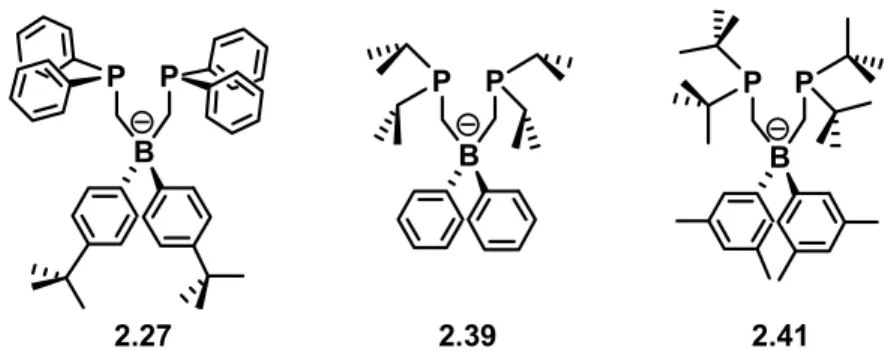
Recently, we have demonstrated the ability to prepare bis(phosphino)borates with diverse steric and electronic attributes,8 which may allow us to direct the reaction chemistry of copper(I). The aim of this initial study is to develop reliable protocols for the generation and isolation of these new copper species, to establish their structural characterization, and to assess their fundamental substitution chemistry. In this context, we examine the copper(I) coordination chemistry of three bis(phosphino)borate ligands: [(p-
tBuPh)2B(CH2PPh2)2][ASN] (2.27[ASN]), [Ph2B(CH2PiPr2)2]Li(THF)2 (2.39[Li]), and [(3,5-Me2Ph)2B(CH2PtBu2)2]- (2.41[Li] and 2.41[Tl]) (Figure 7.1). In particular, we
emphasize the use of the sterically encumbered tert-butyl phosphine ligand 2.41 for its ability to support three-coordinate copper(I) complexes. Our hope is that the complexes described here will serve as useful “[BP2]CuI(L)” synthons in the context of future group transfer studies.
B P P
B P P B
P P
2.27 2.39 2.41
Figure 7.1. Bis(phosphino)borate ligands used to prepare copper(I) complexes.
7.2. Results and discussion
7.2.1. Copper(I) complexes containing halides
The formation of low-coordinate copper complexes using bis(phosphino)borate ligands was examined using several Cu(II) precursors such as CuCl2·0.8THF,9 anhydrous Cu(OAc)2 and Cu(OTf)2. As has been observed in previous efforts to develop Cu(II)-phosphine chemistry,10 Cu(II) is reduced to Cu(I) in the presence of a phosphine ligand to provide a variety of uncharacterized diamagnetic products. In comparison, copper(I) starting materials provided clean 1:1 adducts with monoanionic bis(phosphino)borate ligands. Anionic salts of copper(I) halides were prepared using the phenyl substituted phosphine [(p-tBuPh)2B(CH2PPh2)2]- (2.27) or tert-butyl substituted phosphine [(3,5-Me2Ph)2B(CH2PtBu2)2]- (2.41) ligands. For example, reacting 2.27[ASN] with CuI in THF/EtOH solution resulted in the near quantitative isolation of [[(p-tBuPh)2B(CH2PPh2)2]CuI][ASN] (7.1) (eq 7.1). Reactions using the [Ph2B(CH2PPh2)2][ASN] (2.25[ASN]) ligand provided similar results with CuI and CuCl;
however, the addition of tert-butyl substituents onto the backbone of the ligand framework increased the solubility of the complexes.
Ph2 (p-tBuPh)2B P
PPh2
Cu I
[ASN]
(7.1) THF/EtOH
2.27+ CuI
7.1
Similar attempts to prepare 1:1 adducts of copper(I) halides using the alkyl substituted phosphine ligands 2.39[Li] or 2.41[Li] gave more complicated results. For example, the reaction of copper(I) iodide with either 2.39[Li] or 2.41[Li] resulted in the immediate precipitation of black sediment and concomitant phosphine ligand degradation as observed by 31P{1H} and 11B{1H} NMR spectroscopy. However, it was found that combining pure copper(I) chloride and 2.41[Li] in THF solution provided a single product as observed by 31P{1H} NMR spectroscopy. Spectroscopic and elemental analysis are consistent with the formation of [[(3,5-Me2Ph)2B(CH2PtBu2)2]CuCl]
[Li(THF)4] (7.2) (eq 7.2). Based on these results, the ability to prepare copper(I) halides using the alkyl substituted phosphine ligands 2.39 or 2.41 requires a less reduction-sensitive copper(I) starting material (i.e., CuCl instead of CuI) in order to bypass electron-transfer pathways.
(3,5-Me2Ph)2B P
PtBu2
Cu Cl (7.2)
2.41[Li]
CuCl+ THF
tBu2 [Li(THF)4]
7.2
Anionic complexes 7.1 and 7.2 may be either three-coordinate monomers or four- coordinate, halide-bridged dimers in solution. A significant body of work on {P2CuX}
complexes (P = phosphine, X = Cl, Br, I) shows that their coordination geometry varies
between three-coordinate (P2CuX) or four-coordinate with bridging halides ({P2Cu(µ-X)}2).11,12 For some phosphines, such as PPh3, structural data have been obtained for both forms.11b,11c A related example containing the tert-butyl substituted chelating bis(phosphine) ligand dtbpe (dtbpe = tBu2PCH2CH2PtBu2) provided the dimeric structure {(dtbpe)Cu(µ-Cl)}2.13
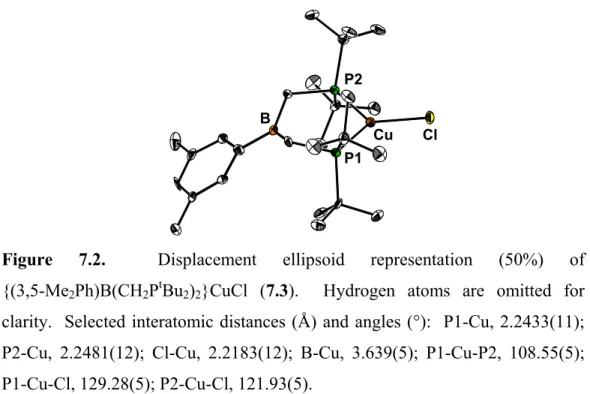
B
Cu Cl P2
P1
Figure 7.2. Displacement ellipsoid representation (50%) of {(3,5-Me2Ph)B(CH2PtBu2)2}CuCl (7.3). Hydrogen atoms are omitted for clarity. Selected interatomic distances (Å) and angles (°): P1-Cu, 2.2433(11);
P2-Cu, 2.2481(12); Cl-Cu, 2.2183(12); B-Cu, 3.639(5); P1-Cu-P2, 108.55(5);
P1-Cu-Cl, 129.28(5); P2-Cu-Cl, 121.93(5).
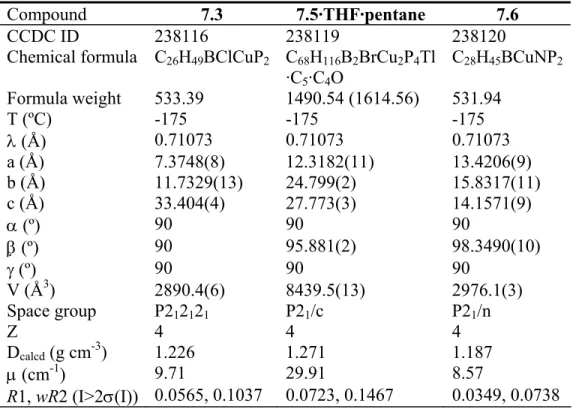
Several reactions between 2.41[Li] and impure copper(I) halide-containing reagents provided a common secondary product. For instance, reactions between 2.41[Li] and impure CuCl provided a mixture of phosphine containing products as observed by 31P{1H} NMR spectroscopy. Along with the formation of 7.2 as the major product, two minor products were often observed. One of the minor products proved to be isolable by fractional crystallization. X-ray diffraction of crystals obtained from the reaction show it to be {(3,5-Me2Ph)B(CH2PtBu2)2}CuCl (7.3) (Figure 7.2). Neutral 7.3 results from the loss of an aryl ring from the borate ligand, generating a neutral
bis(phosphino)borane ligated to copper(I) chloride. Related examples of (phosphino)borate ligand degradation have been observed in iridium, rhodium, cobalt, platinum, and nickel chemistry.14 In all of these cases, a boron-carbon bond is also cleaved. Previous examples, however, have all shown the boron-methylene link to be the preferential site of reaction. The present example demonstrates that the boron-aryl link is also susceptible to being broken.
The spectroscopic identification of 7.3 was supported by the independent synthesis of a structurally analogous species, {PhB(CH2PtBu2)2}CuCl (7.4). Reacting neutral PhB(CH2PtBu2)2 with CuCl in THF solution provided a high yielding route to 7.4 (97% yield).15 Neutral 7.4 has two important spectroscopic features. First, the 11B{1H}
NMR spectrum of 7.4 (singlet at 75.2 ppm) confirms the three-coordinate nature of the boron atom.16 Second, the 31P{1H} NMR chemical shift of 7.4 (23.11 ppm) is consistent with with the resonance ascribed to 7.3 (23.75 ppm). Products with similar 31P{1H}
NMR resonances have been observed in reactions of 2.41 and other impure copper(I) halide-containing reagents such as Me2S·CuBr. It is likely that copper(II) impurities have formed in the copper(I) materials over time as a result of oxidative processes and that these impurities could give rise to species such as 7.3.
To circumvent ligand degradation pathways, alternative copper(I) sources were considered. The substituted halide precursor Me2S·CuBr is one such reagent. Our hypothesis was that a ligated copper(I) halide may be less susceptible to reduction processes. In addition, clean metalation may result from thallium halide precipitation to provide a neutral complex. Upon addition of a THF solution of 2.41[Tl] to Me2S·CuBr, thallium bromide precipitated from solution, and NMR spectroscopy showed a major
product containing a single, symmetric ligand environment. Crystals obtained by crystallization of the reaction mixture were analyzed by X-ray diffraction and provided the molecular structure of dimeric [{[(3,5-Me2Ph)2B(CH2PtBu2)2]Cu}2(µ-Br)]Tl (7.5) (Figure 7.3). Only one-half of an equivalent of TlBr formed in the reaction along with the loss of dimethyl sulfide (eq 7.3).
(3,5-Me2Ph)2B P
PtBu2
Cu Br (7.3)
2.41[Tl]
+
Me2S·CuBr THF - 1/2 TlBr
- Me2S
tBu2 [Tl]
7.5 1/2
2
Br Cu2
B2 P4
P3 Tl
Cu1 P1
P2 B1
Figure 7.3. Displacement ellipsoid representation (50%) of [{[(3,5-Me2Ph)2B(CH2PtBu2)2]Cu}2(µ-Br)]Tl·THF·pentane (7.5·THF·pentane).
Hydrogen atoms and solvent molecules are omitted for clarity. Selected interatomic distances (Å) and angles (°): P1-Cu1, 2.238(2); P2-Cu1, 2.230(2);
P3-Cu2, 2.235(2); P4-Cu2, 2.231(2); Cu1-Br, 2.3660(12); Cu2-Br, 2.3638(12);
B1-Cu1, 3.819(8); B2-Cu2, 3.829(8); P1-Cu1-P2, 110.67(7); P1-Cu1-Br, 125.55(7); P2-Cu1-Br, 123.78(7); P3-Cu2-P4, 110.60(7); P3-Cu2-Br, 124.63(7);
P4-Cu2-Br, 124.70(7); Cu1-Br-Cu2, 178.00(6).
The structure of the 7.5 shows two copper centers connected by a linear bromide bridge, providing an overall monoanionic bimetallic species balanced by a thallium
countercation. All of the phosphine, copper, bromide, and boron atoms of 7.5 are coplanar, with the chelate phosphine ligand in its typical twisted boat conformation. In the molecular structure, the thallium atom resides in the pocket formed by the electron-rich aryl rings of the borate anion. The coordination of thallium by the aryl borate was also observed in the molecular structure of [Ph2B(CH2PPh2)2]Tl (2.41[Tl]).8 Halide-bridged systems are well known for copper(I), although there are few structurally characterized examples of copper centers bridged by a single halide.17 This example appears to be the first of its kind for phosphine-coordinated copper(I). In addition, all previous examples that have been structurally characterized have shown the copper-halide-copper angle to be significantly bent, whereas the present example contains a linear halide bridge (Cu1-Br-Cu2 = 178.00(6)°). Attempts to induce loss of TlBr in solution by presenting a donor ligand such as PMe3, pyridine, or acetonitrile have not been successful.
7.2.2. Neutral three-coordinate acetonitrile copper(I) complexes
To access more substitutionally labile copper(I) complexes, the copper(I) reagent [Cu(CH3CN)4][PF6] proved effective. Reaction of the alkyl-substituted phosphine ligands 2.39[Li] or 2.41[Li] with [Cu(CH3CN)4][PF6] in THF solution led to rapid formation of the three-coordinate products [Ph2B(CH2PiPr2)2]Cu(NCCH3) (7.6) and [(3,5-Me2Ph)2B(CH2PtBu2)2]Cu(NCCH3) (7.7) (eq 7.4 and eq 7.5). Isolated yields of 7.6 are typically about 40% due to the difficulty in separating [Li(solvent)x][PF6] from 7.6.
In comparison, 7.7 can be isolated in greater than 80% yield. Both compounds have been fully characterized by NMR spectroscopy and elemental analysis. Examination of the IR spectra for 7.6 and 7.7 showed νCN at 2265 and 2267 cm-1, respectively. These stretches
are consistent with acetonitrile acting as a weakly bound σ-donor. Previously reported IR data for phosphine-coordinated copper(I) acetonitrile complexes show a wide range of C≡N stretching frequencies (2268 to 2361 cm-1), all of which are above the value for the free ligand (CH3CN, thin film on KBr: 2253 cm-1).18 This is consistent with the absence of π-backbonding from the d10 metal to the nitrile ligand.
Ph2B P
PiPr2
Cu NCCH3 (7.4)
2.39[Li]
+
[Cu(CH3CN)4][PF6] THF - LiPF6
iPr2
7.6
(3,5-Me2Ph)2B P
PtBu2
Cu NCCH3 (7.5)
2.41[Li]
+
[Cu(CH3CN)4][PF6]
tBu2
7.7 THF
- LiPF6
An X-ray diffraction study demonstrated the three-coordinate nature of 7.6 (Figure 7.4). The bis(phosphino)borate ligand is again in a twisted boat conformation:
this solid state arrangement has been observed frequently for the bis(phosphino)borate class of ligands.8,19 Two parameters of interest from the molecular structure of 7.6 are the B-Cu distance and the acetonitrile coordination geometry. In other structures of transition metal complexes coordinated by bis(phosphino)borate ligands, the B-Cu distance in the twisted-boat conformation has typically been observed at B-M = 3.91 to 4.12 Å (M = Fe, Co, Rh, Pd, Pt). In the structure of 7.6 and related three-coordinate structures in this chapter, the B-M distance is relatively short (7.6: B-Cu = 3.823(2) Å).
This is presumably due to the expansion of the P-M-P angle (103.35(2)°) resulting from the three-coordinate structure and the sterically small acetonitrile ligand. Also, the acetonitrile ligand in 7.6 adopts a distorted coordination mode. Rather than residing in
the P-Cu-P plane, the nitrile is canted below the plane and to one side of the C2 axis.
This is likely a solid-state phenomenon, as the solution spectra of 7.6 are consistent with a molecule having a C2 axis.
Cu N
B
P2 P1
Figure 7.4. Displacement ellipsoid representation (50%) of [Ph2B(CH2PiPr2)2]Cu(NCCH3) (7.6). Hydrogen atoms are omitted for clarity.
Selected interatomic distances (Å) and angles (°): P1-Cu, 2.2349(6); P2-Cu, 2.2556(6); Cu-N, 1.934(2); B-Cu, 3.823(2); P1-Cu-P2, 103.35(2); P1-Cu-N, 133.25(5); P2-Cu-N, 118.98(5).
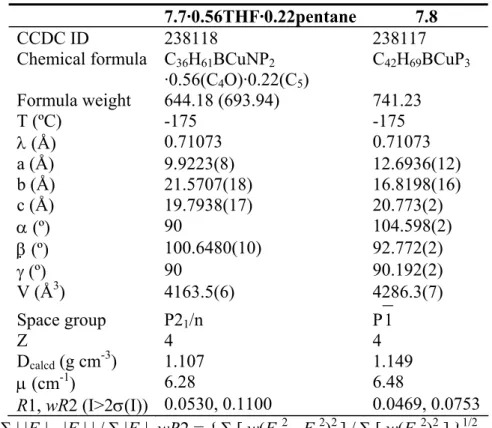
An X-ray diffraction study carried out on 7.7 also shows a trigonal planar three-coordinate copper center (Figure 7.5). The structural parameters of 7.7 are quite similar to those found for 7.6, with two minor differences. First, the acetonitrile ligand is coincident with the C2 axis of the molecule and is thus colinear with the B-Cu vector.
Second, the P-Cu-P angle is modestly wider (108.55(3)°) than that observed in 7.6 (103.35(2)°). The slightly wider bite angle of the bis(phosphine) does not result in a corresponding contraction of the B-Cu distance; instead, an increase in the B-Cu distance of 7.7 as compared to 7.6 (3.861(3) vs. 3.823(2) Å) is observed. The acetonitrile compounds 7.6 and 7.7 are structurally distinctive examples of monomeric phosphine- supported nitrile adducts of three-coordinate copper. A few related examples of
phosphine-coordinated copper nitrile complexes have been structurally characterized;20 however, these examples are all either four-coordinate or contain multiple metal centers (e.g., Cu2 or RhCu).
B Cu N
P1
P2
Figure 7.5. Displacement ellipsoid representation (50%) of [(3,5-Me2Ph)2B(CH2PtBu2)2]Cu(NCCH3)·0.56THF·0.22pentane (7.7·0.56THF·
0.22pentane). Hydrogen atoms and solvent molecules are omitted for clarity.
Selected interatomic distances (Å) and angles (°): P1-Cu, 2.2421(8); P2-Cu, 2.2333(8); Cu-N, 1.930(2); B-Cu, 3.861(3); P1-Cu-P2, 108.55(3); P1-Cu-N, 124.94(7); P2-Cu-N, 126.49(7).
7.2.3. Substitution chemistry of the sterically encumbered complex 7.7
The well-defined three-coordinate acetonitrile complexes 7.6 and 7.7 represent precursors to further substitution chemistry at the three-coordinate metal. Accordingly, replacement of the labile acetonitrile complex 7.7 can be carried out for a variety of donors (eq 7.6). Thus, reaction of 7.7 with dimethylphenylphosphine (PMe2Ph), trimethylphosphine sulfide (S=PMe3), 2,6-lutidine, and tert-butylisonitrile (tBuNC) in THF solution provided the corresponding complexes [(3,5- Me2Ph)2B(CH2PtBu2)2]Cu(PMe2Ph) (7.8), [(3,5-Me2Ph)2B(CH2PtBu2)2]Cu(S=PMe3) (7.9), [(3,5-Me2Ph)2B(CH2PtBu2)2] Cu(2,6-lutidine) (7.10), and [(3,5-
Me2Ph)2B(CH2PtBu2)2]Cu(CNtBu) (7.11). All of these substitutions occur in high isolated yields (85-95%) in less than 15 min. These ligands possess different donor properties, and therefore these complexes may prove to be useful three-coordinate copper synthons for further reactivity studies. In addition to PMe2Ph, several other phosphine donors were examined. It was found that triethylphosphine also resulted in clean formation of a three-coordinate complex, while PMePh2 gave a mixture of the three- coordinate adduct and another unidentified product. Interestingly, PPh3 does not substitute the acetonitrile ligand of 7.7, possibly due to steric constraints. Reacting the phosphite ligand P(OPh)3 with 7.7 results in gradual decomposition to multiple undetermined products as observed by 31P{1H} NMR spectroscopy. In addition to more typical two-electron donors, substitution reactions of 7.7 with olefins were attempted. No reaction was observed by 1H or 31P{1H} NMR spectroscopy for the potentially η2-donors ethylene, 1-hexene, styrene, or azobenzene when present in THF solution in 1 to 10 equivalents. Examination of the literature shows that copper(I) complexes supported by phosphine ligands do not readily form stable olefin adducts, typically requiring large olefin excesses21 or chelation effects22 to result in Cu-olefin binding.
(3,5-Me2Ph)2B P
PtBu2
Cu L (7.6)
7.6 THF
tBu2
L L = PMe2Ph, 7.8
L = S=PMe3, 7.9 L = 2,6-lutidine, 7.10 L = CNtBu, 7.11
The tris(phosphine) complex 7.8 was structurally characterized by X-ray diffraction, verifying its three-coordinate geometry (Figure 7.6). The structural parameters of 7.8 reflect the incorporation of a more sterically demanding phosphine donor ligand relative to the acetonitrile ligand of 7.7. For example, the P-Cu-P angle is reduced (103.87(3)° in 7.8 versus 108.55(3)° in 7.7) and the B-Cu distance is increased
(3.972(3) Å in 7.8 versus 3.861(3) Å in 7.7). Also, the average P-Cu bond lengths for the bis(phosphino)borate ligand are modestly longer (2.27 Å in 7.8 versus 2.24 Å in 7.7), likely reflecting the greater electron-releasing nature of PMe2Ph as compared to acetonitrile.
B1
Cu1 P3 P1
P2
Figure 7.6. Displacement ellipsoid representation (50%) of [(3,5-Me2Ph)2B(CH2PtBu2)2]Cu(PMe2Ph) (7.8). Second molecule in the asymmetric unit and hydrogen atoms are omitted for clarity. Selected interatomic distances (Å) and angles (°): P1-Cu1, 2.2714(8); P2-Cu1, 2.2707(8); Cu1-P3, 2.2477(8); B1-Cu1, 3.972(3); P1-Cu1-P2, 103.87(3); P1- Cu1-P3, 127.29(3); P2-Cu1-P3, 128.84(3).
Neutral 7.8 is similar to previously structurally characterized P3Cu complexes (P
= trialkyl phosphine). Several structures reported for [(Ph3P)3Cu]+ 23 and the related [{(p-MeOPh)3P}3Cu]+ cation24 have shown a mean Cu-P length of 2.295 Å and P-Cu-P angles near 120°. Also, Mathey and coworkers reported a macrocyclic P3-phosphinine ligand coordinated to copper, in which the copper lies in a distorted trigonal planar coordination geometry.25 Additionally, there are two reports of bimetallic [Cu2(η1:η1-L2)3]2+ (L2 = dmpm, (Ph2P)2py), where the two copper centers are both in highly symmetric trigonal planar environments.26 The structures of these homoleptic
phosphine adducts are more C3 symmetric in their bond lengths and angles than 7.8, which is better described as an C2v distorted trigonal plane. A similar distorted trigonal planar structure has been reported for dicationic [{(dppf)Cu}2(η1:η1-dppf)]2+,27 with Cu-P bond lengths of 2.280 Å, 2.283 Å, and 2.260 Å and P-Cu-P angles of 124.6°, 123.4°, and 111.3°. In this latter example and 7.8, the distorted trigonal planar structure is a product of the constrained chelated bis(phosphine) ligand.
A complex related to 7.8 is the phosphine sulfide adduct [(3,5-Me2Ph)2B(CH2PtBu2)2]Cu(S=PMe3) (7.9). One example of a similar copper(I) coordination environment in the literature, [{(dppf)Cu}2(η1:η1-dppfS2)][BF4]2.28 Complex 7.9 does not display any remarkable spectral properties; however, its remarkably poor solubility (< 5 mg/mL) in benzene or THF solution as compared to 7.8, 7.10, and 7.11 was unexpected.
Similar to 7.9, the lutidine derivative [(3,5-Me2Ph)2B(CH2PtBu2)2] Cu(2,6-lutidine) (7.10) contains an uncommon coordination environment for copper(I).
The sterically hindered pyridine derivatives 2,6-lutidine and 2,4,6-collidine have been used previously to prepare two- and three-coordinate copper complexes.29-32 In almost all cases, these complexes have been homoleptic substituted pyridine cations or have included a halide or pseudo-halide donor.29-31 One notable exception reported by Omary et al. is the fluorinated bis(pyrazolyl)borate derivative, [H2B(3,5-(CF3)2Pz)2] Cu(2,4,6-collidine).3 2 Similar to 7.10, the monoanionic borate-based [H2B(3,5-(CF3)2Pz)2]- provides a neutral, three-coordinate copper(I) center.
The isonitrile complex [(3,5-Me2Ph)2B(CH2PtBu2)2]Cu(CNtBu) (7.11) is structurally distinct in that it represents the first example of a three-coordinate phosphine
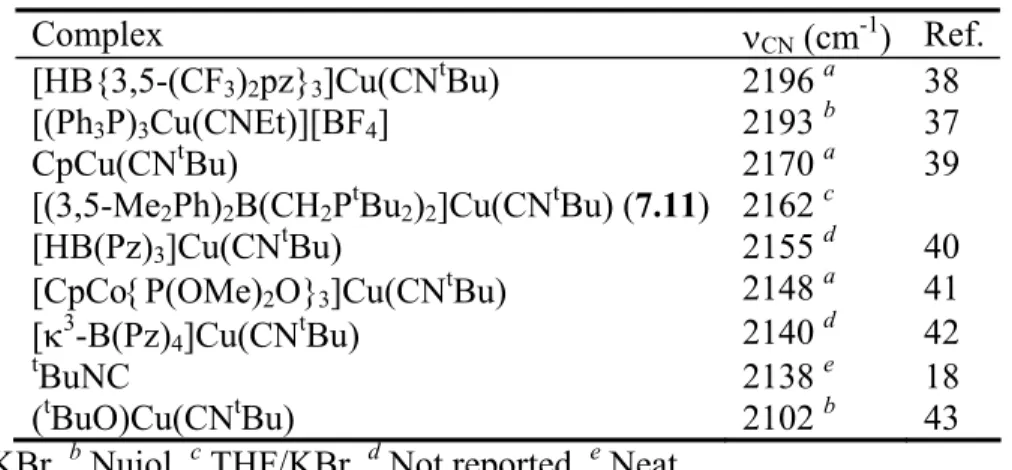
ligated copper monoisonitrile complex to our knowledge. Four-coordinate copper(I) terminal isocyanides containing either three phosphine ligands and an isonitrile or two phosphines and two isocyanides have been described previously.33-37 A key spectroscopic feature of metal-bound isocyanides is their infrared signature. The infrared spectrum of 7.11 shows a νCN band at 2162 cm-1. This value is presented in Table 7.1 along with several other previously reported copper(I) complexes containing a single tert- butyl isonitrile ligand.38-43 As can be seen in Table 7.1, most of the examples have νCN
values greater than that observed for free CNtBu. This increase in the C≡N stretching frequency has been attributed to both poor back-donation from the copper d-orbitals into the ligand π* orbitals and to a strong σ-donor effect that polarizes the C≡N bond.44,45 Thus, the isonitrile ligand in 7.11 is best considered as primarily a strong σ-donor in this context. Since the increase in νCN should be directly proportional to the electrophilicity of the copper(I) metal center, Table 7.1 shows three-coordinate 7.11 to be intermediate in metal electrophilicity among the several four-coordinate isonitrile complexes.
Table 7.1. Infrared resonances (νCN) for some copper(I) monoisonitrile complexes.
Complex νCN (cm-1) Ref.
[HB{3,5-(CF3)2pz}3]Cu(CNtBu) 2196 a 38
[(Ph3P)3Cu(CNEt)][BF4] 2193 b 37
CpCu(CNtBu) 2170 a 39
[(3,5-Me2Ph)2B(CH2PtBu2)2]Cu(CNtBu) (7.11) 2162 c
[HB(Pz)3]Cu(CNtBu) 2155 d 40
[CpCo{P(OMe)2O}3]Cu(CNtBu) 2148 a 41 [κ3-B(Pz)4]Cu(CNtBu) 2140 d 42
tBuNC 2138 e 18
(tBuO)Cu(CNtBu) 2102 b 43
a KBr b Nujol c THF/KBr d Not reported e Neat
Several attempts to prepare a copper carbonyl analogous to 7.11 have provided spectroscopic information about the putative carbonyl complex
[(3,5-Me2Ph)2B(CH2PtBu2)2]Cu(CO) (7.12). To date, no copper carbonyl complexes supported by phosphine ligands have been isolated. This is consistent with the observations of related isonitrile complexes, where copper(I) has been characterized as a relatively poor π-donor. We have found that the reaction between 7.7 and excess CO gas results in the formation of an unstable carbonyl adduct that we formulate as [(3,5-Me2Ph)2B(CH2PtBu2)2]Cu(CO) (7.12). In THF solution, excess carbon monoxide appears to displace the acetonitrile ligand, resulting in a shift in the 31P{1H} NMR resonance from 36.4 ppm to 42.3 ppm. If CO is removed under vacuum, the 31P{1H}
NMR resonance returns to 36.4 ppm. Similarly, if a THF solution of 7.7 is dried under a stream of CO gas, the resulting pale green solids display a 31P{1H} NMR resonance at 44 ppm upon dissolution in benzene-d6. This resonance gradually disappears to be replaced by one at 38 ppm in benzene, suggesting that the CO ligand is displaced. Infrared analysis of the solids isolated by drying under a stream of CO gas shows an infrared band at 2084 cm-1, consistent with a metal-bound carbonyl. The carbonyl species 7.12 does not appear to be stable in the absence of excess CO, forming solvent-bound species with concomitant loss of CO. The lability of the bound carbonyl is consistent with previous results for phosphine-supported copper.20n
(3,5-Me2Ph)2B P
PtBu2
Cu CO (7.7)
tBu2 (3,5-Me2Ph)2B P
PtBu2
Cu NCCH3
tBu2
+ CO - CO
7.7 7.12
7.3. Conclusions
In conclusion, we have prepared and characterized several neutral and anionic copper complexes supported by chelating, monoanionic bis(phosphino)borate ligands. In
particular, the sterically encumbered tert-butyl substituted bidentate phosphine 2.41 is useful for stabilizing three-coordinate species. The substitution chemistry of the labile acetonitrile complex 7.7 has provided several new complexes whose spectroscopic and structural attributes have been highlighted. By exploring the fundamental coordination chemistry of copper(I) supported by bis(phosphino)borate ligands, we have begun to develop a family of well-defined three-coordinate complexes. These studies have provided synthons that should be useful for expanding the reaction chemistry of neutral and anionic phosphine-chelated copper.
7.4. Experimental section 7.4.1. General considerations
Unless otherwise noted, general procedures were performed according to Section 2.4.1.
7.4.2. Starting materials and reagents
The compounds [(p-tBuPh)2B(CH2PPh2)2][ASN] (2.27[ASN]), [Ph2B(CH2PiPr2)2]Li(THF)2 (2.39[Li]), [(3,5-Me2Ph)2B(CH2PtBu2)2]Li(OEt2) (2.41[Li]), [(3,5-Me2Ph)2B(CH2PtBu2)2]Tl (2.41[Tl]) and Me3P=S were prepared by methods described in Chapter 2. tBuNC was purified as described in Chapter 6. 2,6-Lutidine was deoxygenated, and then dried with CaH2 and distilled under dinitrogen.
7.4.3. Syntheses of compounds
[[(p-tBuPh)2B(CH2PPh2)2]CuI][ASN] (7.1). Solid CuI (83.6 mg, 439 µmol) and [(p-tBuPh)2B(CH2PPh2)2][ASN] (351.8 mg, 438.7 µmol) were combined with THF (4 mL) and ethanol (0.3 mL). The reaction mixture was stirred for 2.5 h. Volatiles were removed under reduced pressure. The resulting solids were washed with diethyl ether (3
mL) and dried under reduced pressure, providing analytically pure white 7.1 (432.8 mg, 99.4%).
1H NMR (300 MHz, acetone-d6): δ 7.60 (m, 8H), 7.12 (m, 16H), 6.82 (d, 4H), 3.69 (m, 8H), 2.24 (m, 8H), 1.76 (br, 4H), 1.21 (s, 16H). 13C{1H} NMR (75.4 MHz, acetone-d6): δ 162.7 (br), 144.55, 141.80 (d, 1JP-C = 12.3 Hz), 141.64 (d, 1JP-C = 12.3 Hz), 133.83, 133.71 (d, 2JP-C = 8.0 Hz), 133.60 (d, 2JP-C = 8.0 Hz), 128.72, 128.49 (d, 3JP-C = 4.3 Hz), 128.43 (d, 3JP-C = 4.0 Hz), 123.51, 63.78 (t, (CH2CH2)2N, 1JN-C = 3.4 Hz), 34.42 (Ph-C(CH3)3), 32.15 (Ph-C(CH3)3), 22.84 ((CH2CH2)2N), 22.0 (br, B(CH2PPh2)2).
31P{1H} NMR (121.4 MHz, acetone-d6): δ -13.08. 11B{1H} NMR (128.3 MHz, acetone-d6): δ -12.5. Anal. Calcd. for C54H66BCuINP2: C, 65.36; H, 6.70; N, 1.41.
Found: C, 65.08; H, 6.94; N, 1.21.
[[(3,5-Me2Ph)2B(CH2PtBu2)2]CuCl][Li(THF)4] (7.2). Solid CuCl (26.5 mg, 268 µmol) was suspended in THF (1.5 mL). Stirring, a THF solution (4 mL) of [(3,5-Me2Ph)2B(CH2PtBu2)2]Li(OEt2) (166.2 mg, 268.2 µmol) was added. After stirring for 24 h, analysis by 31P{1H} NMR spectroscopy revealed the formation of a single product. The reaction mixture was filtered. The resulting solution was concentrated under reduced pressure to 0.5 mL. Vapor diffusion of petroleum ether into the THF solution provided white crystalline solids over several days. The isolated solids were dried under reduced pressure to provide [[(3,5-Me2Ph)2B(CH2PtBu2)2]CuCl][Li(THF)4] (163.9 mg, 65.5%).
1H NMR (300 MHz, C6D6/THF-d8, 6:1): δ 7.59 (s, 4H, ortho-(Me2C6H3)2B), 6.62 (s, 2H, para-(Me2C6H3)2B), 3.54 (m, 16H, (CH2CH2)2O) 2.29 (s, 12H, ((CH3)2C6H3)2B), 1.92 (br, 4H, B(CH2PtBu2)2), 1.45 (m, 16H, (CH2CH2)2O) 1.32 (d, 18H, P(C(CH3)3)2,
3JP-H = 5.7 Hz), 1.30 (d, 18H, P(C(CH3)3)2, 3JP-H = 6.3 Hz). 13C{1H} NMR (75.4 MHz, C6D6/THF-d8, 6:1): δ 167.3 (br, ipso-(Me2C6H3)2B), 134.52 (meta-(Me2C6H3)2B), 131.89 (ortho-(Me2C6H3)2B), 124.50 (para-(Me2C6H3)2B), 68.17 ((CH2CH2)2O), 34.22 (d, CH2P(C(CH3)3)2, 1JP-C = 4.6 Hz), 34.16 (d, CH2P(C(CH3)3)2, 1JP-C = 4.6 Hz), 31.05 (br, CH2P(C(CH3)3)2), 30.92 (br, CH2P(C(CH3)3)2), 26.17 ((CH2CH2)2O), 22.68 (((CH3)2C6H3)2B), 14.7 (br, BCH2P). 31P{1H} NMR (121.4 MHz, C6D6/THF-d8, 6:1): δ 33.31. 11B{1H} NMR (128.3 MHz, C6D6/THF-d8, 6:1): δ -14.0. Anal. Calcd. for C50H90BClCuLiO4P2: C, 64.38; H, 9.71. Found: C, 64.30; H, 9.70.
{(3,5-Me2Ph)B(CH2PtBu2)2}CuCl (7.3). Yellow crystals of 7.3 were isolated from a petroleum ether diffusion into a THF solution of a reaction mixture generated in an analogous fashion to the preparation of 7.2. A 31P{1H} NMR spectrum of the solution prior to crystallization showed 7.3 to be present as approximately 15% of the observed diamagnetic phosphorus containing products. 31P{1H} NMR (121.4 MHz, THF): δ 23.75.
{PhB(CH2PtBu2)2}CuCl (7.4). Solid PhB(CH2PtBu2)2 (25.4 mg, 62.5 µmol) and CuCl (6.2 mg, 63 µmol) were combined in THF (4 mL) and stirred for 1 h, forming a homogeneous yellow solution. The solution was filtered, and volatiles were removed under reduced pressure, forming microcrystalline yellow {PhB(CH2PtBu2)2}CuCl (30.7 mg, 97.2%).
1H NMR (300 MHz, C6D6): δ 7.88 (m, 2H), 7.28 (m, 3H), 1.73 (br, 4H, B(CH2PtBu)2), 1.22 (d, 18H, P(C(CH3)3)2, 3JP-H = 6.3 Hz), 1.20 (d, 18H, P(C(CH3)3)2,
3JP-H = 6.6 Hz). 13C{1H} NMR (75.4 MHz, C6D6): δ 134.60, 133.29, 129.05, 34.47 (m, CH2P(C(CH3)3)2), 29.82 (m, CH2P(C(CH3)3)2), 18.8 (br, BCH2P). 31P{1H} NMR (121.4
MHz, C6D6): δ 23.11. 11B{1H} NMR (160.4 MHz, C6D6): δ 75.2. Anal. Calcd. for C24H45BClCuP2: C, 57.04; H, 8.98. Found: C, 57.40; H, 8.67.
[{[(3,5-Me2Ph)2B(CH2PtBu2)2]Cu}2(µ-Br)]Tl (7.5). Solid Me2S·CuBr (16.2 mg, 78.8 µmol) was suspended in THF (3 mL). While stirring, a THF solution (9 mL) of [(3,5-Me2Ph)2B(CH2PtBu2)2]Tl (58.6 mg, 78.8 µmol) was added dropwise. Upon completing the addition, the reaction mixture was stirred for 15 min. The reaction mixture was filtered, removing white and gray solids. The resulting solution was concentrated under reduced pressure to 1 mL. Vapor diffusion of petroleum ether into the THF solution provided colorless crystals over several days. The crystals were dried under reduced pressure to provide 7.5 (28.7 mg, 48.9%).
1H NMR (300 MHz, THF-d8): δ 7.03 (s, 4H, ortho-(Me2C6H3)2B), 6.34 (s, 2H, para-(Me2C6H3)2B), 2.11 (s, 12H, ((CH3)2C6H3)2B), 1.53 (br, 4H, B(CH2PtBu)2), 1.12 (d, 18H, P(C(CH3)3)2, 3JP-H = 6.3 Hz), 1.10 (d, 18H, P(C(CH3)3)2, 3JP-H = 6.0 Hz). 13C{1H}
NMR (75.4 MHz, THF-d8): δ 167 (br), 134.58, 131.50, 124.35, 34.34 (d, CH2P(C(CH3)3)2, 1JP-C = 6.0 Hz), 34.26 (d, CH2P(C(CH3)3)2, 1JP-C = 6.4 Hz), 30.99 (d, CH2P(C(CH3)3)2, 2JP-C = 4.8 Hz), 30.77 (d, CH2P(C(CH3)3)2, 2JP-C = 3.7 Hz), 22.31 (((CH3)2C6H3)2B), 14.8 (br, BCH2P). 31P{1H} NMR (121.4 MHz, THF-d8): δ 38.79.
11B{1H} NMR (128.3 MHz, THF-d8): δ -14.4. Anal. Calcd. for C68H116B2BrCu2P4Tl: C, 54.79; H, 7.84. Found: C, 55.17; H, 7.55.
[Ph2B(CH2PiPr2)2]Cu(NCCH3) (7.6). Solid [Ph2B(CH2PiPr2)2]Li(THF)2 (157.5 mg, 272.2 µmol) and solid [Cu(CH3CN)4][PF6] (101.5 mg, 272.3 µmol) were combined in Et2O (4 mL). The reaction mixture was stirred for 30 min, forming a pale yellow solution. Volatiles were removed under reduced pressure, providing pale yellow solids.
The solids were washed with acetonitrile (3 x 0.5 mL). The resulting solids were dissolved in THF (3 mL) and filtered. Removal of volatiles under reduced pressure provided white solids that analyzed as [Ph2B(CH2PiPr2)2]Cu(NCCH3) (62.7 mg, 43.3%).
Crystals for an X-ray diffraction experiment were grown by vapor diffusion of petroleum ether into a THF solution of 7.6.
1H NMR (300 MHz, THF-d8): δ 7.30 (br, 4H), 6.90 (t, 4H, 3JH-H = 7.2 Hz), 6.72 (t, 2H, 6.9 Hz), 2.206 (s, 3H, CH3CN), 1.73 (m, 4H, P(CH(CH3)2)2), 1.21 (br, 4H, BCH2P), 1.07 (dd, 12H, P(CH(CH3)2)2, J = 7.2, 15 Hz), 0.87 (dd, 12H, P(CH(CH3)2)2, J = 6.9, 13.2 Hz). 13C{1H} NMR (75.4 MHz, THF-d8): δ 166 (br), 133.55, 126.84, 124.24 (CH3CN), 123.88, 21.6 (m, P(CH(CH3)2), 19.34 (P(CH(CH3)2), 17.10 (q, BCH2P, 1JB-C = 41 Hz), 1.52 (CH3CN). 31P{1H} NMR (121.4 MHz, THF-d8): δ 17.83. 11B{1H} NMR (160.4 MHz, THF-d8): δ -14.4. IR: (KBr (s), cm-1) νCN = 2265 (w). Anal. Calcd. for C28H45BCuNP2: C, 63.22; H, 8.53; N, 2.63. Found: C, 63.27; H, 8.73, N, 2.84.
[(3,5-Me2Ph)2B(CH2PtBu2)2]Cu(NCCH3) (7.7). White solids [(3,5-Me2Ph)2B(CH2PtBu2)2]Li(OEt2) (323.1 mg, 521.4 µmol) and [Cu(CH3CN)4][PF6] (194.4 mg, 521.6 µmol) were combined, and diethyl ether (10 mL) was added. The reaction mixture was stirred vigorously for 40 min. Volatiles were removed under reduced pressure, providing pale yellow solids. The solids were washed with acetonitrile (3 x 0.8 mL), and then dissolved in THF (5 mL) and filtered. The resulting solution was concentrated to dryness under reduced pressure, providing fine white, analytically pure 7.7 (280.8 mg, 83.6%). Crystals of 7.7 were grown by vapor diffusion of petroleum ether into a THF solution of 7.7.
1H NMR (300 MHz, THF-d8): δ 7.01 (s, 4H, ortho-(Me2C6H3)2B), 6.33 (s, 2H, para-(Me2C6H3)2B), 2.28 (s, 3H, Cu-NCCH3), 2.11 (s, 12H, ((CH3)2C6H3)2B), 1.51 (br s, 4H, B(CH2PtBu)2), 1.12 (d, 18H, P(C(CH3)3)2), 1.10 (d, 18H, P(C(CH3)3)2). 13C{1H}
NMR (75.4 MHz, THF-d8): δ 166.7 (br q, 1JB-C = 44 Hz), 134.43, 131.59, 124.87 (Cu-NCCH3), 124.27, 34.32 (d, P(C(CH3)3)2, 1JP-C = 6.0 Hz), 34.24 (d, P(C(CH3)3)2, 1JP-C
= 6.0 Hz), 30.85 (d, P(C(CH3)3)2, 2JP-C = 4.3 Hz), 30.79 (d, P(C(CH3)3)2, 2JP-C = 4.3 Hz), 22.34 ((CH3)2C6H3)2B), 14.22 (br q, B(CH2PtBu)2, 1JB-C = 42 Hz), 1.59 (Cu-NCCH3).
31P{1H} NMR (121.4 MHz, THF-d8): δ 36.4. 11B{1H} NMR (128.3 MHz, THF-d8):
δ -14.2. IR: (KBr (s), cm-1) νCN = 2267 (w). Anal. Calcd. for C36H61BCuNP2: C, 67.12;
H, 9.54; N, 2.17. Found: C, 66.98; H, 9.55; N, 2.43.
[(3,5-Me2Ph)2B(CH2PtBu2)2]Cu(PMe2Ph) (7.8). A THF solution (2 mL) of Me2PPh (12.8 µL, 90.0 µmol) was added to solid 7.7 (58.0 mg, 90.0 µmol), providing a colorless solution. After 15 min, the solution was concentrated to dryness under reduced pressure. The resulting white solids were washed with petroleum ether (3 x 1 mL) and dried under reduced pressure, providing analytically pure white 7.8 (61.8 mg, 92.7%).
Crystals of 7.8 were grown by vapor diffusion of petroleum ether into a THF solution of 7.8.
1H NMR (300 MHz, C6D6): δ 7.68 (s, 4H, ortho-(Me2C6H3)2B), 6.96-7.14 (m, 5H, P(C6H5)), 6.74 (s, 2H, para-(Me2C6H3)2B), 2.37 (s, 12H, ((CH3)2C6H3)2B), 1.93 (br, 4H, B(CH2PtBu)2), 1.07 (m, 42H, P(C(CH3)3)2 and P(CH3)2). 13C{1H} NMR (125.7 MHz, C6D6): δ 166.85 (q, 1JB-C = 54 Hz), 135.33, 131.72, 130.65 (d, JP-C = 12 Hz), 130.12, 129.48 (d, JP-C = 8.3 Hz), 125.30, 34.38 (d, P(C(CH3)3)2, 1JP-C = 6.0 Hz), 34.30 (d, P(C(CH3)3)2, 1JP-C = 6.0 Hz), 31.04 (d, P(C(CH3)3)2, 2JP-C = 4.1 Hz), 30.99 (d,
P(C(CH3)3)2, 2JP-C = 4.0 Hz), 22.99 (((CH3)2C6H3)2B), 15.49 (d, P(CH3)2, 1JP-C = 18 Hz), 14.09 (br q, B(CH2PtBu)2, 1JB-C = 43 Hz). 31P{1H} NMR (121.4 MHz, C6D6): δ 40.81 (d, 2P, CH2PtBu2, 2JP-P = 79 Hz), -36.22 (t, 1P, PMe2Ph, 2JP-P = 79 Hz). 11B{1H} NMR (128.3 MHz, C6D6): δ -14.4. Anal. Calcd. for C42H69BCuP3: C, 68.05; H, 9.38. Found:
C, 67.87; H, 9.17.
[(3,5-Me2Ph)2B(CH2PtBu2)2]Cu(S=PMe3) (7.9). Solid Me3P=S (8.8 mg, 81 µmol) and 7.7 (52.1 mg, 80.9 µmol) were dissolved in THF (2 mL). After 15 min, the reaction mixture was filtered and concentrated to dryness under reduced pressure. The resulting white solids were washed with petroleum ether (3 x 1 mL) and dried under reduced pressure, producing analytically pure white 7.9 (49.2 mg, 85.6%).
1H NMR (300 MHz, C6D6): δ 7.73 (s, 4H, ortho-(Me2C6H3)2B), 6.75 (s, 2H, para-(Me2C6H3)2B), 2.39 (s, 12H, ((CH3)2C6H3)2B), 2.03 (br s, 4H, B(CH2PtBu)2), 1.29 (m, 36H, P(C(CH3)3)2), 0.90 (d, 9H, S=P(CH3)3, 2JP-H = 13 Hz). 13C{1H} NMR (75.4 MHz, C6D6): δ 134.76, 131.33, 124.71, 34.10 (br, P(C(CH3)3)2), 30.64 (m, P(C(CH3)3)2), 30.25 (d, S=P(CH3)3, 1JP-C = 6.7 Hz), 22.47 (((CH3)2C6H3)2B). 31P{1H} NMR (121.4 MHz, C6D6): δ 35.05 (s, 2P, CH2PtBu2), 26.48 (s, 1P, S=PMe3). 11B{1H} NMR (128.3 MHz, C6D6): δ -14.3. Anal. Calcd. for C37H67BCuP3S: C, 62.48; H, 9.49. Found: C, 62.28; H, 9.25.
[(3,5-Me2Ph)2B(CH2PtBu2)2]Cu(2,6-lutidine) (7.10). Solid 7.7 (51.7 mg, 80.3 µmol) was dissolved in THF (2 mL). An aliquot of 2,6-lutidine (9.6 µL, 83 µmol) was added to the reaction mixture, providing a pale yellow solution. After 15 min, the solution was concentrated to dryness under reduced pressure. The resulting white solids
were washed with petroleum ether (3 x 1 mL) and dried under reduced pressure, providing analytically pure pale yellow 7.10 (48.9 mg, 85.8%).
1H NMR (300 MHz, C6D6): δ 7.67 (s, 4H, ortho-(Me2C6H3)2B), 6.76 (t, 1H, para-Me2C5H3N, 3JH-H = 7.5 Hz), 6.75 (s, 2H, para-(Me2C6H3)2B), 6.32 (d, 2H, meta-Me2C5H3N, 3JH-H = 7.5 Hz), 2.50 (s, 6H, (CH3)2C5H3N), 2.38 (s, 12H, ((CH3)2C6H3)2B), 1.99 (br s, 4H, B(CH2PtBu)2), 1.14 (d, 18H, P(C(CH3)3)2, 3JP-H = 5.7 Hz), 1.12 (d, 18H, P(C(CH3)3)2, 3JP-H = 6.3 Hz). 13C{1H} NMR (75.4 MHz, C6D6): δ 166.2 (br), 156.98, 137.62, 135.12, 132.57, 125.33, 122.55, 34.17 (d, P(C(CH3)3)2, 1JP-C = 5.4 Hz), 34.09 (d, P(C(CH3)3)2, 1JP-C = 5.7 Hz), 31.05 (d, P(C(CH3)3)2, 2JP-C = 4.3 Hz), 31.00 (d, P(C(CH3)3)2, 2JP-C = 4.0 Hz), 26.70 (o,o-(CH3)2C5H5N), 22.97 (((CH3)2C6H3)2B), 14.88 (br q, B(CH2PtBu)2, 1JB-C = 40 Hz). 31P{1H} NMR (121.4 MHz, C6D6): δ 36.10. 11B{1H} NMR (128.3 MHz, C6D6): δ -14.1. Anal. Calcd. for C41H67BCuNP2: C, 69.33; H, 9.51; N, 1.97. Found: C, 68.94; H, 9.14; N, 2.09.
[(3,5-Me2Ph)2B(CH2PtBu2)2]Cu(CNtBu) (7.11). A THF solution (2 mL) of tert-butyl isonitrile (11.8 µL, 104 µmol) was added to solid 7.7 (66.3 mg, 103 µmol), providing a colorless solution. After 15 min, the solution was concentrated to dryness under reduced pressure. The resulting white solids were washed with petroleum ether (3 x 1 mL) and dried under reduced pressure, providing analytically pure white 7.11 (63.9 mg, 90.4%).
1H NMR (300 MHz, C6D6): δ 7.68 (s, 4H, ortho-(Me2C6H3)2B), 6.74 (s, 2H, para-(Me2C6H3)2B), 2.38 (s, 12H, ((CH3)2C6H3)2B), 1.94 (br s, 4H, B(CH2PtBu)2), 1.24 (d, 18H, P(C(CH3)3)2, 3JP-H = 6.6 Hz), 1.22 (d, 18H, P(C(CH3)3)2, 3JP-H = 6.0 Hz), 0.77 (s, 9H, Cu-CNC(CH3)3). 13C{1H} NMR (75.4 MHz, C6D6): δ 166.7 (br q, 1JB-C = 45 Hz),
144.26 (br, Cu-CNtBu), 135.25, 131.91, 125.30, 57.02 (Cu-CNC(CH3)3), 34.46 (d, P(C(CH3)3)2, 1JP-C = 6.3 Hz), 34.38 (d, P(C(CH3)3)2, 1JP-C = 6.0 Hz), 30.97 (d, P(C(CH3)3)2, 2JP-C = 4.0 Hz), 30.92 (d, P(C(CH3)3)2, 2JP-C = 4.0 Hz), 29.99 (Cu-CNC(CH3)3), 22.98 (((CH3)2C6H3)2B), 12.84 (br q, B(CH2PtBu)2, 1JB-C = 41 Hz).
31P{1H} NMR (121.4 MHz, C6D6): δ 38.07. 11B{1H} NMR (128.3 MHz, C6D6): δ -13.6.
IR: (CH2Cl2/KBr, cm-1) νCN = 2162 (st). Anal. Calcd. for C39H67BCuNP2: C, 68.26; H, 9.84; N, 2.04. Found: C, 68.01; H, 9.81; N, 2.24.
[(3,5-Me2Ph)2B(CH2PtBu2)2]Cu(CO) (7.12). a) Solid 7.7 (11.3 mg, 17.5 µmol) was dissolved in THF-d8 (0.7 mL) and placed in a J. Young NMR tube. The tube was partially evacuated. CO gas (approximately 1 atm) was introduced to the J. Young tube, and the tube was sealed. The solution was analyzed by NMR spectroscopy.
1H NMR (300 MHz, THF-d8): δ 7.00 (s, 4H, ortho-(Me2C6H3)2B), 6.36 (s, 2H, para-(Me2C6H3)2B), 2.12 (s, 12H, ((CH3)2C6H3)2B), 2.03 (s, 3H, CH3CN), 1.53 (br, 4H, B(CH2PtBu)2), 1.14 (d, 18H, P(C(CH3)3)2, 3JP-H = 6.3 Hz), 1.12 (d, 18H, P(C(CH3)3)2,
3JP-H = 6.3 Hz). 13C{1H} NMR (125.7 MHz, THF-d8): δ 186.21(CO), 165.82 (br q, 1JB-C
= 48 Hz), 134.66, 131.48, 124.55, 118.78 (CH3CN), 34.70 (d, P(C(CH3)3)2, 1JP-C = 7.2 Hz), 34.64 (d, P(C(CH3)3)2, 1JP-C = 7.2 Hz), 30.72 (br, P(C(CH3)3)2), 22.28 (((CH3)2C6H3)2B), 12.76 (br q, B(CH2PtBu)2, 1JB-C = 42 Hz), 1.01 (CH3CN). 31P{1H}
NMR (121.4 MHz, THF-d8): δ 42.33. 11B{1H} NMR (128.3 MHz, THF-d8): δ -13.9.
b) In a 25 mL Schlenk flask, solid 7.7 (14.3 mg, 22.2 µmol) was dissolved in THF (1.5 mL) with a stirbar. The solution was stirred under a stream of CO gas until dry, producing pale green solids.
![Figure 7.3. Displacement ellipsoid representation (50%) of [{[(3,5-Me 2 Ph) 2 B(CH 2 P t Bu 2 ) 2 ]Cu} 2 (µ-Br)]Tl·THF·pentane (7.5·THF·pentane)](https://thumb-ap.123doks.com/thumbv2/123dok/10406663.0/7.918.176.808.325.933/figure-displacement-ellipsoid-representation-thf-pentane-thf-pentane.webp)
![Figure 7.4. Displacement ellipsoid representation (50%) of [Ph 2 B(CH 2 P i Pr 2 ) 2 ]Cu(NCCH 3 ) (7.6)](https://thumb-ap.123doks.com/thumbv2/123dok/10406663.0/10.918.190.783.229.651/figure-displacement-ellipsoid-representation-ph-ch-pr-ncch.webp)
![Figure 7.5. Displacement ellipsoid representation (50%) of [(3,5-Me 2 Ph) 2 B(CH 2 P t Bu 2 ) 2 ]Cu(NCCH 3 )·0.56THF·0.22pentane (7.7·0.56THF·](https://thumb-ap.123doks.com/thumbv2/123dok/10406663.0/11.918.190.786.237.726/figure-displacement-ellipsoid-representation-ncch-56thf-22pentane-56thf.webp)
![Figure 7.6. Displacement ellipsoid representation (50%) of [(3,5-Me 2 Ph) 2 B(CH 2 P t Bu 2 ) 2 ]Cu(PMe 2 Ph) (7.8)](https://thumb-ap.123doks.com/thumbv2/123dok/10406663.0/13.918.198.783.277.720/figure-displacement-ellipsoid-representation-ph-ch-bu-pme.webp)