TOURISM AND THE BRANDED CITY
New Directions in Tourism Analysis
Series Editor: Dimitri Ioannides, Missouri State University
Although tourism is becoming increasingly popular as both a taught subject and an area for empirical investigation, the theoretical underpinnings of many approaches have tended to be eclectic and somewhat underdeveloped. However, recent developments indicate that the fi eld of tourism studies is beginning to develop in a more theoretically informed manner, but this has not yet been matched by current publications.
The aim of this series is to fi ll this gap with high quality monographs or edited collections that seek to develop tourism analysis at both theoretical and substantive levels using approaches which are broadly derived from allied social science disciplines such as Sociology, Social Anthropology, Human and Social Geography, and Cultural Studies. As tourism studies covers a wide range of activities and sub fi elds, certain areas such as Hospitality Management and Business, which are already well provided for, would be excluded. The series will therefore fi ll a gap in the current overall pattern of publication.
Suggested themes to be covered by the series, either singly or in combination, include – consumption; cultural change; development; gender; globalisation; political economy; social theory; sustainability.
Also in the series
Raj Rhapsodies: Tourism, Heritage and the Seduction of History Edited by Carol E. Henderson and Maxine Weisgrau
ISBN 978-0-7546-7067-4 Tourism and Borders
Contemporary Issues, Policies and International Research Edited by Helmut Wachowiak
ISBN 978-0-7546-4775-1 Christian Tourism to the Holy Land
Pilgrimage during Security Crisis
Noga Collins-Kreiner, Nurit Kliot, Yoel Mansfeld and Keren Sagi ISBN 978-0-7546-4703-4
Urban Tourism and Development in the Socialist State Havana during the ‘Special Period’
Andrea Colantonio and Robert B. Potter ISBN 978-0-7546-4739-3
Tourism and the Branded City
Film and Identity on the Pacifi c Rim
STEPHANIE HEMELRYK DONALD Institute for International Studies,
University of Technology, Sydney JOHN G. GAMMACK Griffi th University, Queensland
All rights reserved. No part of this publication may be reproduced, stored in a retrieval system or transmitted in any form or by any means, electronic, mechanical, photocopying, recording or otherwise without the prior permission of the publisher.
Stephanie Hemelryk Donald and John G. Gammack have asserted their right under the Copyright, Designs and Patents Act, 1988, to be identifi ed as the authors of this work.
Published by
Ashgate Publishing Limited Ashgate Publishing Company
Gower House Suite 420
Croft Road 101 Cherry Street
Aldershot Burlington, VT 05401-4405
Hampshire GU11 3HR USA
England
Ashgate website: http://www.ashgate.com British Library Cataloguing in Publication Data Donald, Stephanie Hemelryk
Tourism and the branded city : fi lm and identity on the Pacifi c Rim. - (New directions in tourism analysis)
1. Tourism - Pacifi c Area 2. City promotion - Pacifi c Area 3. Cities and towns in motion pictures 4. Tourism - Pacifi c Area - Case studies 5. City promotion - Pacifi c Area - Case studies 6. Cities and towns in motion pictures - Case studies
I. Title II. Gammack, John G.
338.4'791
Library of Congress Cataloging-in-Publication Data Donald, Stephanie.
Tourism and the branded city : fi lm and identity on the Pacifi c Rim / by Stephanie Hemelryk Donald and John G. Gammack.
p. cm. -- (New directions in tourism analysis) Includes bibliographical references and index.
ISBN 978-0-7546-4829-1
1. Tourism--Social aspects--China--Hong Kong. 2. Tourism--Social aspects-- China--Shanghai. 3. Tourism--Social aspects--Australia--Sydney (N.S.W.)
4. Tourism--Marketing--China--Hong Kong. 5. Tourism--Marketing--China--Shanghai.
6. Tourism--Marketing--Australia--Sydney (N.S.W.) 7. Motion pictures--Social aspects--China--Hong Kong. 8. Motion pictures--Social aspects--China--Shanghai.
9. Motion pictures--Social aspects--Australia--Sydney (N.S.W.) I. Gammack, John G. II. Title.
G155.C55D66 2007 910.68'8--dc22
2007009694 ISBN 978-0-7546-4829-1
Printed and bound in Great Britain by MPG Books Ltd, Bodmin, Cornwall.
Contents
List of Figures and Plates vii
Acknowledgements ix
Introduction: An Argument for the Cinematic City 1
1 A Discussion of Method 25
2 Branding the City 45
3 Structures of Attention and the ‘City of Life’ (Hong Kong) 63
4 Flatlands Revisited 87
5 Chromatic Contours 115
6 Shanghai: World City? 141
7 The Future of City Branding 167
References 179 Filmography 207 Index 209
This page intentionally left blank
List of Figures and Plates
Figures
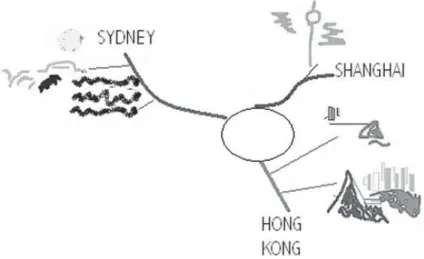
Frontispiece: Tsimshatsui Clock Tower, Hong Kong (photo: John Gammack) viii 1.1 Spray diagram representing a subjective understanding of
relevant city icons 32
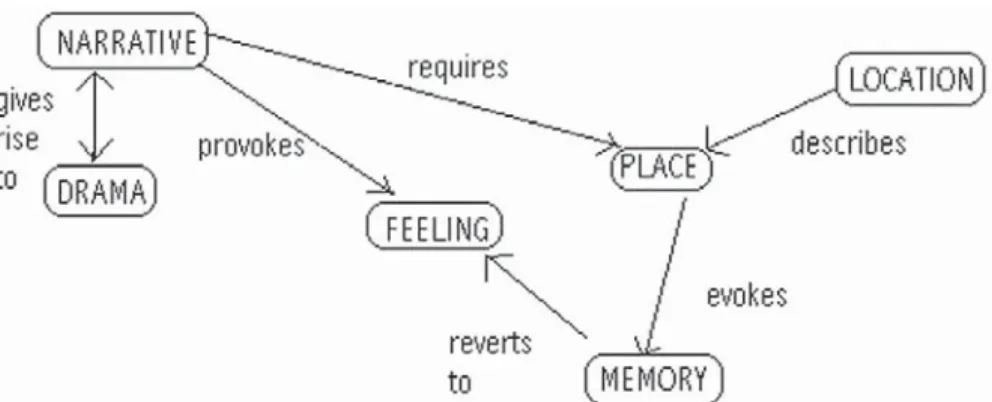
1.2 Concept map showing some elementary concepts and their semantic relationships 32
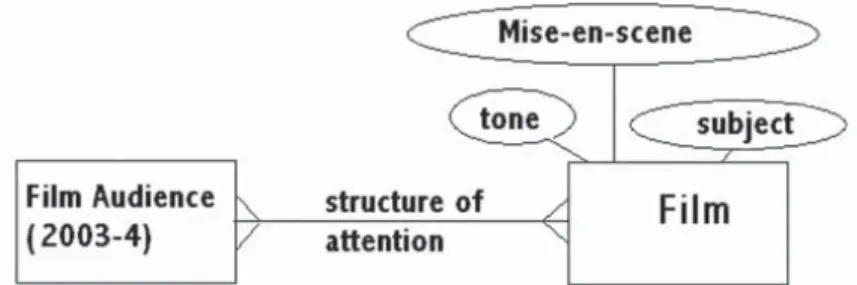
1.3 Examples of entity-relationship notation 33
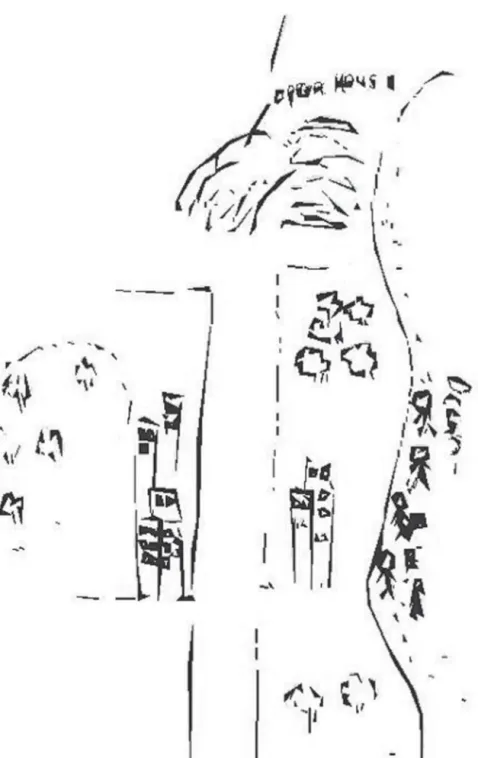
1.4a Structures of attention model using entity relationship notation 36 1.4b Structures of attention model, with some attributes shown 36 1.5 A partial repertory grid for a naive viewer of ‘nostalgic’ fi lms 41 4.1 Drawing Sydney – new arrival, 2004 (ESL student from Italy) 98 4.2 Drawing Sydney – one-year visitor-resident: liminal spaces 99 4.3 Drawing Sydney – six-month student visitor: orientation to the CBD 100
4.4 Drawing Sydney – the Unimaginable West! 101
4.5 Gdansk (Home) 102
4.6 Man by ship (The Hungry Mile, 1953) (reproduced by courtesy
of the Maritime Union of Australia) 109
4.7 Men at wharf (The Hungry Mile, 1953) (reproduced by courtesy
of the Maritime Union of Australia) 114
6.1 Songjian, Shanghai 1975 (courtesy David S.G. Goodman) 158 6.2 Thamestown, Shanghai 2006 (courtesy David S.G. Goodman) 158
Colour Plates
1 Boy at Circular Quay, Sydney (Walkabout, 1971) (reproduced by courtesy of the British Film Institute)
2 Sydney CBD in the 1970s (Walkabout, 1971) (reproduced by courtesy of the British Film Institute)
3 Hong Kong’s Star Ferry (photo: John Gammack) 4 McDull’s Hong Kong (photo: John Gammack)
5 Sydney sandstone (Walkabout, 1971) (reproduced by courtesy of the British Film Institute)
6 The dome of the Chapel of Hospicios de Cabanas, featuring Jose Clemente Orozco’s The Man of Fire, Guadalajara, Jalisco, Mexico (reproduced by courtesy of Q.T. Luong, terragalleria.com)
7 The Oriental Pearl Tower, Shanghai, at night (photo: project team) 8 The Jinmao Tower, Shanghai (photo: project team)
Frontispiece: Tsimshatsui Clock Tower, Hong Kong (photo: John Gammack)
Acknowledgements
Our primary thanks are due to the Australian Research Council, which supported this project for three years. We also thank our institutional homes over that period and in the two years running up to funding: University of Technology Sydney, Griffi th University, University of Melbourne, Queensland University of Technology and Murdoch University. We have worked with many people, including some excellent research assistants and graduate students: Ming Liang, Sandy Ng, Jeannie Wong, Ling Yan, Leicia Petersen, Oli Mould (Visiting Postgraduate Fellow) and Damien Spry. All have moved on to greater things and we hope that their stint on ‘Branding’
helped defi ne some skills and ideas for their brilliant careers. We are grateful to the many respondents who took part in our surveys and interviews, particularly the busy people in the fi lm and tourism industries who were so generous with their time. We have had support from institutions in China and Hong Kong, including the Hong Kong Film Archive, the City University of Hong Kong and the Hong Kong Baptist University. The Transforming Cultures Research Centre at UTS was a great support in 2004-2005, as were other UTS researchers in related fi elds, particularly Martin Kornberger. Amazing help and hospitality came from Ian Aitken and Philippa Kelly in China, and Fiona and Norman Fowler in London. We also thank Catherine Kevin for assisting us so superbly in organising a fi nal conference at the Australian Menzies Centre in London, Australia House for allowing us to hold that event in such spacious grandeur, and to Middlesex University and Eleonore Kofman for their important engagement with that conference. Our ensuing collaborations have created a beginning rather than an end.
We owe thanks also to John Golder, our Sydney editor, whose patience, ability to see the wood through thick trees, and grammatical exactitude are inspiring. As ever, we owe special and heartfelt gratitude to our families, intellectual friends, and loved ones. Stephi thanks James, Morag and Ellen. John thanks Paula, Val and Diarmuid.
* * *
Some of the chapters of this book contain ideas and arguments that have been previously tested in earlier publications. We acknowledge and thank those editors for allowing us to explore the subject of this research in their collections, and hope that they appreciate the considerable revisions in sections of the following:
Donald, S.H. (2004), ‘Love, Patriotism and the City: Hong Kong’s New Regime’, in D. Verhoeven and B. Morris (eds), Passionate City: An International Symposium, held at RMIT, 27 August 2004. Refereed paper in Online proceedings, at <http://
www.informit.com.au/library/default.asp?t=coverpageandr=L_PASCITSYM>.
Donald, S.H. (2006), ‘The Idea of Hong Kong, Structures of Attention in the City of Life’, in C. Lindner (ed.), Urban Space and Cityscapes (London: Routledge), pp. 63–74.
Donald, S.H. and Gammack, J.G. (2004), ‘Branding Cities: A Case Study of Collaborative Methodologies in Cultural, Film and Marketing Research’, Everyday Transformations: The Twenty-First Century Quotidian, CSAA Annual Conference, 9–11 December 2004. Refereed paper in Online proceedings at http://wwwmcc.murdoch.edu.au/cfel/csaa_proceedings.htm.
Donald, S.H. and Gammack, J.G. (2005), ‘Drawing Sydney: Flatlands, Chromatics and the Cinematic Contours of a World’s Global City’, SCAN: Journal of Media Arts Culture 2:1, at www.scan.net.au/scan/journal/0405/refereed.php.
Donald, S.H. and Gammack, J.G. (2007), ‘Competing Regions: The Chromatics of the Urban Fix’, in G. Marchetti and T.S. Kam (eds), Hong Kong Film, Hollywood and New Global Cinema: No Film is An Island (London: Routledge), pp. 193–
205.
Gammack, J.G. and Donald, S.H. (2004), ‘Establishing Identity: Collaborative Methodologies in Film and Tourism’. Proceeding of the International Tourism and Media Conference, held at LaTrobe University, 26–28 November 2004.
Extended abstract, at http://www.ertr.tamu.edu/conferenceabstracts.cfm.
Gammack, J.G. and Donald, S.H. (2006), ‘Collaborative Methods in Researching City Branding: Studies from Hong Kong, Shanghai and Sydney’, Tourism, Culture and Communication 6:3, 171–80.
Introduction
An Argument for the Cinematic City
This book provides an interdisciplinary theoretical basis for understanding and critiquingcity branding as a cultural and political phenomenon, while also setting out an introduction to the practice itself. It approaches the question of branding through critical interpretations of cinematic cities, and is reliant on the discursive prism of cultural research for its tone and declared interests. We should emphasize from the outset, however, that it is not a manual for those who would brand cities or, indeed, any other destination or investment opportunity. Such texts exist (e.g.
Olins 2004; Anholt 2005). There is also a burgeoning fi eld in tourism studies on the subject of place branding (e.g. Morgan et al. 2004), defi ned as a strategy in which the industry and the education sector need to become fl uent. Similarly, there is interest in place branding in the creative industries paradigm. There the focus is on the intersection of digital and visual media, and the creation of hotspots, cultural corridors, quarters or precincts. These are not areas which we avoid, but which we take as a policy-oriented part of a complex background to our underlying questions.
These may be broadly summarized as: how do residents and visitors experience cities, and what part might cultural representations play in that experience? Do the concept and practice of branding have political dimensions? What does branding contribute to a city’s imaginary structure, or, more simply perhaps, how does one live in a ‘branded city’?
A very obvious vector of modern urban experience, which transects all the approaches to place branding, is in the invention of tradition and the deliberate connection of tradition to locale. Festivals are created by tourism authorities, and the subsequent visualisation and dissemination of these events attract domestic and international visitors. In 1998 the Hong Kong Tourism Commission listed sixteen districts, aimed at a mobile population of six million people. The task was to induce them to look at their own city afresh, to ‘see’ it as a place of variety and to ‘use’ it as a leisure destination. The idea came from the then Hong Kong Tourism Commissioner, Rebecca Lai, who lamented that whenever international visitors came to Hong Kong to shop on major holidays, Hong Kongers themselves would go over the Mainland border to Shenzhen to get a better deal. Now, it was not that Hong Kong was ‘shut’
when tourists arrived, but rather that Lai recognized that she needed to initiate brand identities for individual areas. In trying to sell the city as a whole, she had to describe a fragmented city that locals would recognize, and even authenticate, by their support. By 2006 there were eighteen districts listed on the website, each with their own logo, historic credentials and ‘fun’ attraction. Sha Tin is a populous area well off the beaten track for Hong Kong Island tourists, and best known for its shopping mall. Its temple life revolves around kinship and agricultural associations, and has not previously been promoted as a phenomenon of special signifi cance, but
simply accepted – like the bus station next door – as an ordinary aspect of daily life.
Sha Tin is now a tourism district, with attractions that include the Heritage Museum, the Che Kung Temple and Snoopy’s World – something for everyone.
Another way of administering difference is through fi lm. When we started this research in the late 1990s, and began talking to tourism managers, fi lm critics and fi lmmakers in Hong Kong, the link between the marketed city and the fi lm industry was assumed rather than explicit. By 2006 the scale and power of Hong Kong’s cinematic identity had been seriously put to use as an attraction for visitors. At moments of hubris we wonder whether our questions might have helped bring about this massive shift! Brand Hong Kong and the Hong Kong Tourism Board have released joint brochures naming fi lms and linking them to their various locations. They promise ‘cinematic contrasts’ as you wander around a trail of place and image, carefully selected to get you right across the island, up the Peak and into the islands and New Territories. The third part of Infernal Affairs (Mou gaan dou, dir. Wai Keung Lau and Sui Fai Mak, 2002) takes you to Lantau Island’s Big Buddha. It’s a gangster/police thriller, but the brochure is not concerned with genre, preferring to encourage you to look at the fi lm’s Hong Kong landscape, to sit in the tranquillity of Buddha’s surrounding countryside, and to relax. Peter Chan’s fi lm about history, motherhood and prostitution, Golden Chicken (Gam gai, dir. Leung Chun ‘Samson’ Chiu, 2002) is set in Jordan, which is close to Mong Kok, the red-light district on Kowloon. Once enticed there, the tourist is encouraged simply to shop: the brochure passes politely over the location’s most obvious link to the fi lm, sex with Mainland (or, in the case of Golden Chicken, local) prostitutes in the nearby street markets.
The Hong Kong cinematic tour is part of a wider strategy of bringing cinema and location together for the purposes of tourism. The tie-in between enhanced fi lm locations (Beeton 2005) and national tourism campaigns offers a perfect commercial and creative synergy between the digital media, the fi lm industry and the tourism agencies.The Lord of the Rings trilogy (2001–2003) illustrate the point: the digital landscapes created by director Peter Jackson to match Tolkien’s mythic narratives and New Zealand’s aggressive promotion of the country’s natural beauties throughout 2003–2005 proved to be of enormous mutual profi t. However, while it is useful and pragmatically convincing to describe what happens when industries converge, or how a particular marketing mechanism works, it is probably not quite enough to simply state the fact. Just as a fi lm is more than the sum of its locations, so a city is more than the sum of its brands. Indeed, cities are rapidly becoming the main locus for humanity’s future. By the end of 2010, approximately 60 per cent of the world’s population will live in cities. In Australia, where we are writing this book, that fi gure will be 80 per cent. In China the fi gure may be close to 50 per cent (UPI 2006), which might well translate into more than 1.5 billion people. How people live in these urban centres will depend on the centres’ physical resources, as well as various aspects of their infrastructure, both imaginary and actual. Transport, affordable housing, access to water, sustainable energy, adequate jobs, cultural possibilities and education are the assets generally proposed when considering a city’s future. We would like to think about them alongside consideration of two kinds of emotional relationship to a city, that of someone who loves it and that of someone who belongs there.
The question ‘how’ then requires an affective answer, and one which notes that urban infrastructure must be as much a set of emotional and cultural resources as pragmatic ones. How will people imagine their cities and those of other people and other nations? How will they understand the place in which they live? What will it mean to be where they are? What effect will the perceptions of others have on their own experience of everyday life in a city? In the following chapters we shall look at these questions through the prisms of branding and cinema. The seemingly disparate formations of cultural knowledge are, we suggest, both essential to the ways in which cities become visualized, known and inhabited. Brand designers aim to manufacture how we experience a product or a place through their affective use of narrative and image. This is not always successful, nor is it necessarily possible, given the complexity of some forms of lifestyle and urban engagement, particularly if we can describe living in a city as an act of consumption. Nevertheless, the idea of branding is highly suggestive of an infrastructure of symbolic and emotional capital. Certain key features are captured and promoted, others are disdained or re- narrativized, in order that a more desirable sense of self/place may emerge. The cinema also affords insights into how a city tells its own stories, and thereby builds its self-perception and the perceptions of others. New Yorkers are loud, self-obsessed, funny, clever and urbane. Londoners are either suave and class-conscious or edgy and disposed to crime. At least, that is what we learn from fi lms. And, as we shall suggest, Sydneysiders stand for Australians in general, and the Sydney locations used in fi lms are legible as such only to locals. Do these (mis)representations matter?
If so, how might we use our theoretical tools of analysis to make of them meaningful commentaries on the urban condition?
Our discussions are supported throughout by reference to case studies on the West Pacifi c Rim: Shanghai, Hong Kong and Sydney. The geographical choice is pertinent to our core thesis, which is that narrative, whether realized through ‘pure’
text or in image and sound, is fundamental to the organization of space and place on local and global scales of imagination and practice. The West Pacifi c Rim, in which we include Australia, China, Japan and the Pacifi c Islands – although we focus on Chinese and Australian cities – is our deliberate regional bias. The Rim is a globally signifi cant geo-political area that encompasses Greater China, Japan, SE Asia and Australasia. It is differentiated in our argument from the more widely discussed
‘Pacifi c Rim’, which, of course, includes the west-coast cities of North America.
There are two main reasons for this distinction.
First, it separates fi rst-world preconceptions of the Austral-Asian region from a regional understanding of place. In discussions of the global or world city there is a tendency to place Australian experience inside a so-called Western US-oriented paradigm within the Pacifi c Rim discourse (Tse 1999; Sassen 2002), and thus to undermine its strong historical and current links to the West Pacifi c Rim, to Asia and, particularly, to China. A recent example of this dichotomized and geographically illogical thinking is apparent in an otherwise thorough coverage of the Rim in terms of property markets, which yet explicitly divides the book editorially into east and west, and places Sydney and Melbourne in the ‘west’ (Berry and McGreal 1999).
The refusal to allow even the possibility of a liminal Austral-Asian perspective panders to a political expectation that in matters of policy, population and (free)
trade Australia should belong to the West. This tendency also encompasses Hong Kong by feeding a caricature of the city as a required gateway to China coming from a disassociated ‘West’, rather than an Asian city on the West Pacifi c Rim that has responded creatively to colonialism and global commerce. West Pacifi c cities are better seen as negotiators in the historical and contemporary relationship between China and the Western world (Chow 1998; Lo 2001). As such, the Rim is a region in which a city such as Hong Kong has a distinct but connective personality in relation to its neighbours. Hong Kong is entrepreneurial in collaboration with its competitors in Southern China, particularly in Guangzhou, and in competition with Shanghai (Jessop and Sum 2000), while Shanghai is itself self-promotional, addicted to development and hungry for ascendancy within the Chinese urban sphere (Wu 2000).
These partly economic, partly socio-cultural characteristics infuse the cities as places to be, places to watch and places to visit – but also as places that compete with one another for very similar cachet. Secondly, in cinematic terms, the mythological and imaginary power of the US cities on the Rim is extremely well understood and, indeed, has had global cultural purchase for a century. Shanghai audiences were watching the American city on fi lm in the 1920s (Fu 2003). We wonder therefore about the cinematic counter-purchase of cities on the Western Rim, where, although fi lms have been made and consumed, it is doubtful that they have achieved a global imaginary impact, equivalent to that of downtown USA.
It is, of course, no secret that the global narratives of cinematic affect and urban resonance are rooted in the pre-eminence of American and European cities. This is due in part to the academic and popular publishing power in those regions and also, need it be said, to the phenomenal success of American fi lm export over the past century.
Everyone who sees fi lms knows, or thinks they do, what a US city looks like. New York, San Francisco, Chicago and LA are embedded in cinematic consciousness, thanks to the many versions of those cities that populate the Hollywood screen. Even specifi c locations (the easterly view over the Hudson River, the running path by the basketball courts in Central Park) are recognizable to viewers who have never set foot in the United States. Europe also has its cinematic cities: Berlin, London, Paris and Rome, and a number of scholars have dealt with the impact of these cinemas on the formation and character of the cities in question (see Shiel 2006; Lindner 2006; Tallack 2005; Marcus 2007). European cities are also powerfully evoked in literature and have reached way beyond the confi nes of their national and regional origins. Readers, especially those in postcolonial zones of South and South-East Asia and with access to the colonial canon, will surely have a sense of ‘London’
as a textual space which dominates their perceptions and disappointments of the city as an actual place. In her 2004 novel, Small Island, Andrea Levy describes in painful detail the shortfall between the imagined London and the life lived on arrival. But even in so writing she regenerates the image of the city that inspired the originary hope. An affective brand is hard to dispel. How many readers sharing a postcolonial history will know the London of Woolf, Dickens, Wordsworth, Austen, or even Hogarth’s Gin Lane, as well as a Londoner quoting the Tube map? Indeed, how many Chinese intellectuals remember reading, as part of their revolutionary education, Lao She’s story about living in a rented room in London? The ironies
and reversals in the imperial system of text and image are revealed and countered in the works of many literary critics. (Rey Chow’s work (1998a and b) on Hong Kong is particularly signifi cant.) The present book does not take on that important engagement in the same way, but it does proceed from an acknowledgement of the uneven modernities within which we inhabit and consume urban culture, and the degree to which those hierarchies of knowledge and space regenerate themselves through such consumption. We need to counter received versions of the city by insisting on other modernities, different spatial limits and regionally relevant defi nitions of boundaries. So, here we provoke an alternative spatiality by refusing the European and American examples of urban affect, accessing instead a regional narrative of achievement, belonging and imagining.
Hong Kong is a place that exemplifi es the break between colonial and postcolonial belonging. Only recently returned to Chinese sovereignty, its residents are torn between competing patriotic duties: they bear actual and symbolic allegiance to both the People’s Republic of China and to Hong Kong itself. Both nodes of belonging are essential to what it means to be patriotic, and both are heavily involved in producing the meaning of the city, as a cinematic centre of production, as a place brand and as a place to live and have an impact. China is the centre of Chineseness in the region and across the world. It is an undeniable political force with growing authority over its neighbouring states. It is also a multi-social, multi-ethnic and multi-lingual identity structure, within which Hong Kong is but one set of iterations.
To be Chinese is not therefore a homogenizing tendency, but a broadly understood political and social responsibility. Likewise, to be a Chinese city is not to be the same as all other Chinese cities (although this happens), but to recognize one’s position in the state’s hierarchy of economic and political functions. Where local structures exist comfortably and without undue friction alongside that standard requirement, a Chinese city can be both culturally discrete but also suffi ciently ‘national’ to support the agenda of the Party-State. A status quo is thus achieved. Many Hong Kong residents are fi rst- or second-generation Mainland migrants with an emotional stake in the Mainland, while others are fi nding that caring about China’s development and prosperity is a reasonable and workable way of negotiating their new responsibilities in being Chinese. But, as we shall argue later, there is a local sense of belonging that is particular to Hong Kong and which makes narrating the city-as-brand a delicate task. When this narrative exercise is tested against the work of fi lmmakers, arguably the strongest voices in Hong Kong’s cultural world, it emerges that the competing patriotisms are not invariably commensurable.
Sydney is also a postcolonial city, though it has, of course, been separated for far longer from the colonial power. Unlike Hong Kong, however, Sydney has not completely severed its political links with Britain. The British Queen is still the monarch, although her representative, the Governor-General, is nominated by the Australian Government and anyway impinges only minimally on the average Australian’s consciousness. The narrative that Sydney tourism leaders promote is one of pleasure, beauty and diversity. Its soft focus is on the topography of land and people. It is an extraordinarily attractive place in which to spend time, and its visual character somehow smooths its rough history of deportation, settlers’
struggle, crime, inter-racial destruction, and boom-or-bust development policies.
A recent ‘vox pop’ poll of rich ex-pats and new rich (xin gui) in Beijing’s gated villa suburbs found that most people there dreamed of living in Sydney rather than where they were. Arguably, this softening is a boon for the city as a tourist and residential location, but a problem for it as a fi lm location. The ‘edge’ of Sydney does not translate easily to cinema. On the other hand, that may simply be cinema responding to the city’s pathology, where the edginess and the placidity of the city contest Sydney’s character across historical matrices of old and new expectations.
When we suggested to a group of ex-pat intellectuals from China that Sydney had
‘gone fl at’, one very fl uently countered that of course it was fl at, that was why people lived there. They wantedfl at, having had more than enough bumps in their previous places of residence or origin.
Shanghai is compared to Sydney by those of its residents who know both countries. It also has a sweep of topographic elegance, traces of colonial architecture and a predisposition to a relaxed life-style that runs counter to the madcap urge to succeed at all costs. Like Sydney, it has the reputation of being an international city, but in many ways enjoys the character of a much smaller, more parochial place.
Intimate circles of power and infl uence run both cities. The place of the parochial in informing a large city’s depth and variety (indeed, what tourism offi cers would term their ‘districts’) is evident everywhere. But, arguably, in Sydney and Shanghai, these largely benevolent parochialisms are close to the surface. And, fi nally, they share a history of peripheral acceleration. Just as Sydney did in the mid-twentieth century, so Shanghai is currently going through a phase of rapid development, which is altering the landscape dramatically. Historic sites are disappearing under concrete, fewer than 1000 buildings across the city are heritage-listed, and where it was once said that by visiting Shanghai you could see ‘a hundred years of China’s history’, now it is more a case of only seeing the last twenty years of the country’s development.
The wholesale destruction of Sydney’s old quarters stopped at The Rocks, but there is a great deal of concern that in Shanghai it may already be too late to apply any such restraints.
Unlike Sydney, however, Shanghai has a distinguished cinematic past, with fi lms – especially those of the 1930s – that defi ned Chinese cinema of the pre-Liberation period. Indeed, many of the stylistic aspects of these fi lms still defi ne Shanghai’s image of itself. This is ironic when set against the disregard for the buildings that populate, and grace, the fi lms in question. So, Shanghai offers an excellent case study of a brand that is bifurcated along temporal lines. Whereas Shanghai the international city is excessively and obsessively postmodern, Shanghai the cosmopolitan treaty port and metropolitan lodestone is lodged in a 1930s modernity which simply cannot endure the weight of development it is currently undergoing in its new guise as an international centre of fi nance. Nostalgia thus competes with the aesthetic of thebrand new, the globally scaled. But it also complements and contributes to its perverse attraction. As the older buildings and laneways (lilong) disappear, so their very absence becomes potent and piquant to the city’s brand promise. Similarly, the idealization of the beauty and clever energy of Shanghai’s women, memorialized in fi lms as well as in novels, continues. The modern woman (modeng nuxing) of the 1930s was elegant but tragic – Ruan Lingyu, the suicidal fi lmstar-model for the modern woman, is iconic – and even in recent publications women are exhorted to
re-discover that kind of cosmopolitan femininity (Donald and Zheng 2008). Yet, today Shanghai women are mainly known for their ability to succeed in commerce, their political savvy and their high level of education. So Shanghai presents an outrageous face to the world. The city defi nes herself as a modern woman, with a quaint and racy historical past; a show-stopping beauty making her way in the world with a fl air for business, fashion, and self-regard.
The cities on the Rim each manifest specifi c temporal orientations to city identity and character. By way of an opening gambit we shall suggest that Sydney is oriented to the present, with a past that is neither denied nor confi rmed in its brand. Historic Sydney is lauded mainly for its commercial offerings and its everyday hedonism, shopping, eating and drinking latte. Shanghai is oriented towards the future. It has, however, a vertiginous, postmodern approach to the past, whereby one period – the 1930s – ignores several decades of civil war and revolutionary leadership in order to provide a ghostly backdrop to the glamour of internationalization. In Hong Kong the past and present are better integrated. Colonial rule has left traces, and the current political system is powerful, but it is the people themselves who provide a continuum in the image of a city that has often been mistaken for a quintessential global city, as opposed to a Chinese city with strong cosmopolitan experience.
We hope that these city narratives will allow a number of different disciplinary perspectives to suggest themselves as complementary ways of thinking about urban belonging, spatial organization and the globalization of place. We come from different academic traditions – one from fi lm and area studies, the other from psychology and business informatics – and our aim here is to write for our peers across a number of disciplines. We are particularly anxious, however, to interest younger scholars, whose habits of perception are as yet open to the challenge of equivalence across disciplinary boundaries.
As we noted above, the aim of our contribution to existing scholarship and expertise is to extend the idea of branding to cultural research, cinema and media studies. At the same time we critique the concept in so far as it ignores some of the deepest human responses to place, and the political contexts in which those occur. In short, we offer a fresh approach to reviewing the standard and emerging literature in these fi elds, and report primary research fi ndings that include textual analyses, interview data and politically nuanced refl ections on current situations and experience. The book is also careful to include the perceptions, aspirations and ethics that are important to residents, as well as the needs and expectations of tourists, business visitors and fi nancial investors in the city’s economy. Taken as a whole, this work supports our macro-thesis that, in an ideal world, a city brand should contribute to the widest possible discussion on development, identity, and sustainable economic well-being.
‘The Image of the City’
In 1960 Kevin Lynch published a short, but inspiring book, entitled The Image of the City, in which he presented his research on how people understood urban space on a quotidian basis. Half a century later, we discuss our own fi ndings on how urban
space is experienced, extending the ‘image of the city’ to include cinematic and commercial considerations. We take Lynch’s central point, that people make meaning out of space by moving through it in daily life and by fi nding their way as they go.
We extend the point by arguing that fi lmic renditions of certain cities are also crucial to the experience of urban life and visitation. Similarly, we suggest that commercial, marketized, versions of the city can be both profoundly revealing and constitutive of the ways in which a city is understood by those who live in it. The idea of the city is not limited only to its physicality, and neither are its inhabitants its only stakeholders.
These claims lead us inexorably to consider the contemporary phenomenon of ‘place branding’, and the ways in which this phase in urban developmental policy might inform a wider conceptual approach to the image of the city in social science and cultural theory.
The ‘place brand’ – or ‘city brand’, the phenomenon we specifi cally address here – is a concerted attempt to pull attractive and distinctive features of a city into a manageable, imagined alignment. It is a constructed personality of place, which is designed to allow people to build and maintain an ongoing relationship to a particular urban location. The branded city is presented as either touristic or ‘touristed’ (Cartier 2005), as a desirable economic location for investment and as a metonym for the nation. Film is often crucial to branding strategies, particularly where a city is known for and by its cinema.
Lynch’s work was concerned with American cities, but his approach has informed urban planning the world over. Our three core cities are all located on the West Pacifi c Rim and are regionally highly signifi cant. Nonetheless, despite the rise of China, these international cities are not yet in the same global league as those at the heart of American and European infl uence: Paris, London, New York and Los Angeles. Part of the appeal and power of those cities is, we argue, their cinematic presence and their concomitant appeal to branding strategists. Can we see similar potential realized on the Rim? Is it feasible to argue that the fi lmic image of Rim cities can challenge the depth of cinematic attention demanded by New York and Paris? And, if so, how might the activity of branding and the pull of the image come together in a deep structure of international consciousness?
Hong Kong SAR (Special Administrative Region) is the most obvious case in point here. Film is a major export and asset of the city, and the genres are well known and well documented (Chu 2003; Yau 2001). A wider range of fi lm styles and histories is described in the publications of the Hong Kong Film Archive (e.g. Wong 2003), reminding us not only of the martial arts (wuxi), sentimental love stories, gangsters, police dramas and ghost stories, but also of the literary adaptations, Cantonese social dramas, and strange tales (liaozhai) that have been part of a long history of translocal fi lm in the southern part of China (including Hong Kong). As these historical perspectives remind us, Chinese language fi lm (huayu dianying) has been a translocal, and even transnational, phenomenon for most of the last century, with producers (such as the Shaw Brothers), directors and actors moving across and between shifting borders of identity and political belonging. The Shaw family was originally from Ningbo, the children were educated in Shanghai, and the fi lm business stretched and shifted between Singapore, Shanghai and, eventually, Hong Kong. One of the present author’s fi rst contacts with Hong Kong fi lm occurred in
1981 in Taiwan, where she met Jackie Chan. He was shooting a fi lm set in pre- modern China, for the Hong Kong and diasporic Chinese-language (huayu) market.
To her shame, she had no idea ‘who’ he was, only that he was clearly famous and quite fun to socialise with. His status as the emerging ‘King of Comedy Action’ was fulfi lled when, four years later, he made Police Story, possibly the fi lm that most powerfully, and amusingly, captured the strangeness of British colonialism (and withdrawal) in the 1980s. Today Chan is an icon, a symbol of Hong Kong, but his fi lm popularity has decreased markedly amongst young Hong Kongers. Irony and local love of place have not disappeared, however. The McDull cartoon series (My Life as McDull (dir.Toe Yuen, 2001), McDull, Prince de la Bun (dir. Toe Yuen, 2004) and McDull, The Alumni (dir. Leung Chun ‘Samson’ Chiu, 2006)) tells disarming tales about a small pig called McDull, who represents all that is hopeful and hopeless about contemporary Hong Kong culture. This pig was the fi lm character that we singled out in 2003 as a phenomenon speaking eloquently about the unbranded aspects of Hong Kong. Now, in 2006, McDull has been incorporated into the tourism lexicon. Short clips are even shown on welcome monitors as one arrives at Hong Kong international airport, with segments specially animated in order to teach children and parents such things as safety procedures and correct airport behaviour. Such a congruence of scholarly and commercial thinking makes the subject of this book powerfully topical.
It is appropriate, then, that we move from the American sites of Lynch’s book to an Asian-Australian thematic. The image of the city is mobile, and increasingly so.
Lynch’s ‘image of the city’ is the starting point, but certainly not the sole categorization of the relationship between people and the urban/e spaces they create and inhabit. James Donald’s ‘idea of the city’ (1999) makes the point that city space is also cinematic, literary and musical space, accommodated in the minds of those who have read, seen and heard the sights of the city in mediated forms. This is not to argue that the idea of the city is the same thing as experience, but to acknowledge that the imaginative potential of renditions of the city have the ability to inform and enable imaginative responses to actual place. In fi lm and cultural theory, the ‘visual city’ is an important descriptive category for understanding modern urban life, the built environment, and the fantasies and cultural mores that sustain both. Thus, the image of the city exceeds the schematic and emotional mapping of its literal geographical and environmental features, and combines at an imaginative level with the artistic, cinematic, sonic and literary expressions of its sensuality, its tough – or perhaps exotic – beauty and glamour.
So, this book argues that the city, humanity’s most complex built achievement, has always been a text for mapping the spatial ambitions, productive possibilities and mobility, or constraint of human beings. The city constitutes an image, an idea, a vision, a musical score or a sound-scape. It is all of these and more than the sum of its possibilities. Thus, people know a city as they know a particularly dear or complicated friend, but it is also a place they use: material, traversable, liveable.
The idea of a city that exists beyond its solid self is crucial in a project that aims to open up the idea of city branding to historical trajectories, to the interpretative world of fi lm and to the various mapping projects that are logical extensions of ways of understanding the city over time. The most recent iteration of urban mapping is the trend for creative cities and knowledge economies. These part-economic,
part-governmental notions have triumphed as orienting themes for development in post-industrial society. The creative mapping of cities is concerned with making a qualitative, economically-oriented statement about how much revenue certain
‘creative’ activities produce, and the degree to which, especially, digital futures provide a foundation for employment and wealth in modern urban settings. This research, exemplifi ed in the work on the knowledge economy (into which fi lm and branding is categorized) by the Creative Industries Centre in QUT (Keane 2007) and by Simon Roodhouse in the UK (Roodhouse 2006) fi ts into a longer context of visualizing the city in the present or past in order to understand it in the present or future.
Creative mapping is one way of addressing how a city lives as a dynamic sensorium of human occupation and activity. Historical mapping is another crucial pathway to understanding how a city has developed its sense of self, its personality and its engagement with the people who make it work. The idea that one must map the past in order to gain access to the present is the very foundation of the discipline of history. Arguably, then, maps of the city are forerunners, not merely of modern orientation maps, nor of the creative cities with their clusters and hotspots of economic activity, but of the idea of the city in fi lm, the image of the city in modern urban planning, the city as a ‘hub’ in creative policy, the city as a brand, and the visual city of cultural criticism.
Cities on Paper
In Peter Whitfi eld’s Cities of the World: A History in Maps (2005), the world is not confi gured along the West Pacifi c Rim. Nor, on the other hand, is it particularly biased towards the current world order of global cities. Whitfi eld’s maps, drawn from the British Library collection, are interested in the very idea of a drawn city, and what the drawing itself tells us about the world in which that map made meaning.
The collection does not deal with either Hong Kong or Shanghai, but it does look at Sydney, a world city with a relatively recent international profi le and a strong brand, based on sun, sky and relaxation. Sydney is also now a centre for digital imaging for fi lms, a contemporary fact that sits strangely with the haphazard city of the nineteenth-century map, where one gets a decidedly vertiginous sense of a semi- planned economy of space that cannot quite overcome the tyranny of the terrain, the, now prized, spits of land that project into the ocean. Whitfi eld’s book also contains a map of another, much older city that was founded as a repository of learning in an early iteration of the ‘knowledge economy’ of the élites of Europe, Oxford. The Oxford map is a good starting-point for this backdrop to the branded and cinematic city. First, the map is an encounter with a spatially realized ideal of knowledge concentration, what might nowadays be considered a ‘cluster’. The meaning of Oxford is highly controlled in this image. Each college, library and University building is noted in a detailed aerial view ‘as if seen from some non-existent hilltop east of the Cherwell’ (Whitfi eld 2005, p. 139). The map is an engraving of a place in which people (and very few are depicted) are representative of the scholars and travellers who populate the city, but are secondary in importance to the place itself,
to the ‘cluster’ that these august buildings create, and to an idealized and curtailed idea of the city that would in contemporary parlance be dubbed a ‘place brand’ or
‘brand identity’. There is nothing on the map that does not relate to the ideal of learning as embedded in an architectural form, designed to house knowledge and to inspire the minds of those who come to study and teach. This not only suggests that the city’s identity has been established by its spatial proportions and the way in which they map onto an ideal of knowledge accumulation, but also that the visual proportions of the city are bounded by that expectation rather than by any more realistic view of Oxford’s heterogeneous nature (a city of erstwhile car manufacture, deprivation, fi ghts between ‘town and gown’). From this we might speculate that creative clusters, which are vital to much of the developmental and research work in the branding paradigm of urban development, are not unlike the imagined collegial spaces of knowledge in the quintessential Oxford. They exist, and can be shown to exist, through the activities of mapping and visualization, but they offer – as, arguably, does all mapping – no more than a partial view. For instance, the digital industries which ‘characterize’ Sydney, Vienna and London congregate either due to active seeding in urban regeneration projects or educational development programs, or as an unplanned, but organic clustering in relatively cheap areas where start-ups can thrive and personnel can live close to the workplace. Simon Roodhouse (2006) has argued that this leads eventually to infl ated housing costs and the gentrifi cation of areas which succeed, thus enshrining particular high-cost clusters but restricting access to new start-ups. It is not a huge move to suggest that the halls of Oxford also spent many years as a prohibitively guarded institution for the children of the rich and just a few scholars from the lower-middle and working classes. In other words, the creative clusters model is inherently a class-based vision of development, whereby artisans lend cultural value to place, but are themselves inevitably replaced by richer members of the bourgeoisie, the middle classes or the global élites.
One might argue from the start therefore that branded, clustered versions of creativity are threatened by their own success. Knowledge economies attract a different sort of life-style investor, as they are supposed to do, once the creative workers and entrepreneurs have got something moving. Or, the creative cluster promotes affl uence for some, but sits amidst a wider world of disadvantage. The challenge, then, is to manage a knowledge economy to have more porous boundaries in its spatial incarnation – not at all like the walls of Oxford, which were built in the late eleventh century, at a time when the settlement developed from being a farming and religious community into a centre of learning and religious élitism.
The brand image is also a contemporary factor in this reading of creative clusters against the management of knowledge in Oxford. Oxford has become, as Brewer’s Dictionary nicely puts it: ‘a neatly packaged heritage product that attracts very large numbers of tourists from around the world’ (Room 2005, p. 843). The point for academic approaches to branding as a disciplinary focus is that this ‘heritage product’ was set in train eight centuries ago with the walling of the city and the creation of buildings that were at once real and affective. The relationship between urban development, historical trajectories of power and (something like) knowledge economies understood over time, rather than in a bubble of contemporary economics, allows us to see very clearly how place identity is forged.
Sydney is represented by a nineteenth-century map in Whitfi eld’s book and this offers us lessons in how the spatial imagination can give us metaphorical access to the past and the future. The Sydney map is less fi gurative than that of Oxford of the same period. Its aim is to describe the broader pattern of spatial organisation rather than the features of heritage buildings with inspiring contours and contained collegial histories. There is no sense of clusters, but rather of fl ows between the land and the sea. As Whitfi eld points out, the city has not at this stage claimed back the land that is now part of the harbour side. Nor has the city yet gained an identity that can be willingly shared as a branded entity with ‘neatly packaged’
outcomes for its economy. The reality of the city’s nineteenth-century grimy (and plague-ridden) streets is deliberately hidden by a schematic attempt to record its emerging urban shape. Clearly, the latent brand of Sydney has not emerged. This is not yet a map of a place known for its sun, sea and generally relaxed approach to life, although its parallel ambition as a capital city (still obvious to those who live there, but never achieved) is apparent in its adoption of Empire-derived street names and statues. Today, in the twenty-fi rst century, Sydney is a veritable hub of the creative economy in Australia, and it is also the centrepiece of ‘Brand Australia’ (identifi ed by the Anholt-GMI Nation Brands Index (Anholt 2005) as the world’s top national brand). Yet it still resists mapping as a series of discrete and identifi able clusters. Personnel in the digital industries associated with fi lmmaking are instead networked at subtle levels of social and personal horizontal integration (Mould 2007). In other words, this is not a clean set of clusters and architecturally imaginable entities, but rather a viral and interest-based skein of connections and friendships and favours. Again, looking at the nineteenth-century map – or, indeed, at the current and complicated Sydney rail map, which opens up another set of possibilities (and takes us to a second map book, John Clark’s Remarkable Maps (2005)) – it is arguable that the topographical image of Sydney manages to both obscure and inadvertently reveal that productive complexity which characterizes the city’s identity.
Clark proffers the story of the London tube map (p. 76) as evidence of a visualization that undoes unnecessary conceptual complexity, while enabling a workable directional understanding of a major city that grew through several centuries of power, commerce, religion and knowledge and is suitably convoluted as a result. For Sydney, that complexity has not yet been tamed, nor, indeed, might it ever be: there is no teleological imperative that all cities have the same propensity for visual management as the package that is Oxford or the commonly imagined nodes of London travel which are based entirely (we would contend) on four generations of the Tube Map, designed by Harry Beck in 1932.1 The tube map uses spatial relationships, and colour to mark the nodes, edges and lines of the city above, giving ‘the impression that the Underground was the outcome of a conscious, unifi ed, intelligent design – which it certainly was not’ (Whitfi eld 2006:
p 185) Tragically, the location of the London bus and tube attacks of July 2005 were mapped onto our consciousness because of the tube map: anyone who has 1 Without the Central Line, who would connect St Paul’s and Tottenham Court Road?
And what histories have been created by these haphazard connectivities?
visited London for any length of time knew exactly where Aldgate East, Russell Square and King’s Cross stations sat in relation to each other.
There is, of course, an undoubted brand identity attached to the modern Sydney, one that emphasizes its coastal blue and yellow beauty, its sandstone heritage, its playful hedonism and its villages of culture and, crucially, food.
We will explore the chromatic and emotional, tasty side of this brand in later chapters. There is very little in its brand value, however, about its contribution to the knowledge economy of the state, the nation or, indeed, the world. The underplaying of Sydney’s digital brand value appears almost as a self-directed collusion. A Beijing-based fi lm and digital content manager acknowledged to the research team that Sydney was ‘pretty good’ at post-production, but that it
‘wasn’t Hollywood’. What might we learn from these small slights? Perhaps we see simply that the cartography of a city is accurate to the extent that the shape of urban space is indicative of the way in which topography and the nature of settlement occur/develop. In Sydney’s case this was always random, anti-élite (except in the case of those few who were sent out as rulers) and always dominated by people who were either forced out of England, Wales, Scotland and Ireland or else came of their own free will, in search of an alternative set of life chances.
There were also Russians, Dutch and French, and, prior to the White Australia policy after Federation in 1901, there were many Chinese who came to Sydney to (literally) set up shop. The visual city of the European and particularly the British imagination probably did not match what was actually occurring on the streets of Sydney, where the Asian and European settlers, together with Indigenous workers, toiled in an attempt to make the city a going concern. This untidy diversity is not mapped.
Visualizing the city over time and branding the city in the contemporary moment are linked narratives. The one tells us something of a city’s desired self, and the other tells us what aspect of that sells to tourism and investment clients.
Neither does more than hint at the experience of a city on the ground, but those hints are visible if we use maps as a guide to what is hidden as much as to what is on display. In terms of the cinematic present and digital futures, the maps of the past will reveal the ways in which networks and patterns of human activity have been embedded as a spatial characteristic of a specifi c place.
Looking at the more banal examples of the mapping industry, such as tourism brochures or council web-pages, we may feel that urban cartography has gone backwards, losing much of its structural and draughtsmanlike quality. Indeed, we might go so far as to suggest that the city of brochures and websites has taken over from the city on paper. Yet, the combined sophistication and integration of visual media – outdoor screens, cinema, advertising and online commerce – truly bear witness to the world of attractions (Crary 1999) through which we understand ourselves and our daily lives as city dwellers. The screen does not take us away from the content of a city’s history, commercial strengths and cultural mores.
Rather, the importance of narrative is closely tied to the convergence of screen conventions with other modes of public discourse. Thus, a wise brand designer will seek to discover the stories which thrive in a particular location, and which underwrite how people imagine and regulate their lives on a symbolic level.
In Hong Kong in 2003–2004 the city brand team ran competitions in which local residents were invited to submit stories about Hong Kong as a place, inventively combining shared history and personal memory. The resulting submissions married mythology to local detail, and suggested a rising patriotism in the post-SARS era. And memories of sheltering under a Song Dynasty stele during the Japanese invasion of the territory made Hong Kong’s further reaches, up into Sha Tin and areas known for years as the NewTerritories, appear as though they had always been part of the Hong Kong imagination and spatial ontology. ‘Off the map’ for the Hong Kong islanders, Sha Tin is now on the map for visitors who take up the invitation and narrative enticements of these kinds of initiative. Such stretching of the spatial dynamic is more problematic in Sydney, where the concentration on the iconic centre – that rushing down to the sea of the original maps – is unchallenged in all but the most local of print and televisual media stories and is mainly characterised by inter- suburban rivalry at the most banal level. But the point is common to both these cities and arguably all others. However heavily mediatised and digitised a city may appear, it has no shape beyond the scope of its narrated local and international identity.
The visual city of cinema, which reached its premature apogee in the 1920s fi lms of Germany and the Soviet Union, and its postmodern apotheosis in the ‘Tokyo-like city’ of Blade Runner (dir. Ridley Scott, 1982) has moved into a new phase. Over the last twenty years, students of design, cultural studies and media have moved from universities to the professional world, taking with them a canny and assured understanding of the visual fi eld. In the late 1990s, the postmodern city of cinema became utterly familiar, not through fi lm but through its repetitions in other media:
through clever ads, the multiplication of those ads on screens in urban space, and within the convergence of style and identity, commercial and aesthetic taste, use and superfl uity which essentialize urban living on fi lm. Stasis and transition have been used in concert as elements of design, indicators of ludic elegance and, cumulatively, as a dialectic of cultural change which eschews a political agenda.
Situate this argument in the cities on the West Pacifi c Rim, and the visual city opens up a multitude of pertinent political questions of belonging, transition politics and development issues. We might ask how China, a nation increasingly obsessed by national branding, is drawing on its visual heritage and its contemporary attractions to build on stasis in a period of transition. What are the national characteristics that are encouraged, cultivated and encapsulated to sell China to itself and to its neighbours?
How do cities with national and international status position themselves in China as a whole? And, what is the nature of competition in the context of a regime which wants to devolve regional responsibilities across its territory, but which assumes centralised control of the national agenda? We might also ask how Australia, in a close trading relationship with China, and increasingly aware of Chinese strategic pre-eminence, seeks to differentiate itself as a multicultural outcrop of West Pacifi c identity, with specifi c urbanities and aspirations at its core?
The Cinematic Visual City
Elsewhere in this book we argue that place identity has an effect on the status and affect of local cinemas, where cinema and brands converge to either make or break
local fi lm cultures (also Donald 2006 and 2007). The ways in which one measures this effect must be quantitative, qualitative but, fi nally, intuitive. America is the ultimate case in point. Many fi lms are set in New York, Chicago and San Francisco.
Those fi lms sell all over the American international fi lm market, which is one of the two largest such markets in the world. Those same cities are hyper-brands: everyone would claim to know a little about all three – an accent, the weather, an icon, or just a way of being. At the same time Bombay (Mumbai) is the urban centre of the other global fi lm player; India. Its genres, stars and music are exported all over Asia and Europe. But Bombay has no place brand, and very little popular recognition as an urban entity outside of its immediate Indian population and diaspora. This anomaly is partly due to the way in which US fi lms have been used as spearheads of international trade and cultural diplomacy over the century of cinema. The export and consumption of US cinema linked the fi lm industry to the branding phenomenon.
The US recognised early that the cinema offered them not just export dollars but also a cultural stalking-horse in the post-war Cold War era. Of course, the Soviet bloc and the CCP also used fi lm for ideological purposes, but, frankly, the US did it much better and more effectively, perhaps because fi lm was seen fi rst and foremost as an entertainment export. Perhaps the US ideology allowed a diversity of narratives and fantasy structures that created a familiarity based on location rather than solely on typologies or narrative. Perhaps the US was selling its belief in itself as a geopolitical and social destination, more than it was underscoring the ideological means to achieve that. Perhaps its advanced modernity simply suited the rush of fi lm, giving its major European landing-stage more energy and more sensation, all of which could be shown to great advantage in cinematic genres (Tallack 2005).
Principally, however, while American fi lm travels, America’s cinematic brand lies anchored in the glamour and despair of its cities back home. San Francisco has Alcatraz; Sydney has Cockatoo Island. Both were prison islands, but which is the better known and why? Moreover, US fi lmmakers have a domestic audience as well as an international one. Their fi lms are both parochial and attentive to global desires.
Indeed, it is arguable that their local bias makes their international appeal stronger, precisely because of its demands on the international imagination. An American cinematic city becomes the cinematic city, setting a standard that other cinemas must consciously ape or eschew. The effect is that, in national cinemas other than that of the US, cities are by default exotic, other, or – and this is often a problem for Sydney – unrecognizable as cities at all.
The normalization of US cities as the default urban space on fi lm is a remarkable American achievement. In the terms of Michael Billig’s paradigm of nationalist banality (1995), the US has cultivated a banal nationalist branding mechanism through cinema. It is banal, or ‘cool’, in so far as there is no necessary vigour or danger to the patriotic tendency maintained through such cultural strategies of the national brand. Only in times of war or recovery from war (as in the quotas imposed on the export of US fi lm specifi ed in the Marshall Plan following World War Two might this banal narrative of US supremacy burn hot and shift location outside the US.Rambo(dir. Ted Kotcheff, 1982), Apocalypse Now (dir. Francis Ford Coppola, 1979) and The Deer Hunter (dir. Michael Cimino, 1978), for example, are all icons of hot US nationalism after war’s end, and the motivation in each of their narratives
is to get people home, or away from a madness offshore. While variously critiquing the impact of war on individuals, such fi lms never waiver from the assumption of US subjectivity as the continuing factor in narrative interest and closure. To watch these riveting fi lms is to be confronted with American values, and understand them spatially as much as intellectually. Now, two or three decades later – specifi cally since Americans fl ew their fl ags at home in grief at 9/11, and then overseas in the ensuing war against terror – Billig’s cool or banal fl ag-waving has of course shifted entirely to a hot national temper of the times.
The third fi lm exporter is Hong Kong. Although the SAR fi lm industry has experienced diffi culties since reunifi cation with China (Pang 2002 and 2005) fi lm is still a crucial element in the city’s life. The place is still strongly branded through its fi lms, actors and famous genres: martial arts, cops and gangsters, Wong Kar-wai urban romance, with a touch of Cantonese social realism for the locals. The brand requires the idea of fi lm, and the various strategies that support the brand in tourism and investment marketing use fi lm as a vital component of their content. Arguably, without fi lm Hong Kong doesn’t really ‘work’.
The ‘City of Bits’
A different conceptualisation of cities based on informatics concepts and their transformative potential has been emerging in recent years. In 1989 Manuel Castells (1989 and 1999) described ‘the informational city’ and new urban forms where tertiary economy fl ows coexist with devalued social groups and spaces. Coward and Salingaros (2004) view cities as complex interacting systems of fl ows that can be analysed using concepts of information architecture appropriate to evolving, dynamic forms. Their focus on functional rather than structural path-making allows everyday journeys to be conceptually modelled to provide insight into urban connectivity.
Effective plans can then focus on ensuring effective and adaptable information exchanges rather than the urban ‘violence’ of thoughtless road-widening and high rise apartment blocks. These may look neat and effi cient, but they ignore the complexity of human spatiality. Tall buildings are not necessarily ugly, but they contribute to the destruction of sustainable urban life, together with its local paths and connections.
Online communities, whose functions, temporary structures and adaptive shapes are designed by the users themselves, imply different conceptions of distance, time and presence, and suggest new planning models for live or mediated experience (Churchill and Bly 2000). This is particularly important in countries such as Australia, where large distances, even within metropolitan areas, mean social interaction is often dispersed and mediated. Simon Mackay, based in Melbourne, fi rst proposed the concept of an Internet city in 1999. He designed a virtual reality experience of ‘walking’ through specialized precincts. The walker makes electronic purchases and enjoys various entertainments. Plots of land on the walk are sold for real money through estate agents.2 Mackay thereby attempts to usher the capitalism
2 The city was called e-Estate. See ‘City Life Beckons on Net’, Sunday Times (Perth), 12 December 1999.