I would like to give special thanks to Qin Guibing, Liu Xiaofang, Zhang Jizhe, and Chen Lu for helping me research the Chinese literature and documents that form much of the foundation of this paper; and dr. The expansion of enrollment in Chinese higher education is unprecedented in history and defies belief in its speed and scale. I argue that this rapid growth in enrollment is best understood neither as a natural phenomenon of a market economy nor as a deliberate policy consequence, but rather as a byproduct of the structure of the Chinese state.
I suggest that the central government's lack of effective control over lower cadres in local government and individual universities has played a major role in the expansion of enrollments well beyond the intentions of the Ministry of Education.
INTRODUCTION
As a direct intervention by the top leaders of the Chinese Communist Party, the expansion of university enrollment represented a significant challenge to the MOE's authority over education policy. Many of the worst problems in Chinese higher education today are a direct result of this long period of massive enrollment expansion. This focus on the consequences of expansion rather than its causes is typical of the academic literature.
This gap may be due to the lack of documentation and general difficulties in researching the inner workings of the Chinese state.
TESTING ECONOMIC INFLUENCES ON ENROLLMENT GROWTH
The first model to be tested is the hypothesis that expansion of higher education occurred mainly where there was greater demand. The hypothesis for this model predicts that enrollment expansion should have a positive correlation with GDP per capita, but a negative correlation with measures of access to higher education. For all the models, the dependent variable is regular higher education institutions' growth rate of new enrollments – in other words, the percentage increase.
These results support the conclusion that despite the marketization of China's higher education system, enrollment expansion has not been profitable, and therefore has not been strongly influenced by supply and demand.
EVALUATING THE CENTRAL PLANNING HYPOTHESIS
It is possible that the MOE's public support for university expansion was more than just rhetoric, given the rapid pace of enrollment growth. To evaluate this theory, it is necessary first to look at the changing role of the MOE in the Chinese state. In the next section I suggest this, despite the MOE's rhetoric in support of the transition to 'mass higher education'.
Given that the expansion policy originated outside the Ministry of Education, one hypothesis is that the MOE had its own reasons for deliberately turning Tang Min's formula upside down, and the "pyramid" structure was a product of central planning. Therefore, it seems unlikely that the stratifying trend of increasing enrollment would follow the master plan set by the Ministry of Education. The "pyramid" model therefore represents a situation that the Ministry of the Environment would neither want nor be able to introduce.
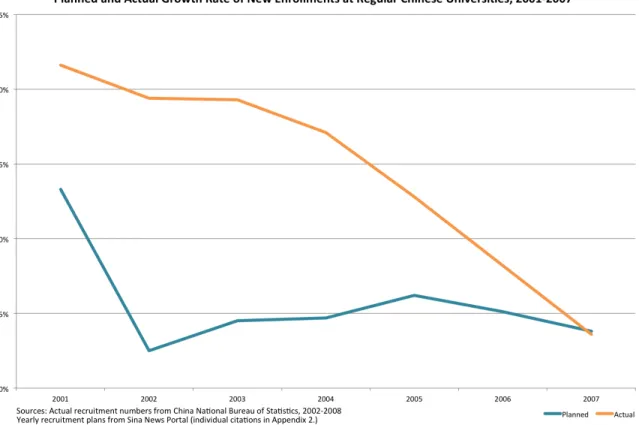
In this section, I provide evidence that the opposite is actually true: From 2002 to 2007, the MOE tried unsuccessfully to slow the rapid growth in higher education enrollments. The fourth column of this table, showing the planned percentage increase in new university enrolments, is particularly illustrative of the MOE's strategy. The sharp decline in 2002, when recruitment was projected to increase by only 2.5% nationally, corresponds to an important shift in the MOE's approach to enrollment expansion.
The contrast between planned and actual enrollment numbers is indicative of the MOE's inability to coordinate national higher education policies in the context of such severe decentralization. The haphazard nature of enrollment expansion, the damage it is doing to educational quality, and the increasing stratification it has created only make sense in light of decentralization and the declining authority of the COE.
CHINESE STATE STRUCTURE AND INSTITUTIONAL BACKDROP
A number of factors contribute to the polymorphic and heterogeneous nature of Chinese policy implementation, such as persistent corruption, the declining financial dependence of local governments on the center, and state structures that encourage personal and institutional survivalism rather than coherent national plans.3 She writes that “ local government officials in the context of significant decentralization are more driven by local and sometimes personal interests. As mentioned in the previous chapters, local cadres gained increasing authority over the governance of Chinese higher education vis-à-vis the MOE, especially as individual universities were transferred from hierarchical tiao management to local kuai management. In the context of fragmented authoritarianism and decentralization, it is crucial to understand the motivations and priorities of these local officials, both at individual universities and at municipal or provincial governments.
Even a predatory authoritarian regime, as long as it is relatively stable, has an incentive to promote health and prosperity in order to extract more income in the future.12 In this sense, highly mobile Chinese officials represent an unusually degenerate form of government, one that. Huang and Pang write that since the university president (xiaozhang) and party secretary are both officials in the government bureaucracy, they are subject to the same rules of evaluation and promotion that apply to all Chinese government cadres. Although the original survey results are not available, an article in the People's Daily notes that the presidents of top-tier universities served for significantly longer terms, an average of 5.9 years; the president of Huazhong University of Science and Technology held the record at the time with 7.7 years in office.19 Assuming that time horizon effects are present in the administration of the Chinese higher education system, this information suggests that they are less severe in these elite universities.
In the next section, I review the literature that describes another major influence on the behavior of local cadres—their ability to take advantage of virtually unlimited free credit. In the case of state aid, concerns about economic or social stability often contribute to such a decision. Since the government ultimately pays for all spending, whether through direct funding or ex-post support in the form of loans, higher education institutions have a hidden incentive to maximize their non-political spending – in other words, to be as inefficient as possible. .
The Chinese language academic environment shows that these phenomena can also occur in the higher education system. In the context of this fragmented authoritarianism, university administrators are suspected of prioritizing their own career prospects more than the quality of education, student welfare, or strict implementation of the central policy of the Ministry of Education.
FRAGMENTED AUTHORITARIANISM IN HIGHER EDUCATION
According to this estimate, the approximately 1.2 million local university enrollments accounted for only 41% of Chinese college students in 1998; by 2006, there were 13.6 million students in locally administered universities, accounting for 81% of the total. What follows is a typical, slightly simplified version of the process that I synthesized from a number of sources, including MoD documents, news articles, and my own interviews and. When the relevant departments (usually at the provincial level) complete the assessment of the annual college entrance examination, the passing scores are divided into four "bunches".
The provincial education office must approve the enrollment plans of each individual school and then compile them to determine the total number of planned places in each of the four levels. For example, if all Tier 1 universities in a province have a total planned enrollment size of 100 students, and the MOE has set the size of the first round to be 20% larger than the planned enrollments, the provincial authority will set the scoring threshold (fenshuxian) for the college entrance examination so that the top 120 students will be eligible for the first recruitment round. As part of the university entrance examination process, each student lists a number of potential schools and academic majors, ranked by preference (tianbao zhiyuan).
It is not considered illegal or worthless by the Ministry of Education, as the students recruited in this way are all 1) students who have legitimately met the score thresholds of both the school and the relevant recruitment round, and 2) who in they actually listed the school. as a preference. The upper limit of this built-in flexibility would be for a university to recruit all 120 students whose files it receives. These kinds of adjustments, when made without the approval of the education bureaucracy one level up, are also part of a legal gray area that the MoD reformed starting in 2005.
The nature of China's higher education system made “out-of-plan expansion” a much more serious problem at the lower levels. This phenomenon, enabled by the bureaucratic design of the university recruitment process, is further supported by the geographical contours of central and local enrollment growth.

CONCLUSION: REASSERTION OF CENTRAL AUTHORITY?
3 Moe, „2000 Nian Putong Gaodeng Xuexiao Zhaosheng Gongzuo Guiding (redne visokošolske ustanove 'Smernice za zaposlitev 2000). (skrajšano)).
14 教育部,《教育部2004年普通高等学校招生鲁区管理工作的晋级同治》(关于加强普通高等学校教育监管的紧急通知》。 22教育部,《教育部观育作号2006年全国普通高等学校招生鲁区工作》德《教育部关于开展普通高等学校招生招生工作的通知》(2006年教育部关于开展普通高等学校招生招生工作的通知)。23同上;另见《2006年普通高中招生工作指导》备忘录第6点(普通高等学校招生工作指导意见)从 2006 年起)。
毕业生失业:中国走向大众高等教育的困境与挑战。《中国季刊》。关宇家强,2004年招聘与招生)。
《关羽作号2007年全国普通高等学校少生录曲工作的同治》(教育部关于2007年普通高等学校招生招生工作的通知)。来自普通高等学校。2001年招生)。
Jiaoyubu guanyu zuohao 2006 nian quanguo putong gaodeng xuexiao zhaosheng luqu gongzuo de tongzhi” (MOE-kennisgewing oor die uitvoering van gereelde hoëronderwysinstellings se 2006-werwings- en inskrywingswerk).