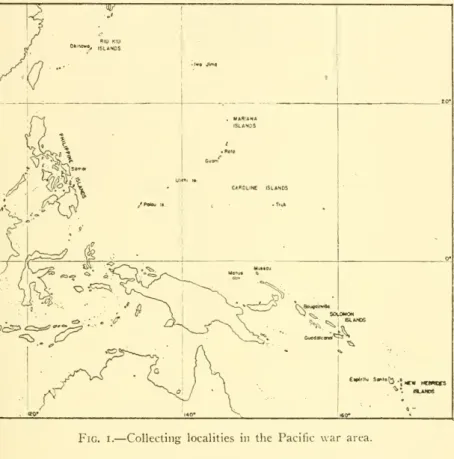
About 1,300 specimens of birds were obtained in the period from June 1944 to December 1945, and are now deposited in the United States National Museum, Wash- . This party joined the rest of the field group at Guam in March 1945, where laboratories were established. Johnson, H(S), USNR, then officer in charge of the Laboratory of Mammalogy, and to collaborators in the laboratory: fellow pharmacists Odis A.
of Medicine and Surgery, United States Navy, under whose direction the report was written, and Lt. Alexander Wetmore, Secretary of the Smithsonian Institution, for the opportunity to work with and use the collections at the United States National Museum. Ernst Mayr and Dean Amadon of the American Museum of Natural History for the opportunity to examine the specimens on their charge.
Most of the birds were identified by comparison with specimens in the United States National Museum. By this time, Japanese forces controlled most of the island and the group could only gather nearby.
SOLOMON ISLANDS
8 SMITHSONIAN MISCELLANEOUS COLLECTIONS VOL. 10/
Guadalcanal Island: Doma Cove — i male, November 17; Lunga Point — I unsexed, December 26
This single specimen has been compared with a large series of rails in the collection of the American Museum of Natural History, and appears to belong to race P. It resembles birds of this race from New Guinea and New Britain in the color of the upperparts. parts and belly color, except that the lower tail-coverts and sides are darker brown than in most of these specimens. and the nape has a more brownish-olive shade. This bird differs from P. Matthias Island specimens in being much paler below and having a longer bill.
To my knowledge this is the first report of this widespread species in the Solomon Islands. From September onwards shorebirds were seen in large numbers; they were on beaches and airstrips.
10 SMITHSONIAN MISCELLANF.OUS COLLECTIONS VOL. IO7
This appears to be a slight trend towards Lariits roratus goodoni Hartert of the Admiralty Islands, which has a larger bill. Seven of the birds captured in October, November and December had molting body and wing feathers.
14 SMITHSONIAN MISCELLANEOUS COLLECTIONS VOL. I07
15 EIRDS OF THE PACIFIC WAR AREA BAKER 1. Probably SANCTA Vigors and Horsfield.) Bougainville Island: Cape Torokina —i young male, September 26; Jaba River—i male, i juvenile female, September 17, 26. The dimensions of the wings of the two males were within the limits of the range studied by Mayr (Amer. Bougainville Island: Cape Torokina —i female, October 16. RHIPIDURA COCKERELLI SEPTENTRIONALIS Rothschild and Hartert Rhipidura cockerelli septcntrialis Rothschild and Hartert, Bull.
20 SMITHSONIAN MISCELLANEOUS COLLECTIONS VOL. 10/
22 SMITHSONIAN MISCELLANEOUS COLLECTIONS VOL. I07 BIRDS COLLECTED IN THE BISMARCK ARCHIPELAGO
BIRDS COLLECTED AT SAMAR, PHILIPPINE ISLANDS
Crows were frequently observed in the wooded areas and along the airstrip at Guiuan.
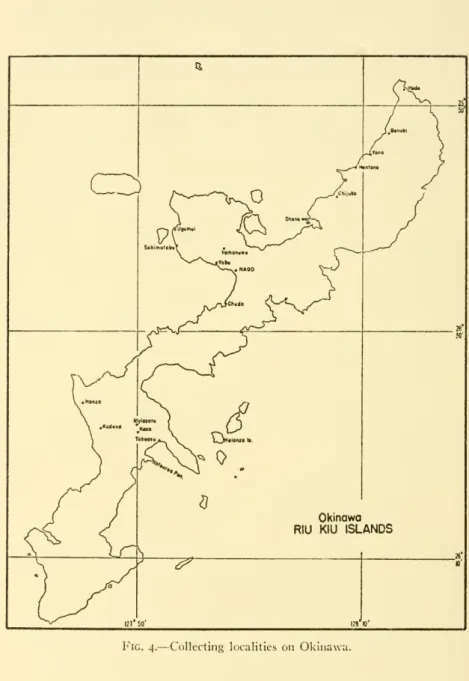
BIRDS COLLECTED AT OKINAWA, RIU KIU ISLANDS
26 SMITHSONIAN MISCELLANEOUS COLLECTIONS VOL. I07
15 BIRDS OF THE PACIFIC WAR AREA BAKER 27 BUTORIDES STRIATUS AMURENSIS Schrenck. Amurland.) Hentona —in female, September ii. The characters of this specimen agree with those used by Phillips in his recent description of the button quail from the southern and.
28 SMITHSONIAN MISCELLANEOUS COLLECTIONS VOL. 10/
The birds collected in May and July are in nuptial phmiage. birds taken in September are in winter plumage.
30 SMITHSONIAN MISCELLANEOUS COLLECTIONS VOL. I07 The noddy terns were collected on the coast following a 2-day
Apparently one bird was misjudged; It. has the plumage of a male. lyugipicus kizuki nigrcsccns Seebohm, Ibis, 1887, p. Loo-choo Islands=.
32 SMITHSONIAN MISCELLANEOUS COLLECTIONS VOL. ID/
34 SMITHSONIAN MISCELLANEOUS COLLECTIONS VOL. IO7
BIRDS COLLECTED AT IWO JIMA, VOLCANO ISLANDS
BIRDS COLLECTED IN MICRONESIA
36 SMITHSONIAN MISCELLANEOUS COLLECTIONS VOL. I07
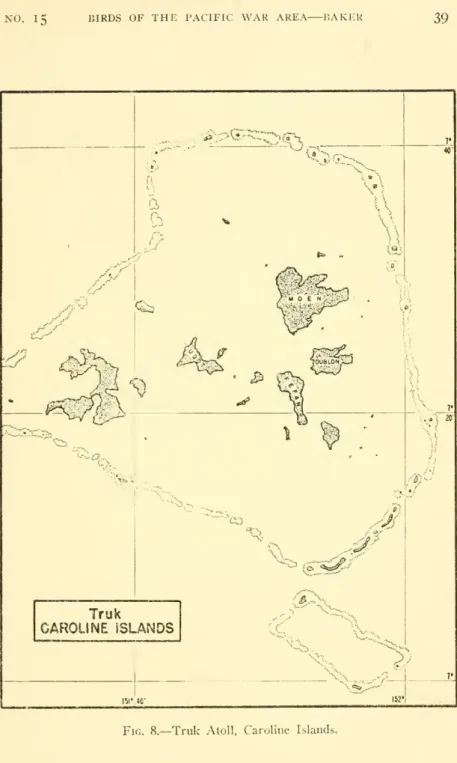
15 15IRDS OF THE PACIFIC WAR AREA BAKER 37 McElroy visited Truk Atoll from 24 November to 18 December. Collections were made on Moen Island, and observations were made on Dublon, Fefan, and Udot, shown by the map, figure 8. Davison, McElroy, Strong, and the writer visited American islands in the southern Palaus from August 24 to September 24. collect.
38 SMITHSONIAN MISCELLANEOUS COLLECTIONS VOL. 10/
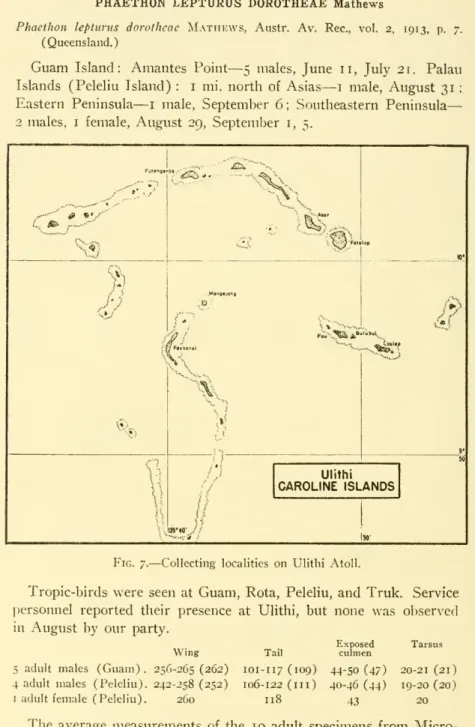
CAROLINE ISLANDS
If we compare the male birds from Guam and Peleliu, the former are larger in appearance and in the length of their wings and bill. These specimens are probably representatives of breeding populations, and it is entirely possible that these breeding populations on different islands would show some variation in size. 15 BIRDS OF THE PACIFIC WAR AREA BAKER 4I On Peleliu, tropical birds were larger than on Guam and occurred in all parts of the island, in jungle areas and on cliffs.
Nests were observed in hollows of the Australian pine {Casuarhia eqiiisetifolia), between 20 and 30 feet from the ground. At Rota, 12 Brown Breasts were seen by Johnson on the high cliffs of the Taipingot Peninsula on 24 October. Palau Islands (Peleliu Island): Akarakoro Point-2 females, 2 juveniles, 7 Sep, 16; Asias-i juvenile female, August 27; Eastern Peninsula – I female, 10 September.
42 SMITHSONIAN MISCELLANEOUS COLLECTIONS VOL. 10/
15 BIRDS OF TPIE PACIFIC WAR AREA – BAKER 43 records extend the range of this bird to the CaroHnes and Mariana Islands. The herd remained in this area and was observed until June 13, when the area was cleared for military use. On July 25 and again on August 6, a flock of 16 birds was seen on the beach of Agfayan Bay.
On the southeastern peninsula, Peleliu, two juveniles and three nestlings in postnatal molt were collected in a clump of low saplings.
44 SMITHSONIAN MISCELLANEOUS COLLECTIONS VOL. I07 IXOBRYCHUS SINENSIS BRYANI (Scale)
As in the case of the Guam bittern race, this form is not distinct. The ducks apparently flew to the outlying islands during the day, but took refuge in the marshes of Moen Island at night. In Peleliu, service personnel reported seeing ducks, but our collection group found none in August and September.
Ducks, possibly of this species, were seen flying over a marsh near Agat on 13 June 1945, and others were seen by service personnel near a fallow rice field in August 1944. It is possible that ducks are present in inland marshes and swamps of the southern interior of Guam. Our field parties explored the lower parts of this valley but did not venture very far from the roads due to the presence of enemy troops in the area.
At Rota two ducks which might have been of this species were seen by Johnson on October 30 in a cultivated field. The presence of war activities and large concentrations of service personnel on the small islands inhabited by this unique bird has undoubtedly disturbed and affected the already small numbers.
46 SMITHSONIAN MISCELLANEOUS COLLECTIONS VOL. IO7 This necessitates careful conservation of the ducks to insure survival,
The Mariana megapod {Megapodius laperouse laperouse Gaimard) was not found by our collectors on Guam or Rota. 57 ring-necked pheasants (16 roosters and 41 hens) were freed at Guam by the US Navy. These birds, provided by the California Game and Fish Division, were 11 weeks old when they were released.
-three settled near the FEA dairy farm about i| miles west of the Prize School. A month after release there was still evidence that the birds were present, although there were reports that some had wandered as far away. They were found singly or in pairs, although a flock of seven birds was reported on Mount Tenjo.
48 SMITHSONIAN MISCELLANEOUS COLLECTIONS VOL. IO7
Ten specimens from Guam, Saipan, and Tinian in the collection of the United States National Museum were compared with gallinules from other areas. The color is paler; the upper wing coverts are less olive brown and more slate, and the back, rump and shoulder blades are less richly washed with olive. The three birds were captured from freshwater and brackish water marshes in Angaur Island.
50 SMITHSONIAN MISCELLANEOUS COLLECTIONS VOL. 10/
On Guam, the birds were seen in March on their northward migration, the last record being on March 21st. The birds returned to Guam from their northern breeding grounds in the early months. in summer, the first record was June i. may be due to the effects of migration.
52 SMITHSONIAN MISCELLANEOUS COLLECTIONS VOL. I07 LIMOSA LAPPONICA BAUERI Naumann
15 BIRDS OF THE PACIFIC WAR ZONE 57 White-headed Wagtails were found at Ulithi, Palau and Truk. On Guam, white terns were numerous and scattered over all parts of the island, especially in the coconut groves. He reports that their habits are very similar to those of the birds in the Marianas.
Palau Islands (Peleliu Island): Small island off the East Peninsula—I male, September 10; Ngabad Island—I young man, i. 15 BIRDS OF THE PACIFIC WAR AREA BAKER 67 Warblers were found in jungle areas and in the new vegetation that covered the war-torn parts of Peleliu.
68 SMITHSONIAN MISCELLANEOUS COLLECTION'S VOL. 10/
It prefers dense undergrowth in jungles and secondary scrub, where it is a much less conspicuous bird than the palav fan-bird Rhipiduralepida. This bird was found in forested areas on all the islands visited in the southern Palaus. It appeared to prefer dense undergrowth and was found in scrub covering battle areas (pi.
70 SMITHSONIAN MISCELLANEOUS COLLECTIONS VOL. IO7 There are only slight differences among the measurements of
The streaked underparts of Marianas chicks and single juveniles from Truku are brighter, while those from Ulithi have paler underparts. In August, a large proportion of the population had apparently just completed nesting activities, as a number of young individuals were observed being fed by adults. Palau Islands (Peleliu Island) : Asias—-i male, August 31; Southeast Peninsula-3 males, 2 juvenile males, I juvenile females,.
As can be seen from the original description, there is some difference in the depth of the beaks of these breeds. The beak depth (at the nostril) of the Palau birds measures between 7 and 8, with one measuring 8.5, while the beak depth of Ulithi specimens measures between 8 and 8. Birds from the Palaus generally have the lower edge of the lower jaw straighter, while this lower edge in the Ulithi birds, it curves slightly downwards, increasing the depth.
2 SMITHSONIAN MISCELLANEOUS COLLECTIONS VOL. 10/
Birds were taken in five localities, where they were found in small groups moving through low trees. No evidence of nesting activity was found although three males taken in June and July had enlarged testes. It is possible that nesting is concentrated in the winter and spring months, although Scale (Occ.
74 SMITHSONIAN MISCELLANEOUS COLLECTIONS VOL. I07 Bridled white-eyes were found at only one locality at Garakayo
FAUALOP ISLAND, ULITHI ATOLL. SHOWING THE AMOUNT OF CLEARING OF THE SMALL ISLAND FOR MILITARY INSTALLATIONS
Woodlands along a Beach at peleliu
Mangrove Swamp at Peleliu. Used by phalacrocorax melanoleucos and nycticorax caledonicus
Brackish-water Marsh on Peleliu rsLAND. Used by Gallfnula chloropus
EXTENSIVE TIDAL FLAT AT PELELIU. USED BY MIGRATORY Shore Birds
JUNGLE Vegetation on Potangeras island. Ulithi Atoll, USED BY APLONIS OPACUS AND GYGIS ALBA
OPEN JUNGLE. TYPICAL OF THE SOUTHERN MARIANAS