University of Mississippi Prepharmacy and Early Entry Students' Professional Commitment and Perceptions of the Professional Role of Pharmacists
By Blake Williams
A thesis submitted to the faculty of The University of Mississippi in partial fulfillment of the requirements of the Sally McDonnell Barksdale Honors College.
Oxford May 2014
Approved by
_______________________________________
Advisor: Professor Erin Holmes
_______________________________________
Reader: Professor Jay Pitcock
_______________________________________
Reader: Professor Donna West-Strum
© 2014 Blake Williams
DEDICATION
My thesis is dedicated to my parents. They have given me my values, my drive, and every opportunity to purse my education. I owe them more than I could ever repay.
ACKNOWLEDGEMENTS
First and foremost, I thank God for his grace and provision. Without Him, I could do nothing.
I would like to acknowledge the faculty and staff of the University of Mississippi School of Pharmacy for their support and assistance.
Dr. Erin Holmes, for guiding me through this project. She was there for inspiration, correction, and encouragement, and I am grateful for the time and energy she so willingly gave.
Drs. Pitcock and West-Strum, for taking time to read and revise my thesis, helping to make it the best it could be.
Drs. McCaffrey, Warren, Robinson, and Brooks, and Dean Bennett, for being so willing to help in my data collection by distributing surveys to their advisees.
And finally, Ms. Angela Ellis and Mrs. Carla Bennett, for making their expertise available in granting my frequent requests.
I would like to thank Dean Sullivan-Gonzáles, Drs. Young and Samonds, Mrs. Penny Leeton, and the rest of the faculty and staff of the Sally McDonnell Barksdale Honors College for giving me an unforgettable experience at the University of Mississippi. I hope to make the Honors College as proud of me as I am to be a part of it.
I would also like to thank my parents, my sisters, my extended family, and all my friends who have supported me throughout my educational journey so far. Every piece of advice and encouragement has been taken to heart, and I am sure I would have faltered by now if it were not for their love.
Lastly, I would like to thank Kayla Creel for being there for me through every failure and every success, every defeat and every victory. I could not ask for more.
ABSTRACT
Introduction: The profession of pharmacy is now largely focused on patient-centered care, rather than the drug-centered focus of the past. Schools of pharmacy have a vested interest in recruiting student pharmacists who are patient-focused. The purpose of this study is to assess University of Mississippi prepharmacy and Early Entry students' perceptions of the professional role of pharmacists, and to determine if these perceptions are related to student characteristics.
Methods: This cross-sectional, descriptive study utilized an online, self-administered survey, administered to prepharmacy and Early Entry students enrolled at the University of Mississippi. The survey included constructs of the theory of planned behavior as a way to measure students’ perceptions of the professional role of pharmacists. Additionally, the survey assessed students’ professional commitment, as well as several demographic characteristics of respondents.
Results: 104 completed surveys were received for a 23% response rate. Respondents were generally were female, between the ages of 18 and 20, and Caucasian. Most respondents reported having a GPA of 2.75 or greater, meeting the minimum GPA required for regular admission into the UM School of Pharmacy. Comparisons of students’ perceptions of the professional role of pharmacists based on GPA, number of semesters completed, Early Entry/prepharmacy status, pharmacists in the family, and work experience, resulted in no significant differences, with the exception of work experience when measuring perception on the basis of the perceived behavioral control component of the theory of planned behavior. Additionally, differences in professional commitment were not found based on the above-listed categories.
Conclusion: Responding students generally demonstrated positive perceptions of the professional role of a pharmacist and also demonstrated professional commitment.
General, insignificant trends suggested that student who completed fewer semesters, were prepharmacy students, had more work experience, or had a pharmacist in the family had more positive perceptions of the professional role of the pharmacists and higher professional commitment scores.
TABLE OF CONTENTS
LIST OF TABLES AND CHARTS………..vii
LIST OF ABBREVIATIONS.……….viii
INTRODUCTION.………..1
METHODS………..5
RESULTS.………...9
DISCUSSION………21
LIST OF REFERENCES.………..26
APPENDICES………...27
LIST OF TABLES AND CHARTS Table 1: Description of Student Respondents
Table 2: Students’ Responses to Theory of Planned Behavior Survey Items Table 3: Comparisons of Students on Attitude Scale
Table 4: Comparisons of Students on Subjective Norm Scale
Table 5: Comparisons of Students on Perceived Behavioral Control Scale Table 6: Students’ Responses to Professional Commitment Survey Items Table 7: Comparisons of Students on Commitment Scale
LIST OF ABBREVIATIONS AACP American Association of Colleges of Pharmacy JCPP Joint Commission of Pharmacy Practitioners APhA American Pharmacists Association
ACPE Accreditation Council of Pharmacy Education GPA Grade Point Average
PCAT Pharmacy College Admission Test IRB Institutional Review Board
UM University of Mississippi
INTRODUCTION
Pharmacists have many responsibilities as part of their professional role. According to the American Association of Colleges of Pharmacy (AACP), pharmacists are responsible for the quality of the medicines they supply, dispensing medicines according to state and federal regulations, ensuring that the medicines prescribed to patients are suitable for them, and educating patients about their indications. These aspects provide the foundation on which the role of a pharmacist is built.1 It is important to note that pharmacists are responsible for more than just the dispensing of medicines. The profession of pharmacy is now largely focused on patient-centered care, rather than the drug-centered focus of the past. In fact, The Joint Commission of Pharmacy Practitioners (JCPP) gives light to the types of services that the profession provides in its “Future Vision of Pharmacy Practice.” A major goal for the year 2015, is that, “Pharmacy education will prepare pharmacists to provide patient-centered and population-based care that optimizes medication therapy; to manage health care system resources to improve therapeutic outcomes; and to promote health improvement, wellness, and disease prevention.”
Headlining the section titled “Foundations of Pharmacy Practice” is, “a commitment to care for, and care about, patients,” further emphasizing the need for patient-centered care.2
Additionally, the American Pharmacists Association (APhA) provides guidance on the professional responsibilities of a pharmacist through their Code of Ethics for Pharmacists. First and foremost, “Pharmacists are health professionals who assist
individuals in making the best use of medications.” As a result of the trust the society places in them, pharmacists have moral obligations to care for each patient in the best way possible, looking out for the needs of the patient first. It is important to maintain professional competence, but the responsibilities extend beyond knowing information and performing tasks. A pharmacist must act with honesty and integrity in every relationship, whether with patients, other health care providers or society as a whole. As stated in Section VII, “The primary obligation of a pharmacist is to individual patients. However, the obligations of a pharmacist may at times extend beyond the individual to the community and society.”3
Accreditation Standards set by the Accreditation Council for Pharmacy Education (ACPE) emphasize how important it is that schools of pharmacy train pharmacy students to provide patient-centered care. Standard No. 1 describes the missions and goals a school or college of pharmacy must set. It states, “These goals must include fundamental commitments of the college or school to the preparation of students who possess the competencies necessary for the provision of pharmacist-delivered patient care, including medication therapy management services, the advancement of the practice of pharmacy and its contributions to society, the pursuit of research and other scholarly activities, and the assessment and evaluation of desired outcomes.” Concerning educational outcomes, Standard No. 12 requires that students are able to provide patient care both independently and as part of a interprofessional healthcare team.4
In addition to these guidelines, The University of Mississippi School of Pharmacy also outlines its “Patient Care Mission,” citing its focus on the advancement and provision
“leading in the development of model practices for implementation in the community setting,” “leading in the development of clinical skills, medication therapy management services, and administrative systems,” and “advancing and adopting standards for professional practice, patient education and monitoring patient outcomes.5” These goals can only be accomplished if graduates from The University of Mississippi School of Pharmacy are well-trained and self-motivated to provide patient-centered care and lead others in doing so.
Therefore, like other schools of pharmacy, The University of Mississippi School of Pharmacy has a vested interest in recruiting student pharmacists who are patient-focused.
The School has high academic standards already in place for grade point average (GPA), Pharmacy College Admission Test (PCAT) scores, and pre-professional course completion.6 The applicant must also meet technical standards in areas of observation, communication, psychomotor skills, intellect, and behavioral and social attributes.
Additionally, candidates for the Doctor of Pharmacy degree are required to exercise good judgment in the pharmaceutical care of patients and have the capacity to develop relationships with them.7
Because the University of Mississippi wants to admit students that will provide patient-centered care throughout their careers, it is important to gauge preprofessional students’ perceptions of the professional role of pharmacists. Once a baseline measure of student perceptions is identified, the School of Pharmacy can take action to address gaps in perceptions to begin to build professionalism among its preprofessional students.
Therefore, the objectives of this study are to:
1. Report on University of Mississippi prepharmacy and Early Entry students’
perception of the professional role of pharmacists, and to determine if perceptions differ based on:
Grade point average (GPA)
Semesters of coursework completed
Student status (prepharmacy or Early Entry) Whether students have pharmacists in their family Pharmacy experience
2. Report on University of Mississippi prepharmacy and Early Entry students’
commitment to the profession, and to determine if professional commitment differs based on:
Grade point average (GPA)
Semesters of coursework completed
Student status (prepharmacy or Early Entry) Whether students have pharmacists in their family Pharmacy experience
METHODS Design
The study utilized a cross-sectional, descriptive design. Responses were collected using a self-administered questionnaire through Qualtrics, an online survey interface.
Sample
The study sample consisted of students at the University of Mississippi who were registered with a pre-pharmacy major, as well as those who were enrolled in the Early Entry program (EE1s, EE2s, and EE3s). A total of 452 emails were sent, 288 to prepharmacy students, and 164 to Early Entry students.
Data Collection
Before data collection began, an exemption application was submitted to the University of Mississippi Institutional Review Board (IRB), and the study was exempted from review. The study employed the use of an online survey generated by Qualtrics.
Prepharmacy students received an email from their respective academic advisors that requested their participation. Early entry students received an email from the School of Pharmacy Dean’s office that also requested their participation. The email contained a description of the project and a link to the questionnaire. The initial email was followed two weeks later with a reminder email, also containing a link to the questionnaire. Refer to Appendix A for the administered survey, Appendix B for the initial recruitment email, and Appendix C for the reminder email.
Survey Design
The questions asked in the survey were modeled after those used by researchers from the Purdue University College of Pharmacy when they were investigating a similar topic. The theoretical framework for the study was the theory of planned behavior.
According to this theory, the intention to perform certain behaviors is determined by attitudes, subjective norm, and perceived behavioral control. Attitude is the positive or negative evaluation of the behavior, subjective norm is the perceived social pressure exerted on an individual to perform a certain behavior, and perceived behavioral control is an individual’s perception of the ease or difficulty of performing a behavior. The theory essentially suggests that behavior is a function of beliefs regarding the behavior.8
The first section of the survey consisted of 13 questions that gathered information about students’ demographics, education, and pharmacy experience. Items reported on included age, gender, ethnicity, cumulative GPA, student status, previous degrees, semesters of coursework completed, pharmacists in the family, and work experience.
The second section included 15 questions designed to assess students’ attitudes about the professional role of pharmacists. These questions were framed using the verb
“will” in order to illustrate this construct of the theory of planned behavior (example: “As a pharmacist, I will interview patients.”).
The third section included five questions assessing the subjective norm students’
expect as pharmacists. These questions were framed using the phrase “will be expected to”
in order to illustrate this construct (example: “As a pharmacist, I will be expected to counsel patients.”).
The fourth section included seven questions about students’ perceived behavioral control in the professional role of pharmacists. These questions were framed using the verb
“can” in order to illustrate the final construct of the theory (example: “As a pharmacist, I can identify problems a patient is having with medications.”).
The fifth and final section consisted of 10 questions and was based on Blau’s career commitment scale in order to measure students’ level of professional commitment.
Responses in sections 2 through 5 were assessed using a 7-point Likert scale (3 = strongly agree, 2 = agree, 1 = somewhat agree, 0 = neutral, -1 = somewhat disagree, -2 = disagree, -3 = strongly disagree).
Pretesting
Before the survey link was sent to prepharmacy and Early Entry students, it was sent to three first-year pharmacy students from the University of Mississippi School of Pharmacy as a pretest. These students completed the questionnaire and gave feedback to the researchers regarding its clarity, understanding, and time required to complete the questionnaire. The questionnaire was revised according to suggestions from these students.
Analysis
A response rate was first calculated by dividing the number respondents who completed questionnaires by the number of students to whom the questionnaire was sent.
The sample was then described through the calculation of descriptive statistics including means, frequencies, and percentages.
The first objective (report on University of Mississippi prepharmacy and Early Entry students’ perception of the professional role of pharmacists, and to determine if perceptions differ based on 1) grade point average (GPA), 2) semesters of coursework
completed, 3) student status (prepharmacy or Early Entry), 4) whether students have pharmacists in their family, and 5) pharmacy experience, was met by first calculating item means, scale means, and scale reliabilities of the attitude, subjective norm, and perceived behavioral control subscales of the ‘perception of the professional role of pharmacists measure’. To test if perceptions for each subscale might differ based on the five demographics listed above, analysis of variance or independent samples t-tests were conducted, depending on how many levels each demographic variable had. Cronbach’s alphas were also calculated to ensure the reliability of the subscales and instrument.
The second objective (report on University of Mississippi prepharmacy and Early Entry students’ commitment to the profession, and to determine of professional commitment differs based on 1) grade point average (GPA), 2) semesters of coursework completed, 3) student status (prepharmacy or Early Entry), 4) whether students have pharmacists in their family, and 5) pharmacy experience, was first met by first calculating item means, the scale mean, and the scale reliability of the professional commitment measure. To test if professional commitment might differ based on the five demographics listed above, analysis of variance or independent samples t-tests were conducted, depending on how many levels each demographic variable had. Cronbach’s alphas were also calculated to ensure the reliability of the subscales and instrument.
RESULTS Response Rate
Of the 452 students invited to take the survey, 104 completed surveys were received for a 23% response rate.
Sample Description
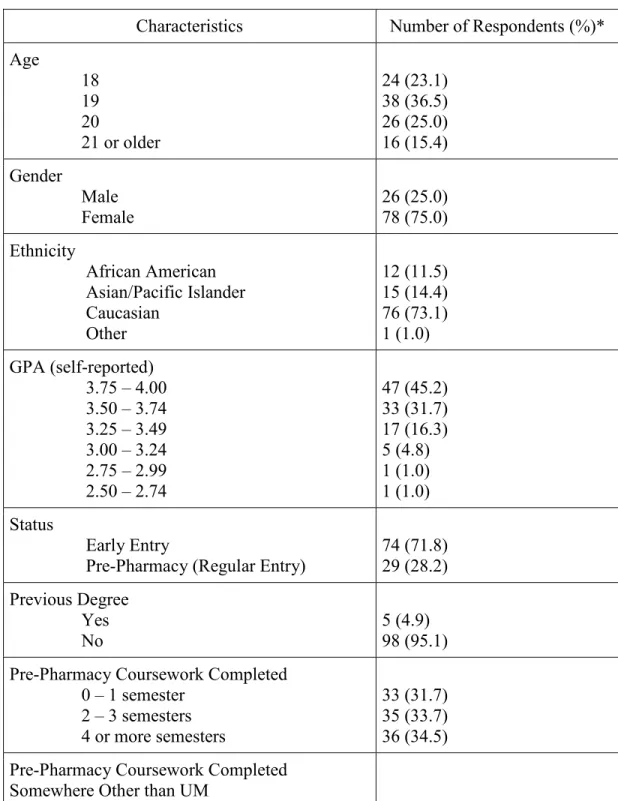
Of the 104 respondents, 75% were female, 84.6% were between the ages of 18 and 20, and 73.1% were Caucasian. Ninety-nine percent had a self-reported GPA of 2.75 or greater, meeting the minimum GPA required for regular admission into the UM School of Pharmacy. Seventy-four students (71.8%) were Early Entry and 29 students (28.2%) were prepharmacy (regular entry). Five percent of the students had a previous degree and 11.5%
completed more than one semester of prepharmacy coursework at a school other than UM.
Respondents are approximately evenly distributed according to the following categories regarding amount of prepharmacy coursework completed: zero to one semesters completed, two to three semesters completed, and four or more semesters completed.
Twenty students (19.2%) reported having a family member who was a pharmacist.
Fifty students (48.1%) reported having pharmacy work or volunteer experience and completed the corresponding items. Twenty-seven percent of all respondents reported experience in independent pharmacy, 18% reported experience in chain community pharmacy, and 15% reported experience in hospital pharmacy. Approximately 7%
answered with experience in other areas of pharmacy practice, citing
compounding, free clinic, and home infusion. Table 1 shows a list of demographic items, as well as frequencies and percentages of student responses.
Table 1: Description of Student Respondents
Characteristics Number of Respondents (%)*
Age
18 19 20
21 or older
24 (23.1) 38 (36.5) 26 (25.0) 16 (15.4) Gender
Male Female
26 (25.0) 78 (75.0) Ethnicity
African American Asian/Pacific Islander Caucasian
Other
12 (11.5) 15 (14.4) 76 (73.1) 1 (1.0) GPA (self-reported)
3.75 – 4.00 3.50 – 3.74 3.25 – 3.49 3.00 – 3.24 2.75 – 2.99 2.50 – 2.74
47 (45.2) 33 (31.7) 17 (16.3) 5 (4.8) 1 (1.0) 1 (1.0) Status
Early Entry
Pre-Pharmacy (Regular Entry) 74 (71.8) 29 (28.2) Previous Degree
Yes No
5 (4.9) 98 (95.1) Pre-Pharmacy Coursework Completed
0 – 1 semester 2 – 3 semesters 4 or more semesters
33 (31.7) 35 (33.7) 36 (34.5)
0 – 1 semester 2 – 3 semesters 4 or more semesters
92 (88.5) 4 (3.8) 8 (7.7) Pharmacist in the Family
Yes No
20 (19.2) 84 (80.8) Pharmacy Experience
Yes No
50 (48.1) 54 (51.9) Type of Pharmacy Experience**
No Experience Independent Chain Hospital Other***
54 (51.9) 28 (26.9) 19 (18.3) 16 (15.4) 5 (4.8) Amount of Experience
No experience Less than 1 month 1 – 9 months 10 months or more
54 (51.9) 19 (18.3) 15 (14.4) 16 (15.4) Hours per week of Experience
No experience 1 -5 hours 6 – 20 hours 21 – 40 hours More than 40 hours
54 (51.9) 20 (19.2) 14 (13.5) 15 (14.4) 1 (1.0)
*Missing demographic data was not considered in calculation of percentages.
**Students could respond with more than one answer
***Compounding, free clinic, home infusion
Objective 1
The first objective of this study was to report on University of Mississippi prepharmacy and Early Entry students’ perception of the professional role of pharmacists, and to determine if perceptions differ based on the characteristics of GPA, semesters of coursework completed, student status, whether students have pharmacists in the family, and pharmacy work experience.
Sections 2, 3, and 4 of the survey asked students to report their level of agreement or disagreement with each item on a 7-point Likert scale (3 = strongly agree, 2 = agree, 1
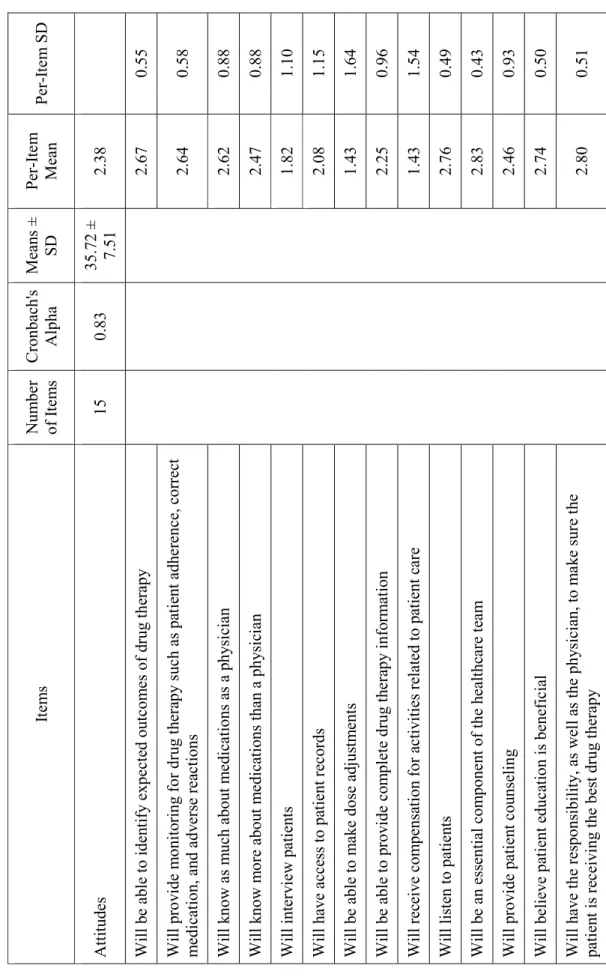
= somewhat agree, 0 = neutral, -1 = somewhat disagree, -2 = disagree, -3 = strongly disagree). The responses were compiled and statistical analyses were performed, according to the theory of planned behavior. Table 2 includes a list of items presented to the students in sections 2, 3, and 4, as well as the cumulative mean and standard deviation, and per-item means and standard deviations. The average scores for the majority of the questions were between 2 and 3 (agree to strongly agree). The highest mean score in these sections was 2.83, from the item, “As a pharmacist, I will be an essential part of the healthcare team.”
The lowest mean score was 1.43, from the items, “As a pharmacist, I will be able to make dose adjustments,” and, “As a pharmacist, I will receive compensation for activities related to patient care.”
Table 2: Students’ Responses to Theory of Planned Behavior Survey Items Items Number of Items Cronbach's AlphaMeans ± SDPer-Item MeanPer-Item SD ttitudes150.8335.72 ± 7.512.38 ll be able to identify expected outcomes of drug therapy2.670.55 ll provide monitoring for drug therapy such as patient adherence, correct edication, and adverse reactions2.640.58 ll know as much about medications as a physician2.620.88 ll know more about medications than a physician2.470.88 ll interview patients 1.821.10 ll have access to patient records2.081.15 ll be able to make dose adjustments 1.431.64 ll be able to provide complete drug therapy information2.250.96 ll receive compensation for activities related to patient care1.431.54 ll listen to patients2.760.49 ll be an essential component of the healthcare team2.830.43 ll provide patient counseling2.460.93 ll believe patient education is beneficial2.740.50 ll have the responsibility, as well as the physician, to make sure the tient is receiving the best drug therapy2.800.51
ve an important role in identifying problems patients are having with therapy2.750.52 ve Norm5 0.8012.69 ± 3.152.54 expected to dispense medication2.521.00 expected to counsel patients2.400.92 expected to communicate with other members of the healthcare ., physician or nurse) 2.610.90 expected to communicate with patients with special needs (e.g., low , hearing impairment) 2.540.76 expected to identify problems patients are having with their drug 2.630.63 d Behavioral Control7 0.8416.03 ± 5.242.29 ntify problems a patient is having with medications2.430.86 ct parameters of patient care to monitor (e.g., blood pressure, blood 1.961.27 uss patient concerns with a physician2.291.13 ain accurate information on all medications a patient is currently 2.411.01 uss information on over-the-counter products 2.630.73 ntify drug problems of patients not detected by the physician2.221.00 ess a patient’s response to therapy as a standard practice2.081.21
Students were sectioned into groups for analysis, and association was determined according to each characteristic of interest. Analysis of variance or independent samples t- tests were conducted, depending on how many levels each demographic variable had; p values were then calculated to find statistical significance. When the various subscales were compiled, the analysis provided an estimate of prepharmacy students’ overall perceptions of the professional role of pharmacists.
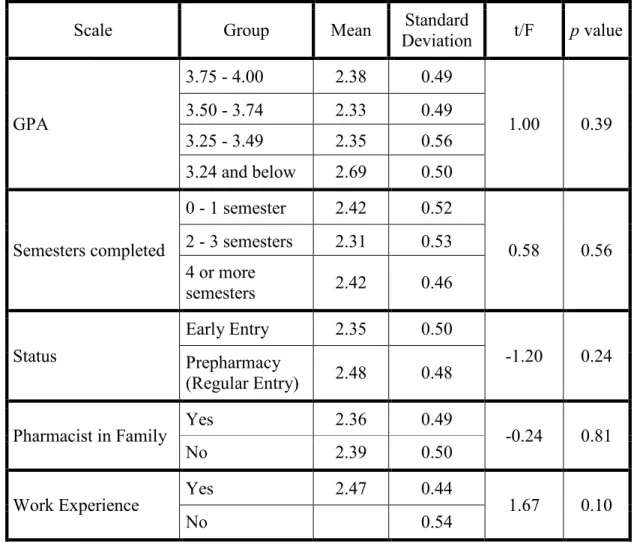
Table 3 compares means and standard deviations, and shows t, F, and p values for each student group on the attitude scale. No statistically significant differences were found in the scale.
Table 3: Comparisons of Students on Attitude Scale
Scale Group Mean Standard
Deviation t/F p value
GPA
3.75 - 4.00 2.38 0.49
1.00 0.39
3.50 - 3.74 2.33 0.49
3.25 - 3.49 2.35 0.56
3.24 and below 2.69 0.50
Semesters completed
0 - 1 semester 2.42 0.52
0.58 0.56 2 - 3 semesters 2.31 0.53
4 or more
semesters 2.42 0.46
Status
Early Entry 2.35 0.50
-1.20 0.24 Prepharmacy
(Regular Entry) 2.48 0.48
Pharmacist in Family Yes 2.36 0.49
-0.24 0.81
No 2.39 0.50
Work Experience Yes 2.47 0.44
1.67 0.10
No 0.54
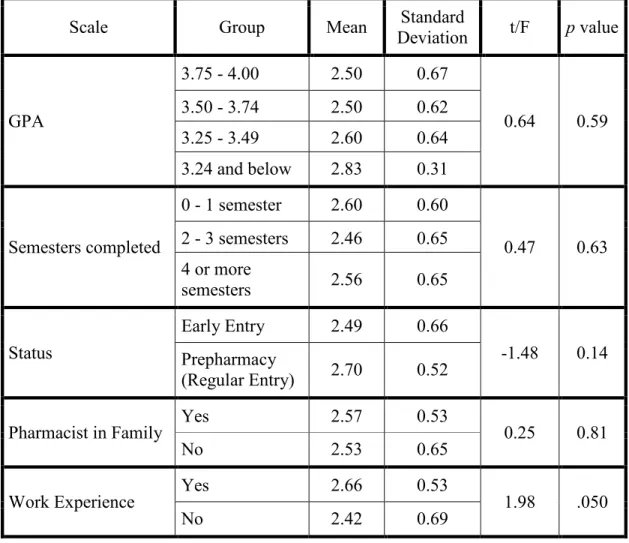
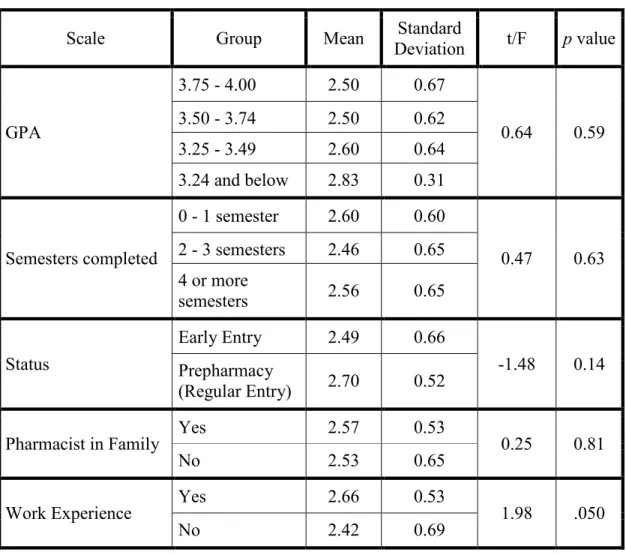
Table 4 compares means and standard deviations, and shows t, F, and p values for each student group on the subjective norm scale. No statistically significant differences among student groups were identified.
Table 4: Comparisons of Students on Subjective Norm Scale
Scale Group Mean Standard
Deviation t/F p value
GPA
3.75 - 4.00 2.50 0.67
0.64 0.59
3.50 - 3.74 2.50 0.62
3.25 - 3.49 2.60 0.64
3.24 and below 2.83 0.31
Semesters completed
0 - 1 semester 2.60 0.60
0.47 0.63 2 - 3 semesters 2.46 0.65
4 or more
semesters 2.56 0.65
Status
Early Entry 2.49 0.66
-1.48 0.14 Prepharmacy
(Regular Entry) 2.70 0.52
Pharmacist in Family Yes 2.57 0.53
0.25 0.81
No 2.53 0.65
Work Experience Yes 2.66 0.53
1.98 .050
No 2.42 0.69
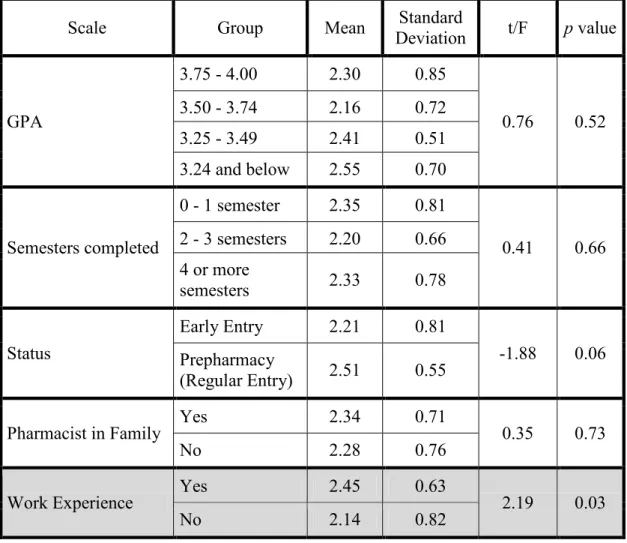
Table 5 compares means and standard deviations, and shows t, F, and p values for each student group on the perceived behavioral control scale. There was a statistically significant difference found for students who had pharmacy work experience (p = 0.031).
Students who had pharmacy work experience reported more positive scores than those who did not have work experience (2.45 vs. 2.14).
Table 5: Comparisons of Students on Perceived Behavioral Control Scale
Scale Group Mean Standard
Deviation t/F p value
GPA
3.75 - 4.00 2.30 0.85
0.76 0.52
3.50 - 3.74 2.16 0.72
3.25 - 3.49 2.41 0.51
3.24 and below 2.55 0.70
Semesters completed
0 - 1 semester 2.35 0.81
0.41 0.66 2 - 3 semesters 2.20 0.66
4 or more
semesters 2.33 0.78
Status
Early Entry 2.21 0.81
-1.88 0.06 Prepharmacy
(Regular Entry) 2.51 0.55
Pharmacist in Family Yes 2.34 0.71
0.35 0.73
No 2.28 0.76
Work Experience Yes 2.45 0.63
2.19 0.03
No 2.14 0.82
Objective 2
The second objective of this study was to report on University of Mississippi prepharmacy and Early Entry students’ commitment to the profession, and to determine if professional commitment differs based on the characteristics of GPA, semesters of coursework completed, student status, whether students have pharmacists in the family, and pharmacy work experience.
Section 5 of the survey asked students to report their level of agreement or disagreement with each item on a 7-point Likert scale (3 = strongly agree, 2 = agree, 1 = somewhat agree, 0 = neutral, -1 = somewhat disagree, -2 = disagree, -3 = strongly disagree).
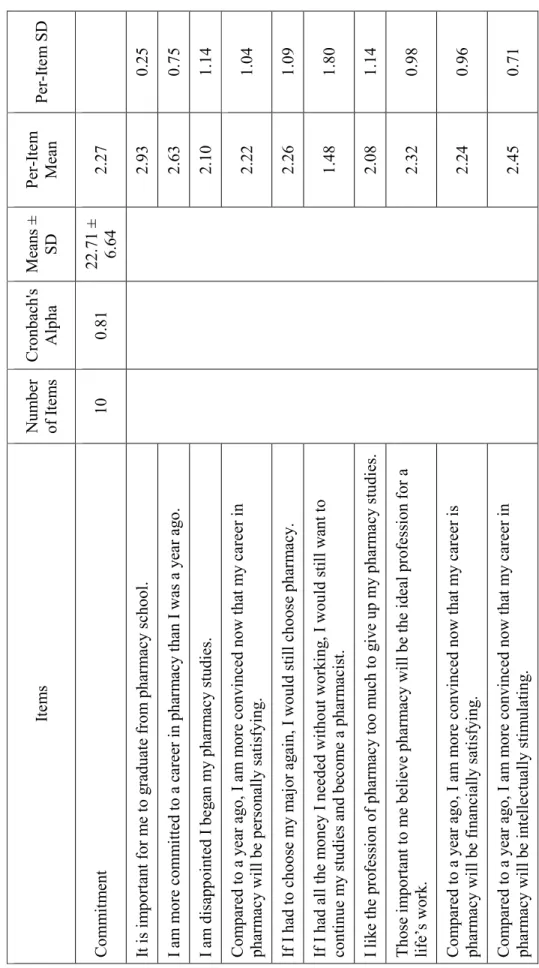
The responses were compiled and statistical analyses were performed, according to Blau’s career commitment scale. Table 6 includes a list of items presented to the students in section 5, as well as the cumulative mean and standard deviation, and per-item means and standard deviations. The average scores for the majority of the questions were again between 2 and 3 (agree to strongly agree). The highest mean score in this section was 2.93, from the item, “It is important for me to graduate from pharmacy school.” The lowest mean score was 1.48, from the item, “If I had all the money I needed without working, I would still want to continue my studies and become a pharmacist.” It is important to note that the scores were inversed for item 3, “I am disappointed I began my pharmacy studies.”
Because the question was negatively phrased, the scores were inversed (-3 becomes 3, -2 becomes 2, -1 becomes 1, and vice versa) to keep the true meaning of students’ responses intact.
Table 6: Students’ Responses to Professional Commitment Survey Items Items Number of Items Cronbach's AlphaMeans ± SDPer-Item MeanPer-Item SD ommitment 100.8122.71 ± 6.642.27 is important for me to graduate from pharmacy school. 2.930.25 am more committed to a career in pharmacy than I was a year ago.2.630.75 am disappointed I began my pharmacy studies. 2.101.14 ompared to a year ago, I am more convinced now that my career in rmacy will be personally satisfying. 2.221.04 I had to choose my major again, I would still choose pharmacy.2.261.09 I had all the money I needed without working, I would still want to inue my studies and become a pharmacist. 1.481.80 like the profession of pharmacy too much to give up my pharmacy studies. 2.081.14 hose important to me believe pharmacy will be the ideal profession for a ’s work.2.320.98 ompared to a year ago, I am more convinced now that my career is rmacy will be financially satisfying. 2.240.96 ompared to a year ago, I am more convinced now that my career in rmacy will be intellectually stimulating. 2.450.71
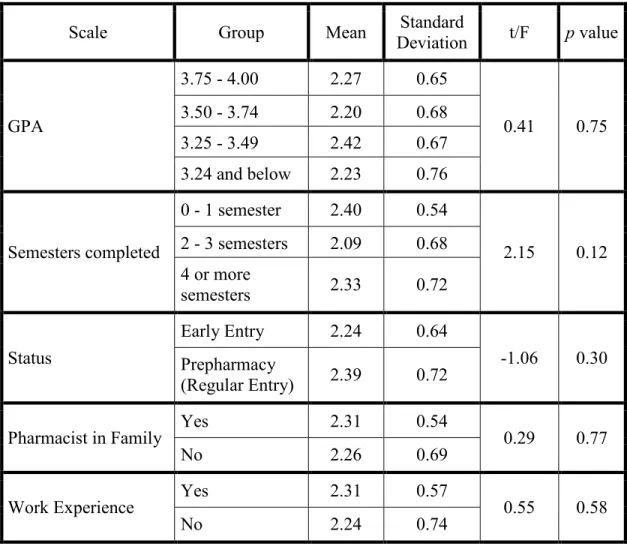
Table 7 compares means and standard deviations, and shows t, F, and p values for each student group on the professional commitment scale. No statistically significant differences were found in the scale.
Table 7: Comparisons of Students on Commitment Scale
Scale Group Mean Standard
Deviation t/F p value
GPA
3.75 - 4.00 2.27 0.65
0.41 0.75
3.50 - 3.74 2.20 0.68
3.25 - 3.49 2.42 0.67
3.24 and below 2.23 0.76
Semesters completed
0 - 1 semester 2.40 0.54
2.15 0.12 2 - 3 semesters 2.09 0.68
4 or more
semesters 2.33 0.72
Status
Early Entry 2.24 0.64
-1.06 0.30 Prepharmacy
(Regular Entry) 2.39 0.72
Pharmacist in Family Yes 2.31 0.54
0.29 0.77
No 2.26 0.69
Work Experience Yes 2.31 0.57
0.55 0.58
No 2.24 0.74
DISCUSSION Objective 1
The first objective of this study was to report on University of Mississippi prepharmacy and Early Entry students’ perception of the professional role of pharmacists, and to determine if those perceptions differ based on characteristics of GPA, semesters of coursework completed, student status, whether students have pharmacists in the family, and pharmacy work experience. The data as whole suggests that students have a positive perception of a pharmacist’s professional role, with most items having a mean score between 2 and 3 (agree and strongly agree). Background knowledge and prior experiences may have exposed students to the patient care model and influenced their views and expectations. Also, the prepharmacy curriculum might have played a role in influencing students’ beliefs about the profession. To determine if students’ perceptions differ according to various demographics, it would be helpful to examine the scores of various groups on the subscale level.
The first characteristic compared among students was GPA. Students with a self- reported GPA of 3.24 and below gave more positive scores on all three scales in the theory of planned behavior, but the results were not significant. No conclusions can be drawn from this data, so perhaps further research in this area is needed.
The second characteristic to be compared was semesters of prepharmacy curriculum completed. Students in their first year of the curriculum had consistently more
significant, this suggests that students who are just beginning prepharmacy studies have a more positive view of the profession. In contrast, Students who have completed 2 or 3 semesters of coursework had consistently lower scores across all categories. This discrepancy may suggest that students in their first year of curriculum are more excited about the profession and future prospects, and students in their second year of studies are less so.
The third characteristic was student status, Early Entry or prepharmacy (regular entry). Prepharmacy students reported higher scores across all sections of the survey.
Although the differences were insignificant, it could be useful to take note of this trend.
This could suggest that prepharmacy students have a more realistic view of the profession in general and may know more of what to expect. These results however, do appear counterintuitive, given that Early Entry students are technically admitted to the pharmacy school. Some factors that might be influencing perception of pre-pharmacy students include the pre-pharmacy club and pre-pharmacy advising. Historically, early entry students have not had access to similar resources, which may, in part, describe what was observed in this study.
The fourth characteristic was whether or not the student had a pharmacist in his or her family. While statistically significant differences were not identified between those students that did or did not have a pharmacist in the family, generally, students with pharmacists in the family had more positive perceptions of the role of the pharmacist than those that did not have a pharmacist in the family. This is encouraging in that exposure to the profession might have some impact on perceptions, which trends positively, not
negatively. But again, these results are not statistically significant, so inferences should not be drawn from these findings.
The fifth and final characteristic tested was whether or not the responding students had work experience. It was found that those responding students that did have work experience in pharmacy were more likely to respond favorably to the perceived behavioral control component of the perception scale. An example item from this scale is “can identify problems a patient is having with medications”. Again, this is an encouraging finding, and demonstrates that work experience may be associated with positive perceptions of the professional role of pharmacists. This certainly validates the emphasis that the School of Pharmacy puts on work experience in the admissions process.
Objective 2
Although no statistically significant differences were found among students on the outcome of professional commitment, trends in means were similar to those found with the professional perceptions measure. Specifically, students who completed fewer semesters trended toward higher professional commitment scores, prepharmacy students trended toward higher professional commitment scores than Early Entry students, and those with pharmacy work experience or pharmacists in the family trended toward higher professional commitment scores. These latter results were expected, but results related to the number of semesters completed and student status were somewhat expected. Similar to explanations provided earlier with regard to perceptions of the professional role, some initial enthusiasm might explain findings related to semesters completed and access to a pre-pharmacy club pre-pharmacy advising might explain findings related to student status.
Limitations
This study has several limitations. Because the students involved were all from the University of Mississippi, the results cannot be generalized to other populations. However, the findings could still be useful to other schools and colleges of pharmacy. Also, students voluntarily enrolled themselves in participation, exposing the study to self-selection bias.
Students may have responded more positively to survey questions in hopes that doing so would increase their chances of being accepted into the UM School of Pharmacy. In an attempt to quell this social-desirability bias, students were explicitly told that their responses to the survey would not affect their grades or acceptance in any way (see Appendices B and C). Finally, it should be noted that findings are limited to how demographic characteristics were categorized for the purpose of analysis. Categorization was based on that used in prior literature, and also practicality when some categories contained too few observations for analysis.
Implications and Conclusions
Responding student generally demonstrated positive perceptions of the professional role of a pharmacist and also demonstrated professional commitment. The only statistically significant finding identified was that students that did have work experience in pharmacy were more likely to respond favorably to the perceived behavioral control component of the perception scale. This validates the emphasis put on work experience in the admissions process. General, insignificant trends suggested that students who completed fewer semesters had, were prepharmacy students, had more work experience, or pharmacists in the family had more positive perceptions of the professional role of the pharmacists and
including work experience as a component of the admissions score is appropriate. The findings of the study may also imply that the pre-pharmacy club, pre-pharmacy advisors, and Early Entry advisors should maintain the enthusiasm that students may have about pharmacy when they enter the university. Finally, it is possible that more efforts may need to be made to foster the profession of pharmacy among Early Entry students. Such efforts appear to have already started, as the School of Pharmacy has hired an advisor who will be responsible for the one-on-one advising of Early Entry students, and who will teach an EDHE 105 course dedicated to incoming Early Entry students. This course will discuss the profession of pharmacy and career options.
REFERENCES
1. PharmCAS [Internet]. Watertown, MA: American Association of Colleges of Pharmacy; c1995-2013. The Role of a Pharmacist; [cited 2014 Jan 11]; [about 1 screen]. Available from: http://www.pharmcas.org/advisors/roleofpharmacist.htm.
2. Joint Commission of Pharmacy Practitioners. Future Vision of Pharmacy Practice [Internet]. Joint Commission of Pharmacy Practitioners; 2004 [cited 2014 Jan 11].
Available from: http://amcp.org/Tertiary.aspx?id=8463.
3. American Pharmacists Association [Internet]. Washington: American Pharmacists Association; c2014. Code of Ethics; 1994 Oct 27 [cited 2014 Jan 13]; [about 2 screens]. Available from: http://www.pharmacist.com/code-ethics.
4. Accreditation Council for Pharmacy Education. Accreditation Standards and Guidelines for the Professional Program in Pharmacy Leading to the Doctor of Pharmacy Degree: Guidelines Version 2.0 [Internet]. Accreditation Council for Pharmacy Education; 2011 Jan 24 [cited 2014 Jan 13]. Available from:
https://www.acpe-accredit.org/standards/.
5. The University of Mississippi School of Pharmacy [Internet]. University, MS: The University of Mississippi School of Pharmacy; c2014. Comprehensive Mission Statement; [cited 2014 Jan 14]; [about 4 screens]. Available from:
http://pharmacy.olemiss.edu/missionstatement.html.
6. The University of Mississippi School of Pharmacy [Internet]. University, MS: The University of Mississippi School of Pharmacy; c2014. Regular Entry Admissions;
[cited 2014 Jan 14]; [about 2 screens]. Available from:
http://pharmacy.olemiss.edu/professional/readmissionspro.html.
7. The University of Mississippi School of Pharmacy [Internet]. University, MS: The University of Mississippi School of Pharmacy; c2014. Admission Standards; [cited 2014 Jan 14]; [about 3 screens]. Available from:
http://pharmacy.olemiss.edu/professional/admissionspro.html.
8. Kiersma M, Plake K, Newton G, Mason H. Factors affecting prepharmacy students’
perceptions of the professional role of pharmacists. Am J Pharm Educ. 2010 Nov 10;74(9):A:161
APPENDICES A. Student Survey
B. Invitation Letter C. Reminder Letter
APPENDIX A Student Survey
APPENDIX B Invitation Letter Dear Colleague,
My name is Blake Williams, and I am a first-year pharmacy student at Ole Miss. This fall, I am conducting research through the Sally McDonnell Barksdale Honors College, and I am asking for your participation. This short survey should take no more than 10 minutes of your time. The survey includes various demographic questions, but it focuses on your perceptions of the professional role of a pharmacist. Your contribution to this research will help us better understand pre-pharmacy students’ perceptions of pharmacy professionalism. You can access the survey by clicking on the link below.
http://uofmississippi.qualtrics.com/SE/?SID=SV_d0F67ViCHb5yau9
Please keep in mind that your participation in this survey is voluntary. Whether or not you complete this survey does not affect your standing in the University, School of Pharmacy, or any of your courses. Your responses will remain anonymous and will be examined only in aggregate with other respondents.
This study has been reviewed by the University of Mississippi’s Institutional Review Board (IRB). The IRB has determined that this study fulfills the human research subject protections obligations required by the state and federal law and University policies. If you have any questions, please contact the IRB at (662) 915-7482.
If you have any questions about the research project specifically, feel free to contact me at [email protected].
Thank you in advance for your participation.
Sincerely, Blake Williams
APPENDIX C Reminder Letter Dear Colleague,
Recently, you should have received an email request for your participation in a short, 10 minute survey about your perceptions of the professional role of a pharmacist. I
understand if you are busy or may have overlooked the previous email, but I would like to urge your participation in this research as soon as possible. To take the survey, just click the link below.
http://uofmississippi.qualtrics.com/SE/?SID=SV_d0F67ViCHb5yau9
Please keep in mind that your participation in this survey is voluntary. Whether or not you complete this survey does not affect your standing in the University, School of Pharmacy, or any of your courses. Your responses will remain anonymous and will be examined only in aggregate with other respondents.
This study has been reviewed by the University of Mississippi’s Institutional Review Board (IRB). The IRB has determined that this study fulfills the human research subject protections obligations required by the state and federal law and University policies. If you have any questions, please contact the IRB at (662) 915-7482.
If you have any questions about the research project specifically, feel free to contact me at [email protected].
The survey will be closing soon, so please take it as soon as possible. Thanks again for your participation.
Sincerely, Blake Williams