1
Sa Sa Aung*,**, Nursalam**, Yulis Setiya Dewi**
*Department of Adult Health Nursing, University of Nursing Mandalay, Myanmar
**Faculty of Nursing, Universitas Airlangga Surabaya Email: [email protected]
ABSTRACT
Introduction: Exposure to pathogens is a serious issue for nurses. The literature explains that standard precautions have not been taken consistently in nursing. The purpose of this study was to analyse the factors affecting the compliance of nurses in Myanmar in taking standard precautions. Methods: This study used a cross-sectional design. Samples included 34 nurses in Waibagi Specialist Hospital (SHW), Myanmar. The independent variables were the characteristics of nurses, knowledge of standard precaution, and exposure to blood/body fluids and needle puncture wounds. The dependent variable was the performance of standard prevention. Data were analysed using descriptive analysis and logistic regression. Results: The results showed that almost respondents (91.18%) had a good knowledge of prevention standards and 73.5% of respondents had good adherence in taking standard precautions. However, in practice, nurses have not been consistent in closing the needles that have been used correctly. The results showed that nurse characteristics did not significantly affect adherence to standard precautions with statistical test results as follows: age (p = 0.97), gender (p = 1.00), religion (p = 0.72), education (p = 0.85), work experience at SHW (p = 0. 84), education training program (p = 0.71), knowledge (p = 0.76), and needle stick injury (p = 0,17). But, there was a significant influence between adherence to standard precautions and the incidence of injury due to needle puncture with p-value = 0.01. Discussion: The barriers to applying standard precautions by Myanmar nurses can be reduced by providing basic training, supervision, and improvement of standard operational procedures.
Keywords: Standard precautions, knowledge, obedience
INTRODUCTION
Health care worker (HCW) exposures and potential exposures to pathogens are widespread (Karmon, Mehta, Brehm &
Dzurenko, 2013; Henderson, 2012). Globally, in 35 million HCWs, about 3 million receive percutaneous exposures to bloodborne pathogens each year, and about 40% of HBV and 40% of HCV infections and 4.4% of HIV infections in health care workers are attributable to occupational sharps exposure among health care workers (WHO, 2002). Almost all health care workers are at risk of exposure to these pathogens, but among those, nurses are the group that is most affected (Yang et al., 2013).
It has been estimated that > 50% of nurses will experience at least one needle stick injury in their careers (Rhode & Dupler, 2013).
Compliance with standard precautions has been shown to reduce the risk of exposure to blood and body fluids (Parkin, 2012).
However, some studies show that compliance with standard precautions among nurses is still sub-optimal and inconsistent (Efstathiou, Papastavrou, Raftopoulos & Merkouris, 2011a;
Gebresilassie, Kumei & Yemane, 2014; Punia, Nair & Shetty, 2014; Eljedi & Dalo, 2014;
Jackson, Lowton & Griffiths, 2014; Takimani, 2015; Abu Bakar, Haruna, Teryila, Hamina &
Ahmadu, 2015).
In Myanmar, some studies show that most HCWs in Myanmar have high knowledge and a positive attitude, but compliance with universal precautions/standard precautions is inconsistent (Shwe, 2007). This is a similar finding to that of Thu (2012) who stated that knowledge of universal precautions already high, only (37.4%) of HCWs (including nurses) had a high compliance score at Yangon Orthopedic Hospital and Khine (2007). Thu also found that most nurses had good knowledge levels but only 49.2% of nurses had good adherence to universal precautions in 300 Beds Teaching Hospital, Mandalay, Myanmar.
In Specialist Hospital Waibagi (SHW), the results of an initial collection of data (preliminary study) on 7 to 8 December 2016, showed that around half of the nurses exposed to the blood and body fluids of HIV infectious patients (40%) and needle stick injury during recapping needle within one year was 12.5%
among nurses. Through telephone interview with one of the nurses in SHW regarding compliance with standard precautions, it was shown that her experience of nurses’
compliance with standard precautions was inconsistent and the major reasons were that they had forgotten to wear gloves and wash hands, available resource storage is a little far from where nursing care is provided, there are time constraints and emergency situations.
2 There is a very limited previous study analysing the factors affecting compliance with standard precautions among nurses in Myanmar. The results of this study will be applicable in determining a strategy for improving health behaviours and the development of an infection control program to prevent occupational exposure to pathogens.
Therefore, the researcher aims to examine nurses’ compliance with standard precautions and analyse factors affecting compliance with standard precautions.
METHODS
In this study, an explanatory research design was used to explain and explore the affecting factors of compliance with standard precautions. There were two phases with a cross-sectional study to formulate the strategic issues in the first phase of study. The sample size was 34 nurses who are working in SHW and, except for a nursing officer (Matron), they were recruited and this research was conducted during March 2016 to April 2016. The dependent variable was compliance with standard precautions, while the independent variables were characteristics of nurses, knowledge of standard precautions, experienced exposure to blood/body fluids and needle stick injury. The instruments used to measure the level of basic knowledge, and compliance with standard precautions was structured questionnaires. The data were collected and analysed using descriptive and logistic regression with a significance level of α≤0.05.
Ethical Clearance
The study was approved for protection of human rights and welfare in medical research by the Ethical Committee of the Faculty of Nursing Universitas Airlangga, Surabaya, Indonesia No 120-KEPK and the Department of Health Professional Resource Development and Management, Department of Health, Ministry of Health and Sports Nay Pyi Taw, Myanmar.
As this project was part of a Masters thesis, the protocol was reviewed, evaluated and approved by a supervisory committee. The completion of questionnaires was considered as informed consent for participation. The participants were free to participate in or withdraw from the study; anonymity and confidentiality of the
participants’ information was strictly maintained.
Data Analysis
The statistical package for the social sciences (SPSS) version 23.0 was used to analyse the data. In descriptive statistics, the scoring of knowledge involves 10 questions, with each question rated as giving 1 mark for the correct response and zero scores for incorrect and no response, and for the score of compliance with standard precautions, it was rated on a Likert scale (1=never, 2=seldom, 3=sometimes, 4=often and 5=always), while for negative statemeng were the conversely. The categories for knowledge for compliance with standard precautions were: low: ≤ 5.5, enough:
5.5-7.5, good: >7.5. For compliance with standard precautions they were: poor: ≤90, good: >90. In inferential statistics, logistic regression was used with a significance level of α≤0.05.
RESULT
The Content Validity Index (CVI) was determined and all items were ≥ 0.98, evidence that a CVI of at least 0.80 is considered to be a good criterion for accepting an item as valid (Davis, 1992). Moreover, the Cronbach’s alpha was also determined by the response to all questionnaires by using the Likert-type response format. It was found to be > 0.70, evidence that the questionnaires had an acceptable level of internal consistency (Bowling, 2009).
Demographic Characteristics of Nurses Demographic characteristics of 34 participants were age, gender, religion, nursing education, working experiences at SHW, education and training. The mean age of participants ranged from 22 to 57 years and the majority of participants (50%) were in the 26–
35 year age group. In terms of gender, almost all (97.1%) participants were females and only one was male. Most of the participants (85.3%) were Buddhist and the remaining participants (14.7%) were Christian. More than two thirds (67.6%) of them were bachelor degree holder and one third had a diploma degree. Total service of participants ranged from less than one year to 19 years and two thirds of participants had 5 to 10 years of service in SHW and only
3 20.6% attended educational training for infection control locally or internationally.
Compliance with Standard Precautions For overall compliance with standard precautions, analysis data showed that 73.5% of participants had good compliance and 26.5%
participants had poor compliance with standard precautions practice in this study. Specifically, all participants had good practice for hand washing and gloving as 100% of participants reported good compliance in each. On the other hand, practice of safety glases was very poor since 100% participants described poor practice and no participant always used an eye shield. In wearing a mask and following safety measures for sharp handling practice, only 8.8% and 17.6% responded positively indicating poor compliance (Table 3).
Major Reasons for Non-Compliance with Standard Precautions
Most reasons for non-compliance with standard precautions in this study were emergency situations, workload, recapping needles, that it is unusual to wear eye shields,
that nurses forgot to wear gloves and wash hands, that it is uncomfortable to use personal protective equipment (PPE) and a poor fit, availability of resources storage is a little far from where nursing care is provided, and time constraints. Therefore, factors affecting compliance with standard precautions should be explored to improve nursing staff’s compliance with standard precautions.
The Effects of Characteristics of Nurses, Exposure to Blood/BodyFluid, Needlestick Injury and Knowledge of Compliance with Standard Precautions
Statistical test results using logistic regression showed a significant value in exposure to blood/body fluids p=0.01, characteristics of nurses such as age p=0.97, gender p=1.0, religion p=0.72, nursing education p=0.60, working experience p=0.84, and educational training program p=0.71, knowledge of standard precautions p=0.76, and needlestick injury p=0.17, did not show a significant effect on compliance with standard precautions (Table 4).
Table 1. Level of Knowledge of Standard Precautions
No Knowledge Total frequency Percentage (%)
1 High 32 94.11
2 Average 2 5.89
3 Low - -
Total 34 100
Table 2. Experienced Exposure to Blood/Body Fluids and Needlestick Injury among Nurses in SHW No Structural variables
Category
Total F(%) Yes
F(%)
No F(%)
1 Exposure to blood or body fluids 15 (44.12) 19 (55.88) 34 (100) 2 Experienced needlestick injury 5 (14.71) 29 (85.29) 34 (100)
Table 3. Overall Compliance and Specific Compliance with Hand Washing, Gloving, Wearing Mask, Eye Wearing, Safe Sharp Handling
No Compliance with SP Good F (%)
Poor F (%)
Total F (%)
1 Overall compliance 25 (73.5) 9 (26.5) 34 (100)
2. Hand washing 34 (100) 0 (0) 34 (100)
3. Gloving 34 (100) 0 (0) 34 (100)
4 Wearing mask 31 (91.2) 3 (8.8) 34 (100)
5 Eye wearing 0 (0) 34 (100) 34 (100)
6 Safety sharp handling 28 (82.4) 6 (17.6) 34 (100)
4
Table 4 The Effects of variables on Compliance with Standard Precautions
Variables B S.E Wald df Sig. 95% CI for
odds ratio
Age 1.10 1.723 .000 1 0.97 1.01
Gender (male/female) 0 -19.91 40192.99 .000 1 1.00 .000
Religion 0.530 1.453 .133 1 0.72 1.70
Education 3.625 1.202 .271 1 0.60 .535
Service at SHW 4 .816 3 0.84
Training (yes/no) 0-626 1.698 .136 1 0.71 .535
Exposure (yes/no) 2.559 .993 6.642 1 .010 12.929
Needle Stick Injury (yes/no) -1.747 1.299 1.808 1 .179 .174
Knowledge (good/average) -474 1.557 .093 1 .761 .622
DISCUSSION
In this study, regarding overall compliance with standard precautions, almost three-quarters (73.5%) of participants showed good compliance among Myanmar nurses in SHW. In Myanmar, this result compared favorably with other studies that reported 62.6%
of nurses had good compliance among 92 participants in Yangon Orthopedic Hospital (Thu, 2012) and 49.2% of Myanmar nurses were found to have good compliance in Mandalay, 300 Beds Teaching Hospital (Khine, 2007). International studies reported that 59.4%
of nurses presented a high mean score of adherence to standard precautions in a university hospital in Brazil (Toffan et al., 2011), HCWs (including nurses) had good compliance in Ethiopia (42.9%) (Gebresilassie et al., 2014) In contrast, it is still lower than the rate of compliance reported by 32 hospital nurses in Cyprus (100%) (Efstathiou et al., 2011b), 120 nurses in Iran whose copmpliance was 97.5% and among 1444 clinical nurses from 18 hospitals in Hunan, China (95%) (Luo, He & Zhou, 2010).
Specifically, with regard to hand washing, all participants (100%) self-reported as having good compliance with hand washing, and only 5.88% participants self-reported that they seldom wash their hands before and after giving care to the patient. These findings strongly approve the statement that hand washing should always be carried out before and after the provision of care as it reduces the count of microorganisms on one’s hands, protecting both healthcare professionals and patients from the spread of infection (Apostolopoulou, Raftopoulos, Terzis, Pissaki
& Pagoni, 2010).
Regarding gloving in practice, there was also good compliance with gloving (100%) in this study. While drawing patient’s blood participants (81.2%) always and only (8.8% of the time) sometimes wear gloves. These are not similar findings as one-third of participants reported that they did not always wear gloves when exposure was likely to happen (e.g. during the drawing of blood) among Cypriot nurses (Efstathiou et al., 2011a). However, it was consistent that gloves were used while drawing the blood (81.0%) and during instances when coming into contact with mucous membranes or non-intact skin of the patients (88.3%) (Punia et al., 2014)
In contrast, the practice of wearing safety glasses was very poor since all participants described compliance with safety glasses as there was poor compliance and no participant always used an eye shield during nursing caring procedures that may lead to the splashing of blood and body fluids. Similarly, Takimani (2015) found that only 5.6% of participants used eye protection and the most neglected personal protective equipment in a high-risk procedure is eyewear among nurses in Nairobi. Punia et al.
(2014) also mentioned that only 22.2% of participants always wear eye protection in an emergency and Trauma Triage Centre from South India. This does not comply with the infection control manual, 2014 that protective eyewear must be worn while performing any procedure where there is a likelihood of splashing or splattering of blood or other body substances (Infection Control Manual, 2014).
This practice leads to the greatest hazard in terms of the possibility of splash or splatter to nurses’ eyes that can increase occupational exposure.
5 With regard to wearing a mask, most participants reported satisfactory good practice (91.2%). They may believe that a face mask can prevent the inhalation of air-transmitted micro- organisms and they are highly recommended when the exposure to such microorganisms is anticipated (Siegel & Rhinehart, 2007).
Safety sharp handling practice also showed good compliance (82.4%) among nurses in this study. When at work nurses always disposed of all potentially contaminated materials in a red (and/or labeled) bag for disposal as biomedical waste and they always discarded the sharp objects in puncture resistant sharps containers (73.5%). Similarly, the majority (95.7%) of participants answered that nurses always discarded used sharp objects into a sharps container among Cypriot nurses (Efstathiou et al., 2011a) This behaviour is in accordance with the requirements of standard precautions, which require such action to prevent the risk of danger of injury for the safety of all healthcare workers. However, Punia et al.
(2014) reported improper disposal of sharps among the healthcare workforce in a trauma care setting in South India.
A used needle poses a serious danger from needlestick injury (Schmid, Schwager &
Drexler, 2007). Used needles should never be recapped, as this could lead to a needlestick inury. Statistical test results using logistic regression showed significant value in exposure to blood/body fluids p = 0.01, (p ≤ 0.05).
Unfortunately, two thirds of participants self- reported that nurses always recapped needles before discarding them in this study.This finding agreed with other studies in Myanmar;
it was surprising to find that a significantly large proportion of respondents (94.9%) recapped the needle after use (Shwe, 2007) and 89%
recapped and more than half of the respondents had experience of needlestick injury (Thu, 2012).
Some studies from other countries, Punia et al. (2014) reported inadequate needle safety precautions among the healthcare workforce in a trauma care setting in South India. Before they discarded needles, 43.7% of the respondents did not always avoid recapping a used needle according to the study of Cypriot nurses (Efstathiou et al., 2011a) and Reda et al.
(2010) also demonstrated needle recapping (46.9%) by healthcare workers (including nurses) in Ethiopia.
In contrast, the practice of recapping used needles was uncommon, (94.4%) amongst participants disposing of the syringe and needle immediately into puncture resistant containers without recapping among nurses in Nairobi (Takimani, 2015). Abubakar et al. (2015) also found that among nurses working at the Federal Medical Centre Gumbo, Nigeria, the majority (76.25%) of the respondents did not recap the needle after use and most respondents (80%) disposed of used syringes and needles in the safety box.
In this study, the practice of recapping needles was not satisfactory. It causes a very dangerous situation for HCWs. Used needles should never be recapped, as this could lead to a needlestick injury. Consequently, it is apparent that recapping a used needle poses a high risk of needlestick injury among nurses in SHW.
The Effects of Characteristics of Nurses on Compliance with Standard Precautions
This current study reported that there was no significant effect between compliance with standard precautions and characteristics of nurses in terms of age, gender, religion, years of experience, nursing education and education training. Osborne (2003) in Australia, Demir (2009) and Hosoglu et al., (2011) in Turkey found that there was a relationship between the low compliance rate and the participant’s demographic characteristics in terms of age, gender and religion. This is consistent with Ayed, Equait, Fashafsheh and Ali's (2015) study in Palestine and Fashafaheh et al.’s study in Egypt (2015) according to age, gender, years of experience, nursing education, education training but is inconsistent with Ayed et al.
(2015), Efstathiou et al.’s, study (2011a) and Mortada & Zalat's (2013), in terms of gender.
Moreover, inconsistently, Abubakar et al.’s (2015) study in Nigeria and Efstathiou et al.’s (2011a) study in Cyprus showed that the longer years of experience nurses had working, the more frequently they would follow standard precautions.
In addition, Efstathiou et al. (2011a) showed that educational programs can influence nurses’ compliance levels and persuade them to use standard precautions more frequently.
According to Luo et al., (2010), the education and health promotion needed to make nurses comply with standard precautions are constant
6 training and provision of continuous seminars especially if these training sessions become a compulsory requirement for nursing staff in hospitals.
CDC (2013) also asserted that education on the basic principles and practices for preventing the spread of infections should be provided to all heath care professionals.
Furthermore, the CDC (2014) stressed that education and training should be conducted on a regular basis (e.g., annually) to maintain competency. In this study, only less than one- fifth of participants received educational training about infection control workshops.
This is a very small amount of education programs for nurses in SHW who are caring for patients with HIV and AIDS, with opportunistic infections such as Tuberculosis, Hepatitis B, Hepatitis C and other contagious diseases.
Concerning Effect of Knowledge, Exposure and Needlestick Injury
Almost all (91.18%) of the participants were found to have a high level of knowledge, and this satisfactory knowledge was found to be higher than the similar report before. A study by Thu (2012) in Myanmar revealed that 68% of participants were reported to have high knowledge of standard precautions. Ayed et al.
(2015) in Palestine found about three quarters (76%) of the respondents had good and fair knowledge of standard precautions. And Abu Bakar et al. (2015) in Nigeria reported that 28.75% of the participants had good knowledge of the components of standard precautions.
This study also demonstrated that knowledge of compliance with standard precautions and needle stick injury were not statistically significant on compliance with standard precautions. In contrast, different studies have indicated that a high level of knowledge of standard precautions was a significant predictor of better compliance with standard precaution practices (Hinkin & Cutter, 2014; Mitchell, Say, Wells Wilson, Cloete and Matheson, 2014). The influence of knowledge and training were the predictors for nursing students’ compliance with standard precautions among nursing students in China (Cheung et al., 2015). Moreover, it should be the nurse who has experienced needlestick injuries, the fear of lethal infection who is more frequently willing to follow the precautions and more careful to protect their life from hospital infections. It is
urgently necessary to improve nurses’
behaviour that is at high risk of getting exposed to blood-borne infections (HIV, HBV and HCV).
The results of parameter estimations indicated that there is a statistically significant effect of exposure to blood/body fluids on compliance with standard precautions (p = 0.01, p ≤ 0.1). Inconsistently, Efstathiou et al. (2011) and Mortada & Zalat (2014) also stated that their study detected a high level of self-reported exposure to blood and body fluids that was significantly different among noncompliant compared with compliant participants. In agreement with another study among HCWs in Ethiopia (Reda et al., 2010) the regression model indicated that HCWs who regularly apply standard precautions reduced their exposure to incidents by 20%.
In this study, almost half of the nurses in SHW had exposure to blood/body fluids. Even though nurses were exposed to infected blood/body fluids, nurses still attributed risk perceptions. Nurses did not always use PPE and focused on work accomplishment rather than their own safety.
However, there are some limitations that dictate caution in the interpretation of the results of this outcome data. Even though the samples size is strongly and completely representative for all nurses in Specialist Hospital Waibagi, it cannot be generalised to all hospital settings.
While collecting the data, there were some nurses leaving for vacation and going back home, causing separate data collection which leads to a possibility of data collection bias.
CONCLUSION
The results of this study showed that nearly all respondents had a good knowledge of the standards for prevention and the majority of respondents had good adherence to standard precautions, but the prevention of injuries from needle puncture still low among Myanmar nurses in SHW. The characteristics of nurses such as age, gender, religion, nursing education, working experience and educational training programs, knowledge of standard precautions and needlestick injury did not significantly affect compliance with standard precautions.
Nurses who have experience of being exposed to a needle prick when performing nursing actions provide significant results in terms of compliance.
7 Nurses should always be alert for infections, prohibited from recapping used needles, anticipate all personal protective equipment and need to take part in continuous education and advance knowledge.
Nurse managers and senior nursing officers need to continuously remind HCWs to follow compliance with standard precautions and update information on CNE (continuing medical/nursing education) about infection control and get feedback from all nurses every month.
Health authorities should provide adequate human and material resources, mandatory seminars/workshops and internal and external motivations for quality health care, a safe occupational environment and reducing identified standard precaution barriers.
Assessment of exposure, and checkup for all HCWs needs to be introduced at SHW.
REFERENCES
Abubakar S.M., Haruna H., Teryila K.R., Hamina D., Ahmadu I., B.M. & B.U., 2015. Assessment of knowledge and practice of standard precautions among nurses working at Federal Medical Centre Gombe, Nigeria. Direct research Journal of Health and Pharmacology, pp. 3(1):1–
11. Available at: http//:direct researchpublisher.org/drjhp>.
Apostolopoulou E., Raftopoulos V., Terzis K., Pissaki K., Pagoni M., D.S., 2010.
Infection probability score, APACHE II and KARNOFSKY scoring systems as predictors of infection onset in haematology–oncology patients. Journal Clinical Nursing patients., 19, p. 1560–
1568.
Ayed A., Eqtait M., F.I. and A.G., 2015.
Knowledge & Compliance of Nursing Staff towards Standard Precautions in the Palestinian Hospitals 36th ed.,
Bowling A., 2009. Research Methods in Health.
Investigating Health and Health Services.
3rd. edition. Berkshire: Open University Press.
CDC, 2014. Guide to Infection Prevention for Outpatient Settings: Minimum Expectations for Safe Care. Available at:
<http://www.cdc.gov/HAI/pdfs/guideline s/Outpatient-care-Guide
withChecklist.pdf.> [Accessed December 17, 2015].
Demir F., 2009. A survey on prevention of surgical infections in operating theatres, Worldviews Evidence Based Nursing, pp.102–113. Available at:
http://www.ncbi.nlm.nih.gov/pubmed/19 422673> [Accessed December 8, 2015].
Efstathiou G., Papastavrou E., R.V.& M.A., Compliance of Cypriot nurses with Standard Precautions to avoid exposure to pathogens. Nursing and Health Sciences,, 13(1), pp.53–59.
Efstathiou G., Papastavrou E., R.V.& M.A., No TitleFactors influencing nurses’
compliance with Standard Precautions in order to avoid occupational exposure to microorganisms : A focus group study.
Bio Medical Center Nursing, 10(1).
Available at:
http://www.biomedcentral.com/1472 6955/10/1> [Accessed April 10, 2015b].
Gebresilassie A., Kumei A., & Y.D., 2014.
Standard Precautions Practice among Health Care Workers in Public Health Facilities of Mekelle Special Zone, Northern Ethiopia. Community Medicine
& Health Education, 4(3), p.1000226.
Henderson D.K., 2012. Management of needlestick injuries. A house officer who has a needlestick. Journal of the American Medical Association, 37(1).
Hinkin J. & Cutter J., How do university education and clinical experience influence pre-registration nursing students’ infection control practice? A descriptive, cross-sectional survey. Nurse Education Today, 34(2), pp.196–201.
Jackson, C., Lowton, K. & Griffiths P., 2014.
International Journal of Nursing Studies Infection prevention as 'a show': A qualitative study of nurses’ infection prevention behaviours. International Journal of Nursing Studies, 51(3), pp.400–408.
Karmon S.L., Mehta S.A., Brehm A., Dzurenko J., P.M., 2013. Evaluation of bloodborne pathogen exposures at an urban hospital.
American Journal of Infection Control, 41(2), pp.185–186.
Khine M.M., 2007. Adherence of nurses to universal precautions of blood products in 300 Bedded Teaching Hospital, Mandalay, Myanmar.
Luo Y., He G.P., Z.J.& L.Y., 2010. Nursing and Care Factors impacting compliance with standard precautions in nursing, China.
8 International Journal of Infectious Diseases, 3(6).
Mortada E.M. & Zalat M.M., 2013. Assessment of compliance to standard precautions among surgeons in Zagazig University Hospitals, Egypt, using the Health Belief Model. J Arab Social Medical Research.
Parkin V., 2012. Infection Prevention Policy Standard Precautions Policy
Punia S., Nair S. & S.R., 2014. Health Care Workers and Standard Precautions : Perceptions and Determinants of Compliance in the Emergency and Trauma Triage of a Tertiary Care Hospital in South India. International Scholarly Research Notices.
Punia, S., Nair, S. & Shetty, R.S., 2014. Health Care Workers and Standard Precautions : Perceptions and Determinants of Compliance in the Emergency and Trauma Triage of a Tertiary Care Hospital in South India, 2014.
Reda, A.A. et al., 2010. Standard Precautions : Occupational Exposure and Behavior of Health Care Workers in Ethiopia. , 5(12), pp.1–6.
Rhode K.A., Dupler A.E, P.J.& S.A., 2013.
Minimizing nurses’ risks for needlestick injuries in the hospital setting.
Schmid K., Schwager C., D.H., 2007.
Needlestick injuries and other occupational exposures to body fluids
amongst employees and medical students of a German university: incidence and follow-up. Journal of Hospital Infection 2007, 65, pp.124–130.
Shwe W.W., 2007. Compliance of Universal Precautions among House Officers of North Okkalapa Genaeral Hospital (NOGH)’, University of Medicine (2), and Yangon.
Siegel J.D., Rhinehart E., J.& C.L., 2007.
Guideline for Isolation Precautions:
Preventing Transmission of Infectious Agents in Healthcare Settings, Healthcare Infection Control Practices Advisory Committee. Available at:
<http://www.cdc.gov/hicpac/pdf/isolation /Isolation2007.pdf> [Accessed December 1, 2015].
Takimani, 2015. Factors influencing compliance with infection prevention standard precautions among nurses working at Mbagathi District Hospital
Nairobi. Available at:
http://nursing.uonbi.ac.ke/node/449 [Accessed December 17, 2015].
Thu K.H., 2012. Knowledge and compliance of universal precautions among Medical Doctors and Nurses at Yangon Orthopaedic Hospital, Public Health.
WHO, 2002. World Health Report 2002:
reducing risks, promoting healthy life.
9
Maria Dyah Kurniasari, Edi Dharmana, Hussein Gasem
Department of Fundamental Nursing, Faculty of Medicine and Health Science, Universitas Kristen Satya Wacana, Jalan Kartini No 11 A 50711, Salatiga, Indonesia
Email: [email protected]
ABSTRACT
Introduction: The Province of West Java is one of the highest HIV sufferers in Indonesia that has increased accumulatively in 2013 to 2014. This condition was proven that in 2014 West Java ranked 4th among the provinces with the highest HIV sufferers in Indonesia. HIV has main target to infect a cell that contains of receptor, CD4. CD4 examination routinely is very important to decide HIV replication process. Meanwhile, CD4 test in the laboratory is quite expensive and not always available in every health facilities. Mangosteen peels extract contains of xanthones as an antioxidant, which is needed for body as a prooxidant that can inhibit the replication of HIV and the activity was seen from the total number of lymphocyte.
Method: The human experimental research has been done by Randomized Control Group Pretest-Post Test Design. There were 20 patients sample for each group. In group 1, HIV patients with ARV therapy were given mangosteen peels extract and in group 2, they were given placebo capsule. Wilcoxon Smith test and Mann-Whitney U test were used to determine the difference between group 1 and group 2. Result: There is no significant difference between lymphocytes (p: 0.102) to HIV patients with ARV in each group examination. Discussion: The ineffectiveness is caused by the phagocytosis and cytoxity of TNF through the increasing of free radicals in HIV patients.
Keywords: Mangosteen peels extract, lymphocytes
____________________________________________________________________________________________________
INTRODUCTION
Nowadays, one of the major public health problems for the world is an epidemic of Human Immunodeficiency Virus /HIV infection (Swity et al. 2016). In Indonesia, the number of HIV sufferers is increasing every year. West Java got 4th rank with the highest HIV sufferers among the provinces in Indonesia with the cumulative number of HIV cases: 9340 people, while the number of AIDS patients were reported until 2013 amounted to 4131 people (Spritia Y & KPA Central Java, 2014). Then, an increasing number of HIV/AIDS people were reported till September 2014 are 13.507 and people with HIV: 4.191.
This retrovirus changes ribonucleic acid (RNA) into deoxyribonucleate acid (DNA) after enter to the host cell. Viral genetic material inserted to the infected DNA cell. The main target is CD4, the cells that have receptors (Nakatani et al. 2002).
Therefore, the ARV therapy and CD4 examination routinely in patients are very important to detect HIV viral replication process. Health services such as BJPS has helped people with HIV to get a free CD4 examination, but not all of them get these services (Swity et al. 2016). The CD4 examination is classified into expensive laboratory tests, especially if the examination
is required as a routine examination.
Moreover, it is not always available at each health facilities. The previous study by Swity (2016) reported that there was a significant correlation between the total numbers of T cell lymphocytes in patients with HIV in Hasan Sadikin Hospital, Bandung. It shows that the examination f immune cells (T cell lymphocytes) is also important when health facilities are limited (Swity et al. 2016). The reports from previous researchers informed that the elevation of T lymphocytes total count depicts the level of the immune system (Ghate et al. 2011). It has reported that the total number of T lymphocytes associated with the level of human body immunity, but the total number of T lymphocytes in immune relate to HIV patients are still rare. The number of T lymphocytes can replace in monitoring the treatment for HIV patients is not clear enough, but logically the total count of T lymphocytes had a scientific base in HIV patients immune monitor.
Mangosteen fruit is one of the diversity floras from Indonesia that has a potential to be a medical plant. The skin of mangosteen fruit contains of xanthones as an antioxidant that is needed in human body as a prooxidant balance (reducing radicals, oxidizing radicals, carbon entered, UV light, metal, etc.) that can inhibit the replication of HIV and the activity T lymphocyte as immune
10 cells play a role in balancing prooxidant (Chen et al. 1996). The medicinal plants can be adjuvant treatment. Researchers hope mangosteen peel extract as an antioxidant can be used as a complementary medicine jointly with the provision of antiretroviral drugs/ARV. The expectation from this study, there is an effectiveness of mangosteen peel extract to the total number of T lymphocytes in HIV with ARV therapy, to improve CD4 cell and also improve health services, especially to decrease the risk of co-infection in people with HIV.
METHODS
Experimental research in human used Double Blind Randomized Pretest-Post Test Control Group Design (HIV patients with antiretroviral therapy in RSUD Gunung Jati, Cirebon, West Java). The total number of respondents were 40 patients, chosen by inclusion and exclusion criteria. 40 patients were divided into 2 groups, treatment group and placebo group. Treatment group was 20 patients who got 90 capsules of mangosteen peel extract for each patient and placebo group was 20 patients who got 90 placebo capsules for each patient. Grouping was done by simple randomized sampling technique. All respondent consumed the capsule 3 times a day (in the morning, in the afternoon, and at night). Researchers also did the blood test twice for both groups. It was before and after getting the treatment for 30 days. The blood
test was used to know the total number of lymphocyte differences between treatment group and placebo group.
The results of a descriptive analysis will be presented in tabular form.For identifying the differences between treatment and placebo group, the researcher used Mann- Whitney test and for pre and post test used Wilcoxon Smith test. Data is considered as a significant difference when the value (p <0.05) with 95% confidence level. The study was conducted after obtained approval from Health Research Ethics Committee of Medicine Faculty, University of Diponegoro and dr.
Kariadi, Semarang.
RESULTS
The basic characteristics of research subjects as shown in table 1 describes the same starting point in each group (treatment and placebo).
After determining the data equality and got the result of pre-post test examination, the changes of median value were presented from each group. The data was presented in median value because the data distribution was not normal. Table 2 showed that there was a decline median value in treatment group and placebo. Changes of this data will be the basis for comparative tests between pre and post-test in each group, as well as a comparison between the treatment and placebo group in pre-test and post-test.
Table 1. Characteristics of Basic Research Subjects Characteristics
The total number of research subjects
(n=40)
Treatment (n=20)
Placebo (n=20)
Difference test (p)
Age (+SD) 34,10+5,93 33,25+5,17 34,95+6,63 0,464
Sex (%) 0,744
Male 62,5 60 65
Female 37,5 40 35
The average of CD4
(mm3) ( +SD) 406+148 373 + 28 438 + 36 0,172
Time using ARV (tahun)
(+SD) 3,55+2,3 3,1+2,31 4,0+2,27 0,135
Weight (kg) 58,23+11,11 58,3+10,6 58,15+11,87 0,828
The number of T
Lymphocite (cells/mm3) 2066+728 1958+591 2175+844
11 Table 02. Median Total Lymphocyte Total
Groups Pretest Post Test Treatment 1879.50 1721
Placebo 2035 2025
The comparative test conducted using Wilcoxon Smith test because the data were not normally distributed and it was tested in pairs.
The result after comparative test between pre test and post test in treatment and placebo group confirmed that there was not a significant difference.
Table 3. Wilcoxon Smith Test (The Pre Test- Post Test of Treatment and Placebo Group)
Groups n p
Treatment Pre Test 20
0.370 Post Test 20
Placebo Pre Test 20
0.794 Post Test 20
After comparative test using Wilcoxon Smith in pre test and post test examination was
done, the researcher did comparative test using Mann-Whitney to identify the difference between treatment and placebo group as shown in Table 4.
Table 04. Different Mann-Whitney test (Treatment group and placebo)
Groups n p
Pretest Treatment 20
0.478 Placebo 20
Posttest Treatment 20
0.102 Placebo 20
It was also necessary to describe the partial distribution of the data from each sample in the following graph. Graph 1 showed that the total lymphocytes count variation changed in each sample. As a result, the fluctuations of each individual in both group changed. It happened because the sample or individual had different multifactor, so the effect of total lymphocytes changing was different from each other.
Graph 1. The total of Lymphocytes Individual Graph in Treatment and Placebo Group
DISCUSSION
The process of HIV infection is T lymphocytes express CD4 as a surface marker
and immune regulation system. CD4 monitoring is commonly done in clinical because it will help to begin giving the ARV and or change different types of antiretroviral
12 drugs for patients with HIV. Consuming the ARV correctly will help patients to improve their health status. Moreover, health status will be monitored by immune cells indicators and it will be checked routinely. Delaying on consuming ARV can cause decreasing of CD4 lymphocyte number and it may increase the risk of opportunistic infection (Kaufmann et al. 2003). Besides ARV therapy, the subjects from this study were given mangosteen peel extract as an antioxidant and the researcher hoped that mangosteen peel extract could be as an adjuvant therapy jointly with the provision of antiretroviral drugs. After being given to HIV patients for 30 days, the total lymphocyte examination of pre-test and post-test was not significantly different in the treatment group, by non-parametric Wilcoxon Smith test: p = 0370 (p> 0.05).
In addition, there was no significant difference in the post-test examination after 30 days consumed mangosteen peel extract between two groups: the treatment and placebo group. This result was shown in Mann-Whitney analysis Table: p= 0478 (p>0.05). Thus, in this case the mangosteen peel extract was not effective against the total lymphocytes in HIV patients with antiretroviral therapy. The antioxidant in body should be able to contribute or protect against TNF cytokine. This ineffectiveness was possible due to the increasing of free radical production that occurs in people with HIV (Jaruga et al. 2002). The production of free radical increases in HIV patients because phagocytosis process that is done by phagocytic cells and TNF was mediated by target cell. Then, when free radical induced TNF toxicity, it could increase HIV viral replication and destroy CD4 T cells (Kameoka et al. 1993). Unbalancing redox happens because superfluous amount of pro-oxidants or antioxidant reduction that affect normal physiological (Kameoka et al. 1993).
In previous study, there was a positive correlation between total lymphocytes with T CD4 cells in HIV patients: r= 0.68 (Swity, 2013).However, in this study, there was no positive association for the results of CD4 T cells increased significantly: p = 0.001 (p
<0.005). The result of this study showed that many factors could affect the total of lymphocytes count and complete blood test was needed to know the factor that affect of
lymphocytes cell. In this study, the subject sampling was human where we know that people have a lot of factor that affect the total of lymphocytes. Although the subject of this study had equal basic characteristic or same starting point based on the statics, but many factors such as daily meal that they consumed, the different daily activities from the research subject were different, the difference of environment, RNA. These factors will have an effect on the general state of the patient. In contrast, if this study was conducted in confounding experimental animals, the factors can be controlled and minimized. As a result, further research is needed with intensity control in general so there are fewer factors that influence the assessment results of research variables. The result of this study could be much better with longer period of treatment and also more research subjects, as well as to minimize other factors that affect the total of lymphocytes.
From HIV form that was provided the researchers also got subjective responses from respondents. Some positive responses that the respondents felt were their appetite increased and they also felt their body healthier.
Motivation, support, and attention from others about their feelings and actions can be considered to next study.
CONCLUSION
Mangosteen peel extract (Garciana mangostana) is not effective against the total lymphocyte count in HIV patient group treated with ARV therapy.
Further research is needed to learn about the development of mangosteen peel extract (Garcinia mangostana) and it is important to study about all of immune cells that contribute to HIV replication, like cytokines, immunoglobulin, CD4 and etc.
REFERENCES
Chen, S.-X., Wan, M. & Loh, B.-N., 1996.
Active Constituents Against HIV-1 Protease from Garcinia mangostana.
Planta Medica, 62(4), pp.381–382.
Available at:
http://www.ncbi.nlm.nih.gov/pubmed/879 2678 [Accessed May 2, 2017].
Ghate, M. et al., 2011. Mortality in HIV infected individuals in Pune, India. The
13 Indian journal of medical research, 133(4), pp.414–20. Available at:
http://www.ncbi.nlm.nih.gov/pubmed/21 537095 [Accessed May 2, 2017].
Jaruga, P. et al., 2002. Supplementation with antioxidant vitamins prevents oxidative modification of DNA in lymphocytes of HIV-infected patients. Free radical biology & medicine, 32(5), pp.414–20.
Available at:
http://www.ncbi.nlm.nih.gov/pubmed/118 64781 [Accessed May 2, 2017].
Kameoka, M., Kimura, T. & Ikuta, K., 1993.
Superoxide enhances the spread of HIV- 1 infection by cell-to-cell transmission.
FEBS Letters, 331(1–2), pp.182–186.
Available at:
http://doi.wiley.com/10.1016/0014- 5793%2893%2980322-L [Accessed May 2, 2017].
Kaufmann, G.R. et al., 2003. CD4 T- Lymphocyte Recovery in Individuals With Advanced HIV-1 Infection
Receiving Potent Antiretroviral Therapy for 4 Years<subtitle>The Swiss HIV Cohort Study</subtitle>
Archives of Internal Medicine, 163(18), p.2187. Available at:
http://www.ncbi.nlm.nih.gov/pubmed/145 57216 [Accessed May 2, 2017].
Nakatani, K. et al., 2002. Inhibitions of histamine release and prostaglandin E2 synthesis by mangosteen, a Thai medicinal plant. Biological &
pharmaceutical bulletin, 25(9), pp.1137–
41. Available at:
http://www.ncbi.nlm.nih.gov/pubmed/122 30104 [Accessed May 2, 2017].
Swity, A.F., Setiabudi, D. & Garna, H., 2016.
Korelasi Total Lymphocyte Count terhadap CD4 pada anak dengan Infeksi Human Immunodeficiency Virus. Sari Pediatri, 15(2), p.81. Available at:
https://saripediatri.org/index.php/sari- pediatri/article/view/275 [Accessed May 2, 2017].
14
Abdul Aziz Alimul Hidayat, Musrifatul Uliyah, Sukadiono Sukadiono
Department of Nursing, Faculty of Health Science, Muhammadiyah University of Surabaya Jl. Sutorejo No. 59 Surabaya
Email: [email protected]
ABSTRACT
Introduction: Most (90.6%) nursing education quality in East Java is still low. That is because the quality improvement process in nursing education generally has been conducted partially (random performance improvement). A solution which might be help would be to identify a proper quality improvement model in nursing education toward competitive advantage.
Method: This research used a survey to gain the data. The research sample was 16 Muhammadiyah Universities chosen using simple random sampling. The data were collected with questionnaires of 174 questions and a documentation study.
Data analysis used was Partial Least Square (PLS) analysis technique. Result: The nursing education profile in Muhammadiyah Universities in Indonesia showed of 10 years establishment, accredited B and the competition level in one city/regency was averagely more than three Universities becoming the competitors. The quality improvement model analysis of nursing education towards competitive advantage in Muhammadiyah Universities was directly affected by the focus of learning and operational process through human resources management improvement; on the other hand information systems also directly affected quality improvement and quality process components: leadership, human resources, focus of learning and operational process. Improving human resources would directly influence proper strategic planning. Strategy planning was directly influenced by leadership. Thus, in improving the quality of nursing education, the leadership role of the department, proper information systems, and the human resources management improvement must be implemented.
Discussion: A quality improvement model in nursing education was directly determined with learning and operational process through human resources management along with information systems, strategy planning factors, and leadership.
The research findings could be developed in the quality analysis application program.
Keywords: Quality, Nursing Education, Competitive Advantage
____________________________________________________________________________________________________
INTRODUCTION
Education for health care professionals, especially nurses, has to be improved to prepare the professional to face the rapid challenge of the healthcare services worldwide (Frenk et al., 2010). An appropriate education must be capable preparing competent alumni who can compete whether nationally or internationally (Altuntaş and Baykal, 2017). In facing these challenges, most nursing education institutions are failing to provide a high-quality standard in responding to the demand from patients and society (Horton et al., 2010). Based on the Indonesian National Accreditation Agency for Higher Education (BAN-PT), 90.6% of nursing schools in Indonesia got a C grade (fair) in accreditation, some of which were nursing schools under Muhammadiyah Universities (BAN-PT, 2012).
Several things that caused the problem include that most nursing education institutions have not comprehensively conducted a quality improvement model and are still conducting it partially (Pepin et al., 2017). According to the evaluation of the
quality assurance systems of the universities, from 384 universities in Indonesia, only 68 universities (17.7%) had a good internal quality assurance system (Dikti, 2008).
Moreover, the rate was lower in the nursing schools with only 7.14% with a qualified internal quality assurance system (Dikti, 2008).
Based on the background, the nursing schools need a proper quality improvement model that is heading towards competitive advantage (Kuspijadi and Sudarso, 2009;
Hidayat, Supriyanto and Nursalam, 2015).
Moreover, based on the prior study, the quality improvement model of nursing education for competitive advantage has not been studied.
METHODS
The method used in this study was cross- sectional. The samples of the study were the Muhammadiyah universities in Indonesia – as many as sixteen universities chosen by simple random sampling. The data were collected by collecting questionnaires, which included 174 questions and performing a documentation study over three months. The data sources
15 were obtained from primary and secondary sources. Primary sources were obtained from the respondents through questionnaires and direct interview, while the secondary data was taken from the accreditation results of BAN- PT. The data analysis technique applied in this study was Partial Least Square (PLS).
RESULTS
This study found that there were several characteristics of nursing schools selected as the samples. As many as 62.5% (n = 10) of the schools were established more than ten years ago. The accreditation status of the nursing schools based on BAN-PT in Health Education showed that 87.5% (n = 14) of the nursing schools had a B grade (good) in accreditation, while 12.5% (n = 2) obtained an A grade (excellent). For the competitiveness, every nursing school had more than three competitor universities within the city (Table 1).
Regarding the components of the quality process in each nursing school, the results of the analysis showed that the nursing education
in Muhammadiyah universities possessed a level of competitive advantage as follows:
25.0% in leadership (n = 4), 75.0% in strategy planning (n = 12), 50.0% in customer focus (n
= 8), 25.0% in human resource focus (n = 4), 50.0% in both learning process focus and information system (n = 8) (Table 2).
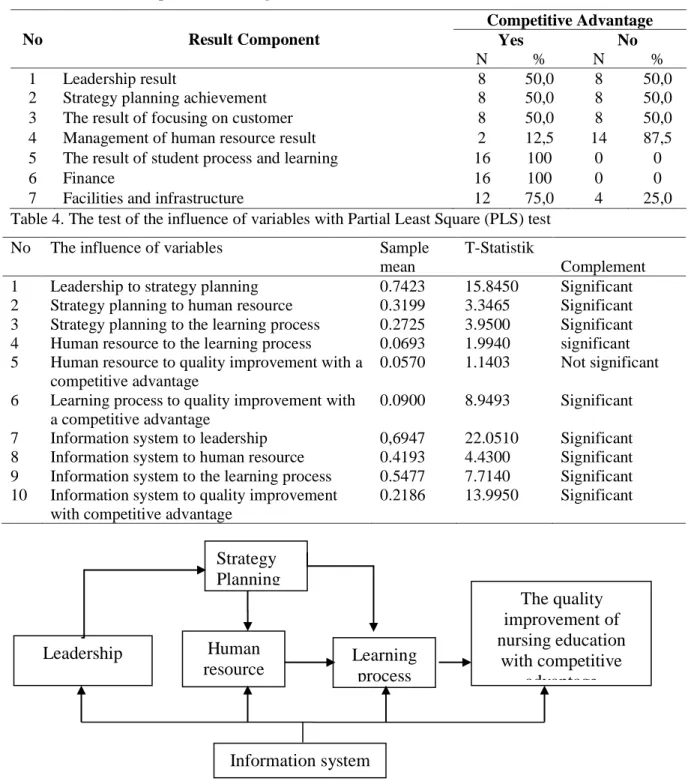
Turning these into the components of the quality results, the results of analysis showed that nursing education in Muhammadiyah universities had an average of competitive advantage as follows: 50.0% (n = 8) in leadership, strategy planning achievement, and customer focus; 100% (n = 16) in the learning process and financial; while 75.0% (n = 12) in facilities and infrastructure.
on the other hand, 87.5% (n = 14) of the samples had not shown competitive advantage in the human resource component (Table 3).
The results indicated as significant if the T-statistic was higher than the outer value loading T-statistic more than 1.96 (Table 4), and the quality development model of nursing education is visualised in Figure 1.
Table 1. Profile of nursing schools under Muhammadiyah universities in 2016
Study department profile n %
Period of existence - < 5 years - 5-9 years - > 10 years
0 6 10
0 37,5 62,5 Accreditation status
- A (Excellent) - B (Good) - C (Fair)
- Not accredited (Poor)
2 14
0 0
12,5 87,5 0 0 The number of similar programs in a city
- 0-3 - > 3
0 16
0 100 Table 2. The components of the quality process in nursing schools under Muhammadiyah universities
towards competitive advantage
No Process Component
Competitive advantage
Yes No
n % n %
1 Leadership 4 25,0 12 75,0
2 Strategy planning 12 75,0 4 25,0
3 Focus on customer 8 50,0 8 50,0
4 Human resource focus 4 25,0 12 75,0
5 Learning process focus 8 50,0 8 50,0
6 Information system 8 50,0 8 50,0
16
Table 3. The components of the quality results in nursing schools under Muhammadiyah universities towards competitive advantage
No Result Component
Competitive Advantage
Yes No
N % N %
1 Leadership result 8 50,0 8 50,0
2 Strategy planning achievement 8 50,0 8 50,0
3 The result of focusing on customer 8 50,0 8 50,0
4 Management of human resource result 2 12,5 14 87,5
5 The result of student process and learning 16 100 0 0
6 Finance 16 100 0 0
7 Facilities and infrastructure 12 75,0 4 25,0
Table 4. The test of the influence of variables with Partial Least Square (PLS) test
No The influence of variables Sample
mean
T-Statistik
Complement 1 Leadership to strategy planning 0.7423 15.8450 Significant 2 Strategy planning to human resource 0.3199 3.3465 Significant 3 Strategy planning to the learning process 0.2725 3.9500 Significant 4 Human resource to the learning process 0.0693 1.9940 significant 5 Human resource to quality improvement with a
competitive advantage
0.0570 1.1403 Not significant 6 Learning process to quality improvement with
a competitive advantage
0.0900 8.9493 Significant 7 Information system to leadership 0,6947 22.0510 Significant 8 Information system to human resource 0.4193 4.4300 Significant 9 Information system to the learning process 0.5477 7.7140 Significant 10 Information system to quality improvement
with competitive advantage
0.2186 13.9950 Significant
Figure 1. Quality development model of nursing education in the University of Muhammadiyah towards competitive advantage
DISCUSSION
The output of this study was the quality development model of nursing education towards competitive advantage. The model emphasised the component process and result of leading indicators, strategy planning, and information systems. It was in line with the study conducted by Teoman and Ulengin
(2016) which stated that leadership was the key to success in quality management. In addition, based on the study of Gunasekaran, Subramanian and Papadopoulos (2017), the information technology also became a key role towards competitive advantage.
In this model, the process components which directly influenced quality development
The quality improvement of nursing education
with competitive advantage Human
resource Strategy Planning
Leadership Learning
process
Information system
17 were the component of the learning process and operational management as well as an information system. The process components were significantly influenced by human resources, while human resources were influenced by strategy planning which was influenced by leadership. In addition, all of the process components were influenced by the information system. Thus, the information system played a role in boosting quality development for every quality indicator (Semuel, Siagian and Octavia, 2017).
Based on the findings of the model developed according to the Higher Education Long Term Strategy (HELPS) 2003–2010 (DIKTI, 2004), to improve the quality of higher education and strengthen the nation's competitiveness required human resource management integrated with institutional management, and human resource management based on competence and performance (Istanto, 2012). Furthermore, the development of a model is directed to making the organisation into a customer-driven model based on a customer's needs and expectations towards competitive advantage, and the implementation of knowledge management through a knowledge sharing culture (Abdul- Jalal, Toulson and Tweed, 2013).
It is consistent with the model strategies developed by Kenichi Ohmae with a model of a strategic triangle, known as model 3C (corporation, customer, and competitive), which states that in achieving competitive advantage an organisation must develop a strategic business-focused corporation, customer, and competitive base (Ohmae, 1991). An organisation that wants to succeed and survive has to market what is required by the customer and remain in the competition; it needs to be superior to its competitors, and be able to create competitiveness by implementing a value creation strategy (Hitt et al., 1999).
Kenichi Ohmae states that strengthening the position of the strategy can be through the utilisation of human resources allocation, by using a relative advantage by finding the difference with competitors, using an aggressive strategic initiative to build an edge compared to other organisations, and using the strategy to innovate (Ohmae, 1991).
In winning the competition, the organisation also takes control of the management of intellectual assets; this is based
on a model that can be developed in this research for the implementation of knowledge management through a knowledge sharing culture. The model is supported by Ikujiro Nonaka’s SECI model that describes the life of the knowledge which undergoes a process described in a spiral shape, consisting of socialisation, externalisation, combination, and internalisation. The externalisation process is the change to explicit knowledge. The process of combination, utilising existing explicit knowledge that is implemented in another area. This process is very useful for developing skills and self-productivity. The internalisation process is changing the coming of inspiration of explicit knowledge as tacit knowledge. The socialisation process changes tacit knowledge into other tacit knowledge (Sangkala, 2007; Mulyanto, 2008).
CONCLUSION
The profile of Nursing Education at the University of Muhammadiyah in Indonesia showed on average that it was established more than 10 years ago, with a B accreditation status and a level of competition in the program study in a city being from an average of more than three universities that are the main contenders.
The model of quality improvement in the University of Muhammadiyah towards competitive advantage is to emphasise the components process and outcome from indicators of leadership, strategy planning, focus on customer, human resource focus, the focus of the learning process, and information systems. The model components which directly affect quality improvement are the component of the learning process and operational management and information systems. Process components are strongly influenced by human resources, and human resources are influenced by strategy planning, and strategic planning is influenced by leadership.
Quality improvement models can be used in courses that have the same indicator if you want to make universities have a competitive advantage, besides the results of research which can be developed to compile the application program to analyse the quality improvement of nursing education based electronics, to accelerate identification of the findings of the weak components of quality to be improved.
18 Acknowledgements
This research is funded by the Ministry of Research, Technology, and Higher Education with Leading Universities Research Grant No.
010/SP2H/P/K7/KM/2016. Thanks to the Kopertis VII East Java for such funding and the leadership of the Chairman of Muhammadiyah Universities in Indonesia for research permits.
REFFERENCES
Abdul-Jalal, H., Toulson, P. and Tweed, D.
(2013) ‘Knowledge Sharing Success for Sustaining Organizational Competitive Advantage’, Procedia Economics and Finance. Elsevier B.V., 7(Icebr), pp. 150–157. doi:
10.1016/S2212-5671(13)00229-3.
Altuntaş, S. and Baykal, Ü. (2017) ‘An analysis of alumni performance: A study of the quality of nursing
education’. doi:
10.1016/j.nedt.2016.11.022.
BAN-PT (2012) Hasil Evaluasi Status Akreditasi Program Studi bidang Kesehatan di Jawa Timur.
Dikti (2008) Hasil Evaluasi Implementasi Sistem Penjaminan Mutu Internal Perguruan Tinggi 2008, Strategy.
Jakarta.
DIKTI, D. (2004) Strategi Jangka Panjang Pendidikan Tinggi (HELTS 2003- 2010) Menuju Sinergi Kebijakan Nasional. Jakarta: Departemen Pendidikan Nasional.
Frenk, J. et al. (2010) ‘Health professionals for a new century: transforming education to strengthen health systems in an interdependent world’, Lancet (London, England). Jossey Bass, San Francisco, 376(9756), pp. 1923–58.
doi: 10.1016/S0140-6736(10)61854-5.
Gunasekaran, A., Subramanian, N. and Papadopoulos, T. (2017) ‘Information technology for competitive advantage within logistics and supply chains: A review’, Transportation Research Part E: Logistics and Transportation Review, 99, pp. 14–33. doi:
10.1016/j.tre.2016.12.008.
Hidayat, A.A.A., Supriyanto, S. and Nursalam, N. (2015) ‘Model of Quality Management System Using Malcolm Baldrige Criteria in Nursing Education
in Surabaya’, Jurnal NERS, 10(1), p.
165. doi: 10.20473/jn.V10I12015.165- 174.
Hitt, M.A. et al. (1999) Dynamic Strategic Resources: Development, Diffusion &
Integration. Chichester, UK: John Wiley & Sons, Inc.
Horton, R. et al. (2010) ‘A new epoch for health professionals’ education’, Lancet (London, England). Princeton University Press, 376(9756), pp.
1875–7. doi: 10.1016/S0140- 6736(10)62008-9.
Istanto, Y. (2012) ‘Pengaruh Strategi Keunggulan Bersaing dan Positioning terhadap Kinerja’, Buletin Ekonomi, 8(2), pp. 124–135.
Kuspijadi and Sudarso (2009) Pengukuran Kinerja Fakultas Teknik Ubhara dengan Menggunakan Kriteria Malcolm Baldrige.
Mulyanto, A. (2008) Implementasi Knowledge Management untuk Meningkatkan Kinerja Perguruan Tinggi. IST AKPRIND, Yogyakarta.
Ohmae, K. (1991) The Mind Of The Strategist:
The Art of Japanese Business, McGraw-Hill.
Pepin, J. et al. (2017) ‘A nursing education research framework for transformative learning and interdependence of academia and practice ☆’, Nurse Education Today, 52, pp. 50–52. doi:
10.1016/j.nedt.2017.02.001.
Sangkala (2007) Knowladge Managament;
suatu pengantar memahami bagaimana organisasi mengelola pengetahuan sehingga menjadi organisasi yang unggul. Jakarta: PT Raja Grafindo Persada.
Semuel, H., Siagian, H. and Octavia, S. (2017)
‘The Effect of Leadership and Innovation on Differentiation Strategy and Company Performance’, Procedia – Social and Behavioral Sciences, 237,
pp. 1152–1159. doi:
10.1016/j.sbspro.2017.02.171.
Teoman, S. and Ulengin, F. (2016) ‘The impact of management leadership on quality performance throughout a supply chain: an empirical study’, Total Quality Management and Business Excellence. doi:
10.1080/14783363.2016.1266244.
19
Nadia Rohmatul Laili*, Sulistiawati**, Ika Yuni Widyawati*
*Faculty of Nursing, Universitas Airlangga
**Faculty of Medicine, Universitas Airlangga Email: [email protected]
ABSTRACT
Introduction: Education is the important component in self-management of Diabetes mellitus patients. Nurse as one of the health care provider should