Prefac'e
Contents .... ... .... .. .... .. .. ... .. .... ... ... ... .. .. .. ... . iii
Conference Program .. .. ... .. ... ... .. .. ... ... .. .. . 1
Parallel Session Schedule .. .. ... ... .. .. .. .... .. .. . 2
Abstract of Conference Papers .... .. ... ... .... .. . 7
MACC03
THE IMPACT OF TARGET SETTING AND LOCUS OF CONTROL ON MANAGERIAL MOTIVATION AND
PERFORMANCE
Amalia Rachma Sari
Universitas Islam Sultan Agung, Semarang [email protected]
Muhammad Ja’far S.
Universitas Islam Sultan Agung , Semarang [email protected]
Field of Research : Management Accounting
ABSTRACT
This prior research describes managerial perceptions of the relationship between target setting system (TSS) and managers’ attitudes and behavior. On the basis of the Expectancy-Valence (E-V) theory of motivation, a model is developed and a number of propositions are advanced about the interactive effect of participation, target attainability, target specificity and commitment on managerial motivation and performance. We set this research by using a partial least squares (PLS) methodology, there are 49 samples, was collected directly and used clustered random sampling. The perceptions of 49 middle managers in a Central Java manufacturing companies are analyzed. The results partially support the model. They show that participation tends to affect the perceived commitment to the targets directly, through the perceived commitment tends to managers’ performance.
Target specificity has a significant influence to be attainable for setting the targets, however, target attainability doesn’t have a significant influence on managers’ locus of control and subsequent motivation. Further, managerial perceptions of the specificity and attainability of targets appear, not to contribute to target commitment. While the locus of control theorizes that internal occurs on better job performance, this is distingushable.
Overall, the study’s findings are different from the consistence of conclusions of goal setting theory about the motivational potential to be attainable on performance targets.
However, as well as with the literature on the participating in the targets has important implications for the way targets are set within the performance measurement, evaluation and reward system (PMERS).
Key words:
middle management motivation, incentives, target setting, performance, locus of control.
INTRODUCTION
Background
This paper examines the managerial motivation and performance in target setting and locus of control. Performance management, as (Heslin et.al., 2008) involves all the initiatives where managers get enforce to guide and motivate high performance by employees. Management control theory describes that the motivational impact of any incentive scheme for middle managers depend on the linking of the ex-post measurement and evaluation of managerial performance with a desirable reward package that carries some value for the managers (Kominis and Emmanuel, 2007). In this paper we demonstrate the reputational incentive can arise endogeneously, then the other factors can also affect the motivational and performance for the middle managers. Thus, incentive is one of motivation- commitment links, supports motivation (Koch and Peyrache, 2004) even as a recognition for high performance (Heslin et.al., 2008) on middle managers behavior. Therefore, there will be commitment toward target and motivation. Systems of performance measures, based on Emmanuel et.al. (2008) identifies the areas that are essential for the organization’s success; target, which define the organizational desirable level of achievement in all these essential areas, and reward, which are expected to stimulate the motivation and performance to managers in relation to their contribution to the accomplishment of the targets.
There is the previous literature on target setting on managerial behavior has concentrated mainly on three issues (Emmanuel et.al., 2008). One research has looked into the effects of target specificity (Latham & Yukl, 1975; Kenis, 1979); another has focused
on the impact of target difficulty (Kenis, 1979), whereas a third of research has examined the role of participation in the target setting process (Emmanuel at.al., 2008). The empirical findings on the relationships between these variables and managerial motivation and performance need to integrate the fragmented literature and examine the whole network of direct and indirect relationships among these variables has been recognized (Emmanuel at.al., 2008; Shields et al., 2000). While, the locus of control has a positive relations to the impact of managerial motivation and performance, (Caliendo et.al., 2010) A person whose external locus of control dominates tends to believe that much of what happens is beyond his or her control. Life’s outcomes are instead attributed to other forces, like fate or luck, rather than to ones own actions. In contrast, a person with an internal locus of control sees future outcomes as being contingent on his or her own decisions and behavior. According to Emmanuel et.al.(2008), attainability of these targets must be put on the managers’
behavior, so it could affect the magnitude of motivation appearance. They also show their good performances, which is connected with a link and relationship between commitment and motivation. That target commitment builds in motivation, related with commitment to the motivation.
The purpose of this paper theoretically is to report the findings of a study aimed at filling these gaps in the existing literature. A model showing the interactive effect of participation, target attainability, target specificity on managerial commitment, locus of control, motivation and performance is developed from previous management control and organizational behavior research. A partial least squares methodology is set to test the propositions obtained from the model with data gathered. These results can be important for setting the strategy development for middle managers in the organizations.
Problem Formula and Research Goals
Heslin et.al. (2008) found that participation in goal setting does increase goal commitment, but that assigned goals are also effective so long as a compelling purpose is given. While, motivation and commitment reveals a distinguishable, however, that Pinder (1998) described motivation as a set of energizing forces and that Meyer (2004) defined commitment as a force that binds an individual to a course of action. Commitment and motivation are different, have been difficulty concept to define (Meyer et.al., 2004). Meyer and Allen (1990) initially developed their three-component model to address observed similarities and differences in existing unidimensional conceptualizations of organizational commitment. They argued that one of the most important reasons for distinguishing among the different forms of organizational commitment was that they have very different implications for behavior. Furthermore, Wiener (1982) believed that commitment binds an individual to an organization. The main differences were in the mindsets considered to characterize the commitment. These mindsets reflected three distinguishable forms:
affective attachment to the organization, obligation to remain, and perceived cost of leaving. Distinguishing among commitments characterized by these different mindsets, Meyer and Allen (1991) labeled them “affective commitment,” “normative commitment,”
and “continuance commitment”. Those research depicted that affective commitment has the strongest positive correlation with performance, organizational citizenship behavior, and attendance, followed by normative commitment. Continuance commitment tends to be unrelated, or negatively related, to these behaviors. (Huczynski, 1997) maintains that, although a variety of special factors (such as the individual’s abilities, skills, and
understanding of his role), as well as a number of situational and environment parameters (such as the size, structure, and culture of organization, the management control, leadership systems, and styles in place) show some impacts on the way individuals perform in the organizational setting. Of course, even when commitment is involved, motivation can flow over time as commitment increases and decreases. (Meyer et.al., 2004) gave for example, a commitment to obtain a university degree should contribute to generally high levels of motivation to study, but day-to-day behavior will also be shaped by other sources of motivation. Therefore, locus of control (internal or external) is needed on development of qualified managers’ motivation and performance. In this study, (Emmanuel et.al., 2008) a positive relationship is predicted between managerial motivation and performance. This review of the literature on target setting attempts to uncover the processual determinants of managerial motivation utilising both the organizational psychology and the managemnet control systems literature. Nevertheless, an inclusive approach is taken in that target setting perceptions of specificity and attainability, the adoption of participation, target commitment and locus of control are admitted and specifically addressed simultaneously.
Based on that statement, the research questions we explain are:
1. Is participation occuring a significant effect on the perception of target specificity, while through this perception has a positive relationship with locus of control?
2. Is participation occuring a significant effect on the perceived target as attainable, while through this perception has a positive relationship with target commitment and locus of control?
3. Is participation occuring a significant effect on locus of control directly?
4. Does participation have positive effect on locus of control by perceived target to commit?
5. Do both the perceptions of target specificity and target obtaining to be attainable occur the significant effect on target commitment, through this perception can affect the managers’ locus of control?
6. Do both the perceptions of target specificity and target obtaining to be attainable occur the significant effect directly on the managers’ locus of control?
7. Can it be predicted that the perceived specificity to target have a positive effect on the perceived attainability to target?
8. Can it be predicted that the managers’ motivation have a positive effect on the managers’ perception to perform well?
9. Through some perceptions from target setting (participation, target specificity, target attainability, and perceived target to commit), does locus of control have a significant effect on managerial motivation and performance?
Based on background and the problem formula, the goals we want reach in this paper:
1. To examine participation is occuring a significant effect on the perception of target specificity, while through this perception has a positive relationship with locus of control.
2. To explore participation is occuring a significant effect on the perceived target as attainable, while through this perception has a positive relationship with target commitment and locus of control.
3. To examine how significant participation is occuring an effect on locus of control directly.
4. To explore participation has a positive effect on locus of control by perceived target to commit.
5. To examine both the perceptions of target specificity and target obtaining to be attainable occur the significant effect on target commitment, through this perception can affect the managers’ locus of control.
6. To examine both the perceptions of target specificity and target obtaining to be attainable occur the significant effect directly on the managers’ locus of control.
7. To examine prediction of the perceived specificity to target have a positive effect on the perceived attainability to target.
8. To examine prediction of the managers’ motivation have a positive effect on the managers’ perception to perform well.
9. To explore a prediction of locus of control have a significant effect on managerial motivation and performance through some perceptions from target setting (participation, target specificity, target attainability, and perceived target to commit).
A model showing the interactive effect of participation, target attainability, target specificity on managers’ commitment, motivation and performance is derived from previous management control and organizational behavior research. A partial least squares methodology is used to test the propositions derived from the model with data gathered from 49 middle managers in a Central Java manufacturing companies.
The results are then reported, followed by a final section which discusses issues for future research relative to the theoretical model of the study.
LITERATURE REVIEW AND HYPOTHESIS DEVELOPMENT
Motivation
Motivation has been a difficult concept to properly define, in part because “there are many philosophical orientations toward the nature of human beings and about what can be known about people” (Pinder, 1998). Although some have argued that the term defies definition (Meyer et.al., 204), (Pinder , 1998) provided a definition that nicely accommodates the different theoretical perspectives which have been brought to bear in the explanation of work motivation. According to Meyer et.al. (2004), work motivation is a set of energetic forces that originates both within as well as beyond an individual’s being, to initiate work-related behavior. Meyer et.al. (2004) described that there are two features of this definition. First, motivation is identified as an energizing force—it is what induces action in employees. Second, this force has implications for the form, direction, intensity, and duration of behavior (Meyer et.al., 2004). That is, it explains what employees are motivated to achieve, how they will strive to accomplish it, how hard they will work to do, and when they will stop.
On the other hand, motivation is the key to performance improvement. (Locke &
Latham, 1990, 2002; Meyer et.al., 2004) At the heart of the motivation process is goal setting. All consciously motivated behavior is goal-oriented, whether the goals are self- generated or assigned by others. Also, Meyer et.al. (2004) found that naturally occurring goals derive from the activation of basic human needs, personal values, personality traits, and self-efficacy perceptions shaped through experience and socialization. Individuals also set, or accept, goals in response to external incentives. The goals individuals can vary in difficulty and specificity, these attributes, in combination with perceptions of self-efficacy,
the direction of behavior, the amount of effort exerted, and the degree of persistence that individuals will extend strategies to facilitate goal achievement.
Goal setting is among the most dominant theories of work motivation (Miner, 2003;
Meyer et.al., 2004), and Locke’s general model is one of the most comprehensive to date.
Perhaps more important, the causal connections it proposes are generally well supported by empirical evidence (Locke, 1997; Pinder, 1998; Meyer et.al., 2004). Therefore, by the modifications described, Locke’s model provides an excellent foundation for integrating the motivation and commitment processes.
Performance
(Chris et.al., 2010) Performance is considered to be a function of ability and motivation, thus: Job performance =f(ability)(motivation). Furtheremore, they stated that ability in turn depends on education, experience and training and its improvement is a slow and long process. Besides, motivation can be improved quickly. When specific difficult goals are set by a team, (Heslin et.al., 20080) each team member does not necessarily personally adopt the team goal. In order for individuals’ efforts to be directed toward performance, the goal must be adopted as their own.
Target Setting and Managerial Motivation
There is a motivational point of view (Outley, 1999), the concept of target setting revolves around two central issues: what type of targets, and what process of setting these targets.
Target Specificity
Target specificity refers to the extent to which the targets are specific and clear, so that they are understood by those responsible for meeting them (Kenis, 1979; Emmanuel et.al.,2008)). Locke’s goal setting theory hold, that is specific, clear goals regulate behavior and result in greater effort (that is higher level of motivation) than do more general goals (Locke et al, 1988; Locke and Latham, 1990; Emmanuel et.al., 2008). According to (Steers and Porter, 1974) setting specific targets can serve to focus attention and effort, and lead to improved job performance. Latham(1975), Baldes(1975), and Emmanuel et.al. (2008) found that the setting of a target that is specific lead to an increase in motivation and performance because it makes clear to the individual.
From the expectancy-valence framework, a manager sets the targets that are clear and specific in nature increases the knowledge of what is expected on the job, and theoretically reduces the unnecessary search for job-relevant behaviors in the work setting (Steers and Porter, 1974). the manager see more clearly the relationship between effort, performance, and resulting outcomes in his job, that is clarify and strengthen the expectancy, and commitment to targets (Kim, 1984; Emmanuel et.al., 2008). Target specificity can be also seen as a prerequisite for the perception that targets are attainable (Motowildo et al., 1978).
There is very little evidence of the effect of target specificity on motivation (Burke &
Wilcox, 1969; Steers, 1975; Emmanuel et.al.,2008). Locke et al.(1981) and Emmanuel et.al.(2008) reviews the limited empirical literature in the area of organizational psychology, however, indicate that both laboratory, field and correlational studies provide consistent evidence that target specificity generally tends to result in improved
performance. Furthermore, (Latham and Yukl, 1975; Steers, 1976; Ivancevich, 1976;
Emmanuel et.al., 2008) several research studies have provided evidence of a positive effect of target specificity on target commitment and target achievement.
Target Attainability
According to Emmanul et.al. (2008) and Drury (1996) rightly emphasises that “if we accept that the setting of targets can increase managerial motivation, we must then consider at what level of difficulty the targets should be set”. Targets may range from very loose and easily attainable to very tight and unattainable. Also, easily attainable targets are failed to present a challenge to managers and unlikely to have any significant motivational effect (Kenis, 1979; Emmanuel et.al., 2008). Besides, very tight and unattainable targets may lead to feelings of frustration, failure, lower aspiration levels, and rejection of the goals by the managers (Dunbar, 1971; Emmanuel et.al., 2008). The basic theoretical contention is increasing target difficulty increases the perceived challenge of a goal, which increases the amount of effort that is expended for target attainment (Steers and Porter, 1974; Emmanuel et.al., 2008).
According to E-V theory (Vroom, 1964) and Emmanuel et.al.’s (2008) statement, targets that are objectively very difficult to attain, or perceived as such, are likely to be associated with low expectancies that task behaviors will lead to desirable consequences, and, consequently, with relatively low levels of motivation and performance (Motowildo et al., 1978). There is a reasonable probability of attaining a demanding target, that is a reasonably feasible path-goal in expectancy theory terms, this target is expected to increase
motivation. However, the target is perceived as unrealistic and unfair, leading those responsible for attaining it or even compensate for the perceived unfairness of the target by deliberately distorting the PMERS (Performance Measurement, Evaluation, and Reward System) in order to make it appear as if the target has been met (Porter et al., 1975;
Emmanuel et.al., 2008). The latter implies also that target commitment varies inversely as a consequence of target attainability (Motowildo et al., 1978; Emmanuel et.al., 2008).
(Latham and Yukl, 1975; Emmanuel et.al., 2008) When targets are perceived as excessively difficult, they are unlikely to be internalised, that is, accepted by the managers as their own targets, thus the manager’s perception that the goal is reasonable is likely to influence target commitment.. For motivational purposes, therefore, targets should be tight but attainable. As Emmanuel et.al (2008) points out, tighter targets lead to higher motivation; beyond a certain limit, tightening targets is likely to reduce motivation.
Research on the impact of target attainability on motivation and performance has failed to provide clear evidence. Blumenfeld and Leidy (1969) and Tosi (1970) found a positive relationship between perceived target attainability and managerial performance.
Carroll and Tosi (1970) and Dachler and Mobley (1973) were able to identify positive correlations between target attainability, motivation and performance only when the moderating effect of self-assurance, maturity and job tenure were taken into account.
While, Emmanuel et.al.(2008) provide evidence of the positive effects of target attainability on motivation. On the other hand, reviews of the empirical, mainly experimental, research in the area of organisational psychology (Locke, 1968; Locke et al.,
1981) report strong evidence of a positive linear relation between perceived goal difficulty and task performance (Emmanuel et.al., 2008).
Participation in Target Setting
People are more likely to commit to difficult goals that are important to them personally. Participation in the setting of goals (Heslin et.al, 2008) improves job performance by enhancing the importance of goals to each member and thereby increasing goal commitment. However, participation in goal setting may not always be an option for managers. Latham, Erez, and Locke (1988) found that participation in goal setting increase goal commitment, but that assigned goals are also effective so long as a compelling purpose or rationale for the goal is given. Target participation refers to the extent to which managers are allowed the opportunity to influence the targets within the targets setting process (Kenis, 1979; Emmanuel et.al., 2008). The existing theoretical literature in management control has proposed that participation enhances managerial performance through managerial motivation. This is based upon the assumption that participation encourages managers to identify with the targets, accept their relevance, and expend higher amounts of effort toward their attainment (Dunbar, 1971; Erez et al., 1985; Emmanuel et.al., 2008).
From an E-V theory point of view, (Emmanuel et.al., 2008) allowing manager participation in target setting is seen to enhance motivation as a result of the tendency of managers to become ‘ego involved’ in decisions to which they have contributed. This interpretation is consistent with Steers and Porter’s (1974) argument that participation has the potential to affect an individual places on goal attainment through ego-involvement and
commitment. Assuming participation should increase a manager's valence for potential rewards and lead to increased effort (Emmanuel et.al., 2008).
(Emmanuel et.al., 2008) Participation provides managers with an opportunity to negotiate targets that are more attainable than would be set without participation, thereby increasing the perceived probability that effort expenditure will result in the expected outcomes (Brownell and McInnes, 1986). A number of studies have reported a positive relationship between participation and motivation (Monczka, 1973; Collins, 1978; Kenis, 1979; Merchant, 1981), while Emmanuel et.al. (2008) found that it’s failed to any significant relationship between the two variables (Staw, 1977; Ivancevich, 1979;
Brownell, 1983; Brownell and McInnes, 1986). Although most of the early research failed to detect significant differences in target commitment when targets are assigned or set participatively (Latham and Yukl, 1976; Latham et al., 1978; Dosset et al., 1979; Latham and Saari, 1979; Latham and Marshall, 1982; Latham et al., 1982; Latham and Steele, 1983; Emmanuel et.al., 2008), there is some experimental evidence indicating an effect of participation on target commitment (Emmanuel et.al., 2008). Both reviews of the participation literature in general (Locke and Sweiger, 1979; Locke et al., 1980; Emmanuel et.al., 2008) as well as relevant meta-analyses (Mento et al., 1987) all suggest only a negligible effect favouring participative over assigned target setting.
Target Commitment
On the basis of the findings of this research, Meyer and Herscovitch (2001) and Meyer et.al. (2004) offered a general set of predictions concerning the consequences of
commitment. Specifically, they argued that regardless of the target of commitment, all three forms of commitment bind an individual to a course of action specified within the terms of the commitment, which (Meyer et.al., 2004) the authors referred to as “focal behavior.” They proposed that the differences will be seen primarily in effects on related behavior that, though not clearly specified in the terms of the commitment, would nevertheless be beneficial to the target of the commitment. Locke et al. (1988) and Emmanuel et.al. (2008) points out that the motivational effectiveness of targets presupposes the existence of target commitment, is likely to have little impact on managerial motivation and performance (Erez and Kanfer, 1983; Locke and Latham, 1984;
Emmanuel et.al., 2008).
According to Steers and Porter (1974) and Emmanuel et.al. (2008), target commitment (otherwise termed as goal acceptance or internalisation) represents the degree to which a subject agrees with and accepts his task targets in preference to other potential targets. Instead, it includes a strong positive attitude toward the targets which may be likened to target ownership. Target commitment (Emmanuel et.al., 2008) is viewed in terms of a congruence between assigned job targets and individual aspiration level with respect to these targets.
(French et al., 1966; Emmanuel et.al., 2008), participation serves to adjust personal aspiration level toward that of the task targets and presumably such target commitment leads to greater effort and performance. It is therefore reasonable to expect a positive relationship between the perceived attainability of a target and managers’ commitment to this target. Based on Emmanuel et.al.(2008) the empirical evidence in the area of target commitment is inconclusive. A number of experimental studies, however, have failed to
identify any relationship between target commitment and performance (Oldham, 1975;
Frost & Mahoney, 1976; London & Oldham, 1976; Organ, 1977; Ivancevich & McMahon, 1977; Latham et al., 1978; Yukl & Latham, 1978; Dossett et al., 1979; Latham & Saari, 1979a, 1979b; Mento et al., 1980), whereas Emmanuel et.al (2008) found that a significant effect on target commitment and performance.
Locus of Control
Locus of control (Rotter, 1966) refers to an individual's generalized expectations concerning where control over subsequent events resides. In other words, who or what is responsible for what happens. It is analogous to, but distinct from, attributions. Also, he argues that there is a three stage process which underlies an attribution. Step one: the person must perceive or possibly observe the behavior. Step two is to try and figure out if the behavior was intentional, and step three is to determine if the person was forced to perform that behavior. (Caliendo et.al., 2010) Thus far we have assumed that locus of control affects individuals’ search behavior through their perceptions of the effect of job performance. Furtheremore, specifically it’s higher for those with a more internal locus of control than for those with a more external locus of control. In short, individuals with an internal locus of control have a higher subjective probability of achieving a target performance at any given level of search intensity. The latter occur after the fact, (Rotter, 1966) that is, they are explanations for events that have already happened. Expectancy, which concerns future events, is a critical aspect of locus of control. Locus of control is grounded in expectancy-value theory, which describes human behavior as determined by the perceived of an event or outcome occurring contingent upon the behavior in question.
More specifically ( Rotter, 1975) expectancy-value theory states that if (a) someone values a particular outcome and (b) that person believes that taking a particular action will produce that outcome, then (c) they are more likely to take that particular action.
Rotter's original (1966) locus of control formulation classified generalized beliefs concerning who or what influences things along a bipolar dimension from internal to external control: "Internal control" is the term used to describe the belief that control of future outcomes resides primarily in oneself while "external control" refers to the expectancy that control is outside of oneself, either in the hands of powerful other people or due to fate or chance. (Levenson, 1973) offered an alternative model, whereas Rotter's conceptualization viewed locus of control as unidimensional (internal to external), Levenson's model asserts that there are three independent dimensions: Internality, Chance, and Powerful Others. According to Levenson's model, one can endorse each of these dimensions of locus of control independently and at the same time. For example, A person might simultaneously believe that both oneself and powerful others influence outcomes, but that chance does not. Generally, the development of locus of control stems from family, culture, and past experiences leading to rewards. Most internals have been shown to come from families that focused on motivation, effort, education, and responsibility. (Rotter, 1966) Psychological research has found that people with a more internal locus of control seem to be better off, they tend to be more achievement oriented. In short (Caliendo et.al., 2010), individuals with an internal locus of control have a higher subjective probability of receiving a job offer at any given level of search intensity because they believe the payoff to search is higher, their performance are better in the next. That is, people’s locus of
control (internal or external) is predicted of a positive relationship between managerial motivation and performance.
The model shown in (Figure 1), illustrating the positive effects or relationships between these variables, is tested by data from middle managers of a Central Java manufacturing companies in the subsequent sections.
Based on that explanation above, the hypothesis can be described bellow:
Hypothesis 1 : there is a significant influent of the participating in target setting on the perceived target specificity.
Hypothesis 2 : there is a significant influent of the target specificity on their commitment to the targets.
Hypothesis 3 : it is predicted of the relationship between specificity perceptions and manager’s locus of control (internal or external.)
Hypothesis 4 : a positive effect of managers’ locus of control toward managerial motivation.
Hypothesis 5 : there is a positive relationship between managers’ locus of control and managerial performance.
Hypothesis 6 : there is a positive relationship between participation and the perceieved target as attainable.
Hypothesis 7 : there is a positive relationship between target attainability and the perceived target of managers’ commitment.
Hypothesis 8 : a significant effect of target attainability and managerial locus of control.
Hypothesis 9 : a significant effect of participating in targets toward the target commitment.
Hypothesis 10 : there is a positive relationship between managerial perceptions to commit and their locus of control.
Hypothesis 11 : there is a positive relationship between participation and managerials locus of control directly.
Hypothesis 12 : a significant effect of target specificity and attainability directly.
Hypothesis 13 : through the perception (participation and commitment), it is predicted that can affect of managers’ effort to perform.
Hypothesis 14 : through the perception (participation and commitment), it is predicted that can affect of managers’ motivation.
Hypothesis 15 : it is predicted of the relationship between managers’ motivation and managers’ effort to perform directly.
RESEARCH METHOD
Population and Sample
Kind of research we do are quantitative which explaining about something by using analytic statistic. Population on that research is all middle managers in a Central Java manufacturing companies. In order to be eligible, all managers were subject to the same PMERS, held their current positions for at least 2 years and were classed as middle managers.
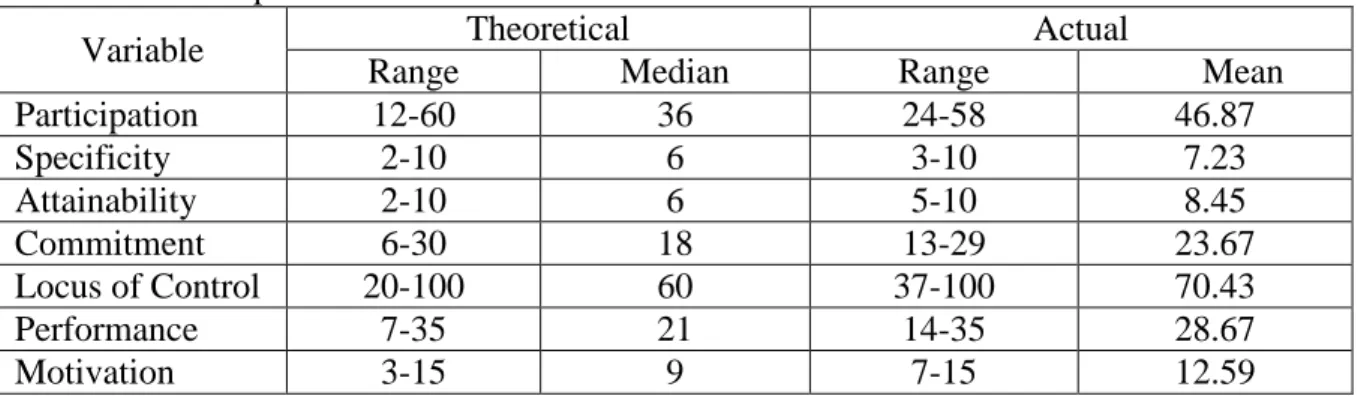
It takes clustered random sampling. Data for the study are collected by means of an analytic questionnaire administered to a sample of middle managers in a Central Java manufacturing companies. The questionnaire was written in Indonesian language then, translated to analyze the results into English (see Attachment 1). Requests for involvement came from the human resource department of the enterprise after an initial approach from the research team and in total 130 questionnaires were distributed in July 2010. In order to be eligible, all managers were subject to the same PMERS, held their current positions for at least 2 years and were classed as middle managers. In total, 49 completed responses were received by the researchers and those provided fully completed questionnaires, giving a response rate of 38%. (Table 1 presents some demographics of the sample of the study and Table 2 presents descriptive statistics).
Variable Measurement
All variables in the questionnaire are measured by instruments previously developed and tested in practice, the study’s construct validity and its comparability with previous research.
Independent Variables
The long tradition in expectancy theory research concerning the collection of data on personal beliefs, preferences and estimations (Hackman and Porter, 1968; Matsui and Ikeda, 1976; Emmanuel et.al., 2008), all the independent variables in the study are measured through a self-reported questionnaire. The questionnaire requires managers to indicate their personal judgements regarding specific features of the target setting process related to i) the specificity of performance targets, ii) the attainability of performance
targets, iii) the level of participation in target setting (Likert, 1961), and iv) their level of commitment to the performance targets (developed by Ganesan et al., 1996). (Emmanuel et al., 2008) Scores for these four variables are obtained by having respondents rate on a five- point, verbally anchored response scale, ranging from ‘strongly disagree’ (1) to ‘strongly agree’ (5), how agree (Emmanuel et al., 2008) they felt that
�the performance targets they were required to achieve were clearly stated and defined.
�the performance targets they were required to achieve were attainable.
� they contributed to the setting of the targets of performance they were required to achieve.
�they could commit to the performance targets established within the PMERS.
Then variable of locus of control is the twenty-item self-rating, measured by Pareek and Udai (1985), developed by having respondents rate on a five-point, as well as four variables above.
Dependent Variables
Managerial motivation is regarded throughout E-V research as being most directly reflected in the manager’s effort, which most closely corresponds to the motivational component that is presumed to affect performance (Emmanuel et al., 2008). To measure motivation, the Hackman and Porter (1968) three-dimension self rating scale was used, which requires each respondent to rate on a five-point, verbally anchored response scale of
‘not a lot’ (1) to ‘very much’ (5), the amount of effort put into, the enthusiasm for, and the importance of job responsibility to others with similar management duties in the organisation.
Then, in the second part of the questionnaire, the seven-item self-rating measure developed by Heneman (1974) is employed in a five-point, Likert-scaled form to provide scores for managerial performance (P), whereas Emmanuel et.al.(2008) measured with four indicators from Heneman (1974). Each manager uses a verbally anchored response scale ranging from ‘low’ (1) to ‘high’ (5) to rate performance relative to others with similar management duties in the organization (Emmanuel et al., 2008).
Further, Emmanuel et al., (2008) used of the Mahoney et al. (1963; 1965) research instrument is supported because a self-rating rather than a superior-rating measure is considered to overcome the problem of ‘halo error’, that is, the tendency to evaluate on only one cognitive dimension, which seems to occur with superiors’ ratings (Nealy and Owen, 1970), the nine-dimensional structure of the measure captures the multidimensional structure of performance without introducing the problem of excessive dimensionality (Brownell, 1982). While, the eight performance dimensions of the instrument are behaviorally meaningful and applicable to managerial functions across organisations (Heneman, 1974), and previous research provides evidence of the measure’s construct, criterion validity, and reliability (Penfield, 1974; Govindarajan, 1986).
RESULTS
The data analysis technique we use in this research is multiple regression, thus it uses tool of Partial Least Square (PLS). Partial least squares regression is an extension of the multiple linear regression model. In its simplest form, a linear model specifies the (linear) relationship between a dependent (response) variableY, and a set of predictor variables, the X's, so that : Y = b0+ b1X1+ b2X2+ ... + bpXp.
In this equation b0is the regression coefficient for the intercept and the bi values are the regression coefficients (for variables 1 through p) computed from the data. So for example we could estimate a person's participation, attainability, specificity, commitment, locus of control as a function of the person's motivation and performance. We could use linear regression to estimate the respective regression coefficients from a sample of data, measuring participation, attainability, specificity, commitment, and locus of control then observing the subjects' motivation and performance. The multiple linear regression model has been extended in a number of ways to address more sophisticated data analysis problems. SmartPLS 1.4.2, a latent variable path modeling software utilising a partial least squares (PLS) approach to structural equation model (SEM) estimation (Wold, 1982, 1985;
Lohmoller, 1989; Emmanuel et.al., 2008), is used to test the causal model summarised in Figure 1. The PLS procedure has been gaining interest and use among social science researchers in recent years (Aubert et al., 1994; Compeau and Higgins 1995; Chin and Gopal 1995; Emmanuel et.al., 2008) because of its ability to model latent constructs under conditions of nonnormality and small to medium sample sizes. Being a components-based structural equations modeling technique, PLS is similar to regression, but simultaneously models the structural paths (theoretical relationships among latent variables) and measurement paths (relationships between a latent variable and its indicators). It is considered as more appropriate for the majority of the studies and data sets typically used in social science research (Chin and Newsted, 1999; Falk and Miller, 1992). More specifically, (Emmanuel et al., 2008) the PLS method has an advantage over the variance- covariance based structural equation modeling techniques in at least three aspects : since its iterative ordinary least squares (OLS) regression-like estimation proceeds block by block, it
requires smaller sample size; it imposes less severe requirements about the distribution assumptions; and it allows for the use of both formative and reflective variables in the models it tests. Furthermore, the PLS algorithm allows each indicator to determine how much it contributes to the composite score of the latent variable (Chin et al., 1996). This indicates which is with weaker relationships to related indicators and the latent construct are given lower weightings, which makes PLS preferable to techniques such as regression that assume error free measurement (Wold 1982, 1985, 1989; Emmanuel et al., 2008).
Measurement Model
An important step prior (Emmanuel et al., 2008) to evaluate the structural model is assessing the accuracy of the measurement model in terms of the individual item reliability, construct reliability, convergent and discriminant validity of the composite variables in the model (Bagozzi, 1994). The goals for the accuracy of the measurement model are to demonstrate that the measures used are valid and that they reflect the underlying theoretical constructs (Teigland and Wasko, 2003). The model presented in Figure 1 is essentially a MIMIC (multiple effect indicators for multiple causes) model (Tenenhaus et al., 2005), composed of four variables measured by one indicator (participation, target specificity, target attainability, commitment to targets, and locus of control) and two reflective variables (motivation and performance) measured by three and seven indicators respectively.
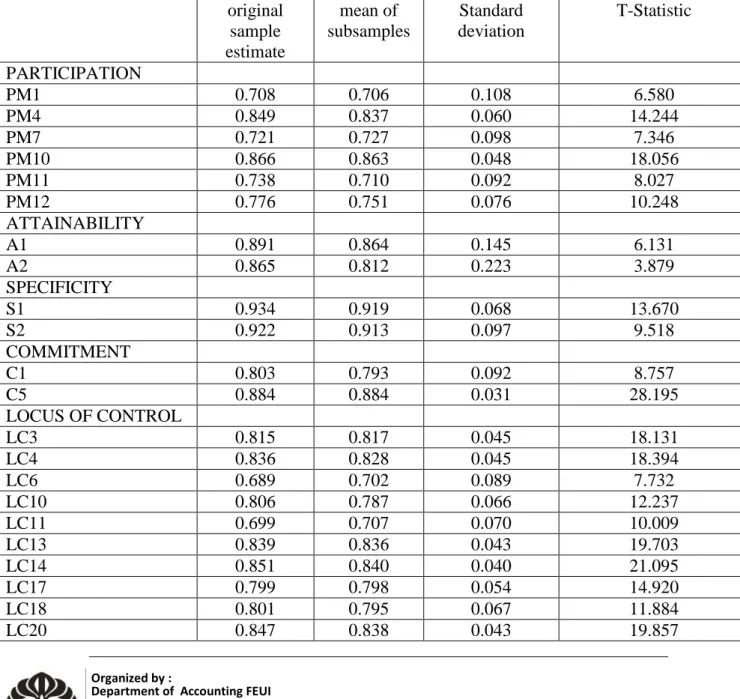
Individual item reliability is considered adequate when an item has a factor loading that is greater than 0.70 on its respective construct (Chin, 1998). As shown (in Table 3), the factor loadings for the two reflective variables in the model, that is, managerial motivation and performance, exceed the 0.70 gets providing evidence of satisfactory individual item
reliability. The only exceptions are three indicators for performance (coordination, evaluation, and delegation) and one indicator for motivation (enthusiasm), which has nevertheless been included in the analysis because they satisfy the minimum standard for acceptable construct reliability (Dillon-Goldstein’s ρ > 0.7) identified by Tenenhaus et al.
(2005), therefore they must be eliminated.
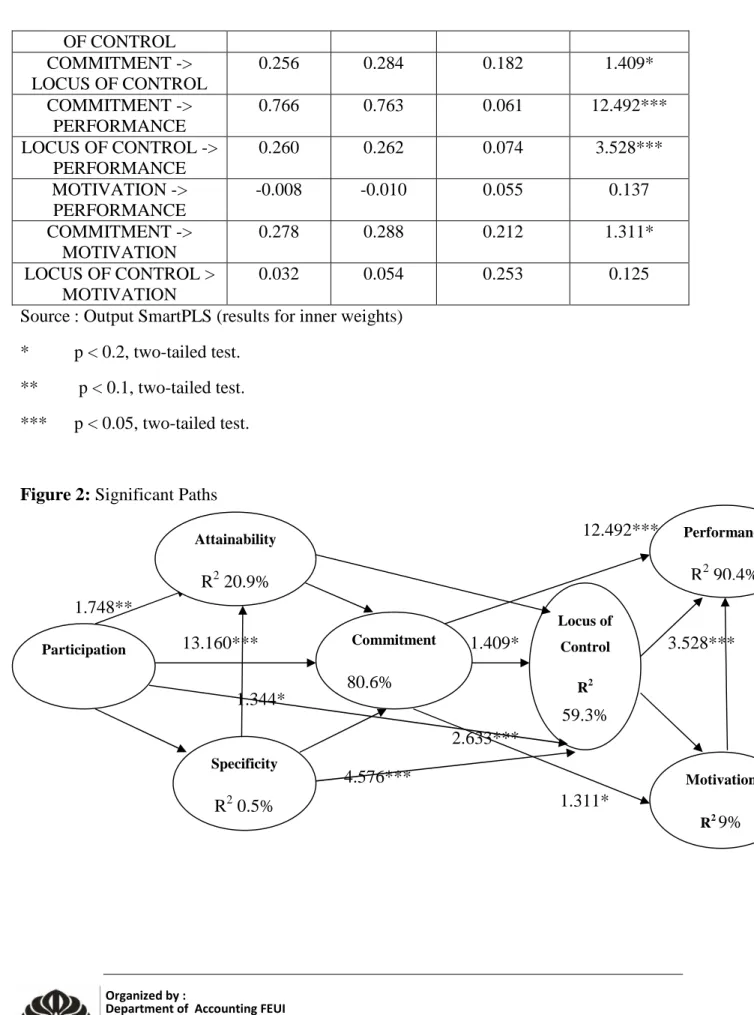
To assess (Emmanuel et al., 2008) the internal consistency of the two composite scales in the study, convergent and discriminant validity of the two composite constructs is assessed by the average variance extracted (AVE), which represents the average variance shared between a construct and its indicators (Fornell & Larcker, 1981). AVE greater than 0.50 indicates satisfactory convergent validity, whereas discriminant validity is assessed by cross-loadings and comparisons of AVE to the variance shared between any two constructs. As shown (in Table 4), the AVE values for both the motivation and the performance measures are greater that the 0.5 cut-off point, indicating acceptable levels of convergent validity. Table 5 provides the PLS structural analysis and Figure 2 provides a diagrammatic representation of the significant structural paths in the proposed model (Figure 1). To evaluate the model, R
2
values are calculated for endogenous constructs. In addition, the predictive validity of the parameter estimates is assessed via a cross-validated redundancy index or so called Stone-Geisser Q
2
test (Geisser, 1974; Stone, 1974;
Emmanuel et.al., 2008). PLS models lack an index that can provide the goodness of fit statistics as in variance-covariance based SEM-ML. Tenenhaus et al. (2005) , Vandenbosch (1996), and Emmanuel et.al. (2008) argue that next to the reliability and validity of constructs, and the significance of the variance explained (R2 values) for all
constructs provide an assessment of model fit. Interpreted like multiple regression results, the R2values indicate the amount of variance explained in each of the latent variables in the model (Chin, 1998). In more detail, the overall model explains 9% of the variance in managers’ motivation and 90.4% of the variance in their performance. Moreover, the model explains 80.6% of the variance in managerial commitment to targets, 20.9% of the variance in managerial perceptions of target attainability, 0.5% of the variance in managerial perceptions of target specificity, and 59.3% of the variance in locus of control.
The estimated path regression coefficients (see Table 5 and Figure 2) indicate the strength and the direction of the relationships among the specified latent variables. The PLS analysis shows support for hypothesis 1 and 2 about no effect of participation on the perceived specificity (p = 0.333, p<.05, t-statistics < 1.96) and the perceived specificity on target commitment (p = 0.325, p<.05, t-statistic<1.96). Support is found for hypotesis 3 that managers who specify the targets will increase their external locus of control (see Table 2 for Locus of Control: value of Mean is more than Median, it shows that managers tend to external, while Mean value is less than Median, it shows that managers tend to internal), (p
= 4.576, p<.05, t-statistic<1.96). Also, it is found for hypothesis 5 that managers whose external locus of control has a higher performance (p =3.528, p<.05,t-statistic>1.96), in contrast, there is no evidence of managers who whose external locus of control has a higher motivation by hypothesis 4
(p = 0.125, p<.05, t-statistic<1.96). Hypothesis 11, a positive effect of participation on managers’ locus of control. However, expectations in hypothesis 10 about the positive effect of the perceived target to commit on managers’ locus of control is observed. In contrast, there is no evidence of a relationship between the perceived targets as attainable and managerial locus of control as predicted by hypothesis 8. Hypothesis 9 and 13 that participating in targets result in higher levels of target commitment (p = 13.160, p<.05) and target commitment on managers’ performance (p = 12.492, p<.05) are confirmed. We find support for the positive effect of participation on the perceived targets as attainable (p = 1.748, p<.1) predicted by hypothesis 6, however the positive relationship between target specificity and target attainability proposed by hypothesis 12 is supported. Hypothesis 14 shows a significant effect of target commitment on managers’ motivation directly. In contrast, there is no effect of target attainability on the perceived target to managers’
commit (p = 0.357, p<.2) by hypothesis 7 and managers’ motivation on their performance directly (p = 0.137, p<.2) by hypothesis 15.
CONCLUSION
The goal of this study was to investigate the complex pattern of interrelationships among a number of characteristics of the target setting system, which affect managerial motivation and performance (Emmanuel et al., 2008). The results presented above principally underline the importance of participation for the commitment to targets and the performance impact. Managerial perceptions of specificity in particular appear necessary if targets are to be specified by managers and to be used to influence the perceived these targets as attainable. This finding is not consistent (Caliendo et.al., 2010) with the generally locus of control, that managers tend to internal will more expectations of performance are
better in the next. The perceived specificity of targets appears to be equally important, as it affects managers’ effort to the targets as attainable directly. Overall, it appears that the setting of a target that is both specific and attainable is not likely to lead to increases in performance without locus of control (external), whereas there’s no effect of both of them on managers’ motivation and performance directly. The attainability of targets doesn’t have important implications for the way performance targets are set within the PMERS, however it is possible for locus of control as a linking of target attainability and performance. The results of this study indicate that the participation of managers in the target setting process can contribute to their perceptions to commit them. At the conceptual level therefore, the expectation of a positive relationship between target commitment and motivation is intuitively logical. Thus, it’s failure to find empirical support for the commitment- motivation link may relate to the limitations of conducting a positive study in the field although target commitment affect locus of control. The need improving managerial motivation-performance link directly is limited indeed. Variables such as the target attainability and specificity, level of participation in the target setting process, and the managers’ commitment to targets are effectively measured through a single questionnaire item in each case, making the assessment of the reliability of these measures problematic.
The small size of the sample comes from a single organization in a Central Java manufacturing companies are potential threats to the study’s population validity.
Those limitations highlight several potential directions for future research.
Replicating the present study in different environmental and cultural settings, in different industry sectors, and over different time periods could also provide the relationships identified in this research. Future research may also step the scope up the theoretical
framework of target setting impact presented here by considering the direct and indirect effect to set aside the individual’s characteristics (such as the individual’s self-efficacy) or the maturity of strategies. This will allow a better understanding of these variables and processes through, that the targets and locus of control affect managerial motivation and performance.
REFERENCES
Arvey, R.D and Dunnette,M.D. 1970. Task Performance as a Function of Perceived Effort- Performance and Performance-Reward Contingencies. Minneapolis: University of Minnesota, The Center for the Study of Organization Performance and Human Effectiveness. September, Technical Report No. 4003.
Atkinson, J.W. 1964. An Introduction to Motivation. Princeton, New Jersey: Van Nostrand.
Aubert, B.A., Rivard, S. And Party, M. 1994. Development of Measures to Assess Dimension of IS Operation Transactions, in DeGross, J.I., Huff, S.L. and Munro, M.C.(editors). Proceedings of the Fifteenth International Conference on Information Systems. Vancouver: British Columbia. pp.13-26.
Baiman, S. 1982. Agency Research in Managerial Accounting: A Survey. Journal of Accounting Literature. Vol.1. pp. 154-213.
. 1990. Agency Research in Managerial Accounting: A Second Look.
Accounting Organization, Organization and Society. Vol.15. No.4. pp. 341-371.
Barrett, R.S. 1963. Performance Suitability and Role Agreement: Two Factors Related to Attitudes. Personnel Psychology. Vol.16.pp. 345-357.
Bassett, G.A. 1979. A Study of the Effects of Task Goal and Schedule Choice on Work Performance. Organizational Behavior and Human Performance. Vol. 24.pp 202-227.
Becker, S.W. and Green, D. 1962. Budgeting and Employee Behavior. Journal of Business.
pp.3-8.
Blumenfeld, W.S. and Leidy, T.R. 1969. Effectiveness of Goal Setting as a Management Device: Research Note. Psychological Reports. June. pp. 752.
Brownell, P. and Mclnnes, M. 1986. Budgetary Participation, Motivation, and Managerial Performance. The Accounting Review. Vol. 61. No.4. October. pp. 587-600.
. 1982. The Role of Accounting Data in Performance Evaluation, Budgetary Participation and Organizational Effectiveness. Journal of Accounting Research. Vol.
20. No.1. Spring. pp. 12-27.
. 1983. The Motivational Impact of Management-By-Exception in a Budgetary Context. The Journal of Accounting Research. pp. 456-472.
Bryan, J.F., and Locke, E.A. 1967. Goal Setting as a Means of Increasing Motivation.
Journal of Applied Psychology. Vol. 51. pp. 274-277.
Buchanan, D. and Huczynski, A. 1997. Organisational Behavior: An Introductory Text. 3rd Edition. London : Prentice Hall.
Caliendo, M., Clark, D.C., and Uhlendorff, A. 2010. Locus of Control and Job Search Strategies. Discussion Paper Series. IZA discussion paper. pp.4750.
Chin, W.W. and Newsted, P.R. 1999. Structural Equation Modeling Analysis with Small Samples Using Partial Least Squares. in Hoyle, R. (Editor). Statistical Strategies for Small Sample Research. Sage Publications. pp. 307-341.
Drury, C. 1996. Management and Cost Accounting. 4
th
Edition. London : International Thomson Business Press.
Dunbar, R.L.M. 1971. Budgeting for Control. Administrative Science Quarterly. March.
pp. 88-96.
Earley, P.C. 1985. Influence of Information, Choice and Task Complexity upon Goal Acceptance, Performance, and Personal Goals. Journal of Applied Psychology. Vol.
70. pp. 481-491.
Erez, M., Earley, P.C. and Hulin, C.L. 1985. The Impact of Participation on Goal Acceptance and Performance - A Two-Step Model. Academy of Management Journal. Vol. 28. pp. 50-66.
Frost, P.J. and Mahoney, T.A. 1976. Goal Setting and the Task Process : An Interactive Influence on Individual Performance. Organizational Behavior and Human Performance. Vol. 17. pp. 328-350.
Hackman, R.J. and Porter, L.W. 1968. Expectancy Theory Predictions of Work Effectiveness. Organizational Behavior and Human Performance. Vol. 3. pp. 417- 426.
Heneman, H.G., III 1974. Comparisons of Self and Superior Ratings of Managerial Performance. Journal of Applied Psychology. October. pp. 638-642.
Heslin, P.A., Carson, J.B. and Vandewalle, D. 2008. Practical Applications of Goal Setting Theory to Performance Management. San Fransisco: CA-Jossey Bass.
Hofstede, G.H. 1967. The Game of Budget Control. Van Gorcum.
Hopwood, A.G. 1973. An Accounting System and Managerial Behaviour. Westmead, Farnborough, Hants : Saxon House Ltd.
Koch, A.K. and Peyrache, E. 2004. Mixed up? That’s Good for Motivation. Discussion Paper Series. IZA discussion paper. October. pp.1331.
Kominis, G. and Emmanuel, C.R. 2007. The Expectancy-Valence Theory Revisited : Developing an Extended Model of Managerial Motivation. Management Accounting Research. Vol. 18. No. 1. March. pp. 49-75.
Latham, G.P. and Lee, T.W. 1986. Goal Setting. in Locke, E.A. (Editor). Generalizing from Laboratory to Field Settings. pp. 101-117. Lexington, MA : Lexington Books.
Lawler, E.E., III 1994. Motivation in Work Organizations. San Francisco : Jossey-Bass Inc., Publishers.
Likert, R. 1961. New Patterns in Management. New York : McGraw-Hill.
Locke, E.A. and Latham, G.P. 1984. Goal Setting - A Motivational Technique that Works.
Englewood Cliffs, NJ : Prentice-Hall.
. 1990. A Theory of Goal Setting and Task Performance.
Englewood Cliffs, NJ : Prentice-Hall.
Mahoney, T.A., Jerdee, T.H. and Carroll, S.J. 1965. The Jobs of Management. Industrial Relations. February. pp. 97-110.
March, J.G. and Simon, H.A. 1958. Organizations. New York : Wiley.
Matsui, T. and Ikeda, H. 1976. Effectiveness of Self-Generated Outcomes for Improving Prediction in Expectancy Theory Research. Organizational Behavior and Human Performance. Vol. 17. pp. 289-298.
Meyer, J.P., Becker, T.E., and Vanderberghe, C. 2004. Employee Commitment and Motivation: A Conceptual Analysis and Integrative Model. Journal of Applied Psychology. Vol.89. No.6. 991-1007.
Otley, D.T. 1987. Accounting Control and Organizational Behavior. William Heinemann Ltd.
Porter, L.W., Lawler, E.E., III and Hackman, J.R. 1975. Behavior in Organizations. New York : McGraw-Hill, Inc.
Vroom, V.H. 1964. Work and Motivation. New York : John Wiley and Sons, Inc.
Wold, H. 1982. Soft Modeling - The Basic Design and Some Extensions. in Jöreskog, K.
and Wold, H. (Editors). Systems Under Indirect Observation II. Amsterdam: North- Holland Press. pp. 1-53.
. 1989. Introduction to the Second Generation of Multivariate Analysis. in Wold, H. (Editor). Theoretical Empiricism. New York : Paragon House. pp. vii-xl.
Yukl, G.A. and Latham, G.P. 1978. Interrelationships among Employee Participation, Individual Differences, Goal Difficulty, Goal Acceptance, Goal Instrumentality, and Performance. Personnel Psychology. Vol. 31. pp. 305-323.
APPENDIX Figure 1:Framework for the Study
H8 H13
H6 H7
H5
H9 H12 H10
H11
H2 H4 H15
H1 H3 H14
Attachment 1:Administered Questionnaire
DATA RESPONDEN
Nama :
Perusahaan/ Instansi : Alamat Perusahaan/Instansi :
Lama Kerja :
Jabatan :
Jenis Kelamin :
Pendidikan : D3/ S1/ S2/ S3 *)
*) harap lingkari yang perlu saja.
Data ini tidak dipublikasikan sesuai dengan kode etik penelitian.
Dimohon untuk menjawab pernyataan di bawah ini dengan sejujur-jujurnya. Jika sangat tidak setuju maka beri tanda (√) pada kolom “1”, Jika tidak setuju maka beri tanda (√)
Attainability
Participation
Specificity
Commitment
Locus of Control
Performance
Motivation Attainability
Participation
Specificity
Commitment
Locus of Control
Performance
Motivation
pada kolom “2”, Jika kurang setuju maka beri tanda (√) pada kolom “3”, jika setuju maka beri tanda(√) pada kolom “4”, dan Jika sangat setuju maka beri tanda (√) pada kolom“5”.
PARTISIPASI MANAJERIAL
No Pernyataan 1 2 3 4 5
1. ada informasi yang diberikan kepada karyawan baik tentang kondisi organisasi saat ini maupun rencana perubahan yang diusulkan.
2. Ada sebagian informasi organisasi yang disampaikan namun tidak menyangkut tentang rencana perubahan, dan perubahan-perubahan organisasi terjadi secara tiba-tiba.
3. Pemberitahuan singkat tentang usulan perubahan disampaikan segera sebelum perubahan dilaksanakan.
4. Pemberitahuan singkat tentang usulan perubahan disampaikan segera sebelum perubahan dilaksanakan dengan alasan- alasan perubahan.
5. Dibutuhkan laporan tentang karyawan yang menghadapi masalah dalam melaksanakan pekerjaan mereka.
6. Pemberitahuan tentang rencana perubahan dan penjelasan alasan perubahan diberikan sebelumnya dalam waktu yang cukup.
7. Karyawan diberitahu tentang usulan perubahan sebelum terjadi dan karyawan diberi kesempatan untuk memberikan tanggapan dan saran terhadap usulan perubahan.
8. Biasanya dilakukan pencarian gagasan- gagasan dari karyawan.
9. Karyawan diberitahu tentang usulan perubahan dan kemudian diadakan diskusi kelompok sehingga karyawan dapat memberikan pendapatnya.
10. Karyawan diberitahu tentang masalah yang ada dan diadakan diskusi kelompok untuk mencari cara yang tepat menangani masalah sesuai dengan saran-saran yang diberikan oleh
kelompok.
11. Atasan dan anak buah mengambil tindakan untuk menyelesaikan masalah setelah mempertimbangkan saran-saran dari diskusi kelompok, tetapi pimpinan punya wewenang (hak) veto (menerima/menolak).
12. Pimpinan dan bawahan berfungsi sebagai kelompok untuk menangani masalah dan menyelesaikannya dengan menggunakan metode terbaik yang ada.
SPESIFIKASI DALAM PENCAPAIAN TARGET
No Pernyataan 1 2 3 4 5
13. Pimpinan mempunyai spesifikasi dalam menargetkan usulan perubahan organisasi.
14. Pimpinan mempunyai spesifikasi dalam menargetkan anggaran.
PENCAPAIAN TARGET
No Pernyataan 1 2 3 4 5
15. Ada kejelasan capaian target kinerja.
16. Target kinerja yang disepakati tercapai.
KOMITMEN TERHADAP KINERJA
No Pernyataan 1 2 3 4 5
17. Saya dapat berkomitmen terhadap target kinerja.
18. Saya bersedia bekerja melebihi dari yang biasa diharapkan untuk mencapai target anggaran yang telah disepakati.
19. Saya bersedia menerima risiko apabila target anggaran yang telah disepakati tidak tercapai.
20. Seringkali sulit bagi saya untuk menyetujui kebijakan-kebijakan penting terkait target anggaran yang akan disepakati bersama karyawan.
21. Saya sangat peduli dengan pencapaian target anggaran yang disepakati.
22. Saya memutuskan untuk bertanggung jawab menerima risiko apabila target anggaran tidak tercapai.
LOCUS OF CONTROL
No Pernyataan 1 2 3 4 5
23. Promosi saya dalam organisasi sama sekali tergantung dari kemampuan saya sendiri.
24. Dalam arti luas, hidup saya dikendalikan oleh kejadian-kejadian yang kebetulan.
25. Saya merasa bahwa keefektivan saya dalam organisasi ini sama sekali ditentukan oleh orang-orang yang lebih senior.
26. Keberhasilan atau kegagalan saya sama sekali tergantung pada jumlah usaha yang saya lakukan.
27. Apabila saya mempersiapkan rencana- rencana dengan baik, saya merasa hampir pasti bahwa rencana-rencana itu akan berhasil.
28. Keberhasilan atau kegagalan rencana- rencana tergantung untung-untungan saja.
29. Saya dapat diterima oleh orang lain dalam organisasi karena saya selalu beruntung.
30. Meskipun saya mungkin memiliki kemampuan dan kompetensi, saya tidak akan diberi tanggung jawab yang lebih tinggi kalau tidak ada seorang senior berkuasa yang memperhatikannya.
31. Penerimaan orang lain terhadap saya akan bergantung pada perilaku saya dengan mereka.
32. Saya sering mengerti bahwa apa yang akan terjadi, terjadilah.
33. Hidup saya telah dikendalikan dan dipengaruhi oleh orang-orang yang berpengaruh di sekitar saya.
34. Keberhasilan dan kegagalan saya sama
sekali merupakan masalah
keberuntungan.
35. Orang seperti saya hanya mempunyai
sedikit peluang untuk membela kepentingan pribadi apabila kepentingan itu bertentangan dengan kepentingan kelompok yang sangat kuat dalam organisasi.
36. Bagi saya tidak bijaksana untuk membuat rencana terlalu jauh ke depan karena banyak hal berubah menjadi baik atau buruk.
37. Saya dapat menyelesaikan sesuatu yang menyenangkan para senior di atas saya.
38. Apakah saya akan dipromosikan atau tidak tergantung pada apakah saya cukup beruntung berada pada tempat yang tepat dan waktu yang tepat.
39. Jika para senior saya tidak menyukai saya, mungkin saya tidak akan berhasil dalam organisasi.
40. Saya dapat menentukan apa yang akan terjadi pada diri saya dalam organisasi.
41. Saya selalu dapat melindungi kepentingan pribadi saya.
42. Keberhasilan atau kegagalan saya sama sekali tergantung pada orang-orang lain yang bekerja dengan saya (bawahan saya).
MOTIVASI MANAJERIAL
No Pernyataan 1 2 3 4 5
43. Saya sangat berusaha dalam pencapaian target dan perubahan organisasi.
44. Saya selalu antusias dalam melaksanakan tanggung jawab saya dalam organisasi ini.
45. Kepentingan organisasi menjadi prioritas tanggung jawab saya.
KINERJA MANAJERIAL
No Pernyataan 1 2 3 4 5
46. Saya selalu menentukan tujuan, sasaran, kebijakan, dan tindakan.
47. Saya selalu mengumpulkan dan menyiapkan informasi, biasanya dalam bentuk laporan, catatan, dan rekening.
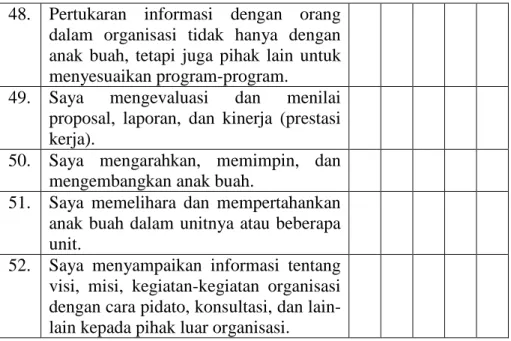
48. Pertukaran informasi dengan orang dalam organisasi tidak hanya dengan anak buah, tetapi juga pihak lain untuk menyesuaikan program-program.
49. Saya mengevaluasi dan menilai proposal, laporan, dan kinerja (prestasi kerja).
50. Saya mengarahkan, memimpin, dan mengembangkan anak buah.
51. Saya memelihara dan mempertahankan anak buah dalam unitnya atau beberapa unit.
52. Saya menyampaikan informasi tentang visi, misi, kegiatan-kegiatan organisasi dengan cara pidato, konsultasi, dan lain- lain kepada pihak luar organisasi.
Table 1:Sample Demographic
No. Total Percentage (%)
1 Gender Male 34 69.4
Female 13 26.5
Other 2 4.1
Group Total 49 100
2 Academic Background D3 6 12.3
S1 25 51.0
S2 15 30.6
S3 1 2.0
Other 2 4.1
Group Total 49 100
3 Working Time (year) Between 1-5 years 23 51.1
Between 6-10 years 10 22.1
Between 11-15 years 4 8.9
Over 15 years 8 9.7
Other 4 8.2
Group Total 49 100
4 Position HRD 7 14.3
Accounting 9 18.4
Internal Auditor 6 12.2
Production 16 32.7
Personnel 6 12.2
Marketing 3 6.1
Other 2 4.1
Group Total 49 100
Table 2 :Descriptive Statistics
Variable Theoretical Actual
Range Median Range Mean
Participation 12-60 36 24-58 46.87
Specificity 2-10 6 3-10 7.23
Attainability 2-10 6 5-10 8.45
Commitment 6-30 18 13-29 23.67
Locus of Control 20-100 60 37-100 70.43
Performance 7-35 21 14-35 28.67
Motivation 3-15 9 7-15 12.59
Table 3:Outer Loadings (Measurement Model) original
sample estimate
mean of subsamples
Standard deviation
T-Statistic
PARTICIPATION
PM1 0.708 0.706 0.108 6.580
PM4 0.849 0.837 0.060 14.244
PM7 0.721 0.727 0.098 7.346
PM10 0.866 0.863 0.048 18.056
PM11 0.738 0.710 0.092 8.027
PM12 0.776 0.751 0.076 10.248
ATTAINABILITY
A1 0.891 0.864 0.145 6.131
A2 0.865 0.812 0.223 3.879
SPECIFICITY
S1 0.934 0.919 0.068 13.670
S2 0.922 0.913 0.097 9.518
COMMITMENT
C1 0.803 0.793 0.092 8.757
C5 0.884 0.884 0.031 28.195
LOCUS OF CONTROL
LC3 0.815 0.817 0.045 18.131
LC4 0.836 0.828 0.045 18.394
LC6 0.689 0.702 0.089 7.732
LC10 0.806 0.787 0.066 12.237
LC11 0.699 0.707 0.070 10.009
LC13 0.839 0.836 0.043 19.703
LC14 0.851 0.840 0.040 21.095
LC17 0.799 0.798 0.054 14.920
LC18 0.801 0.795 0.067 11.884
LC20 0.847 0.838 0.043 19.857
PERFORMANCE
P1 (planning) 0.892 0.884 0.033 27.098
P2 (investigation) 0.703 0.696 0.095 7.420
P5 (supervision) 0.842 0.835 0.065 12.880
P6 (staffing) 0.876 0.867 0.041 21.489
MOTIVATION
M1 ( energy) 0.941 0.903 0.135 6.969
M3 (importance) 0.869 0.852 0.106 8.216
Source : Output SmartPLS (after elimination) Table 4:Quality Criteria
AVE Composite
Reliability
R Square
Participation 0.607 0.902
Attainability 0.771 0.871 0.209
Specificity 0.861 0.925 0.005
Commitment 0.713 0.832 0.806
Locus of Control 0.640 0.947 0.593
Performance 0.691 0.899 0.904
Motivation 0.820 0.901 0.090
Source : Output SmartPLS Table 5:Result of PLS Analysis
original sample estimate
mean of subsamples
Standard deviation
T-Statistic
PARTICIPATION ->
ATTAINABILITY
0.341 0.370 0.195 1.748**
SPECIFICITY ->
ATTAINABILITY
0.282 0.297 0.210 1.344*
PARTICIPATION ->
SPECIFICITY
0.072 0.076 0.216 0.333
PARTICIPATION ->
COMMITMENT
0.885 0.865 0.067 13.160***
ATTAINABILITY ->
COMMITMENT
0.029 0.055 0.082 0.357
SPECIFICITY ->
COMMITMENT
0.021 -0.006 0.064 0.325
PARTICIPATION ->
LOCUS OF CONTROL
0.447 0.429 0.170 2.633***
ATTAINABILITY ->
LOCUS OF CONTROL
0.046 0.045 0.089 0.517
SPECIFICITY -> LOCUS -0.391 -0.405 0.085 4.576***
OF CONTROL COMMITMENT ->
LOCUS OF CONTROL
0.256 0.284 0.182 1.409*
COMMITMENT ->
PERFORMANCE
0.766 0.763 0.061 12.492***
LOCUS OF CONTROL ->
PERFORMANCE
0.260 0.262 0.074 3.528***
MOTIVATION ->
PERFORMANCE
-0.008 -0.010 0.055 0.137
COMMITMENT ->
MOTIVATION
0.278 0.288 0.212 1.311*
LOCUS OF CONTROL >
MOTIVATION
0.032 0.054 0.253 0.125
Source : Output SmartPLS (results for inner weights)
* p < 0.2, two-tailed test.
** p < 0.1, two-tailed test.
*** p < 0.05, two-tailed test.
Figure 2:Significant Paths
12.492***
1.748**
13.160*** 1.409* 3.528***
1.344*
2.633***
4.576***
1.311*
Participation
Specificity
R20.5%
Commitment
80.6%
Locus of Control
R2
59.3%
Motivation R29%
Attainability
R220.9%
Performance
R290.4%