In this volume, contributors will use, critique, critically extend and develop Bourdieu's social theory to address some of the most pressing issues of our time. It is this kind of critical interrogation of Bourdieu's social theory as carried out by Moi that characterizes the contributions to this volume.
Context and Background: Pierre Bourdieu’s analysis of class, gender and sexuality
The child also influences its parents and the organization of the sexual division of labour. Embodiment is the product of the composition and amounts of capital that can be built up and carried by the body and the alignment between the habitus (the disposition-organizing mechanism) and the field.
Rethinking class and gender
Bourdieu, class and gender
The return of the living dead’?
Conflicts over class and gender
The class status of women themselves due to their participation in the labor market becomes invisible in this classification of the family/. housekeeping. Goldthorpe argues that the conventional view provides the basis for a realistic assessment of women's position within social structures.
Women: biological sex, social class, status category or series?
Moi was part of the 'psychoanalytic turn' in feminist literary studies, but she combined it with Bourdieu's sociology at a time when his work had little circulation within feminism. Delphy, like British Marxist feminists of the same period, located her materialism within the concept of 'the production of material life' and 'the social relations between production and reproduction'.
Bourdieu and the social field: ‘does gender fit?’
In terms of class hierarchy, he refers to them as "the dominated fraction of the dominant class". 3 Savage, one of the editors of the Crompton et al collection, elsewhere articulates a position which attempts to hold together in the same framework both class and 'cultural' analysis (Savage, 2000).
Gendering Bourdieu’s concepts of capitals?
Emotional capital, women and social class
She saw emotional capital as a variant of social capital, but characteristic of the private, rather than the public sphere (Nowotny, 1981). Across all three research projects, one of the few constants was mothers' emotional involvement in their children's education. Much of the data demonstrates the cost to mothers of their emotional involvement in their children's schooling.
Many mothers seem to strive for educational success at the expense of their child's emotional well-being. As a result, in some mothers' accounts, children's educational success resulted in an emotional cost rather than a gain, thus enhancing children's cultural capital while diminishing the value of their emotional capital. In contrast, most working-class women and a few middle-class mothers made a distinction between children's emotional well-being and educational success, favoring the former.
I suggest that the concept of emotional capital is useful in unraveling some of the confounding class and gender processes embedded in contemporary educational markets.
Exchange, value and affect
Bourdieu and ‘the self ’
Anthony Giddens (1991) and Ulrich Beck (1992) promote the reflective self as a model of the universal self. But it is this corporeal nature that limits Bourdieu's understanding of the working class or feminists or anyone whose positions are not legitimized by dominant symbolic relations. In The Weight of the World, the habitus of the working class is absolute and complete lack, adaptation without the possibility of change.
We need to be aware of the different value systems that exist outside the dominant symbolic (for this we would need decent ethnography and a lack of attachment to the dominant symbolic value system or dominant self-theories to explore reactions). An account of the disapproval of the dominant barter value system is also required. This is why these dominant bourgeois models of the self are so dangerous; they always portray the working class as individualized moral deficiency.
3 Strathern does not use the concept of the self that he claims presupposes the Western model of conformity.
Symbolic violence and the cultural field
Notes on ‘What Not To Wear’ and post-feminist symbolic violence
How do these changes relate to the sharpness of the class antagonisms in these programs. The victim of the make-over TV show presents his class habitus (including home, family, friends and neighbors and social environment) for analysis and criticism by the experts. However, Butler takes Bourdieu to task on the basis that, with habitus so easily capitulating to the demands of the field, she wonders how they can be conceptually understood as separate.
Field and habitus allow me to envision, through cultural means, a reconfiguration of the relations between class and gender in contemporary Britain. Thus we see very clearly that the field and habitus of the cultural intermediaries must remain separate (and therefore unfeasible) from that of the victims and participants. Often the women belong to the upper middle class and are "loud" in voice and appearance, sharing aspects of the cultural capital they have effortlessly built.
This analysis emphasizes the field's power to redirect habitus to produce new class differences between women.
Rules of engagement
Habitus, power and resistance
This is not because the stories somehow 'reveal' the habitus of the writers, but because they are elements in much larger cultural configurations of class and femininity. It is worth noting that the protesters in Balham were not scorned by being described as 'not understanding' the greatest danger of the private sphere. These children closely approximate the figure of the 'child', which, like femininity, is a classed (and contested) sign.
The 'working class' or 'underclass' was now further removed from 'the proletariat' which was of interest to many on the left only because of their key role in relation to capital, and therefore in revolutionary politics. So what I am suggesting here is that a conceptualization of 'resistance' only in terms of the (potential) overthrow of systems, together with a constitution of the white working class as reactionary and backward - its antithesis. 2002) 'The Vigilant (e) Parent and the Pedophile: The News of the World Campaign 2000 and the Contemporary Governmentality of Child Sexual Abuse' Feminist Theory.
2000) 'Marathon court hearing on sex offender protests' The Independent A historical construction of the working class', in H.
Habitus and social suffering
Culture, addiction and the syringe
In addition, I want to show how such substances play a key role in the cultural production of the fictional group 'underclass'. Interestingly, this reconfiguration of gender emerges from Bourgois' cursory analysis of the crack epidemic in media and popular culture. In the case of "crack moms", Campbell points out that the representation of crack as relating to the destruction of the drug-.
Nevertheless, Keane points out that the negative perception of drugs in the body is structured by the discursive juxtaposition of the 'pharmacological' with it. Put together and used interchangeably the unnatural in the popular medical terms 'crack baby' and. Indeed, this concern for the child's body is most evident in the 'biological account of the growing impoverishment of urban communities of color' (Oritz and Briggs, 2002:48).
Having little or no embodied potential makes strong claims about the social experience of childhood and the child's developing habitus.
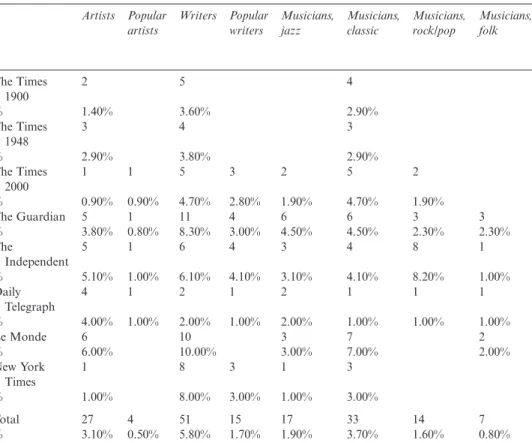
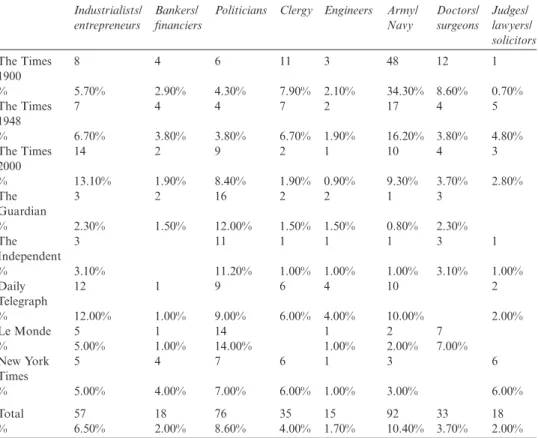
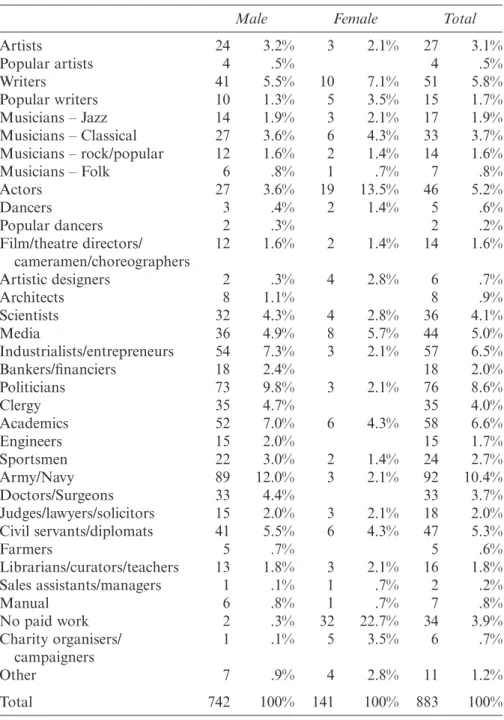
Mapping the obituary: Notes towards a Bourdieusian interpretation
In using this as an obituary, I accept Bourdieu's point that we must avoid the seductive common sense inherent in a single view of the subject. The official history of The Times refers to the inclusion of obituaries from its earliest days (1785), but the format was by then a standard feature in all daily newspapers (Anonymous, 1935, see also Grant, 1871). Of course, there is something of a fusion of old and new in this form.
There were no manual workers represented in The Daily Telegraph's 2000-1 obituary sample and only 2%. And those of social origin in the manual labor class were still only a small part of the whole. Even in the usual – more restrictive – sense of political exiles or economic immigrants, 11 (10%) of The Timescome are in this category.
Male figures, like Hailsham, lie in the most venerable tradition of the obituary, as we have seen.
Retheorizing the habitus
Agency and experience
Nancy Fraser's (1997 and 2000) work on redistribution and recognition is some of the most notable in this regard. For example, the repeated effects of racial slurs live and thrive in the flesh of the recipient. It is this reappropriation of the authorized position within language that serves to reveal prevailing forms of authority.
In the final analysis, this undermines claims about the generative nature of habitus. Yet this difference is somewhat overstated due to the polarizing effect of polemics. The idea of phenomenology as a relational rather than an ontological style of inquiry avoids the problem of reification.
I will now move on to consider some of the implications of Bourdieu's idea of a phenomenology of social space for an understanding of gender as a lived social relation.
Reflexivity: Freedom or habit of gender?
This exploration of the limits of the Bourdieusian thesis linking feminization, critical reflexivity and social transformation will in turn lead to a critical discussion of Bourdieu's ideas regarding social transformation. Indeed, reflexivity cannot be understood as cognitive at all, since knowledge of the world never concerns an external knowing consciousness. In short, by extending and elaborating Bourdieu's social theory, Lash is able to explain the existence of collective identities in the context of socio-structural retrocession.
For McNay, the recognition of the unconscious, pre-reflexive, and non-cognitive understanding of practice (and the integration of the social into the corporeal) in Bourdieu's social theory is central to McNay. In short, while McNay is critical of the idea of some kind of self-directed notion of social transformation, he suggests so. For example, in discussing Bourdieu's analysis of critical reflexivity, Christopher Bryant (1995) also draws attention to the transposable nature of the habitus and how movement across and within fields of action "can lead to collisions or prompt reflection" (Bryant, 1995:74).
Such mobility is thus understood as productive of the kind of contradictions and conflict through which a critical awareness towards gender can arise.