USE OF BUNDLE OF LEARNING WITH EMT STRATEGIES WITH CHILDREN WITH LANGUAGE DELAY AND ASD
by Natalie Formento
Thesis
Submitted to the Faculty of Peabody College of Vanderbilt University in Partial Fulfillment of the Requirements
for the Degree of
Master of Education in
Early Childhood Special Education
May 2023
4/30/23
ii
USE OF BUNDLE OF LEARNING WITH EMT STRATEGIES WITH CHILDREN WITH LANGUAGE DELAY AND ASD
By
Natalie Formento, M. Ed.
Peabody College of Vanderbilt University May 2023
Major Area: Early Childhood Special Education Number of words: 145 words This study examined the use of Bundle of Learning with Enhanced Milieu Teaching (EMT) strategies with children with language delay and ASD. An
alternating treatment design (ATD) was utilized to compare the Bundle of Learning + EMT to repeated reading alone. The number of different words (NDW) used by the target child was the primary outcome measure used to determine the effectiveness of the intervention compared to repeated reading alone. The intervention was delivered in a small group reading activity. The participants included a 25-month-old child with a language delay and a 29-month-old child without an identified language delay.
Results indicated that there was a functional relation between the Bundle of Learning + EMT strategies and the NDW of the target child during the intervention condition (shared book reading) compared to the control condition (repeated reading alone).
Implications for future research and practice are discussed.
iv
TABLE OF CONTENTS
Chapter Page
I. INTRODUCTION ………... 1
Language Development ………... 1
Evidence Based Interventions ………. 3
Purpose and Research Questions ………. 6
II. METHODS ……….. 9
Recruiting and Screening……….. 9
Participants ……….. 10
Settings and Materials……….. 15
Experimental Design ……… 16
Response Definitions and Measurement Systems ……….... 17
Procedure……….. 20
Expressive Language Probes ………. 20
Play Generlization Probes……….. 21
Control ………... 22
Intervention ……… 23
Interobserver Agreement ………. 26
Procedural Fidelity ……….. 28
Social Validity ………. 30
Data Analysis ……….. 31
III. RESULTS ……… 32
Child Data ……… 33
Inteobserver Agreement ………... 38
Procedural Fidelity ……….. 38
Social Validity ………. 39
IV. DISCUSSION ……….. 40
Limitation ………. 42
Implication ……… 43
Conclusion ……… 44
V. REFERENCE ………... 45
VI. APPENDIXES ………. 47
v
A. Study Consent Form ……….. 47
B. Participant Demographics Form ………... 51
C. MacArthur-Bates CCDI-WS ………. 60
D. Bundle of Learning Materials ……… 89
E. Adult Coding Protocol ………... 90
F. Child coding Protocol ……… 94
G. Expressive Language Probe Scoring System………. 98
H. Expressive Language Probe Book………. 99
I. Outline of Strategies in Four Reads ……….. 100
J. Reading Set Rotation Chart ………... 102
K. Question Asking Episode Flowchart ………. 103
L. Control Procedural Fidelity Checklist ……… 104
M. Intervention Procedural Fidelity Checklist ………. 103
N. Social Validity Survey Form …….………. 106
vi
LIST OF TABLES
Table Page
1. Child Participants Characteristics……….. 10
2. Inclusion and Exclusion Criteria for Target Child ……… 12
3. Inclusion and Exclusion Criteria for Peer Participant……… 13
4. Interventionists and Coders Characteristic ………... 14
5. Definitions and Examples of Child Behavior ……… 18
6. Intervention and Control Condition……… 24
7. Interobserver Agreement Result: Child Behaviors...……….. 27
8. Interobserver Agreement Result: Adult Behaviors………. 28
9. Procedural Fidelity Results ………. 29
10. Target Child’s Expressive Language Probes Scores ……… 37
11. Peer Participant’s Expressive Language Probes Scores……….. 37
vi
LIST OF FIGURES
Figures Page
1. Target Child’s Number of Different Words Used During Book Reading ….. 33 2. Target Child’s Number of Unprompted Words Used During Book Reading 34 3. Peer Participant’s Number of Different Words Used During Book Reading 35 4. Peer Participant’s Number Unprompted Words Used During Book Reading 36
CHAPTER I INTRODUCTION
Language is a critical component of children’s social, cognitive and academic development. Early language skills help establish social-communicative skills such as initiation, turn-taking, joint attentiveness, and responsiveness in interactions with adults and peers (Craig-Unkefer & Kaiser, 2003). Early language skills also promote successful long-term academic outcomes, such as writing and reading (DEC, 2023).
Early language intervention
Shared Book Reading as an Evidence Based Practice
Shared book reading (SBR) is an instructional approach in which an adult engages with a child during book reading and models language, book handling skills, and early literacy skills. Research has demonstrated that the use of SBR can support a wide range of skills for early learners, including vocabulary acquisition and general language skills (Noble et al., 2020 ). Caregivers and practitioners have been
encouraged to read with young children using a set of strategies called dialogic reading. Dialogic reading strategies include expansions, recasts, and open-ended questions that have positive effects on the language development of a child (Baker &
Nelson, 1984). A study on accelerating the language development of 2-year-olds using picture book reading in a dialogic reading style demonstrated positive outcomes. Children who received the dialogic reading intervention scored
significantly higher on both receptive and expressive language compared to children who did not receive the intervention (Valdez-Menchaca & Whitehurst 1992). In another study on the impact of interactive SBR on young children’s language skills, results indicated that the interventions using a SBR approach were effective
improved caregiver reading behaviors (Nobel et al., 2020).
Throughout the last few decades, there has been a push to strengthen language development through early interventions for learners with language delays (Curtis et al., 2019). Enhanced Milieu Teaching (EMT) is an evidence-based language
intervention in which the interests and initiations of children are utilized to model and prompt the use of language across everyday environments (Kaiser & Roberts, 2013).
EMT utilizes six key strategies: responsiveness, environmental arrangement, modeling target language, eliciting, expanding communication, and prompting communication. Instead of directing a child’s play behaviors, adults are taught to observe and imitate a child’s play actions, expanding on a child’s play and talking about the interest of focus for the child (Curtis et al., 2019). Expanding includes imitating exactly what a child communicated then adding new content words to link what they have already produced (Kaiser & Wright, 2013). Researchers have shown that EMT strengthens both the linguistic and social communication aspects of language use by children with disabilities (Hancock & Nietfeld, 2000).
Several studies have demonstrated that EMT is an effective intervention. EMT has been shown to strengthen children’s expressive and receptive language skills immediately following intervention (Curtis et al., 2019). In a study on the effects of EMT with phonological emphasis on speech and language skills of young children with a cleft palate, it was determined that the children who received the treatment (EMT + phonological emphasis) had significantly better receptive language scores compared to the children who did not receive treatment (Kaiser et al., 2017). In another study on using EMT and book reading on the target word approximations of young children with language delays, a functional relation was found between the intervention (EMT) and the number and frequency of targeted approximations for participants (Kang & Kim, 2022).
However, there are some limitations in the existing research in terms of solely utilizing EMT as an intervention for children with early language delays. Additional research on determining language outcomes for toddlers with language delays
demonstrated that toddlers did not maintain outcomes over the 12 months of the EMT intervention (Curtis et al., 2019). Early learners with receptive language delays may be able to improve their language skills to the levels of their TD peers; however, additional intervention procedures may be necessary for children with comorbid receptive and expressive language delays (Curtis et al., 2019). These findings suggest that some early learners with language delays receiving naturalistic language
interventions such as EMT may require additional supports to improve language outcomes. To help strengthen language development, both caregivers and teachers can encourage the use of gestures, play skills, and vocabulary use (McLaughlin, 2011).
Gestures are a vital component of a child’s expressive communication capabilities. In the early childhood years, the use of gestures such as pointing, reaching, showing, and giving allow young children to communicate with caregivers and provide caregivers opportunities to respond with specific linguistic input. The use of gestures by young children may also contribute to strengthening their receptive vocabulary by soliciting input from adults, which in turn may increase the number of words the child uses expressively (Roberts & Kaiser, 2015). Children who experience delayed gesture development may also have spoken language delays (Romano &
Windsor, 2020). Adults who use gestures also serve a significant role in supporting a child’s expressive communication. Research examining the relationship between expressive language delays and gestures has shown that children who have expressive language delays show significant improvements in their language use when adults incorporate the use of gestures while speaking to children (Lowry, 2016).
Play skills are also related to early language development. Play is an important context for the development and growth of exploration, problem solving, and social awareness. When young children engage in play, they have opportunities to build emergent social communication skills and social competence (Jester & Johnson, 2016). However, children with disabilities have been found to play less often and demonstrate fewer pretend play behaviors compared to children who are typically developing (Barton, 2015). Rescorla and Goossems (1992) explored the pretend play skills of toddlers with and without language delays and found that children with language delays demonstrated limited pretend play skills (i.e., relatively fewer pretend-play occurrences, forms and schemas) compared to the children without language delays.
More recently, researchers have examined the relationship between language skills and pretend play. Children with language deficits displayed fewer theory of mind skills during play compared to their peers with typical language abilities (Jester
& Johnson, 2016). Children with language delays may demonstrate deficits in other domains and stages of development (e.g., manipulating objects) and are less likely to answer questions from peers, initiate routines, and design their own rules. When children have less access to language for play interactions, they may have challenges with generalizing play strategies to varied contexts, connecting past and current play experiences, and controlling their language to finish tasks (Dennis & Stockhall, 2015).
Because of this, it is important that adults provide early learners with the play
strategies needed to strengthen their social, cognitive, and emotional well-being. In an article on teaching generalized pretend play and related behaviors to young children with disabilities, Barton and Wolery (2010) specifically encouraged teachers
implement play-focused interventions with children who have development delays or disabilities.
Vocabulary and syntax development in early learners is related to long-term reading and academic outcomes (Dennis & Stockhall, 2015). Children with expressive delays demonstrate a delayed progression in sentence structure and articulation
(American Speech Language Hearing Association, 2022). For reading
comprehension, strengthening children’s vocabulary attainment is a vital goal within the preschool classroom (McLeod et al., 2017). To promote language development, modeling vocabulary and sentence structure utilizing comments or descriptive commentary is highly beneficial to the learner (Badii, 2018).
Language interventions + Integrated Supports for Learning
The Bundle of Learning: Language and Literacy brings evidence-based ingredients into books and story-related materials, providing adults with techniques to strengthen a child’s learning through the practice of language, social, and cognitive skills (Landa, 2021). Each bundle contains a book with prompts and icons, a backpack, and 15 toy props. The book bundles were created to reinforce play, language, and social development for children ages 12 months to 6 years of age.
Gestures for verbs corresponding to the pictures are included to help children understand the meaning of the verb and to make actions salient in the narrative. The story narrative and range of toys included in the bundle provide children the
opportunity to engage in play at various levels, from simple actions with objects to thematic pretend play.
Vocabulary in the books is designed to support language learning. The vocabulary is redundant across pages to allow for repeated use of a particular word.
The books include nouns, verbs, prepositions, and adjectives at a range of
developmental levels to support vocabulary development across the toddler and preschool period. The bundles include embedded prompts that help adults model play, gestures, and vocabulary in ways that are likely to promote language development.
The Bundle of Learning: Language and Literacy also includes tips for adults to promote a child’s engagement and learning throughout the book sharing time (Landa, 2021).
Purpose and Research Questions
There is a critical need for early interventions to strengthen language
development in early learners with language delays (Curtis et al., 2019). While EMT has been utilized in both single case and group design studies (Kaiser & Hampton, 2017) there are no published studies of EMT used only in book reading. Similarly, the Bundle of Learning is a relatively new packaged intervention, and empirical studies using this intervention are forthcoming.
Recently, researchers explored combining Enhanced Milieu Teaching (EMT) and Bundle of Learning (BB) strategies into a single book reading intervention
(Delmare, 2022; Jang, 2022; Lanier, 2022). Two studies included a single case design with one child with a language delay, and one included a single case design with two typically developing children. These studies aimed to determine if the use of BB + EMT strategies increased the number of different words, gesture use, and play actions used during book reading compared to standard repeated reading in a small group setting for the child with a language delay. Interventionists conducted intervention and control conditions where the use of BB-EMT strategies were used in the intervention sessions (i.e., language modeling, expansions, question-asking sequences) and the control sessions as standard reading alone (reading the books through with no strategies). Results determined that the use of the BB-EMT strategies
resulted in a larger NDW across participants compared to the repeated reading condition. Therefore, functional relationships were identified between the use of BB- EMT strategies in shard book reading compared to the standard repeated book reading for the target child (Delmare, 2022; Jang, 2022; Lanier, 2022).
Given this, the purpose of the present study was to replicate the previous studies by comparing the use of the blended intervention, The Bundle of Learning + EMT, for promoting language skills in young children, compared to a business-as- usual shared book reading condition with both the child with a language delay and the typically developing child within the same dyad. This study incorporated double the amount of intervention and control sessions as the previous researchers to expand the length of the procedure. This study also integrated play sequences through
intervention sessions with improved toy quality in each book bundle set. The research questions addressed are as follows:
Research Question 1: Do children with and without language delays use a greater
number of different words (NDW) during the Bundle of Learning + EMT
condition compared to repeated reading in a shared book reading format in a small group setting?
Research Question 2: Do children with and without language delays use a greater number of unprompted words (UP) during the Bundle of Learning + EMT
condition compared to repeated reading in a small group setting?
CHAPTER II METHOD
Recruiting and Screening
After approval of the IRB, we asked teachers in a local inclusive preschool to nominate both children with potential language delays and peers without language delays. Parent consent for participation in the study was obtained for all nominated students. Once students were nominated, they were screened for potential inclusion in the study. The MacArthur Bates Communicative Developmental Inventories
(Bruckner et al., 2007) and the Preschool Language Scales 5th edition (Hsiao et al., 2021) were administered by master’s level clinicians to screen the expressive and receptive language skills of the target child and peer. Participation inclusion criteria for the target child and the peer participant are found in Table 2. After the inclusion criteria were confirmed, demographic data were collected for both participants.
Participant data such as the (a) age at intake, (b) gender, and (c) race/ethnicity were collected. Detailed demographic data and child standardized assessment results for both the target child and peer participant are found in Table 1.
Table 1.
Child Characteristics
Characteristic Target Child Peer Child
Age at entry 25 mo 29 mo
Gender Male Female
Ethnicity/Race Multiple, Non-Hispanic White, Non-Hispanic
Diagnosis None None
MCDI Total words 59 346
MCDI Total words % 5th 15th
PLS-5 Auditory
Comprehension standard score
PLS-5 Auditory
Comprehension percentile 92 30th
112 79th PLS-5 Expressive
communication standard score
PLS-5 Expressive communication %
88 21st
111 77th
PLS-5 Total language score 89 112
Total language percentile 23rd 79th
Participants
This study was approved by the Vanderbilt University Institutional Review Board (IRB #211858). We recruited two children: one child who was reported to have a potential expressive language delay by their classroom teacher and one peer
participant with no suspected expressive language delay. Participant inclusion criteria for the target child (i.e., child with a language delay) and the peer participant (i.e., child without a language delay) are in Tables 2 and 3. The target participant was a 25- month-old male toddler. A secondary participant was recruited as a peer. This peer was a 29-month-old female toddler. Language skills of both children were assessed using standardized measures. Standardized measures included the (a) MacArthur- Bates Communicative Developmental Inventories – Words and Sentences (MCDI-
WS) completed by the children’s caregivers and (b) Preschool Language Scales 5th edition (PLS-5).
The results of the MCDI indicated that the target child produced 59 words at intake and was in the 5th percentile, whereas the peer participant produced 346 words at intake and was in the 15th percentile. The results of the PLS-5 indicated that the target child received a standard score of 92 on the standard auditory comprehension section in the 30th percentile, an 88 on the expressive communication section in the 21st percentile and had a total language score of 89 in the 23rd percentile. The results of the PLS-5 indicated that the peer participant scored a 112 on the auditory
comprehension section in the 79th percentile, a 111 on the expressive communication section in the 77th percentile and had a total language score of 112 in the 79th
percentile.
Although the peer participant was nominated as a child without language concerns, the assessments suggest that her language skills were below norms for her age. Because no specific exclusion criteria for language were proposed, the child was included as a peer. These child characteristics are found in Table 3. Demographic information of the two participants is found in Appendix B. An MCDI form is in Appendix C.
Table 2.
Inclusion and Exclusion Criteria Target Child Characteristics
Inclusion Criteria Exclusion Criteria Child must have single word use and
have at least 20 reported words that they use expressively in a multitude of modes (words, AAC, signs) as reported by parents
Have primary diagnosis of any specific disability other than language delay or autism spectrum disorder including (1) severe motor impairment (e.g., cerebral palsy), (2) sensory impairment such as blindness or deafness
Score at or below the 20th percentile on the MacArthur-Bates Communicative Developmental Inventories1 word and sentence section using sex-specific norms in the last six months
Have less than 20 reported words that they use expressively in a multitude of modes (e.g., vocally, signs, AAC) as reported by parents
Expressive language delays of at least 1.0 SD below age norm on the
expressive communication section of the Preschool Language Scales 5th edition2
Have a PLS-5 total score with 1.0 SD of age norms on the expressive
communication section of the Preschool Language Scales 5th edition
Age between 15 – 48 months Have a MCDI score above the 20th percentile for age and sex
Consistent attendance at school Age below 15 months or above 48 months
Child must be able to attend to a book at least 3 minutes as observed through a probe and parent report
Does not have consistent attendance at school
Is not able to attend to book for at least 3 minutes as observed through a probe and parent report
1MacArthur-Bates Communicative Developmental Inventories (Fenson et al., 2007)
2Preschool Language Scales 5th edition (Zimmerman, Steiner, & Pond, 2012)
Table 3.
Inclusion and Exclusion Criteria Peer Participant Characteristics
Inclusion Criteria Exclusion Criteria
Teacher recommendation for inclusion based on social interaction with peers with language impairments
Have no diagnosed disability Age between 15-48 months Consistent attendance at school
Child must be able to attend to a book at least 3 minutes as observed through a probe and parent report
Teacher did not recommend for inclusion based on social interaction with peers with language impairment
Have primary diagnosis of any specific disability other than language delay or autism spectrum disorder including (1) severe motor impairment (e.g., cerebral palsy), (2) sensory impairment such as blindness or deafness
Age below 15 months or above 48 months Does not have consistent attendance at school
Is not able to attend to book for at least 3 minutes as observed through a probe and parent report
The primary researchers (hereafter referred as interventionists) were two master’s students in Early Childhood Special Education at a research university in the southeastern United States. The demographic and complete description of both interventionists are shown in Table 4.
Table 4.
Interventionist and Coder Characteristics Primary
interventionist/Reliability coder
Primary Coder
Age in Years 24 24
Race/Ethnicity White, Non-Hispanic Asian, Non- Hispanic
Education BS BS
Years of teaching or behavioral intervention experience
4 4
Setting and Materials
All sessions were conducted in an inclusive university-based preschool in the southeast United States. Participants were brought from their classroom to a separate therapy room for all sessions. The therapy room was equipped with a table and a chair, however, the implementor and the children sat on the carpeted floor for all book reading sessions.
Instructional materials included two book bundles, (1) Bear’s Applesauce Picnic and (2) Friend’s Frosty Fun with the corresponding book and toys.
Participants always had access to the corresponding play manipulatives for each book.
Bear’s Applesauce Picnic included: a stuffed bear, duck, dog, and mouse; play cutlery including a bowl, spoon, and knife; a truck made from a shoebox; apples with and without fastening Velcro; a small wooden box; and a small blanket. Friend’s Frosty Fun included: a stuffed bear, bunny, mouse, and dog; a sled, a small blanket; a small muffin pan; six fabric snowballs; a scarf; a hat; and a snowman puzzle. Stickers were provided to participants after the completion of each session. Pictures of the Book Bundle materials are in Appendix D.
A stimulus book was created for pre- and post-intervention expressive probes.
The book included pictures of scenes from the books Bear’s Applesauce Picnic, (2) Friend’s Frosty Fun, and (3) Bear’s Beary Good Cookies. During play generalization probe sessions, participants had access to limited toys from the Bear’s Applesauce Picnic and Friend’s Frosty Fun. These toys included a sled, snowballs, pan, blanket, hat, truck, apples, pot, knife, spoon, bear, duck, mouse, bunny, and the dog.
Sessions were videorecorded using Zoom software on a laptop, phone or iPad.
Once a session was completed, the interventionist named and uploaded the Zoom recording to Vanderbilt Box, a secure cloud-based content management software.
Session data were transcribed and coded from video recordings using DataVyu software (Gee et al., 2020) and Microsoft Excel. Data were graphed using Prism GraphPad software (Docos et al., 2022).
Experimental Design
An alternating treatments design (ATD; Ledford & Gast, 2018) was used to compare the Bundle of Learning (hereafter referred as BB) and EMT intervention to repeated reading. An ATD allowed for the comparison of two independent variables (IVs; i.e., the blended use of BB+ EMT to repeated reading alone). Additionally, this design was appropriate for reversible behaviors (i.e., number of different words used in sessions). The use of the ATD limited several threats to internal validity. For example, history threats were controlled for because both interventions were run concurrently. Changes in level or trend due to history threats would be evident in both conditions and easily identified using visual analysis. As the design was relatively brief, both history and maturation threats were controlled for. If there was a
significant event that occurred outside of the study, it would affect both conditions (i.e., a diagnosis or new medicine). Although the study was brief, participants would have shown a change in behavior or maturity in both conditions if maturation was a threat (i.e., getting older).
Instrumentation threats were controlled by observers who were equipped with a coding manual containing the response definitions with examples and recording systems and were trained to a high criterion. Interventionists and coders were blind to ongoing visual analyses, meaning they were unaware of data trends until the end of the study. Maintaining blind visual analysis limited potential bias of both the
interventionists and coders during the study. It is important to note that the observers could not be blind due to their knowledge of the procedures.
Visual analysis of level, trend, and variability of data was used to draw comparisons between two alternating conditions with at least five data points (Ledford & Gast, 2018). This was conducted following the completion of the intervention to limit any bias. The degree of differentiation in levels of the two data paths allowed for comparisons across the two conditions. Visual analysis also allowed for determinations about whether there were functional relations. To determine if there was a functional relation, a vertical separation between the intervention and control condition were observed.
Response Definitions and Measurement Systems
Both children’s language was transcribed using SALT conventions and coded for presence of dependent variables. The number of different words (NDW) was the primary dependent variable utilized to make experimental decisions. NDW indicated the number of different words roots the participants used within a session based on SALT definitions of word roots. Proper names and the varied forms of “to be” verbs (e.g., is, was, were, are), were excluded when counting the NDW. Phrases such as “all done” and “thank you” were counted as one word. NDW was counted from the
transcripts of each session. Response definitions and examples are found in Table 5.
Spontaneous, prompted, and imitated child utterances were also recorded.
Child utterances included unintelligible vocalizations, imitated language, and
spontaneous word use. For example, if the child said “bear” without an adult prompt, the words was counted as spontaneous word use. If an adult asked the child what was falling from the sky and the child said “snow”, that would count as a word for NDW calculations but would not be considered spontaneous. And if the adult said “hat” and then the child said “hat”, that would also count as a word. Each 3-15 video
observation was coded using the coding protocol. Timed event sampling was used to
record how often the child used different words during the sessions. It also estimated the use of gestures, play rate, and vocabulary use of the target participant and peer participant.
Table 5.
Definitions and Examples of Child Behavior Dependent
Variable
Definition Example Non-example
NDW The number of different words that the child uses during the shared book reading
Child says, “bear eats;” two different words
Child’s utterance is unintelligible or says, “roar” as an animal sound Number of
unprompted words
The number of different unprompted words that the child uses during the shared book reading
Child says, “bear is driving” without being prompted;
spontaneous
Child says, “snow”
after the interventionist asked, “what is falling from the sky?”
Note. NDW = Number of Different Words
EMT Coding Protocols. A Book Bundle EMT Coding Protocol was designed
to code adult and child communication which is found in Appendix E and F. Child utterances were coded for single codes, communicative form, and independence.
Single codes were assigned if a child’s utterance was potentially communicative but otherwise uncodeable. For example, if the child’s utterance was unintelligible, it would be coded as a potentially communicative vocalization. Non-word vocalizations were also assigned single codes. If the child communicated by saying a word, using a gesture, or using an AAC device, this would be coded based on the coding protocol.
For example, if the child reached for the pot, it would be coded as a gesture (g). If the child communicated in a way that was prompted, unprompted, elicited, or imitated, this would be coded based on the codes assigned. For example, if an adult said “bear”
and the child then “bear”, this would be coded as imitated.
Adult communication was coded based on single codes, turn taking,
expansion, and target language codes. For single codes, when the adult read the book to the participants, this would be coded as the adult was reading. If there was any unintelligible utterance from an adult, this would be coded as unintelligible. And if the adult does not take a turn within 3 s of the child’s communication, this would be coded as a no response. If the interventionist responded to any communicative act of the participants with semantically contingent content within 3 s, that utterance was coded as a matched turn. For example, if the child reached for the bear, the
interventionist may have said, “You want bear!”. Turns were coded as unmatched turns if the interventionists took back-to-back turns or responded non-contingently to a communicative act of the child participants. If the interventionist expanded a child participant’s words into a grammatical simple sentence or recasted a speech error, that utterance was coded as an expansion. For example, if a participant said “Bear”, the interventionist may have expanded by saying, “The bear is eating!”.
An adult utterance would be coded as no expansion if the interventionist responded to a child’s expandable utterance without completing an expansion or recasting. Question asking episodes were coded based on their quality. Possible quality scores included “outstanding performance”, “not-outstanding performance”, or “child loss of interest”. Question asking episodes that included the interventionist maintaining the participant’s interest, giving the child adequate time to respond, and expanding on their response would be coded as “outstanding performance”. For example, if the interventionist asked, “What’s on bear’s head?” and a participant responded by saying, “Hat”, the interventionist would then say, “The hat is on bear’s head!”. A question asking episode would be coded as “not outstanding performance”
if the interventionist continued a question asking episode that did not have the
participant’s interest or did not follow the correct question asking sequence. The code
“child loss of interest” was coded if the interventionist abandoned the question sequence when the participant was not interested. A question asking flowchart is found in Appendix K.
Expressive Language Probes
The interventionist conducted three probes of children’s book-related expressive vocabulary. Two expressive language probes were conducted before the intervention began and one session was conducted following the conclusion of intervention. The interventionist conducted sessions with the target participant and peer separately. Before each probe session began, the interventionist minimized distractions and sat face-to-face with the child. The interventionist presented one scene one-at-a-time from the two books used during the comparative design (i.e., Bear’s Applesauce Picnic and Bear and Friend’s Frosty Fun) as well as from a third book that child participants were never exposed to (i.e., Bear’s Beary Good Cookies).
On the first page, the interventionist modeled an active declarative sentence describing the scene (e.g., “Bear is stirring the applesauce"). On subsequent pages, the interventionist used an open-ended prompt (i.e., “What’s happening here?”) to probe children’s story-related expressive language skills. If 3 s elapsed with no child response, the interventionist provided a more supportive prompt (i.e., “Tell me about the bear”). Models of sentences were interspersed with prompts every two pages. The interventionist was responsive to all child responses but provided no feedback about the child’s response. An expressive probe scoring checklist is in Appendix G and example of the probe book is in Appendix H.
Play Generalization Probes
The interventionist conducted one play generalization probe session before the intervention and one play generalization probe session following the intervention. The materials were pre-selected from the control read book set and intervention read book set. Before each probe session began, the interventionist minimized distractions, prepared the materials, and used a statement such as, “Let’s play with Bear and his friends!”. The interventionist would engage with the participant and peer in child-led play (e.g., comment on a child’s play and imitating play actions). Once per minute, the interventionist would comment on play (e.g., “You’re rolling the apple!”) and add a new action that was exclusive from the book actions and semantically related to the ongoing play (e.g., “Bear took a big bite of the snowball!”). An equal number of comments and an equal number of added actions from each book were used.
Procedures in the BB+EMT and Repeated Reading Conditions
Following guidelines outlined for ATDs, two conditions (i.e., the BB+EMT;
repeated reading alone) were compared via rapid alternation across sessions (Ledford
& Gast, 2018). An independent research assistant who did not code data or conduct the intervention used a random number generator to assign individual books to experimental conditions. Bear’s Applesauce Picnic was identified as the book used for all BB+EMT sessions (i.e., “intervention”) and Bear and Friends’ Frosty Fun was identified as the book used for all repeated reading alone sessions (i.e., “control”).
The interventionist conducted 1-2 small-group sessions per school day. Only the interventionist and participants were present during each session. Each session was 3-15 min in duration and lasted 7 minutes on average (range: 4-10 mins). When two sessions were conducted in one day, 4-5 hours elapsed between sessions to reduce carryover effects. To protect against sequencing effects, condition order was
randomized in blocks of two using a random number generator. The document containing the randomized order of sessions is in Appendix J.
Both the control and intervention sessions included the interventionist, the target participant and the peer. Throughout both the control and intervention sessions, the target participant and peer sat next to one another on one side of the wall in the therapy room. The interventionist was seated across from the participant and peer to present the book. Before each session began, the interventionist minimized
distractions, prepared the book and materials, reviewed behavioral expectations (e.g., modeling and presenting visuals of rules) and used a statement such as, “Let’s read about Bear and his friends” to begin the read.
Repeated Reading Alone (Control).
A pre-selected Bundle of Learning book was presented in a manner that excluded the use of BB+EMT strategies. The book was read alone (i.e., shared book reading without BB+EMT strategies). The interventionist did not model gestures, play or specific vocabulary words outside of the flow of narrative reading. Child use of gestures, play with related toys and use of vocabulary words within the book were not prompted or suggested. The interventionist responded to the participant or peer by acknowledging their communication or responding with positive statements without using BB or EMT strategies (e.g., if the target child pointed to the bear on the page and said “bear”, the interventionist responded, “Good job, that is a bear!” and then continued reading. Behavioral expectations were enforced, if necessary. For example, the interventionist encouraged the participant and peer to share the toys with one another, to stay in the book reading area and to show a safe body (not kicking or hitting the other child). The interventionist did not use any of the intervention strategies associated with BB or EMT for the entirety of every 3-15-min control
session. At the end of the control sessions, the interventionist praised the participant and peer for staying in the session area and rewarded them with stickers.
BB+EMT (Intervention).
Intervention sessions incorporated the use of BB+EMT strategies. We incorporated an equal number of strategies distributed across four different book reading sessions, then the next four reads repeated those strategies in the same distribution. For example, “Bear’s Applesauce Picnic,” the intervention book, page 1 had one strategy (e.g., expanding language), page 2 had another strategy (e.g., pointing to show an object), and so forth. The strategies were color-coded within the book and across the four read alouds to support the interventionist’s use of the different strategies. An outline of the strategies is found in Appendix I. Behavioral expectations were enforced, if necessary, where the participant and peer were
encouraged to share the toys with one another and/or have a safe body. At the end of the intervention sessions, the interventionist provided praise to the participant and peer for staying in the session area and rewarded them with stickers. A table of the intervention and control conditions are found in Table 6.
Table 6.
Intervention and Control Condition
Intervention Control
Shared book reading with BB+EMT Shared book reading
BB strategies: language modeling, related play with toys, and pantomime gestures
No BB strategies;
related toys available
EMT strategies: Responsive interaction, language modeling and expansions, modeling joint attention gestures, question asking
No EMT strategies
Embedded toy play episodes throughout book reading No embedded toy play episodes Note. EMT = Enhanced Milieu Teaching
Bundle of Learning Strategies. There were three primary strategies that were
incorporated in BB: language modeling, gestures of relevant actions in the book, and play models using toys from the book bundle. Vocabulary words throughout the books were included to promote language learning through repetition of key words and exposure of new words. Gestures were used to support communication by physically modeling or pantomiming actions (e.g., apples rolling down the hill, stirring the pot) and emotions (e.g., surprise, happy) via body language. The book reading incorporated toys that corresponded to the related story, providing
opportunities for children to engage in play at their developmental levels using objects (e.g., play ranged from simple actions with objects to enacting a part of the story such as driving the truck over the bump and the apples falling out).
The BB books include suggestions for multiple language support strategies on each book. For this study, the complete set of suggestions was divided in to four subsets, and one subset was assigned to each of the reads 1 through 4. Only one suggestion per page of text was implemented. Thus, when each page of the book was read, the pre-selected language, gesture, or play strategy was implemented. During read alouds 1-4, a different strategy was used on each page during the read. Strategies to support use of vocabulary words were integrated throughout the book. For
example, if the interventionist read about bear picking apples, she could also recast the text and say, “Bear is picking apples!” to model language for the children.
Gestures were used throughout the read to express or draw attention to the actions or emotions that were happening in the book. For example, if the interventionist read about bear stopping his truck, she could put up a hand to gesture the “stop” motion.
Children were encouraged to interact with the materials and sometimes with each other during the opportunities for play embedded into the reading. For example, when the interventionist read, “Bear picks four red apples, and then he is done,” she could put apples into the box (model a play strategy) then hand the box to the children to add more apples.
EMT Strategies. Enhanced Milieu Teaching (EMT) strategies were also
embedded throughout reading the BB books. Engagement, communication, play, and prompting strategies were incorporated into the book reading sessions. Books and toys designed for a high level of interest kept the participants engaged during the sessions. Adult behaviors such as following the child’s lead, imitating and labeling child actions, pointing to pictures while saying the label or modeling an active declarative sentence, giving objects for play and labeling objects and the child’s
actions with objects, plus responding to the child’s communication supported engagement and use of language.
Modeling target language and expanding the child’s language provided the child with new vocabulary and models of short sentences. For example, if a child pointed to a picture of the bear in the story and said “bear”, the adult responded with an expansion in the form of an active declarative sentence, “the bear is picking the apples.” If a child was interested in an object, the adult pointed to the object and labeled it using target level language tailored to the child. When modeling new actions and adding objects to a play sequence with labeling or describing the actions or objects, this provided opportunities for more language modeling and contributed to keeping child interest in play high. For example, if a child was playing with an apple, the adult might imitate the child by playing with the apple, then adding a pot and spoon to stir the apple in the pot.
The use of prompts included asking questions about the book, offering choices and using ‘say’ prompts when the child was unable to respond. For example, after reading about bear making applesauce, the adult might ask, “What is the bear making?” If the child responded, she expanded the child’s response into a short sentence. If the child did not answer or gave an incorrect answer, the question was repeated once, then the adult modeled the answer and asked the question again. If the child still did not respond, she modeled the answer one last time. These prompts allowed for an opportunity for the child to use new language. Prompts were use about 2-3 times per reading session.
Interobserver Agreement. Interobserver agreement (IOA) data were collected for at least 33% of sessions across the participants, dependent variable, and session
conditions. IOA sessions were selected using a random number generator and assigned by a member of the research team not assigned to coding or delivery of intervention. Agreement was measured utilizing the point-by-point method. The total number of agreements, divided by agreements plus disagreements were multiplied by 100 to determine the percentage of agreements amongst coders (Ledford et al., 2018).
If IOA fell below the 90% agreement criteria, coders reviewed the behavior definitions and examples to see if there were challenges determining whether a behavior met the requirements of a definition. Table 7 and 8 provide IOA data.
Table 7.
Interobserver Agreement Result: Child Behaviors
Child Behavior Average Score Percentage of sessions (%)
Single Code 86.99 33%
Communication Form 93.83 33%
Independence 90.65 33%
Overall 90.49 33%
Table 8.
Interobserver Agreement Result: Adult Behaviors
Adult Behavior Score Percentage of sessions (%)
Matched Turns 90.89 33%
Expansion 91.01 33%
Target Language 89.84 33%
Overall 90.58 33%
Coder Training. The primary coder and secondary coder (i.e., the
interventionist), were trained to code videos by reviewing the response definitions with examples and non-examples. They were trained to a 90% criterion on adult and child codes for intervention and control videos from a previous cohort. Child codes included single codes, communication, and independence codes, while adult codes included single codes, turn taking, expansion, question asking episodes and target codes.
Procedural Fidelity. Procedural fidelity (PF) was measured for 33% of both the control and intervention sessions for both participants. PF was scored utilizing the recorded video clips and a separate checklist for both the control and intervention sessions. The coded sessions were determined using a random number generator.
Items on the checklists incorporated the guidelines for the interventionist’s use of BB+EMT strategies with the participants. This information was collected from the DataVyu coding file. Procedural fidelity also measured the interventionist’s behaviors through a checklist. Data were analyzed separately for each behavior. For both the control and intervention sessions, interventionist behaviors included, (a) arrange the
setting space by removing any distractions, (b) prepare the book and materials, (c) announce the behavioral expectations of the participants, and (d) begin with a
statement such as, “Let’s read about Bear’s applesauce”. The checklists also listed the interventionist’s adherence to either withholding or incorporating Bundle of Learning and EMT strategies in the control and intervention sessions, as appropriate.
Procedural fidelity checklist rating scales for both the control and intervention sessions are found in Appendix L and Appendix M. Procedural fidelity was
determined by adding all the scores of the control and intervention sessions separately and dividing that number by the maximum number of points possible. An acceptable level of fidelity was at least 85% of correct implementation to ensure that the
interventionist was conducting the sessions accordingly. If procedural fidelity fell below criterion, the interventionist was re-trained by reviewing and the
implementation procedures. (Ledford & Gast, 2018). Table 9 provides procedural fidelity data.
Table 9.
Procedural Fidelity Results
Session Average (range) Percentage of sessions (%)
Control 100 (100-100) 33
Intervention 97.33 (92-100) 33
Social Validity
To measure the social validity of the effects of the study, the interventionist collected summative data by gathering information from naïve individuals regarding their viewpoints on the intervention (Ledford & Gast, 2018). A digital questionnaire was provided to a class of students within the special education department of a university in a southeastern state. Inclusion criteria for selecting student raters were as follows: (a) not involved in the implementation of the study, (b) unaware of the control and intervention procedures, and (c) had not seen the video clips from the sessions in the study. Once students were determined to be eligible, they participated in the assessment of the social validity of the study. These students served as masked raters who were unaware of treatment assignment to help reduce bias.
Students were shown video clips of the target and peer during the BB+EMT and comparison repeated reading condition. Video clips were selected from the 5th session of both control and intervention sessions around the 3–4-minute mark. This was decided by a random number generator. A video of a 1-minute clip an
intervention session and a video of a 1-minute clip of a control session was presented.
The class was told to respond independently by clicking which video the child circled in red was more engaged in and communicated more. A question also asked in which video there were higher quality teaching strategies. This process was repeated for intervention and control sessions of both the target child and peer participant for videos A-H. Responses on the questionnaire were collected via REDCap to receive data on the effectiveness of the study at a rapid pace (Harris et al., 2009). The social validity data collection form is found in Appendix N.
Data Analysis
Data were collected throughout the intervention. After an equal number of sessions for the intervention (BB +EMT) and the comparison condition were completed, the data were graphed for analysis. Visual analyses were conducted in a summative manner, following the completion of all 20 sessions by the primary research in consultation with the supervising doctoral student. Visual analysis was used to determine whether there was a functional relational was identified between participants and conditions (Ledford & Gast, 2018).
CHAPTER III RESULTS
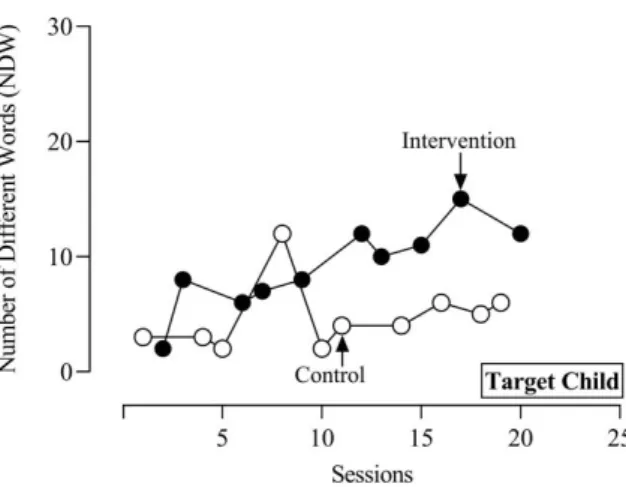
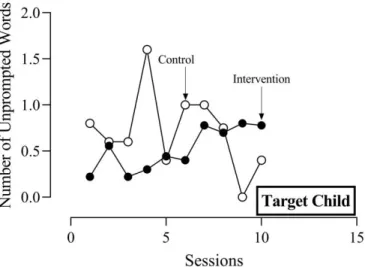
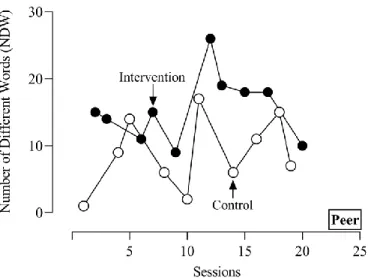
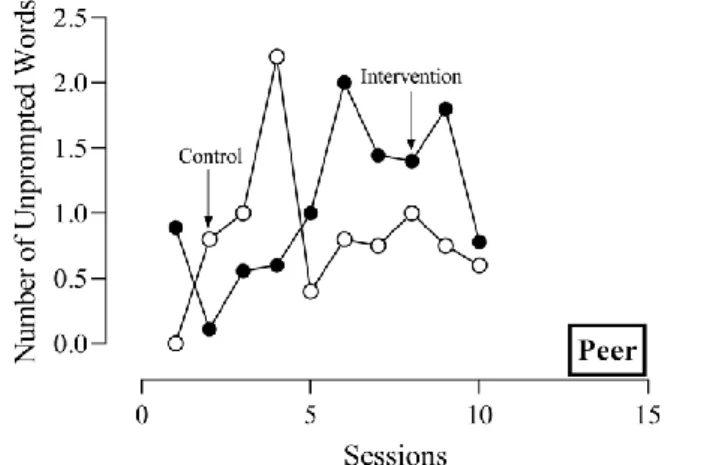
Results for the NDW of the target child are represented in Figure 1. Results for the NDW of the peer participant are represented in Figure 2. In each graph, the numbers on the y-axis (i.e., 0-70) depict the NDW of the participants. Results for unprompted words (UP) for the target child and the peer are in Figures 3 and 4 respectively. The numbers on the x-axis (i.e., 0-20) depict the number of sessions for the intervention and control sessions. The closed circles represent the intervention sessions (i.e., BB+EMT) and the open circles represent the control sessions (i.e., shared book reading). It is important to note that the primary result of interest is the separation of graphed data paths for the intervention and control sessions for NDW and UP.
Figure 1. The number of different words used by the target child during book reading in intervention and control sessions.
Visual inspection of the level, trend, and variability of the target child’s data revealed that NDW increased steadily across BB+EMT sessions. In the repeated reading condition, NDW data remained low and stable with the exception of one data point (i.e., session 8). Distinct vertical separation was observed between intervention and repeated reading condition data paths. The target participant was using a greater number of different words in the intervention condition compared to the control condition across sessions with minimal overlap between conditions. A pair-wise comparison analysis was completed to determine the number of paired data points in which the intervention condition was superior. Based on this analysis, the intervention condition was superior in 9/10 pairs. Therefore, a functional relation was identified between the use of BB+EMT strategies in the intervention condition compared to the standard repeated book reading for the target child.
Figure 2. The number of unprompted words (UP) per minute used by the target child during book reading in both intervention and control sessions.
A visual inspection of the level, trend, and variability of the target child’s data revealed that unprompted words increased slightly across intervention sessions. In the standard repeated reading condition, number of unprompted words data was variable and remained at a higher level compared to the BB+EMT condition. There was not a distinct vertical separation between conditions and overlap occurred in sessions. And based on the pair-wise comparison analysis, the control condition was superior in 7/10 pairs. Therefore, a functional relation cannot be determined between the use of
BB+EMT strategies in the intervention condition compared to the standard repeated book reading for the target child.
Figure 3. The number of different words used by the peer participant during book reading in intervention and control sessions.
For the peer participant, visual analysis revealed a moderate but somewhat variable use of NDW across the BB+EMT sessions. In the standard repeated reading condition, the level of NDW data was slightly lower; data were variable. There was a small degree of vertical separation between the control and intervention data paths, with moderate overlap between conditions across sessions. Based on the pair-wise comparison analysis, the intervention condition was superior in 9/10 pairs. And because of the observed vertical separation, a functional relation was identified between the BB+EMT condition and NDW, compared to repeated reading. The peer participant was using a greater number of different words in the intervention condition compared to the control condition across sessions; however, the magnitude of the differences observed between conditions was relatively small.
Figure 4. The number of unprompted words (UP) used by the peer participant during book reading in both intervention and control sessions.
For the peer participant, visual analysis revealed a variable use of unprompted words across the BB+EMT sessions. In the repeated reading condition, the level of unprompted words also was variable, while there was an increasing trend in
unprompted words in the BB-EMT condition. There was vertical separation between the control and intervention data paths across later sessions. And based on the pair- wise comparison analysis, the intervention condition was superior in 7/10 pairs.
However, because of the variability in both intervention and comparison condition data, a functional relation was not established between the BB+EMT condition and child UP.
Table 10.
Target Child’s Expressive Language Probes Scores Scores Bear and
Applesauce Picnic
(Experimental)
Bear and Friends Frosty Fun (Comparison)
Bear’s Beary Good Cookies (Control;
unread)
Total
/9 possible /9 possible /9 possible /27 possible
Semantics Pre 1 0 3 1 4
Semantics Pre 2 1 1 2 4
Semantics Post 2 6 2 10
Syntax Pre 1 0 2 1 3
Syntax Pre 2 1 1 1 3
Syntax Post 1 6 2 9
Table 11.
Peer Participant’s Expressive Language Probes Scores Scores Bear and
Applesauce Picnic
(Experimental)
Bear and Friends Frosty Fun (Comparison)
Bear’s Beary Good Cookies (Control;
unread)
Total
/9 possible /9 possible /9 possible /27 possible
Semantics Pre 1 4 6 1 11
Semantics Pre 2 8 9 4 21
Semantics Post 8 8 5 21
Syntax Pre 1 2 6 2 10
Syntax Pre 2 7 8 7 22
Syntax Post 8 8 8 24
Expressive probe results were determined by adding each semantics score and syntax score and dividing the total score from the total possible score. The scoring system had options of 3, 2, 1, and 0 for both semantics and syntax for child responses, and therefore has total of 27 possible score. The score of the target child’s response during the first pre-expressive probe session was 13, 8 for semantics and 5 for syntax.
During the second pre-expressive probe session, the target participant scored 11, 7 for semantics and 4 for syntax. For the last probe session, which occurred after the intervention, the target participant scored 26, 14 for semantics and 12 for syntax. The score of the peer participant’s response during the first pre-expressive probe session was 32, 16 for semantics and 16 for syntax. During the second pre-expressive probe session, the peer participant scored 46, 21 for semantics and 25 for syntax. For the last probe session, the peer participants scored 46, 22 for semantics and 24 for syntax.
Interobserver Agreement
IOA data were collected for 33% of randomly selected sessions across the participants, dependent variable, and conditions. IOA data were collected for each child and adult behavior. These included single codes, communication forms, independence, matched turns, expansions, target language, and overall scores. For target and peer participant data, the average IOA per category was above
conventionally acceptable levels. The percentage agreement was 86.99% for single codes, 93.83% for communication form, 90.65% for independence, and 90.49% for the overall average. IOA for codes for adult behaviors were also high. The percentage agreement was 90.89% for matched turns, 91.01% for expansions, 89.84% for target language, and 90.58% for an overall score.
Procedural Fidelity
Procedural fidelity data were collected for 33% of intervention and control sessions. The procedural fidelity checklist for the intervention condition was used to ensure that BB+EMT procedures were implemented appropriately. In the control condition, the procedural fidelity checklist was used to verify that BB+EMT strategies
were not used. Across both intervention and control conditions, the procedural fidelity checklist ensured that the interventionist successfully managed academic and play materials, supported positive behavior, and responded to children readily. The correct use of strategies during the control sessions were 100% and 97.33% for intervention sessions with a range of 92-100%. The implementer conducted the sessions
accordingly based on the procedural fidelity rating scale.
Social Validity
Once the social validity assessment was complete, each respondents’ choices for each item on the questionnaire was analyzed and then all responses were
summarized to determine the percentage of respondents who selected the BB+EMT example as indicating more communication and more engagement by the target child and peer participant and the percentage of respondents who indicated higher quality teaching strategies were used in the BB+EMT vs the control condition.
All respondents (100%) indicated that the interventionist used higher quality teaching strategies in the BB+EMT video clips of the intervention compared to the control condition video clip. According to the questionnaires, 100% of respondents indicated that the target child was more engaged and communicated more in the BB+EMT video clip of the intervention compared to the control video clip. The results for the peer differed from the results for the target child. When indicating in which video clip (BB+EMT or control) the peer participant was more engaged, 56.66% selected the video clip of the BB+EMT and 44.44% of respondents selected the video clip of the control session. Only 22.22% of students selected the video clip of the BB+EMT when indicating in which video clip the peer participant
communicated more.
CHAPTER IV DISCUSSION
The aim of this current study was to determine if children used more different words (NDW) and more unprompted words (UP) during book reading with
BBB+EMT strategies compared to their use of NDW and UP during repeated reading in a small group setting for children with and without language delays. We also explored children’s learning of words and sentences associated with the BB+EMT book during probes of their expressive and receptive language. There was vertical separation between control and intervention data paths for the target child and a small separation between data paths for the peer participant, suggesting that the BB+EMT condition promoted use of a higher NDW compared to the control conditions. The results for unprompted words did not indicate a separation between the BB+EMT and comparison repeated reading conditions. Therefore, a functional relation could not be determined between the BB+EMT condition compared to repeated reading condition for both participants.
Results from the expressive language probes indicated that the target child scored higher in the expressive post-probe session compared to the pre-probe sessions for semantics and syntax. The target child scored a 14 in the post-session for
semantics compared to scoring a 7 and 4 for pre-sessions and scored a 12 in the post- session for syntax compared to scoring a 5 and 4 in pre-sessions. For the peer
participant, post-session scores for semantics and syntax were slightly higher or the same compared to pre-sessions scores. These results suggest that the target child and peer participant were able to better comprehend the images depicted in the BB and sightly improve on grammar abilities.
This study replicates the primary findings of the previous studies by Delmare, Lanier, and Jang (2022). Those studies also focused on whether the use of BB+EMT strategies increased the NDW used during book reading compared to standard
repeated reading for children with and without language delays; however, the current study incorporated additional intervention and control sessions to allow a longer time frame to establish the comparison between the two conditions.
This study contributes to a better understanding of how shared book reading combined with strategies used in BB+EMT may increase child vocabulary use.
Shared book reading with BB+EMT allowed for the interventionist to model language presented in the books to increase the vocabulary repertoire of the participants. EMT strategies such as expansion, following the child’s lead, and asking questions related to the intervention read strengthened the social communication skills and linguistic abilities of the participants. The Bundle of Learning promoted vocabulary learning with the use of words that were redundant across the pages to allow for repeated uses of a particular word for a participant.
All the respondents to the Social Validity Survey indicated that the target child was using more play, language, and gesture strategies during the sessions with
BB+EMT compared to the control sessions. All the respondents also indicated that the interventionist use more high-quality teaching strategies during the intervention clips compared to the control clips. However, a minority (22%) respondents indicated that the peer participant was more engaged in the intervention clip compared to the control. One possible explanation for the differences in engagement between the target child and the peer could be that the peer did not require the same level of support as provided during the intervention condition so there was little difference in her engagement and communication between the conditions. Additionally, this was a
1-minute random sample of one session, meaning it may not have been a representable display of her engagement in both conditions.
Limitations
Although the results of study indicated that both the target child and the peer used a higher NDW during the intervention condition compared to the control condition, there are notable limitations of the study. First, only one group of two children between the ages of 15-48 months at a school in southeastern United States participated in this study. Additional replications of the study are needed with
children of various ages in diverse populations to acquire more information about the effectiveness of the intervention.
Second, results did not indicate that the target child or peer used a higher number of unprompted words (UP) during the intervention condition compared to the control condition. This means that there was no difference in how often participants were spontaneously using words across the two conditions. Results from the
expressive and receptive probes indicated that the addition of BB+EMT strategies had somewhat limited effects of immediate vocabulary use but did not increase children’s rate of talking or change their performance on probes of receptive and expressive language.
A third limitation is that the study used only two Bundle of Learning books with different corresponding play materials. Although the two books were randomly assigned to the BB+EMT and control conditions, there were potential differences in the narrative and the materials accompanying each set. For example, the Applesauce book contains toys that are familiar and easily manipulated by young children (apples, pot, spoons) where the Frosty Friends bundle has snowballs, a scarf and a sled, which
were less familiar to the children and may have required more pretend actions. In addition, the materials in one book set may have been more preferred, and children may have engaged with more toys in one condition over the other. This may have affected the validity of the comparison of conditions if materials were utilized in one condition differed in some important way with materials used in the other condition.
In addition, participants may have been preferred one book set over the other,
potentially resulting in a higher NWD with the preferred book set over the other book.
A fourth limitation was that the peer participant was in the 15% percentile compared to peers of the same age on the MCDI-WS. Although this score was low, the peer produced 346 words at intake and her PLS-5 score in the typical range. The peer used more NDW during the intervention than her target child partner, suggesting that she was an appropriate peer participant even thought her reported vocabulary was not typical for her age.
A fifth limitation was that the secondary coder for child NDW and for
procedural fidelity was the interventionist in the study. There may have been potential bias in completing IOA coding or in calculating IOA in child behaviors and
procedural fidelity.
Implications for Research and Practice
Results from the current study illustrate the positive impact of an embedded book reading intervention on the language use by children with and without language delays. The use of BB+ EMT strategies can help caregivers, therapists, and caregivers can support children to learn a wide range of skills for through book reading.
BB+EMT can allow teachers to use the books and corresponding objects to support a student’s language development, teach joint attention skills, and model language. As