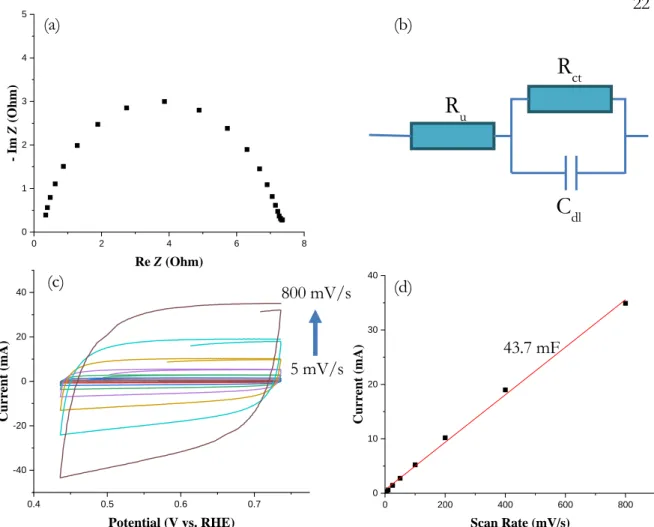
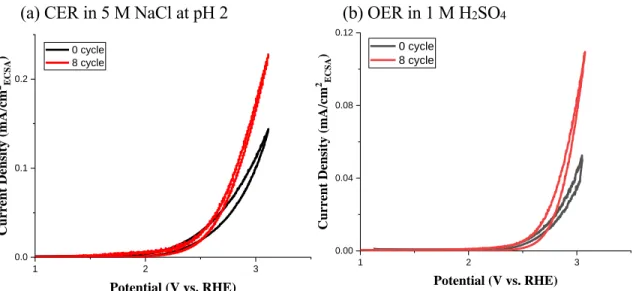
Example Nyquist plot of black TiO2 nanotube arrays with 8 ALD cycles in 5 M NaCl at pH 2. ECSA measurements for the CER and the OER as a function of the number of ALD cycles. In addition to overpotential measurements, electrochemically active surface area (ECSA) was determined for the CER and the OER as a function of the number of Al2O3 ALD cycles on black TiO2 nanotube arrays.
8 cycles of ALD Al2O3 increased ECSA 3-fold for CER and OER compared to bare TiO2 nanotube arrays. In other words, the total number of electrochemical active sites was the highest at 8 ALD cycles, which confirms the lowest CER and OER overvoltages observed in Figure 5. Active site concentrations may not be as high at lower ALD cycles, as it may not be able to produce uniform, conformal Al2O3 overlays on arrays of black TiO2 nanotubes. ECSA measurements for (a) CER and (b) OER as a function of the number of ALD cycles.
The long-term stability of TiO2 black nanotube arrays needs to be verified by Al2O3 ALD, which is one of the important prerequisites for electrocatalysts. Total Nitrogen (TN) and Total Phosphorus (TP): TN and TP of the synthetic greywater were determined colorimetrically using a Hach DR 900 colorimeter (Hach, Loveland, USA) at the beginning and end of treatment. Next, adsorption isotherms and kinetics of organic compounds on AC fibers will be studied using isotherm models such as Langmuir, or pseudo-first-order/pseudo-second-order models, for data analysis. 2 Chemical Characteristics and Interactions Organic compounds with AC fibers will also be studied, to understand their difference.
Ozone is known to have potential deteriorating effects on the chemical and textural characteristics of AC surfaces.3 The optimal ozone dose will be determined to improve not only the mineralization performance but also the AC regeneration efficiency by the E-peroxone process.

Introduction
Problem Statement
There has been a lot of research focused on innovation of wastewater treatment and recycling applications with improved water quality and productivity for non-potable methods. Given the economic and technological limitations present in developing countries, the new wastewater treatment and recycling systems must be accessible for on-site use and practical in terms of energy and material costs.
Atomic Layer Deposition (ALD)
The precursors have high reactivity and thermal stability and produce only methane as a by-product that does not participate in the deposition process. In the next reaction, H2O removes the other two methyl groups from the adsorbed Al-containing species.
Electro-Peroxone (E-peroxone) Process
- Introduction
- Experimental Section
- Results and Discussion
- Conclusion
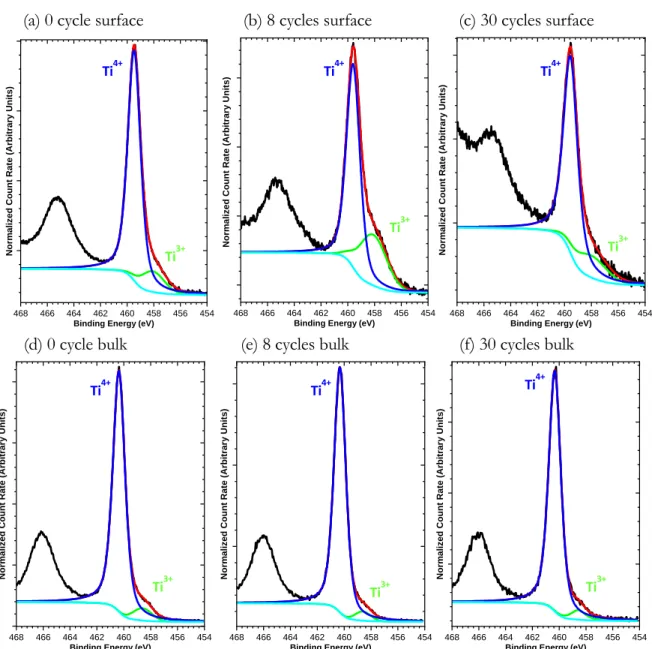
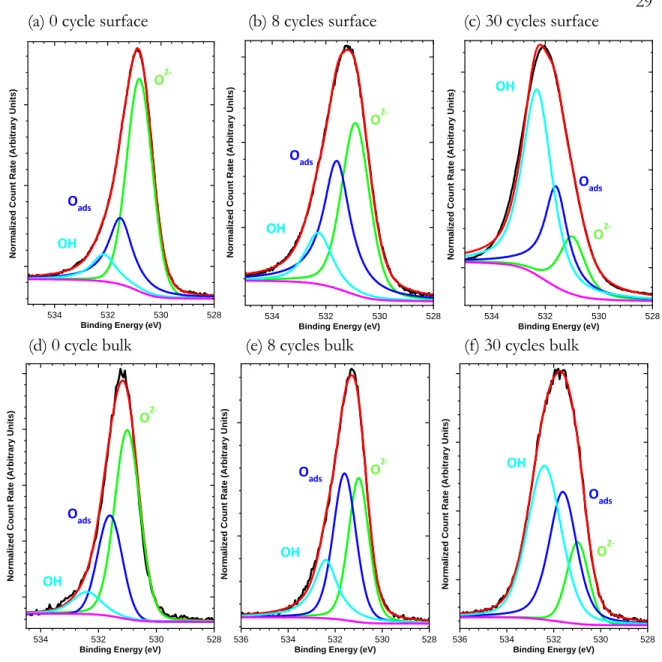
Surface-sensitive and bulk XPS measurements for Ti 2p, O 1s, and Al 2p core levels of 0-cycle, 8-cycle, and 30-cycle black TiO2 nanotube arrays. Comparison of treatment performance between 8-cycle black TiO2 nanotube arrays and IrO2 DSA in terms of BA, NH4+ and COD reduction.
Onsite Graywater Treatment in a Two-Staged Electro-Peroxone Reactor with a
Introduction
Climate change has increased water scarcity in many parts of the world leading to the need to develop new practices for water supply management. 1, 2 In-situ water reuse is one of the main opportunities to increase water supply without impact. harmful to the environment. 3 Important steps in this direction have been taken through the development of sewerless systems with low or near-zero water consumption that compete with large-scale wastewater treatment plants. 4, 5 A complementary approach is treatment and gray water reuse. To achieve a high level of water quality for reuse, as described in the NSF 350 recommended standard, graywater treatment systems often use the same processes used in large-scale wastewater treatment plants. This is especially true for small-scale wastewater treatment in semi-autonomous on-site units, where component replacement must be minimized.13 Compared to the one-step E-peroxone process, H2O2 production is separated from the actual chamber peroxone reaction in order to increase the lifetime of carbon cathodes from attack by ∙OH.
The effluent quality from the two-chamber reaction system is designed to be suitable for either discharge, recycling as toilet flush water, or return to the H2O2 production chamber as source water. The system tested is shown to be suitable for either a single pass treatment sequence or for continuous reuse of the treated greywater as influent for the H2O2 generation step. The goals of the reaction system are to meet the requirements of the standards set forth by NSF 350/350-for effluent quality conditions of COD, TOC, BOD, pH and turbidity or for safe discharge to receiving waters or for reuse for non-applications. of drinking water such as toilet and urine flushing.
System Design
Finally, the treated water is either collected or recycled for use in the subsequent treatment cycle. A titanium O2 diffuser is placed along the centerline and at the bottom of the reactor with a flow rate of 0.8 standard cubic feet per hour (SCFH). The electrode pair is placed above the O2 diffuser in a 3D-printed 110 mm × 70 mm × 105 mm ABS-based housing, which covers the edges of the electrodes to prevent electrical shorting and to increase the mechanical stability of the electrolysis unit (Figure S2, Supplementary Information).
The influent (i.e. synthetic greywater) is added directly from an external waste container, while H2O2 is transferred from the H2O2 generator and introduced to the bottom of the peroxone reactor using a flexible hose. The treated wastewater is pumped from the bottom of the cylinder to an external storage container. The fluid flow in the system is controlled by five identical INTLLAB peristaltic pumps with an inner diameter of 3 mm x 5 mm outer diameter, driven by the 12V DC, 0-30 A power supply.
Methods
A CHI 151 Hg/HgSO4 electrode (CH Instruments, Austin TX, USA) was used as the reference electrode, while the platinum counter electrode and gas outlet occupied the third neck of the flask. 10 mL samples were collected 10 cm from the bottom of the peroxone reactor with a 25 mL pipette and briefly stored at room temperature (21 ± 1 °C) before being analyzed for turbidity, [H2O2], COD, pH, and TOC. The TOC content was obtained indirectly by subtracting the measured TIC content from the measured total carbon (TC) content.
For TP measurement, the Hach 8190 method was used with the Test 'N tube low range total phosphate reagent set. The synthetic greywater used in this study (Table S2, Supplementary Information) was adapted from the NSF standard 350/350-1.17 A 10-L batch of synthetic greywater was prepared in a 30-L container by dissolving the ingredients in tap water. , except deodorant and toothpaste. Finally, the synthetic greywater solution was mixed with a DLH overhead mixer (Velp Scientifica, Usmate, Italy) at 2000 rpm for 20 min and settled for 10 min before use.
Results and Discussion
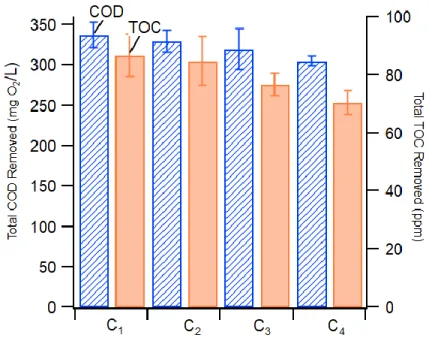
During each run (Figure), a decrease in COD and TOC concentrations in the bulk solution of the peroxone reactor was observed following the treatment sequence described in section 3.3.1. The second factor affecting the decrease in CODrem and TOCrem is due to the lower [H2O2] in the electricity-generated solution injected into the peroxone reactor. The increase in H2O2 generation time over multiple cycles is attributed to the change in the chemical composition of the electrolyte solution (i.e., as treated graywater is recycled).
On the other hand, the loss of H2O2 was negligible in a mixture of treated greywater containing very low levels of oxidizable species after treatment with ∙OH and O3 in the Peroxone chamber. The dose of H2O2 was determined based on the H2O2 depletion rate observed in the peroxone reactor. To maximize the use of H2O2 for the generation of ∙OH, 250 mL of the electrochemically generated H2O2 solution was injected into the peroxone reactor in three time-separated increments during the treatment.
Conclusion
Supplementary Information
This study will work towards characterizing the adsorption behavior of HAAs and THMs on AC fibers; evaluation of the removal and subsequent mineralization of the organic compounds by the E-peroxon process; and assessment of the potential of the E-peroxon process for recycling the regenerated AC fibers. As a next step, this study will evaluate the removal efficiency of HAAs and THMs from AC fibers and the mineralization ability of the compounds and their by-products by the E-peroxone by measuring their concentrations adsorbed on AC and in the bulk via high-performance liq. chromatography. In addition, the mineralization rates of HAAs and THMs by measuring adsorbed and bulk TOC levels will be determined, as well as the efficiency of the E-peroxon process for complete mineralization and the chemical composition of the bulk solution throughout the process.
Finally, the adsorption capacity and the properties of regenerated AC fibers will be analyzed after multiple cycles of adsorption/regeneration to evaluate the viability of the E-peroxone process for reuse of regenerated AC. In Situ XPS Analysis of the Atomic Layer Deposition of Aluminum Oxide on Titanium Dioxide. Future drought in the US Southwest and the hydrology of the early 21st century drought.

Regeneration of Disinfection-Byproduct-Saturated Activated Carbon Fiber by
Proposed Research
Coupling of the E-peroxone process with activated carbon (AC) fibers for mineralization of disinfection by-products and regeneration of AC will be investigated. Therefore, the integration of the E-peroxone process and AC will lead to the degradation of disinfection by-products and further the regeneration of AC since hydroxyl radicals (·OH) readily oxidize the adsorbed concentrated contaminants from AC. The first part of this study will be to investigate the adsorption capacities and kinetics of HAAs and THMs on AC fibers.
The evolution of the regeneration efficiency, which determines how much THM and HAA can be adsorbed on regenerated AC fibers compared to fresh ones, will be tracked after multiple adsorption cycles followed by E-peroxone regeneration. With the help of analytical techniques such as scanning electron spectroscopy and Raman spectroscopy, the morphological structure and chemical composition of the regenerated AC fibers will be inspected for any possible changes after each adsorption/regeneration cycle. The final parts of this study will be to apply this developed technology to a laboratory-scale pilot reactor, where both adsorption and regeneration of E-peroxone can occur sequentially, and to perform an economic evaluation of the technology ( (eg, energy consumption for each pollutant removed).