Ministry of Education and Science of the Republic of Kazakhstan M. Narikbayev KAZGUU University
«Approved for Defense»
Supervisor _________________
___________________
«__» _________ 20__
MASTER’S THESIS
«Influence of socio-psychological climate on employee performance and job satisfaction among men and women at Kazakhstani companies»
program 6М050700 - «Business and management»
Written by A.Akniyet
Supervisor: K.Akizhanov
ii Nur-Sultan, 2022
M. Narikbayev KAZGUU University
INFLUENCE OF SOCIO-PSYCHOLOGICAL CLIMATE ON EMPLOYEE PERFORMANCE AND JOB SATISFACTION AMONG MEN AND WOMEN AT KAZAKHSTANI COMPANIES
Aigerim Akniyet
April 26, 2022
«Approved»
Supervisor’s First and Last Name_________________
Supervisor’s Signature ___________________
«__» _________ 20__
Nur-Sultan, 2022
iii TABLE OF CONTENTS
Abstract ………...……….……….iii
1. Introduction.………...……….…………1
2. Literature review……….3
2.1. Socio-psychological climate…..………..………....3
2.2. Organisational climate………...………...…...6
2.3 The impact of organisational climate on efficiency of a company……….…...…...9
2.4. Factors affecting the formation of the psychological climate in the organisation……….…12
2.4.1. Employment performance in the context of psychological climate………16
2.5. Differences in this scope between men and women……….……….16
2.6. The case of Kazakhstan: Overview of the current situation……….………….19
3. Methodology……….21
4. Results and data analysis……….………..…23
5. Discussion……….31
6. Limitations………33
7. Conclusion……….………34
8. Recommendations……….…35
Bibliography……….………….……37
iv Abstract. The research was conducted to identify the influence of organisational climate on employee commitment and job satisfaction. We discovered that the socio-psychological or organisational climate is a complex of psychological characteristics, reflecting the state of relationships and the degree of satisfaction of employees with various factors of the life of the collective of services and units of law enforcement agencies. According to the research, the formation of a high-quality social environment in the organisation makes it possible to achieve high labour efficiency, by increasing the level of satisfaction with the work of personnel. During the research, the effect of employee performance and job satisfaction among Kazakhstani workers were analysed and the difference of patterns for male and female employers was investigated. Using a quantitative research method, as well as a survey of male and female workers, it was discovered that the socio-psychological climate has a significant impact on workers’ productivity, with some differences between genders. One of the major findings was that a favourable socio-psychological environment, good relationships with colleagues and job flexibility might be more influential for the job satisfaction of female workers than their male counterparts. These findings require additional investigation and implementation of practical solutions in order to improve Kazakhstan's organisational climate.
Key words: organisational climate, socio-psychological climate, job satisfaction, organisational commitment, gender differences
1 1. Introduction
The staff of the organisation is its key resource. This is the basis on which the whole organisation is built. It is from the staff that two key indicators of the organisation's activity depend on to a large extent - its viability and competitiveness. The employees of the company cannot exist separately and are always subjected to interaction with each other. That is why employees’ mental well- being and socio-psychological working environment should be taken into account as a serious determinant of a company’s productivity and workers’ job satisfaction.
Of great importance is the nature of the relationship between employees, the mood that dominates the working group. To denote the psychological state of the group, the term “socio- psychological climate” is used.
When talking about the climate in the organisation, it means the following: a set of socio- psychological characteristics of the group; the prevailing and stable psychological mood of the collective; character of the relationship in the team; an integral characteristic of the state of the collective.
Currently, there is an active restructuring of all spheres of society, the factors influencing the activities of the organisation are changing, globalisation of the world economy is gaining momentum, and the need for creating a favourable social and psychological climate within the organisation is especially acute. If the leaders strive to achieve the organisation's goal, then precisely one of the topical and primary tasks facing the organisation's management is the management of the creation of a favourable social and psychological climate that stimulates the professional development of the individual, the use of its potential to ensure the high efficiency of the collective as a whole. Scientists note that a person when interacting with other people, not only feels differently, but his psychological processes start to develop differently. A number of experiments conducted in the early 20th century (V.
Mede in Germany, F. Allport in the USA, V. Bekhterev in Russia) showed that the presence of other people can both facilitate and significantly hamper the activity and behaviour of the individual.
2 The climate in the team is a significant factor in optimising the professional activities of the group. The dynamics of the socio-psychological processes that make up the climate essentially depends on the conditions under which they take place: in conditions of conflict or cooperation. The instability of the economic state of the organisation, financial difficulties, and so on, do not contribute to maintaining a good socio-psychological climate, since the head has to devote much more time not to human communication and the functions of personnel management, but directly to production, marketing, finance, that is to say other functions.
Based on the contradiction and the problem that appeared, the research subject is the interrelation of interpersonal relations and job satisfaction in a team. However, there have been many research studies on the importance of socio-psychological climate both for company’s performance and individual workers’ achievements at the workplace. To be more specific, we are interested in how this impact varies or does it even differ if we add gender perspective. The aim of the research is to investigate how socio-psychological climate affects employee performance and job satisfaction at Kazakhstani companies and to differentiate whether this effect is identical for male and female employers. We allow the possibility that the socially accepted gender roles can affect men and women’s attitude, motivation, and expectation from work. Thus, job satisfaction and performance at work might be differently influenced by various factors for men and women. We also put forward the assumption that employee commitment and job satisfaction are influenced by various factors, among which the organisational climate of the team and interpersonal relationships are crucial: the better the psychological environment and interpersonal relations, the higher the degree of job satisfaction.
The results of this study will be useful to companies to deepen their understanding of the impact of organisational culture in influencing employee performance and job satisfaction for men and women.
It will also assist management in achieving corporate culture approaches, which will enhance the organisation's economic success.
3 The research questions:
1. How does the socio-psychological climate at work influence employee performance and job satisfaction at Kazakhstani companies?
2. How do the results differ, if any, among male and female workers?
3. How can the socio-psychological and organisational climate be developed to meet the needs of both genders and to maximise the utility of a company?
2. Literature review
2.1. Socio-psychological climate
To analyse the role of the socio-psychological climate in the employees' satisfaction with the work of the organisation's personnel, we will first understand the concepts. There are many definitions of the concept of "socio-psychological climate". In most cases, it is used approximately in the same sense along with such concepts as "moral and psychological climate", "psychological climate",
"emotional climate", etc.
The socio-psychological climate is a complex psychological characteristic, reflecting the state of relationships and the degree of satisfaction of employees with various factors of the life of the collective of services and units of law enforcement agencies. In psychology, similar categories are often used:
"socio-psychological climate," "moral and psychological climate," "psychological climate,"
"psychological atmosphere of the team." The most common term is "socio-psychological climate"
(Schneider, 2014).
Often the essence of the socio-psychological climate is reduced to the following psychological phenomena:
- The state of collective consciousness;
- Reflection of features of interaction of people;
- Emotional and psychological mood of the group;
- Mood of the group and Group state;
4 - Psychological unity of the members of the group;
- Mutual relations in groups and collectives, etc.
It is advisable to note that among the main factors of the socio-psychological climate are people's attitudes and conditions of joint activity. It is also believed that the socio-psychological climate is a system of norms, customs, and values prevailing in this group of people. The climate is expressed by the way the members of the group or the team depend on each other (social ties), as well as the way people depend on shared functions or tasks (communication tasks).
The socio-psychological climate is a complex emotional and psychological state of a professional collective, reflecting the degree of satisfaction of workers with various factors of life activity. The socio-psychological climate expresses the general mood and degree of satisfaction of workers with the organisation of personal labour, relations with other employees and the general level of organisation in the unit or service. This attitude of employees is caused by internal organisational factors, internal factors and relatively neutral with respect to non-systemic influences (contacts with offenders, the population, leisure activities, family and household factors, etc.) (Thayer, 2008).
The personal equivalent of the mood is the satisfaction of the employee with various factors of the vital activity of the professional team. The research reveals the influence of the socio-psychological climate on the effectiveness of official activity, the motivation of work and mental states of law enforcement officers.
It is generally accepted to divide the socio-psychological climate into two categories: favourable and unfavourable. With a favourable socio-psychological climate, the team is dominated by a businesslike, creative mood, a cheerful tone of the relationship between employees. If we are talking about an unfavourable psychological climate, here, on the contrary, one can observe pessimism, irritability, conflictual relations in a group, and the unwillingness of workers to invest in their work. It is not difficult to determine the atmosphere in the work collective. Sometimes one day may be enough to reveal obvious signs of team cohesion, psychological state, and general mood. Why is it so important for the leaders of organisations to maintain a favourable social and psychological climate? First, the
5 organisation still works as a single organism. And all the processes taking place in this "organism" are closely interrelated. And if the organisation has any sore spot, then the overall well-being is on a decline and productivity is falling. Secondly, if a couple of dissatisfied people appear in the team, then the epidemic begins in time. Employees begin to gossip, discuss the corners of the news, every delay in wages and so on. Thirdly, nothing prevents the qualitative performance of the work, such as a constant lack of mood for work and hostility from colleagues. Here the effect of "social inhibition" begins, which manifests itself in the inhibition of human activity in the presence of other people. This hampers the increase in labour indicators much more than even the lack of automation, advanced technology or proper economic conditions. Unfortunately, more often than not, managers of companies think about the need to manage the psychological climate when the situation in the company is so tense that it jeopardises its continued existence (Ariyani, 2014).
American sociologist E. Locke, defining the concept of "satisfaction with work," formulated it this way: "job satisfaction is the result of evaluating one's work, allowing to achieve certain values associated with work, provided that these values make it possible to satisfy the needs of the individual"
(Locke, 1984). The list of factors influencing the satisfaction with work is quite wide. They can be divided into five large groups:
- Pay;
- Career;
- Psychological climate;
- Leadership, and work directly.
To date, psychologists have established a direct link between the state of the socio-psychological climate of the collective and its labour indicators. In their opinion, the more favourable the socio- psychological climate of the work collective, the higher the satisfaction with the labour of its members.
Low satisfaction with work can be considered as one of the reasons for the decline in staff productivity (Anderson, 2001).
6 In numerous definitions and interpretations of the socio-psychological climate proposed, general ideas are traced: everywhere it is said about the interaction of the individual with the organisational environment. Kurt Lewin, one of the founders of the psychological theory of organisation, first used the definition of "social atmosphere." And although Lewin did not give a precise definition of this concept, we can conclude that it meant a set of psychological characteristics of the environment and that it is synonymous with the concepts of "climate environment," "the climate of the organisation" (Lange, 2012).
2.2. Organisational climate
The definitions of the organisational climate proposed in the studies differ only in the different prioritisation and the inclusion of some additional features. Organisational climate is more about personnel' shared, common perceptions of their company's official policies and unofficial leadership behaviours. For example, Litwin and Stringer attach special importance to the degree of structuring, Rodei, Schneider and Barlett - the type of leadership, Gorma and Malloy emphasise the importance of opportunities and conditions for the emergence and application of new ideas and methods, as well as for the intellectual and professional growth and development of members of the organisation (Furnham, 2012). Among the many other factors singled out by various authors as signs and dimensions of the organisation's climate, one can name the degree of bureaucratization of the organisation, the "morale of the group, the value systems or values of the members of the organisation, and so on.
J. Campbell identifies the characteristics of the climate of the organisation, the following four factors:
- the degree of autonomy of actions for an individual;
- the degree of the structural role specification of his position;
- remuneration tactics;
- the level of mutual support, warmth, and attention to relations between members of the organisation [Rogelberg, 2016].
7 The main drawback of these definitions of climate can be called too general nature of the factors that are put forward as the main characteristics of the organisational climate. The general definition of the socio-psychological climate was given by the French psychologist Gadbois: "The climate of the organisation is a global perception by its members of a number of common, relatively stable properties of this organisation and the social impacts that occur within it" (Dunnette, 1994).
Many American psychologists have felt the one-sidedness of the subject-based interpretation of the climate and tried to differentiate between the concepts of the organisational climate and the socio- psychological climate. The climate of the organisation began to be considered in the measurements of its structure and functional characteristics, and the psychological climate as a perception of these properties of the organisation by its members. Thus, the organisational climate is a complex of objective properties of the organisation, and the psychological climate is the result of the perception of these properties by the members of the organisation.
In this work, we present the climate concept of Litwin and Stringer. They identified 3 needs, the most important, in their opinion, for the analysis of the individual's behaviour in the organisation:
the need for success (or "achievement"), expressed in the desire to succeed, to obtain some results of activities that are comparable to certain standards;
the need for power, expressed in the desire to influence the behaviour of other individuals;
the need for affiliation, that is, the desire to have a close, friendly, interpersonal relationship (Litwin, 1968).
Depending on which of these motive needs is most encouraged by the existing conditions in the organisation, its climates differ, which in turn affect the behaviour of the members of the organisation and the results of its activities. Litwin and Stringer singled out 9 criteria-measurements of the organisational climate and tried to analyse their influence on each of the above motives. Among these criteria are:
the structural characteristics of the organisation and the level of restrictions that they impose on the actions of the individual;
8
the degree of responsibility of the individual;
warmth and mutual support in the relations of the members of the organisation;
the system of rewards and punishments;
conflict level, etc (Litwin, 1968).
Since most of the selected criteria could vary depending on the style of leadership adopted by the organisation, they became the main factors determining the climate of Litwin and Stringer.
The desire to find climate assessment criteria outside the scope of individual needs led to what many researchers began to study with the structural and functional characteristics of organisations. As a result, there was confusion, due to which the description of the organisational climate was often replaced by a description of the structure and functional characteristics of the organisation. This confusion was also facilitated by the fact that the same methodological tools were often suitable for studying the structure and climate, especially when it came to subjective methods of evaluation.
In the methodological plan, two approaches to assessing the characteristics of the structure and climate of an organisation can be distinguished. One of them relies on objective criteria, the other on subjective criteria. Recently, there has been a tendency to combine these approaches, and it has been proven that they give unequal or even contradictory results.
American psychologist Payne in his study of the psychological climate noted that the correlation between subjective estimates of the organisation's structural variables and their objective changes was insignificant (Ehrhart, 2013). However, in the study of various organisations, these correlations varied in the most unexpected way. Some objective measurements of the structure of the organisation correlated in a certain way with objective climate measurements, such as the fluidity of the workforce, the number of claims from members of the organisation. From this, we can conclude that there is no need to raise the issue of changing the environment, that is, the real conditions in which employees of a particular organisation interact. We need only find ways to influence the perception of the environment, and this will help solve all the economic and socio-psychological problems of the organisation. This conclusion reveals the danger of a subjective understanding of the problem of the psychological climate
9 since it opens a wide road for a manipulative approach to solving social and psychological problems.
Subjectivist understanding of climate is one of the manifestations of ‘orientation toward the individual’.
2.3. The impact of organisational climate on efficiency of a company
The problem of forming a favourable social and psychological climate in the team is one of the leading places in the organisation's management system, and it is necessary to solve three inextricably related problems:
- Improving the group and organisational climate;
- Necessary changes in leadership and leadership models;
- Study the application of constructivist models of conflict resolution at all levels of the organisation.
The peculiarity of effective organisation management is very often the socio-psychological climate. Such phenomenon as an observance of the socio-psychological climate in recent times is for parents as large companies, for small firms is quite a big problem. Proceeding from this, it is necessary to know and understand what is included in the components of the socially psychological climate. A favourable socio-psychological climate is a long process of systematic work with the staff of the organisation, with managers and psychologists. It is necessary to understand that in the work collective the overall picture of interaction is also personal relations. By the way, the relationship is a system of closely connected communication channels and joint actions of people. Let's pay attention to the fact that interpersonal relationships very often rely on public relations and can be determined by them. For example, as a person behaves within the collective: this aspect may be the result of his work on himself, or the expectation of a certain reaction from other members of the group. Proceeding from this, a system of mutual relations within the work collective can develop. If we pay attention to how difficult it is to build relations in the primary labour collective, we will understand that very often informal or personal authority in this group of people comes to the fore. Therefore, we must understand that the primary labour collective is a rather complex system of relationships that concerns both official positions and the
10 availability of certain authoritative moments. Communication in the work collective is a very voluminous process, which is based on psychological characteristics, on the specifics of establishing contacts, which allow developing special relationships and structuring interactions within the collective (Waldron, 2013). The main function of such relationships is communication channels. Another function of communication is the knowledge of each other's people, as well as the formation and development of interpersonal relationships. The concept of a psychological climate in a team can include a whole structure of interpersonal relationships. They may include such psychological aspects as sympathy or friendship. Such universal principles as imitation, empathy or assistance can also be included.
Sociological research shows that if the success of the activities of the economic manager is 15%
dependent on his professional knowledge, then 85% on the ability to work with people [Dawes, 2016].
Knowing the features and specifics of the behaviour of staff within the team, the leader can fully and fully predict and direct the behaviour of the team in the necessary direction. First of all, it is tied to the aspect that in each group their psychological inclinations are the behavioural climate. Again, an essential condition can be the formation and development of labour collectives, which is based on the observance of principles and specific psychophysical characteristics. Japanese sociologists argue that the mood, the desire to work and the moral and psychological situation in the team may for about 1.5 times increase or several times decrease the productivity of labour. Insufficient attention to social and psychological aspects of management causes unhealthy relationships in the team, which reduces labour productivity. As practice shows, the formation of a healthy moral and psychological climate, the upbringing of a feeling of comradely mutual assistance and collectivism is more active in the collectives of the market type. Sometimes insufficient attention to social aspects of management can be caused by unhealthy relationships within the collective.
Such an aspect can qualitatively reduce labour productivity and create a negative moral and psychological climate. To avoid this, it is necessary to apply special psychological methods that will have a point effect on the personal relationships that arise in the work collectively and also stimulate social processes. They are based on the use of moral incentives to work, affect the personality through
11 psychological techniques in order to turn the administrative task into an informed duty, an internal human need. The main purpose of the application of such methods is first of all the formation in the collective of a qualitative and favourable socio-psychological climate. Such a climate can increase labour productivity and will achieve high organisational and economic objectives (Barbera, 2014).
Therefore, the goals set for the team can be solved and achieved with the help of only one criterion: the human factor and favourable conditions. Ability to take into account this circumstance will allow the head to purposefully influence the collective, create favourable conditions for work and, ultimately, form a collective with common goals and tasks. The main means of influencing the collective is persuasion.
Convincingly, the leader should take into account as much as possible the nature of human behaviour and human relations in the process of the joint activity. But first of all when the leader convinces him entirely and completely of the feature of human behaviour the company. If the leader understands the biological nature and the inner world of the individual, this allows him to activate the collective and achieve the set goals in management. The need to use social and psychological methods of management in the organisation's management practice is obvious since they allow us to take into account the motives of the activity and the needs of employees in a timely manner, see the prospects for changing the concrete situation, and make optimal management decisions. Methods and methods of socio-psychological impact are largely determined by the preparedness of the leader, his competence, organisational skills and knowledge in the field of social psychology. The success of the activity of a leader in this direction depends on how correctly he applies various forms of social and psychological influence, which ultimately will form healthy interpersonal relationships. As the main forms of such impact can be recommended: the planning of social development of labour collectives, persuasion as a method of education and personality formation, economic competition, criticism and self-criticism, constantly operating production meetings that act as a method of management and as a form of workers' participation in management, and rituals.
12 2.4. Factors affecting the formation of the psychological climate in the organisation
There are a number of factors that determine the quality of the socio-psychological climate in the team. They will be listed in the following paragraphs.
Global macro environment: the situation in society, the totality of economic, cultural, political and other conditions. Stability in the economic and political life of society is ensured by the social and psychological well-being of its members and indirectly affects the socio-psychological climate of working groups.
Local macro environment: i.e. an organisation in the structure of which the labour collective is included. The size of the organization, the status-role structure, the lack of functional role contradictions, the degree of centralization of power, the participation of staff in planning, in the allocation of resources, the composition of structural units (sex, age, professional, ethnic), etc.
Physical microclimate, sanitary and hygienic working conditions: heat, stuffiness, poor illumination, constant noise can become a source of increased irritability and indirectly affect the psychological atmosphere in the group. On the contrary, a well-equipped workplace, favourable sanitary and hygienic conditions increase job satisfaction in general, contributing to the formation of a favourable social and psychological climate.
Satisfaction with work: of great importance for the formation of a favourable socio- psychological climate is the extent to which the work is interesting, diverse, creative for a person, whether it corresponds to its professional level, whether it allows to realise creative potential, to grow professionally (Borne, 2008).
The attractiveness of the work increases the satisfaction with working conditions, payment, the system of material and moral stimulation, social security, vacation distribution, work mode, information support, career prospects, the opportunity to increase the level of professionalism, colleagues' competence, etc.
13 The attractiveness of the work depends on how much its conditions correspond to the expectations of the employee and enable him to realise his interests, to satisfy the needs of the individual:
- in good working conditions and decent material rewards;
- in communication and friendly interpersonal relationships;
- achievements, recognition and personal authority, the possession of power and the ability to influence the behaviour of others;
- creative and interesting work, opportunities for professional and personal development, realising their potential (Deshpande, 1997).
Nature of the activity: monotony of activity, its high responsibility, the presence of a risk to the health and life of the employee, a stressful character, emotional saturation, etc. - all these are factors that indirectly can negatively affect the socio-psychological climate in the work collective.
Organisation of joint activities: the formal structure of the group, the way of distribution of powers, the presence of a single goal affects the socio-psychological climate. The interdependence of tasks, the fuzzy distribution of functional duties, the discrepancy of the employee in his professional role, the psychological incompatibility of participants in joint activities increase the tension of the relations in the group and can become a source of conflicts.
Another important factor affecting the socio-psychological climate is psychological compatibility. It means the ability to work together, based on the optimal combination of personal qualities of the participants in the team. Psychological compatibility may be due to the similarity of the characteristics of participants in joint activities. People who are similar to each other are easier to establish interaction with. Similarity contributes to the emergence of a sense of security and self- confidence, which increases self-esteem (Ashkanasay, 2004).
At the heart of psychological compatibility may lie the difference in characteristics on the principle of complementarity. In this case, they say that people approach each other "as the key to the castle." The condition and result of compatibility are interpersonal sympathies, attachment of
14 participants of interaction to each other. Forced communication with an unpleasant subject can become a source of negative emotions. The degree of psychological compatibility of employees is affected by how homogeneous is the composition of the working group for various social and psychological parameters.
There are three levels of compatibility: psychophysiological, psychological and socio- psychological:
- The psychophysiological level of compatibility is based on the optimal combination of the sensory system (vision, hearing, touch, etc.) and temperament properties.
This level of compatibility becomes particularly important when organising joint activities.
Choleric and phlegmatic will perform the task at different rates, which can lead to disruptions in work and tension in the relations between workers.
- The psychological level implies the compatibility of characters, motives, types of behaviour.
- The socio-psychological level of compatibility is based on the coherence of social roles, social attitudes, values, interests. It will be difficult for two entities striving for domination to organise joint activities. Compatibility will facilitate the orientation of one of them to submission. An impetuous and impulsive person is more suitable as a team-mate for a calm and balanced employee. Psychological compatibility is promoted by criticality towards oneself, tolerance and trust towards the partner for interaction (Amann, 2013). Harmony is the result of employee compatibility. It ensures the maximum possible success of joint activities at minimal cost.
The nature of communications in the organisation acts as a factor of the SEC. The lack of complete and accurate information on an important issue for employees creates fertile ground for the emergence and spread of rumours and gossip, weaving intrigues and behind-the-scenes games.
The leader should closely monitor the satisfactory information support of the organisat ion. Low communicative competence of employees also leads to communication barriers, increased tension in
15 interpersonal relationships, misunderstanding, distrust, conflicts. Ability to clearly and accurately state their point of view, mastery of constructive criticism techniques, active listening skills, etc. Create conditions for satisfactory communication in the organisation.
Talking about the styles of leadership, the role of the leader in creating the optimal socio- psychological climate is decisive:
Democratic style develops sociability and trustworthiness of relationships, friendliness. At the same time, there is no sense of imposing decisions from the outside, "from above." Participation of team members in management, inherent in this style of leadership, contributes to the optimization of SEC.
Authoritarian style usually engenders hostility, obedience and fawning, envy and distrust. But if this style leads to success, which justifies its use in the eyes of the group, it promotes a favourable SEC, for example, in sports or in the army.
Admissive style has as a consequence low productivity and quality of work, dissatisfaction with joint activities and leads to the formation of an unfavourable SEC. Opposition style can be acceptable only in some creative groups (Stringer, 2002).
Thus, the formation of a high-quality social environment in the organisation makes it possible to achieve high labour efficiency, by increasing the level of satisfaction with the work of personnel.
Satisfaction with work is an emotionally colored evaluation of the subject of activity about the result of his labour activity, the actual process of work and the external conditions in which it is carried out. The comprehensive study of job satisfaction as an integral scientific and practical category of management focuses on the study of satisfaction with work as a psychological state and as the results of employees' assessment of the factors of the labour situation. The list of factors forming satisfaction with work does not pretend to be complete, indicating the need for a systematic analysis of the factors of influence in two areas: internal factors that determine the identity of the employee and external factors conditioned by the labour situation.
16 2.4.1. Employment performance in the context of psychological climate
Employment performance has always been an important question to study, since employees are the key resource of any organisation, especially taking into consideration changes in the work structure brought by the improvement of technology and globalisation. However, it is hard to evaluate and identify what factors drive high performance, since employers can be influenced from personal factors, factors related to a given company or any other factors at macro level. Having said that, prior research indicates that management support, organisational climate, and job environment are important aspects of employment performance (Diamantidis and Chatzoglou, 2019). Moreover, Brown and Leigh (1996) explain how perceived favourable psychological climates increase job involvement among workers and in turn lead to the increase of effort and finally rise in performance. Most research studies highlight that psychological climate does not directly relate to the employee performance, rather it is mediated with several other factors. For instance, a meta-analysis by Parker et.al (2003) concludes that correlation of psychological climate and employee performance is mediated by work attitude, which can be determined with work satisfaction, job involvement and employee motivation. The fact that it is not possible to identify what factor influenced what category of people to behave a certain way is one of the limitations of the study. However, just like in every sociological study, we rely on tendencies, try to justify them according to the relevant data. In this study, macro level factors will not be considered as the main purpose of this research is to investigate the effect of organisational climate the development of which is in our control.
2.5. Differences in this scope between men and women
In the study of Iyer et al. (2005) in the accounting field, a total of 110 alumni from the offices of the Big 4 firms were polled and various other authors’ findings were summarised and evaluated. The results of the research and summary of various previous works shed the light to the development of our work. The significant points from the Iyer et al. (2005) work will be written above:
17 1. Female professionals faced higher levels of job-related stress and dissatisfaction than male
professionals. Moreover, rather than male workers, stress seems to be a more crucial determinant for female workers' decisions to leave the sphere;
2. Males are judged less severely than females by their accounting managerial staff and male stereotypes seem to be embedded in the mindset of administrative personnel.
Despite the fact that the research by Iyer et al. (2005) is solely concerned with the differences between genders in the accounting field in the USA, it can also be considered as an one example of the general situation happening in the formal working fields. There can be differences in the trend between fields of work and countries, however, the finding can be used for the development of the research further.
The general trend is that female workers in almost all countries earn less than male workers and the amount of this disparity varies dramatically between countries (Ortiz-Ospina, 2018). This disparity between genders has narrowed in recent decades, but it ranges from 33.59% in South Korea to 0.34%
in Colombia (Ortiz-Ospina, 2018). Despite being paid less, and having worse working conditions in terms of hiring, job responsibilities, opportunities for advancement, career development and sexual harassment, female workers are more satisfied with their jobs than their male counterparts (Clark, 1997). There are differences in job satisfaction among men and women and the repeated findings were summed up as the “paradox of contended female workers” where women are more satisfied with their job despite being paid low, receive less benefits (pension, health insurance) and have less opportunities for promotion (Bender et al., 2005).
In order to explain this paradox, we have to understand that the satisfaction is directly related to the expectations, and those who expect less will be satisfied more from the outcome. According to the studies, instead of implying that jobs for female workers are more appealing than for male workers, the greater fulfilment of women should be linked to their lower expectations, which is likely the outcome of women's historically worse standing in the labour market (Clark, 1997). The other explanation of this difference in job satisfaction can be that male and female workers want different things from work.
18 Favourable characteristics of a job can appeal to female workers more than lower income and other job related difficulties. The analysis of the Bender et al. (2005) can explain the difference in more detail:
- Female workers tend to value social interactions, good colleagues and the importance of the task at work more and male workers tend to value the payment and responsibility more;
- The increase in the usual working hours correlates with the dissatisfaction of work among female workers more than their male counterparts;
- Although the system is very complex, job satisfaction for male workers decreases with the high proportion of women in a team and job satisfaction of female workers decreases in the male dominated areas of work;
- Women tend to value the flexibility of work to a greater extent because of the family responsibilities and tend to choose self-employment more for the same reason;
- Women have lower expectations about their labour outcome which serve to increase the satisfaction from the result.
So, the findings suggest that assumed factors such as payment, promotion and bonuses are not attractive enough to be content with their work for female workers. Rather than that, women generally prefer good interpersonal relationships with other workers and employers, work autonomy and flexibility. Having said that, we can admit the possibility of a favourable socio-psychological environment being more influential for job satisfaction of female workers than their male counterparts.
In another study by Redmond and McGuinness (2019), the authors state that female workers value employment security, abilities, job interests, obtaining experience, closeness to house, and balance between work and life more than males. The study determined several key points which can be helpful for the development of our research. More specifically, it claims that income, promotion at work, improvements in the used technology, increasing job autonomy, and, interestingly, having a spouse and children are all factors that enhance job satisfaction. It also claims that unstable work prospects, part-time employment, long working hours, having higher qualifications, mismatching required skills, employment in the private sector, and the irrelevance of skills in the future are all factors
19 that decrease the job. The study by Redmond and McGuinness (2019) reveals that when it comes to picking a job, female workers place a higher value on being engaged and having a healthy work-life balance. These factors are directly linked to higher levels of job satisfaction, and affect it multiple times higher than other factors. As a result, accounting for these two criteria alone, the gender coefficient becomes statistically insignificant and it can explain the gender disparity in job satisfaction (Redmond
& McGuinness, 2019).
Although study results may marginally differ according to the prospect they are looking from, the general tendency in finding is undeniable. There is another example from the study of Miao et al. (2017) which was conducted among medical professionals in rural western China. It implies that:
- With no difference in the educational background, there were significant differences in the distribution of professional positions (male workers were more likely to hold the positions of chiefs and associate chiefs);
- Female doctors reported higher job satisfaction with their income in relation to workload, working environment, use of personal autonomy and promotion. The reason for that can also be explained by the different priorities and lower expectations from work outcome.
2.6. The case of Kazakhstan: Overview of the current situation
First, some general information about Kazakhstan’s labour market will be given as it is the key to understanding the tendencies in the labour market and to have a broader idea of what is happening in the country. Despite the fact that women make up approximately half of Kazakhstan's population, their contribution to indicators of economic well-being and development is far less than the maximum capacity (Alshanskaya, 2020). In the World Economic Forum's gender gap ranking for 2018 year, where gender inequalities in the context of access to resources and opportunities are evaluated, Kazakhstan was ranked 60th out of 149 nations (Alshanskaya, 2020). Moreover, Kazakhstan's labour market is highly stratified. According to the Bureau Of National Statistics of Kazakhstan (2020), the female population makes up 42.4% of the agriculture sector, 28.6% of the industrial and construction sector,
20 55.2% of the services sector and 64.4% of leaders in the education sector in the Republic of Kazakhstan. The higher and lower representation of women in different sectors should also be taken into account when constructing favourable working conditions by the administration sector of companies. The researcher Alshanskaya (2020) suggests that this uneven distribution can be resonated with the preference of women to choose more flexible and balanced working conditions in favour of family and other duties. It can also be resonated with the fact that a considerably low percentage of women have technical qualifications and female workers continue to be refused entry to 191 types of work (main reason is unfavourable work settings). Noteworthy, considering the fact that women make up a substantial portion of the workforce, their salaries were only 65.8% of male's in 2018 (Alshanskaya, 2020). For Kazakhstan, developing working conditions and increasing the presence of female workers is crucial for sustainable economic growth. These differences and external factors should also be considered when building a favourable socio-psychological climate at work.
According to the study of Frolova (2014), where 154 Kazakhstani bachelor students were surveyed, "career advancement chances", "career development opportunities", “meaningfulness of the profession” are the most essential factors for employment satisfaction regardless of gender or major.
Moreover, when choosing the job, the additional factors which were important for the majority of female students were feeling safe, job security, payment and opportunities, good communication between employees and management, flexibility in terms of work-life balance (Frolova, 2014). The least important factors when choosing the profession were “autonomy and independence” and “overall corporate culture” (Frolova, 2014).
Even though there has been plenty of research on socio-psychological climate, it lacks the Kazakhstani case. There is also not enough work on the difference of the effect of the working environment for different genders in Kazakhstan. In this regard, research will firstly contribute to existing literature by providing holistic analysis of Kazakhstani cases. Moreover, it would be carried out in a post pandemic period, which greatly affected companies and the work environment. The tasks of our research are: analysis of the problem of the social and psychological climate in the work collective,
21 by studying the literature, determining the degree of satisfaction with work in the team, studying the peculiarities of the psychological climate in the work collective, studying the nature of the relationship between interpersonal relations and job satisfaction. Methods of research: analysis of the literature on the problem, a generalisation of the material, comparison and modelling, surveying workers in order to get first-hand data.
3. Methodology
This research aims to analyse the impact of socio-psychological climate on employment performance and job satisfaction among men and women at Kazakhstani companies. Based on a quantitative approach, data will be collected via survey. Stratified sampling method will be used to select samples for this research study. If applicable, some annual reports, data and statistics from the company will also be used for the analysis. Under the positivist paradigm, a deductive approach will be used for the research. Proposed hypotheses are as follows:
Hypothesis 1a: Perceived favourable socio-psychological climate increases employment performance for women.
Hypothesis 1b: Perceived favourable socio-psychological climate does not increase employment performance for men to the same extent as for women.
Hypothesis 2a: Perceived favourable socio-psychological climate increases job satisfaction for women.
Hypothesis 2b: Perceived favourable socio-psychological climate increases job satisfaction for men
Socio-psychological climate will be evaluated based on the perception of employers, considering additional aspects such as: employee-employer relationship, interpersonal relationship among workers, sense of belonging to the collective, attitude of employers toward their work, presence of supportive, friendly atmosphere etc. Since perception of socio-psychological climate might differ from person to person, questionnaires will include direct questions if the employer's working environment regards his/her job as favourable, but also will touch on the above mentioned aspects to evaluate the answers. In
22 addition to the perception of employers, presence of open space areas, organisation of shared activities, traditions in the company will also be incorporated.
Job satisfaction will also be analysed whether people are happy to stay at the companies, if they recommend others to work in this company and other features which might reflect employers’ content with their jobs. Employee performance was mainly evaluated from the data available about Kazakhstani companies in the open sources. In our study, we will look at the effect of promotion, gratitude letters for active involvement or additional benefits from the company based on the performance of the employee.
There are different ways of evaluating employment performance in different companies due to their sector peculiarities. That is why various approaches will be used.
It is critical that the sample includes individuals of all ages, genders, professional
backgrounds, and job experience in order for the study to yield results that are reliable. We gathered the responses from 82 completed surveys. The questionnaire consisted of 3 main parts:
- The first part consisted of only one question, consent form that the participant is over 18 years old, has read and understood the consent form and agrees to participate in this study. Only after completing the first part and agreeing to participate, it is possible to open the second part and start the survey.
- The second part consisted of standard questions in order to get the information of respondents general background such as age, gender, academic background, work experience, specialisation, living area and marital status. The types of questions used were dropdown questions about age, demographic questions,
- The third part consisted of information about the effect of socio-psychological climate on work abilities and productivity. In order to access the topic from different perspectives, the
combination of questions were used such as multiple choice questions, likert scales, matrix questions and ranking questions.
23 4. Results and Data analysis
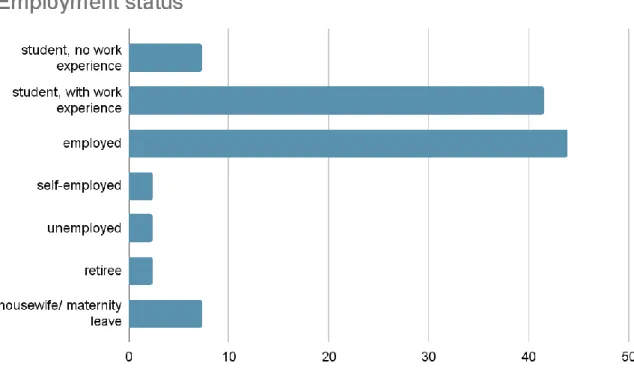
This section summarises the key features of the 82 Kazakhstani public officials who took part in the study. Before providing an overview of all respondent characteristics, let us first visualise their demographics. The majority of the respondents are young adults 51.2% of which being between 18-25 , 41.5% being between 26-35, 2.4 % being between 36-49 and 4.9% being older than 49 years old. The majority of the respondents are females (68.3%), and almost all respondents have higher education or equivalent (68.3% have or completed a Bachelor’s degree or equivalent college degree, 29.3% of respondents have Master’s degree or higher). The work status of the respondents is evenly distributed as shown in Figure 1 with 41.46% being students with work experience and 43.9% being employed, 7.3 % being students with no work experience and the same percentage being housewives or women on maternity leave.
Figure 1. Employment status of respondents ( %)
The working spheres are also evenly distributed as there is no general tendency. The biggest
percentages of respondents work in the education sector (34.1%) which is then followed by services sector (29.3%), sales (17.1%), industrial branch (9.8%), 4.9% in medicine and the same percentage being in the IT sphere. The geographical distribution is also considerably even as respondents have
24 priorly worked in various different parts of the country (48.8% from Nur-Sultan, 24.4% from
Shymkent, 12.2% from Almaty, 4.9% from Aktobe, 2.4% from Kostanay Region, 2.4% from
Petropavlovsk etc.). The majority of respondents have never been married (70.7%) and the rest (29.3%) are married.
Next, after collecting the general information about respondents, we start to review the results from the third part of the survey: various types of questions connected to the socio-psychological climate.
1. How important is the social and psychological climate of the team at work?
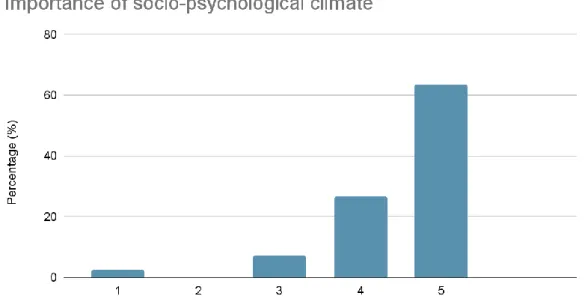
Figure 2 represents the results to the question: “How important is the social and psychological climate of the team at work?” (on the scale of 1 to five, 1-not important, 5-very important). The terms which can be unclear were explained in advance.
Figure 2. Visual representation of the answers on the importance of socio-psychological climate
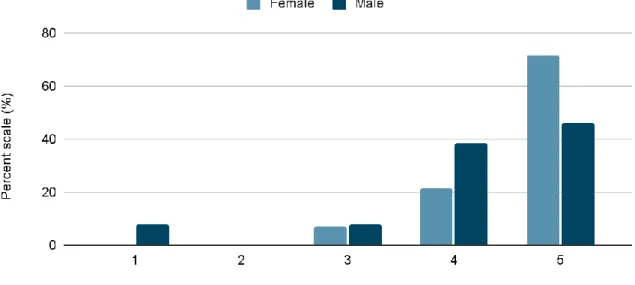
If we differentiate these results in accordance with the gender factor, the difference becomes very distinct. Out of female respondents, no one answered 1 and 2, only 7.14% answered 3, 21.43%
answered 4 and 71.43% answered 5 (Figure 3). It turns out that the working climate is very important for the majority of women. However, the situation is drastically different for male workers. 7.69% of
25 male respondents put 1, no one put 2, 7.69% answered 3, 38.46% put 4 and the rest (46.15%) answered 5. The difference is also clear from Figure 3. While 71.43% of female respondents chose the option “5”
by identifying that socio-psychological climate is very important at work, only 46.15% of male respondents chose the option “5”. To sum up, it can be concluded from this question that a favourable socio-psychological climate of the team is more important for female workers than for male
counterparts.
Figure 3. The representation for female and male worker workers, separately.
2. How often during a typical week do you feel overwhelmed or stressed?
The next question was “How often during a typical week do you feel overwhelmed or stressed?”. 4.9%
responded “very often”, 68.3% responded “from time to time”, 22 % - “not often” and 4.9% - “do not feel stressed”. The distribution for different sexes is given in Figure 4. As it can be seen from the chart, 79.31% of male respondents feel stressed/overwhelmed during a typical week which is a lot higher than the 46.15% for female respondents. However, from other choices, female responses are slightly higher in the percentage.
26 Figure 4. Feeling stressed, difference between male and female
3. Are you getting an adequate salary for your work?
Absolutely yes 7.7%
Yes 15.4%
Probably yes 46.2%
Probably no 15.4%
No 12.8%
Absolutely no 2.6%
There are not big differences between the responses of men and women. Generally, it can be concluded that 69.3% of respondents are on a “yes” side (“absolutely yes”, “yes”, “probably yes”) and to a certain extent are satisfied with their salary whereas the rest 30.7% is on another side of the spectrum
(“absolutely yes”, “yes”, “probably yes”).
4. To what extent do your colleagues value your opinion at work?
Very much appreciated 17.9%
More than the opinions of others employees
17.9%
Pretty much the same as other people's opinions employees
64.1%
Less than the opinions of others employees
0%
27
Not appreciated at all 0%
There are not big differences between the responses of men and women. The tendency remains the same and the majority of both sexes’ opinion at work is valued to the same extent as their colleagues.
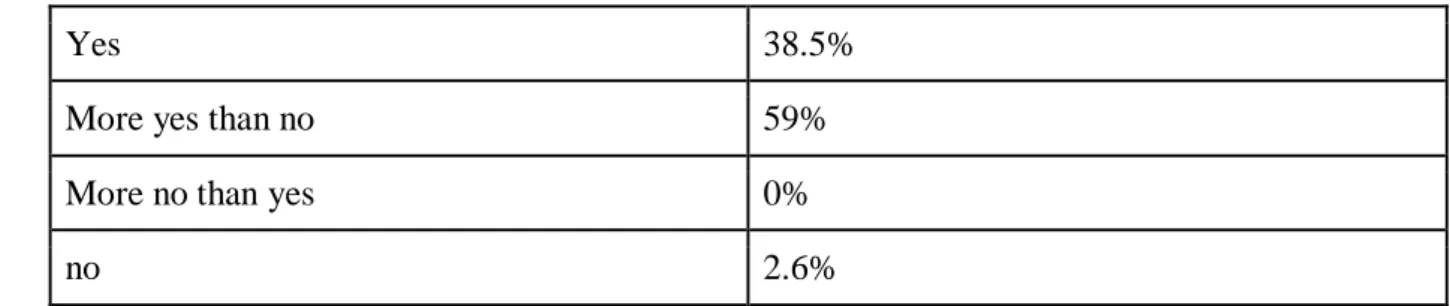
5. Does your employer's management style influence your work results?
Yes 38.5%
More yes than no 59%
More no than yes 0%
no 2.6%
There are not big differences between the responses of men and women. The tendency remains the same. For almost all people (97.5%), the employer's management style affects the work results.
6. What would be the most important reason for leaving a job?
The Figure 5 represents the results of this question for both genders. Let us first explain what is meant by each criteria:
1. Global macro environment: the situation in society, the totality of economic and political conditions.
2. Local macro environment: organisation size, status-role structure, personnel participation in planning
3. Physical microclimate: sanitary and hygienic working conditions, heat, stuffiness, poor lighting, constant noise.
4. Dissatisfaction with work: not interesting, does not allow to realise creative potential 5. Dissatisfaction with working conditions: payment, social security, vacation distribution 6. Nature of activity: monotony of activity, high responsibility, risk to health
7. Working atmosphere: psychological incompatibility with colleagues, working environment etc.
8. Personal circumstances: maternal leave, family issues, health problems, etc.
Figure 5. Results of question 6 for both genders
28 As it can be seen from the chart, the most important reason for male workers to quit the job is
dissatisfaction with work (not interesting, does not allow to realise creative potential
local macro environment), whereas for female workers it is dissatisfaction with working conditions in terms of payment, social security, vacation distribution etc. Another difference is that the local macro environment (organisation size, status-role structure, personnel participation in planning) is much more important for men, whereas personal circumstances and dissatisfaction with working conditions is much more important for female workers. The global macro environment, physical microclimate and working atmosphere affect both sexes to the approximately same extent.
7. What is the most important thing when choosing a job?
The results are given in percentage measure in Figure 6. The last factor social package means paid annual leave, pension contributions, benefits etc. There are no great differences between genders. Some minor things to mention would be that the social package of the job, its balance between work life and personal life, caring for society and the environment are more important factors for female workers, whereas good reputation, high salary, and interest in the job are more important factors for male
workers. While choosing the job, both sexes tend to pay approximately the same amount of attention to the career growth and prospects, pleasant working atmosphere and company’s financial stability.
29 Figure 6. Results of question 7 for both genders
8. To what extent do you agree with the following statements about your workplace?
The answer options included:
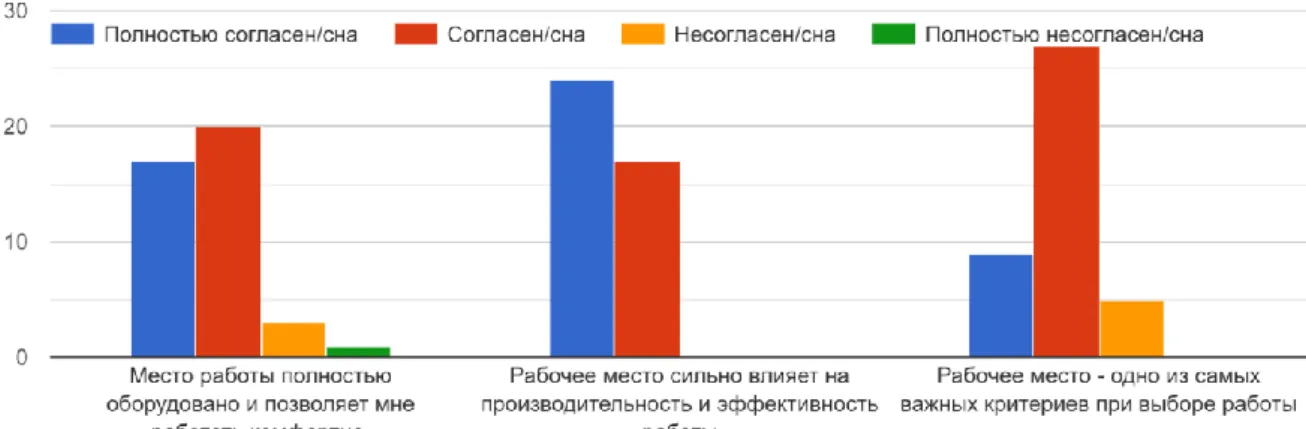
1. The place of work is fully equipped and allows me to work comfortably.
2. The workplace has a strong impact on productivity and work efficiency 3. The workplace is one of the most important criteria when choosing a job.
There were no major differences between answers of men and women. Some minor trends can be that the working place is a little more important for females than males and more percentage of female workers have fully equipped working areas. The answers for both genders can be seen in the Russian language in Figure 7.
Blue chart: Fully agree Red chart: Agree
Yellow chart: Do not agree Green chart: Fully disagree
30 For some questions, respondents freely chose to answer, or not to answer the questions. The vertical row represents the number of people who answered this question. As it can be seen, more than half of the respondents skipped the questions. The reason for that is unknown.
Figure 7. The importance of workplace for both genders
9. To what extent do you agree with the following statements about colleagues?
The questions within the topic were:
1. We are one working group. I can rely on my colleagues.
2. We respect each other with our superiors. This is a priority for me.
3. Working atmosphere - greatly affects productivity and work efficiency
4. The support of colleagues and mutual understanding at work is very important to me.
5. My personal problems greatly affect my productivity at work.
6. Global problems and incidents greatly affect the change of profession and work productivity.
The answer choices were: completely agree, agree, do not agree, completely disagree.
According to the results, the majority of people do agree with each statement. No big differences between genders was found except the fact that only 21% of male respondents chose
“disagree and 10.5% of male respondents chose” “fully disagree” for the first statement concerning good relationships with colleagues. Also only male respondents (6.67%) disagreed with the statement that the working atmosphere greatly affects productivity and work efficiency.
31 10. How important are these criteria to you in your work (1-no value, 5-very valuable)
The criterias were:
1. Free work schedule
2. Opportunity for career growth 3. Friendly atmosphere
4. Benefits for employees (food stamps, sports sections)
It turns out that opportunity for career growth and friendly atmosphere at work are the most important factors at work. There were no great differences among men and women, however, it turns out that benefits for employees (food stamps, sports sections) and flexible work schedules are less important factors for male workers than for female counterparts.
5. Discussion
The socio-psychological or organisational climate is a complex psychological characteristic, reflecting the state of relationships and the degree of satisfaction of employees with various factors of the life of the collective of services and units of law enforcement agencies. In psychology, similar categories are often used: "socio-psychological climate," "moral and psychological climate,"
"psychological climate," "psychological atmosphere of the team." The most common term is "socio- psychological climate".
In this work, we present the climate concept of Litwin and Stringer. They identified 3 needs, the most important, in their opinion, for the analysis of the individual's behaviour in the organisation: the need for success (or "achievement"), the need for power and the need for affiliation, that is, the desire to have a close, friendly, interpersonal relationship.
Apart from that, we studied the factors that affect the formation of the psychological climate in the organisation. The organisation forms its social environment, which includes elements, among which the socio-psychological climate, which is formed from people's relationship to work and relationship to each other. We found that management style also impacts on the organisational climate and, as a result, on the employee commitment and job satisfaction. Socio-psychological methods of leadership require
32 that at the head of the team there are people who are flexible enough to use various aspects of management. The success of the activity of a leader in this direction depends on how correctly he applies various forms of social and psychological influence, which ultimately will form healthy interpersonal relationships. As the main forms of such impact can be recommended: the planning of social development of labour collectives, persuasion as a method of education and personality formation, economic competition, criticism and self-criticism, constantly operating production meetings that act as a method of management and as a form of workers' participation in management, and rituals.
Thus, the formation of a high-quality social environment in the organisation makes it possible to achieve high labour efficiency, by increasing the level of satisfaction with the work of personnel.
Satisfaction with work is an emotionally colored evaluation of the subject of activity about the result of his labour activity, the actual process of work and the external conditions in which it is carried out. The comprehensive study of job satisfaction as an integral scientific and practical category of management focuses on the study of satisfaction with work as a psychological state and as the results of employees' assessment of the factors of the labour situation.
According to the results of the conducted survey, let us present the main highlights of the survey and summarise the general findings:
1. Favourable socio-psychological climate of the team is more important for female workers than for male counterparts (from Question 1).
2. For almost all people (97.5%) regardless of their gender, the employer's management style affects the work results (from Question 5).
3. The most important reason for male workers to quit the job is dissatisfaction with work (not interesting, does not allow them to realise creative potential), whereas for female workers it is dissatisfaction with working conditions in terms of payment, social security, vacation
distribution etc. Moreover, the local macro environment (organisation size, status-role structure, personnel participation in planning) is much more important for men, whereas personal