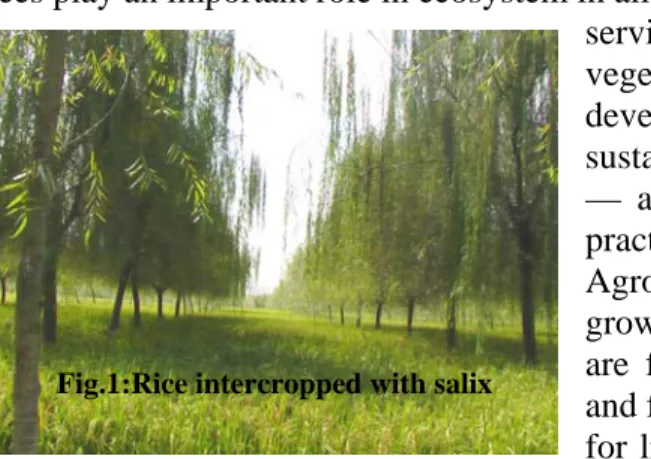
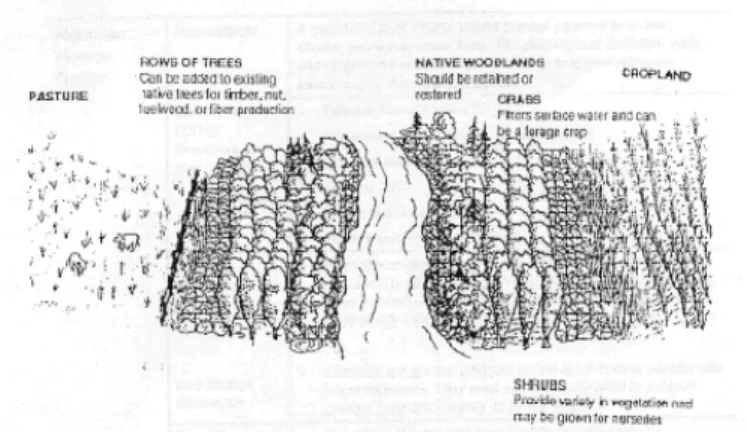
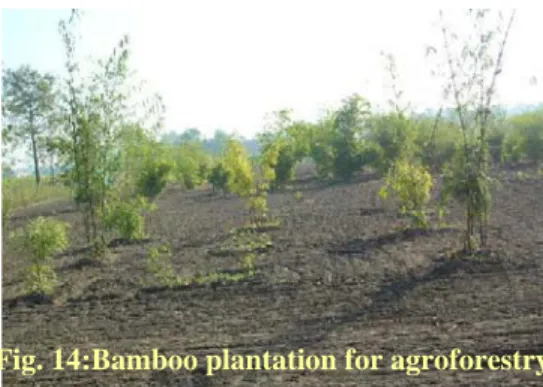
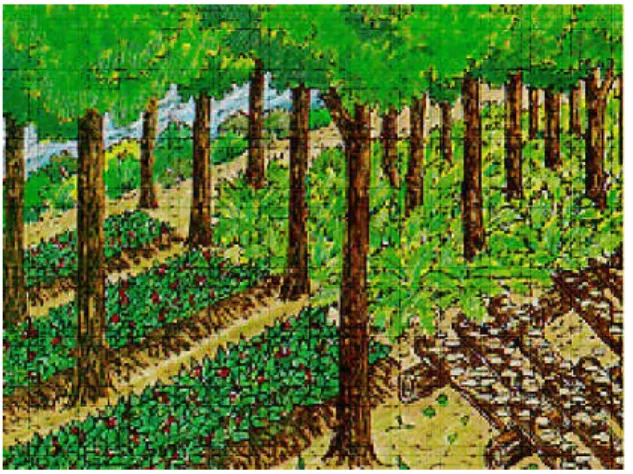
34; Agroforestry is a form of multiple cultivation that fulfills three basic conditions (i) there are at least two biologically interacting plant species, (ii) at least one of the plant species is a woody perennial, and (iii) at least one of the plant species is managed for fodder, annual or perennial crop production." There is great variation in the intensity of trees, species and crops based on the size of the farm, the needs of the people who inhabit the lands, and the microclimate. Thus, the multitude of plant species on the lands of the household helps meet the basic needs of the farmer such as food, fuel, fodder, timber and money.
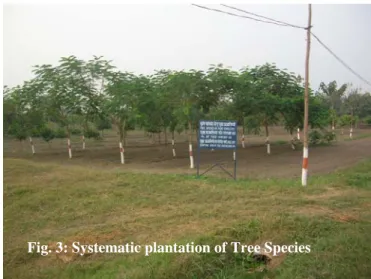
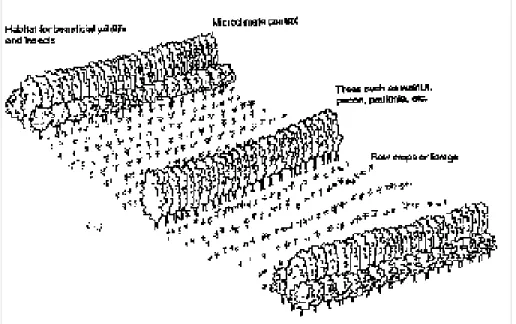
Some plantation crops such as coconut and palm were cultivated very early, but their economic returns remained low. Many border plantings also help as buffer strips and windbreaks, especially in fruit orchards. Agroforestry practices are deliberate systematic combinations of trees with crops and/or livestock that involve intensive management of the interactions between the components as an integrated agricultural ecosystem.
Recycling of some leached or desiccated nutrients by deep tree roots;. The possibility of combining the interests of the farmer (for the inheritance of wood) and the farm (for access to arable land). Improved biomass growth of widely spaced trees (+80% over 6 years in most trial plantations).
A large reduction in the maintenance costs of the plantation, thanks to the presence of catch crops.
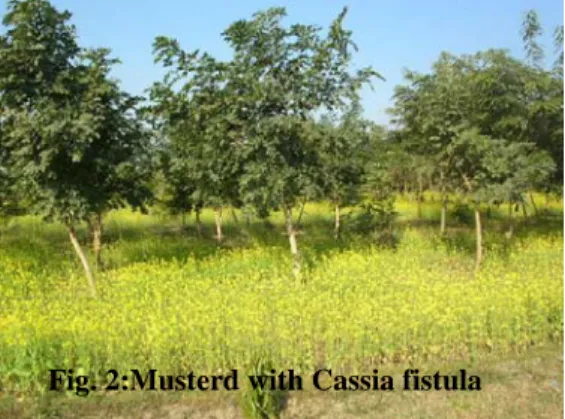
Structura
Social benefits: In addition to economic benefits, social benefits occur from increased yields and higher (ii) food and health due to increased food quality and diversity (iii) and improved mountain communities through the elimination of the need Classification of Agroforestry System. General ecological benefits include:. i) Reduction of pressure on forces (ii) More efficient recycling of nutrients. iii) Better protection of ecological systems. iv) Reduction of surface runoff, nutrients. the effect of tree roots and stems of these processes. Improving the microclimate, such as reducing soil moisture evaporation through a combination of mulching and shading. vii) Improvement of soil structure through continuous addition of decomposed organic waste. benefits for the farmer, community, region or nation. i) Increasing the maintenance of food production, firewood, fodder, wood fertilization; monocultural system; and Increase farm levels i. yields of tree products and sustainability of these products. i) improvement of rural living standards from sustainable employment and income;
Ecological basis: Takes into account the environmental conditions, assuming that certain types of systems may be more suitable for certain ecological conditions.
Classification of Agroforestry System on Structural Basis: The structural of a sys
Silvopastoral System (trees + pasture and/or animals)
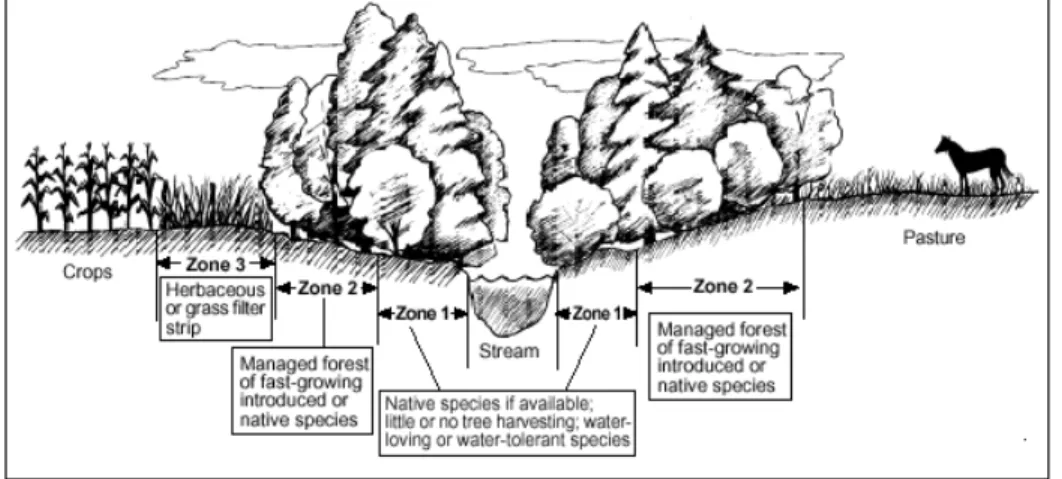
Silvopastoral ears and livestock production. systems of pine and coastal Bermuda grass have determined their potential to be a better economic investment of land use than producing exclusively timber or. The trees and shrubs can mainly be used to produce fodder for livestock or they can become. i) Protect a time of agroforestry, various multi-purpose trees. rotein-rich trees) are planted on or around agricultural land and pasture for cut-and-carry feed systems is characterized by trees with f. Traditionally, silvopastoral systems involved grazing livestock in wooded pastures and incorporating trees into pastures for shade and timber. Most rangeland grazing in hills usually consists of grazing natural herbaceous and shrubby vegetation for under trees like pine, bhimal, oak etc. which graze cattle in open pasture.
In addition, if the removal of pine straw from the system is included, there can be economic benefits. surpasses even that made of wood. For the most part, studies of forest-pasture systems have shown that tree growth is not adversely affected when seeded with forage grasses, although there have been some observations that uncontrolled or excessive grazing can reduce tree survival and growth of all agroforestry practices encouraged , systems perhaps the most promising in terms of adoption and potential economic benefits. In arid areas, a forest pastoral system is needed, especially to help meet wood and fodder needs throughout the year.
This system is again classified into three categories: ii) Live fencing of fodder tree. (iii) Trees and Shrubs. In this silvopastoral system (p. production to meet the feed needs of livestock during the period of feed shortage in winter. For humid and sub-humid areas: Artocarpus spp., Anogelssus lattifolia, Bombax malabaricum, Cordiadichtotoma, Dalbergia jambolana, Samanea spp., Zizyphus etc.
For dry areas: Acacia nilotica, Ailanthus excelsa, Opuntia ficus, Prosopis spp., Rhus etc. ii) Live. In this system, various fodder trees and hedges are planted as hedges to protect the property from stray animals or other biotic influences. In this system, different tree and shrub species are scattered irregularly or arranged according to some sy.
Agrosilvopastoral system, (trees + crops + pasture/animals) (in) Huisduinen: this is one of the oldest agroforestry practices.
For dry regions: Acacia nilotica, Ailanthus excelsa, Opuntia ficus, Prosopis spp., Rhus, etc. ii) Live fence of fodder trees and hedges: In this system various fodder trees and hedges are planted as live fences to protect the property from stray animals. or other biotic influence.
Other Systems T
In this system, special location-specific MPTS are mixed or planted separately for various purposes such as timber, fodder, soil protection, soil reclamation arrangement of components: The arrangement of components gives first priority to the plants even in AF systems involving animals.
Functional Classification of Agroforestry Systems: Two fundamental attributes of s
Agroforestry systems: Based on socio-economic criteria such as the scale of production and the level of technological input and management, agroforestry.
Ecological Grouping of Agroforestry Systems: Based on the major agroecological zones,
Socioeconomic Classification of c
Due to differences in growth patterns and resource requirements for the components of the agroforestry situation, interactive relationships are obvious, which can be of different kinds. The success of an agroforestry system largely depends on the utilization of the component interactions. Component interaction refers to the influence of one component of a system on the performance of the other components as well as the system as a whole.
For example, once it is easy to adopt some or all of the following strategies: i) Choose leguminous trees that have small or light crowns so that sufficient sunlight reaches the food production for photosynthesis; ii) Choose tree species that have deep roots in order to absorb moisture and nutrients from the surface layer of the soil; and. iii) Space trees further apart to reduce their competitive effects on food crops. To understand how extension can better accommodate natural resource management through the successful introduction of agroforestry and tree planting, extension agents, both public and private, must strive to understand the socio-economics of agroforestry and the communities within it. in which they work ("On the farm..."). More emphasis on participatory program development, more efficient targeting and an intensified focus on traditional communication channels will increase the adaptability of agroforestry in dryland communities.
The scientific benefits of agroforestry as mentioned above are well documented within the humid and semi-humid agricultural regions, and the challenge for extension agents is to successfully spread these benefits in arid areas where farmers have traditionally been marginalized due to resource constraints (such as soil fertility and water availability). For training and education to be localized, extension agents need to understand the important role of socio-economic factors as well as the technical aspects of agroforestry, and therefore they need to start focusing more on the social and communication constraints of the specific villages and communities in which they work. Indeed, the basis of success is "the participation of the people for whom the forestry program is intended".
In this way, participants are much more responsive to the education and training provided by extension agents. Villagers and communities, depending on a number of variables, are constantly gathering knowledge from different sources, and extension agents should do less to emphasize the strict dichotomy of global science and indigenous knowledge as it may be detrimental to adoption rates. tree management and agroforestry. . By allowing participants to innovate beyond their previous knowledge capacity, extension agents are facilitating local ownership of knowledge, which increases program success and promotes long-term farmer and community commitment.
When extension agents invest time in learning how villages and farmers communicate, they also see that participatory programs and targeted initiatives are critical in creating successful agroforestry farms; “The decision to adopt agroforestry was found to be determined by farmers' attitudes towards agroforestry, which in turn was shaped by information obtained through farmer-to-farmer and farmer-to-extension contact. It is therefore equally important that extension agents take on the role of facilitators when they first enter communities; they can create or enhance pre-existing village meetings and farmer-to-farmer contact. Extension agents can take advantage of local social structures to increase the "suitability" of agroforestry.
In addition, for small landowners, face-to-face communication with neighbors and extension workers are the two forms of communication and knowledge sharing most strongly associated with potential adoption and tree planting. Extension agents in India have laid the scientific foundation and technical background to support the adoption of agroforestry; however, they have yet to master the socio-economic tools to analyze communities and strengthen local social structures that enable agroforestry adoption and facilitate knowledge sharing and generation, crucial components of successful agroecosystems. If extension workers can use socio-economic analysis to better understand the local conditions in which they operate, so will the adoption rate of agroforestry.
Further examination of nutrient management in Indian dryland agriculture is needed to understand the future of agricultural productivity and the overwhelming importance of agroforestry in degraded landscapes.
What is the appropriate time and procedure of bamboo planting?
Which type of trees should be selected for agroforestry?
What are high yielding poplar clones and which is the early variety?
The soil of my field is clay? Is it fit for poplar and eucalyptus plantation?
What crops should be grown with poplar and eucalyptus?
How should pruning be done in poplar?
The leaves of upper part of the shisham have dried. After 3-4 days whole tree becomes died
How much time taken by teak for growing. Give the details of its varieties and fertilizer uses etc?
What are the uses of Salix? What is the time of nursery planting?
The hyprid eucalyptus trees transplanted in the field and its leaves in upper part have become white due to a white veb. What is the remedy?