Through chapters 1, 2 and 3, I tried to draw attention to the important role of convex sets and their related convex functions in mathematical analysis. A fundamental idea to understand is that convex functions on Rn can be identified by certain convex subsets of Rn+1 (their epigraphs), while convex sets in Rn can be identified by certain convex functions on Rn (their indicators). The fact that a convex function can have at most one minimum and no maximum is an important piece of information that turns out to be very useful.
We relate convex functions to an elegant characterization of gamma functions by Bohr Mollerup's theorem. We start by taking the convexity of the epigraph to be the definition of a convex function, and allow convex functions to be extended -real values.
To begin with
Geometric Functional Analysis is the branch in which people study the extent to which the properties of finite-dimensional spaces generalize to infinite-dimensional spaces. On the other hand, in an infinite dimensional space there is more than one topology that respects the linear structures of the space; the topological dual (i.e. the set of all continuous linear functionals) depends on the topology assigned to this space. In infinite dimensional space, the convex functionals which are not necessarily continuous, the convex hull of a compact set not necessarily compact and disjoint closed convex sets generally cannot be separated by hyperplanes.
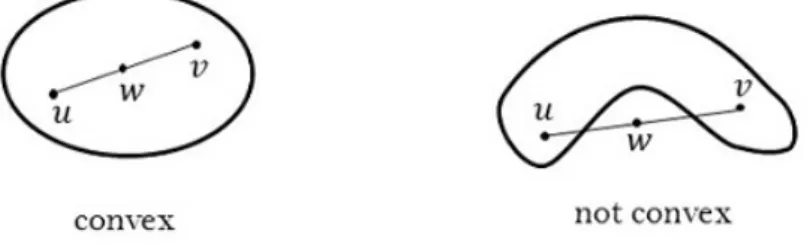
However, with the right topology and perhaps some additional assumptions, each of these results has a corresponding infinite dimensional version. We first extract some geometrical properties of convex sets in linear space, and then turn our attention to convex functions.
A few necessary ingredients
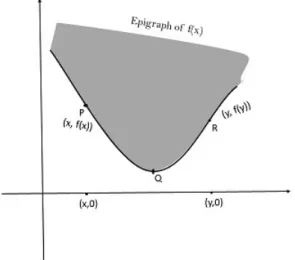
Our goal in this project is to relate the analytic structure of convex functions to the structure of the underlying space using the geometry of the space. It is also known as the supergraph of a function f. ii) Strict epigraph is the epigraph with the graph of the function removed from the supergraph. Before proceeding to the proof of the above result, there are a few facts - separation of convex sets that are summarized in the following well-known theorem.
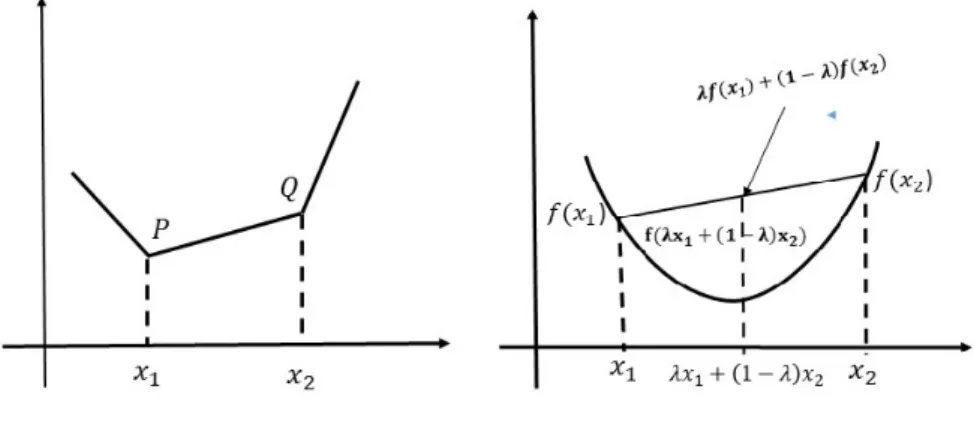
Thus, the geometric meaning of the definition is that the line segment joining (x, f(x)) and (y, f(y)) is never below the graph of the function. ii) If P,Q and R are three points on the graph of f with Q between P and R, then Q is on or below chord PR. The first two cases are again trivial, and the third is precisely the hypothesis of the theorem. The mean value theorem of differentiation, contained with the two statements in the previous theorem, shows that a real differentiable function f is convex on (a, b).
Going back from this to (2.16), it should become clear why the left and right sides of the inequality.
A few basic results of Convex function on R n
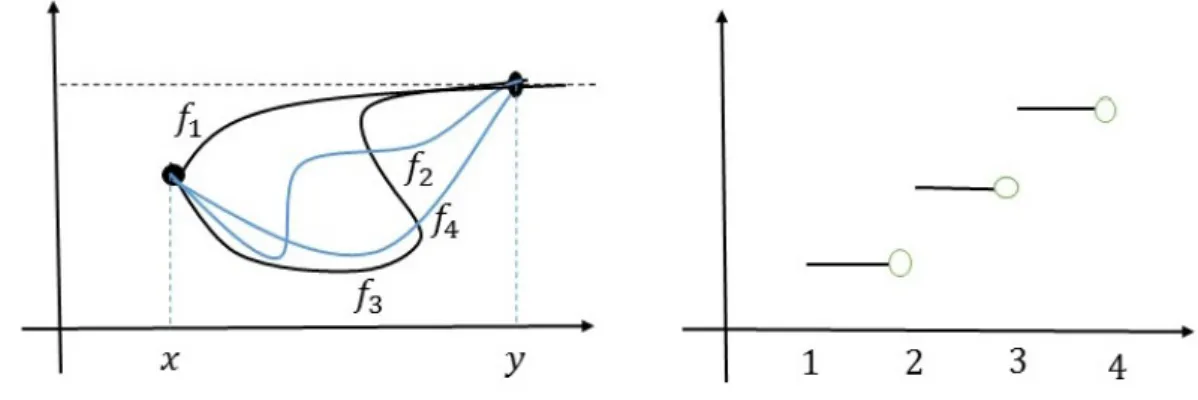
A Characterization of the Gamma Function by means of convexity
29 Chapter 2 Convex functions In other words, the Gamma function is interpreted as an extension of factorials. It is clear from the proof that one of the integers on the left-hand side and the right-hand side can be independent of each other and still preserve the inequality. Substituting n+ 1 to the left and keeping the right side unchanged, we get. The definition of convex (or concave) function that we have used to date is not the most useful for the analysis of convex sets and functions.
So far, we have been able to define convex functions on a convex subset of the vector space. It is more useful to require that a convex (or concave) function be defined everywhere. The set of points where a convex function does not assume the value ∞ is called its effective domain.
A convex function is said to be correct if its effective domain is not empty and furthermore never takes on the value. Any real-valued convex function defined on a non-empty convex subset K of If f is finite at x, x actually belongs to the interior of the effective domain of f.
An extended proper convex function f on a topological vector space X is lower semicontinuous if and only if its epigraph is a closed (and convex) subset of X×R. For a particular case, in a locally convex space X, any proper closed convex subset of X is the intersection of all the closed half-spaces that include it. If x belongs to the effective domain and α < f(x), then there exists a continuous affine function g satisfying g(x) = α, and g f means g(y)< f(y) for all y∈X.
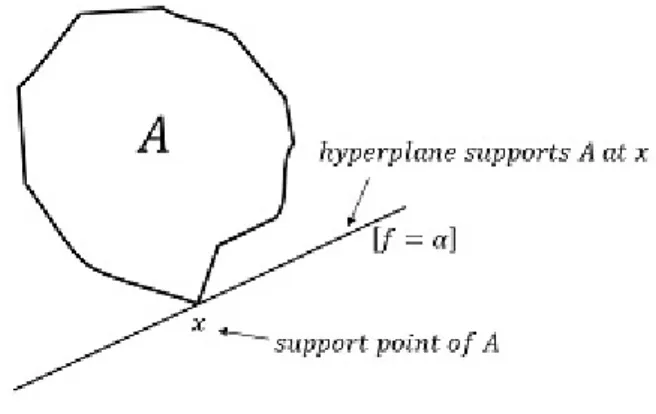
Support Points
If A is a nonempty subset of the topological vector space X and a nonzero linear functional f onX satisfies f(x)≥α for all x∈A then f(x)> α for all x∈A0 Now we come to the theorems ,. We now have an example showing that the above inclusion can fail for a convex set with an empty interior. Consider the set l1+ of the nonnegative sequence in l1, the Banach space of all summable sequences under the k.k1-norm.
To see this we use the fact that the dual space of l+1 isl∞, the bounded space. On the other hand, if some x ∈ l1+ has xk = 0 for some k, then the nonzero continuous linear function ek ∈liy satisfies.
Subgradients
By then considering y ∈ domf, we see that the subgradient inequality can only be satisfied if f(x)<∞, that is ifx∈ domf. The functionlex0 is a subgradient of the right convex functionf atx∈ dom(f) if and only if (x, f(x)) maximizes the linear functional (x0,−1) over epi(f). 45 Chapter 3 Convex functions on infinite dimensional spaces Letx+λv=y then y−x=λv, by putting it in subgradient inequality we get,.
The directional derivative map v 7 → d+f(x)(v) from its effective domain is a convex cone.
Supporting hyperplanes and Cone
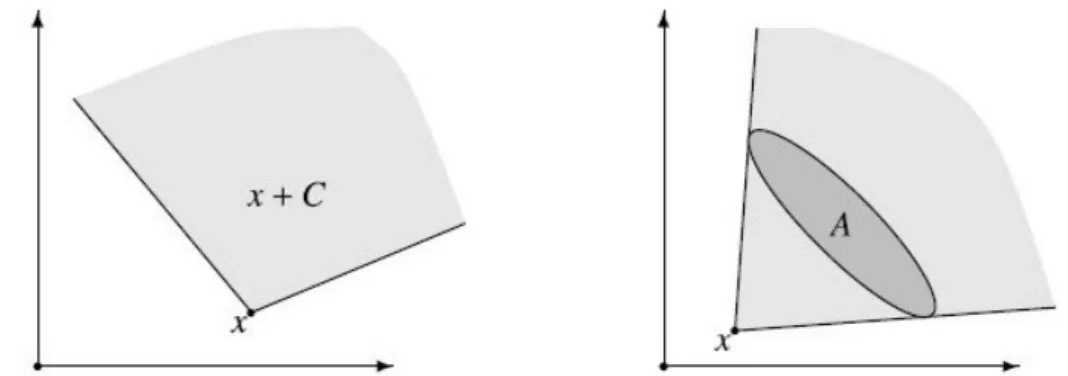
In a locally convex space, a convex cone is supported at its vertex if the cone is not dense. If C is supported atx, it lies in some closed half-space and is thus not dense. Since C is a closed convex set, the Separation Corollary (3.1.11) guarantees the existence of some nonzero continuous linear functional f satisfying f(x0)< f(x) for all x∈C. Let C be a convex subset of locally convex space and let x be a boundary point of K. If x∈C, then the following statements are equivalent:. i) The set C is supported atx. ii).
There is a non-dense convex cone with vertex X that includes C. Or equivalently, a convex cone with vertex x generated by C is not dense. iii). There exists a nonzero vector v and a neighborhood v of zeros such that x−αv+z ∈C with α >0 implies z6∈λv. i)⇒(ii). Every closed half-space bearing C on the axis is a closed convex cone with vertex x that is not dense and includes C. ii) ⇒(iii) Let ˆK be a non-dense convex cone with vertex X that includes C.
Now if f is a nonzero continuous linear functional and reaches its maximum over ˆK at x, then the open half-space K = [f > f(x)] is an open convex cone with vertex x satisfying K∩ C =φ. The given condition allows the open convex cone K to be generated by −v+V with vertex zero, i.e. Recall that the cone generated by S is the smallest cone that includes S and is thus {αx:α≥0}and.
The Bishop-Phelps Theorem
Now we will see that the cones K(f, ∂) are related to the supports of convex sets. For the converse, assume that C∩[c+K(f, δ)] ={c}for a continuous linear function of norm one and some 0< δ <1. A continuous linear functional defined on a subspace of a normed space can be extended to a continuous linear functional on the entire space while retaining the original norm.
Let f and g be bounded linear functionals of norm one on a Banach space, and let 0< < 1. Thus, to complete the proof, we must show that the partially ordered set (Dd,≥) ' has a maximum element. For a closed convex subset K of a Banach space X we have the following:. i) The set of support points of K is dense in the boundary of K.
54 Chapter 3 Convex functions on infinite-dimensional spaces (ii) If an addition K is norm bound, then the set of bounded linear functionals is on. Then there exists a kind of ∈K such that. ii) Now assume that C is a non-empty, closed, norm-bounded and convex subset of Banach space X. To see this, note that for each y we have∈V.
Assume that A and B are two non-empty disjoint convex subsets of a Banach space. X is such that A is closed and B is weakly (and in particular norm) compact. Every real non-empty closed subset of a separable Banach space is the intersection of a countable set of closed half-spaces that support it. Let C be a real non-empty convex closed subset of a separable Banach sapace X and let x−1, x2, .be be a countable subset of
Extreme points
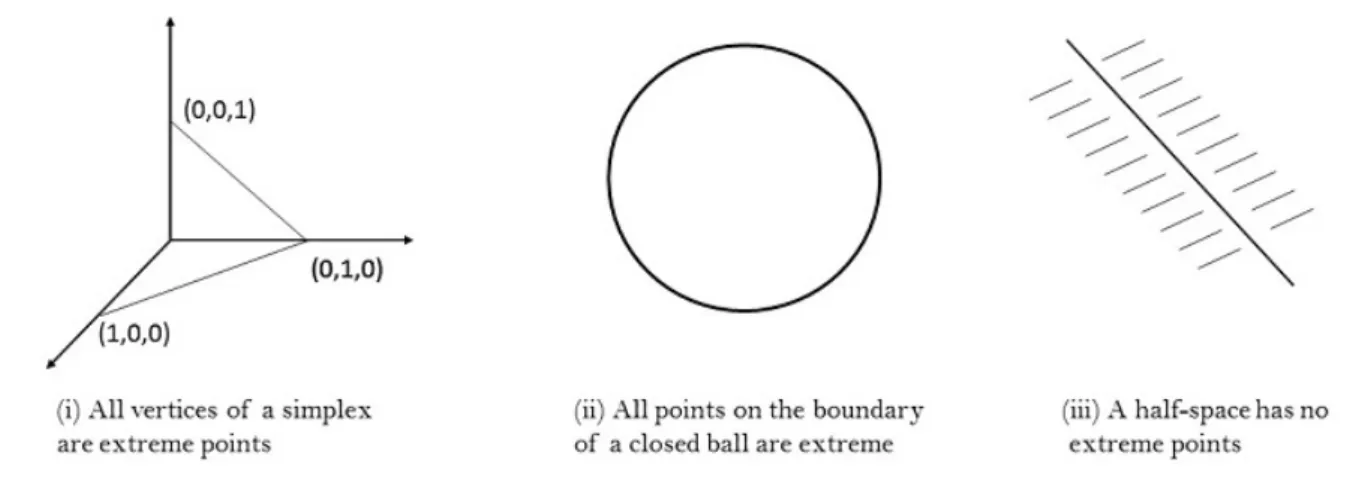
58 Chapter 3 Convex Functions in Infinite-Dimensional Spaces The following useful property is easy to verify. A point a in a convex set C is an extreme point if and only if C\{a} is a convex set. In general, the set of endpoints of a convex set K can be empty, and if it is not empty, it need not be closed.
For example, the set C of all strictly positive functions on the unit interval is a convex subset of R[0,1] without extreme points. As an example of a compact convex set for which the set of extreme points is not closed, consider the subset of R3. You can verify the following properties of extreme subsets. i) An extreme subset of a setC is an extreme subset of C. ii).
Likewise, the set of minimizers for a concave function is either set to extreme or empty. In a locally convex Hausdorff space, every compact extreme subset of a set C contains an extreme point of C. Let C be a subgroup of a locally convex Hausdorff space, and let F be a compact extreme subset of C.
The compactness of F (as expressed in terms of the infinite intersection property) guarantees that every chain in F has a non-empty intersection. It is clear that the intersection of extreme subsets of C is an extreme subset of C, since it is not empty. So Zorn's lemma applies, yielding a minimal compact extreme subset of C, included in F, call it G.
Quasiconvexity
A real-valued lower semicontinuous function on a compact space attains a maximum value, and the nonempty set of minimizers is compact. Similarly, an upper semicontinuous function on a compact set attains a maximal value, and the nonempty set of maximization is compact. Every upper semicontinuous explicit quasiconvex function has a maximization onK that is an extreme point of K.