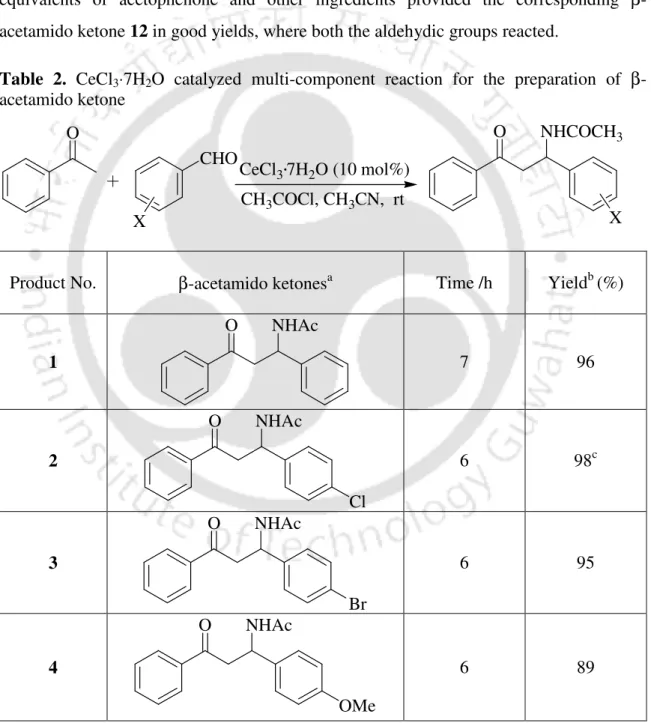
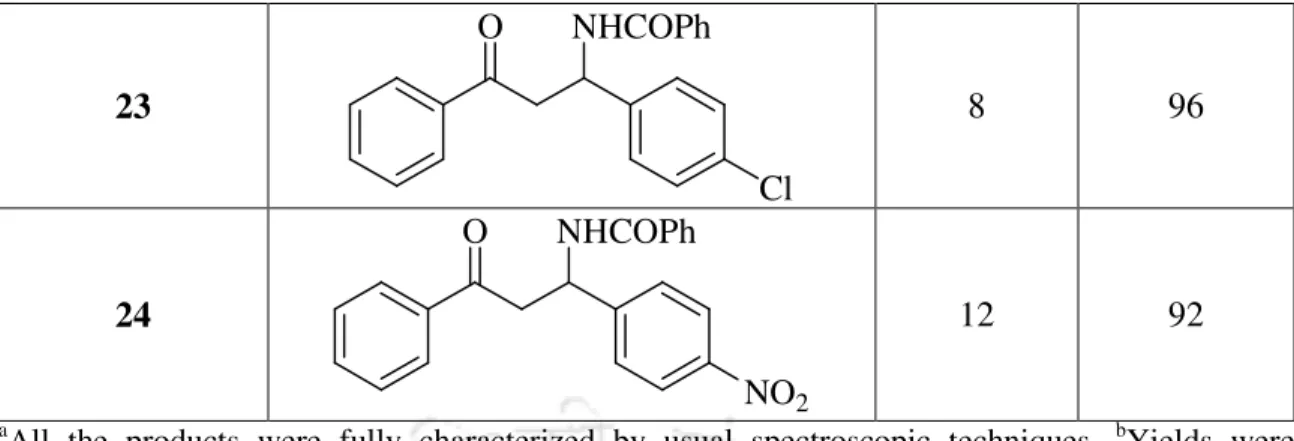
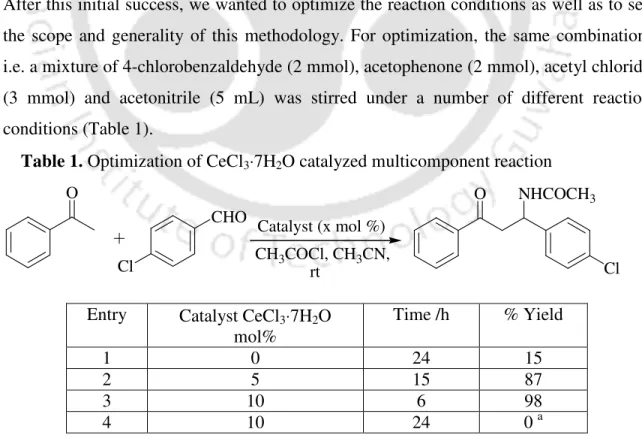
Section A shows a simple, efficient and more environmentally friendly protocol for the preparation of -acetamido carbonyl compounds using CeCl37H2O as a catalyst. In the conclusion of the thesis, we describe some new and effective synthetic methodologies for the synthesis of various -amino carbonyl compounds.
Introduction
- Multicomponent reactions
- Brief History of Multicomponent Chemistry
The development of new synthetic methods is one of the most important research areas in modern organic chemistry due to the increasing demand for selective, efficient and environmentally friendly chemical processes in academics as well as in industry. Green chemistry is one of the main concerns in the chemist's mind.3 The different types of reactions most commonly used in synthesis can have varying degrees of impact on human health and the environment.
Prebiotic synthesis of adenine
The history of the multicomponent reaction began as early as 1850 with the publication of the Strecker4 reaction, reaching its apogee nowadays. The concept of MCRs is not unknown in nature, it is especially important in evolution.
Strecker synthesis of -amino acids
Multicomponent reaction has only emerged as a powerful synthetic tool after the discovery of the Ugi reaction5, although the history of MCRs was started in the second half of the 19th century with the reactions of Strecker,4 Hantzsch6 and Biginelli.7 More recently, it is has become a promising tool for the efficient synthesis of natural products and screening compounds for the discovery of biological probes and drugs.8a. Another contribution of Hantzsch to MCRs was the synthesis of pyrroles by reacting primary amines, -ketoesters and -halogenated -ketoesters.9.
Hantzsch synthesis of pyrroles
Biginelli synthesis of dihydropyrimidines
- ββββ-Amino carbonyl compounds & their importance
- C 6 F 5 COOH (0.2 eq.)
- References and Notes
- Introduction
Some recently developed multicomponent reactions for the synthesis of various β-amino carbonyl compounds are discussed below. Comparison of results for the preparation of β-acetamido ketone(1) using multicomponent reactions with other catalysts.
CNOAc
Plausible mechanism
After completion of the reaction (monitored by TLC), the reaction mixture was poured into 50 ml of ice water. Accordingly, as shown in Scheme 5, this β-acetoxyketone was again treated with 10 mol% of the catalyst in acetonitrile as solvent, and the corresponding β-acetamidoketone (2) was obtained in 80% yield under the same experimental conditions.
![Figure 2: 1 H NMR spectrum of N-[1-(4-Nitrophenyl)-3-oxo-3-phenyl-propyl]acetamide (9) ONHAc](https://thumb-ap.123doks.com/thumbv2/azpdfnet/10467483.0/59.1188.135.980.167.788/figure-nmr-spectrum-nitrophenyl-phenyl-propyl-acetamide-onhac.webp)
Probable mechanism of Fe (III) chloride catalyzed multicomponent reactions for the preparation of β-acetamido carbonyl compounds
To illustrate that acetyl chloride is not involved in the final product and acetonitrile itself is the N-donor and nucleophile (i.e. following the Ritter reaction pathway), we attempted the reaction of 4-chlorobenzaldehyde under similar experimental conditions using benzonitrile (1.5 equiv) instead of acetonitrile. The formation of benzamide (98) clearly shows that in this reaction the nitrile acts not only as a solvent but also as a nitrogen donor. To a mixed solution of aldehyde (2 mmol) and acetophenone/methyl acetoacetate (2 mmol) in acetonitrile (3 mL) or benzonitrile (3 mmol) was added acetyl chloride (3 mmol) and FeCl3⋅6H2O (0.2 mmol) and the reaction was stirred at room temperature.
The progress of the reaction was monitored by TLC, and after completion of the reaction, crushed ice (50 mL) was added to the reaction mixture and stirred thoroughly. The mixture was extracted with ethyl acetate (3 x 20 mL), washed with water (3 x 20 mL), dried over Na 2 SO 4 , and the solvent was removed using a rotary evaporator. The crude mixture was recrystallized from ethyl acetate/hexane and solid product (mixture of diastereomers) was isolated.
The solid products were recrystallized from the solvent mixture (hexane/ethyl acetate) and fully characterized by recording IR, NMR and elemental analysis.
Nature: Yellow solid
25) AcHN
26) PhCOHN
Introduction
In general, the aza-Michael reaction requires basic conditions or some special reaction conditions.14 However, this reaction can also be mediated by acid catalysis.15 Both protic and Lewis acids can increase the reaction rate by making the Michael acceptor electrophilic. The main problem with the classical Mannich reaction is that the reaction is very slow and requires heating/reflux conditions and sometimes the reagents (and the desired product) start to polymerize. Mannich-type reactions can be classified into two types: a) indirect Mannich reactions and b) direct Mannich reactions. However, they have the disadvantage of requiring the isolation and purification of enol equivalents.
Although these methodologies are quite useful, some of the methods do suffer from certain limitations, such as either expensive catalysts or longer reaction time. The Michael addition of amines to electron-deficient alkenes, i.e. aza-Michael addition is one of the most widely used techniques to obtain β-aminocarbonyl compounds. The disappearance of signals in the alkene region and the appearance of a signal at 2.78 ppm as a triplet clearly indicate the formation of the 1,4-addition product.
The present protocol represents an improvement over some of the recently reported methods in terms of reaction time as well as % yields obtained.

Chemoselective conjugate addition of aliphatic amines in the presence of aromatic amines
- General experimental procedure for the Michael reaction
Encouraged by these results, acrylonitrile was then treated with a wide variety of amines, yielding the corresponding addition products (13-17) in relatively good yields. The catalytic activity of bromodimethylsulfonium bromide was established by the fact that in the absence of the catalyst, the reaction of pyrrolidine with acrylonitrile gave only a 20% yield of adduct even after 6 hours of stirring at room temperature. Next, we wanted to see if the same catalyst will be useful for Michael addition of aromatic amines to the -unsaturated ketones.
Mechanistically, we believe that bromodimethylsulfonium bromide acts here as a precatalyst to generate dry HBr in situ, essentially driving the reaction. In summary, we have developed a simple and efficient methodology for the conjugate addition of amines to electron-deficient alkenes using bromodimethylsulfonium bromide as an inexpensive and efficient catalyst. This method is very efficient for the 1,4-addition of primary and secondary aliphatic amines to electron-deficient alkenes.
To a mixture of methyl acrylate (430 mg, 5 mmol) and pyrrolidine (355 mg, 5 mmol) was added bromodimethylsulfonium bromide (56 mg, 0.5 mmol) and the reaction mixture was stirred at room temperature. The reaction was completed within 5 minutes. minutes as directed by TLC.
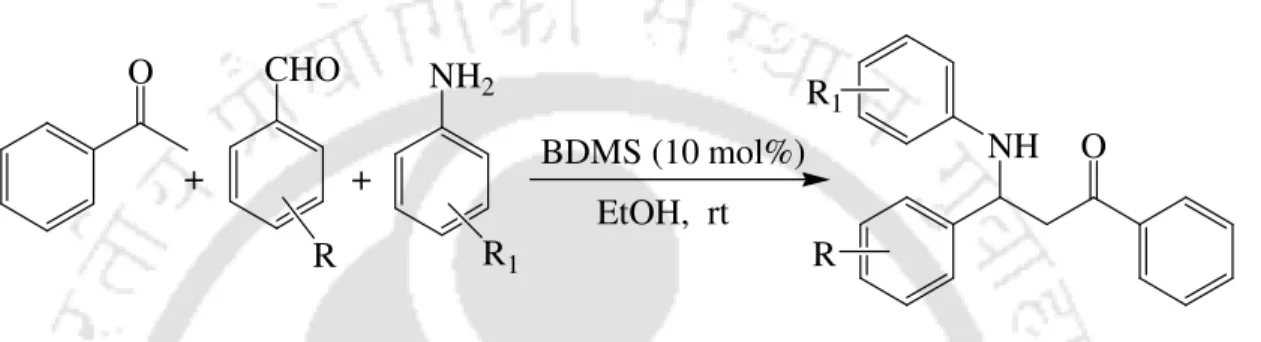
Next, benzaldehyde was individually treated with a variety of aromatic amines such as 3-chloro-, 2-nitro- or 4-nitroaniline in combination with acetophenone and the corresponding products 19-21 were obtained in very good to excellent yields within 30 min to 1h time . Subsequently, aldehydes attached with electron withdrawing groups such as 3-bromo- and 4-chlorobenzaldehyde were separately treated with a variety of aromatic amines in combination with acetophenone under the same experimental condition and the corresponding desired products (23-30) were isolated in very good yields without any. To generalize the method, an aliphatic aldehyde such as heptanal was treated with aniline and acetophenone under similar conditions.
Similarly, the combination of aliphatic amine such as n-butylamine with benzaldehyde and acetophenone under the same experimental condition was also unsuccessful even after prolonged stirring. Similarly, the reaction of aliphatic ketone such as acetone was also not applicable for Mannich type reaction with. Next, to extend the preparative utility and generality of this multi-component reaction, benzaldehyde and 4-chlorobenzaldehyde were individually treated with aniline and 3-chloroaniline in combination with other enolizable carbonyl compounds such as cyclohexanone or diethyl malonate under the same experimental condition as shown. in Scheme 5.
BDMS catalyzed a multicomponent reaction of aromatic aldehydes, amines, and cyclohexanone or diethyl malonate.
Syn and anti isomer of product 33
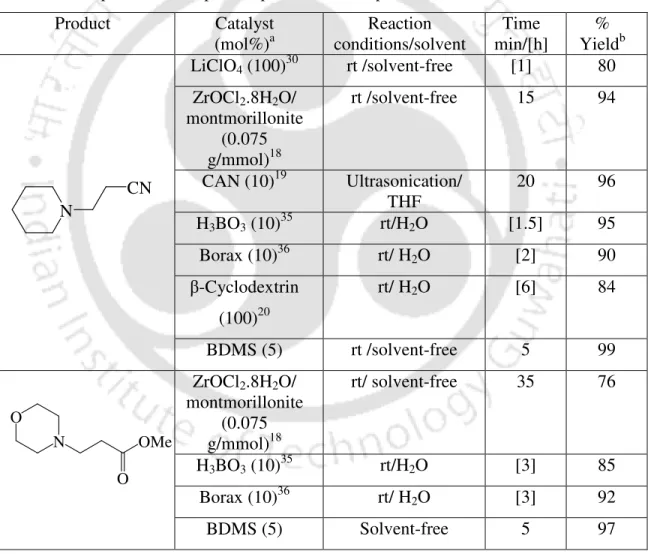
Comparison of the catalytic activity of BDMS with different catalysts for the Mannich reaction of benzaldehyde, aniline and acetophenone.
Plausible mechanistic illustration of BDMS catalyzed Mannich-type reaction Run Catalyst Reaction condition Reaction Time Yield
- General Reaction Procedure
- References
- Introduction
- Substituted piperidine and its importance in organic synthesis
In section B of the previous chapter, we have shown the three-component Mannich type reaction of aromatic aldehyde, amine and 1,3-dicarbonyl compound such as diethyl malonate, for the preparation of β-amino ester using bromodimethylsulfonium bromide as a catalyst. Interestingly, when the same reaction was performed with other 1,3-dicarbonyl compounds such as methyl acetoacetate, we did not get the expected Mannich-type product as indicated in the 1H NMR spectrum. From the literature review discussed in the introductory part of this chapter, we realized the importance of piperidines in modern organic chemistry.
In our first study, a mixture of 4-methylbenzaldehyde (2 mmol), aniline (2 mmol), and methyl acetoacetate (2 mmol) in acetonitrile (5 mL) was stirred in the presence of 10 mol% BDMS. A variety of 1,3-dicarbonyl compounds were treated with benzaldehyde and aniline in the presence of a catalytic amount of bromodimethylsulfonium bromide and the results are summarized in Table 1. However, in the case of benzoylacetone, the corresponding piperidine 16 was obtained in moderate amounts. yield.
This suggests that the presence of a methyl group in the β-position of β-keto esters is necessary for the successful formation of highly functionalized piperidines using these multicomponent reactions.

Reaction of ethyl butyrylacetate with aniline and benzaldehyde
In the case of nitroaldehydes (25-27) the yields were low which may be due to steric factors as well as the electron withdrawing effect of the nitro group. Aniline derivatives such as 4-methoxyaniline and 4-bromoaniline were also tested in the multicomponent reaction, which smoothly provided the corresponding piperidine derivatives (28-29) in good yields. Other β-keto esters such as ethyl acetoacetate, tert-butyl acetoacetate and allyl acetoacetate also participated in this multicomponent reaction to provide the corresponding piperidine derivatives (32-37) in good yields under the optimized reaction conditions.
Unfortunately, in the case of the aliphatic aldehyde, heptanal, the current method failed to produce the corresponding functionalized piperidines. Results for the reaction of aldehydes, anilines, and β-keto esters in the presence of bromodimethylsulfonium in acetonitrile. From our study we have discovered that the R group of β-keto esters plays a crucial role in this multicomponent reaction (See Table 1).
In the case of β-keto esters where R is a methyl group, enamine X (path B) is formed by reaction with an amine.

Possible mechanistic illustration showing the role of R group and the formation of functionalized piperidines via intermediates Z
We believe that BDMS facilitates the formation of imine as well as enamine X in this multicomponent reaction. This imine and the intermediate Z undergo [4+2] aza-Diels-Alder reaction to provide the functionalized piperidine. In an attempt to prove this mechanism, we synthesized the enamine from methyl acetoacetate and aniline and the resulting enamine was treated with another equivalent of 4-methylbenzaldehyde.
However, we could not isolate the intermediate Z, instead we found a trace amount of the corresponding piperidine 12 . In summary, we have demonstrated that bromodimethylsulfonium bromide mediates a novel multicomponent reaction for the synthesis of highly functionalized piperidines. In addition, we have shown that substituents on the 1,3-dicarbonyl components determine the course of the reaction.
Studies towards further generalization of this approach and the application of this method to access other heterocyclic scaffolds are underway.