Informal Trade in Agricultural Inputs in
Eastern South Asia
Informal Trade in Agricultural Inputs in Eastern South Asia
Published by
D-217, Bhaskar Marg, Bani Park, Jaipur 302016, India Tel: +91.141.2282821, Fax: +91.141.2282485
Email: [email protected], Web site: www.cuts-international.org
Supported by
© CUTS International, 2018
First published: February 2018
Cover picture was clicked while conducting field survey under the project, in Kaptangunj, Nepal, by CUTS, of farmers using informally traded seeds and fertilisers
This document has been produced by CUTS International.
The views expressed here are those of CUTS International.
ISBN 978-81-8257-257-7
Printed in India by MS Printer, Jaipur
#1806, Suggested Contribution M350/US$35
&
Contents
Acronyms 5
Contributors 7
Acknowledgements 9
Foreword 11
Preface 13
Executive Summary 15
Chapter 1 Introduction 19
1.1 Existing Scenario of Formal Trade 21
1.2 Background and Context 24
1.3 Objectives and Methodology 24
Chapter 2 Drivers of Informal Trade between India-Nepal and India
Bangladesh: A Literature Survey 27
2.1 Drivers of Informal Trade 27
2.2 Drivers Related to Trade Facilitation 33
2.3 Domestic Policy Distortions 35
2.4 Socio-Economic Aspects 36
2.5 Political Aspects 36
Chapter 3 Nature, Extent and Drivers of Cross-border Informal Trade
and its Impact on Livelihood: Field Level Observations 37
3.1 Case of India-Nepal: Survey Findings 37
3.2 Case of India-Bangladesh: Survey Findings 44
Chapter 4 Conclusion and Recommendations 53
4.1 Conclusion 53
4.2 Recommendations 54
References 57
Annexure 1: Questionnaire for Household Survey on Informal
Trade in Agricultural Input Commodities 60
Annexure 2: Questionnaire for Focussed Group Discussions
and Key Informant Interviews 65
Endnotes 66
List of Tables and Figures
Tables
Table 1.1 Bilateral Trade Flows between India and Nepal in
Agricultural Inputs (2013-15) 22
Table 1.2: Bilateral Trade Flows between India and Bangladesh in
Agricultural Inputs (2013-15) 24
Table 1.3: Description of Selected Agricultural Inputs 25 Table 2.1: Restrictiveness of Trade Policy of India and Nepal for
Selected Informally Traded Agricultural Inputs 28
Table 2.2: Restrictiveness of Trade Policy of India and Bangladesh for
Selected Informally Traded Agricultural Inputs 29
Table 2.3: Legal and Regulatory Framework for Agriculture
Inputs in India, Bangladesh and Nepal 33
Table 3.1: Categorisation of Possible Drivers of Informal Trade 38 Table 3.2: Drivers Influencing Informal Trade in Agricultural Input
Commodities between India and Nepal 40
Table 3.3: Variation in Prices of Informally Traded Paddy Varieties
Based on Distance from the Nearest Market 46
Table 3.4: Drivers Influencing Informal Trade in Agricultural Input
Commodities between India and Bangladesh 48
Figures
Figure 1.1 A: India’s Exports to Nepal 21
Figure 1.1 B: India’s Imports from Nepal 22
Figure 1.2 A: India’s Exports to Bangladesh 23
Figure 1.2 B: India’s Imports from Bangladesh 23
Figure 2.1: Import Tariff on Selected Agriculture Inputs in India,
Bangladesh and Nepal 31
Figure 3.1: Informal Flow of Wheat Seeds from Nepal to India
(Dhanusha to Madhubani) 41
Figure 3.2: Informal Flow of Wheat Seeds from Nepal to India
(Sunsari to Arariya) 42
Figure 3.3: Informal Flow of Sona Mansuli Paddy Seeds from
India to Nepal (Giddha) 42
Figure 3.4: Informal Flow of Potato Seeds from India to Nepal (Kaptangunj) 42 Figure 3.5: Informal Flow of DAP from India to Nepal
(Kaptangunj and Giddha) 43
Figure 3.6: Informal Flow of Swarna Rice Seeds from India to Bangladesh 49 Figure 3.7: Informal Flow of Rocky Tomato Seeds from India to Bangladesh 50 Figure 3.8: Informal Flow of Paddy Seeds – BR28/29 from Bangladesh
to India 50
Figure 3.9: Informal Flow of Herbicide (Sathi) from Bangladesh to India 51
Acronyms
ADB Asian Development Bank
ASEAN Association of Southeast Asian Nations
ACIAR Australian Centre for International Agricultural Research BARI Bangladesh Agricultural Research Institute
BIS Bureau of Indian Standards
BSTI Bangladesh Standards Testing Institute CGE Computable General Equilibrium
CIMMYT International Maize and Wheat Improvement Centre DFID Department for International Development
DAP Diammonium Phosphate
DAE Department of Agriculture Extension DES Directorate of Economics and Statistics DGFT Directorate General of Foreign Trade EAT Enabling Agricultural Trade
FAO Food and Agriculture Organisation FCO Fertiliser Control Order
FGD Focussed Group Discussion HYV High Yielding Varieties
ICAR Indian Council of Agricultural Research ICT Information and Communication Technology
ICEGATE Indian Customs Electronic Data Interchange Gateway MoA Ministry of Agriculture
MRAs Mutual Recognition Agreements NARC Nepal Agricultural Research Council
NATP National Agriculture Technology Programme NBSP Nepal Bureau of Standards and Metrology NOC No Objection Certificate
MRA Mutual Recognition Agreement NTBs Non-Tariff Barriers
RCEP Regional Comprehensive Economic Partnership SAFTA South Asian Free Trade Area
SAPTA SAARC Preferential Trading Arrangement
SAWTEE South Asia Watch on Trade, Economics and Environment SCDP Second Crop Diversification Project
SPS Sanitary and Phyto-sanitary
SRFSI Sustainable and Resilient Farming Systems Intensification in the Eastern Gangetic Plains
SSNP Social Safety Net Programme
SWS Single Window System
TBT Technical Barriers to Trade
UNESCAP United Nations Economic and Social Commission for Asia and the Pacific
USAID United States Agency for International Development VERs Voluntary Export Restraints
Taramani Agarwal
is workingat CUTS in the capacity of Senior Programme Officer. She has been working closely on the issues related to international trade and regional economic cooperation in South Asia and has more than five years of research experience. She holds Master’s degree in Actuarial Science from the Amity University. In the past, she has worked with Bureau of Research on Industry and Economic Fundamentals and Deloitte Consultancy.
Rahul Arora
is working in the capacity of a Policy Analyst at CUTS. He has Doctorate in Economics with specialisation in International Trade from Indian Institute of Technology, Kanpur.His research interests lies in analysing International Trade with particular focus on
Computable General Equilibrium (CGE) Modelling of Free Trade Agreements, Regional Economic Integration, Gravity Modelling, Trade Facilitation and Trade Policy. He has worked with ARTNeT, United Nations Economic and Social
Commission for Asia and the Pacific (UNESCAP) to study the trade facilitation measures in RCEP countries and published various research papers and chapters in journals and books of national and international repute.
Sayandeep Chattopadhyay
is working as a Research Associate at CUTS. He holds a
Contributors
Bachelor’s in Economics from the University of Calcutta and Master’s in Economics from Symbiosis International University. His areas of interest include international economics, regional cooperation, and political economy of economic regulations. Previously, he has worked at the Institute for Social and Economic Change,
Bengaluru.
Arnab Ganguly
holds aMaster’s Degree in Economics and Business Management.
Presently, he is working with CUTS as Assistant Policy Analyst and engaged in various projects on International Trade, Regional Economic Cooperation and Cross-border Electricity Trade. He has also worked with West Bengal Consultancy
Organisation and Confederation of Indian Industry in various capacities. He has more than ten years of experience in action research and policy advocacy.
Suvayan Neogi
is a Research Associate at CUTS. He obtained his Master’s degree inAgribusiness Economics from Gokhale Institute of Politics and Economics (GIPE), Pune. He has contributed in a number of studies as a researcher for various institutes including IIT Kanpur, Calcutta University, among others. His interest areas include regional economic cooperation, trade facilitation, among others.
Sudip Kumar Paul
is aResearch Associate at CUTS. He has been awarded with M.Sc. in Economics from the University of Calcutta. He has more than three years of research experience and has previously worked with Indian Statistical Institute and Jadavpur University, Kolkata. His interest lies in the regional economic integration which comes under the area of international trade.
Sarbjit Singh
is working in the capacity of a Policy Analyst at CUTS. He has Doctorate in Economics with specialisation in International Trade from IIT Kanpur. His research interest lies in the Quantitative Analysis of International Trade. In particular, he works on Gravity Modelling, Trade Facilitation, GTAP Models, Regional Economic Integration and Trade Policy. He has completed a project withARTNeT, UNESCAP on trade facilitation measures in RCEP countries and published various research papers and chapters in journals and books of national and international repute.
Surendar Singh
is a Fellow at CUTS. He holds Ph.D ininternational trade from Kumaon University and has more than ten years of experience in research and teaching. His areas of interest include international trade, global value chains, regional economic integration, and trade facilitation. He has published several research studies, articles and discussion papers in national and international journals. He has also written two books on international trade and export- import management, which have been adopted by Sikkim Manipal University as core books for its courses on international trade and economics.
Acknowledgments
This study is the result of a year- long project ‘Linkages and Impact of Informal Trade in Agricultural Input Commodities in Eastern South Asia’ supported by the Australian Centre for International Agricultural
Research (ACIAR) and the United Kingdom’s Department for International Development (DFID). In this study, an attempt has been made to identify drivers influencing informal trade in agricultural input commodities in Eastern South Asia and gauging the impact of informal trade on the livelihood of the nearby residents.
The study is largely based on survey findings from Bangladesh, India and Nepal, and presents the views of differentiated group of stakeholders, who are involved in informal trade and related activities in the border areas of these countries. We duly appreciate their cooperation.
We offer our sincere thanks to Dr. Ejaz Qureshi, Dr. John Dixon and Dr. Kuhu Chatterjee of ACIAR and Dr. Duncan
Overfield, Jaya Singh Verma and Harjeet Kaur of DFID, for
providing their extensive support for reviewing our work in progress and providing timely and valuable inputs. We also acknowledge the valuable inputs provided by Dr. Sisira
Jayasuriya, Dr. P K Joshi, Dr.
Rajesh Chadha, and Dr. Nisha Taneja, among many others, during the implementation of the project and finalisation of this report. We would like to express
our profound gratitude and indebtedness for their wise counsel.
This study is also benefitted from the unreserved assistance extended by our partner organisations, Unnayan Shamannay from Bangladesh and South Asia Watch on Trade, Economics and Environment (SAWTEE) from Nepal. Their useful contributions including conducting extensive field work in the remote areas, organising local meetings and stakeholders consultation, in their respective countries, are acknowledged.
We thank them for sharing our passion for bringing about policy reforms in Bangladesh, India and Nepal that would benefit the people at large. Special thanks are due to Robert Shuvo Guda and Shaheen Ul Alam of Unnayan Shamannay and Dikshya Singh and Dhrubesh Regmi of SAWTEE.
We are also grateful to
colleagues from Indian Council of Agricultural Research (ICAR), Bihar; Uttar Banga Krishi Visvavidyalaya, West Bengal;
Nepal Agricultural Research Council (NARC), Nepal; and Bangladesh Agricultural Research Institute (BARI), Bangladesh, for their immense support in conducting field research in the remote locations of the respective three countries.
Without their assistance, the project would not have been successful. Along with the contributors of the report, we are
also thankful to CUTS colleagues:
Ujjwal Kumar, Prithviraj Nath, Prashant Sharma and Mohini Ganguly for giving their valuable inputs and contributing in the study, under the overall guidance of Bipul Chatterjee.
We also thank all the participants of stakeholder consultation meetings organised in
Bangladesh, India, and Nepal.
We are extremely grateful for their enthusiastic support and knowledge, which they shared with us.
Garima Shrivastava carried out the editing of this report and Madhuri Vasnani, Mukesh Tyagi and Rajkumar Trivedi contributed
in its proof-reading and lay- outing. G C Jain, L N Sharma and Lokesh Sharma handled its financial management. We thank all of them. Many other names deserve special mention but could not be referred here for want of anonymity. We thank them all for their support.
Finally, any error that may have remained is solely our
responsibility. Our dedication to this critical and sensitive subject will be sustained while
contributing towards the current and future discourse on the regional as well as individual country-wise development objectives.
CUTS Centre for Inter CUTS Centre for Inter CUTS Centre for Inter CUTS Centre for Inter
CUTS Centre for Internationalnationalnationalnationalnational TTTTTrade, Economics &rade, Economics &rade, Economics &rade, Economics &rade, Economics &
Environment EnvironmentEnvironment Environment Environment
Foreword
This pioneering study of informal agricultural input trade between Bangladesh, India and Nepal, is both important and timely. It highlights the continuing, expanding informal trade in agricultural inputs in the South Asian region.
Further, expanding trade in agricultural inputs is a global phenomenon, and the study raises a number of issues that have wider relevance beyond South Asia.
At first glance, this seems puzzling because formal barriers to trade between these countries have come down very substantially in recent years due to both unilateral and regional trade liberalisation initiatives. However, in reality agricultural input trade as in the case of
agricultural trade more generally, the reduction in formal trade barriers – both tariff and non-tariff barriers – has lagged well behind the pace of overall trade liberalisation in South Asia, and significant barriers to international trade in agriculture remain.
Further, as the study describes, the structure of trade barriers also differs between the
geographically contiguous neighbours, Bangladesh, India and Nepal, reflecting differences in the policy stances of their
governments that implement significantly different domestic tax/subsidy policies in the agriculture sector.
In the case of agricultural input trade, incentives for informal trade are enhanced by the lack of harmonisation in standards, seed certification
systems, and in Sanitary and Phyto-sanitary regulations, and costly and cumbersome custom clearance procedures.
The resulting cross-border price differentials and consumer demands that are not met through formal trade channels, generate large incentives for informal trade. The study shows how close ethnic, social, and sometimes even family links, between communities that straddle the porous borders makes it difficult and costly to enforce restrictions on cross-border transactions. The high incentives for informal trade also reinforce and entrench corruption in the inefficient and corruption-prone bureaucracy.
What are the welfare consequences of such informal trade? The study provides many examples of the positive effects of informal trade on agricultural communities as farmers across borders share seeds, technologies and other inputs, improving productivity and income.
This appears to be a powerful illustration of the
‘welfare increasing smuggling’ thesis advanced by Professors Jagdish Bhagwati and Bent Hansen in 1973 where they showed that in some
circumstances informal (or illegal) trade can be positively beneficial for communities or countries.
But the costs associated with informal trade and evading legal channels should also be recognised, and in the case of agricultural inputs, these may be quite large.
Sisira Jayasuriya
Director, Centre for Development Economics and Sustainability and Professor of Economics Monash University
Melbourne, Australia
There are legitimate concerns about the potentially catastrophic consequences of evading bio-security restrictions on movement of seeds and other inputs.
This is in addition to the non-trivial economic and social costs of encouraging people to engage in activities that break or bend laws and regulations and strengthen corruption and waste resources.
There are also other aspects of input trade to be considered. In particular, trade in inputs can significantly impact outputs of agricultural products, and consequently on prices and cross-border trade.
The study recognises these issues, and the conclusions and policy recommendations are balanced. It presents a strong case for accelerating the broader process of agricultural trade
liberalisation in South Asia to exploit the economic complementarities among neighbouring countries and regions, while emphasising the need for appropriate measures to harmonise standards and coordinate bio-security measures.
However, the study also points to the formidable policy challenges that stand in the way of
eliminating such trade because the trade barriers that exist are essential if the countries are to maintain different domestic of tax subsidy policies that have powerful political economy roots. For example, in the case of subsidised inputs that can be traded across country borders, such as fertilisers, informal trade results in a transfer of the subsidy to the
consumers in neighbouring importing countries.
If India wishes to maintain high fertiliser subsidies, then restrictions on cross-border trade are almost mandatory. It will not be easy to craft a set of transitional policies that can facilitate greater formal trade in agricultural inputs while minimising bio-security risks, and navigating the minefield of politically
entrenched tax/subsidy policies.
The authors of this report must be congratulated for a most valuable contribution to this regional policy challenge and ongoing policy debate on agricultural trade liberalisation. I hope that this study will stimulate other studies, broader in scope, depth and geographical coverage.
Preface
Bipul Chatterjee
Executive Director CUTS International
The deep-rooted shared historical, cultural, ethnic and geographical contiguity are pillars of
economic and trade relations among Bangladesh, India and Nepal. Notwithstanding the political boundaries, the flow of both resources and people has continued to thrive across the borders of these countries. While the nature of porosity of India’s borders with these countries is different, it has never meant that they cease to exist. In some cases, however, with political boundaries posing as hurdles, the process has become more difficult and also become more of informal exchange.
Since early 1990s, Bangladesh, India and Nepal have taken various bilateral and regional initiatives to expand their economic and trade ties. These include treaty of transit, duty-free quota-free market access, the Agreement on South Asia Free Trade Area (SAFTA). The overarching goal of these initiatives was to enhance economic and trade cooperation. Trade Agreements like SAFTA has been able to make some progress in liberalising trade in the region, but import tariffs are still high on some agriculture products, including
agricultural inputs.
In addition, some member countries have put a large number of products under the sensitive list of SAFTA. In particular, restriction on trade in agriculture products has enabled large-scale informal exchange of such goods. Other than this, non-tariff barriers (NTBs), particularly trade restricting regulations increased the cost of doing
cross-border trade, which encouraged traders and local people to get into informal trading.
Bangladesh and Nepal share long borders with India and large volume of informal trade takes place through these borders. Cross-border informal trade in agricultural inputs is
significant because of diverse range of issues, which include quality concerns and productivity.
Other than this, ineffective trade facilitation, domestic policy distortions and other related impediments also result in huge informal trade in agricultural inputs across these countries.
Divergent rules and regulations including SPS and TBT regulations for specific products, often create obstacles to formal cross-border trade. In this study, it is noted that frequent quarantine checks and administrative hassles in cross- border trade compel local traders, agents and also local people to use informal channels. The lengthy process of laboratory testing with multiple authorities, pre-shipment certificates and other documents to prove compliance with the given norms, customs clearance documents, and transhipment at the border point result in unnecessary delay and cost escalation, which in turn, hamper efficient movement of goods across borders. Consequently, traders prefer to adopt informal channels for export and import of goods as it is relatively less cumbersome and cost-effective.
Absence of policy coherence between border sharing countries is another reason for informal trade. Social and welfare-oriented schemes in which governments use subsidies or administered price mechanism for distributing products to the domestic consumers also play a catalytic role behind informal trade. This issue is primarily noted in case of subsidised agricultural inputs, such as fertilisers and machineries. Besides this, inadequate employment opportunities as well as social, ethnic relationship between the communities across borders are two additional factors behind the increasing trend of informal trade in the border areas of this region, which is exacerbated by
inadequate attention of governments to the welfare of border communities and lack of political willingness for the betterment of their livelihood.
Thus, this study has captured some of key factors which are responsible for informal trade between India-Bangladesh and India-Nepal. Some of the key factors found in this study are differences in quality, prices and productivity, due to which both farmers and traders are involved in informal trade.
It underscores the current state of such trade along the these border areas and has come up with a set of policy recommendations, such as reduction in tariffs on the part of Bangladesh and Nepal, harmonisation of standards and technical regulations, improvement in soft and hard infrastructure, addressing domestic policy distortion, development of border haats, and
capacity building and knowledge sharing of border agencies to convert informal trade into formal channels.
CUTS believes that if the set of policy recommendations provided in this study are recognised and implemented, a significant volume of informal trade can be shifted into formal channels which will have far-reaching socio-economic implications, and will contribute towards better livelihood of those who are marginalised in the current development discourse.
Therefore, I hope that this report will be disseminated among the relevant policymakers and will generate interest amongst them, which will result in a more comprehensive economic cooperation between Bangladesh, India and Nepal.
I thank my colleagues at CUTS and our partners in Bangladesh and Nepal – Unnayan
Shamannay and South Asia Watch on Trade, Economics and Environment – for their diligent work. Let me also thank the Australian Centre for International Agricultural Research and the United Kingdom’s Department for International Development, for their support. Last but not the least, thanks are due to the project advisers for their guidance. Any errors remain those of ours.
Executive Summary
Background
Economic and trade relationships among India, Bangladesh and Nepal (the Eastern South Asian region) are shaped by
geographical, historical, ethnical and cultural linkages. They have been strong facilitators of cross- border trade between India- Bangladesh and India-Nepal.
These trade relations are further augmented by a number of factors, which include
preferential, unilateral, bilateral and regional trade agreements.
Various agreements have been playing catalytic roles in expanding economic and trade ties among the three countries.
Despite the growth of bilateral trade flows, a significant portion of informal trade is also taking place. The term informal trade refers to unofficial trade that takes place due to high NTBs, ineffective trade facilitation, domestic policy distortions and other related impediments.
Among others, tariff barriers have been recognised as the major issue for unprecedented growth of informal trade in the Eastern South Asian region.
Despite the consistent efforts to reduce the tariffs under the SAPTA, followed by SAFTA, the import tariffs are still very high on the trade of agricultural inputs in the region. High tariff provides
‘incentives’ to local inhabitants and traders to circumvent formal channels and move towards informal ones.
This is also recognised in case of these three countries. India impose high import tariffs on the imports of paddy seed, wheat seed, maize seed and potato seed. Exports of Urea and DAP are also restricted, to fulfil the domestic requirements.
In addition to the tariff barriers, bilateral trade flows of
agricultural products between India-Bangladesh and India- Nepal are subject to a large number of NTBs. Bangladesh, India and Nepal have their specific SPS measures, quality related norms and standard related regulations for export and import of agricultural input and output products. The lengthy process of laboratory testing with multiple authorities, pre-shipment certificates, customs clearance documents, transhipment at the border points, result in
unnecessary delay and cost escalation, consequently, affecting the formal trade negatively.
The existing studies have found various factors responsible for the large amount of informal trade between India-Bangladesh and India-Nepal. Some of the major reasons are inadequate attention by the state machinery towards informal trade, lack of policy coherence between border sharing countries and improper use of country specific domestic social and welfare policies.
Inadequate employment opportunities as well as social, ethnic relationship between the
communities across borders are two additional factors behind the increasing trend of informal trade in this border region which is duly supported by existing corrupt bureaucratic systems, political protection and lack of political will.
Evidence from the Field Survey
In order to understand the dynamics of informal trade in agricultural inputs at the borders, primary evidences were collected from Indo-Nepal border, i.e. Madhubani and Arariya districts in Bihar- India and Dhanusha and Sunsari districts in Nepal; and Indo-Bangladesh border, i.e. Malda and Coochbehar districts in West Bengal-India, Rajshahi and Rangpur districts from Bangladesh.
The study analysed the impact of informal trade on the livelihoods of the people living in the border areas (farmers and local traders both formal and informal), who are engaged in informal trade.
Case of Indo-Nepal border
Most of the farmers along this border are small and marginal farmers. Women participation in informal trade is not direct but quite significant.
The farmers earn their livelihood through agricultural income by supplying the surplus output, after self-consumption, into the local markets, which help them meeting the demand of local consumers. Poverty and lack of job
opportunities in the border areas are the main reasons resulting in their involvement in informal trade.
Other key drivers influencing informal trade of agricultural input commodities are high
productivity, proximate markets across borders, easy accessibility and availability of products, cultural, social and ethnic relations, lower transportation cost, longevity and post-harvest management.
Case of Indo-Bangladesh border
Farmers along this border are also small and marginal and both men and women are engaged in farming practices. Most of the women along this border are engaged in secondary farming
practices, while a huge number of them are involved in other informal activities, such as smuggling. Informal trade activities are the easy ways of earning their livelihood and meeting the sustained lifestyle for both men and women.
The key reason influencing farmers to get indulged in informal trade is easy availability of agricultural inputs at lower prices on the other side of border.
Other reasons are high productivity of informally traded seeds incomparison to the formally available seeds, lack in the supply of suitable alternatives, longevity and post-harvest management, and cultural, social and ethnic relationships that are shared between the two countries.
Policy Recommendations
The study has identified few but relevant policy recommendations for addressing informal trade between India-Bangladesh, India-Nepal in particular and overall for the sub-region. It is recommended that necessary actions should be taken by the governments and private sector to channelise informal trade into formal trade.
Trade Policy Reforms
Trade policies in Eastern South Asian countries are restrictive which in turn, affect cross-border trade. As a result, local traders and agents tend to get into informal trading which is relatively easy, less cumbersome and less time consuming.
Tariff Barriers
Tariffs on most of the informally traded agricultural inputs are relatively high which magnify the cost of formal export and import.
Considering this, it is important for the Eastern South Asian countries to emphasis on greater degree of tariff liberalisation in these products to facilitate cross-border trade. The reduction in tariffs and elimination of sensitive lists under the SAFTA could play an important role in this regard. Additionally, the possibilities can also be explored at bilateral basis to eliminate sensitive lists.
Non-Tariff Barriers
Trade in agricultural inputs, such as seeds, fertilisers, pesticides, chemicals, is more prone to SPS and TBT issues. Cross-border trade in these products face more barriers given their health, safety and quality concerns. Harmonisation of trade, technical and regulatory standards through Mutual Recognition Agreements (MRAs) and conformity assessment procedures could be an option to reduce the potential incidence of NTBs, which will further help the people and traders to move to formal channels of cross-border trade.
Research institutions, such as Indian Council of Agricultural Research (ICAR) in India, National Agricultural Research Council (NARC) in Nepal and Bangladesh Agricultural Research Council (BARC) in Bangladesh, should work on
developing quality seeds and fertilisers together under the ambit of regional bodies, such as South Asian Regional Standards Organisation (SARSO).
They should collectively come up with a plan to develop, produce and distribute these inputs in the local markets of the respective countries, in the markets of the border areas and thus to meet the regional demand.
High trade transaction costs due to inefficient customs clearance procedures, cumbersome export and import formalities, absence of single window system (SWS) and Information and Communications Technology (ICT), encourage traders and local people to get involved into informal trading, which is efficient, less time consuming and involves no transaction costs.
Therefore, it becomes imperative for governments of the three countries to create better
infrastructure facilities, streamlined customs clearance procedures and SWS to reduce the operational costs.
Development of Formal Routes
Governments of these three countries should emphasis on identifying and developing more of formal border points while considering their cost benefit analysis. Moreover, it is important to upgrade the existing formal border points, known as, land customs stations, in terms of better road infrastructure, better internet facilities, and single window documentation system, risk management system for both exporter and importers.
Regional Policy Coherence
Domestic policies, such as subsidies to
agricultural inputs, lead to price distortions across the markets of other country, thus providing incentives to local traders, agents and people to involve in informal trade practice. The
government of these three countries should emphasise on promoting greater policy coherence in institutional and regulatory framework, so that the prevailing policy induced distortions can be addressed.
Setting up Regional Factories
Informal trade of fertilisers in the Eastern South Asian region can be addressed and channelised by setting up regional factories of fertilisers similar to those in South-East Asia. India, Nepal and Bangladesh can jointly pool financial resources for the establishment of regional factories which will significantly lower informal trade in fertilisers.
Development of Border Haats
It is being recognised that border haats have been instrumental in promoting trade between India and Bangladesh, and they have helped the people living in border areas in getting
productive employment and positively impacted their socio-economic transformation. It has been noticed that border haats have played an essential role in arresting and reducing informal trade in that area. Currently, there are only four border haats across the lengthy Indo-Bangladesh border, along the borders of Meghalaya and Tripura states of India. Considering their importance and impact, replication of border haats in the new locations will greatly help towards better local economic development, people-to-people connectivity and apprehending informal trade.
Trade Capacity Building Programmes Countries should create more awareness generation programmes at local and regional level about trading through the formal routine or on the benefits that can accrue from regularising informal trade. Also, they need to be informed about the quality of the product that they are producing. They need to be educated regarding the bio-safety issues and environmental issues.
Mandatory Education Schemes and Job Creation
As people residing along the borders are mostly uneducated and lack job opportunities,
governments of the respective countries should allocate some funds from the Border Area Development Programme towards mandating compulsory education. Education will help them availing job opportunities which will lead to better livelihood, thus alleviating poverty. In Addition, governments should consider and focus upon creating jobs in the border areas resulting in employment opportunities for better livelihood.
Countries of Eastern South Asia – Bangladesh, India, and Nepal – share deep-rooted historic &
cultural linkages that play an important role in shaping their economic and trade relationships (Rahman et al, 2012). Despite the political boundaries, the flow of both resources and people has continued to thrive across the borders of all the three countries.
The long open porous borders between India, Bangladesh and Nepal have never ceased the flows of water and movement of cattle in these areas. However, in some cases, these political boundaries have posed
numerous challenges, which lead to hidden transactions across the borders, termed as informal trade.
Different studies have interpreted the term informal in different contexts. The term informal refers to illegal economic activities;
parallel markets (not regulated by the government).
Undoubtedly, there exists an illegal component to informal trade if one takes into account trafficking in drugs, narcotics or arms. In addition, informal trade is a form of smuggling of goods across frontiers due to policy related barriers (tariff and NTBs).
It is possible that a substantial volume of informal trade is in the nature of ‘extra-legal trading, tolerated in practice even if illegal in the letter of the law’.
This happens due to the fact that
the governance of state
machinery does not extend to all corners of the society in poor countries (Taneja, 2000).
In the past, studies have tried to estimate the quantum of informal trade along India’s border with Bangladesh and Nepal, and most of them have estimated very high figures for such trade. This comprises of both bootleg and technical smuggling.1 Estimates based on a survey in
Bangladesh, undertaken in the year 2002-03, put the figure at a whopping US$500mn for the year 2002-03, which is about 42 per cent of Bangladesh’s
recorded imports from India and 30 per cent of its total (formal plus informal) imports during the same year (World Bank, 2006).
One of the most striking observations of the World Bank (WB) study is that a large volume of the cross-border informal trade is in agricultural products, which constitute 14 per cent of the total informal trade. This is well aligned with the findings of Taneja (2005) which claimed that food/agricultural products constitute a major proportion of India’s trade with Bangladesh and Nepal through both formal and informal channels.
A recent study by United States Agency for International Development (USAID) and Enabling Agricultural Trade (EAT) observed that both Bangladesh
Chapter 1 Introduction
and Nepal are heavily dependent on India for their seed and fertiliser requirements. It indicates that Indian seeds going to Nepal via informal channel can account for as high as 30 per cent to 45 per cent of the total vegetable seeds consumed in Nepal (Ministry of Agriculture and Cooperatives,
Government of Nepal, 2011).2 The main reason behind this is the prevalence of policy, procedural, political and regulatory barriers that hinder smooth flow of agricultural inputs across borders through official route. This indirectly encourages trade of such inputs through informal channels.
However, such informal trade in agricultural inputs often translates into high prices and low quality of products for farmers. The resilience, climate suitability and high returns of these seed varieties and non-availability of other agricultural inputs at the local-level are the principal reasons that farmers are informally adopting/sourcing them from across political borders. Moreover, people living in border areas of these three countries share common practices in agriculture.
This is well documented in the earlier work of CUTS, in the border areas of Bangladesh, where it was found that migration from Bangladesh to the Eastern states of India has contributed to the rise in
agricultural productivity in the region, through the introduction of better techniques, crop diversity, and multiple cropping.
This phenomena started during the colonial era and still prevails. In the present times, a substantial part of intensive agriculture in the Eastern part of India is done by such migrant cultivators. This has generated more demand for agricultural technology, seeds, equipment, among others across the border from Bangladesh.
Another remarkable feature of trade in selected locations in agricultural products in the region is the gender dimensions; agriculture is a female labour-intensive3 activity in Bangladesh, India and Nepal (FAO et al, 2010). An increase in women’s participation in agricultural activities has been witnessed owing to increasing migration of the rural male population to other urban centres within the respective countries and also to other countries in search of work and higher wages. This has led to the delegation of a lot of responsibilities of agricultural work on women. A study by Food Agriculture Organisation revealed that around 3 per cent of households headed by women used mechanical equipment, compared with 8 per cent of those headed by men (FAO 2010- 11). In short, agriculture farming managed by women generally characterised by low level of mechanisation and technological inputs.
Easy and cheap availability of agricultural inputs, arguably has a huge potential to increase incomes for marginalised and women farmers in the region, which can result in higher consumption.
Existing scenario brings forward that informal trade in agriculture items is mainly focussed on High Yielding Varieties (HYV) of rice, wheat and maize seeds amongst India,
Bangladesh and Nepal
Literature highlights that cross-border
informal trade in seeds and fertilisers across the border has
enhanced the resource use efficiency in
farming activities
1.1 Existing Scenario of Formal Trade
1.1.1 Trade between India and Nepal
India and Nepal are important trading partners in the Eastern region. Nepal, as a landlocked country, is highly dependent on India for its foreign trade.
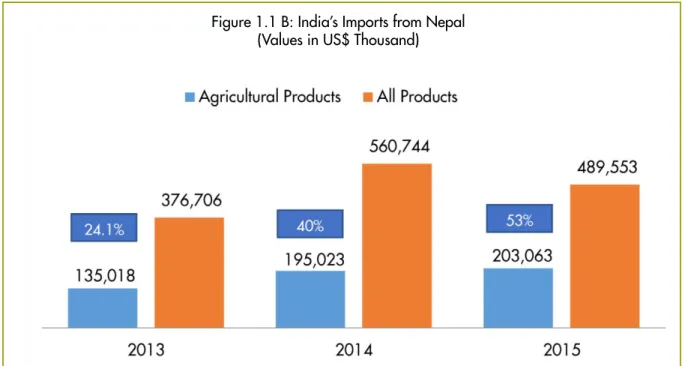
Figures 1.1.A and 1.1.B show the export and import flows of all products including agricultural products and non-agricultural products, between India and Nepal for the last three years (2013-2015).
In the entire trade between India and Nepal,
agricultural trade plays an important role. Although, the share of India’s exports to Nepal is less than the share of India’s imports from Nepal, the volume of exports is higher than imports. Major exports from India to Nepal are milled rice, maize, rice in husk, paddy, potatoes and wheat (excluding seed for sowing).
The agricultural products coming from Nepal to India through formal channels majorly comprise non-alcoholic beverages, cardamoms, nuts and tea.
There is negligible trade in agricultural seeds like wheat, rice, vegetable seeds from Nepal to India because of the restrictive policy of India on seeds trade.
Given the fact that the focus of work is on trade in agricultural inputs, particularly in seeds, fertilisers and agriculture machinery, Table 1.1 shows bilateral trade flows between India and Nepal in these products, in the last three years.
The data demonstrates that India’s exports in seeds to Nepal were US$36,026 in 2013 and increased to US$47,339 in 2015 while imports from Nepal were insignificant in the same period. Exports of fertilisers from India were US$15,286 in 2013 and decreased to US$11,083 in 2015. The declining export of fertilisers might be caused by restrictive export policy.
Moreover, India had no import of fertilisers from Nepal over these three years. Exports of
machinery products from India to Nepal have also declined from US$35,516 in 2013 to US$25,600 in 2015 and imports have also declined from US$1,633 in 2013 to US$1472 in 2015. The current bilateral trade flows in selected agricultural inputs reflects ups and downs.
Figure 1.1 A: India’s Exports to Nepal (Values in US$ Thousand)
Source: ITC Trade map, as on May 2017
1.1.2 Trade between India and Bangladesh
Despite varying political relations, economic and trade relationships between India and Bangladesh have improved over the years. In the recent years, India and Bangladesh have registered strong growth in their bilateral trade flows. This has contributed to significant social and economic development in both the countries (CUTS, 2014).
Figures 1.2.A and 1.2.B show the values of export and import between India and
Bangladesh, both in agricultural products and all products. It is important to note that bilateral trade between India and Bangladesh is
dominated by agriculture products. This reflects traditional comparative cost advantage and trade complementarity in the agriculture sector of both the countries.
Bilateral Trade Flows between India and Nepal in Agricultural Inputs (2013-15)4 (Values in US$ thousand)
Product Label India’s Export to Nepal India’s Import from Nepal
2013 2014 2015 2013 2014 2015
Seeds 36,026 46,513 47,339 53 98 62
Fertilisers 15,286 10,743 11,083 0 0 0
Machinery 35,516 42,281 25,600 1,633 187 1,472
Source: ITC Trade Map database, as calculated on September 2016 Source: ITC Trade map, as on May 2017
Figure 1.1 B: India’s Imports from Nepal (Values in US$ Thousand)
Table 1.1
Table 1.2 shows the trade flows specific to seeds, fertiliser, and machinery between India and Bangladesh in 2013-15. Values of imports given in Table 1.2 reveals that India’s imports in seeds and machinery are very less relative to Bangladesh’s imports from India in the same products.
In case of imports of fertilisers, the value of imports in the year 2015 reveals that India’s imports of
fertilisers are approximately double of its exports to Bangladesh. This trade flow between India and Bangladesh is below the trade potential.
There is huge scope of gains from trade to both the producers and the consumers due to geographical proximity and ethnic ties among other reasons.
Source: ITC Trade map, as on May 2017
Figure 1.2 A: India’s Exports to Bangladesh (Values in US$ Thousand)
Figure 1.2 B: India’s Imports from Bangladesh (Values in US$ Thousand)
Source: ITC Trade map, as on May 2017
The main reason behind low trade flow is the restrictive trade policy in terms of high non-tariff barriers (NTBs), para tariff measures and lack of trade facilitation measures. Particularly in case of trade in agricultural inputs (seeds, fertiliser, and agriculture machinery), restrictive trade policy has been followed by both of the countries. It mainly includes stringent SPS and TBT measures related to trade of seeds and fertiliser, particularly by India.
1.2 Background and Context
It is a well-established fact that tariff and NTBs escalate the cost of export and import of goods and hence affects the growth of trade. This in turn, creates potential opportunities of informal trade particularly in those countries, which have geographical proximity and long open borders.
The issue of informal trade is well noted across many regions of Africa, South Asia and
Association of Southeast Asian Nations (ASEAN).
The informal trade is recognised as a major issue in the South Asian and Eastern South Asian countries.
A large body of literature proves that tariff and non-tariff barriers are the most important factors behind thriving informal trade. In a notable study by Taneja (2011) it was revealed that the volume of informal trade constituted 72 per cent of formal trade in the South Asian region (Taneja, 2005).
She further added that informal trade in the region is due to inadequate trade liberalisation in agricultural products.
The existing literature only provide adequate insights on existing drivers and estimates about total volume of informal trade but it does not deal with product specific drivers of informal trade and there linkages with livelihood of local people. This creates the need for a deeper analysis to
understand the product-wise drivers of informal trade.
This study is an attempt to understand the key drivers of informal trade in agricultural inputs (seeds, fertilisers and machinery) between India and Nepal and India and Bangladesh through primary-level survey. It also attempts to analyse the impact of informal trade in agricultural inputs on the livelihood of rural households in the border areas.
1.3 Objectives and Methodology
The overall goal of the study is to frame policy proposals for addressing high volume of informal trade in agricultural input products along the borders of India-Nepal and India-Bangladesh, in a way that it does not adversly impact the livelihood of the local economy negatively. The specific objectives of the study are:
Bilateral Trade Flows between India and Bangladesh in Agricultural Inputs (2013-15) (Values in US$ Thousand)5
Product Label India’s Export to Bangladesh India’s Import from Bangladesh
2013 2014 2015 2013 2014 2015
Seeds 24,237 24,629 23,442 27 47 —
Fertilisers 912 2,144 3,129 00 00 6,001
Machinery 15,114 15,398 17,448 117 143 183
Source: ITC Trade Map database, as calculated on September 2016 Table 1.2
• Understanding the drivers of informal trade in agriculture inputs across specific locations along the India-Bangladesh and the India-Nepal border,
• Understanding the impact of informal trade in agricultural inputs on the livelihoods of local people who are engaged in the same, and
• Suggesting policy recommendations for addressing informal trade in agricultural input products
To pursue these objective, CUTS along with its partners, have conducted field research in eight locations. The locations are Malda-Rajshahi and Coochbehar-Rangpur (near Indo-Bangla border);
and Madhubani-Gidhha and Arariya-Sunsari (near Indo-Nepal border).
The selection of these locations was done in
consultation with the International Maize and Wheat Improvement Centre (CIMMYT), which is
implementing a project study ‘Sustainable and
Resilient Farming Intensification in the Eastern Gangetic Plains (SRFSI)’ in the region, supported by the Australian Centre for International Agricultural Research (ACIAR).
At each location, three rounds of survey were done, comprising of one scoping visit and two rounds of field survey as per the Delphi technique. Scoping visits were made to contact project partners, establishing SRFSI contact points and identify grassroot stakeholders to be interviewed in the following two rounds of survey. Lists of 60 stakeholders, including both men and women, were prepared for each of the eight locations, comprising farmers, local agents, retailers and traders.
Some of these stakeholders were contacted in this round to identify key agriculture input product(s) at each location to be studied further, and to validate the draft questionnaire.
Questionnaires are given in Annexure -1 & 2.
Description of Selected Agricultural Inputs
Category India to Nepal Nepal to India
Dhanusha Sunsari Madhubani Arariya
Seed Rice Seed Vegetable Seed Wheat Seed Wheat Seed
(Sona Mansuli) (Gautam) (NL297)
Fertiliser DAP* DAP – –
Machinery Spray Machine Spray Machine – –
India to Bangladesh Bangladesh to India
Rajshahi Rangpur Malda Coochbehar
Seed Tomato Seed (Rocky) Rice (Guti Swarna) Paddy (BR11/BB11) Paddy (BIRI 28/
29/Heera)
Fertiliser DAP Thaiodin Sathi (Herbicide) —
Machinery Tractor Parts and CD Pump —
Nut Bolts
Note: *Di-Ammonium Phosphate Source: Primary Survey
Table 1.3
Three broad categories of agricultural input products were considered under the study – seed, fertiliser and machinery. Selection was made on the basis of the products which are brought illegally in that particular location from the other side of the border. Specific products identified at each of the selected location are given in the Table 1.3. Scoping visits were followed by finalising of the questionnaires and two other rounds of survey were conducted on an interval of two-three months, at each of the eight locations by using Delphi Technique.6 Same set of
respondents were interviewed in both the rounds of survey. The responses were validated and those respondents were eliminated whose responses did not match in both the rounds of survey.
Those respondents whose responses deviated by more than 20 per cent were deleted. Also, in some cases, there were some outliers, which too got eliminated. Thus, after elimination, analysis has been carried out on data collected from 240 respondents, 30 each from each of the eight locations. Some of the respondents were also deleted for some locations to maintain symmetry across all locations.
The questionnaire (see Annexure-1) was designed to accommodate almost all possible drivers that can influence informal trade in the selected
locations. The collected data on all such drivers has been analysed to develop strong narrative. Other than this, the study has also used the qualitative information collected from the relevant
stakeholders through interview method, group discussion, using a separate questionnaire, as given in Annexure-2.
There is no formal estimation of informal trade between India and Nepal in the existing literature.
Taneja (1999) in her study stated that informal trade between these two countries is eight to ten times higher than that of official recorded trade. It has also been highlighted in her study that the informal trade flow is mostly one- sided from India to Nepal. In recent times, it has been observed that farmers from Terai areas in Nepal use unregistered Indian varieties, such as maize that have been smuggled from India.
Similarly, the smuggling of agricultural inputs from India to Nepal also takes place in rice seeds (USAID and EAT, 2014) and fertilisers (Joshi et al, 2012). A seminal study by Tanjea and Pohit (2001) identified the role of policy related factors in thriving informal trade in South Asian region. These factors are tariffs, non-tariff barriers and ineffective trade facilitation.
Chaudhari (1995) quantified the informal trade between India and Bangladesh for the year 1992-93.
He estimated the volume of trade by using Delphi technique in the three states: Assam, Tripura and West Bengal. Results showed that in value terms, India’s total exports to Bangladesh were INR1165 crore in 1992-93. This figure was higher than 1992-93 formal exports (INR1050 crore) to Bangladesh. Among major traded
Chapter 2 Drivers of Informal Trade between India-Nepal and India Bangladesh:
A Literature Survey
commodity groups, food items and animal products account the major share of such exports (58.7per cent). Among the food items, sugar, rice (coarse), pulses (mainly lentil), common salt, food, and vegetables are being
smuggled (Chaudhari, 1995).
According to a survey, rice inbred varieties have covered 12 per cent of farming areas of Bangladesh in all seasons. In addition to this, informal trade also facilitates the movement of Bangladeshi seeds into India.
Farmers in India plant smuggled varieties such as BR 11 (released in 1980 by Bangladesh Rice Research Institute), BR 28 and BR 29 (released in 1994).
2.1 Drivers of Informal Trade
The situation where trading of product formally becomes difficult because of various factors, creates the situation of informal trade. Formal trade procedure is a cumbersome process, and requires passing through various stages. Therefore, traders, informal agents, or people living in the border areas, often tend to adopt the easy way, and start trading informally. Major reasons or drivers that are found by number of studies, which influence informal trade over formal, which are discussed in this section.
2.1.1 Trade Policy Drivers
Because of high dependence of people on agriculture in the border regions of India, Bangladesh and Nepal, it is argued that informal trade of agricultural inputs is highly influenced by trade policy regime at country level. Therefore, it is important to understand the role of trade policy in facilitating cross-border informal trade in agricultural inputs.
Trade Policy of India and Nepal for Selected Agriculture Inputs Table 2.1 analyses the restrictiveness of trade policy of India and Nepal in selected agricultural inputs. The import policy of India is restrictive for the trade of paddy seed, wheat seed, and potato seed.
On one hand, the import policy for other agricultural inputs, such as Diammonium Phosphate (DAP) and spray pumps are liberal and permit their imports. On the other hand, the export policy of India put restrictions on export of DAP and Urea while paddy, wheat and potato seeds are allowed for export.
The key reasons behind the extensive usage of restrictive trade policy is either to protect domestic market or to address domestic supply shortage. In addition, restrictions are also used to reduce the Restrictiveness of Trade Policy of India and Nepal for Selected Informally Traded Agricultural Inputs Import Policy
HS Code Agriculture Inputs India Nepal
10061010 Paddy Seed Restricted* Free
10019100 Wheat Seed Restricted* Free
07011000 Potato Seed Restricted* Free
31021000 Urea State Corporation State Corporation
31053000 DAP Free State Corporation
84242000 Spray Machine Free Free
Export Policy
10061010 Paddy Seed Free Free
10019100 Wheat Seed Free Free
07011000 Potato Seed Free Free
31021000 Urea Restricted* Free
31053000 DAP Restricted* Free
84242000 Spray Machine Free Free
Note: * Diammonium Phosphate Source: Trade policy of India and Nepal
Note: Restricted* - export and import is allowed with special permission from competent trade authority in respective country. For example, Directorate General of Foreign Trade (DGFT) regulates the export and import of products.
Table 2.1
potential risk of variety specific disease, which could come through trade.
The import and export policies of Nepal is liberal and allows trade of agricultural inputs. The import of Urea and DAP is managed by State Trading
Corporation in Nepal.
Trade policy of India and Bangladesh for selected agriculture inputs
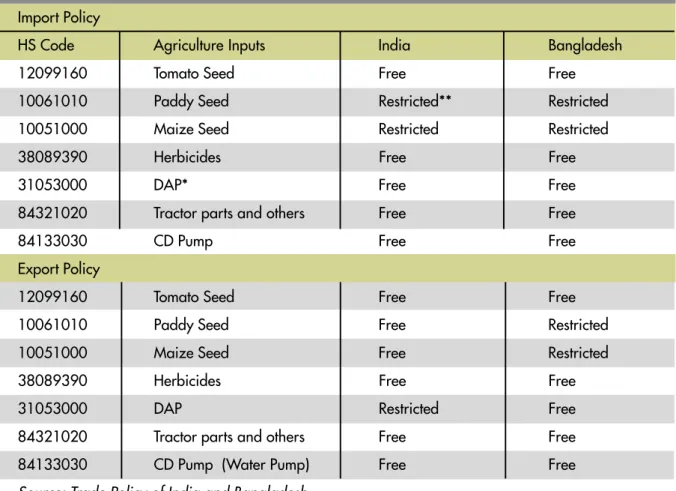
Table 2.2 shows the restrictiveness of trade policy of India and Bangladesh for selected agricultural inputs. The import policy of India for paddy seed
Restrictiveness of Trade Policy for India and Bangladesh Selected Informally Traded Agricultural Inputs Import Policy
HS Code Agriculture Inputs India Bangladesh
12099160 Tomato Seed Free Free
10061010 Paddy Seed Restricted** Restricted
10051000 Maize Seed Restricted Restricted
38089390 Herbicides Free Free
31053000 DAP* Free Free
84321020 Tractor parts and others Free Free
84133030 CD Pump Free Free
Export Policy
12099160 Tomato Seed Free Free
10061010 Paddy Seed Free Restricted
10051000 Maize Seed Free Restricted
38089390 Herbicides Free Free
31053000 DAP Restricted Free
84321020 Tractor parts and others Free Free
84133030 CD Pump (Water Pump) Free Free
Source: Trade Policy of India and Bangladesh Please Note:
*DAP is Diammonium phosphate,
**Restricted export and import is allowed with special permission from competent trade authority in respective country. For example, Directorate General of Foreign Trade (DGFT) regulates the export and import of products.
and maize seed is restrictive and imports of such seeds are not allowed. However, there is no restriction on the imports of other
agricultural inputs. The export policy of India is liberal, which permits the exports of most of the selected agricultural inputs except DAP.
Furthermore, the import and export policies of Bangladesh are open for all agricultural inputs except for paddy seed and maize seed. The restrictions are used to protect its domestic agriculture sector and domestic shortage.
Table 2.2
Tariff barriers
The role of high tariff barriers is intrinsically linked with cross-border informal trade (Taneja, 1999). A plethora of studies show that tariffs play a major role in thriving informal trade among three countries of Eastern South Asia. High tariff
provides ‘incentives’ to traders to circumvent formal channel and move towards informal channel. This in turn, allows them to save substantial amount of costs and makes the final product more profitable.
Tariffs are still high in India, Bangladesh and Nepal despite their consistent efforts towards trade liberalisation through various initiatives, such as SAPTA and SAFTA (Chatterjee and George, 2012).
Countries use different type of policy instruments to address their demand and supply shocks of agricultural commodities in Eastern South Asian countries. The most common policy instruments used include export restriction, quantitative
restrictions and ban of export (Dorosh 2009; Dawe 2010).
However, one of the major limitations of these studies is that they failed to establish the link between high tariff barriers and growth in informal trade. Though, there are some passing remarks to explain the relationship between the two but they lack substance and depth.
The prevailing tariff structure of selected agricultural inputs that are informally traded between India-Bangladesh and India-Nepal are given in Figure 2.1. It reflects that tariffs applied by
Overall, the bilateral trade policies of India and Bangladesh are not restrictive and allow exports and imports of majority of agriculture inputs
India are very high in comparison to tariffs applied by Bangladesh on the same set of products. The import tariffs are very high on paddy and maize seeds by India as compared to Bangladesh. Similarly, in case of India-Nepal, tariffs applied on the imports of selected
agriculture inputs are high in India as compared to Nepal.
India maintains high import tariffs on paddy seed, wheat seed and potato seed. The current tariff structure of agriculture inputs in India, Bangladesh and Nepal clearly demonstrates that high tariff provides significant scope to traders and local people to indulge into informal trade.
The informal channel is always attractive both for traders and consumers because of two reasons. First, traders circumvent duties and taxes while trading through informal channel, allowing them to generate higher economic gains. Second, consumers are able to buy informal traded products at affordable prices.
The vested interest of both traders and consumers acts as natural driver of flourishing informal trade. Therefore, high tariffs could be considered as a potent factor behind growing informal trade in agricultural inputs between India-Bangladesh and India-Nepal.
Informal trade plays an important role in price convergence and co-movement of certain agriculture products. In this context, a notable study by Akhter (2017) analysed ‘the spatial market integration between an adjacent rice surplus market (India) and deficit markets (Bangladesh and Nepal) in the wake of global financial crisis of 2007-08’. The study
summarised that domestic prices of rice are closely integrated both in short run and long run period among the three countries. The key reason for ‘smooth price transmission and market co-integration’ in India, Bangladesh and Nepal are associated with a significant volume of informal trade. The study clearly outlined the importance of promoting convergence in food policies between these countries.
2.1.2 Non-Tariff Barriers
NTBs include a variety of trade impediments and regulations, such as: TBT and SPS; administrative and custom procedures; arbitrary export ban; licensing; trade through state agencies; mandatory labelling and packaging; infrastructural barriers; export and price- based measures – quotas and Voluntary Export Restraints (VERs), state level taxes, antidumping and countervailing duties; among others. Intra-regional trade within South Asia is subject to wide range of NTBs (CUTS 2013).
Source: Extracted from Customs manuals of India, Bangladesh and Nepal 2016-17
Figure 2.1: Import Tariff on Selected Agriculture Inputs in India, Bangladesh and Nepal
Prevalence of NTBs is one of the most important factors behind the sub-optimal growth of cross- border trade between India- Bangladesh and India-Nepal.
Bilateral trade between India- Bangladesh and India-Nepal is hindered by different types of NTBs. A study by Asian Development Bank (ADB and UNCTAD, 2008) found that there exist a large number of NTBs, mainly related to TBT and SPS measures. The former is related with labelling requirement while the latter is related with safety related regulations, to ensure food security and prevent spreading of diseases. Both SPS and TBT measures made up 86 per cent of all NTBs in South Asia. Among South Asian countries, India, Bangladesh and Nepal have high number of incidence of TBT and SPS related measures.
In India, there exist bio-security and SPS related regulations. All agricultural imports including livestock and food products require some kind of SPS
certificate and import permit. The procedure of getting such certificates is often cumbersome and time consuming (Raihan et al, 2013).
In a similar manner, Bangladesh and Nepal have their specific food safety and SPS related regulations that largely aim to check the quality of imported agricultural products. The purpose of these regulations is to ensure the quality of imports but there are many occasions when SPS and TBT related regulations have been used in a disguised manner to prevent exports. Other than SPS and TBT measures,
India, Bangladesh and Nepal tend to use export restrictions to deal with seasonal shortages of agricultural commodities, such as rice, onion, potato and fish.
Incidence of NTBs is high due to low level of standards, especially in Nepal and Bangladesh. There exist huge inequality with regard to the development of standards and testing procedures and cooperation. The Indian standards and testing procedures are relatively developed as compared to Nepal and Bangladesh and they find it difficult to comply with the Indian standards. On the other hand, it is to be noted that legal and regulatory frameworks in India, Bangladesh and Nepal are not fully harmonised.
Regulatory framework dealing with agricultural inputs is divergent and creates disguised trade barriers.
For example, a SPS certificate issued by the Indian testing agency is not accepted by Bangladesh testing agency despite the
agreement for cooperation between Bureau of Indian Standards (BIS) and Bangladesh Standards and Testing Institution (BSTI). This is happening due to divergent testing procedures for particular ingredients of the product at laboratory level in each country.
The aforementioned literature fails to establish a clear link between NTBs and cross-border informal trade due to limited empirical evidence by which the direct relationship between the two could be clearly contextualised. One of the key reasons behind this is that a gamut of exogenous factors that come in the state of play and influence the cross-border informal trade cannot be envisioned. Therefore, it is very challenging to establish a direct relationship between the prevalent NTBs and their impact on cross-border informal trade in the region.
However, it is well established fact that complexities arising due to divergent rules and regulations in Eastern South Asian region make cross-border trade a formidable task for traders. Frequent quarantine checks and administrative hassles in cross-border trade between India-Bangladesh and India-Nepal compels traders, agents and local people to engage in informal trade as they are able to evade administrative checks, phyto-sanitary inspection and other related regulatory requirements. The relationship between increasing prevalence of NTBs and increasing cross-border informal trade among Eastern South Asian countries is palpable.
The cost associated with NTBs and uncertainties due to non- transparent regulations affect the profitability of traders. This in turn, encourages them to indulge in informal trading. This is, particularly true in case of cross-border informal trade in seeds between India-Nepal and India-Bangladesh. Divergent SPS measures for seeds trade in India, Nepal and Bangladesh is
Bilateral trade flows between India-
Bangladesh and India- Nepal are concentrated in agricultural
products and encounter a large number of NTBs. The most common NTBs in agriculture products are SPS and TBT related requirements, which usually arise due to lack of
harmonisation of trade, regulatory
standards, testing and certification
procedures
pushing the significant volume of formal trade into informal trade where there is no SPS monitoring.
This demonstrates that NTBs could be another important factor, which compels traders to find alternative ways, resulting in increased informal trade between India-Bangladesh and India-Nepal.
2.2 Drivers Related to Trade Facilitation
One of the major obstacles in enhancing regional trade in South Asia is associated with the quality of trade and transport infrastructure. Poor quality of soft and hard infrastructure in South Asia
Legal and Regulatory Framework for Agriculture Inputs in India, Bangladesh and Nepal
Source: Governments of India, Nepal and Bangladesh Agricultural
Inputs Seeds
Fertiliser
Machinery
India
1966 Seeds Act and amendments;
Seeds Rules and amendments;
Seeds (control) order;
New Policy on Seeds Development,1988;
Destructive Insects and Pests Act, 1914;
Plants, Fruits and Seeds (regulation of import into India) Order, 1989;
Plant Variety Protection act and regulations.
The Fertiliser Control Order, (FCO) 1957;
Essential Commodity Act, 1955;
1973 Fertiliser (Movement Control) Order.
Indian Bureau Standards (BIS)
Bangladesh
Seed Ordinance, 1977;
Bangladesh Seed Policy, 1993;
Biosafety Guidelines, gazetted in 2008;
National Biosafety Framework, gazetted in 2008;
Bangladesh’s Plant Quarantine Act 2011 (GOB 2011);
Destructive Insects & Pests Rules, 1966 (Plant Quarantine) (GOB 1989).
Fertiliser (Control) order, 1999;
Fertiliser Management Act, 1995, and Subsequent amendments.
Bangladesh Standard Testing Institute (BSTI)
Nepal
Seeds Act 2045 (1988) as revised through 2010;
The Plant Protection Act 2059;
Plant Variety and Farmers’ Rights Protection Bill.
Chemical Fertiliser (Control) Order, 1998;
Chemical Fertiliser Directives, 2000;
The National Fertilizer Policy 2002, and Revisited 2009.
Nepal Bureau of Standards &
Metrology (NBSM)
magnifies the cost of cross-border trade, thereby affecting the growth of regional trade in the region (De, 2014). South Asian countries face two major impediments in terms of trade and transport facilitation.
The first problem is related to procedural, administrative, regulatory issues as well as absence of transit agreements and weak ICT. The second problem relates with the state of road, railway and trade infrastructure (testing agencies, banking facilities, and border management agencies).
Table 2.3
Currently, trade and transport facilitation between India and Banglades