Transcultural Perspective
Comparing Kauäilya with Sun-Zi, Nizam al-Mulk, Barani and Machiavelli
The ArthaàÈstra in a
Transcultural Perspective
Comparing Kauäilya with Sun-Zi, Nizam al-Mulk, Barani and Machiavelli
Editors
Michael Liebig Saurabh Mishra
INSTITUTE FOR DEFENCE STUDIES & ANALYSES NEW DELHI
P E N T A G O N P E N T A G O N P E N T A G O N P E N T A G O N
P E N T A G O N P R E S S P R E S S P R E S S P R E S S P R E S S
Editors: Michael Liebig and Saurabh Mishra
First Published in 2017
Copyright © Institute for Defence Studies and Analyses, New Delhi
ISBN 978-81-8274-938-2
All rights reserved. No part of this publication may be reproduced, stored in a retrieval system, or transmitted, in any form or by any means, electronic, mechanical, photocopying, recording, or otherwise, without first obtaining written permission of the copyright owner.
Disclaimer: The views expressed in this book are those of the authors and do not necessarily reflect those of the Institute for Defence Studies and Analyses, or the Government of India.
Published by PENTAGON PRESS
206, Peacock Lane, Shahpur Jat, New Delhi-110049
Phones: 011-64706243, 26491568 Telefax: 011-26490600
email: [email protected] website: www.pentagonpress.in
In association with
Institute for Defence Studies and Analyses No. 1, Development Enclave,
New Delhi-110010 Phone: +91-11-26717983 Website: www.idsa.in
Printed at Avantika Printers Private Limited.
Preface vii
Contributors ix
1. Introduction 1
Michael Liebig and Saurabh Mishra
2. Kauäilya Redux? Re-use, Hybridity, Trans-cultural Flow and
Resilience of the State in India 31
Subrata K. Mitra
3. Understanding Kauäilya’s ArthaàÈstra: Origination,
Migration and Diffusion 68
Pradeep Kumar Gautam
4. Kauäilya and Machiavelli in a Comparative Perspective 113
Michael Liebig
5. ArthaàÈstra: Reflections on Thought and Theory 172
Medha Bisht
6. RÈjadharma, Legitimacy and Sovereignty in the ArthaàÈstra 195
Saurabh Mishra
7. Kauäilya and Sun-Zi: Comparative Philosophical Analysis 222
M.S. Prathibha
8. FatÈwÈ-ye jahÈndÈri: Hybrid Political Theory in the Delhi Sultanate (Perso-Islamic and Endogenous Traditions of
Statecraft in India) 241
Seyed Hossein Zarhani
References 264
Index 286
This edited volume continues the series of publications of the Institute for Defence Studies and Analyses (IDSA) that address the pre-modern Indian political theorist Kauäilya and the relevance of his thought for contemporary strategic thinking and practice. The three conferences on Kauäilya’s ArthaàÈstra organised by IDSA since 2012 are documented in three edited volumes.* These contain analyses of the core ideas and concepts of Kauäilya’s ArthaàÈstra and investigate their relevance for India’s strategic culture.
This particular volume takes us a step further by situating Kauäilyan thought in a comparative perspective. That means, first, taking a trans-temporal, mainly intra-cultural perspective on the significance of Kauäilyan thought for the evolution of India’s political institutions and practices. Here, the concepts of intra and trans-cultural hybridity, and the ‘re-use of the past’ are key. In addition, a comparative perspective involves correlating Kauäilya to pre-modern political thinkers of other civilisational spaces and historical contexts, such as Sun Tzu, Ziauddin Barani, Niccolo Machiavelli, and Nizam-ul-Mulk.
The impulse for these publications came from a brainstorming in spring 2014, when a group of researchers from IDSA and the South Asia Institute (SAI), University of Heidelberg, met in New Delhi. They shared the view that the academic evaluation of the core concepts of Kauäilya’s ArthaàÈstra – and their contemporary relevance – remain inadequate, and devoid of a comparative dimension. As a result, two trilateral workshops were held: one in May 2015 at IDSA in New Delhi, and another in February 2016 at ISAS in Singapore – the latter titled ‘Evolution of the Modern State in India: Comparing Kauäilya, Machiavelli, Nizam-ul-Mulk, Barani and Sun-Tzu.’ Meanwhile, Prof. Subrata
*Gautam, P.K. / Mishra, S. / Gupta, A. (Eds.) (2015, 2016a/b): Indigenous Historical Knowledge – Kautilya and his Vocabulary, vols. I, II, III. New Delhi: Institute for Defence Studies and Analyses/Pentagon Press.
Mitra moved from Heidelberg to the Institute of South Asia Studies (ISAS), National University of Singapore.
The project has been enriched by the researchers and their research subjects drawn from different cultural and national traditions. The research results presented at the workshops are both interesting and novel – offering fresh insights into the evolution of the science of politics, statecraft, and inter-state relations.
We are delighted that these research findings are being shared with a wider audience.
Jayant Prasad Subrata Mitra
Director General, IDSA Director ISAS, NUS
Col. Pradeep Kumar Gautam (Retd.) is currently a Research Fellow in the Military Affairs Centre at the Institute for Defence Studies and Analyses (IDSA), New Delhi, India.
Dr. M. S. Prathibha is currently an Associate Fellow in the East Asia Centre at the Institute for Defence Studies and Analyses (IDSA), New Delhi, India.
Dr. Medha Bisht is an Assistant Professor in the Department of International Relations at the South Asian University, New Delhi, India.
Dr. Michael Liebig is a Fellow and Lecturer at the South Asia Institute, Heidelberg University, Germany.
Dr. Saurabh Mishra is a Research Assistant at the Institute for Defence Studies and Analyses (IDSA), New Delhi, India.
Dr. Seyed Hossein Zarhani is a Fellow and Lecturer at the South Asia Institute, Heidelberg University, Germany.
Prof. Subrata K. Mitra is the Director of Institute of South Asian Studies, National University of Singapore, Singapore.
1
Introduction
Michael Liebig and Saurabh Mishra
In writing this introduction, we have to take a somewhat bigger sweep. This edited volume is already the fifth in a series of books published by the Institute for Defence Studies and Analyses (IDSA) that are addressing Kauäilyan thought and its contemporary relevance.1 This volume, however, is the first in the series that has an international character right from the beginning – both with respect to the researchers involved and its subject area – looking at Kauäilya’s ArthaàÈstra in a comparative, transcultural perspective. Yet, it needs to be emphasised that it was a long way until the ‘comparative moment’ was reached.
The contents of this edited volume are derived from two workshops on Kauäilyan thought – one in May 2015 at the IDSA in New Delhi and the other one in February 2016 at the Institute of South Asian Studies (ISAS), National University of Singapore. However, the genesis of this book goes back to 2012, when a group of Political Science researchers from India and Germany2 came to the conclusion that the idea-contents of Kauäilya’s ArthaàÈstra are far too important for Political Science – political theory, International Relations (IR) theory, Security Studies and Intelligence Studies – as to be solely left to Sanskrit philologists. Unquestionably, Indology has done most valuable scholarly work on the ArthaàÈstra – including making it accessible to the social sciences. But we thought that a fresh approach was overdue that situated Kauäilyan thought firmly in a Political Science frame. After all, the ArthaàÈstra deals with political theory and theorised statecraft and Kauäilya himself calls it a work of ‘Political Science’. We felt that we should work with respect to Kauäilya’s ArthaàÈstra
in a directionality that somewhat paralleled that of Amrita and Aruna Narlikar with respect to the MahÈbhÈrata.3 We had, still somewhat vaguely, three research areas in mind:
(a) Exploring the relevance of Kauäilyan ideas and concepts for the present – that is, the foreign and domestic policies of post-independence India.
(b) The interpretive explication of the central ideas and concepts of Kauäilya’s ArthaàÈstra with respect to its domestic and foreign policy dimension.
(c) Exploring the significance of Kauäilya for the genealogy of political thought and the evolution of Political Science and IR theory.
Back in 2012/13, the focus of our research had been the relevance of Kauäilyan thought for present-day India.4 What influence, if any, does Kauäilyan thought have on post-independence India’s institutional evolution and political culture as well as on Indian strategic culture? Through expert interviews and the (content) analysis of contemporary political and strategic texts, our research finding was rather clear-cut: Yes, Kauäilyan thought-figures are a significant ideational ingredient of modern India’s politico-strategic culture. This applies to the manifest influence of Kauäilyan thought via the conscious and deliberate
‘re-use of the past’ (Mitra) in addressing contemporary challenges by politico- strategic actors – embedded in India’s paradigm of the ‘modernity of tradition’.5 Equally significant is the latent influence of Kauäilyan thought within the
‘habitus’ (Bourdieu) of political and strategic actors as well as within ‘popular politicising’.6 Subrata K. Mitra’s article in this volume provides the theoretical entrée to the question of the relevance of Kauäilyan thought for modern India’s political institutions and behaviour.
However, we quickly came to a second and quite sobering finding – the consequence of which is this volume: In order to explore the contemporary relevance of Kauäilya, it is indispensable to thoroughly study the ArthaàÈstra – which means analysing and explicating its central ideas and concepts. That is actually a simple and logical correlation: Without an in-depth understanding of the ArthaàÈstra’s idea-contents, there can be no adequate understanding of its (continual) efficacy in present-day political and strategic contexts. Yet, we realised that, to the extent Political Science has addressed the contemporary relevance of Kauäilyan thought at all, this simple and seemingly self-evident fact has been mostly disregarded.
In a philological framing, Indologists have debated endlessly about the authorship and dating of the ArthaàÈstra, while, not surprisingly, showing only sparse interest in its idea-contents in terms of Political Science and IR theory.
Yet, Kauäilya does state consistently that his ArthaàÈstra is a work of ‘Political
Science’ and, indeed, with respect to its subject areas, its explicitly stated methodology and its philosophical underpinnings, the ArthaàÈstra has to be characterised as a (pre-modern) work of Political Science and IR theory. But most political scientists and IR theorists, including in India, have either ignored the ArthaàÈstra altogether or have been content with merely superficial knowledge of the work via secondary literature. Such ignorance and sciolism in the Political Science milieu has embarrassing consequences: crude misrepresentations of the idea-contents of the ArthaàÈstra and unsubstantiated ideological attributions to Kauäilya like expounding anti-secular ‘brahmanical political theology’, panegyrising the caste system7 or pushing cynical power politics devoid of any ethical constraint.8 Kauäilya is being paraded as the golden boy of those pushing for ‘indigenism’ and ‘nativism’ in Indian Political Science and thus, albeit indirectly, reactionary Hindutva ideology.9 We come back to such misrepresentations and ideological projections in some more detail below.
While we keep the question of Kauäilya’s relevance for both contemporary India’s politico-strategic behaviour and for the evolution of Political Science firmly in the back of our minds, we first concentrate on the ArthaàÈstra’s idea- contents. In this introduction, we first sketch the conceptual gestalt of the ArthaàÈstra as a whole. Then, we analyse and explicate, in a concise fashion, its central thought-figures. The enterprise of analysis and explication of the core ideas and concepts of Kauäilya’s ArthaàÈstra leads inevitably to the necessity to introduce a comparative dimension. Without the inclusion of a comparative approach, the analysis and explication of Kauäilya’s core ideas and concepts would remain one-dimensional and miss out on their actual intellectual substance and value. But that is not really an issue for this introduction, but the subject of the essays in this volume.
In a Political Science perspective, the main characteristics of Kauäilya’s ArthaàÈstra in its entirety can be listed as following:
(a) Foundational text of (pre-modern) political theory and theorised statecraft (Political Realism).
(b) Scholarly exposition of its contents (Book XV deals exclusively with methodology).
(c) Basic assumption: autonomy, normative eigenvalue and inherent logic of the political sphere and statecraft.
(d) No ‘ideological’ presuppositions in religious, metaphysical, moralistic or eschatological terms.
(e) Experience-saturated (Kauäilya’s own participant observation in state affairs).
(f) Theoretical text featuring an ideal-type polity (ideal-type in Max Weber’s sense).
(g) No historiographic account of the politics and institutions of the Maurya Empire.
(h) Instructional, but no utopian construction.
(i) Holistic understanding of the state and statecraft (Grand Strategy):
governance, administration, economy, legal system, foreign affairs, intelligence and military strategy.
(j) Ideal-type polity based on the patrimonial state (monarchy).
(k) Agency perspective in foreign affairs: The Kauäilyan ‘revisionist’ ruler (vijigÏ–u) pursues the unification of the politically fragmented Indian subcontinent.
Next, we need to sketch our interpretive explication – in the framing of Political Science and IR theory – of the central ideas and concepts of Kauäilya’s ArthaàÈstra. While, within our group, Saurabh Mishra possesses basic knowledge of Sanskrit, we had to rely on translations of the ArthaàÈstra from the Sanskrit. We could draw not only on English translations, our clear choice being R.P. Kangle’s 1972 translation, but also on Johann Jakob Meyer’s 1926 German translation from the Sanskrit original.10 Beyond the problem that both (excellent) translators are unfamiliar with Political Science/IR terminology, we were faced with the problem of explicating latent meanings of some Kauäilyan narratives and his sometimes rather metaphorical vocabulary.
For example, the ‘idea’ or conceptual meaning (sinngehalt, as Max Weber would put it) of raison d’état is ever present in the ArthaàÈstra. Yet, the category of raison d’état is still absent – both in the Sanskrit original and the English and German translations. Thus, the explication of latent idea-contents in this pre-modern text of political theory is not simply a matter of ‘correct’ translation, but necessitates the interpretive utilisation of categories and concepts of modern Political Science. Such interpretive approach is no anachronism since the (political) subject matter addressed by both the pre-modern idea and the modern category is ontologically self-similar and time-transcending. And, equally important, the modern category is genetically rooted in the pre-modern idea.
One might say, the ‘idea’ is the category ‘in its youth’ – both share the same basic meaning, but the category has a more complex semantic morphology in terms of dimensions of meaning and their delineations.
The validity of our approach – ‘Political Science Hermeneutics’, as one might say – for interpreting a pre-modern text of political theory is supported by the puzzling fact that in Machiavelli’s political writings too the category of raison d’état is missing. However, as in the case of Kauäilya some 18 centuries
earlier, the idea of raison d’état permeates The Prince and the Discorsi. No cognoscenti of Machiavelli’s writings would dispute that, and many people, even political scientists, assume that the term raison d’état was coined by Machiavelli. In fact, the category raison d’état [ragion di stato] was first developed by Giovanni Botero some six decades after Machiavelli’s death.
Botero defined raison d’état as “the knowledge of the means and measures that are necessary to establish, preserve and enlarge a state.” We may add:
Botero’s definition of raison d’état is fully homologue with both Kauäilya’s and Machiavelli’s idea of it.11
The Core Concepts of Kauäilya’s Arthaàästra
The Political Science-vectored analysis and interpretation of Kauäilya’s ArthaàÈstra yields a core set of ideas, concepts and concept clusters. These central concepts do not map the actual comprehensiveness and richness of valuable and time-transcending thought-figures in the ArthaàÈstra, but understanding them is the necessary precondition for any meaningful engagement with the text itself as well as the exploration of the relevance of Kauäilyan thought in historical and contemporary contexts. Therefore, we provide in the following a brief sketch of these concepts and concept clusters:
(a) Political anthropology: the basic disposition for material gain and power – and consequent conflicts of interest and anarchy (mÈtsya-nyÈya).
(b) The saptÈnga theory: the ‘seven state factors’ (prak‚ti) constituting the power of the state
(c) The –ÈÇgu‡ya theory: the ‘six methods of conducting foreign policy’.
(d) The upÈyas cluster: ‘the four basic means of politics’.
(e) The ma‡Çala scheme: the ideal-type constellation of friendly, adversary and neutral states.
(f) The Kauäilyan idea of raison d’état based on the saptÈnga and –ÈÇgu‡ya theories.
(g) Kauäilya’s political realism.
(h) The normative foundations of Kauäilyan thought.
(a) Political Anthropology
Kauäilya accepts the pursuit of lust, material gain and power (‘the six enemies’) as ‘facts of life’. These basic anthropological dispositions must be hedged, argues Kauäilya, but cannot be denied nor durably eradicated. Thus, politics must soberly take the anthropological realities of seeking wealth and power into account. Kauäilya writes: “Material gain, spiritual good and pleasure: this
is the triad of gain. Of that, it is better to attain each earlier one in preference to each later one.” And: “Since material wealth is the root of spiritual good and has pleasure for its fruit, the attainment of that utility means attainment of all gains.”12
Kauäilya’s political anthropology has a second basic feature: Human beings, individually as well as in social groups, pursue ‘selfish’ interests because of their basic dispositions of greed and striving for dominance. Therefore, conflicts of interest are inevitable and they often lead to (violent) conflicts. For Kauäilya, conflicts of interest and subsequent non-violent and violent struggles between individuals and social groups (family, clan, tribe or state) are an anthropological constant in human existence.13 Usually, the resolution of conflicts of interest and struggles derived thereof means that the stronger party enforces its will upon the weaker party. This basic anthropological situation – mÈtsya-nyÈya or anarchy – is expounded by Kauäilya already at the beginning of Book I of the ArthaàÈstra: [T]he law of fishes (mÈtsya-nyÈya). For, the stronger swallows the weak in the absence of the wielder of the rod.14
To summarise: Kauäilya’s political anthropology rests on two basic theorems: the preponderance of the pursuit of material gain and power and the conflictual nature of social and inter-state relations. These anthropological constants are neither philosophically elevated nor ethically abominated. As basic ‘facts of life’, these anthropological dispositions must be carefully considered in political theory as well as in practical statecraft.
(b) SaptÈnga Theory
In Books VI and VIII of the ArthaàÈstra, Kauäilya expounds the saptÈnga theory which refers to the seven ‘constituents’ (Kangle) or ‘state factors’ (Meyer).
The seven prak‚tis are:
1. swÈmÏ: the ruler
2. amÈtya: the Minister [government and administration]
3. janapada: territory & the people [in the countryside]
4. durga: the fortress [capital city]
5. koàa: the treasury [economy]
6. da‡Ça: armed might
7. mitra: the ally [in foreign policy]
The saptÈnga theory is the conceptual foundation of Kauäilya’s theory of the state as well as statecraft (with respect to domestic as well as foreign policy):
The king and his rule [state], this is the sum-total of the seven constituents of
the state.15 For Kauäilya, all seven prak‚tis constitute (state) power, not just armed might. The saptÈnga theory means that state power is an aggregate of material and immaterial variables. Thus, state power can, if not precisely measured, at least be adequately evaluated and estimated. Kauäilya provides a substantive concept of state power, which is comprehensive as well as differentiated in itself. Kauäilya’s holistic and substantive concept of state power is a truly outstanding theoretical achievement.
The singular significance of the saptÈnga theory for the evolution of Political Science becomes evident when we compare Kauäilya’s ArthaàÈstra with the political writings of Niccolo Machiavelli. In The Prince, the 10th chapter is titled: ‘How the strength of all states should be measured,’ but what Machiavelli writes there does not even approximate the theoretical quality of Kauäilya’s saptÈnga theory. Kauäilya’s saptÈnga theory becomes even more impressive when we relate it to Hans J. Morgenthau’s theory of Political Realism in the mid-20th century. In his most famous book, Politics Among Nations, Morgenthau develops the concept of ‘national power’ which shows remarkable homologies with Kauäilya’s concept of state power. Morgenthau’s concept of
‘national power’ includes the following components which are partly material and quantitatively measurable variables, partly immaterial, intellectual-mental factors: 1) the geographical setting of a state (while sharply rejecting the theory of geopolitics); 2) the availability of raw materials and agricultural products;
3) the industrial potential; 4) the population size; 5) the military potential of a state; 6) ‘national character’; 7) ‘national morality’ and 8) the ‘quality’ of government and diplomacy.16
(c) “ÈÇgu‡ya Theory
In Book VII of the ArthaàÈstra, Kauäilya sets forth the –ÈÇgu‡ya theory: a state has six policy options for the conduct of its foreign policy – nor more, no less: “These are really six measures, because of differences in the situations”, says Kauäilya.17 The ‘six methods of foreign policy’ are:
1. peace (sa£dhi) 2. war (vigraha)
3. ‘staying quiet’, ‘wait and see’, neutrality (Èsana)
4. ‘marching’, coercive diplomacy, mobilisation for war (yÈna) 5. ‘seeking shelter’, alliance building (sa£àraya)
6. ‘dual policy’, diplomatic duplicity (dvaidhÏbhÈva)
The –ÈÇgu‡ya cluster can be understood as a continuum of which peace and war are the poles. However, neither peace nor war is normatively charged
up by Kauäilya. Yet, for reasons of purposive political rationality, a policy of achieving policy aims without going to war, is preferred by Kauäilya, because war inevitably means the destruction of personal and material resources: one’s own and the enemy’s.
The selection of one of the six methods of foreign policy is wholly dependent on situational factors, yet it follows an inherent logic. The guiding principle, in determining which of the six foreign policy options is to be adopted, derives from the intrinsic connectivity between the sÈÇgu‡ya and saptÈnga theories: The circle of constituent elements [the seven prak‚tis] is the basis of the six measures of foreign policy [–ÈÇgu‡ya].18
Kauäilya wants an objective assessment of the situation in policy planning.
In inter-state relations, there are necessarily at least two independent actors involved. Therefore, it is not one’s own state’s power potential (prak‚ti aggregate) that is decisive, but the ratio of the prak‚ti aggregates of two (or more) states. Before making decisions in foreign policy, the task of the ruler and his advisers is ascertaining the relative strength or weakness of powers.19 The ratio of prak‚ti aggregates or the correlation of forces is the key concept of the Kauäilyan theory of inter-state relations. The seven parameters of the saptÈnga theory provide objective and substantive criteria for making a sound assessment of the correlation of forces between competing or adversary states and deciding on the course of action in foreign policy. The correlation of forces (in terms of prak‚ti aggregates) determines which of the six foreign policy methods has to be chosen:
1. peace > the rival state is stronger and will remain so in the foreseeable future.
2. war > the rival is vastly inferior in power.
3. neutrality > the correlation of forces is balanced.
4. coercive diplomacy > one’s own power is rising vis-a-vis the rival state.
5. alliance building > the rival state’s power is rising faster than one’s own.
6. diplomatic double game > the constellation among rivals and allies is highly fluid.
Kauäilya’s insistence that the conduct of foreign policy is restricted to a fixed array of policy options, is shared by Hans J. Morgenthau: “Governments might have been wise or unwise in their choice of policies, successful or unsuccessful in their execution; they could not have escaped the rational necessity of selecting one of a limited number of avenues through which to
bring the power of their nation to bear upon the power of other nations on behalf of the national interest.”20
(d) The UpÈya Cluster
The upÈyas are not an original Kauäilyan concept, but go back to the oldest sources of ancient Indian political literature.21 In the ArthaàÈstra, the upÈyas are explicitly introduced in the 10th chapter of Book II, but Kauäilya refers to them many times in course of the text. The means [of politics] are conciliation (sÈma), gifts (dÈna), dissension (bheda) and use of force (da‡Ça).22
Following Max Weber, one may say that the upÈyas state how a political actor can enforce his will against the resistance of another actor(s). While the upÈyas – the four basic principles of political action – apply to all fields of politics, the –ÈÇgu‡ya cluster can be seen as a derivative of the upÈyas in the field of foreign policy. For Kauäilya, there is a ranking among the upÈyas; its criterion being the amount of effort necessary to enforce one’s will upon the other party.
This is the group of four means. Each preceding one in the enumeration is the easier and lighter one. Conciliation is simple. Gifts are twofold being preceded by conciliation. Dissension is three-fold, being preceded by conciliation and gifts. Use of force is four-fold, being preceded by conciliation, gifts and dissension.23
(e) The Ma‡Çala Scheme
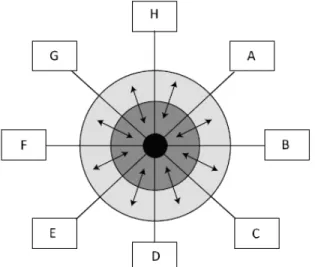
The Kauäilyan ma‡Çala conception is based on an ideal-type constellation of states: In the centre of concentric circles of states, the ‘activist’ or ‘revisionist’
state of the vijigÏ–u is located – like the hub of a wheel. Grouped around it, are the immediate neighbour states, which are regarded as enemy states (ari). In the rear of the first circle of (enemy) states, there is a second circle of states.
These indirect neighbours are friends (mitra) or potential allies, because their relation to the first circle states – their direct neighbours – is hostile. Beyond these two circles of states, come two more. The ordering principle of the ma‡Çala scheme is: direct neighbour equals to enemy, and indirect neighbour equals to friend.24 For the ‘activist’ state, the first and third circle tends to be hostile, while the second and the fourth circle is friendly. However, beyond friends and enemies, there are middle states (madhyama), bordering the ‘activist’
state and its allies as well as its enemies. And, there are distant powerful or neutral states (udÈsÏna), which (at least temporarily) stay out of the conflicts in which the ‘activist’ state is involved.
The ma‡Çala conception is often described as the ‘essence’ of the Kauäilyan theory of foreign policy. However, we do not think that the ma‡Çala scheme defines a rigid friend-foe relation in the sense of a quasi-geometric and/or
‘geopolitical’ determination. The ma‡Çala scheme is designed to provide a dynamic foreign policy orientation for the vijigÏ–u – the ruler who is trying to form one dominant state out of a multitude of smaller states. After all, once the direct neighbour has been conquered or made a vassal, the erstwhile (second- circle) friend becomes an enemy. Kauäilya’s foreign policy theory is
‘revisionist’, because it aims at the elimination of political fragmentation on the Indian subcontinent – and the ma‡Çala scheme provides a conceptual framework for the strategy of forming a pan-Indian state structure. Once the vijigÏ–u has completed the unification of the subcontinent, he becomes the cakravartÏ – the ‘ruler of the earth’. But for Kauäilya, the ‘earth’ is the Indian subcontinent between the Himalaya and the sea.25 Beyond India’s geo-cultural boundaries, with respect to Tibet, China, Iran, Central Asia or the Indian Ocean rim states, the political status quo is not called into question by Kauäilya.
In Kauäilya’s strategic agenda of politically uniting the Indian subcontinent, we find a striking parallel with Machiavelli, whose political writings must be seen in the light of the strategic goal of Italy’s political unification and liberation from foreign domination.26 In Machiavelli’s time, at the turn of the 15th to the 16th century, Italy was not only politically fragmented, but suffered from serial foreign interferences and outright military invasions. Drekmeier rightly notes:
“Kauäilya was faced with the same need for political union in the face of disorder and external threat that confronted Machiavelli in northern Italy...Northern India was comparable in this respect to the Italy of Machiavelli’s time.”27 And Adam Watson writes:
Just as Machiavelli wrote a treatise called The Prince as a guide to a man who might be able to conquer and unite Italy, so Kauäilya wrote a manual called ArthaàÈstra or Book of the State. In this, he described in detail the nature of the Indian states system and the relations between one ruler and another, and explained how a prince, whom he called the conqueror [vijigÏ–u], might exploit the pattern in order to bring all India into a Persian-type of Empire. Kauäilya also found a man capable of doing this [Chandragupta Maurya], which Machiavelli did not.28
(f) The Kauäilyan Idea of Raison d’État
We noted above that the category raison d’état is absent in the ArthaàÈstra, while the idea of raison d’état permeates the work. The Kauäilyan idea of raison d’état is inextricably linked to the saptÈnga theory. The directionality of change that Kauäilya demands for the state factors (prak‚ti) is unambiguous as he wants the optimisation of the seven state factors. The fundamental benchmark for the conduct of policy – in domestic as well as foreign politics – is the
optimisation of the state factors. Preserving and expanding the power of the state, is the basic understanding of raison d’état shared by Kauäilya, Machiavelli and Botero as well as most modern IR theoreticians. For Kauäilya, the aggregate of the seven state factors constitute state power and the first imperative of statecraft is the optimisation of the seven prak‚tis – in quantitative and qualitative terms. And when the king is possessed of excellences, he makes the state factors perfect with their respective excellences.29 This optimisation imperative means that the Kauäilyan idea of raison d’état entails a substantive definition of the maintenance and expansion of the state’s power. Thus, the Kauäilyan idea of raison d’état loses the character of an abstract proposition and indeterminate maxim. Instead, Kauäilyan raison d’état acquires substantiality and can be operationalised.
However, there is also a normative dimension of the Kauäilyan idea of raison d’état. Kauäilyan raison d’état not only means maintaining and expanding the power of the state via the optimisation of the seven state factors, but also ensuring the welfare and security of the people. This normative pillar of Kauäilyan idea of raison d’état is not declaratory. In Book I of the ArthaàÈstra, Kauäilya states unambiguously: “In the happiness of the subjects lies the happiness of the king and in what is beneficial to the subjects is his own benefit.”30 Thus, the ruler is both the ‘first servant of the people’ and the ‘first servant of state’. In the sphere of statecraft, Kauäilya denies a fundamental contradiction between purposive political rationality – the inherent logic of the state, i.e. raison d’état – and normativity, i.e. assuring the welfare of the people. Moreover, in Kauäilya’s view, each of the two value ideas underpinning raison d’état has a dimension of purposive political rationality and a dimension of political normativity.
The Kauäilyan idea of raison d’état is rooted in the saptÈnga theory. And, equally so, the –ÈÇgu‡ya concept cluster is based on the saptÈnga theory because the choice of one of the six policy options depends on correlation of forces in terms of the state factors. Thus, we see a logical and substantive connectivity between the saptÈnga theory, the –ÈÇgu‡ya concept cluster and the Kauäilyan idea of raison d’état.
Kauäilya’s idea of raison d’état represents a ground-breaking intellectual achievement in the history of political thought. Referring to ancient Indian political thought and particularly to Kauäilya, Charles Drekmeier rightly notes:
“Thus does the problem of raison d’état develop [in ancient India]– before its appearance in the West.”31 While the category of raison d’état is an intellectual child of early European modernity, the idea of raison d’état was developed in pre-modern India and Kauäilya was the first to substantially theorise it.
(g) Kauäilya’s Political Realism
Kauäilya’s realist attitude in analysing political phenomena, is homologue with what Machiavelli writes in his The Prince:
But my intention being to write something of use to those who understand, it appears to me more proper to go to the real truth of the matter than to its imagination; and many have imagined republics and principalities, which have never been seen or known to exist in reality; for how we live is so far removed from how we ought to live, that he who abandons what is done for what ought to be done, will rather learn to bring about his own ruin than his preservation.32 Kauäilya submits that his political theory is grounded in empirical analysis of political reality and scientific in that his theory-building proceeds methodologically and according to the principles of causality and logical consistency. Consequently, his theorems are not derived from any ‘ideological’
presuppositions. Kauäilya sees politics as an autonomous sphere with an inherent rationality in terms of theory and practice. Thus, we can recognise the contours of the Kauäilyan idea of political realism, even though the category of ‘political realism’ is absent in the ArthaàÈstra.
From the above explication of Kauäilya’s political anthropology and his central thought-figures, we can identify the following ideas and concepts as constituting Kauäilya’s idea of political realism that encompasses the whole sphere of politics, not only the field on inter-state relations:
• The preponderance of the pursuit of material gain and power as anthropological constant.
• (Self)interest and consequent conflicts of interests as anthropological constant.
• Understanding of politics as struggle and the anarchic nature of inter- state relations (mÈtsya-nyÈya).
• The centrality of power in politics expressed through the saptÈnga theory as well as the upÈyas and –ÈÇgu‡ya concept-clusters.
• Politics as an autonomous sphere with inherent logic and normative eigenvalue.
Based upon this set of Kauäilyan idea-clusters, we argue that the ArthaàÈstra is the foundational text of the theory of Political Realism, even though the antecedent The Art of War of Sun-Zi and Thucydides’ The Peloponnesian War do already contain important realist thought-figures.
If structural homologies between central ideas and concepts of the ArthaàÈstra and key concepts of early modern and modern political realism, as represented by Machiavelli and Hans J. Morgenthau, can be verified, the
logical conclusion would be that modern theory of Political Realism is (also, and maybe significantly so) built upon the pre-modern political realism of Kauäilya.
Morgenthau locates the conceptual starting point of his theory of Political Realism in ancient political philosophy – not only of Greece, as one would expect, but also of China and India: “Human nature, in which the laws of politics have their roots, has not changed since the classical philosophies of China, India, and Greece endeavoured to discover them. Hence, novelty is not necessarily a virtue in political theory, nor is old age a defect.”33 Morgenthau does not name any authors or works of classical Chinese and Indian philosophy, but we know of his intellectual familiarity with Kauäilya from his book Dilemmas of Politics, which contains five explicit references to Kauäilya.34
Is it not really puzzling that, for the past sixty years, no political scientist or IR theorist – in India or elsewhere – has followed up on Morgenthau’s own statements about the intellectual roots of his theory of Political Realism in ancient India or his direct references to Kauäilya?35 Less surprising is the fact that the ‘established’ genealogy of political thought in general and the intellectual history of political realism in particular are flawed and Eurocentric.36 (h) The Normative Foundations of Kauäilyan Thought
A wide-spread perception about Kauäilya’s ArthaàÈstra is its supposed amorality and some scholars go as far as judging the text as immoral. But, even a cursory reading of the text would reveal strands of morality and ethical considerations throughout the ArthaàÈstra. And, its in-depth reading and analysis would reveal the ethical logic underpinning the text. The ArthaàÈstra’s ethical logic can be derived from key elements constituting the intellectual and philosophical context of the ArthaàÈstra since Kauäilya elucidates, elaborately, these elements in the text. He unambiguously declares his text as standing in the line of the great ArthaàÈstra tradition that can be traced to the Vedas, RÈmÈyaëa and MahÈbhÈrata. These works are considered to be the repositories of philosophical and mundane reflections from the most ancient political tradition on the Indian subcontinent. Howsoever historical or mythical these texts are, they are situated within the whole of the Indian philosophical traditions addressing the fundamental questions of existence and human behaviour – notably including those of the social and political spheres.
The notion of rÈjadharma in the ancient Indian political traditions, especially in the MahÈbhÈrata, as a normative yardstick to evaluate governance, compels us to search for the ethical structure in the ArthaàÈstra. Right at the beginning of Book I of the ArthaàÈstra, we find references to texts and traditions as well as behavioural prescriptions for the ruler, which are loaded with ethical
deliberations. Next, we find the ancient Indian notion of puru–Èrthacatu–äya – the balance of dharma, artha, kÈma, mok–a – which considers ethics (dharma) as one of the essential elements of a life to be complete and fulfilled. Therefore, the claim that the ArthaàÈstra would outrageously flout ethical principles is simply unsustainable. How can an author, who, at very outset of his book, respectfully acknowledges the importance of antecedent texts on ethics and political morality, be a propagator of immorality! However, the ethical logic of the ArthaàÈstra is different from the logic of the various ‘idealist’ schools of ancient as well as contemporary philosophies, yet that ethical logic is clearly identifiable – and Kauäilya offers us intellectual tools to that end.
In Book I, Chapter 2, of the ArthaàÈstra Kauäilya talks of “establishing (the necessity of) philosophy”, and continues, “SÈ£khya, Yoga and LokÈyata–
these constitute philosophy (ÈnvÏk–ikÏ).” Here we find the conceptual key that gives us access to the ethical logic of the ArthaàÈstra. Kauäilya further says that “philosophy is ever thought of as the lamp of all sciences, as the means of all actions (and) as the support of all laws (and duties).”37 Philosophy, here, is the “science of enquiry” and laws and duties mean dharma. The dharma, in context of the political sphere, becomes rÈjadharma in the Indian tradition.
Thus, Kauäilya considers the ÈnvÏk–ikÏ as the central tool (‘lamp’) for generating valid knowledge and judging ethical behaviour. For Kauäilya, the ‘science of enquiry’ or ÈnvÏk–ikÏ is the benchmark for ethical behaviour and thus leads to dharma, including rÈjadharma. The chapter titled “RÈjadharma, Legitimacy and Sovereignty in the ArthaàÈstra” discusses the normative and ethical logic of the text in detail.
Kauäilya and the Arthaàästra as a Foil for Ideological Projections The ArthaàÈstra is not an easy text to study (we too went through that experience). At the first onset, the novice is unlikely to get a conceptual grasp of the text. However, patience and self-discipline (not settling for CȇakyanÏti or commentary books) pays off; and soon the ArthaàÈstra’s logical and substantive structure reveals itself to the reader. The ArthaàÈstra is a book that seems designed for multiple reading: time and again, when paging through it, one runs into fresh ideas, aspects and puzzles, and gains new insights. One may agree or disagree with some (or many) ideas or concepts contained in the ArthaàÈstra, but one can be rather sure that they won’t be shallow and banal.
Unfortunately, many political scientists (and social scientists more generally), who have expressed at times, firm views on the ArthaàÈstra and its author, are suspected of having never studied the work. Similarly, the rich and complex intellectual gestalt of Kauäilya gets reduced to the ‘Chanakya metaphor’: ‘the cunning statesman who gets things done whatever it takes’ –
and without any ethical considerations. When surveying articles on Kauäilya and the ArthaàÈstra – both journalistic and academic – we have often rubbed our eyes in disbelief: Is it possible that apparently smart authors are actually innocent of any deeper knowledge of the ArthaàÈstra’s idea-contents?
Closely connected with the superficiality syndrome with respect to Kauäilya’s ArthaàÈstra, is another virulent phenomenon among political and social scientists: projections and attributions upon the ArthaàÈstra which are evidently neither derived from the text’s content nor its structure. The usual modus operandi for such projections and attributions consists in first constructing some ideological bugaboo – ‘indigenism’, ‘brahmanical political theology’, ‘adulation of caste system’ or ‘cynical, amoral power politics’. Once the ideological bugaboo has been erected, Kauäilya as an intellectual gestalt and/or the ArthaàÈstra (in toto or selected thought-figures thereof) are swiftly subsumed under the bogeyman label.
We analyse here two academic articles to demonstrate how the bugaboo method is operating. The first article that we analyse attributes to Kauäilya
‘brahmanical political theology’.38 We also examine Atul Mishra’s article Indigenism in Contemporary IR Discourses in India: A Critique, in which Kauäilya’s ArthaàÈstra is presented as a key asset of ‘indigenism’ in Indian Political Science and IR theorising.39
… Kauäilyan Secular Politics Twisted into ‘Political Theology’
A key problem regarding Kauäilya’s perception is the controversial issue whether Kauäilya is a ‘Hindu’ or a ‘political’ thinker. An article by Stuart Gray has drawn our attention because he makes great (rhetorical) efforts to reinforce the perception that Kauäilya is first and foremost a ‘Hindu’ thinker. He ascribes to Kauäilya a ‘political-theological’ ethic, which, in his view, is identical with the
‘brahmanical’ settings of rigid var‡Èàrama-dharma – stratification of the society in the hierarchy of four castes (brÈhma‡a, k–atriya, vaiàya and àÊdra) and four stages of life (brahmacarya, g‚hastha, vÈnaprastha and sanyÈsa). Gray sees the brahmanical caste cum dharma system as the determining frame of the ArthaàÈstra within which the king has to perform all his political functions and tasks. Supposedly based on this interpretation, Gray introduces the term
‘political theology’ that was coined in the early 1920s by Carl Schmitt in Weimar Germany. It seems unlikely that Gray was not aware of the negative (proto- fascist) connotation of the term ‘political theology’ that he tries to superimpose upon Kauäilya and the ArthaàÈstra.
Gray’s understanding of philosophical foundations of the ArthaàÈstra and his imposition of the label ‘political theology’ on Kauäilya are profoundly flawed. It is quite true that the caste system is based on mythology constructed
through the puru–asÊkta of the ‚gveda and that it was the hegemonic social order in Kauäilya’s times. But, to say that the caste and caste dharma system had a deterministic value and leverage for all decisions and actions of the Kauäilyan king, is not only an exaggeration, but a misplaced idea. Right at the beginning of the ArthaàÈstra, Kauäilya explicitly states that ÈnvÏk–ikÏ is the indispensable tool [“lamp of all sciences, as the means of all actions (and) as the support of all laws (and duties)”] for the ruler’s prudent decision-making and action. Gray completely misses ÈnvÏk–ikÏ (the ‘science of enquiry’) which is explicitly presented and explained in the ArthaàÈstra. Although ÈnvÏk–ikÏ is the source of the text’s inner logic, and none of its analyses or recommendations makes sense without it, Gray ignores it. He seems to be driven by the idée fixe that texts written by brÈhma‡as or ‘Hindus’ are primarily, if not exclusively, based on theological axioms and considerations.
The ArthaàÈstra predominantly features the LokÈyata current of Indian philosophy. Kauäilya accurately acknowledges the stalwarts of the LokÈyata school at the very outset of his book by stating: “Salutation to ƒukra and B‚haspati”. Both ƒukra and B‚haspati have the status of political gurus of the dÈnavas and devas respectively. While both have been considered brÈhma‡as, quite ironically, LokÈyata is probably the most anti-brÈhma‡ philosophy among the Indian traditions of thought. The LokÈyatas (or CÈrvakas) openly and explicitly label the brÈhma‡as as ‘scoundrels’, ‘knaves’ and the like. Thus, it is illogical to assume that a text which explicitly praises the LokÈyatas should be a pure manifestation of brahmanical ideology aiming solely at the continuation of the var‡a order. For any unbiased reader of the ArthaàÈstra, it is evident that other state goals are the primary focus of the text and Kauäilya names them precisely as yogak–ema – acquisition and protection – of wealth.
Even though the spiritual well-being of the people is also a state goal in the ArthaàÈstra, yogak–ema has primacy. However, Kauäilya never forgets the fundamental philosophical frames of ÈnvÏk–ikÏ that are needed for the rational selection of the objectives and endeavours of statecraft.
Gray tries hard to demolish the image of Kauäilya as a secular thinker who attributes to the king’s edicts the authority to transgress, if necessary, established religious law and custom. Gray cites the ArthaàÈstra stating: “A matter of dispute has four feet – law, transaction, custom, and royal edict; (among them) the later one supersedes the earlier one.”40 Gray disputes this statement of Kauäilya by contrasting it with another quote from the ArthaàÈstra: “(Carrying out) his own duty by the king, who protects the subjects according to law, leads to heaven; of one who does not protect or who inflicts an unjust punishment, (the condition) is the reverse of this.”41 Gray interprets this citation as revealing Kauäilya’s overwhelmingly strong brahmanical impulse, who thus supposedly
states what any brÈhma‡ advisor would offer as advice to the ruler. Moreover, the king is to follow his svadharma or ‘his own duty’; that means his caste (k–atriya) duty and not his obligations to the state and the people in terms of statecraft guided by ÈnvÏk–ikÏ.
According to Gray, Kauäilya is a full-fledged advocate of ‘political theology’
and a conservative who is focused on the preservation of the caste system and the caste duties as the means to achieve the ultimate soteriological goal –
‘heaven’ (swarga). However, the ultimate goal of ‘Hindu’ life is mok–a, not swarga. Heaven plays an important role as a spiritual tool for guiding and moulding the minds of ‘ignorant people’ towards an (established) order. But the (Kauäilyan) king is certainly not expected to be suffering from such ignorance (avidyÈ). In Book I of the ArthaàÈstra, Kauäilya submits the elaborate provisions for the training of the king in different sciences, especially the
‘science of enquiry’ (philosophy). The king is expected to be a rÈjar–i who knows the depths of ÈnvÏk–ikÏ (SÈ£khya, Yoga and LokÈyata) – which surely does not prioritise heaven (swarga). For the first two of the three philosophical schools, heaven is the realm of ‘unrealised/ignorant people who need further attitudinal evolution to attain mok–a, while LokÈyata does not recognise either a real or a conceptual existence of anything like heaven. Thus, Gray’s prioritising the second cited statement by Kauäilya mentioning heaven over the first that mentions the supremacy of the king’s edict over other legal or customary matters seems to be based on a profound misconception since ÈnvÏk–ikÏ, not the brahmanical construction of something like heaven, is supposed to lead towards the attainment of the mok–a. Kauäilya has clearly identified ÈnvÏk–ikÏ as the science of truth-seeking that is providing the rationalising tool for the conduct of human life in general as well as for the king’s ‘royal edicts’ and thus his legitimacy. Since ÈnvÏk–ikÏ is a complete non-issue for Gray, he won’t notice its priority over any mythological and customary issues in the ArthaàÈstra.
And, by blanking out ÈnvÏk–ikÏ, Gray can claim that Kauäilya was devoutly brahmanical – and little else.
Adequately defining the term ‘Hindu’ requires a significant intellectual effort, but in his article, Gray does not offer any definition of the term. The reader is left with his own imaginations of the term without any criteria of their adequacy. The definition of a ‘Hindu’ or ‘Hinduism’ is a much-debated and controversial issue. Gray’s article gives an impression that he associates the ‘Hindu’ religion with theist brahminical Aryan order vectored on the var‡Èàrama-dharma. He effectively equates var‡Èàrama-dharma with ‘Hindu’.
Such understanding of the term ‘Hindu’ is bound to lead any analysis of the ArthaàÈstra astray because the text contains strong atheist strands throughout.
Among the three composites of ÈnvÏk–ikÏ, SÈ£khya and LokÈyata are recognised
as atheist philosophical systems, while the third (Yoga) is an adaptation of the SÈ£khya by the theists.42 Thus, any idea of declaring the spirit of the ArthaàÈstra as ‘theological’ or labeling the text as ‘political-theology’ is utterly misplaced.
Analysis shows that the spirit of the ArthaàÈstra is unquestionably secular, i.e. discussing ways and means of acquisition and protection of wealth that do not derive their validity from religious or theist texts, but from refined systems of (atheist) philosophy – ÈnvÏk–ikÏ. Moreover, Hinduism is no equivalent to the ‘religions of books’ because it includes theist and atheist (yet orthodox) schools of philosophy. Hinduism also deeply interacts with the non-orthodox systems that are at loggerheads with the orthodox systems in many aspects.
Hinduism is a conglomeration of different schools of philosophies co-existing together, not just the ‘brahmanical’ Aryan order based on mythology and sustained by a socially and politically dominating section of brÈhma‡s in the Indian society. Kauäilya mentions the Aryan order as both the ideal-type and the self-evident social order of his times that needed no further explanation or justification. But even in his times, India had not a homogenous social structure.
One important thing to remember here is that if Kauäilya was a conservative due to pragmatic necessities with respect to the social order of his time, so were Plato, Aristotle and Machiavelli. They did not challenge the social order and stratification of their times, sometimes even legitimising abominable institutions like slavery.
Gray’s allegations that Kauäilya does not separate politics from religion and does not prioritise politics over religion, necessitate the clarification what religion is. In our understanding, religion is a set of ideas for conducting personal life and organising the social order that is based on some mythological constructions or some miraculous revelations by some almighty supreme being that is infallible and ought not be questioned and disobeyed. If we accept these basic characteristics of religion, then the ArthaàÈstra is far from anything religious or theological since it is based on empirical experience and analytical thinking. The text is completely free of the assumption of or the guidance by an almighty supreme being, even though Kauäilya favours brÈhma‡as and mentions the preservation of var‡Èàrama-dharma as one of the king’s duties.
We always need to keep in mind that Kauäilya is simultaneously a grand political analyst, rigorous scholar, and an experienced political practitioner.
He can be called a political theorist since he has analysed and theorised – i.e.
transformed into coherent conceptual configurations – antecedent political traditions of which we have only selective and thus incomplete knowledge.
Kauäilya, as a political practitioner and actor of statecraft in the context of the existing social and ideological realities had to take into account the dominant social and ideological order backed by the political elite. Hence, the
var‡Èàrama-dharma is preserved as one of the king’s duties in the ArthaàÈstra.
His stance seems to be due to practical constraints rather than philosophical considerations – and certainly not any so called ‘theological’ commitment.
Caste and religion are subjects only treated en passant in the ArthaàÈstra and discriminatory caste-connected provisions are marginal compared to the idea- contents of the ArthaàÈstra as a whole.
The disputed lineage of Chandragupta Maurya, who founded the Maurya Empire with Kauäilya’s help, and is still widely celebrated as a ‘non-k–atriya’
king, only adds up to support the proposition of Kauäilya’s secularism and relativisation of caste status. What is remarkable in the ArthaàÈstra are the many references to ‘lower’ castes emphasising the meritocratic perspective versus some ‘inherent value’ of caste status. Gray, while discussing the sources of political legitimacy in Kauäilya’s and Machiavelli’s writings, states: “While Kauäilya appeals to a particular theology and aims to preserve traditional brahmanical socio-political order, Machiavelli appeals to secular aims (glory, liberty) and seeks to acquire and maintain a new state in a delegitimised world without the help of Christianity or any other religious tradition.”43 This statement reveals Gray’s misunderstanding of the ArthaàÈstra, in which the ultimate goal is political – the preservation and expansion of the power of the state and the welfare of the people – and not the adulation of ‘a particular theology’ and the
‘brahmanical social order’. Kauäilya was not intent to challenge the social order or the social stratification of the day, but to theorise polity and governance on the basis of secular philosophical tools – ÈnvÏk–ikÏ. The secular political goals driving Machiavelli – surely not just ‘liberty’ and ‘glory’ – were quite similar to those of Kauäilya’s eighteen centuries earlier: preservation and expansion of the power of the state and the welfare of the people.
Verse 2.1.11. of the ArthaàÈstra further proves Kauäilya’s rational stance by demanding the use of reasoning in determining what is good and bad even in the ‘Vedic lore’. This idea of reasoning and questioning even the Vedas, which Gray proclaims to be the foundation for Kauäilya’s alleged brahmanical
“political theology”,44 shows his profound misunderstanding not only about the nature of the ArthaàÈstra, but of the Vedas as well. He seems to project the nature and status of the ‘books of revelation’ of the great ‘religions of books’
onto the Vedas that have a very different character altogether. Vedas are, in general, revered for being repositories of the whole spectrum of knowledge – mundane, philosophical as well as mythical – but not as any infallible and thus dogmatic religious texts. The mythologies associated with the Vedas’ origins are evidently later creations by certain brahmanical groups which are disputed in texts like the ArthaàÈstra by subjecting them to rational enquiries. So, Kauäilya’s acknowledgment of the value of Vedas does not mean that he views
them as infallible religious texts. Instead, Kauäilya suggest that the whole gamut of traditional knowledge should not only be learned, but interrogated by the king using the tools of reason as to strengthen his insights in the theoretical and practical realms of politics. Thus, theology has no place in fundamental theoretical understanding of polity. Rather, it has an instrumental role in the pragmatics of social and political affairs. The issue of legitimacy as a secular value in the political ethics of the ArthaàÈstra is elaborately dealt within the chapter “RÈjadharma, Legitimacy and Sovereignty in the ArthaàÈstra”.
To sum up, obviously, Kauäilya is a ‘political thinker’ not a ‘Hindu thinker’
as such. Kauäilya is ‘Hindu’ or ‘brahmanical’ just to the extent that he gives religion and the dharmaàÈstras a certain space as customary law in the political realm. But the freedom of practicing any religion is the secular principle that in Kauäilya’s view belongs to the people. However, in case of political necessity, all matters of religion can be overruled by royal edicts. But decisive is that such edict, just like all other political decisions of the ruler, must be based on philosophical truth-seeking that is inherently secular. In all that, Kauäilya stands en par with Plato, Aristotle or Machiavelli.
… The Smokescreen of ‘Indigenism’ in Political Science and IR Theory
The intellectual bogeyman called ‘indigenism’ seems to have its exclusive habitat in the academic milieus of contemporary India. Imagine you read in a refereed journal the following statement:
Indigenism involves the claim that a select corpus of ancient European resources – the heritage of classical European political thought ranging from Thucydides to Aristotle, Cicero and to Saint Augustin – are relevant for understanding contemporary politics in Europe and international relations.
Most likely, you would think that both the author and his referees have a serious intellectual problem with touting the term ‘indigenism’ for Europe’s classical legacy. Yet, if you are in India and proclaim the same sentence, except for substituting the words ‘European’ and ‘Europe’ with ‘Indian’ and ‘India’
and naming Kauäilya, the MahÈbhÈrata, Manu and Kamandaka instead of the Greek and Roman thinkers, you apparently stand on respected academic ground when extolling the term ‘indigenism’.
Within present-day Indian social sciences, there seems to exist some eerie disposition to put up with the term ‘indigenism’ or to be more precise, the alleged need to combat ‘indigenism’ in Indian Political Science and IR theory.
One reason might be the term’s nebulosity, so people can have the most diverse associations with ‘indigenism’. Still, the Indian ‘indigenism’ discourse remains
a kind of mystery. Think of the Italian Niccolo Machiavelli, who at the dawning of modernity was convinced that only by engaging with the classics of Roman antiquity would Political Science be able to advance. How right he was!
Those who uphold the academic combat term ‘indigenism’ pretend to oppose the ‘indigenist’ claim of superiority of endogenous political-cultural sources over ‘Western’ resources.45 Thus, the impression is created as if Western political thought would be negatively privileged in Indian academia. In reality, the exact opposite is the case. Atul Mishra finds the ‘indigenist’ assertion outrageous that Kauäilya’s much older ArthaàÈstra would be more comprehensive and conceptually dense than Machiavelli’s much later political writings. He even polemicises against Max Weber for holding such view.46 He also expounds the need to protect endogenous ‘sub-altern’ and post-modernist resources against an alleged onrush of ‘indigenism’ – listing Christian, Muslim, low-caste, tribal, female and ‘alternative modernity’ sources as endangered species. Behind these smokescreens, something quite different is lurking:
‘indigenism’ is used as a deliberately vague, but clearly pejorative umbrella term under which India’s pre-modern politico-cultural resources are to be subsumed. The purpose of such classification seems to be the academic marginalisation of these pre-modern resources. The actual message carried by the academic combat term ‘indigenism’ is: stay away from whatever or whoever has been labelled as ‘indigenist’.
In his article, right from the beginning, Mishra leaves no doubt about the prime target of his campaign against ‘indigenism’: the intellectual engagement of Indian social scientists with Kauäilya’s ArthaàÈstra. He is indignant that Raja Mohan would call Kauäilya “a true founder of what we now call Political Science”, that other (unnamed) Indian political scientists would present the ArthaàÈstra “as the definitive classical text in Indian political thought”. He also rejects the proposition that the ArthaàÈstra is “the earliest treatise on Political Science, statecraft and ‘realism’ in the world.”47 However, these three statements on Kauäilya by putative Indian ‘indigenists’ are perfectly valid and can be corroborated by anyone who has actually studied the ArthaàÈstra and analysed it in comparative perspective. In his article, Mishra mentions Kauäilya and/or the ArthaàÈstra 24 times, yet in the references, the ArthaàÈstra is not listed.
Mishra seems to hold the view that the intellectual engagement with classical, pre-modern Indian texts in a Political Science context, is eo ipso an
‘ahistorical’, if not anachronistic, enterprise. Or, in simpler words: India’s ancient political classics are utterly irrelevant for analysing or designing policies and strategies in the 21st century. His polemics against the ‘ahistoricity’ of