At the Confl uence of
Capital, Politics and Nature
tells the citizens of our continent that the AU and NEPAD are not merely a set of good and grand ideas whose accomplishment will be in the distant future.
This Transfrontier Park says that each passing day transforms the dream of
an African Renaissance into reality.’
Thabo Mbeki, 9 December 2002
At the Confl uence of
Capital, Politics and Nature
MAANO RAMUTSINDELA MA, PhD
Department of Environmental & Geographical Science University of Cape Town
South Africa
CABI Head Offi ce CABI North American Offi ce
Nosworthy Way 875 Massachusetts Avenue
Wallingford 7th Floor
Oxfordshire OX10 8DE Cambridge, MA 02139
UK USA
Tel: +44 (0)1491 832111 Tel: +1 617 395 4056
Fax: +44 (0)1491 833508 Fax: +1 617 354 6875
E-mail: [email protected] E-mail: [email protected]
Website: www.cabi.org
© M. Ramutsindela 2007. All rights reserved. No part of this publication may be reproduced in any form or by any means, electronically, mechanically, by photocopying, recording or otherwise, without the prior permission of the copyright owners.
A catalogue record for this book is available from the British Library, London, UK.
A catalogue record for this book is available from the Library of Congress, Washington, DC.
ISBN: 978 1 84593 221 3
Maps drawn by Anne Westoby Project managed by User Friendly
Typeset by Nina Maister. Cape Town, South Africa
Printed and bound in the UK by Athenaeum Press, Gateshead
v
Acknowledgements ... vi Preface ... vii Abbreviations ... viii
Chapter 1
Perspectives on transfrontier conservation areas: an introduction ... 1
Chapter 2
On the ideological foundations of transfrontier conservation areas ... 13
Chapter 3
Peace through ecology? A soft approach to hard realities ... 29
Chapter 4
Local initiatives and their regional and global connections ... 53
Chapter 5
Southern African Development Community: a regional catalyst ... 81
Chapter 6
Silencing community struggles ... 103
Chapter 7
The renaissance of the bush: the reinvention
of the Cape to Cairo route in contemporary Africa ... 123
Chapter 8
Mapping Africa’s future ... 141
Chapter 9
Postscript: transfrontier parks and the legacy of Rupert ... 149 References ... 157 Index ... 173
vi
Acknowledgements
The title of this book has been taken from the honours course, which I developed at the University of Cape Town four years ago. I wish to thank all the students who enrolled for that course for keeping the theme of this book alive and for their engaging questions during the seminars. Over the past years I participated in, and benefited from, various regional workshops and training sessions on transfrontier conservation organised by the Programme for Land and Agrarian Studies (PLAAS), IUCN–ROSA and the Centre for Applied Social Sciences (CASS). The contents of some of the chapters developed from papers presented at the IGU Congress (Glasgow, 2004), the Geography Graduate School Conference (Oulu, 2005), the Annual Conference of the Norwegian Association for Development Research (Äs, 2005) and the ATLAS Africa Conference (Mombasa, 2006). I am grateful to the following individuals for sharing their knowledge and experiences of transfrontier conservation areas with me:
Adin Stamelman, Carmel Mbizvo, Chaba Mokuku, David Masilela, Deborah Kahatano, Dominic Mbanjwa, Elna de Beer, Ernest Mokganedi, Evaristo Musonda, Francois Odendaal, Gilberto Vincente, Giuseppe Daconto, Johan Verhoef, Kevan Zunckel, Mark Thornton, Moliehi Shale, Muleso Kharika, Noel de Villiers, Paul Maro, Rabson Dhlodhlo, Refiloe Ntsohi, Sedia Modise and Tankiso Mabote.
The book draws on material from my research projects on transfrontier conservation areas, which were funded mainly by the National Research Foundation and supported by funding from the South Africa–Norway Programme and the University of Cape Town, for which I am grateful. To Claire Parfitt I express my gratitude for her encouragement and understanding during the writing of this book.
vii
As the emergence of transfrontier conservation areas (TFCAs) in southern Africa in the early 1990s enjoyed national and international media coverage, scholars were not ready to engage with the development of such areas since it was a new area of research altogether.
The fast pace at which TFCAs were being promoted, together with the lack of analytical tools to engage with them, resulted in much speculative writing. In a rush to explain ‘the new phenomenon’, such writings ignored the global and regional contexts in which TFCAs were located or to which they were connected. More crucially, there was lack of appreciation of the historical foundations of TFCAs in the southern African region. These weaknesses in scholarship were perpetuated by research that adopted an empiricist analytical gaze that sought to analyse TFCAs in isolation. This book seeks to fill these gaps and to provide new avenues for future research on TFCAs in Africa and beyond. In order to achieve these goals, the book establishes the links between TFCAs in Africa and the global and regional processes from which they flow, and of which they are part; accounts for the use of southern Africa as a launch pad for TFCAs in Africa; and establishes the commonalities of TFCAs in the southern African region.
The book suggests that an adequate analysis of transfrontier conservation initiatives in Africa would have to go beyond explaining specific cases and the circumstances surrounding them if we are to achieve a comprehensive understanding of these initiatives. This is imperative, not least because TFCAs provide the platform on which various interests are pursued at, and between, various scales. The book challenges the emerging and common view of TFCAs as a southern African phenomenon or, at worst, a South African experience.
Instead, it argues that TFCAs should be understood in the context of the intersections between the environmental movement and the private sector, and the place and role of the state – individually and collectively – in those intersections. It concludes that events and processes that shaped TFCAs and their emergence in Africa are not perfectly discrete, but are linked to the trajectories of environmentalism and associated practices in a changing socio-political environment.
Maano Ramutsindela
viii ARTP Ais-Ais/Richtersveld Transfrontier Park
AU African Union
CARTPAN Central Albertine Rift Transfrontier Protected Area Network CBD Convention on Biological Diversity
CBNRM Community Based Natural Resource Management CESVI World Aid from Italy
CI Conservation International
CITES Convention on International Trade in Endangered Species of Wild Flora and Fauna COMESA Common Market for Eastern and Southern African States
DAP Drakensberg Approaches Policy
DEAT Department of Environmental Affairs and Tourism EAC East African Community
ECCAS Economic Community of Central African States ECOWAS Economic Community of West African States ELMS Environment and Land Management Sector GEF Global Environmental Facility
GLTP Great Limpopo Transfrontier Park
GTZ German Agency for Technical Co-operation IGAD Intergovernmental Authority on Development
IGADD Intergovernmental Authority on Drought and Development IGCP International Gorilla Conservation Programme
IIPT International Institute for Peace through Tourism IUCN World Conservation Union
KAZA Kavango–Zambezi
KCS Kalahari Conservation Society
KfW German Development Bank
KMIA Kruger Mpumalanga International Airport KTP Kgalagadi Transfrontier Park
KTPF Kalahari Transfrontier Park Foundation LSDI Lubombo Spatial Development Initiative MoU Memorandum of Understanding
MS Movement for Survival
NAFTA North American Free Trade Agreement NATO North Atlantic Treaty Organisation NEPAD New Partnership for Africa’s Development NGO Non-Governmental Organisation
PPF Peace Parks Foundation
RETOSA Regional Tourism Organisation of Southern Africa SABSP Southern African Biodiversity Support Programme SADC Southern African Development Community
SADCC Southern African Development Co-ordination Conference SANF Southern African Nature Foundation
SANParks South African National Parks
SCA Special Case Area
SDI Spatial Development Initiative
ix
SREAP Southern Africa Sub-Regional Environmental Action Plan SWAPO South West Africa People’s Organisation
TBCA Transboundary Conservation Area
TBNRM Transboundary Natural Resources Management TBPA Transboundary Protected Area
TFCA Transfrontier Conservation Area TGLP Tribal Grazing Land Area
UMA Arab Maghreb Union
UNEP United Nations Environment Programme
UNESCO United Nations Educational, Scientifi c and Cultural Organisation USAID United States Agency for International Development
WILD International Wilderness Leadership School WMA Wildlife Management Area
WWF World Wide Fund for Nature
1
Perspectives on transfrontier conservation areas:
an introduction
The development of transfrontier conservation areas1 (hereafter TFCAs) in Africa in the early 1990s has created much media hype and high interest in academic circles, precisely because of the expectations it has raised2 and the consequences3 that might arise from it. The common and, sometimes, overdrawn question being asked from various quarters is whether and how transfrontier conservation initiatives in Africa and elsewhere would contribute to the conservation of biodiversity (Kemp et al. 2001; Bennett 2003; Langlois and Ballantine 2005; McKie et al. 2005) and the development of impoverished local populations (Katerere et al. 2001; Dzingirai 2004; Jones 2005; Van Amerom and Büscher 2005), particularly those living inside or adjacent to areas affected by such initiatives. The question arises mainly as a result of the framing of transfrontier conservation initiatives in the languages of conservation, neo-liberalism and political transformation. Conceptually, the question has its own wider implication: it imposes limits to those seeking to interrogate TFCAs by forcing them to reaffirm the necessity of TFCAs as a point of departure. Put in another way, the question seeks to generate answers about how best transfrontier conservation initiatives should or could work rather than who needs and drives them in the first place. The implication is that the research focus becomes part of the agenda of the environmental movement, with the researcher joining that movement by intention or default.4 This is so because answers to that question lead to, and fit into, the proliferation of crusades and campaigns for human survival. The campaigns take different forms that are all centred on the notion of sustainable development. On the one hand, proponents of TFCAs view the protection of ecological systems as critical for human survival (Westing 1998). On the other hand, critics of transfrontier conservation initiatives call for ways in which those initiatives could be made more relevant to the livelihoods of, mostly, the rural poor (Jones 2005)5, and to peace-building efforts (Brock 1991; Ali forthcoming).6
An inquiry on what the consequences of transfrontier conservation initiatives are or could be demands, at the minimum, an understanding of what these initiatives are and what drives them. In the context of southern Africa, suggestions have been made that TFCAs – in their various names7 – emerged from the search for an Afrikaner homeland (Ellis 1994; Draper et al. 2004; Hughes 2005), as a mechanism for national identity building in post-apartheid South Africa (Draper et al. 2004), an application of the World Conservation Union (IUCN) conservation ideas by the World Wide Fund–South Africa (Simon 2003), an outcome or aspect of globalisation (Duffy 2001, Ramutsindela 2004a), an experiment with selected elements of bioregionalism (Wolmer 2003), or an extension of the community based natural resource management (CBNRM) industry (Dzingirai 2004). While these explanations are sound as far as they go, they raise more serious questions that are yet to be answered. For example, it has been suggested that Afrikaner nationalists embarked on cross-border nature conservation initiatives as a
strategy to secure their foothold on land after the demise of the apartheid state. Ellis (1994) argued strongly that the new environmental discourse and the development of a cross- border park on the Mozambique–South Africa–Zimbabwe border were linked up with the broad military strategy of the apartheid state. He concluded that, ‘whatever the merits of the new parks in conservation terms, the fact remains that, in the foreseeable future, control of land remains a matter of crucial importance, especially when it is in such a strategic area as the South Africa–Mozambique border’ (Ellis 1994, 69). Admittedly, South Africa’s military intelligence and Special Forces infiltrated, and even worked through, conservation areas and agencies,8 but using these factors to explain the rise of the TFCAs in the region is severely limiting for reasons that I advance below.
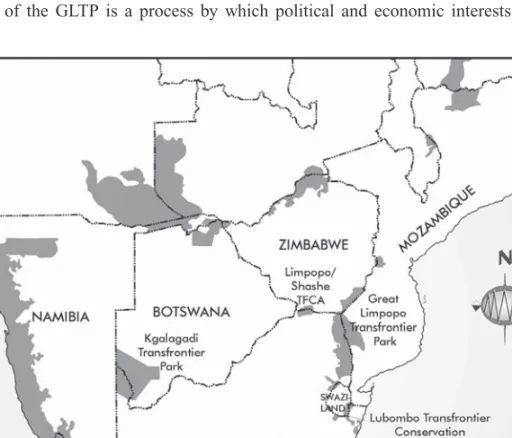
The link between the development of the Great Limpopo Transfrontier Park (hereafter GLTP) on the Mozambique–South Africa–Zimbabwe border (Figure 1.1) and Afrikaner nationalism has been suggested on the grounds that interest in TFCAs coincided with the search for an Afrikaner homeland, and that the Kruger National Park – which is key to the creation of the GLTP – has historically played a crucial role in the development of Afrikaner nationalism. In this sense, analysts viewed the creation of the GLTP as a strategy for entrenching the Afrikaner’s hold on the Kruger National Park in changing political environments. That strategy has been captured by the notion of ‘Krugerisation’, which is occasionally used outside the official circles. Implicit in ‘Krugerisation’ is the view that the creation of the GLTP is a process by which political and economic interests that are
Figure 1.1 TFCAs in southern Africa.
historically embedded in the Kruger National Park are being extended beyond the borders of South Africa, still serving a privileged group at the expense of mostly poor black people. To make the association between the GLTP and Afrikaner nationalism more explicit, analysts have referred to the dominance of the Afrikaners in the Peace Parks Foundation (PPF) (Ellis 1994; Draper et al. 2004), which is the main force behind the process of joining contiguous national parks across political boundaries in order to establish transfrontier parks, such as the GLTP.
Admittedly, the interests of the Afrikaner in the GLTP cannot be underestimated.
However, the links between Afrikaner nationalism and the GLTP are not as simplistic as they are made to be. My argument here is that while there is merit in the association of Afrikaner nationalism and the Kruger National Park (Carruthers 1995), the relationship between TFCAs and Afrikaner nationalism is less convincing. Afrikaner nationalism has been less homogeneous throughout much of its history, resulting in different Afrikaner- dominated political parties in different time periods (see Greenberg 1987; Giliomee 1992).
More importantly, the establishment of TFCAs is not unique to South Africa, and the first official transfrontier park was not even established in Africa.
The pioneers of TFCAs in Africa were involved with conservation projects in southern Africa as early as 1968, and the sites on which TFCAs are established in post-apartheid southern Africa have little or no bearing on the Afrikaners’ quest for a homeland. The search for the Afrikaner homeland, the volkstaat, was not directed at national parks, but was based mainly on the areas that formed the core of the defunct Afrikaner republics such as the Transvaal (Christopher 1994). Moreover, the main parties that represented the interests of the Afrikaners at the political negotiation table9 in Kempton Park in 1991–1993, the National Party and the Freedom Front, made proposals for the demarcation of the internal boundaries of the country for a democratic dispensation. The proposals by the two political parties did not suggest that Afrikaner nationalists were preoccupied with national parks, including the Kruger, as part of their envisaged areas of control. Even the more conservative Afrikaners who aimed at establishing their own volkstaat under the banner of the constitutionally volkstaat under the banner of the constitutionally volkstaat sanctioned Volkstaat Council (see Ramutsindela 1998) suggested maps in which the TFCAs Volkstaat Council (see Ramutsindela 1998) suggested maps in which the TFCAs Volkstaat were not central (Figure 1.2). In no way do I suggest that Afrikaners were less interested in national parks during the transition to a democratic South Africa. Rather, the point is that TFCAs were not central to the geographical expression of Afrikaner interests at the time.
Even if this were the case with regard to the Kruger National Park, how would we relate Afrikaner nationalism to other TFCAs such as the Maloti/Drakensberg and the Kgalagadi.
Moreover, the Afrikaner-dominated PPF is not the only organisation involved in the creation of TFCAs in the sub-region. Other bodies and institutions such as the World Wide Fund for Nature (WWF), Conservation International (CI), the Global Environmental Facility (GEF) and the like, are active players in the creation of TFCAs in southern Africa and beyond.
It could be argued that interests in cross-border nature conservation projects in southern Africa emerged long before the current idea of an Afrikaner homeland was firmly established.
In the 1920s, General Jan Smuts was interested in establishing a wildlife sanctuary in Mapungubwe,10 and in linking that sanctuary with conservation areas in neighbouring countries (Tiley 2004). Smuts was also interested in a cross-border nature conservation project that would expand the Kruger National Park beyond the borders of South Africa.
It is said that the Mozambican ecologist, Gomes, was interested in joining Mozambique’s protected areas with the Kruger National Park to establish some form of a cross-border nature conservation area in the 1930s (South African National Parks 1997).
An adequate analysis of transfrontier conservation initiatives in Africa would have to go beyond explaining specific cases and the circumstances surrounding them if we are to achieve a comprehensive understanding of these initiatives. The first step towards achieving this goal is to discard the view of TFCAs as a southern African phenomenon or, at worst, a South African experience. Failure to do this will most likely insulate transfrontier conservation initiatives in the region from their wider ideological milieus, as is currently the case with most studies. TFCAs should be understood in the context of intersections between the environmental movement11 and the private sector, and the place and role of the state in those intersections. In other words, there is a need to establish the roots of TFCAs within and beyond the borders of the African continent. This will certainly help us to develop meaningful analytical frameworks for, and approaches to, TFCAs in Africa.
It would also be useful to understand the commonalities and differences among transfrontier conservation initiatives, if we are to avoid producing insufficient general conclusions. For instance, most explanations of the emergence of TFCAs in southern Africa are often generalised from the experiences of the GLTP, mainly because of its popularity and the extensive resource base that is accessible to researchers compared to most other TFCAs in the region. The GLTP is increasingly being used to generalise TFCAs in the region despite the evidence that the first officially sanctioned example of a TFCA in the region and the continent was the Kgalagadi Transfrontier Park, which was formally established in May 2000.
More crucially, most analyses are limited to the post-1990 southern African situation, with Figure 1.2 Proposed Afrikaner ‘homelands’.
casual references to the colonists’ attempts at cross-border nature conservation schemes (South African National Parks 1997; Wolmer 2003). A closer inspection of most of the sites on which transfrontier conservation initiatives received their official seal in post-apartheid southern Africa reveals that bioregional planning of some sort took place long before the official launching of TFCAs in the region. Generally, African states were involved in managing some of their shared natural resources before the creation of TFCAs. That is to say that transfrontier conservation in Africa has historical roots that have been completely ignored, leading to the under-theorisation of either the processes towards the establishment of contemporary TFCAs or the ideological foundations on which they are anchored.
A more helpful approach towards understanding TFCAs in the region and the African continent would be to trace their development in the region, particularly different activities that preceded the formalisation of cross-border nature conservation projects in the early 1990s.
Identifying and explaining those activities is important, because TFCAs were not established in a vacuum, but were systematically developed from existing nature conservation projects, including national parks. Questions of academic interest are whether different transfrontier conservation initiatives are in fact informed by the same ideas, and what similarities and differences do TFCAs have in different parts of Africa and the world at large. In seeking answers to these pertinent questions we might arrive at a deeper understanding of the rise and operation of TFCAs in Africa. I do not suggest for a moment that there is a single explanation for the emergence of TFCAs in the continent nor that one perspective is more important than the others. Neither do I privilege the use of any particular theory above others. Rather, I suggest that the analyses of, and perspectives on, TFCAs in Africa that have been offered in the first decade of TFCAs in the continent are insufficient.
My contention is that events and processes that shaped TFCAs and their emergence in Africa are not perfectly discrete, but are linked to the trajectories of environmentalism and associated practices in a changing socio-political environment. Arguably, TFCAs in Africa are by and large a product of ideas about ecological integrity while, at the same time, representing ways by which protected areas can be created and expanded through the merging of conservation and development ideals with the appropriate political and financial backing.
The aim of the book
The current but nascent perspectives on TFCAs in Africa suffer from four main weaknesses, the first being the failure to acknowledge the connections between TFCAs in the continent and the external processes from which they flow, and of which they are part. Secondly, almost all analysts of TFCAs in southern Africa ignore the roles that the frontrunner of the PPF, the Southern African Nature Foundation, played in laying the foundation for contemporary TFCAs in the region. Thirdly, there is lack of information on why and how southern Africa stood out as the launching pad for TFCAs in the continent. Fourthly, there is no systematic account for why TFCAs have been embraced by different interest groups. This book seeks to make a contribution towards addressing these weaknesses by first providing a background to different ideologies that are closely related to the TFCAs. In particular, the book sketches out the agendas and strategies of the environmental movement and discusses the relevance of environmental security, regionalism and ecotourism to the analysis of TFCAs.
The principal objectives of the book are to provide background to the ideologies and practices underpinning the content and form of TFCAs in Africa, to historicise the PPF
– as the main actor in TFCAs – and its global linkages, to analyse regional dynamics and their relationships with the rise of TFCAs, and to account for the apparent lack of resistance towards the creation of TFCAs in southern Africa. Though the book covers different parts of Africa, most of the examples of TFCAs are drawn from southern Africa, simply because the region has been a launching pad for TFCAs in the continent. The book treats the relatively slow pace of TFCAs in other politico-economic regions of the continent as part of the explanation of the forces and motives behind TFCAs in Africa. In other words, the geographical difference in the spread of TFCAs in Africa is part of the explanation of why and how TFCAs have emerged in the continent.
Organisation of the book
Rather than giving detailed accounts of each TFCA in Africa, the approach taken in this book is to generate overarching ideas and trends from the empirical evidence from the author’s own research, and from various studies and unpublished material. This approach has been taken in an attempt to move research on TFCAs beyond the constraints of empiricism while, at the same time, acknowledging the value of empirical evidence in the formulation of theory. In line with this approach, each chapter focuses on a theme that goes beyond specific TFCA sites. The aim is to offer what Castree (2005, 544) calls a ‘concretised abstract discussion’.
Chapter 2 On the ideological foundations of transfrontier conservation areas
The statement by the former South African President, Nelson Mandela (2001) in which he said, ‘I know of no political movement, no philosophy, no ideology, which does not agree with the peace parks concept as we see it going into fruition today’,12 has been used by proponents of TFCAs to validate the ideas behind the creation of TFCAs, particularly in Africa. This was possible because the quotation is strategically silent about which philosophy actually does support TFCAs. To expose the philosophy behind TFCAs would make TFCAs vulnerable to the weaknesses of that philosophy. It may also be that if a particular philosophy is overtly associated with TFCAs, the tenets of that philosophy might be challenged in places where TFCAs are to be established. The task of scholars of TFCAs is therefore to identify and engage with ideologies that underpin or are relevant to the analysis of TFCAs. The focus of this chapter is on the environmental movement and the general foundation it has laid for the development of ecoregions of different kinds. The relevance of the environmental movement to the discussion on TFCAs is that the notions of environmental crisis, together with the responses to that crisis by the environmental movement and its allied institutions, are central to the mobilisation of ideas that underpin the creation of TFCAs. The premise of this chapter is that a careful analysis of the environmental movement is helpful for understanding the rationales for, and interests in, TFCAs. The chapter suggests that TFCAs are closely connected to the notion of the environmental crisis and the global solutions that have emerged from the interpretation and framing of that crisis.
The environmental movement responded to the environmental crisis in different ways.
The three main responses that are relevant to our discussion are, firstly, the development of non-governmental organisations (NGOs) to promote ecological integrity from outside the state. Secondly, the infiltration of the state by political parties that are founded on ecological
grounds, the ‘green parties’. The ultimate aim of the green parties is to create a ‘green state’.
Thirdly, a complete restructuring of the nation-state in favour of the development of grass- roots autonomous regions. For Africa, interpretations of the environmental crisis are directly linked with the poor socio-political conditions in that continent. The absence of ‘green parties’
and the movement for grass-roots autonomous regions (bioregional movement) means that environmental NGOs, such as the PPF, are the main actors in the creation of TFCAs.
Chapter 3 Peace through ecology? A soft approach to hard realities
The concept of peace parks has been used in southern Africa to highlight the significance of TFCAs beyond the imperatives of ecological integrity. Notably, peace parks are not an African phenomenon as they have been established in different parts of the world. The Waterton/Glacier International Peace Park on the US–Canada border is generally considered the forerunner of, and model for, peace parks globally. In this chapter I suggest that TFCAs in Africa should be understood in the context of global models of peace parks. Two main types of peace parks stand out: the first being parks that are established within particular countries as commemorative sites or as a way of preserving particular local sites; the second involves the amalgamation of contiguous national parks across state borders, using the need to preserve the ecological integrity of areas as a guiding principle. The discussion in this chapter and the volume as whole focuses exclusively on the second category of peace parks.13 In order to emphasise the application of the cross-border peace park model to the African context, the chapter highlights three main general propositions of peace parks. These are that: (i) international boundaries are more important for peace parks than sub-national ones; (ii) boundaries around peace parks are natural; and (iii) the environment is indissolubly interlinked with instability and peace.
The end of the Cold War heralded shifts in the concept of national security, a process that was reinforced in southern Africa by the collapse of the apartheid state. New ideas about security incorporated the environment as an element of international security. For Africa, it is assumed that environmental problems will contribute to the insecurity of the continent, hence there is a view that Africa’s strategic vision should include regional and subregional co-operation on shared problems. TFCAs are therefore seen as part of the strategy to bring about the much-needed peace on the continent by acting as symbols of peace and a platform for inter-state co-operation. The chapter concludes that, in Africa, proponents of peace parks have used boundary narratives, which are relevant to ongoing discussions about the future of Africa and the unity of its people and their environment to promote TFCAs as politically, economically, socially and ecologically relevant to the continent.
Chapter 4 Local initiatives and their regional and global connections
Proceeding from the peace park model and its adoption in Africa, this chapter sketches the development of contemporary TFCAs from disparate nature conservation projects in southern Africa. The focus of the chapter is twofold. The first part focuses on the background and activities of the Southern African Nature Foundation as a forerunner of the PPF. That background is important for understanding the development of TFCAs in the region and the rest of the continent on the one hand, and to establish the links between TFCAs in Africa and the rest of the world, on the other hand. The chapter uses the background of the Southern African Nature Foundation to argue that the map of TFCAs in southern Africa has its roots in activities
that occurred long before the formalisation of TFCAs, and that the links between TFCAs and the private sector have a long pedigree that studies on TFCAs in Africa should acknowledge.
The second part of the chapter focuses on the rise of transfrontier parks in southern Africa. It captures the development of the first transfrontier park, the Kgalagadi through to the proposed Limpopo/Shashe,14 to suggest that transfrontier parks in southern Africa reinforce the dominance of national parks in cross-border nature conservation. The Kgalagadi Transfrontier Park therefore provided the first model for TFCAs15 in which national parks are pillars of an ecoregion. The model also suggests a shift from TFCAs to transfrontier parks, a process that has led to the establishment of national parks in areas earmarked for TFCAs. The consequence of that shift is the move towards the creation of ecoregions that are devoid of human settlements. Where such human settlement exists, the plan is to remove people from the areas that are designated for transfrontier parks, as I show in Chapter 6.
Chapter 5 Southern African Development Community: a regional catalyst
The launching of TFCAs in southern Africa and the delays in the establishment of TFCAs in other parts of Africa warrant some explanation. That explanation is important, not least because there is a well-established but ill-founded tendency to offer generalised solutions to Africa’s varied and context-specific problems, including those related to the continent’s natural environment. The question that arises from the establishment of TFCAs in southern Africa, and the delay in creating them in the continent’s other regions, is what is unique about southern Africa. This chapter engages with that question by referring to ecological conditions that are optimal for the establishment of TFCAs in other parts of Africa, particularly, East and West Africa. The chapter notes that the Convention on Biological Diversity (CBD) that was adopted at the Earth Summit in Rio in 1992 sanctioned the merging of conservation and development that became a benchmark for developing national environmental policies.
A review of the status of signature, ratification, accession, acceptance and approval of the CBD in Africa reveals that southern African states, with the exception of the island states of Mauritius and Seychelles, did not necessarily take the lead in ratifying the CBD. Stated differently, most countries in other regions of Africa ratified the CBD before southern African states. The same can be said about the process of regionalism. Eastern and western African states embarked on the process of economic and political regionalism long before the Southern African Development Community (SADC) was established in 1992. Nevertheless, regionalism in East and West Africa did not strongly support or facilitate the development of TFCAs in those regions, despite the fact that environmental and socio-economic conditions favoured the establishment of TFCAs in those regions. Admittedly, regionalism is a differentiated process in the continent hence the outcomes of that process are bound to be different. However, most regions in Africa have been involved in one form of cross-border natural resources management initiative or another,16 yet those initiatives did not necessarily translate into TFCAs.
The chapter suggests that regionalism in southern Africa opened up opportunities for creating TFCAs and for inserting them into the regional environmental agenda.
The Washington-based Biodiversity Support Programme commissioned a study on the development of transboundary natural resource management (TBNRM) areas in southern Africa, which identified 17 potential terrestrial TBNRM areas. Most of those areas had already been proposed by the PPF. The SADC structures became instrumental in formalising the TFCAs plans that had been developed outside those structures.
Chapter 6 Silencing community struggles
Despite the history of community struggles for natural resource rights in southern Africa, there has not been any visible protest17 against the establishment of TFCAs in the region.
This is rather surprising, because TFCAs involve some of the national parks that were – and some still are – being contested by local communities. Moreover, some of the TFCAs directly affect the communities living inside and adjacent to areas designated for TFCAs by, say, resettlement. Against this backdrop, the purpose of this chapter is to account for the lack of community protests against the TFCAs. The chapter seeks to offer a theoretical explanation that is grounded on the practices of proponents of TFCAs. Theoretically, the chapter explains the lack of community protests by drawing on insights from a well- established body of work on scale analysis, the aim being to locate the community within the construction of the scale at which TFCAs are established. In other words, we need to observe processes that underscore the creation of TFCAs at the appropriate level so as to understand how those processes open or close the spaces of community engagement. The chapter refers to construction of scales to make three related arguments. Firstly, it argues that TFCAs manifest a particular construction of scales that disengages local communities, hence those communities are unable to contest or engage with the TFCA process. That is to say that the local communities are marginal to the processes that produce TFCAs. Secondly, it argues that TFCAs involve the double rearticulation of political scales. Whereas the need for the joint protection and management of biodiversity and fund raising forces the state to scale up its regulatory functions to a regional entity, the local demands and struggles for natural resources result in the scaling down of the functions of the state. Individual states remain responsible for their citizens in terms of their constitutions. Apart from signing the necessary legislative documents, states play a crucial role in realigning their policies to the ideals of transfrontier conservation. The third argument is that at the sub-national level, community-based natural resources management projects mediate conflict over natural resources while, at the same time, ensuring that communal land functions as corridors for transfrontier conservation.
To substantiate these arguments, the chapter draws on the experiences in Botswana, Mozambique, Namibia, South Africa and Zimbabwe. Specifically, Wildlife Management Areas in Botswana are referred to in order to demonstrate the ways in which state policies are appropriated to support the creation of TFCAs. Namibia’s conservancies are useful for understanding the realignment of land use options for the promotion of TFCAs, while the drive for privatisation and ecotourism in South Africa highlights the trend towards developing national policies that reflect interests in TFCAs. Central to the discussion of the experiences from those countries is the claim that the TFCAs involve a process of scaling that disengages local communities who are supposed to be the beneficiaries of TFCAs.
Chapter 7 The renaissance of the bush: the reinvention of the Cape to Cairo route in contemporary Africa
The main focus of this chapter is on the links between TFCAs and ecotourism in Africa.
Those links are established by, firstly, analysing one of the famous tourism routes in Africa, the Cape to Cairo route. The analysis begins by considering the idea of the Cape to Cairo in its colonial context, the purpose being to excavate the content of that idea in the age of imperialism so as to reassess its re-emergence in 21st century Africa. It has been suggested
that Cecil Rhodes embraced the idea of the Cape to Cairo, because it expressed all he had ever dreamt of, namely, the establishment of a British World Federation in which a British Pax Africana formed an important part. The Cape to Cairo idea was initially inspired by commercial interests, such as mining, before it developed into a sharp colonising instrument.
Another commercial interest that is significant for the theme of this chapter is overland tourism. Contemporary TFCAs promote ecotourism along the Cape to Cairo axis by establishing an unbroken zone of protected areas from the Cape to the north of the continent.
Other routes have been planned to promote tourism in TFCAs.
The chapter concludes that the reappearance of the Cape to Cairo idea as a nature conservation and tourism scheme begs the question of the manner in, and extent to, which colonial ideas are reinvented. The chapter suggests that the construction of the Cape to Cairo idea in different historical moments provides a useful framework for analysing the colonial presence. It argues that the British imperialist vision of connecting Africa through the railway and the telegraph, and contemporary trans-Africa eco-based conservation schemes both have common political and economic resonance, and deploy similar tactics. The fact that southern Africa has been a launching pad for ideas for a continent-wide linkage in different historical moments suggests complex ways in which geography is embroiled in the propagation of visions for Africa.
Chapter 8 Mapping Africa’s future
O’Riordan (1996, 458) correctly pointed out that ‘environmentalism thrives by being injected with ideas and adherents of other social movements, whose aims and political purpose overlap with environmentally more stable and socially more peaceful and just futures’. In essence, environmentalism provides a platform on which possible futures are forged on environmental grounds. For ecologists and like-minded individuals and institutions, the future of humankind hinges on the proper working of ecosystems. The Gaian perspective of nature has even gone further to suggest that humans have to find their place in the natural order that existed long before it was interrupted by humans. Within the social sciences, human survival is conceptualised in terms of socio-political needs and aspirations, thereby dismissing a narrow biophysical view of the environment. Against this backdrop, TFCAs embrace different layers of environmentalism,18 hence they lead to a fusion of interests among ecologists, politicians, social movements, capitalists and local communities. That fusion is facilitated by the diverse roles that ecology plays as an ‘institutional shaman that can be induced to pronounce natural whatever we wish to espouse’ (Everden, cited in Pedynowski 2003, 807). In Africa, the coalescence of interests in TFCAs has moved from local projects to continental schemes such as the New Partnership for Africa’s Development (NEPAD). Clearly, the intention is to define the future of Africa’s natural resources and to suggest how and by whom those resources would be controlled and used across state borders.
Chapter 9 Postscript: transfrontier parks and the legacy of Rupert
Comments that were made on the death of Anton Rupert in January 2006 do not only reveal that Rupert was one of the main founders of TFCAs in southern Africa, but also suggest that his vision of the African landscape has been embraced by politicians, the private sector and NGOs. The elevation of Rupert to the status of a hero implies that a critical assessment of TFCAs in Africa on ideological grounds is a challenging task.
Endnotes
1 In this volume, a transfrontier conservation area is regarded as a conservation area made up of protected areas and other land use types across international boundaries.
2 These include a tourism boom (City Press 2005), better management of protected areas and peace among participating states.
3 Concerns have been raised that TFCAs might lead to the marginalisation of local residents, loss of land rights, the dominance of one country over others, and so on.
4 The ‘moral imperative’ of TFCAs accounts largely for the absence of an intellectual project that seeks to argue against the necessity of TFCAs in southern Africa.
5 Jones (2005) laments that there has been minimal research on the impact of TFCAs on local communities, and used the case of Mbangweni community on the South African side of the Maloti/
Drakensberg transfrontier conservation area to demonstrate that local communities could experience decreased access to social, natural and economic resources as a result of the TFCA initiative.
6 Within the social sciences, there is a nascent but growing body of work that seeks to critique the socio-political objectives of transfrontier conservation initiatives (see Duffy 2001; Simon 2003;
Wolmer 2003; Ramutsindela 2004a; Van Ameron and Büscher 2005).
7 Some of the common names used in southern Africa are peace parks and transboundary natural resources management areas.
8 It has been reported that Colonel Gert Otto of the apartheid-era South African Defence Force attempted to promote a cross-border park between the Kruger National Park and part of Mozambique in order to facilitate the fl ow of intelligence material to the South African security forces (South African National Parks 1997).
9 Following the unbanning of the liberation movements in South Africa, political parties and civil society were involved in negotiating the new political dispensation. The main parties at the negotiation table were the then ruling National Party and the African National Congress (see Sparks 2003).
10 Tiley (2004) has described Jan Smuts as Mapungubwe’s visionary.
11 In its various forms.
12 Referring to the release of elephants from South Africa’s Kruger National Park into Mozambique to mark the fi rst step towards the creation of a borderless landscape of the GLTP.
13 For reasons that are discussed in full in the chapter.
14 Transfrontier Park.
15 In the southern African region.
16 This is particularly true in the water sector.
17 In no way do I suggest that all local communities are happy with the establishment of TFCAs that impact on their lives. Rather, my view is that no form of community dissatisfaction has translated into a campaign against the establishment of a particular TFCA.
18 According to O’Riordan (1996) the four layers of environmentalism are underpinned by views of nature, intervention, political economy, and the fusion of social movement.
13
On the ideological foundations of transfrontier conservation areas
The multi-layered bases on which transfrontier conservation areas are founded and promoted challenge any simplistic explanation of TFCAs. The layers range from interests in promoting ecological integrity and governance through international relations and peace to socio- economic development. A full explanation of TFCAs should therefore deal with the ideas on which they are founded and the various actors that are involved in, and with, them. The focus of this chapter is on the environmental movement and the general foundation it has laid for the development of ecoregions. The relevance of the environmental movement to the discussion on TFCAs is that the notions of environmental crisis, together with the responses to that crisis by the environmental movement and allied institutions, are central to the mobilisation of ideas that underpin the creation of TFCAs. In addition, those notions and responses largely account for the coalescence of interests among disparate groups and institutions. The premise of this chapter is that a careful analysis of the environmental movement is helpful for understanding the rationales for, and interests in, TFCAs.
Environmental crisis and global solutions
The former President of the World Bank, James Wolfensohn, and his colleagues from Conservation International and the Global Environmental Facility, issued a warning that ‘we are failing to stem the lethal dynamic of chronic poverty and growing population, which is destroying species a thousand times faster than ever before’ (Wolfensohn et al. 2000, 38).
Indeed, studies demonstrating the catastrophic extinction of animal and plant species are common in the natural sciences, and any contrary view to the environmental crisis1 is often dismissed as ill informed or speculative (FitzRoy and Smith 2004). The criticism levelled against, and the dismissal of, Lomborg’s Skeptical Environmentalist (2001), is an obvious Skeptical Environmentalist (2001), is an obvious Skeptical Environmentalist example of some such reactions. Critiquing the notion of environmental crisis is misconstrued as a deliberate ignorance of scientific truths or a delay in solving a life-threatening crisis. For environmentalism there is no time to waste, as global ecosystems require millions of years to recover and therefore no further destruction of ecosystems can be allowed to continue. The crisis is not only about the destruction of fauna and flora, but is also about the disintegration of ecological systems that are a source of all life. In support of that perspective, Brunckhorst (2002, 1) remarked that, ‘our future, along with the rest of life on earth, depends on … the services provided by fully functional ecological systems’. In this way, the environmental crisis translates into a threat to life, thereby bringing together diverse groups of people who are concerned with those ‘threats’: anti-war, anti-nuclear proliferation, anti-industrialisation, and the list is endless. The point here is that the environmental movement has been a broad church
since the elevation of local environmental issues to the public domain. The New Republic aptly described the American ecological movement in 1970 as ‘the biggest assortment of ill-matched allies since the crusades – young and old, radicals of the left and right, liberals and conservatives, humanists and scientists, atheists and deists’ (cited in McCormick 1989, x). The ‘assortment of ill-matched allies’ is one of the defining characteristics of the environmental movement.
As I will show later, the same can be said about transfrontier conservation initiatives, because the initiatives pursue the logic of the environmental movement. For the moment I focus on the nature and agendas of the environmental movement in order to understand how and why the environmental movement brings people of diverse backgrounds together.
Proceeding from the view that the environmental movement has no clear beginning, McCormick (1989, 37) regards the United Nations Scientific Conference on the Conservation and Utilisation of Resources (UNCCUR) that was held at Lake Success (New York) between 17 August and 6 September 1949 as ‘the first major landmark in the rise of the international environmental movement’. The theme of the conference centred on the adequacy of natural resources to meet growing demands – a rehearsal of Thomas Malthus’
doctrine of the inverse relationships between population growth and food supply. Though Malthus’ population-resource doctrine has been criticised for being too simplistic and ignoring technological advancement in food production, his doctrine provided the solid foundation on which ideas about the environmental crisis were developed and nurtured.
It is therefore not surprising that population issues have since become the first point of reference in the discussion of environmental crises and proposed solutions. The Club of Rome – an informal organisation that originated from the meeting2 of 30 individuals in the Academia dei Lincei in Rome in April 1968 – added dimensions to the environmental crisis when it sought to understand the interdependence of economic, political, natural and social components of the world system in order to promote new policy initiatives and actions (Meadows et al. 1972). The Club’s project3 on the predicament of mankind sought to ‘examine the complex of problems troubling men of all nations: poverty in the midst of plenty; degradation of the environment; loss of faith in institutions; uncontrolled urban spread; insecurity of employment; alienation of youth; rejection of traditional values; and inflation and other monetary and economic disruptions’ (Meadows et al. 1972, 10). It used population growth and resource exploitation to develop models, which suggested the need for an orderly transition to a global equilibrium between population growth and resource usage (Meadows et al. 1972). It was thought that such a state of equilibrium would release people from the pressures for survival, and would ensure that people direct their energy and ingenuity towards solving other problems. That idea ties well with Maslow’s hierarchy of needs.
The manner in which the ecological problems were to be solved, with respect to human survival, has been, and still remains a source of contention. In Britain a group of scientists endorsed the views of the Club of Rome and sought to offer a ‘Blueprint for Survival’, which was published as a special issue of the Ecologist in January 1972 under the editorship of Ecologist in January 1972 under the editorship of Ecologist Edward Goldsmith. The publication heralded the formation of the Movement for Survival (MS), which sought to champion a new age in which humans ‘will learn to live with the rest of nature rather than against it’ (Ecologist
of nature rather than against it’ (Ecologist
of nature rather than against it’ (Ecologist 1972, 1). Its point of departure was the defect of Ecologist 1972, 1). Its point of departure was the defect of industrialism, as the following quotation suggests:
the principal defect of the industrial way of life with its ethos of expansion is that it is not sustainable … We can be certain, however, that sooner or later it will end and that it will do so in one or two ways: either against our will, in a succession of
famines, epidemics, social crises and wars; or because we want to – because we wish to create a society which will not impose hardships and cruelty upon our children – in a succession of thoughtful, human and measured changes (Ecologist
– in a succession of thoughtful, human and measured changes (Ecologist
– in a succession of thoughtful, human and measured changes (Ecologist 1972, 2).Ecologist 1972, 2).
It was hoped that the MS would become an international movement with a new philosophy of life that would provide the basis for four principal conditions towards a stable society:
(i) minimum disruption of ecological processes, (ii) maximum conservation of materials and energy, (iii) stabilising the population, and (iv) establishing a decentralised system of government. According to the Blueprint for Survival, ecological processes were being disrupted by ‘introducing into them either substances that are foreign to them or the correct ones in the wrong quantities’ (Ecologist
ones in the wrong quantities’ (Ecologist
ones in the wrong quantities’ (Ecologist 1972, 9). The solution to this included restrictions on Ecologist 1972, 9). The solution to this included restrictions on the use of pesticides and fertilisers. Of significance to the theme of this chapter is the Blueprint for Survival’s injunction that wilderness areas and wetlands should be conserved at all costs. It viewed areas of wilderness as the world centres of diversity – the gene banks. It also proposed the creation of a new system of government based on decentralisation, the emphasis being on the creation of small communities that will guarantee both the minimal impact of humans on the environment and community participation. The Blueprint for Survival therefore suggested the restructuring of society and governance on ecological grounds, presenting decentralisation as an authoritative organisational structure of society for the attainment of ‘global equilibrium’.
How these objectives were to be achieved generated different responses. The three main responses that are relevant for our discussion are, firstly, the development of non-governmental organisations (NGOs) to promote ecological integrity from outside the state. Secondly, the infiltration of the state by political parties that are founded on ecological grounds, the ‘green parties’ with the aim for creating a ‘green state’. Thirdly, a complete restructuring of the nation- state in favour of the development of grass-roots autonomous regions. Accordingly, Dryzek et al. (2003) have categorised environmental groups according to those that are unconcerned with the state, those that co-operated with the state and those initially based in oppositional civil society. These categories imply that the environmental movement does not fit nicely into life- cycle progression theory in which it is assumed that social movements begin from oppositional and confrontational positions and later on gravitate towards the state. Instead, the shape and fortunes of the environmental movement are influenced by the structural response of the state and the state’s general orientation to societal needs (Kitschelt 1986; Dryzek et al. 2003).
Promoting ecological integrity: acting from outside
It should be noted that the attempt to develop the MS was based on the view that there were already environmental interest groups in existence in different parts of the world, which would form the building blocks for the international movement. According to McCormick (1989), the first environmental interest group – the Commons, Footpaths and Open Spaces Preservation Society – was founded in Britain in 1865. Since then, environmental interest groups have mushroomed all over the world. Of importance to our discussion in this chapter is the point that most of these groups opted to pursue an ecological agenda from outside government structures. For instance, at the height of post-world war reconstruction, the conservation network in continental Europe, the International Office for the Protection of Nature (IOPN), successfully opposed Britain and America’s attempts to establish an international nature protection organisation under the auspices of the United Nations system. The IOPN opted to pursue the environmental agenda outside state systems. In reality such an agenda can only be pursued through the governments,
leading to the hybrid nature of environmental interest groups, as has been the case with the constitution of the Provisional International Union for the Protection of Nature (IUPN) that was signed on 5 October 1948. As such, the purpose of the IUPN was to facilitate co-operation between governments and national and international organisations. It should be noted that the IUPN is a product of the Swiss-sponsored meeting that was attended by 70 delegates from 24 countries between 28 June and 3 July 1947 in Brunnen. The organisation changed its name to the International Union for the Conservation of Nature and Natural Resources (IUCN) in 1956 (McCormick 1989). The point here is that those environmental organisations that opted to operate outside the state were caught in the unenviable position of having to co-operate with the same governments that were, in the organisations’ view, destroying – directly or indirectly – the ecosystems on which human survival depends. Environmental organisations deploying conventional lobbying strategies became increasingly less oppositional to the state, as they sought to access bureaucratic and informal opportunities offered by government officials. This is the case with moderate mainstream environmental organisations such as the Wilderness Society (United States), Norwegian Society for the Conservation of Nature (Norway), the Ramblers Association (United Kingdom), and the German League for Nature Conservation and Environmental Protection (Germany) (Dryzek et al. 2003).
It would be unrealistic to assume that the influence over the environmental movement is one-directional. Over the years, environmental NGOs have operated in partnership with the private sector to exert influence and pressure on the state. For example, the IUCN has used public platforms such as its World Parks Congresses to suggest directions that states should follow in matters of nature conservation. Those directions have found their way into state policies and strategies. A clear example of this is the IUCN’s recommendation that each country should set aside the minimum of 10% of its land for protected areas. In government circles, the recommendation has become a necessity rather than a suggestion by a non-state actor. The IUCN considers itself as the world’s largest4 and most important conservation network that seeks to influence, encourage and assist societies in conserving biodiversity.
The link between environmental NGOs and the private sector means that governments can access funds from donors if they follow the guidelines of environmental NGOs. This is so because most funding5 for environmental matters comes through those NGOs.
Operating within and with the state
The second response towards the environmental crisis was to follow the Blueprint’s suggestion that the MS should be committed to act at a national level, including contesting elections.
At the time of drawing up the Blueprint, there were no clear models for the kinds of states that Green parties were to develop and administer, and how the aim for a green state could be achieved. To give substance to the feasibility and viability of such models, the Ecologist published President Nyerere’s model of a state based on the vision of a self-reliant independent Tanzania. In writing for the Ecologist, Jimoh Omo-Fadaka (1972, 7) painted a picture of the Tanzanian state that appealed to the authors of the Blueprint by suggesting that:
Tanzania does not want to turn into a western society if this means the constant pursuit of materialist goals and the social divisions produced by the differential accumulation of wealth. It does not want to turn into a country where a capital city swells up like an infected gland, attracting to itself manpower, which cannot be employed. Nor does it want to become a Marxist state.
Clearly Nyerere’s philosophy of Ujamaa was more the quest for independence from colonial rule and influence than a belief in the imminent ecological disaster. Nevertheless, Nyerere’s ideas of self-reliance resonated with the Blueprint’s ideals for decentralisation, and also reaffirmed the possibility of a state-driven ecological agenda.
In pursuit of the ideals of the Blueprint, the world’s first ‘green’ party, the Values Party, was founded in New Zealand in 1972. Unlike most environmental movements that focused mainly on conservation issues in the 1960s and 1970s, the Values Party ‘provided a broader ideological critique of the state’s preoccupation with materialist concerns’
(Downes 2000, 474). The 88-page policy programme (Beyond Tomorrow), which was publicised as an election manifesto for the 1975 national election, committed the Values Party to limits on economic and industrial development, a stable population, liberal social policies, the devolution of power in the workplace and community, and environmental protection (Miller 1991). Essentially, the Party was responding to the exclusion of environmental interests from the political agendas that were dominated by the National and Labour parties. In particular, the Muldoon National Government’s interests on big energy projects acted as a catalyst for the environmental groups’ engagement with the state (Downes 2000). The successor to the Values Party, the Green Party of Aotearoa–New Zealand, which was formed shortly before the 1990 General Election, also adopted the same anti-industrialist stance.
Europe’s first green party, the Ecology Party, held the view that the imminent ecological disintegration could only be averted through political transformation. In its view, that goal could be achieved by either acquiring power or by provoking other parties to take up the policies of the Ecology Party. Rudig and Lowe (1986) observed that the Ecology Party was formed by a core group of four people in 1973, as a result of the combined effects of the widely distributed doomsday predictions (such as the work of the Club of Rome) and the consequences of industrial decline in Coventry, England. The Party was therefore conceived in the fervour of the Blueprint, and presented itself to the public as ‘part of a world-wide awakening to the need to reconstruct our way of life if there is to be any chance of survival with decency’ (New Ecologist
with decency’ (New Ecologist
with decency’ (New Ecologist 1979, 21). It was guided by a belief that ‘ecology lays special New Ecologist 1979, 21). It was guided by a belief that ‘ecology lays special emphasis on the qualities of diversity, acknowledging and putting to good use the differences that exist between people and encouraging the widest possible variety of life styles rather than forcing everyone to accept the same mould’ (Porritt 1979, 21). Whereas the Club of Rome was unclear about the sort of institutions that would be needed to achieve the equilibrium state, the Ecology Party reaffirmed the Blueprint’s proposal for decentralisation.
The Party’s Manifesto for the 1979 General Elections called for setting up of Scottish and Welsh Assemblies and regional assemblies (New Ecologist
Welsh Assemblies and regional assemblies (New Ecologist
Welsh Assemblies and regional assemblies (New Ecologist 1979).New Ecologist 1979).6 In this sense, the call for self-determination by the Ecology Party went beyond concerns with the environmental issues to suggest the political division of the United Kingdom into regions. Writing for the Ecologist, Waites (1984, 164) emphasised the need for regions in the United Kingdom in these words:
Equally important, … and perhaps more elusive, is the recognition that our country must give more scope for regional consciousness not only in its everyday life but also in its political administration. We must encourage the regions more, not depress them further; we must find our strength from them, not look on them as a weakness;
we must use them to renew our national consciousness for the soul of England is in its regions.
The Ecology Party emphasised economic self-reliance and political self-determination.
Elsewhere other parties followed the same route of contesting elections.
According to Spretnak and Capra (1984), the Union of German Ecological Citizen’s Group (Bundesverband der Bürgerinitiativen Umweltschutz
(Bundesverband der Bürgerinitiativen Umweltschutz
( ) was the first German organisation to
structure a grassroots movement, which promoted ecological consciousness on a large scale in the 1970s. At the time, ecological concerns in West Germany were shaped by internal and external influences. As we have noted above, the work of the Club of Rome, The Limits to Growth, had influence in different parts of the world, and West Germany was no exception.
Inside West Germany, the post-World War II political and economic environment led to the emergence of a social movement, which sought to oppose the development of nuclear power plants, the use of missiles as part of the NATO defence system, toxic waste and the like; while, at the same time, promoting an alternative culture. With the influence of the counterculture in the United States and Britain, ‘the alternative movement [in Germany]
fostered multiple developments with similar intentions, rejecting forced adherence to any one dogmatic line of thought, a mode [it] associated with both the Nazis and the Marxist/
student protests’ (Spretnak and Capra 1984, 14).
The impetus for the formation of the Green Party in that country came from a group of eco