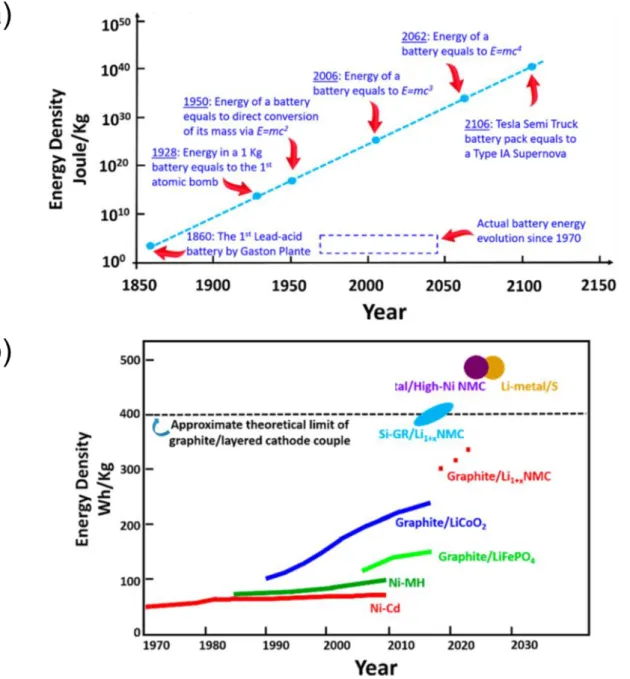
Relative capacity is a ratio of the capacity at a specified temperature to capacity at room temperature, 25oC. The marked capacities are discharge capacity at 3rd cycle in 0.2 C. b) Voltage profile of WiSE SLMO in discharge at various temperatures. The first market-significant hybrid EV (HEV) used nickel metal hydride (Ni-MH) batteries using aqueous alkaline electrolytes.1 Subsequently, lithium ion batteries (LIBs) using carbonate-based organic electrolytes replaced the aqueous batteries in EVs due to their high energy densities .2 The use of organic electrolytes was inevitable to allow the operating cell voltages of LIBs to be greater than 3 V, even if it had the problems of flammability and toxicity of organic solvents. Therefore, the batteries based on aqueous electrolytes have been reconsidered from an eco-friendly point of view, even if high energy densities of the LIB level are not fully guaranteed.
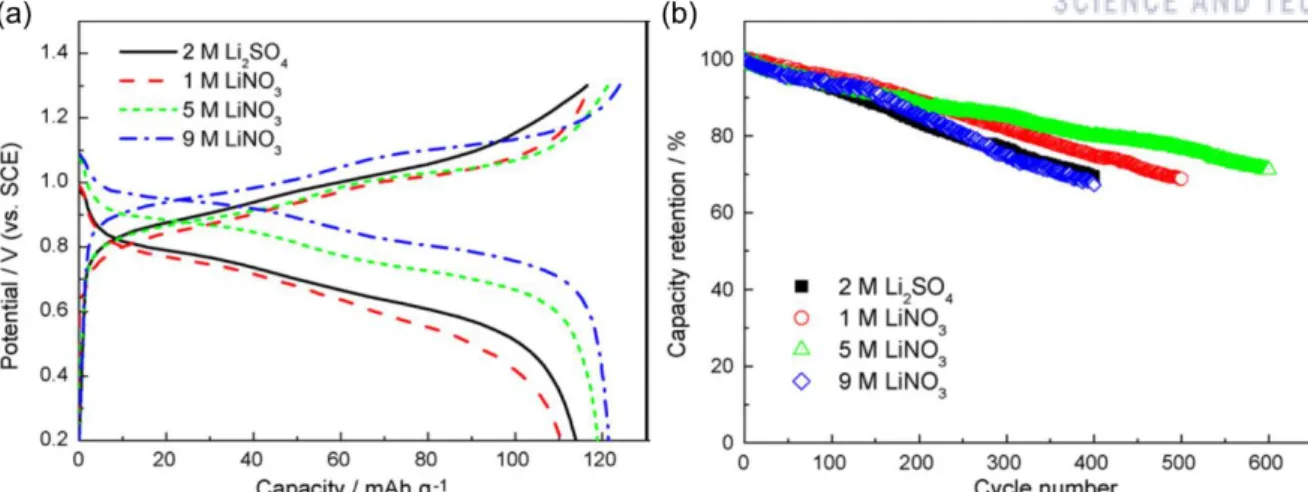
One of the very first works of the Dahn group used lithium manganese oxide spinel (LiMn2O4) as the active materials of both cathode and anode in the presence of the aqueous solution of 5 M LiNO3.7 The symmetric cell design was possible because LiMn2O4 is amphi-redox active .8 During the charging process of the LiMn2O4||LiMn2O4 cells, LiMn2O4 is delithiated on the cathode. 7 Both electrode and electrolyte failures would be responsible for the failed operation of the LiMn2O4||LiMn2O4 cells. From the electrode point of view, the additional lithiation of LiMn2O4 (Equation 2) changes the structure from cubic to tetragonal, inducing the Jahn-Teller deformation.9 The stress developed by the deformation promotes the structural instability of the anode material .
It was reported in our previous work that the LMO@Gn showed significantly improved reversibility of the 3 V reaction (equation 2) leading to extended cyclability.
History of battery
These shortcomings were greatly improved in the Daniell cell, which was invented by Daniell in England in 1836. In the gravity cell, the porous partition was removed and the electrode positions were fixed with copper at the bottom and zinc at the top. The zinc sulfate solution layer formed by the dissolved zinc anode was separated from the copper sulfate solution layer due to the change in density and polarization of the battery.
At the positive electrode, hydrogen ions in the acidic electrolyte react with lead dioxide to generate water. The stability and cyclability of the early lithium batteries was very poor due to the dendrite formation at the lithium metal anode and the high reactivity of this.

Aqueous electrolytes in Li ion batteries
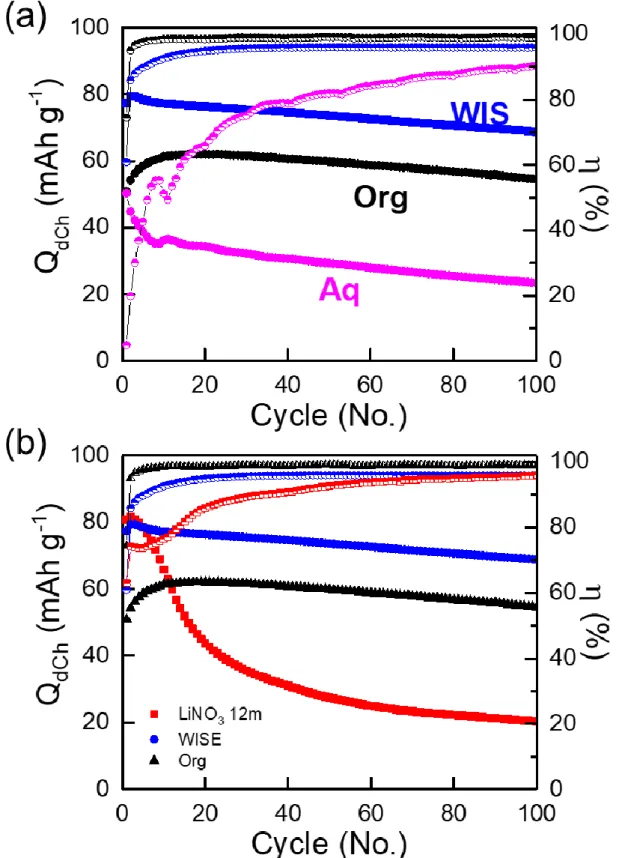
The organic electrolytes used in current battery systems guarantee high energy density and lifetime with wide voltage window and stability, but at the same time have disadvantages such as low ionic conductivity (~ 10 mS cm-1), environmental pollution and explosion due to flammability. The low coulombic efficiency and poor cyclability of water-based lithium ion batteries is also due to water decomposition.4. However, the anodes using the LMO 3 V region reaction did not work stably due to the instability described in section 1-4, and other types of cells also had a drastic capacity fade due to water decomposition after 20 cycles.
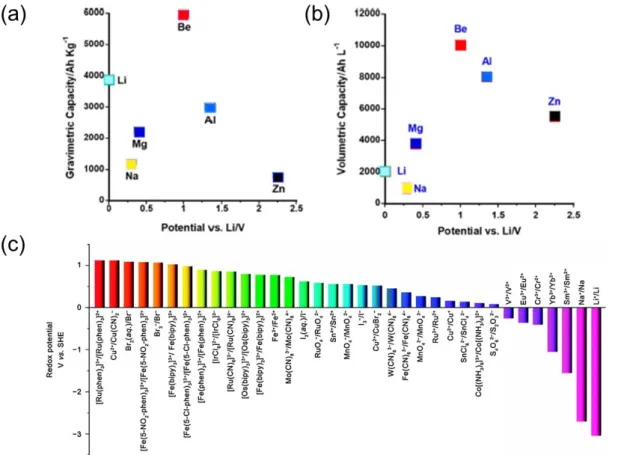
Attempts have been made to suppress OER at the positive electrode or HER at the negative electrode, but failed due to proton co-insertion in an acidic environment, damage to the active material, and dissolution in an extremely basic or acidic environment. It has a low charge density due to the large anion and weak cation-anion interaction. This is mainly due to the low concentration of water in the solution due to excess salt.
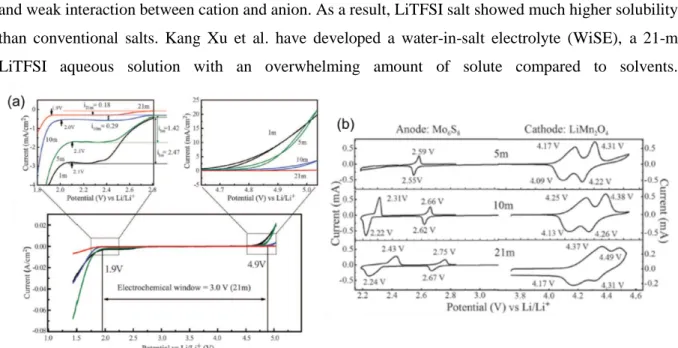
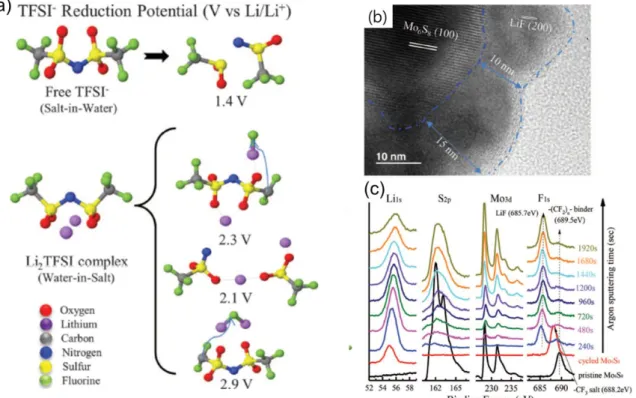
Due to reduced water activity and formation of SEI layers, the voltage window of WiSE was significantly increased. In the cyclic voltammetry using stainless steel as working electrode and platinum as counter electrode, the hydrogen evolution reaction occurs at 1.9 VLi and the oxygen evolution reaction occurs at 4.9 VLi, which has a wider electrochemical window of 3.0 V than the conventional aqueous electrolyte . Due to the excess salt in WiSE, the fluidity is only 0.02 cp-1 and the ionic conductivity is only about 10 mS cm-1.10. However, because 0.7 of the transfer number (tLi+) is much higher than that of conventional electrolytes, the actual conductivity is 7 mS cm-1, which is higher than conventional EC/EMC based organic electrolytes (~4 mS cm-1 1).21.
The voltage window of the hydride fusion electrolyte becomes wider as the amount of free water molecules decreases and the water activity decreases. LNMO and LTO have higher electromotive force due to active materials that were not used due to hydrogen and oxygen generation in normal WiSE. In 2018, Yi Cui Group developed WiSE mixed cation acetate using lithium acetate and potassium acetate.23 Since the electrolyte is difficult to ensure high solubility due to the high charge density of Lithium, potassium is used together.
Jahn-Teller distortion in lithium manganese oxide
When the amount of Mn3+ exceeds 50 percent, the structure of LiMn2O4 begins to change into a tetragonal, resulting in Jahn-Teller distortion. At high C rates, the movement of lithium ions in the solution is faster than the diffusion of lithium ions in the electrodes, resulting in frequent Jahn-Teller distortion. However, the change from LiMn2O4, which is a cubic spinel structure, to Li2Mn2O4, which has a tetragonal structure, causes Jahn-Teller distortion.
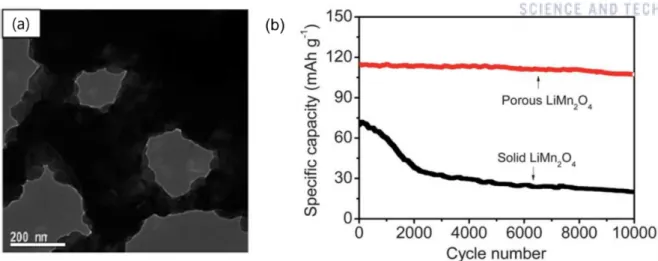
As a result, a stable reactance of the 3V region is not usable in the bulk LMO and a severe capacitance decay occurs. To overcome the Jahn-Teller distortion and use the 3 V reaction of LMO, the Yang-Kook Sun group synthesized the sulfur-doped spinel structure LiAl0.24Mn1.76O3.98S0.02. Lithium metal sheet was used as cathode and 1 M LiClO4 in EC/PC (1:1) was used as electrolyte.
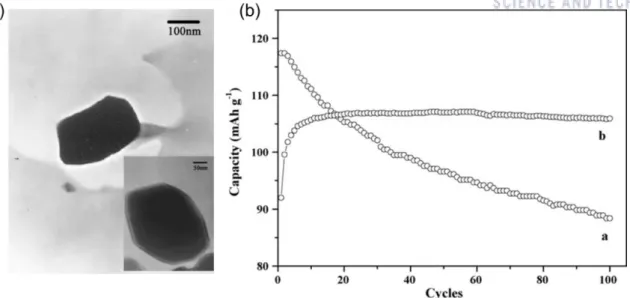
This material showed a capacity of 100 mAh g-1 in the 4 V region response and showed good lifetime characteristics. In 2009, another method to suppress Jahn counter distortion by another synthesis was reported by Chunlei Wang. The modified LMO, synthesized by adding Ni(NO3)2 and CO(NH2)2 when forming the cathode material slurry, forms a solid LiNixMn2-xO4 solution shell on the surface and suppresses Jahn counter distortion.
As such, attempts have been made to prevent Jahn-Teller distortion by methods to reduce the amount of Jahn-Teller distortion-inducing Mn3+ by doping other cations onto the LMO, and to suppress the volume change by forming layers on the surface. In 2014, the Noh groups succeeded in suppressing the Jahn-Teller distortion in a simpler way and using a 3 V reaction.9 Microsize LMO and graphite were exposed to a high-energy ball mill for 6 hours at an 80:7 (LMO:graphite) mass ratio, through which was LMO@Gn coated with a thin graphite layer coated on LMO. Effective suppression of Jahn-Teller distortion has been demonstrated in cell tests using lithium metal as the anode.
Characterization
The mixed powders were milled by high energy vibrating ball mill (SPEX 8000D) for 6 hours. Polyvinylidene fluoride (PVDF; Solef 5130) binder and carbon black (Timcal Super P) conductive additive, synthesized LMO@Gn powder was mixed with N-methyl-2-pyrrolidone solvent. The suspension was cast on the aluminum foils as current collector for organic electrolyte cells and WiSE cells.
When aluminum foil was used as a current collector in conventional aqueous electrolytes, severe corrosion reactions occurred during charging.13 (Figure S2) The mass loading of electrodes was about 1~2 mg cm-1.
Electrochemical measurement
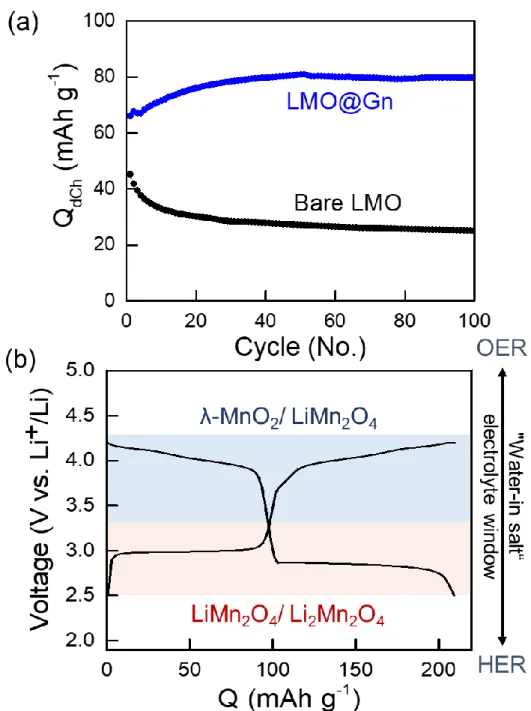
The yellow area represents the 3 V area reaction, which is the second intercalation of lithium ion into LiMn2O4 during charging or deintercalation from Li2Mn2O4 during discharge. A few-layer graphene coating on LiMn2O4 (that is, LMO@Gn) has been shown to improve the electrochemical reversibility of the 3 V reaction.9 In a common carbonate-based organic electrolyte (org.), the 3 V region reaction of bare LMO and LMO@Gn were tested in Fig. 17 a. From half-cell tests, when the C level was 1 C, bare LMO showed poor cycling ability and low capacity (45 mAh g-1,.
28. maximum capacity during cycle) than LMO@Gn which was great in capacity (82 mAh g-1, maximum capacity during cycle) and cyclability. As reported, graphite coating on micro-sized LMO made 3 V region response useful in overcoming Jahn-Teller distortion. Based on LMO@Gn half-cell investigation, we set the effective cut-off voltages from 0.4 V to 1.65 V for realization of symmetric cells using LMO@Gn as both cathode and anode.
Traditional aqueous electrolyte versus “Water-in-Salt” electrolyte
The failures of LiNO3-based aqueous electrolytes must have been caused by the low stability of water molecules. The differences in electrochemical stability and performance come from the unique property of water in WiSE. The strongest O-H bond which peak position is 3630 cm-1 indicates that water molecules are free from hydrogen bonding.
The peaks at 3570 cm-1 come from the O-H bond of water molecules forming three hydrogen bonds. And most water molecules, if there are no added salts, participate in the hydrogen bond network. In WiSE, almost water molecules participate in the solvation shell and the water molecules contained in the solvation shells do not form hydrogen bonding.
The denser LiTFSI solution has the smaller relative peak intensities of weak O–H bonds, indicating that the water molecules are well included in the solvation shell whose center is the lithium cation. The activity of water molecules is also important parameter to explain electrochemical stability of aqueous solution. LiNO3 12 m shows wide voltage window, even IR showed its weak O-H bond of water molecules.
In dense solution, the percentage of water molecules on the surface decreases and this means that the water activity also decreases. The reduction potential is higher than the hydrogen evolution reaction (HER) initiation potential at pH 7, and the SEI layer can effectively exclude water molecules from the anode surface. Relative capacitance is the ratio of capacitance at a given temperature to capacitance at room temperature, 25oC. Capacitances marked are discharge capacity in the third cycle at 0.2 C. b) Voltage profile of WiSE SLMO in discharge at different temperatures. retention, but at -30°C the discharge capacity of the Ni-MH battery decreased dramatically.
Improbably, the WiSE SLMO still realized capacity, which was about half the capacity at 25°C. The capacity of WiSE SLMO. The low temperature rechargeability of WiSE SLMO is caused by WiSE's thermal properties.
Kinetics and thermal properties of SLMO battery using WiSE