Database Management System
Lecture 8 Join
Today’s Agenda
• Join Algorithm
Join Algorithms
Join Algorithms
• R ⋈ S is very common
• R X S followed by a selection is inefficient ... why?
• So we process joins (rather than cross product) when possible
• Much effort in query processing invested in join algorithms
SELECT *
FROM Reserves R, Sailors S WHERE R.sid = S.sid
Sailors(sid, snam, rating, age) Boats(bid, bname, color) Reserves(sid, bid, day)
Notations
• M -- pages in R
• P
R-- tuples per page
• N -- pages in S
• P
S-- tuples per page
table R page
tuple
tuple
page
table S
tuple
tuple
page
Join Algorithms
• Simple nested loops Join
Join on i-th column of R and j-th column of S 1. foreach tuple r in R do
2. foreach tuple s in S do
3. if r
i== s
jthen add <r, s> to result
For R ⋈ S ...
• We call R the “outer” relation
• We call S the “inner” relation
Join Algorithms
• For each tuple in the outer relation R, we scan the entire inner relation S tuple-by-tuple ...
• If M = 1000 pages in R, PR = 100 tuples/page
• If N = 500 Pages in S, PS = 80 tuples/page
• If 100 I/Os per second
• Cost R ⋈ S = M + (PR * M) * N = 1000 + 100*1000*500 I/Os
• 50,001,000 I/Os ≈ 500,010 seconds ≈ 6 days!
Simple Nested Loops Join
• This example highlights
• Simple nested loop join isn’t very practical
• We need algorithms that optimize joins
• There are also the other operations to consider ...
Simple Nested Loops Join
Memory Buffers Table 1 on Disk
2. …6. … 3. …
1. … 5. …9. …
Table 2 on Disk
2. … 7. …
6. …9. …
1. … 5. …
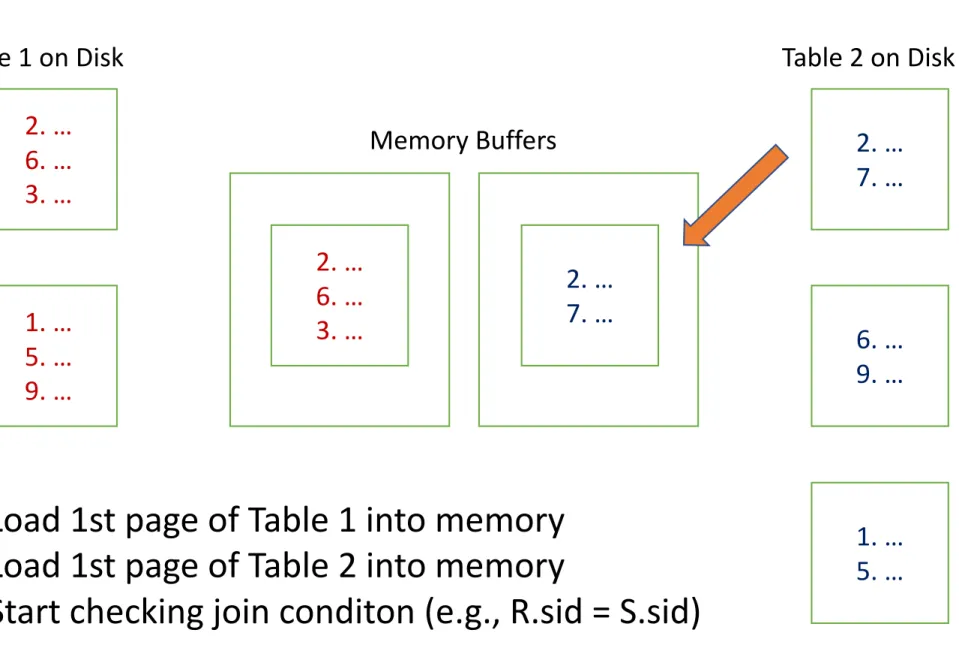
Simple Nested Loops Join
Memory Buffers Table 1 on Disk
2. …6. … 3. …
1. … 5. …9. …
Table 2 on Disk
2. … 7. …
6. …9. …
1. … 5. …
• Load 1st page of Table 1 into memory
• Load 1st page of Table 2 into memory
• Start checking join conditon (e.g., R.sid = S.sid)
2. …6. … 3. …
2. … 7. …
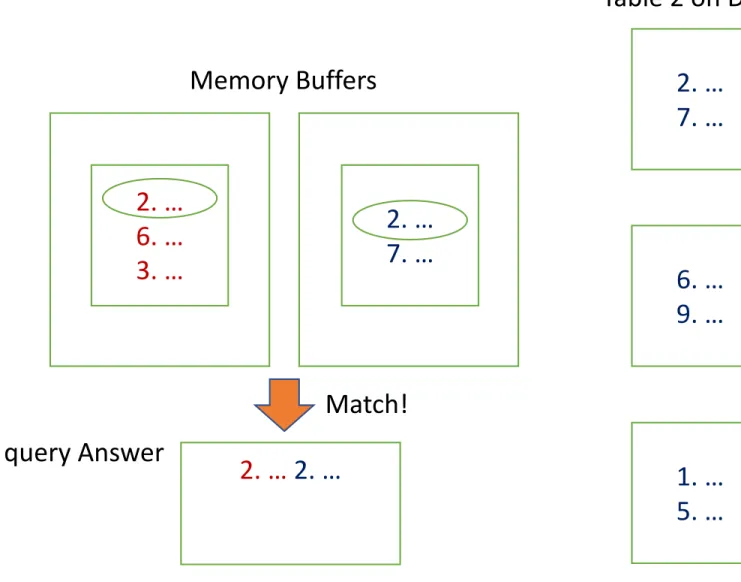
Simple Nested Loops Join
Memory Buffers Table 1 on Disk
2. …6. … 3. …
1. … 5. …9. …
Table 2 on Disk
2. … 7. …
6. …9. …
1. … 5. … 2. …6. …
3. …
2. … 7. …
2. … 2. …
Match!
query Answer
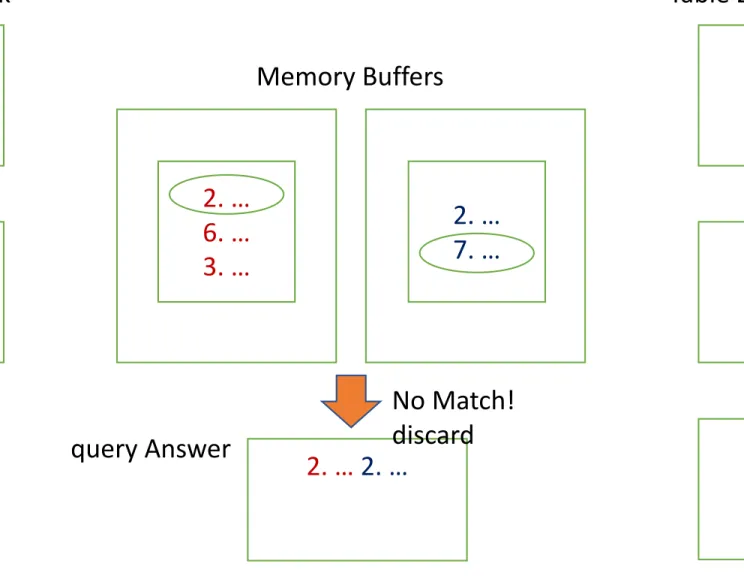
Simple Nested Loops Join
Memory Buffers Table 1 on Disk
2. …6. … 3. …
1. … 5. …9. …
Table 2 on Disk
2. … 7. …
6. …9. …
1. … 5. … 2. …6. …
3. …
2. … 7. …
2. … 2. …
No Match!
discard query Answer
Simple Nested Loops Join
Memory Buffers Table 1 on Disk
2. …6. … 3. …
1. … 5. …9. …
Table 2 on Disk
2. … 7. …
6. …9. …
1. … 5. … 2. …6. …
3. …
2. … 2. …
No Match!
discard query Answer
6. …9. …
Load 2nd page of Table 2 into memory
Simple Nested Loops Join
Memory Buffers Table 1 on Disk
2. …6. … 3. …
1. … 5. …9. …
Table 2 on Disk
2. … 7. …
6. …9. …
1. … 5. … 2. …6. …
3. …
2. … 2. …
No Match!
discard query Answer
1. …5. …
Load 3rd page of Table 2 into memory
Simple Nested Loops Join
Memory Buffers Table 1 on Disk
2. …6. … 3. …
1. … 5. …9. …
Table 2 on Disk
2. … 7. …
6. …9. …
1. …
• Go to next tuple in
5. …1st page of Table 1
2. …6. … 3. …
2. … 7. …
2. … 2. …
No Match!
discard query Answer
Simple Nested Loops Join
Memory Buffers Table 1 on Disk
2. …6. … 3. …
1. … 5. …9. …
Table 2 on Disk
2. … 7. …
6. …9. …
1. … 5. … 2. …6. …
3. …
2. … 2. … 6. … 6. …
Match!
query Answer
6. …9. …
(Re)Load 2nd page of Table 2 into memory
and so forth…
Simple Nested Loops Join
Memory Buffers Table 1 on Disk
2. …6. … 3. …
1. … 5. …9. …
Table 2 on Disk
2. … 7. …
6. …9. …
1. … 5. … 2. …6. …
3. …
2. … 2. … 6. … 6. …
Match!
query Answer
6. …9. …
(Re)Load 2nd page of Table 2 into memory
and so forth…
Does this algorithm work for R.sid < S.sid ?
Does this work for cross for cross product
Join Algorithms (Revisited)
• simple nested loops join
• For each tuple in the outer relation R, we scan the entire inner relation S tuple-by-tuple ...
• If M = 1000 pages in R, PR = 100 tuples/page
• If N = 500 Pages in S, PS = 80 tuples/page
• If 100 I/Os per second
• Cost R ⋈ S = M + (PR * M) * N = 1000 + 100*1000*500 I/Os
• 50,001,000 I/Os ≈ 500,010 seconds ≈ 6 days!
Join on i-th column of R and j-th column of S 1. foreach tuple r in R do
2. foreach tuple s in S do
3. if r
i== s
jthen add <r, s> to result
Join Algorithms (Revisited)
• “page-oriented” nested loops join
• For each page in R, get each page in S ...
• If M = 1000 pages in R,N = 500 Pages in S,and 100 I/Os per sec.
• Cost R ⋈ S = M + M * N = 1000 + 1000*500 = 501,000 I/Os
• Cost S ⋈ R = N + N * M = 500 + 500*1000 = 500,500 I/Os
• Thus, we typically use smaller relation as outer relation
• 500,500 I/Os ≈ 1.4 hours
Join on i-th column of R and j-th column of S 1. foreach page of tuples in R do
2. foreach page of tuples in S do
3. foreach record r and s in memory
4. if r
i== s
jthen add <r, s> to result
Page-Oriented Nested Loops Join
Memory Buffers Table 1 on Disk
2. …6. … 3. …
1. … 5. …9. …
Table 2 on Disk
2. … 7. …
6. …9. …
1. … 5. …
Page-Oriented Nested Loops Join
Memory Buffers Table 1 on Disk
2. …6. … 3. …
1. … 5. …9. …
Table 2 on Disk
2. … 7. …
6. …9. …
1. … 5. …
• Load 1st page of Table 1 into memory
• Load 1st page of Table 2 into memory
• Check every combination of records in buffers
2. …6. … 3. …
2. … 7. …
Page-Oriented Nested Loops Join
Memory Buffers Table 1 on Disk
2. …6. … 3. …
1. … 5. …9. …
Table 2 on Disk
2. … 7. …
6. …9. …
1. … 5. …
• Do the same thing for 2nd page in table 2
2. …6. … 3. …
6. … 9. …
Page-Oriented Nested Loops Join
Memory Buffers Table 1 on Disk
2. …6. … 3. …
1. … 5. …9. …
Table 2 on Disk
2. … 7. …
6. …9. …
1. … 5. …
• Do the same thing for 3rd page in table 2
2. …6. … 3. …
1. … 5. …
Page-Oriented Nested Loops Join
Memory Buffers Table 1 on Disk
2. …6. … 3. …
1. … 5. …9. …
Table 2 on Disk
2. … 7. …
6. …9. …
1. … 5. …
• Repeat for the 2nd page of Table 1
• and so on…
1. …5. … 9. …
2. … 7. …
Another Alternative Algorithm: Use Buffer
• ”Block” nested loops join
• For multiple pages in R, get each page in S ... check all pairs and output – If M = 1000 pages in R,N = 500 Pages in S,B = 35,and 100 I/Os per sec.
• Cost R ⋈ S = M + (M / (B – 2)) * N = 1000 + (1000/33)*500 ≈ 16,000 I/Os
• Cost S ⋈ R = N + N * M = 500 + (500/33)*1000 ≈ 15,500 I/Os
Join on i-th column of R and j-th column of S 1. Assume B pages of memory in buffer
2. Assign one page of memory in buffer to output 3. Load B-2 pages of tuples from R
4. Load 1 page of tuples from S
5. foreach record r and s in memory
8. if ri == sj then add <r, s> to result
Block Nested Loops Join
Memory Buffers Table 1 on Disk
2. …6. … 3. …
1. … 5. …9. …
Table 2 on Disk
2. … 7. …
6. …9. …
1. … 5. …
• Load 1st page of Table 2 into memory
• Load as many pages of Table 1 into memory as possible
• Check every combination of records in buffers
2. …6. …
3. … 2. …
7. … 1. …5. …
9. …
Yet Another Alternative Algorithm: Use Index
• Index nested loops join
• For records in R, use search key to obtain matching S records
• If M = 1000 pages in R, PR = 100 tuples/page, and 100 I/Os per sec.
• Cost R ⋈ S = M + (M*PR) * cost of finding matching S tuples
= 1000 + (1000*100) * 3 ≈ 300,100 I/Os ≈ 1 hour
• Cost S ⋈ R = 500 + (500*80)*4 ≈ 160,500 I/Os ≈ 30 minutes
• If probing R is 2 I/Os, then ≈ 15 minutes
Join on i-th column of R and j-th column of S
1. Assuming there is an index on the j-th column of S 2. foreach tuple r in R do
3. find tuples s in S with matching search key r
i4. for each such s, add <r, s> to result
Page-Oriented Nested Loops Join
Memory Buffers Table 1 on Disk
2. …6. … 3. …
1. … 5. …9. …
Table 2 on Disk
2. … 7. …
6. …9. …
1. … 5. …
• Load 1st page of Table 1 into memory
• For each tuple in page, probe index of Table 2
• Output resulting tuples
2. …6. … 3. …
Table 2 index
And Another Alternative Algorithm: Sort
• If each relation is sorted on the join attributes ...
• Cost of joining R and S can be reduced to M + N
• But what if R and S are not sorted?
• We need to sort them
• The Challenge: The tables do not fit into memory!
• The Solution: External Sorting
• Note that other relational operator algorithms also require sorting
1. …2. … 3. …
2. …3. …
• Compare 1st in R and 1st in S
• If match output <r, s>
• Otherwise discard smallest and repeat
N-Way External Sorting
• Employ the “merge” step in the mergesort algorithm
• On the first pass:
• Read pages of file until memory (buffers) full
• Sort data in buffer pages on (search/sort) key
• Write result back out to disk
• Result is a “sorted run” ...
A sorted run consists of a (sub-) set of small sorted files
N-Way External Sorting
• Employ the “merge” step in the mergesort algorithm
• Once we have a “sorted run”
• Do an “N-way” merge
... rather than a 2-way merge as in mergesort
• N = B – 1 is the number of available buffers
• One buffer reserved for output
• Results in a set of additional passes
• In each pass we create larger sorted sub-files
Ex: 4 Buffer Pages
253 14
20 136
11 212
10 191
12 245
4 2227
15 167
26 179
8 1823
188 23 1
23
106 11
1314 19
20 2125
45 7
9 1215
16 1722
2426 27
New File of 3 sorted sub-files
First Pass:
load B = 4 pages, sort, and store as sorted sub-files
Ex: 4 Buffer Pages
8 1823 1
23
6 1011
13 1419
2021 25
4 57
129 15
1617 22
24 2627
In this case 3-way merge
8 1823 12
3
4 57
Buffer
Load Buffer
Merge B – 1 of the
sorted sub files
(sorted runs)
Ex: 4 Buffer Pages
8 1823 1
23
6 1011
13 1419
2021 25
4 57
129 15
1617 22
24 2627
In this case 3-way merge
8 1823 4
57
Buffer
Output 1st Page
12 3
Merge B – 1 of the sorted sub files
(sorted runs)
Ex: 4 Buffer Pages
8 1823 1
23
6 1011
13 1419
2021 25
4 57
129 15
1617 22
24 2627
In this case 3-way merge
8 1823 106
11
4 57
Buffer
Load Buffer again
12 3
Merge B – 1 of the sorted sub files
(sorted runs)
Ex: 4 Buffer Pages
8 1823 1
23
6 1011
13 1419
2021 25
4 57
129 15
1617 22
24 2627
In this case 3-way merge
8 1823 1011 7
Buffer
Output 2nd Page
12 3
45 6
Merge B – 1 of the sorted sub files
(sorted runs)
Ex: 4 Buffer Pages
8 1823 1
23
6 1011
13 1419
2021 25
4 57
129 15
1617 22
24 2627
In this case 3-way merge
8 1823 1011
Buffer
Output 3rd Page
12 3
45 6
7
Merge B – 1 of the sorted sub files
(sorted runs)
Ex: 4 Buffer Pages
8 1823 1
23
6 1011
13 1419
2021 25
4 57
129 15
1617 22
24 2627
In this case 3-way merge
8 1823 1011
9 1215
Buffer
Load Buffer again
12 3
45 6
7
Merge B – 1 of the sorted sub files
(sorted runs)
Ex: 4 Buffer Pages
8 1823 1
23
6 1011
13 1419
2021 25
4 57
129 15
1617 22
24 2627
In this case 3-way merge
1823 1011 12
15
Buffer
Output 3rd Page
12 3
45 6
78 9
Merge B – 1 of the sorted sub files
(sorted runs)
Ex: 4 Buffer Pages
8 1823 1
23
6 1011
13 1419
2021 25
4 57
129 15
1617 22
24 2627
In this case 3-way merge
1823 1215
Buffer
Output 4th Page
12 3
45 6
78 9
1011
Merge B – 1 of the sorted sub files
(sorted runs)
Ex: 4 Buffer Pages
8 1823 1
23
6 1011
13 1419
2021 25
4 57
129 15
1617 22
24 2627
In this case 3-way merge
1823 1314
19 12
15
Buffer
Load Buffer again
12 3
45 6
78 9
1011
Merge B – 1 of the sorted sub files
(sorted runs)
Ex: 4 Buffer Pages
8 1823 1
23
6 1011
13 1419
2021 25
4 57
129 15
1617 22
24 2627
In this case 3-way merge
1823 1314
19 15
Buffer
Output 4th Page
12 3
45 6
78 9
1011 12
Merge B – 1 of the sorted sub files
(sorted runs)
Ex: 4 Buffer Pages
8 1823 1
23
6 1011
13 1419
2021 25
4 57
129 15
1617 22
24 2627
In this case 3-way merge
1823 19
16 1722
Buffer
Load Buffer again
12 3
45 6
78 9
1011 12
1314 15
Merge B – 1 of the sorted sub files
(sorted runs)
Ex: 4 Buffer Pages
8 1823 1
23
6 1011
13 1419
2021 25
4 57
129 15
1617 22
24 2627
In this case 3-way merge
23
19 22
Buffer
Output 6th Page
12 3
45 6
78 9
1011 12
1314 15
1617 18
Merge B – 1 of the sorted sub files
(sorted runs)
Ex: 4 Buffer Pages
8 1823 1
23
6 1011
13 1419
2021 25
4 57
129 15
1617 22
24 2627
In this case 3-way merge
23 22
Buffer
Output 7th Page
12 3
45 6
78 9
1011 12
1314 15
1617 18
19
Merge B – 1 of the sorted sub files
(sorted runs)
Ex: 4 Buffer Pages
8 1823 1
23
6 1011
13 1419
2021 25
4 57
129 15
1617 22
24 2627
In this case 3-way merge
23 2021
25 22
Buffer
Load Buffer again
12 3
45 6
78 9
1011 12
1314 15
1617 18
19
Merge B – 1 of the sorted sub files
(sorted runs)
Ex: 4 Buffer Pages
8 1823 1
23
6 1011
13 1419
2021 25
4 57
129 15
1617 22
24 2627
In this case 3-way merge
23
25 22
Buffer
Output 7th Buffer
12 3
45 6
78 9
1011 12
1314 15
1617 18
1920 21
Merge B – 1 of the sorted sub files
(sorted runs)
Ex: 4 Buffer Pages
8 1823 1
23
6 1011
13 1419
2021 25
4 57
129 15
1617 22
24 2627
In this case 3-way merge
23 25
Buffer
Output 8th Buffer
12 3
45 6
78 9
1011 12
1314 15
1617 18
1920 21
22
Merge B – 1 of the sorted sub files
(sorted runs)
Ex: 4 Buffer Pages
8 1823 1
23
6 1011
13 1419
2021 25
4 57
129 15
1617 22
24 2627
In this case 3-way merge
23 25
24 2627
Buffer
Load Buffer again
12 3
45 6
78 9
1011 12
1314 15
1617 18
1920 21
22
Merge B – 1 of the sorted sub files
(sorted runs)
Ex: 4 Buffer Pages
8 1823 1
23
6 1011
13 1419
2021 25
4 57
129 15
1617 22
24 2627
In this case 3-way merge
25 26
27
Buffer
Output 8th Buffer
12 3
45 6
78 9
1011 12
1314 15
1617 18
1920 21
2223 24
Merge B – 1 of the sorted sub files
(sorted runs)
Ex: 4 Buffer Pages
8 1823 1
23
6 1011
13 1419
2021 25
4 57
129 15
1617 22
24 2627
In this case 3-way merge
Merge B – 1 of the sorted sub files
(sorted runs)
Buffer
Output 9th Buffer DONE!!
12 3
45 6
78 9
1011 12
1314 15
1617 18
1920 21
2223 24
2526 27
N-Way External Sorting
• Merge may require multiple passes
• At each merge pass the number of sub-files is reduced by B – 1
initial sort
1st Merge
2nd Merge
N-Way External Sorting
• The cost:
• Each pass does 2*M I/Os (for M pages in table)
• We read and write the entire file (all pages) in each pass
• So ... how many passes?
• Number of passes depends on buffer space available
• Passes = ⎡LogB – 1 (M/B)⎤... Why M/B?
• Can sort 100 million pages in 4 passes w/ 129 pages of memory
• Can sort M pages using B memory pages in 2 passes if √M < B (often true)
Sort Merge Join
• Sort R on join attribute (if not already sorted)
• Sort S on join attribute (if not already sorted)
• Merge R and S
• Scan of R until R-tuple ≥ current S-tuple
• Then scan S until S-tuple ≥ R-tuple
• Repeat until R-tuple = S-tuple
• At this point, we have a match, and output
• Then resume scanning R and S
Sort Merge Join
• Outer relation R is scanned once
• Each time an R-tuple r matches first S-tuple
• We form a “group” of S-tuples that match r
• Each such group is scanned once per matching R tuple
• Either:
• This group fits into memory (and the scan is “free”)
• Or we have extra page I/Os (to reread the group)
Sort Merge Join
• Best case cost (all matches in memory):
• Cost to sort R + Cost to sort S + (M+N)
• Worst case cost (all R and S have same value)
• Matching group is the entire S relation
• Cost to Sort R + Cost to sort S + M + M*N
• ... note this is worse than page-oriented nested loops! (since you also have to sort R and S)
Sort Merge Join
• For Reserves and Sailors:
• Reserves has 1000 pages
• Sailors has 500 pages
• With 35 pages in the buffer, each sorted in 2 passes
• Best case cost is:
• 4*1000 + 4*500 + 1000 + 500 = 7500 I/Os ≈ 1 minute
• ... multiply by 4 since it takes 2 passes and each pass reads and writes each page of file
Sorting using B+ Trees
• Lets say the table we want to sort has a B+ Tree defined on the sorting attributes
• Can the B+ Tree help to retrieve records in order?
• It can help if the B+ Tree is clustered
• We can retrieve records in order by traversing leaf pages
• Records either stored in leaf pages or can be obtained from leaf pages
• It can be a very bad idea if B+ Tree is not clustered
• Why?
Sorting via Clustered B+ Trees
• Cost for clustered case
• Root to the left-most leaf, then retrieve all pages
• What if it is unclustered?
• Additional cost of retrieving data records
• Each page fetched just once
• Always better than external sorting!
Sorting via Clustered B+ Trees
• Similar to the case of doing a range query
• unclustered case - data entries
• Each entry on one leaf page can point to a different page
• In general, one I/O per data record!
Hash Join
• Simple case: entire S table fits into main memory
• Build an in-memory hash index for S (“build” phase)
• recall a hash index maps keys to buckets of records
• Scan R and find matching S-records (“probe” phase)
• this is identical to the index nested loops join
• Cost is:
• Cost to read R (the outer relation)
• Cost to read S (the inner relation + build index)
• Each time we read a page in R we find all matches with S
• So total cost is M + N!
Hash Join
• What do we do if S does not fit into memory?
• Define a hash function h that can be used to partition R and S
• Each S partition should be small enough to fit into main memory
• Apply h to R and S and store each resulting partition in a file
• Do the simple case (index nested loop join) on each pair of matching partitions (files)
Hash Join
P1 foreach r in R, h(r)
R partitions
P2
Pn
…
P1 foreach s in S, h(s)
S partitions
P2
Pn
…
Store each in File Store each in File
P1 P2
Pn
…
P1 P2
Pn
…
Probe R partitions Probe S partitions
simple hash join
Hash Join
• Partitions:
• We assume that the number of partitions k < B
• Each partition may have many pages
• Cost of Hash Join:
• 2*M to partition R (read and write)
• 2*N to partition S (read and write)
• Cost to join partitions: M + N
• Total cost is: 3*(M+N)
• For reserves and sailors:
• 3*(1000 + 500) = 4500 I/Os ≈ 45 seconds
Sort Merge Join vs. Hash Join
• Sort-Merge Join
• Less sensitive to data “skew” (e.g., clusters of similar values)
• Result is sorted (... more on this later)
• Hash Join
• Highly parallelizable (join partitions concurrently)
• For inequality conditions (e.g., R.name < S.name)
• Hash and Sort-Merge Join not applicable
• Block nested loops likely to be the best approach
Comparison of (approximate) costs
Join Algorithm I/Os Time
Simple Nested Loops Join 50,000,000 6 days Page Nested Loops Join 500,000 1.4 hours Block Nested Loops Join 16,000 3 minutes Index Nested Loops Join 160,500 30 minutes
Sorted-merge Join 7500 (at best) 1 minute (at best)
Hash Join 4500 45 seconds
Assuming:
• R has 1000 pages, 100 tuples/page
• S has 500 pages, 80 tuples/page
• 35 buffer pages
• 100 I/Os per second
For Next Week
• Read
• Ch. 16