Asif H.Qureshi* & Nany Hur**
* Professor of International Economic Law, School of Law, Korea University, Seoul, Korea.
The authors are grateful to Professor Jina Cha of Korea University Law School for her suggestions on the section titled ‘Applicability of WTO law in the Korean Legal Order;’
and to the anonymous referees for this article for their constructive suggestions. Email:
** Ph.D candidate, School of Law, Korea University, Seoul, Korea. Email : nanyhur@korea.
ac.kr
Ⅰ. Introduction
Ⅱ. Part One: Context
A. Conceptualizing the Framework for Analysis B. Korean Foreign Trade Regime: Generally
C. Brief Overview of Trade Disputes and Trade Policy Re- views
Ⅲ. Part Two: Analysis
A. Concerns Raised in the Trade Policy Review Mechanism B. Recent Disputes Involving Korea in the WTO Dispute
Settlement System – 2003-2012
Ⅳ. Conclusions
terms of Korean responses to issues raised by other members of the WTO with respect to the Korean foreign trade regime from the perspective of non- state actors. In the same vein, recent Korean cases are considered in terms of Korean responses. The materials drawn from the trade policy reviews and the cases are illustrative and not intended to be exhaustive. The primary pur- pose of the paper is to highlight the point that there is a non-state dimension in the conflict management of the WTO, at the level of responses that calls for greater appreciation. This perspective is set against the background of the legislative setting of the foreign trade regime within the Korean legal system.
Key Words: WTO; Trade policy review; Dispute settlement; Non-state ac- tors; Custodian
Manuscript received on January 15, 2013; review completed on February 21, 2013; accepted on March 20, 2013.
I. Introduction
Within and from Korea, understandably, there has been much scholarly focus on the Korean involvement and engagement in the WTO dispute set- tlement.2 Two articles particularly stand-out3 – one in Korean and the other published in the Journal of International Economic Law. Both set out the Korean context of the GATT accession and the WTO membership, as well as, the Korean engagement in disputes as a respondent, claimant and a Third Party. However, at least a decade has passed since these were written. Simi- larly, there has been little analysis of the various specific concerns raised in the different trade policy reviews of Korea in the WTO – in particular with reference to the consistency of Korean measures with the WTO agreements.
This paper builds, in some manner, upon the existing body of materials.
First, it gives an insight into the kind of concerns with respect to Korean for- eign trade legislation and its practice in terms of the WTO consistency. These have been raised by the members of the WTO, both in ‘reviews’ of the mem- ber’s trade practices within the framework of the WTO Trade Policy Review Mechanism (TPRM),4 and in ‘disputes’ within the WTO Dispute Settlement System.5 The objectives of the TPRM, as they are well understood, are to
‘contribute to improved adherence by all Members to’ the WTO disciplines ‘by achieving greater transparency in, and understanding of, the trade policies
1. Panel Report, United States – Section 301-310 of the Trade Act of 1974, WT/DS152/R at
¶ 7.73 (Dec. 22, 1999) [hereinafter “Section 301 Panel Report”].
2. See Soo-Jin Gong et al., WTO Dispute Settlement and Korea (Hakyoungsa 2006) (S. Kor.)
; Don Moon, Korea and WTO Dispute Settlement Body: Economic Analysis of Law, 13 Nat’l Strategy 5-40 (2007) (S. Kor.).
3. Wook Chae & Chan-Bae Seo, Kor. Inst. Int’l Econ. Pol’y, Policy Analyses 01-14, Assess- ment of WTO & Korea-related Trade Disputes and Policy Implications (2001), available at http://www.kiep.go.kr/eng/publications/pub02_view.jsp?page=1&no=131625&sCate=0 13001&sSubCate= (S. Kor.); Dukgeun Ahn, Korea in the GATT/WTO Dispute Settlement System: Legal Battle for Economic Development, 6 J. Int’l Econ. L 597-633 (2003).
4. For general evaluation of the WTO Trade Policy Review Mechanism as such, see Asif H.
Qureshi & Andreas Ziegler, International Economic Law (Sweet & Maxwell 2011).
5. For general evaluation of the WTO Dispute Settlement System as such see Id.
and practices of Members.’6 On the other hand, disputes between members of the WTO are settled solely within the WTO dispute settlement system; the objective of which, inter alia, is to preserve the rights and obligations of the members and thereby, ‘ensure security and predictability to the multilateral trading system.’7
This juxtaposition of concerns expressed by the members in trade policy reviews and their disputes under dispute settlements is an appropriate cap- ture of the continuum of practice where member concerns are expressed, discussed and ultimately resolved. This assimilative approach of focusing on concerns regarding the aspects of the Korean foreign trade regime invites questions as to the relationships between the issues raised in trade policy re- views and the actual disputes. This is despite the fact that the TPRM is not
‘intended to serve as a basis for the enforcement of specific obligations un- der’ the Agreements of WTO Furthermore, there has not been any systemic analysis of the Korean trade policy reviews in literature, neither generally nor in terms of concerns raised with respects to the consistency of Korean measures with the WTO obligations. Although this paper does not cover this, it does serve the purpose of highlighting the value of future comprehensive research and analysis of such topic. In the same light, this paper touches on recent disputes involving Korea in the WTO dispute settlement process. Such recent disputes have not been the focus of significant analysis till now.
Second, the focus, herein, is mainly on the manner in which Korea has re- sponded to concerns raised by other members of the WTO, in relation to its foreign trade regime being consistent with WTO obligations. There are two main reasons for focusing particularly on the Korean responses. First, such an inquiry is concerned with the Korean foreign trade legislation from an external standpoint, this is particularly so since it focuses on the problematic areas of the Korean foreign trade regime from the perspective of the WTO.
Second, from an internal stand-point, such a focus sheds light on the Korean capacity and approaches in responding to disputes in dispute settlements. It also airs concerns in the review of Korean trade practices in relation to con- forming to the WTO agreements under the TPRM. Thus, the thrust of the fo-
6. Marrakesh Agreement Establishing the World Trade Organization, Apr. 15, 1994, 1894 U.N.T.S. 154 [hereinafter “Marrakesh Agreement”] at annex 3.
7. Understanding on Rules and Procedures Governing the Settlement of Disputes, Apr. 15, 1994, 1869 U.N.T.S. 401 [hereinafter “DSU”].
cus of this paper is on ‘disputes’ under the WTO dispute settlement system;
as well as, ‘concerns,’ with respect to conformity with WTO obligations aired through the TPRM.
Finally, this study seeks to contextualize this focus outlined above into a conceptual framework from the perspective of non-state actors. A non-state actor is essentially an open ended category that excludes the State while in- cluding diverse entities and interests such as, importers, exporters, raw mate- rial suppliers, manufacturers, retailers, multinational enterprises, consumer organizations, trade unions and NGOs. The interests of non-state actors can therefore be divergent and even conflicting. This approach is also of general relevance in terms of analyzing other member’s disputes and concerns ex- pressed in the TPRM.
II. Part One: Context
A. Conceptualizing the Framework for Analysis
Member responses to the potential and actual disputes can be analyzed from a number of perspectives viz., substantively in terms of the law, meth- odologically in terms of the general approach, qualitatively in relation to the kind of engagement in the dispute discourse, space of policy oriented with the State’s trade and non-trade regulatory authorities, and implementation and outcome focused in terms of the subsequent action taken and results achieved.
First, the substantive member responses can range from mea culpa to de- fensive in terms of the claim, non-trade justifications and procedure. Second, the methodology in responding can be diplomatic, pragmatic, grounded in economic analysis, legalistic, ad hoc, strategic and indeed, culturally based.
Third, the responses can be qualitatively assessed, for example, in terms of rigor and quality of an argument. Fourth, since these disputes are at the State level, they may well be underpinned by the need to preserve and guard a member’s policy space – thus, Dukgeun Ahn titles his article as, ‘Korea in the GATT/WTO Dispute Settlement System: Legal Battle for Economic De- velopment.’ The guarding of policy space can act as the hand maiden for dif- ferent objectives to include not only development objectives but protectionist capacities. Fifth, the analysis of responses can be oriented by implementa-
tion, focusing on the manner in which implementation has taken place, as for instance, through the legislative changes.
Conceptualizing the member responses within the frameworks of such a range of perspectives have an obvious analytical value, both from the stand- points to better understand a member as a respondent, and for the responding member, in terms of capacity building, as a respondent in the future. These perspectives generally have one underlying focus, namely, ‘the State mem- ber’. The engagement by the State member in dispute resolutions and the capacity of the State member to effectively engage in dispute discourse and subsequent implementation are given emphasis. This is understandable given that the normative framework of the WTO is set in terms of member State actors; and the State member is the filter through which various interests are litigated and raised, in particular, private consumer and trade interests. Much of the case-oriented analysis of other members’ experiences in the WTO dis- pute settlement is also drawn from the State paradigm.8 However, to note, there has been a focus on the public-private partnerships in the WTO litiga- tions as well.9 The emphasis in that discourse has been mainly in terms of working with the State to initiate litigation. Additionally, another thing to take note of is the general human rights approach to international trade which also has relevance to the dispute settlements.10
8. See e.g., Chi Manjiao, China’s Participation in WTO Dispute Settlement over the Past De- cade: Experiences and Impacts, 15 J. Int’l Econ. L. 29-49 (2012) and Victor Mosoti, Afri- ca in the First Decade of WTO Dispute Settlement, 9 J. Int’l Econ. L. 427-53 (June 2006);
J. Lacarte-Mur & P. Gappah, Developing Countries and the WTO Legal and Dispute Set- tlement System: A View from the Bench, 3 J. Int’l Econ. L. 395-401 (2000) and A. Rosas, Implementation and Enforcement of WTO Dispute Settlement Findings: An EU Perspec- tive, 1 J. Int’l Econ. L. 131-44 (2001); Int’l Ctr. Trade & Sustainable Dev. (ICTSD), Asian Participation in the WTO Dispute Settlement System December (Dec. 2012), available at http://ictsd.org/downloads/2013/02/asian-participation-in-the-wto-dispute-settlement- system.pdf (last visited Feb. 22 2012).
9. See G. C. Shaffer & R. Melendez-Ortiz, Int’l Ctr. Trade & Sustainable Dev. (ICTSD), Dis- pute Settlement at the WTO: The Developing Country Experience (G. C. Shaffer & R. Me- lendez-Ortiz eds., Cambridge 2012), available at http://www.scribd.com/doc/92208824/
Dispute-Settlement-at-the-WTO-The-Developing-Country-Experience#download; G. C.
Shaffer, Defending Interests: Public-Private Partnerships in WTO Litigation (Brookings Inst. Press 2003); G. Shaffer et al., ICTSD, Resource Paper No. 5: Towards A Develop- ment-Supportive Dispute Settlement System in the WTO (2003).
10. See Ernst-Ulrich Petersmann, International Economic Law in the 21st Century: Constitu- tional Pluralism and Multilevel Governance of Interdependent Public Goods (Hart Publ’g 2012).
The State-centric analysis of the WTO disputes has been somewhat at the expense of an appropriate consideration of the ‘custodian’ role that the State has – at any rate once it takes on a dispute – in the manner in which it man- ages disputes, responds to disputes and raises the WTO consistency concerns in the TPRM. The State member, in effect, is the guardian of the interests of the non-state participants in its constituency. These interests are enshrined in the WTO agreements, the agreements that a member was mandated initially to negotiate and agree on behalf of its constituency. The actions of a mem- ber engaging in disputes make an imprint on the development of the WTO law through the interpretations brought in litigation, and changes in domes- tic law. Such actions of the State member affect and concern the non-state economic and non-economic actors in its constituency. The actors, therefore, have a legitimate expectation that the State member’s defense will be in- formed (or tampered) by its ‘custodianship’ of the non-state actors’ interests which are within the WTO Agreements. Thus, there is a non-state perspec- tive to the conflict management in the WTO – albeit one that is somewhat nuanced, probably not addressed nor, at any rate, consciously made as such.
Indeed, support for such a custodian role can, in part, be found in the US- Section 301 Trade Act case11albeit in the context of the deliberations of the Panel with respect to the relationship of domestic trade legislation with non- state actors. The Panel, in that case, confirmed that ‘the GATT/WTO legal order’ had an indirect effect on the non-state actors,12 and that, reference in the Dispute Settlement Understanding of the ‘security and predictability’ of the multilateral trading system is ‘per force, composed not only of States but also, indeed mostly, of individual economic operators. The lack of security and predictability affects mostly these individual operators…’13 ‘the protec- tion of which is one of the principal objects and purposes of the WTO.’14 This observation is equally relevant to the advanced normative developments resulting from engagements in dispute settlements, including the manner of the State’s engagement in the dispute settlement proceedings. The custodian role referred to however, in this paper, is not simply in relation to individual economic actors but also to a wider set of non-state actors.
11. Section 301 Panel Report, supra note 1, at ¶ 7.71 onwards.
12. Section 301 Panel Report, supra note 1, at ¶ 7.78.
13. Id. at ¶ 7.76.
14. Id. at ¶ 7.86.
Given that the non-state perspective is not ‘monolithic’ in terms of this cus- todian role, two questions are posited. First, does the State (and if so, how) inculcate the divergence of interests in the management of responses to dis- putes and concerns raised through the TPRM? Second, within the dynamics of the competing non-state interests, which interests manage to be dominant in influencing the State apparatus that manages the conflicts? To respond to both questions authoritatively, empirical work is needed, and indeed, the practices would be diverse in different jurisdictions. Some observations may, albeit somewhat intuitively, be proffered. With respects to the former ques- tion, in relation to the actual practice of the States, a member State may or may not have an institutional mechanism from which an interest amongst the divergent non-state interests manages osmosis in initiating litigation and perhaps even driving it through the litigation process. However, in the actual management of the dispute, particularly regarding the responses within the process of a dispute, the likelihood of the divergent non-state interests having a bearing on the conduct of the proceedings is probably diminished. This is because the proceedings, generally, are not open to the public in the WTO, and very likely, there are no institutional mechanisms for the inculcation of the non-state interests at this juncture of the proceedings. Moreover, there are also two inhibiting factors. First, once a case is started, it has its own momentum, informed by a certain time-framework and the State’s defensive apparatus is, in any event, likely to be blind to the non-state interests at this level of the proceedings. Second, given that the non-state interests can be diverse, and possibly not even represented, actually delivering the custodian role can be complex. However, despite these inhibitors, the advocacy for the role and value of the custodian function is not undermined. The diversity of non-state interests needs to be kept in perspective, as indeed the complex- ity in weighing the divergent interests. Importantly, the mere awareness that there is a custodian role here that calls for reflection is in itself significant.
Finally, in so far as trade policy reviews are concerned, these are also some- what insulated from non-state inputs. Generally thus, trade policy reviews are not the subject of discussion, albeit post-facto, in national parliamentary deliberations. However, the Trade Policy Report compiled by the WTO Sec- retariat, which forms the basis of the trade policy review, may well be based on and takes into account the non-state interests; and non-state actors may have a greater degree of opportunity in pressing their points of views through the filter of a member State through on-going reviews provided that they
were cognizant of it. In so far as questions that relate to the conformity with the WTO agreements are concerned, which are given to the member in the trade policy review process, the input with respects to the response is from the State member, and therefore, insulated from the non-state participation.
One assumption that could be read underlying the State centric approaches to evaluate conflicts in the WTO is whether all responses to disputes and within disputes in the WTO can be assumed to be anti-trade or anti non- state actor? This is not necessarily the case as for instance, when non-trade justifications are invoked or indeed when the claims are without justifica- tion. Conceivably, responses could be trade re-enforcing. Similarly, although there is an assumption in most analysis of WTO trade disputes that the State paradigm is exclusive, this does not, however, cast aside the value of State centric approaches to evaluating conflicts in the WTO for non-state actors.
An analytical framework that unpacks member responses to and in disputes provides for some measure of greater transparency, albeit at a pace removed, to the non-state actors on whom the manner of responding of a member in a dispute has a real impact and ultimate bearing upon. Moreover, State re- sponses can be non-state actors’ concerns of reinforcing. Thus, policy space arguments may ultimately be to the non-state actor’s advantage. For example, it has been observed15 that Korea had been reluctant to be embroiled in le- gal confrontations in disputes during the GATT era. This has been attributed inter alia to (i) pragmatism; (ii) legal culture of avoiding confrontation; and (iii) economic security evidenced by large trade surpluses during this period.
On the other hand, during the WTO era, at any rate, until 2003, Korea has been more proactive a user of the WTO dispute settlements but has been pre- pared to settle cases where the merits of the case so suggest and where the economic states are not high.16 These are interesting insights in terms of a State member centric analysis of a member’s behavior in the management of conflicts. However, from the perspective of the non-state actor, the observa- tions in relation to Korean management of disputes also call for the insight that, during the GATT era, the Korean approach to disputes was set against a Korean economy that was more dictatorial then.17 In such circumstances, the
15. See Ahn, supra note 3, 598, 607-08.
16. See Id. at 611.
17. Right after he took the power, President Park tried to facilitate more rapid economic growth by using rather coercive economic policies which might have been against the
Korean state should take a more ‘global’ approach to the management of its portfolio of disputes. It should take a pragmatic stance to secure in its trade surplus. Korea was in a position to ignore the individual impacts on non-state actors to the point, which in the long run, could have had a graver signifi- cance, for example, on particular domestic industries/economic actors.
In this paper, materials from Korea’s trade policy reviews are considered in terms of Korean responses to issues raised by other members of the WTO, with respect to the Korean foreign trade regime from the perspective of non- state actors. Moreover, recent Korean cases are considered in terms of Kore- an responses. The materials drawn from the trade policy reviews and the cas- es are illustrative and not intended to be exhaustive. To reiterate, the primary purpose of this paper is to highlight the point that there is a non-state dimen- sion in the conflict management of the WTO at the level of responses that calls for greater appreciation. This perspective is set against the background of the legislative setting of the foreign trade regime within the Korean legal system.
B. Korean Foreign Trade Regime: Generally
Korea’s trade policy is formulated mainly by the executive branches of the government through respective concerned ministries – at the time of writ- ing this, the Ministry of Foreign Affairs and Trade (MOFAT)18 was the most prominent one. The National Economic Advisory Council (NEAC) also ad- vises the president on the development of policies relating to domestic and
spirit of democracy. This oppressive tactics may have been a driving force of Korea’s trade liberalization. See for example, Byeong-cheon Lee, Developmental Dictatorship and the Park Chung-Hee Era at iv (Byeong-cheon Lee ed., Homa & Seley Books 2003);
Hyung-A Kim, Korea’s Development Under Park Chung Hee: Rapid Industrialization, 1961-79 at 13 (RoutledgeCurzon 2004).
18. MOFAT is divided into two departments with different ministers: the Minister of Foreign Affairs and Trade and the Minister for Trade. The Minister of Foreign Affairs and Trade is mainly responsible for trade matters, in practice, and later the Minister for Trade acquires the delegation. See Ministry of Foreign Affairs and Trade, Republic of Korea [MOFAT], Organizational Chart, http://www.mofat.go.kr/ENG/ministry/organization/organizational/
index.jsp?menu=m_50_60_20. See also Trade Policy Review Body, Trade Policy Review:
Report by the Secretariat, Republic of Korea Revision, WT/TPR/S/268/Rev.1 at 18 (Nov.
8, 2012).
international economic affairs.19 MOFAT has also been charged with protect- ing Korean interests ‘against unfair trade practices of its trading partners,’ as well as, defending the Korean economic system from external challenges.20 In this respect, MOFAT has been assisted by other concerned ministries,21 as for example, the Ministry of Knowledge Economy (MKE) which has a broad mandate including information and communications, science and technology, and finance and economy.22
According to the President-elect Park Geun-hye’s government reorganiza- tion plans,23 the current trade functions of the Ministry of Foreign Affairs and Trade (MOFAT) will be transferred to a new Ministry of Industry, Trade and Energy, which will be formed by the Ministry of Knowledge Economy.
Under this form, the new ministry will deal with the issues of industry, trade and energy altogether. Since the plan has been perceived as controversial, its constitutionality was debated with regards to the separation of foreign af- fairs from trade. Moreover, it has been observed that this type of government structure is outdated and inappropriate for the current economic situations of Korea, which no longer rely on the industry-based trade policies. For some non-state actors, however, the de-coupling of a State-centric foreign policy from trade may be welcomed.
There is no independent statutory body in Korea which can ‘publicly assess trade or assistance policies from a national welfare perspective,’ although the trade policy formulation process is quite open to the public – providing with various opportunities to participate, in particular, in the business communi- ty.24 Thus, the MOFAT’s Trade Negotiation Advisory Council, a branch of the Policy Advisory Council, holds consultation sessions to map out general trade policy directions and strategies.25 In these sessions both domestic and
19. Trade Policy Review Body, supra note 18, at 18.
20. MOFAT, WTO Policy Issues, http://www.mofat.go.kr/ENG/policy/wto/overview/index.
jsp?menu=m_20_90_10.
21. Id.
22. Ministry of Knowledge Economy [MKE], MKE History, http://www.mke.go.kr/language/
eng/about/history.jsp (last visited Dec. 6, 2011); Ministry of Knowledge Economy [MKE], MKE Responsibilities, http://www.mke.go.kr/language/eng/about/responsibilities.jsp (last visited Dec. 6, 2011).
23. It was announced by the 18th Presidential Transition Committee on January 15th, 2013.
24. Trade Policy Review Body, supra note 18, at 19-20.
25. Press Release, Spokesperson for MOFAT, Tongsangjeolchabeobe Ttareun Tongsanggyose-
foreign firms are able to participate during the regular enlarged meetings on trade and investment policy by the Council. With Korea’s well-developed information technology and internet network, many ministries, including MOFAT and MKE, keep their ears open to the community.26 Moreover, the sub-committee on Trade and Industry of the NEAC ‘involves private sector representatives (including two foreign representatives) and academics when advising on development policies and launching-related research projects.’27 Certain foreign firms can make representations to the Advisory Council for Foreign Investment under Invest Korea, which advises the government on foreign investment policy.28
Public research organizations focusing on trade policy also act as a bridge between the public and private sectors in the process of trade policy making,
29organizations such as, the government-funded think-tank Korea Institute for International Economic Policy (KIEP), the Korean Institute for Industrial Economics and Trade (KIET), the Korea Development Institute (KDI), the Korea Economic Research Institute, and the Korea Rural Economic Institute (KREI).30 In particular, the Institute for International Trade under the Korea International Trade Association encourages public debate on Korea’s trade policies by ensuring that the public sector considers private sector interests when developing trade policy.31
In sum, although the role of the private sector is limited to advising and consultation, the opportunities provided by the ministries and the public in- stitutions seem to enable non-state actors to participate in the trade policy formulation process. Having that said, there is little public material on how the interaction between the Korean State apparatus in trade policy formula- tion and implementation is institutionalized. Also, it is difficult for outsiders to discern the actual practice of the interaction as between the State apparatus
omminganjamunwiwonhoe Chulbeom (Nov. 22, 2012), MOFAT, available at http://www.
mofat.go.kr/webmodule/htsboard/template/read/korboardread.jsp?boardid=235&seqno=3 44840&tableName=TYPE_DATABOARD&typeID=6 (S. Kor.). See Trade Policy Review Body, supra note 18, at 19-20.
26. Trade Policy Review Body, supra note 18, at 19-20.
27. Id.
28. Id.
29. Id.
30. Id.
31. Note, supra note 18, at 19-20.
and non-state actors.32
Applicability of WTO law in the Korean Legal Order
The manner of the setting of international trade norms, in particular, the WTO law, within Korea’s legal system is important for a non-state actor in ensuring the implementation of international norms within Korea. Under Ar- ticle 6 paragraph 1 of the Constitution of the Republic of Korea, international law (treaties ratified by Korea, including the General International Law) has the same effect as domestic ‘law’.33 According to many scholars, interna- tional laws that are consistent with the Korean Constitution34 do not need any further domestic legislative process (except for a procedural step of the promulgation)35 to have a direct effect in the Korean domestic legal system.36
32. In this paper this legitimate line of enquiry is not followed further as it does not detract from the central focus of the paper.
33. 1987 Daehan Minkuk Hunbeob [Hunbeob] [Constitution] art. 6 (Oct. 29, 1987) (S. Kor.):
(1) Treaties duly concluded and promulgated under the Constitution and the generally rec- ognized rules of international law shall have the same effect as the domestic laws of the Republic of Korea.
(2)The status of aliens shall be guaranteed as prescribed by international law and treaties.
See also Min-seo Kim, Classification of the Domestic Legal Status of the Treaties by the Types, 89 Kor. Soc’y Int’l L. 29-30 (2001) (S. Kor.).
34. Treaties which become the ‘law’ of Korea cannot overcome the superiority of the Con- stitution in accordance with the legal hierarchy. See Constitutional Court [Const. Ct.], 99HeonGa13, Apr. 26, 2001 (S. Kor.).
35. Beom-nyeong-deung-gong-po-e-gwan-han-beom-nyul [Promulgation of Acts and Subordi- nate Statutes], amended by Act No. 10059 art. 11 ¶ 1, Mar. 12, 2010 (S. Kor.), translated in http://elaw.klri.re.kr/eng_service/main.do (S. Kor.):
“In cases where amendments to the Constitution of the Republic of Korea, Acts, treaties, presidential Decrees, Ordinances of the Prime Minister, and Ordinances of Ministries are promulgated, and proposed amendments to the Constitution of the Republic of Korea, budgets, and contracts incurring financial obligation on the State outside the budgets are publicly notified, they shall be published in the Official Gazette.” Especially about trea- ties, Promulgation of Acts and Subordinate Statutes art. 6 says: “In cases of treaties, the fact the treaties have obtained the consent of the National Assembly or have undergone the deliberation of the State Council shall be mentioned in the preambles of promulgations of those treaties, on which the President shall affix his/her seal after signing his/her name and write the date of promulgation and which the Prime Minister and the competent mem- bers of the State Council shall countersign.”
36. Kyung Soo Jung, Korean Legal System and Experience on Domestic Application of In- ternational Law, 28 Kor. Int’l L. Rev. 98 (2008) (S. Kor.). See also on monism, Anthony Aust, Modern Treaty Law and Practice 146 (Cambridge Univ. Press 2000); Thomas Buer- genthal, Self-Executing and Non-Self-Executing Treaties in National and International Law, 235 Recueil des Cours 303, 316 (1992).
Since Korea has adopted and promulgated the covered agreements of the WTO as a package in 1994, these international agreements are enforceable domestically.37
The direct effect of the WTO agreements and their invocations in domes- tic courts by non-state actors has been considered in several decisions of the Supreme Court of Korea,38 as well as in the Constitutional Court of Korea.39 Thus, in the Constitutional Court case of A Constitutional Appeal on the Act on the Aggravated Punishment, ETC. of Specific Crimes,40 Mr. Kim submitted a petition challenging the imposition of an aggravated punishment alleging that it was based on a ‘treaty’ that violated the Constitution. Mr. Kim’s im- portation of Chinese sesame without an approval41from the Minister violated Article 10-3 of the Act on Distribution and Price Stabilization of Agricultural and Fishery Products [hereinafter “Agreement on Agriculture”].42 Article 10-3 of the Agreement on Agriculture sets out the prerequisites for importation in order to keep the Market Access Volume less than 5% of the total domestic consumption.43 Mr. Kim’s smuggling was considered as a hindrance to the
37. Trade Policy Review Body, supra note 18, at 22; The Special Act on the Implementation of the Agreement Establishing the World Trade Organization, Act. No. 4853, gazetted on Dec. 31, 1994, amended by Act No. 8681, Dec. 14, 2007, was revised to simplify its origi- nal text.
38. See Supreme Court [S. Ct.], 91Nu10763, July 14, 1992 (S. Kor.); Supreme Court [S. Ct.], 2004Chu10, Sept. 9, 2005 (S. Kor.); Supreme Court [S. Ct.], 2004Chu72, Dec. 24, 2008 (S. Kor.); Supreme Court [S. Ct.], 2008Du17936, Jan. 30, 2009 (S. Kor.).
39. Constitutional Court [Const. Ct.], 97 Hun-Ba65, Nov. 26, 1998 (S. Kor.).
40. Id.
41. This can be seen as a sort of permission since it needs a process to request for a recom- mendation first and be accepted.
42. Currently, Act on Distribution and Price Stabilization of Agricultural and Fishery Products [hereinafter “Agreement on Agriculture”] art. 15 (Recommendation of Agricultural Prod- ucts Imports) states:
(1) Any person who intends to import agricultural products which are not pre- scribed otherwise by other Acts from among the agricultural products which are imported at the concessionary tax rates that apply to the market access volume as shown on the Schedules of Concessions of the Republic of Korea following the Marrakesh Agreement Establishing the World Trade Organization (WTO) shall get the recommendation from the Minister for Food, Agriculture, Forestry and Fisheries. Act on Distribution and Price Stabilization of Agricultural and Fishery Products, amended by Act No. 8852, Feb. 29, 2008, translated in http://
elaw.klri.re.kr/eng_service/main.do (S. Kor.).
43. In the Agreement on Agriculture, a part of Marrakesh Agreement, especially Article 4 sets out about Market Access concessions and Korea had made such concessions as this.
Korean government’s restriction on the Market Access Volume that was in- tended to reflect commitments under the Marrakesh Agreement. This viola- tion aggravated the punishment on his smuggling. The petitioner argued that a mere ‘treaty’ cannot be the sole reason for such an aggravated penalty,44 since there is no specific wording that states a ‘treaty’ can be the cause of an aggravated penalty in the Customs Act or “the Act on the Aggravated Pun- ishment, etc. of Specific Crimes”. According to the petitioner, further amend- ment of this Act is necessary to make this ‘aggravation’ possible. Also, he insisted that this was an infringement of his fundamental rights and the prin- ciple of “nulla poena sine lege” since the aggravation was not based on the
‘law’ as stated in the Constitution, which should be a ‘domestic legislation’
according to the petitioner.45 However, the Court pointed out Article 12:146 and 13:147 of the Constitution, especially Article 6 in relation to the direct effect, saying that a treaty has the same effect as a domestic Act. The Court said “since the Marrakesh Agreement is also a lawful treaty having the same effect as a domestic Act, the aggravated punishment based on the Marrakesh Agreement should be treated equally as if it were based on a purely domestic legislation.” Thus, the Court had ruled in this case, that the aggravated pun- ishment based on the Marrakesh Agreement is not “a criminal punishment without any reason under the law” and did not infringe any fundamental rights of Mr. Kim. In sum, the Court recognized the direct effect of the WTO agreements in considering the challenge by the petitioner of the criminal pun- ishment imposed upon him.
The decisions supporting the direct applicability in the Korean Supreme Court are as follows. First, in the case of Cancellation of the Imposition of
44. Under the Marrakesh Agreement, this is just a concession by Korea and the “penalty” for Korea violating its concession would be the countermeasures by other Member states. But here in this case, “penalty” is on Mr. Kim’s smuggling due to the violation of Korea’s do- mestic law which gives effect to the Marrakesh Agreement.
45. Constitutional Court [Const. Ct.], 97 Hun-Ba65.
46. Constitution of the Republic of Korea, Article 12:1 “… No person shall be punished, placed under preventive restrictions or subject to involuntary labor except as provided by Act and through lawful procedures.” 1987 Daehan Minkuk Hunbeob [Hunbeob] [Consti- tution] art. 12(1), translated in http://elaw.klri.re.kr/eng_service/main.do (S. Kor.).
47. Constitution of the Republic of Korea, Article 13:1 “No citizen shall be prosecuted for an act which does not constitute a crime under the Act in force at the time it was commit- ted, nor shall he be place in double jeopardy.” 1987 Daehan Minkuk Hunbeob [Hunbeob]
[Constitution] art. 13(1), translated in http://elaw.klri.re.kr/eng_service/main.do (S. Kor.).
Tariff,48 Daewoo Electric Generation brought a suit against the customs au- thority’s tariff imposition. The Supreme Court based its decision on Article VII (a) and (b) of GATT 1947 and provisions of the Korean Customs Act.49 The case, however, only affirmed that the customs authority, a governmental body, has the duty to comply with the relevant provisions of GATT 1947 as it bears the international obligation qua ‘state.’ On the facts of the case, the Supreme Court did not need to analyze the consistency of the Korean legisla- tion with GATT as such.
Second, in the Ordinances for School Food Service in the Province of Jeol- labukdo case,50 the Superintendent of Education in Jeollabukdo brought a suit against the Provincial Assembly with respect to one of its ordinances. The ordinance at issue is provided as follows:
[T]he use of quality agricultural/marine/livestock products and pro- cessed food produced in that region (“quality agricultural products”) shall be preferred in the school food service of the elementary/mid- dle/high schools by a specific local government; part of the food or the subsidy for its purchase money is offered selectively to consum- ers of quality agricultural products; recipient schools of monetary grants must use them for the purchase of quality agricultural prod- ucts.51
The plaintiff, the Superintendent of Education, claimed that this local gov- ernment ordinance was invalid, due to its violation of the national treatment standard set out in Article III of GATT 1994, since it explicitly encouraged preference for the locally produced ingredients to the imported ones.52 In its response, the defendant, the Provincial Assembly, tried to justify the viola- tion of the national standard under the government procurement exception in Article III (8) (a) of GATT 1994. The Supreme Court ruled on whether the ordinance (a lower rule than the ‘law’ in the hierarchy of the Korean legal
48. Supreme Court Decision, 91Nu10763 (S. Kor.).
49. Id.
50. Supreme Court [S. Ct.], 2004Chu10 (S. Kor.).
51. Id.
52. Id.
system) complied with the WTO law.53 In this case involving a wide-region local government like Jeollabukdo, according to Articles 1, 2 and 3 of the Agreement on Government Procurement (AGP), and Korea’s Schedules of Concessions, a government procurement exception can only be recognized if the goods are valued at less than the procurement price of 200,000 SDR.54 Articles 4 (2), 6 (2) and 6 (3) of the enacted ordinance under challenge in this case did not place any restrictions on the price of the foods ‘which are purchased or for which subsidies are granted by a Wide-Area Local Government.’55 The Supreme Court, therefore, held that the ordinance violat- ed ‘the principle of national treatment under Article 3 of the AGP even in the case of purchase for the governmental utilization.’56 In particular, the court stated the treaties ’were accorded legal validity equivalent to the domestic law under Article 6 (1) of the Constitution, and accordingly, the ordinances enacted by local governments are invalid if they violate the GATT or the Agreement on Government Procurement (AGP).’57 Moreover, the defendant had argued that the Supreme Court was not the appropriate forum because only the WTO dispute settlement body had the authority to rule on the issues related to the WTO agreements, according to the Understanding on Rules and Procedures Governing the Settlement of Dispute (DSU) Article 23:1 and Ar- ticle 23:2 (a) and (b).58 However, the Supreme Court rightly denied the dis- placement of its jurisdiction through the application of Article 23 of the DSU, on the basis that the DSU only applied with respect to disputes between the members of the WTO and was not relevant with respect to issues as between the local government and the central government within a member state.59
While this case caused some public sensation,60 a lower court followed the
53. Supreme Court [S. Ct.], 2004Chu10 (S. Kor.).
54. Id.
55. Id.
56. Id.
57. Id.
58. Id.
59. Id.
60. Many newspaper articles dealt with this decision having debates on whether it is a ‘right’
decision regarding the sensitive agricultural sector in Korea. For example, See Young-jin Jung, The WTO Agreement and the Ordinances for School Food Service, Gyung-hyang Shinmun, Sept. 26, 2005 (S. Kor.) and Hee-kyung Byun, Regretful Decision of the Su- preme Court on the Ordinances for School Food Service, Seoul Shinmun, September 21, 2005 (S. Kor.).
Supreme Court decision, and directly referred to WTO law in a subsequent case.61 In this case, the Cancellation of the denial of the Ordinance Enact- ment Request,62 before the Seoul Administrative Court, Mr. Hong, the plain- tiff, challenged the defendant Eunpyung-gu (town) ward with respect to its cancellation of the ordinance that encouraged the use of Korean agricultural products in the school food service. The court maintained that it had the au- thority to judge on the consistency of the ordinance with WTO law.63Just as in the Supreme Court decision, the Seoul Administrative Court ruled that the proposed ordinance, which had the same contents as the ones in the previ- ous Ordinances for School Food Service in the Province of Jeollabukdo case, were inconsistent with the higher laws, such as GATT 1994 and AGP. Thus, regarding the hierarchical relationship between ‘laws’ and ‘ordinances’, the ordinance cannot overrule the treaties, and the denial of the request by the Plaintiff to enact the ordinance by the Eunpyung-gu (town) ward, was not unreasonable.64
Third, in The Confirmation on the Invalidity of Ordinances for School Food Service in the Province of Kyungsangnamdo the Supreme Court also followed its former decision.65 In this case the Superintendent of Education in Kyungsangnamdo, brought a suit against the Provincial Assembly with respect to one of its ordinances similar to the one implicated in the case in Jeollabukdo.66 The Supreme Court ruled as invalid the enacted ordinance for the same reasons as in the former Jeollabukdo case with direct reference to it.67 It invoked Article III of GATT 1994 and applied it directly to find the in- validity of the ordinance, thus affirming the direct effect of WTO agreements in domestic courts.
However, there are still negative views on the direct effect and the invo- cability of the WTO rules in the domestic Korean legal system. Thus, with
61. Seoul Administrative Court [Seoul Admin. Ct.], 2006GuHab 37738, July 4, 2007 (S.
Kor.).
62. Id.
63. Id.
64. Id.
65. Supreme Court [S. Ct.], 2004Chu72 (S. Kor.).
66. The ordinance decided by Kyungsangnamdo provincial assembly had same contents as the ones by Jeollabukdo provincial assembly. See Seoul Administrative Court [Seoul Admin.
Ct.], 2006GuHab 37738 (S. Kor.).
67. Id.
respect to the Ordinances for School Food Service in the Province of Jeol- labukdo case (and other later cases with the same factual background), some scholars consider these cases as exceptions. Thus, Ju68 observes that given the fact that the WTO system is underpinned by the reciprocity principle, Korea should not unilaterally afford direct effect while other members, such as the U.S., EU and Japan require additional domestic legislative steps to implement international laws domestically, and thus bring to bear domestic considerations on the question of direct applicability.69 Moreover, Korea is not ‘obliged’ to allow the direct application of the WTO agreements in its domestic courts.70 In the same vein, Park71 observes that the plaintiff in this case was not a ‘private party’ but a person with the authority given by the government.72And since the ruling itself does not deliberate on the private parties’ rights and obligations, the case cannot be seen as recognizing the di- rect effect of WTO agreements in the Korean domestic legal system.73 Thus, it has been observed Korea is not different from other WTO members such as the U.S. and EU.74
More recently in 2009, the question of direct applicability of WTO law appears to have taken a negative twist. In the Supreme Court decision of Cancellation of the Imposition of Anti-dumping Duties, a Chinese company, Shanghai ASA Ceramic Co., brought a suit against the Minister of Strategy and Finance asking for the cancellation of the imposition of Anti-dumping duties since it violated the Agreement on Implementation of Article VI of the General Agreement on Tariffs and Trade 1994 (ADA). The Supreme Court ruled that the ‘ADA is an ‘international treaty’ which sets out rights and ob- ligations as between states. And due to the content and nature of the treaty, a legal dispute involving the agreement should be resolved in the WTO dispute settlement body. Thus, the ADA does not have a direct effect and cannot be
68. Jin-Yul Ju, A Critical Review of the Domestic Effect of the WTO Agreement in Korea, 23 Seoul Int’l L. J. 39-41 (2005) (S. Kor.).
69. Ju, supra note 68.
70. Ju, supra note 68.
71. Nohyung Park, Korean Courts, Acceptance of International Law: Direct Effect of WTO Agreements, 92 Justice 458-59 (2006) (S. Kor.).
72. Id.
73. Id.
74. Id.
invoked by the parties in the Korean domestic courts.75 The court observed that ‘a private party cannot bring a suit directly against the government of a member of the WTO in its domestic courts in order to invoke the violation of the ADA, to challenge the imposition of ant-dumping duties.’76 The court did not refer to the former Ordinances for School Food Service in the Province of Jeollabukdo case. Not surprisingly, scholars such as Ju77consider this deci- sion as reinforcing their stand-point that WTO agreements generally do not have direct effect in the domestic Korean legal system.78
However, could this decision rest on the textual interpretation by the Court, correctly or incorrectly, of the specific provisions of the ADA as not being able to have direct effect, given that the Agreement specifically provides for an inter-state based system of resolving disputes relating to the ADA? In the US- Section 301 Trade Act,79 the Panel was open to the fact that some WTO obligations may or may not produce the direct effect. The Panel observed, albeit in a footnote, as follows:
We note that whether there are circumstances where obligations in any of the WTO agreements addressed to Members would create rights for individuals which national courts must protect, remains an open question, in particular in respect of obligations following the exhaustion of DSU procedures in a specific dispute (see Eeckhout, P., The Domestic Legal Status of the WTO Agreement: Intercon- necting Legal Systems, Common Market Law Review, 1997, p. 11;
Berkey, J., The European Court of Justice and Direct Effect for the GATT: A Question Worth Revisiting, European Journal of Interna- tional Law, 1998, p. 626). The fact that WTO institutions have not to date construed any obligations as producing direct effect does not necessarily preclude that in the legal system of any given Member, following internal constitutional principles, some obligations will be found to give rights to individuals. Our statement of fact does not prejudge any decisions by national courts on this issue.
75. Supreme Court [S. Ct.], 2008Du17936 (S. Kor.).
76. Id.
77. Ju, supra note 68, at 39-41.
78. Id. at 3-41.
79. Section 301 Panel Report, supra note 1, at ¶ 7.72.
A related question to the direct applicability issue is whether foreign busi- ness enterprises registered in Korea and foreign nationals can invoke the provisions of the WTO agreements with respect to Korean legislation and practices as they relate to trade? In principle this seems possible given that the State Compensation Act of Korea provides that remedies under Korean law are available to foreigners, who are subject to such remedies being avail- able also to a Korean national in a similar law suit in the country of the for- eign national.80 Thus, when this reciprocity condition is met, a foreign citizen or foreign enterprise can challenge the measures of the Korean government or local public entities directly in the Korean courts, and obtain redress.81 Moreover, foreigners are also qualified to bring a suit according to the Civil Procedure Act.82
In sum, although there is no doctrine of stare decisis operating in Korea’s civil law system, the jurisprudence of the courts, in particular, the Supreme Court carries weight. Given, however, the existence of some ambivalence in the interpretation of the deliberations of the courts and the seeming lack of consistency in the judgments – in the least, it can be observed that the jury is still out. It would be controversial to categorically assert that there is no chance for a non-state actor, whether or not a national, to claim rights reflect- ed in the WTO agreements in the Korean domestic courts. Thus, although Korea does not appear to have institutionalized a comparable mechanism, such as the Section 301 in the US or the Trade Barriers Regulation in the EU, to enable non-state actors to voice concerns about illegal trade practices in third countries’ direct applicability within Korea, to some extent, serves the purpose of arming the non-state actors with respect to Korean WTO law
80. Gukgabaesangbeop [State Compensation Act], Act No. 09803 art. 7 (Liability for Alien), Oct. 21, 2009, translated in http://elaw.klri.re.kr/eng_service/main.do (S. Kor.):
“This Act shall apply only in cases where a mutual guarantee with a corre- sponding nation exists, if an alien is a victim”.
81. Moon-soo Chung, Implementation of the Results of the Uruguay Round Agreements:
Korea, in Implementing the Uruguay Round 393 (John H. Jackson & Alan Skyes eds., Clarendon Press & Oxford Univ. Press 1997).
82. Minsasosongbeop [Civil Procedure Act], No. 10373 art. 57 (Special Provisions for Litiga- tion Capacity for Foreigners), July 23, 2010, translated in http://elaw.klri.re.kr/eng_serv- ice/main.do (S. Kor.):
“In case where a foreigner has a litigation capacity under the laws of the Re- public of Korea, he shall be deemed to have a litigation capacity, even in case where he does not have such capacity pursuant to the laws of his home coun- try.”
inconsistencies.
C. Brief Overview of Trade Disputes and Trade Policy Re- views
This section sets out in outline form, only the disputes Korea has been involved in thus far, along with a brief account of the number of times Ko- rea’s trade policy has been the subject of review in the WTO. The section is intended as background to Section 5 below wherein the relationship between the TPRM and Dispute Settlement is further discussed.
In the GATT era, Korea was involved only in two disputes.83 In both cases, Korea was a respondent.
Table 1: Korea – Disputes in the GATT
Dispute
Complainant/
respondent (WTO document)
Request for consultation
Panel report circulated
Panel/
Appellate Body Report
adopted
Restrictions on imports of beef
Australia/Korea (BISD 36S/202) New Zealand/Korea (BISD 36S/234) United States/Korea (BISD 36S/268)
07.11.89
Anti-dumping du- ties on imports of polyacetal resins from the United States (BISD 40S/205)
United States/Korea
(BISD 40S/205) 27.04.93
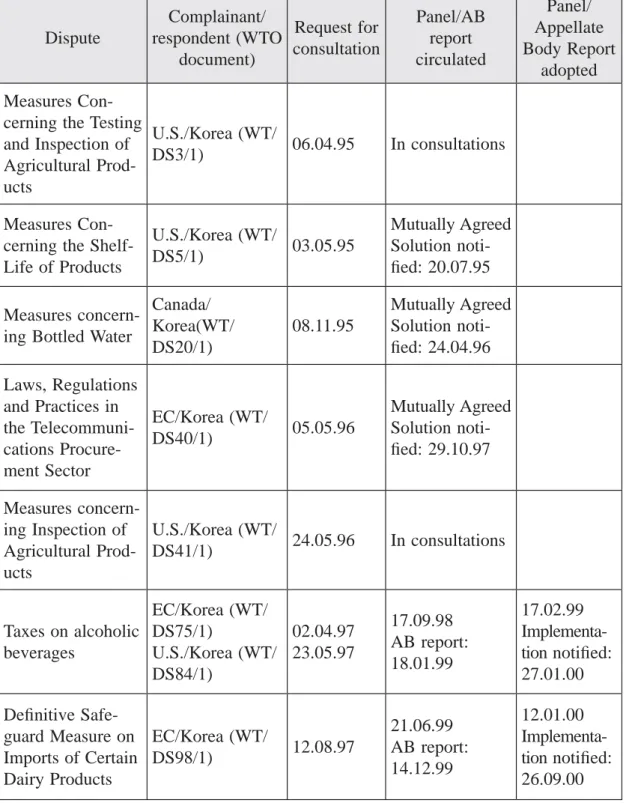
In the WTO system, as a respondent, Korea was involved in 12 cases set out below until 2012.84
83. WTO, Guide to GATT Law and Practice: Analytical Index 1040 (WTO & Bernan Press 1995).
84. See WTO, Dispute Settlement: Disputes by Country/Territory, available at http://www.
wto.org/english/tratop_e/dispu_e/dispu_by_country_e.htm.
Table 2: Korea – Disputes in the WTO as a Respondent85
Dispute
Complainant/
respondent (WTO document)
Request for consultation
Panel/AB report circulated
Panel/
Appellate Body Report
adopted Measures Con-
cerning the Testing and Inspection of Agricultural Prod- ucts
U.S./Korea (WT/
DS3/1) 06.04.95 In consultations
Measures Con- cerning the Shelf- Life of Products
U.S./Korea (WT/
DS5/1) 03.05.95
Mutually Agreed Solution noti- fied: 20.07.95 Measures concern-
ing Bottled Water
Canada/
Korea(WT/
DS20/1)
08.11.95
Mutually Agreed Solution noti- fied: 24.04.96 Laws, Regulations
and Practices in the Telecommuni- cations Procure- ment Sector
EC/Korea (WT/
DS40/1) 05.05.96
Mutually Agreed Solution noti- fied: 29.10.97
Measures concern- ing Inspection of Agricultural Prod- ucts
U.S./Korea (WT/
DS41/1) 24.05.96 In consultations
Taxes on alcoholic beverages
EC/Korea (WT/
DS75/1)
U.S./Korea (WT/
DS84/1)
02.04.97 23.05.97
17.09.98 AB report:
18.01.99
17.02.99 Implementa- tion notified:
27.01.00 Definitive Safe-
guard Measure on Imports of Certain Dairy Products
EC/Korea (WT/
DS98/1) 12.08.97
21.06.99 AB report:
14.12.99
12.01.00 Implementa- tion notified:
26.09.00
85. Table 2 is composed by the authors checking the cases listed in the WTO official website.
Dispute
Complainant/
respondent (WTO document)
Request for consultation
Panel/AB report circulated
Panel/
Appellate Body Report
adopted Measures Affect-
ing Imports of Fresh, Chilled and Frozen Beef
U.S./Korea (WT/
DS161/1) Australia/Korea (WT/DS169/1)
01.02.99 13.04.99
31.07.00 AB report:
11.12.00
10.01.01 Implementa- tion notified:
25.09.01 Measures Affect-
ing Government Procurement
U.S./Korea (WT/
DS163/1) 16.02.99 01.05.00 19.06.00
Measures Affect- ing Trade in Com- mercial Vessels
EC/Korea (WT/
DS273/1) 21.10.02 07.03.05
11.04.05 Implementa- tion notified:
11.04.05
Korea – Anti- Dumping Duties on Imports of Cer- tain Paper from Indonesia
Indonesia/Korea
(WT/DS312/1) 04.06.04
28.10.05 Art.21.5 Panel Report: 28.09.07
Compliance proceed- ings com- pleted with finding(s) of non- compliance:
22.10.07
Measures Affect- ing the Importation of Bovine Meat and Meat Products from Canada
Canada/
Korea(WT/
DS391/1)
09.04.09
Mutually Agreed Solution noti- fied: 19.06.12 Panel Report:
03.07.12
Settled or terminated (withdrawn, mutually agreed so- lution):
20.06.12
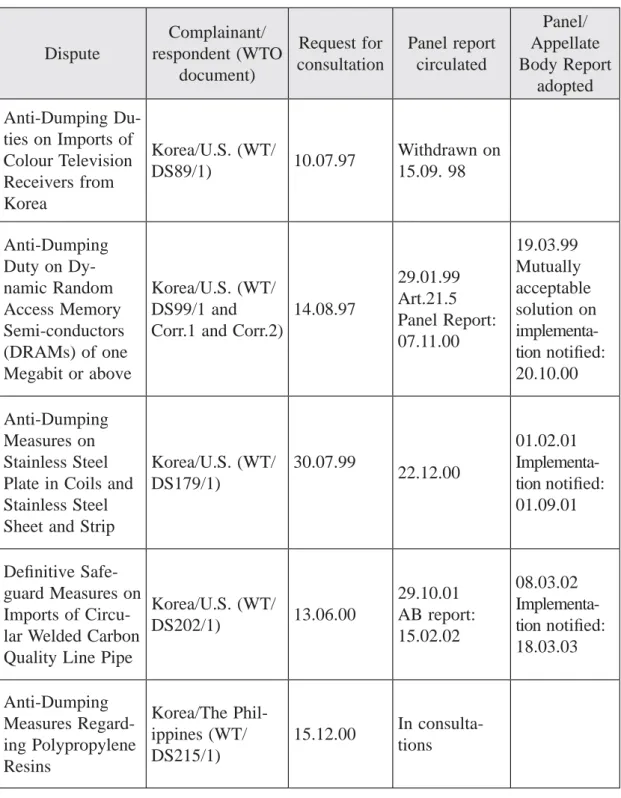
As a complainant, Korea has been involved in 15 cases set out below until 2012.86
86. See WTO, supra note 84.
Table 3: Korea – Disputes in the WTO as a Complainant87
Dispute
Complainant/
respondent (WTO document)
Request for consultation
Panel report circulated
Panel/
Appellate Body Report
adopted Anti-Dumping Du-
ties on Imports of Colour Television Receivers from Korea
Korea/U.S. (WT/
DS89/1) 10.07.97 Withdrawn on 15.09. 98
Anti-Dumping Duty on Dy- namic Random Access Memory Semi-conductors (DRAMs) of one Megabit or above
Korea/U.S. (WT/
DS99/1 and Corr.1 and Corr.2)
14.08.97
29.01.99 Art.21.5 Panel Report:
07.11.00
19.03.99 Mutually acceptable solution on implementa- tion notified:
20.10.00 Anti-Dumping
Measures on Stainless Steel Plate in Coils and Stainless Steel Sheet and Strip
Korea/U.S. (WT/
DS179/1)
30.07.99
22.12.00
01.02.01 Implementa- tion notified:
01.09.01
Definitive Safe- guard Measures on Imports of Circu- lar Welded Carbon Quality Line Pipe
Korea/U.S. (WT/
DS202/1) 13.06.00
29.10.01 AB report:
15.02.02
08.03.02 Implementa- tion notified:
18.03.03 Anti-Dumping
Measures Regard- ing Polypropylene Resins
Korea/The Phil- ippines (WT/
DS215/1)
15.12.00 In consulta- tions
87. Table 3 is composed by the authors checking the cases listed in the WTO official website.
Dispute
Complainant/
respondent (WTO document)
Request for consultation
Panel report circulated
Panel/
Appellate Body Report
adopted
Continued Dump- ing and Subsidy Offset Act of 2000
Korea/U.S. (WT/
DS217/1)
(action also taken by Australia, Chile, the EC, India, Indonesia, Japan and Thai- land)
21.12.00
16.09.02 AB report:
16.01.03
27.01.03 Authoriza- tion to retali- ate granted:
26.11.04
Definitive Safe- guard Measures on Imports of Certain Steel Products
Korea/U.S. (WT/
DS251/1) 20.03.02
11.07.03 AB report:
10.11.03
10.12.03
Countervailing Duty Investiga- tion on Dynamic Random Access Memory Semicon- ductors (DRAMs)
Korea/U.S. (WT/
DS296/1 and WT/
DS296/1/Add.1)
30.06.03 and 18.08.03
23.01.04 AB report:
27.06.05
20.07.05 Implementa- tion notified:
14.03.06
Countervailing Measures on Dy- namic Random Access Memory Chips
Korea/EC (WT/
DS299/1 and WT/
DS299/1/Rev.1/
Add.1)
25.07.03 and
25.08.03 23.01.04
03.08.05 Implementa- tion notified:
21.04.06
Measures Affect- ing Trade in Com- mercial Vessels
Korea/EC (WT/
DS301/1) 03.09.03 19.03.04
20.06.05 Mutually acceptable solution on implementa- tion notified:
20.07.05 European Com-
munities – Aid for Commercial Ves- sels
Korea/EC (WT/
DS307) 13.02.04 In consulta- tions