Nyquist plot of impedance data for PBM(Co-Fe)/LDC/LSGM/PBSCF50-GDC cell. Comparison of SOEC performance reported in the literature and in this study.
Motivation and Research Objective
Solid Oxide Fuel Cell and Solid Oxide Electrolysis Cell Overview
General Fuel Cell
Accordingly, the fuel recovery reaction can be performed without an external reformer system, which allows for an increase in efficiency (~50%).4 Among these types of fuel cells, SOFCs are one of the most promising fuel cells with high energy conversion efficiency and excellent adaptability for a wide range of applications. fuels such as hydrogen, synthesis gas, biogas and coal.5.
Operating Principle of SOFCs
Operating Principle of SOECs
Theoretical Background of SOFCs and SOECs
- Performance of SOCs
- Thermodynamics of SOFCs
- Thermodynamics of SOECs
- Electrochemical Reaction Mechanisms of SOCs
- Charge and Mass Transport Process of SOCs
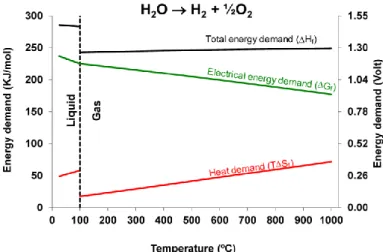
Using the ambient temperature as a reference for calculating the Gibbs free energy (∆𝐺), the reversible work of the reaction (𝑤𝑟𝑒𝑣) is equal to the Gibbs free energy of the reaction. The ion conductor phase (i.e., the electrolyte) is connected by a continuous ion pathway in the electrolyte membrane, providing a sink for the oxygen ions produced by the reaction.22.
Materials for SOFCs and SOECs
Electrolytes
But lanthanum in LSGM easily diffuses to the electrode side, leading to the formation of an insulator at the interface.26 GDC has received attractive attention as an alternative electrolyte with its high conductivity at lower temperature. This reduction reaction leads to an increase in electronic conductivity with the occurrence of leakage current and reduces the efficiency of the fuel cell.
Air Electrodes
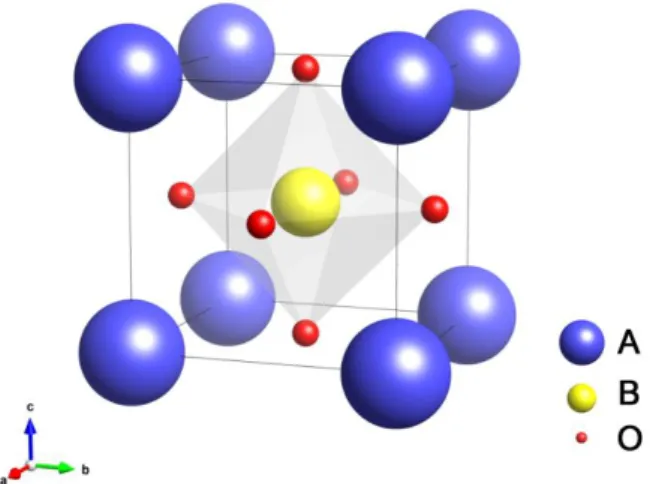
The general formula of a site ordering layered perovskite is AA′B2O5+, where A is occupied by a trivalent lanthanide ion, A′ is a rare earth metal, and B is assigned a 3d transition metal ion (Mn, Fe , Co, Ni Cu, etc). The general formula for RP phases is An+1BnO3n+1, where A is assigned a lanthanide or alkaline earth ion, B is occupied by transition metal ions, and n indicates the number of perovskite layers.46 It consists of oxides of related to the RP phase. of AO rock salt layers alternating perovskite (ABO3)n layers along the crystallographic c axis as shown in Figure 1.11.
Fuel Electrodes
Development of double-perovskite compounds as cathode materials for solid oxide fuel cells at low temperatures. The effect of H2S on the performance of Ni-YSZ anodes in solid oxide fuel cells.
Experimental
Cell Fabrication
- GDC Electrolyte Based Cell
- LSGM Electrolyte Supported Single Cell
- BZCYYb Electrolyte Based Anode Supported Single Cell
The LDC layer was used as an interlayer between the air electrode and the electrolyte to prevent the interdiffusion of ionic species between the electrode material and the LSGM.1 The electrode mixture was applied to the LSGM pellet by screen printing and then sintered at 950 oC in air for 4 hours. Air electrode mixtures were applied to the BZCYYb electrolyte surface by screen printing and finally sintered at 950 oC for 4 hours in air.
Basic Characterization
- Structural Analysis
- Thermal Analysis
- Electrical and Electrochemical Analysis
- Redox Property and Oxygen Non-stoichiometric Analysis
- Oxygen kinetics determination
Coulometric titration was used to accurately quantify the oxidation/reduction state of the sample as a function of p(O2). The measured samples were annealed for more than ten times longer than the isotope oxygen exchange time.2 The sample was cooled to room temperature and residual oxygen was removed from the system.
Experimental
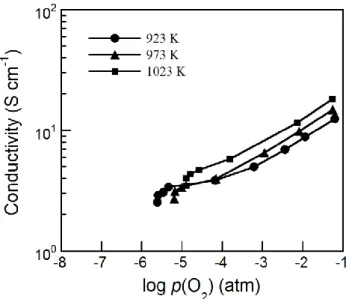
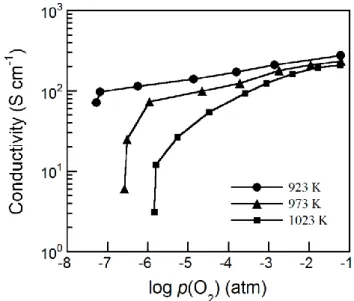
The electrical conductivities of BSCF and LSCF pellets were measured by a four-probe DC conductivity technique. Coulometric titration was used to accurately quantify the oxidation/reduction state of BSCF and LSCF as a function of p(O2).
Results and Discussions
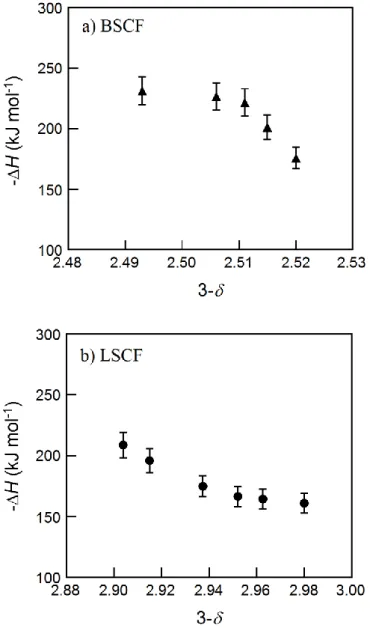
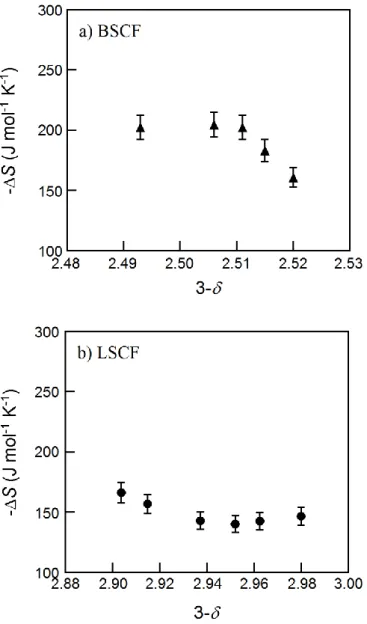
The suitability for BSCF and LSCF cathode materials should be assessed cautiously with regard to the instability predicted from the isotherm. In general, the cathode experiences a lower p(O2) under operating conditions due to cathodic polarization. Therefore, sufficient electrical conductivity at relatively low p(O2) is also important to ensure efficient current collection and long-term stability.16 The p(O2) ) dependence of the 4-probe electrical conductivity for BSCF and LSCF at different temperatures (923 < T(K) < 1023) are shown in figures 3.6 and 3.7. The slope of electrical conductivity in BSCF and LSCF becomes much steeper below 10-5 and 10-6 atm. The partial molar entropies of BSCF and LSCF are not much different, meaning that the probability of an oxygen vacancy reaction is similar.
Conclusions
Evaluation of La-Sr-Co-Fe-O Perovskites for Solid Oxide Fuel Cells and Gas Separation Membranes. Thermal and electrical properties of new cathode material Ba0.5Sr0.5Co0.8Fe0.2O3−δ for solid oxide fuel cells. Optimization of Sr content in layered SmBa1-xSrxCo2O5+ perovskite cathodes for medium-temperature solid oxide fuel cells.
Experimental
The microstructures of the SmBa1-xSrxCo2O5+ composites and the cross sections of single cells were investigated using a field emission scanning electron microscope (Nova SEM). The electrical conductivities of SmBa1-xSrxCo2O5+ samples were measured by a four-terminal DC regulation technique. A NiO-GDC anode supported cell was fabricated to measure the electrochemical performance of SmBa1-xSrxCo2O5+.
Results and Discussions
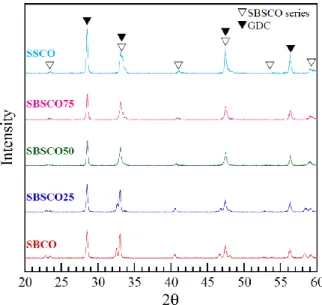
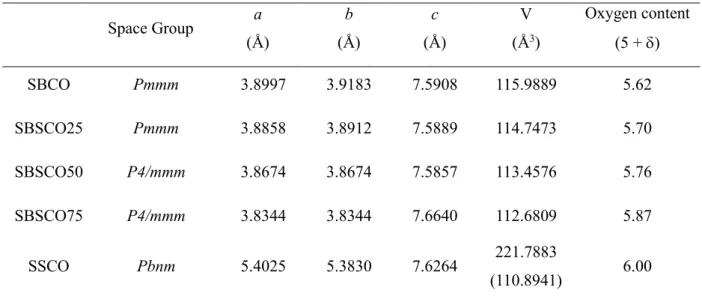
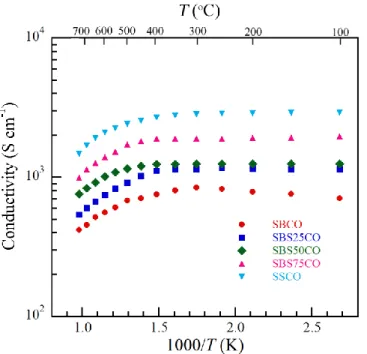
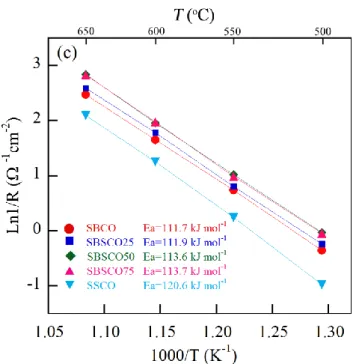
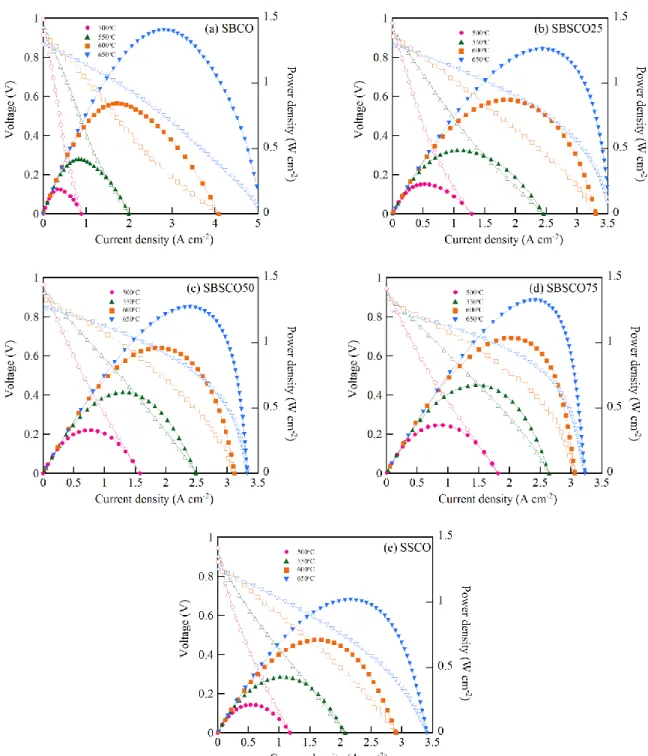
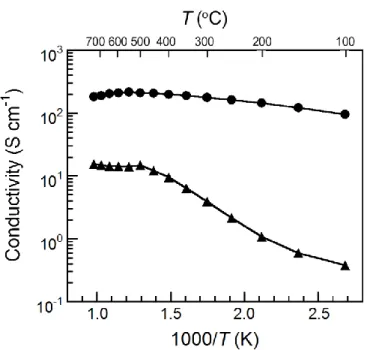
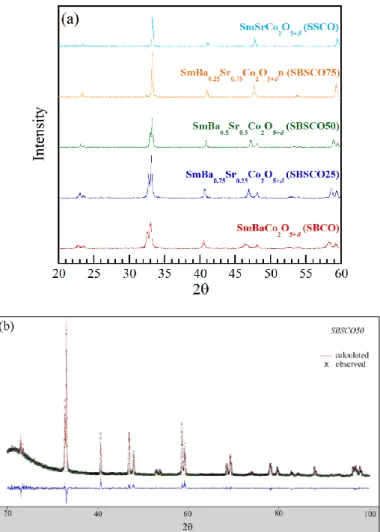
The inset in Figure 4.4 shows TGA data collected from the weight change of SmBa1-xSrxCo2O5+ samples after heating to 900 oC in air. The electrical conductivity of SmBa1-xSrxCo2O5+cathodes in air is shown by the Arrhenius graph in Figure 4.5. Therefore, SBSCO75 is expected to provide rapid bulk oxygen diffusion and high surface kinetics on the electrode surface between SmBa1-xSrxCo2O5+ samples.
Conclusions
Characterization of Ba-Deficient PrBa1−xCo2O5+δ as Cathode Materials for Intermediate Temperature Solid Oxide Fuel Cells. Stability, chemical compatibility and electrochemical performance of GdBaCo2O5+x-layered perovskite as a cathode for medium temperature solid oxide fuel cells. Electrochemical performances of NdBa0.5Sr0.5Co2O5+x as potential cathode material for medium-temperature solid oxide fuel cells.
Experimental
The microstructures of the SmBa0.5Sr0.5Co2-xCuxO5+composites and cross-sections of single cells were examined using field emission scanning electron microscopy (Nova Nano SEM, FEI, USA). The initial oxygen content of the SmBa0.5Sr0.5Co2-xCuxO5+oxides was determined by iodometric titration. Coulometric titration was used to accurately quantify the oxidation/reduction state of the SmBa0.5Sr0.5Co2-xCuxO5+ as a function of p(O2).
Results and Discussions
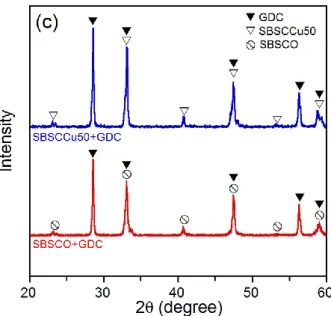
Thermogravimetric analysis data of SBSCO and SBSCCu50 by the weight change with temperature in air. The lowest electrical conductivity of SBSCO and SBSCCu50 samples is still higher than 200 S cm-1 from 100 to 750 oC. Comparison of the long-term performance of SBSCO-GDC|GDC|NiO-GDC and SBSCCu50-GDC|GDC|NiO-GDC with humidified H2 as the fuel and still air as the oxidant under a constant current load of -0.4 A cm-2 at 600 oC.
Conclusions
SmBaCoCuO5+x as cathode material based on GDC electrolyte for intermediate temperature solid oxide fuel cells. Structure-property relationship in layered perovskite cathode LnBa0.5Sr0.5Co2O5+δ (Ln = Pr, Nd) for solid oxide fuel cells. Electrochemical investigation of composite cathodes with SmBa0.5Sr0.5Co2O5+δ cathodes for solid oxide fuel cell operating at intermediate temperature.
Electrochemical properties of B-site Ni-doped layered perovskite cathodes for
Experimental
The initial oxygen content of the SmBa0.5Sr0.5Co2-xNixO5+ oxides was determined by iodometric titration. A NiO-GDC anode-supported cell was fabricated to measure the electrochemical performance of SmBa0.5Sr0.5Co2-xNixO5+. Schematic diagram of the single-cell (SmBa0.5Sr0.5Co2-xNixO5+-GDC|GDC|Ni-GDC) test equipment.
Results and Discussions
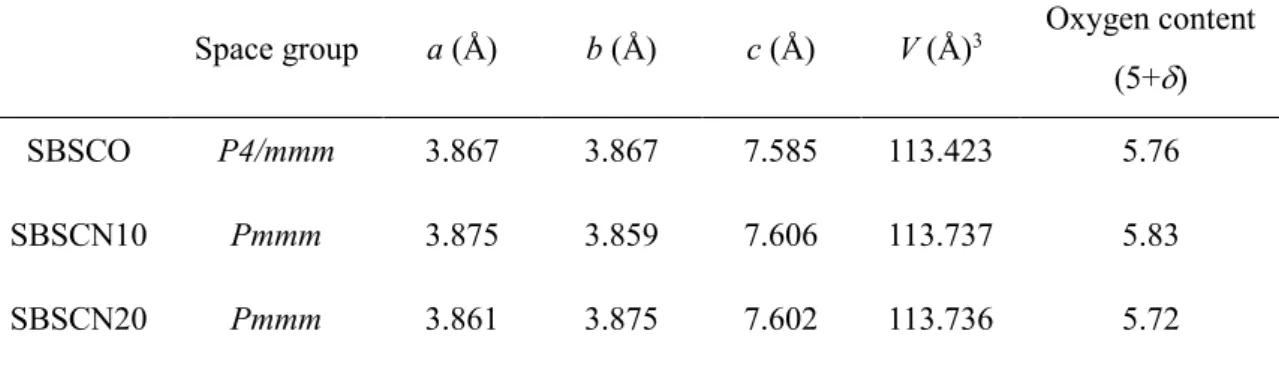
In general, the chemical reaction between the electrode and the electrolyte can cause the formation of an unwanted insulating layer at the interface, which hinders ion and electron transport.24 As shown in Figure 6.2 (c), SBSCN(x = 0, 0.1, and 0.2 ) and GDC retain their structures without any apparent reaction between SBSCN (x = 0, 0.1 and 0.2) and GDC. All samples SmBa0.5Sr0.5Co2-xNixO5+ (x = 0, 0.1 and 0.2) show a decrease in electrical conductivity with increasing temperature due to the loss of oxygen from the lattice above 200 oC, indicating metallic conductive behavior. The temperature dependence of the ASR with the composition SmBa0.5Sr0.5Co2-xNixO5+-GDC is illustrated by an Arrhenius plot in Figure 6.6(b).
Conclusions
Electrochemical Performance of PrBaCo2O5+δ Layered Perovskite as an Intermediate Temperature Solid Oxide Fuel Cell Cathode. Effect of Mn on the Electrochemical Properties of a Layered Perovskite NdBa0.5Sr0.5Co2−xMnxO5+δ (x and 0.5) for Intermediate Temperature Solid Oxide Fuel Cells. High Redox and Performance Stability of Layered SmBa0.5Sr0.5Co1.5Cu0.5O5+δ Perovskite Cathodes for Medium-Temperature Solid Oxide Fuel Cells.
Correlation between fast oxygen kinetics and enhanced performance in Fe
Experimental
The crystalline structure of SmBa0.5Sr0.5Co2-xFexO5+ was characterized using an X-ray diffractometer (Rigaku diffractometer, Cu K radiation). The electrical conductivity of SmBa0.5Sr0.5Co2-xFexO5+ samples was measured using a four-terminal DC arrangement technique. A NiO-GDC anode-supported cell was fabricated to measure the electrochemical performance of SmBa0.5Sr0.5Co2-xFexO5+.
Results and Discussions
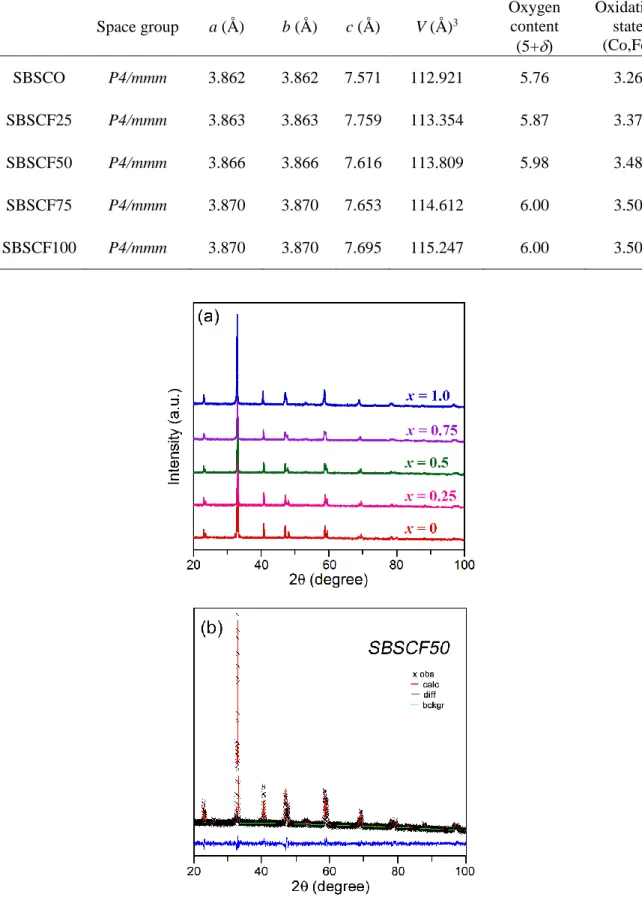
The entire SmBa0.5Sr0.5Co2-xFexO5+(x = 0, 0.5 and 1.0) sample achieve their respective maximum at a range of 400-500 oC and then decrease as the temperature is further increased, exhibiting typical semiconductor behavior. Therefore, SBSCF50 is expected to provide fast oxygen diffusion in the bulk and high surface kinetics on the surface of the electrode among the SmBa0.5Sr0.5Co2-xFexO5+ (x = 0, 0.5 and 1.0) samples. Single cell performance improves with increasing Fe content up to x = 0.5 in the SmBa0.5Sr0.5Co2-xFexO5+ oxides, while SBSCF100 shows a sudden reduction in cell performance, consistent with the trend of ASR and electrical conductivity results.
Conclusions
Highly efficient and robust cathode materials for low temperature solid oxide fuel cells: PrBa0.5Sr0.5Co2-xFexO5+δ. Chemically stable perovskites as cathode materials for solid oxide fuel cells: La-doped Ba0.5Sr0.5Co0.8Fe0.2O3-δ. Trade-off optimization of electrochemical performance and thermal expansion of co-base cathode material for medium temperature solid oxide fuel cells.
Achieving high efficiency and eliminating degradation in solid oxide
Experimental
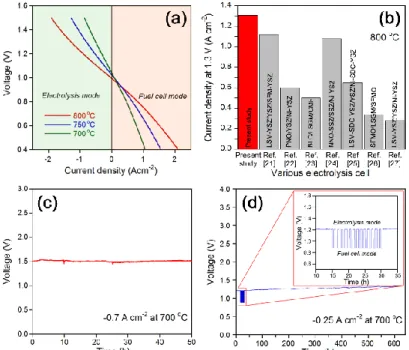
The LDC layer was used as a buffer layer between the air electrode and the electrolyte to prevent inter-diffusion of ionic species between PBM and LSGM. 6 The electrode slurry was applied to the LSGM pellet by screen printing method and then fired at 950 oC in air for 4 hours. 15 wt.% of Co0.5Fe0.5 (Co-Fe) catalyst solution was infiltrated on the fuel electrode side and heated in air to 450 oC. For reversibility and long-term stability, the PBM(Co-Fe)/LDC/LSGM/PBSCF50-GDC cell was tested at 700 oC under 10% steam and 90% H2 fed to the fuel electrode side and air exposed to the air electrode . lateral.
Results and Discussions
After reversible cycling, the voltage of the PBM(Co-Fe)/LDC/LSGM/PBSCF50-GDC cell was recorded with an applied current density of -0.25. Nyquist plot of the impedance data for the PBM(Co-Fe)/LDC/LSGM/PBSCF50-GDC cell at OCV at different temperatures under 10% steam and 90% H2 supplied to the fuel electrode side. The voltage of the electrolytic cell is almost constant and there is no degradation at a high current of -0.7 A cm-.
Conclusions
High performance intermediate temperature cells for solid oxide electrolysis using Nd2NiO4+δ impregnated zirconium oxygen electrode stabilized with Scandia. Co-electrolysis of H2O and CO2 in a solid oxide electrolysis cell with hierarchically structured porous electrodes. High temperature solid oxide electrolysis cell using porous structured (La0.75Sr0.25)0.95MnO3 with improved oxygen electrode performance.
Novel system for the production of hydrogen
Experimental
To test the chemical stability between NBSCF and BZCYYb, the NBSCF-BZCYYb composite electrode slurries were applied to the BZCYYb electrolyte by a screen-printing method and then ignited at 950 oC in air for 4 hours. For the electrolysis tests, Ag wires were attached to both electrodes of the Ni-BZCYYb/BZCYYb/NBSCF-BZCYYb cell using the Ag paste as a current collector. The cell was completely sealed at one end of the aluminum tube using a ceramic adhesive (Aremco, Ceramabond 552).
Results and Discussions
Nyquist plot of the impedance data measured at OCV in Dual SOEC mode is shown in Figure 9.5. Comparison of the performance of Dual SOEC in the present study and O2--SOEC and H+- SOEC reported in the literature. Therefore, Dual SOEC can be considered as one of the most promising electrolytic systems in terms of efficient hydrogen production.

Conclusions
Areum Jun, Junyoung Kim, Guntae Kim "Novel Hydrogen Production System: Dual Solid Oxide Electrolyzer" (2016) (Submitted). Junyoung Kim, Areum Jun, Jeeyoung Shin, Guntae Kim*, “Effect of Fe doping on layered GdBa0.5Sr0.5Co2O5+ perovskite cathodes for medium-temperature solid oxide fuel cells” J. Areum Jun, Junyoung Kim, Jeeyoung Shin, Guntae Kim* , “Optimization of Sr content in layered SmBa1-xSrxCo2O5+ perovskite cathodes for medium-temperature solid oxide fuel cells” Int.