Due to the inhibition of Al corrosion and the bifunctional electro-catalysis of MOF, the Al-air battery shows ultra-high discharge capacity. The red line represents the open circuit voltage of the AMA battery under humid conditions (99 % blowing dry air through a 3:7 v/v water/methanol mixture). The green line is for a galvanic cell containing similar Al carbon and glass electrodes, but a 1M KOH solution instead of the electrolyte-injected Rb-CD-MOF crystal………..20 Figure 2.7.
SEM images of Al surfaces and EDS spectrum map for oxygen content on Al surfaces (a,b) before discharge and (c,d) after discharge of AMA battery. FTIR spectroscopy of polyester layer with embedded Zn nanoparticles (Zn@polyester) and coated on Al surface (cf. Section S1).
List of Tables
General Introduction
Introduction
- Electrochemical energy storage system
- History of batteries markets
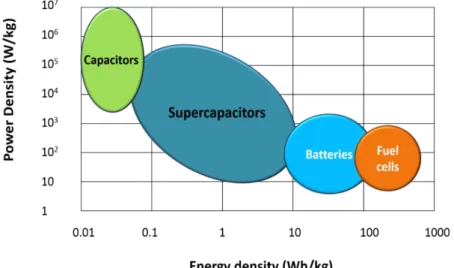
As the diagram has shown that capacitors have high power, fuel cells have high energy and batteries are between them. For this reason, metal-air batteries are being investigated to supplement the disadvantages of batteries and fuel cells. However, the limiting factors for lead-acid batteries are relatively low cycle life and battery operating time.
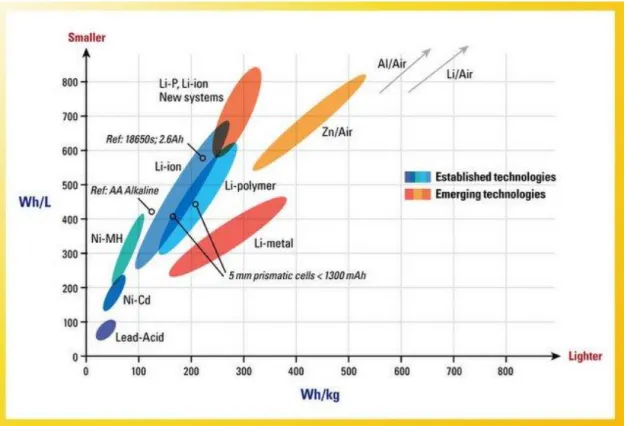
The above diagram shows metal-air batteries as an emerging technology, which means that these studies are insufficient. Metal-air batteries are installed in a place where it is smaller in size and lighter in weight.
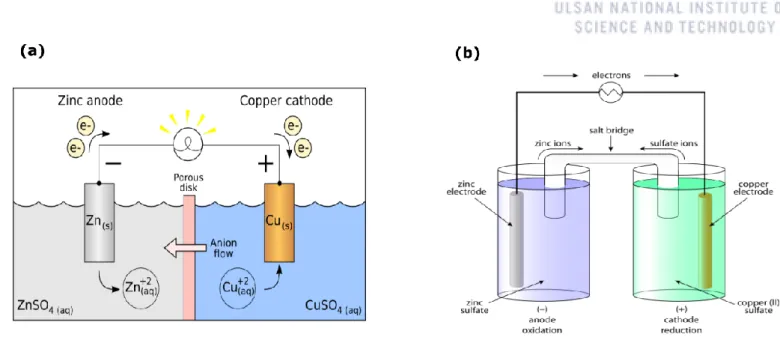
Metal-air batteries
- Anode of metal-air batteries
- Air cathode
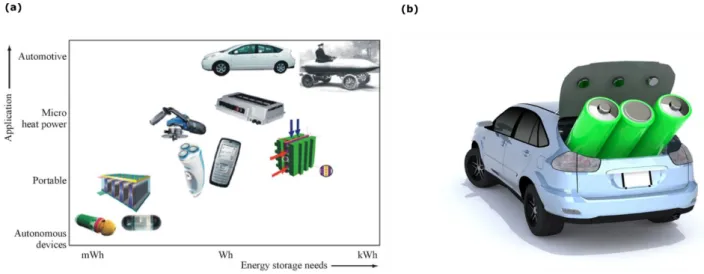
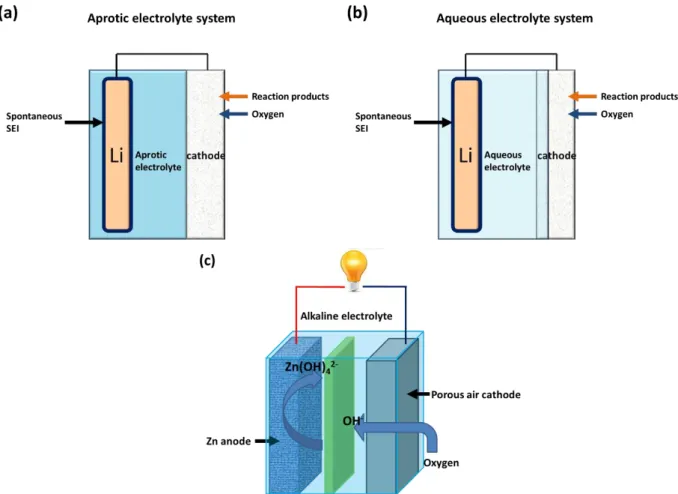
In addition, metal-air batteries have potential of cheap price and reduced weight of the battery because the cathode is oxygen from air. Metal-air batteries use pure metal as an anode such as Li, Zn, Al and Mg etc. Among the anode metals, Li and Zn are representative metals for metal-air batteries (Figure 1.7).
However, Li-air batteries have many challenges which are incomplete blocking of the porous carbon cathode, unstable anode in vapor and lack of effect of catalysts in the cathode etc. Lithium-air batteries are divided into two types depending on the electrolyte: aprotic electrolyte and aqueous electrolyte. The chemical reactions of Li-air batteries in each of the aprotic and aqueous electrolytes are shown below.
Representative metal-air batteries (a) aprotic electrolyte and (b) aqueous electrolyte Li-air batteries (c) Zn-air batteries. Zn-air batteries have a theoretical energy density of 1086 Wh/kg, about five times higher than lithium-ion cells25. All metal is an attractive candidate for metal-air batteries due to its low cost, environmental friendliness, abundance of earth.
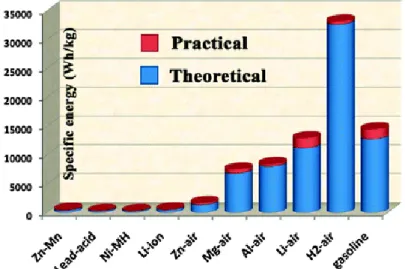
Al-air batteries are made of Al metal as anode, porous carbon atoms as cathode and electrolyte (Figure 1.8). Normally, Al-air batteries are not rechargeable because they no longer generate electricity due to the formation of an aluminum oxide layer. Although metal-air batteries have a high theoretical energy density, the practical energy density is shown to depend on cathode materials.
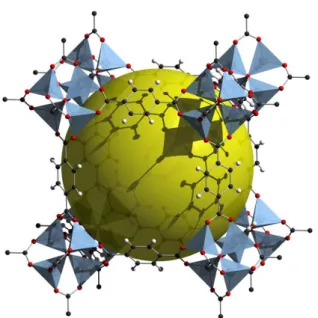
Metal Organic Frameworks (MOFs)
- Examples of Metal-Organic Frameworks batteries applications
The reaction takes place on the rotating disk and then the products are moved to the ring disk to react again. However, attempts to remove guest molecules from the pores often failed due to framework collapse. Yaghi and co-workers reported the synthesis of a MOF that remains crystalline and stable secondary building blocks (SBUs)48,49,50.
The clusters of carboxylate are mullidentate linkers allow for the formation of more rigid frameworks as they can be combined with metal ions in M-O-C bridges39. MOFs are promising materials for many applications in catalyst51, 52, gas storage separation and molecular recognition57 due to their properties inherent to the building block such as geometry stiffness chemical functionality, or chirality. Furthermore, although people are interested in electrochemical energy storage by applying MOFs58,59,60, these experiments have not been sufficient.
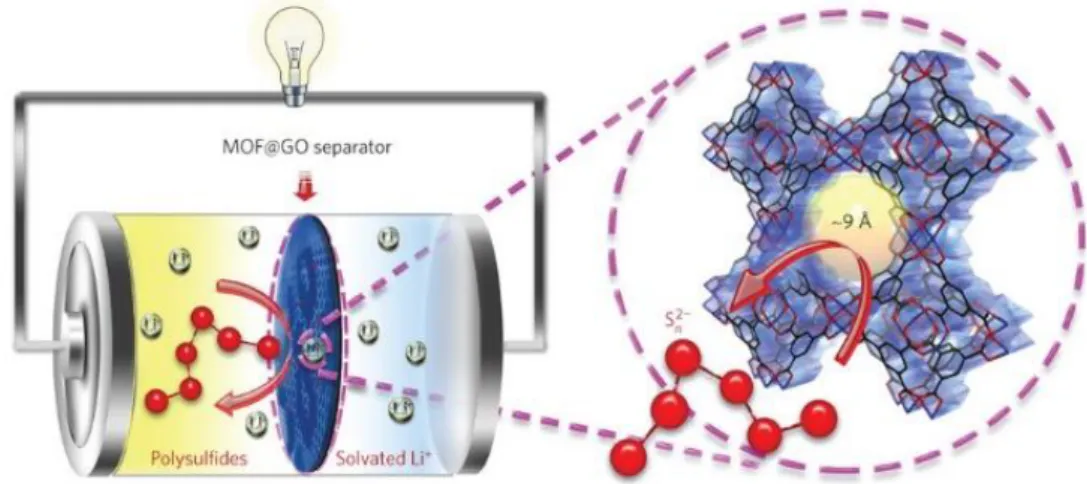
But successive researches related to this topic have proven the possibilities of MOF applications for electrochemical energy storage61,62,63. For example, some MOFs are used as electrodes for Li-ion batteries, Na-ion batteries67,68 and supercapacitors69. However, sulfur has poor reversibility due to the loss of the active site during cycling72 because the MOF can take up soluble polysulfide, which can be dissociated during battery cycling, promoting capacity degradation and low efficient battery performance.
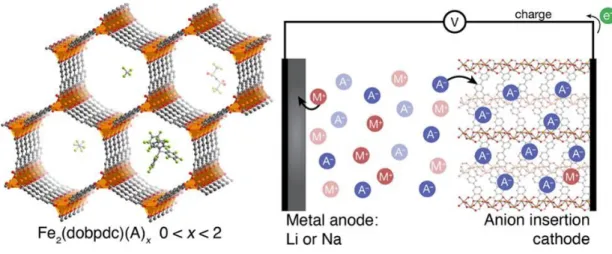
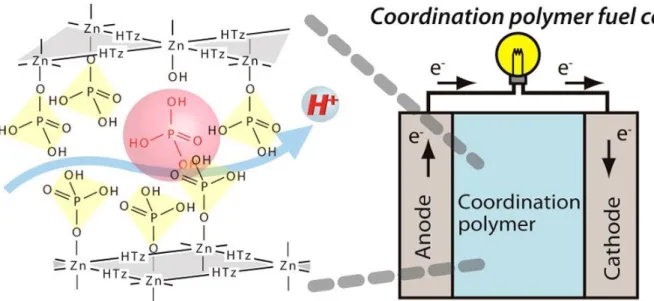
Zhou et al.73 reported Li-S batteries with MOFs separators improved battery cycle and structural stability. (Fig. 1.12). Nevertheless, Long et al proved construction of dual-ion prototype batteries using Fe2 (dobpdc) MOF as cathode, which is shown bitactic oxidative insertion reaction with weak coordinated anions including BF- and PF-74 (Figure 1.13). Therefore, to overcome this problem, kitagawa et al.75 used defective non-porous coordination polymer as solid electrolyte for fuel cell (Figure 1.14).
Aluminum-MOF-air battery (AMA battery)
Introduction
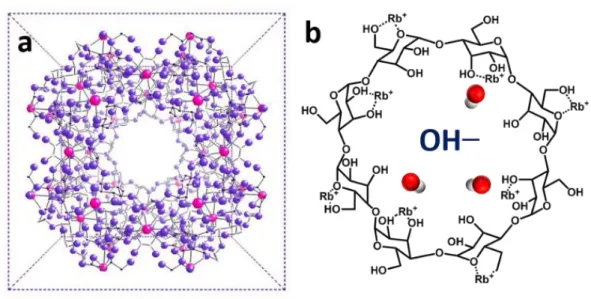
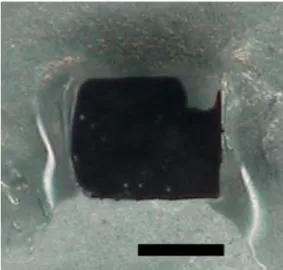
The Al-MOF-air battery (henceforth AMA) was assembled (i) by coating a polished Al foil (99.99 % Sigma Aldrich) with a ~10 μm thin layer of polyester (Allied High-Tech Products) that 0.02 w /w contains % of Zn nanoparticles (Sigma Aldrich, average diameter 40 nm, dispersity 0.16), (ii) place a single crystal, rubidium-based γ-cyclodextrin MOF (Figure 2.1) soaked with 1M RbOH (1M RbOH@Rb- ) on this film CD-MOF), and (iii) cover the top surface of the MOF crystal with conductive carbon paste (Figure 2.2). Image of MOF battery covering the top surface of the MOF crystal with conductive carbon paste. The Rb-CD-MOF single crystals were synthesized as previously described76,77,78 and were typically ca.
These crystals hosted hydroxide anions (OH-) that balanced the charge of Rb+ cations and allowed the crystal's ionic conductivity measured by AC impedance to be S/cm (Figure 2.3). Moreover, this conductivity could be increased to 7.83ⅹ10-4 S/cm when the crystals were infiltrated with additional RbOH (by soaking in 1M RbOH solution of 70% MeOH and 30% H2O). Images in Figure 2.4 and the corresponding powder XRD spectra in Figure 2.5 confirm that the MOFs do not lose their crystallinity when soaked, which agrees with us.
Powder x-ray spectra of RbOH@CD-MOF crystals as synthesized (black line) and infiltrated with 1M RbOH (red line). We note that the above conductivity values are higher than for other ionically conducting MOFs79,80,81, probably due to the hydrophilicity of channels and hydrogen bonding network between water and OH guests81,82 Also the ionic conductivity of the as-synthesized Rb-CD- MOF single crystals are one order of magnitude higher than reported for polycrystalline CD-MOF grains,83 highlighting the role of long-range ordering of MOF's channels and the lack of grain boundaries.82.
Results
The specific capacity of the AMA battery is unprecedented for any reported Al-air batteries.84 With these characteristics, AMA batteries based on MOF crystals only a few hundred microns in diameter can power small electronic devices such as timers or LEDs for hours. in Figure 2.8. To understand the mechanism underlying the operation of the AMA battery, it is important to consider the roles of the polymer/Zn NP layer, the MOF itself and the humidity. Indeed, EDS studies of the carbon electrode delaminated after battery discharge indicate that Al is present on this electrode when the polyester/Zn NP layer is not used; no Al signal is detected when the coating is applied.
We note that the data shown were obtained in 0.1 M RbOH dissolved in methanol - this choice was made to avoid dissolution of the CD-MOF crystals in pure water78; at the same time, experiments performed in a 10:90 v/v water/methanol mixture (see Figure 2.12) yield similar results (i.e., similar initial voltages and kinetics) sparing higher current densities. On the other hand, the mixture of CD and RbOH does not give stable ORR cycles in CV (full in a). g) Dependence of electron transfer number, n, on potential for 1M RbOH@ Rb-CD MOF, Rb-CD MOF and mixture of CD and RbOH. The histogram gives the values of the number of electrons transferred, n (red bars) and the electrochemical activity (given as the fully diffusion-limited current density, jL, at 0 V vs. RHE; empty bars) for the ORR performance of the reported MOFs94 , 95, mixtures of CD and RbOH, and Rb-CD-MOFs with and without the RbOH electrolyte.
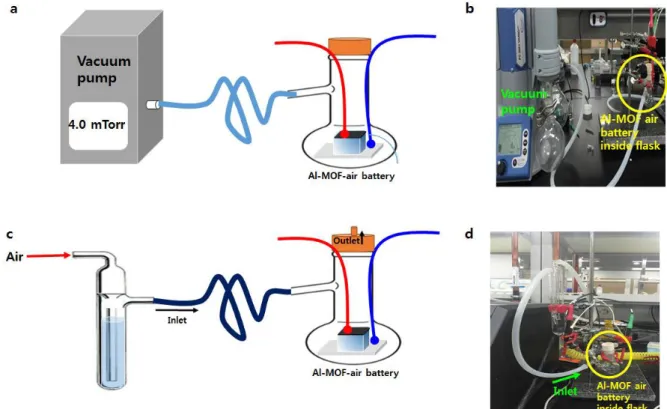
Finally, the K-L diagrams in Figure 2.16 show the linear relationship between the inverse kinetic current, jk-1, and the inverse square root of the electrode angular velocity, ω-1/2, which is typical of first-order reaction kinetics regarding the diffusion of O2 in the electrocatalysts.96. Although the role of OER is not as clear as that of ORR, the discharge experiments described below suggest that it could be important for the regeneration of the “fuels” of water and oxygen. In this context, Figure 2.17 illustrates the performance of the AMA battery under a vacuum of 10-3 mTorr, without inflow of water and oxygen.
It is reasonable to assume that the ORR assists in this operation by using adsorbed water and oxygen in the single crystal MOF and regenerating oxygen from within the hydroxide anions present inside the crystal. SEM image of the “top” carbon electrode delaminated from (a) AMA battery with Zn@polyester layer coated on the Al anode and (b) AMA battery with only bare Al anode, not coated with Zn@polyester. To increase the diffusion-limited current density (jL) of the catalysts, 2 wt% carbon paste was added as a conducting agent.
5 μL of the thus prepared catalyst ink was dropped onto the ring disc electrode and then dried at ambient conditions. The value of N = 0.412 was estimated from the ratio of the limiting ring current to the limiting disk current (note: this value was close to the theoretically calculated value of 0.424 based on the dimensions and geometry of our RRDE).

Conclusion
Experimental section
Loh, A graphene oxide and copper-centered metal-organic framework composite as a tri-functional catalyst for HER, OER, and ORR. Wu, Nanocarbon electrocatalysts for oxygen reduction in alkaline media for advanced energy conversion and storage. Yang, Design principles of oxygen reduction activity on perovskite oxide catalysts for fuel cells and metal-air batteries.
Qiao, Sulfur and nitrogen doubly doped mesoporous graphene electrocatalyst for oxygen reduction reaction with synergistically enhanced performance. Tarascon, Mixed-valence Li/Fe-based metal-organic frameworks with both reversible redox and sorption properties. Doublet, Design of electrode materials for lithium-ion batteries: the example of metal-organic frameworks.
Vittal, Lithium storage in a metal organic framework with diamondoid topology - a case study on metal formats. Walton, In situ Fe XAFS of reversible lithium insertion into a flexible metal organic framework material. Double, FeⅡ/FeⅢ Mixed-Valence State Induced by Li Insertion into the Mil53(Fe) Metal-Organic Framework: A DFT-U.J Study.
Xu, From metal-organic framework to nitrogen-decorated nanoporous carbon: high CO2 uptake and efficient catalytic reduction of oxygen. High hydroxide conductivity in a chemically stable crystalline metal-organic framework containing a supramolecular water-hydroxide chain. Chem.Soc., Design and synthesis of hydroxide ion-conducting metal-organic frameworks based on salt inclusion.
Acknowledgement