Principle of OPVs
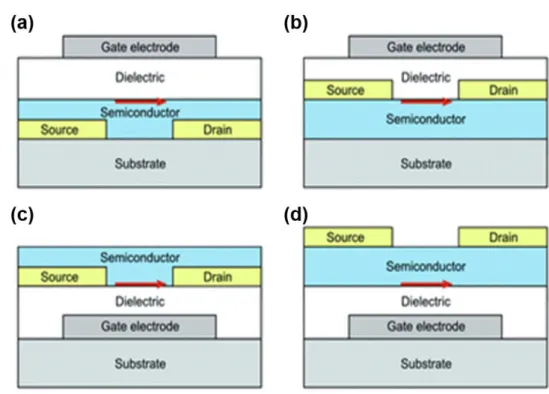
Principle of OFETs
Brief Concept of Random Polymerization
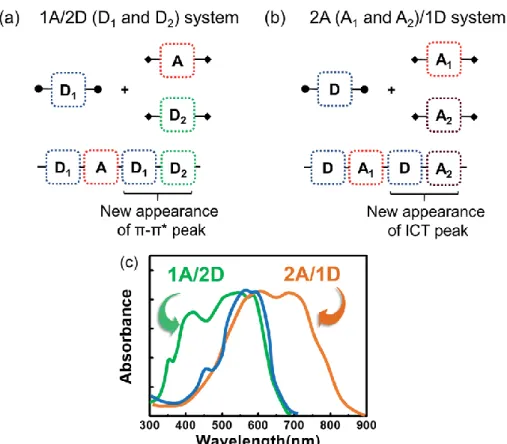
A promising strategy to overcome alternating donor–acceptor polymer limitations is to use the concept of random terpolymer strategy. Another type of random terpolymer is 2D-1A type terpolymer consisting of two donor and one acceptor units, which was used to control the crystallinity of terpolymers.
The synthetic method of Stille Coupling Reactions
The synthetic method of Suzuki Coupling Reactions
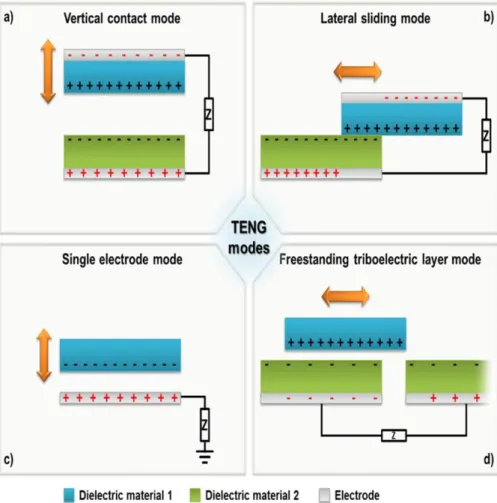
Principle of TENGs
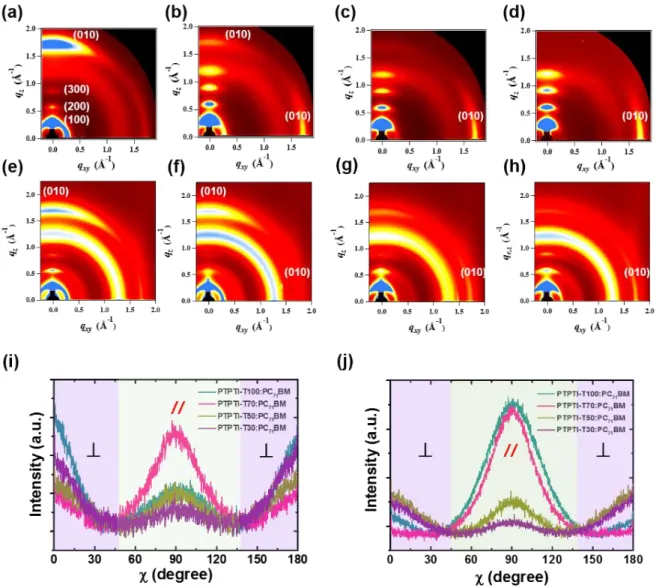
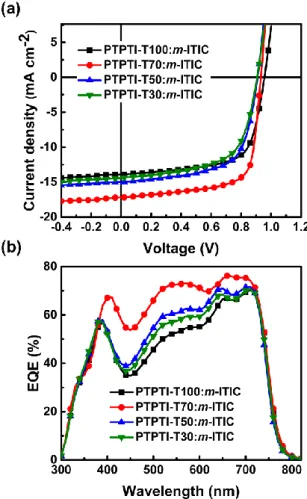
Note that both the JSC and FF values of the random terpolymers show a gradual decrease as the 2T content in the backbone increases. 2D-GIWAXD images of the polymer:PC71BM blend films measured at the critical angle of films (αi = 0.11° < αc). The broad peaks in the range of 1.56-1.00 are assigned to methylene protons (-CH2-R, methylene) of the hexyldecyl side chain groups.
The higher absorption coefficient observed in the PTPTI-T70:m-ITIC blend (Figure 25b) is one of the factors responsible for the highest JSC of the devices. The change in the VOC value matched the trend of the HOMO levels of the corresponding PTPTI-Tx polymers. There are no systematic trends in CCL010 values as a function of alkyl substituents.
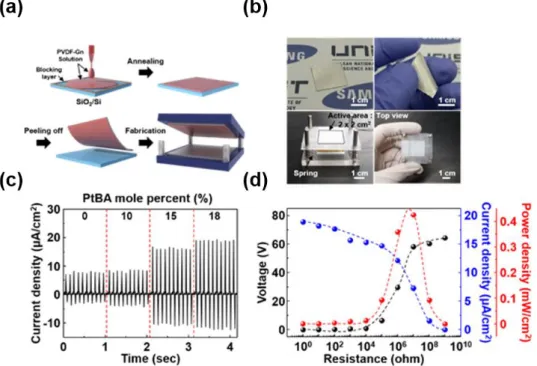
All OFET parameters (e.g. hole (hole) and electron (electron) mobilities, threshold voltage (VT) and on/off current ratio (Ion/Ioff) for the annealed polymer films are summarized in Table 5. The output voltages and current densities of the TENGs were measured and plotted in Figure 37d This is because the dipole relaxation of the polymers cannot catch up with the external oscillating field.
I evaluated the surface morphology of PVDF-Gn films measured using atomic force microscopy (AFM), as shown in Figure 39a. These results may imply that the effect of roughness on power output is negligible.
The synthetic method of ATRP
A Study on TPTI-based Random Terpolymers by Tuning Composition Ratio for Solar
Results and Discussion
- Photovoltaic Performance
- Thin Film Mophology Analysis
- Charge carrier dynamics-generation, collection, and recombination
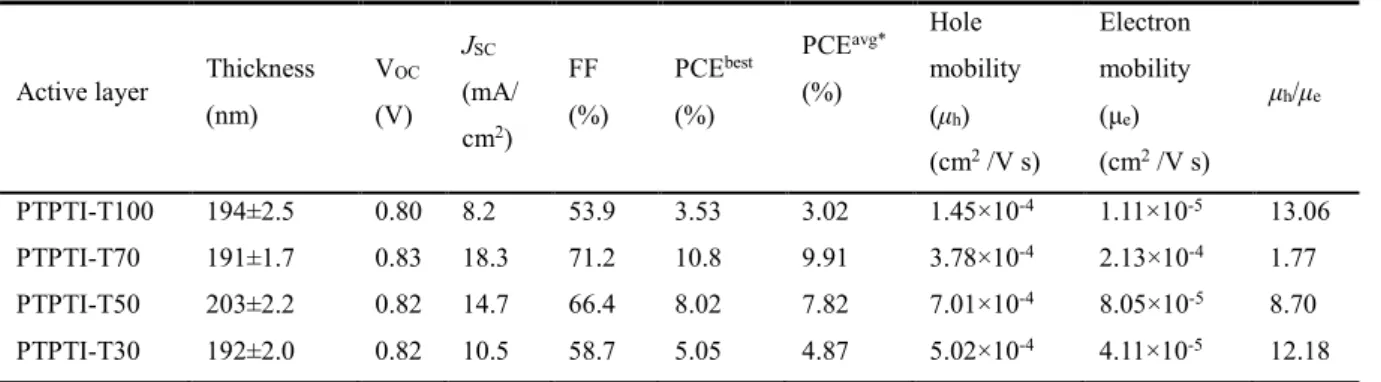
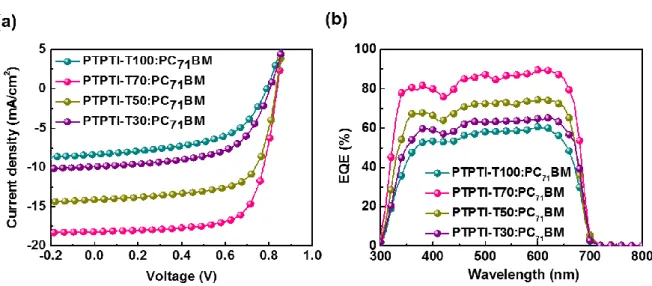
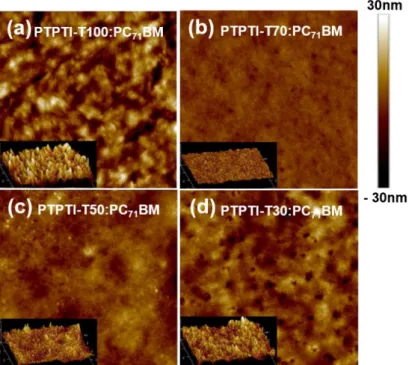
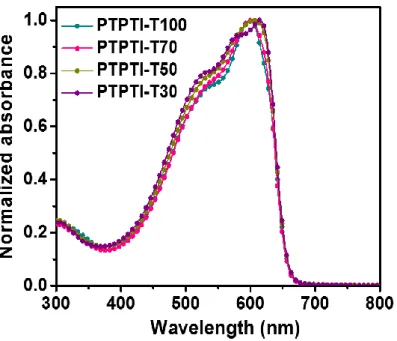
Surprisingly, although the energy levels and absorption coefficients of the used donor polymers are very similar to each other, a dramatic improvement in the JSC and FF of the random terpolymer systems is observed. The terpolymer-based devices show much better EQE values over the entire wavelength range than those of the PTPTI-T100-based control device, so the EQEs are in the order PTPTI-T100 < PTPTI-T30 < PTPTI-T50 < PTPTI - T70, which is essentially consistent with the JSCs obtained from the J–V44 features. To understand the surface and bulk morphology of the textures of the active layer, we perform atomic force microscopy (AFM) measurements.
The neat PTPTI-T100 film exhibits strong (010) – stacking peaks along the out-of-plane direction, whose intensity gradually fades with increasing 2T content in the backbone, while affecting the intensity of the in-plane (010) – stacking peak, which implies a gradual shift of the parallel – stacking orientation to a perpendicular46, 51. Specifically, the PTPTI-T100:PC71BM blend film shows a stronger – along-plane. than the out-of-plane direction, while the other blend films show quite similar orientations of the – stacking peaks with respect to those of the neat polymers. The net photocurrent density of TPTI-T based polymer solar cells as a function of rms voltage (a), VOC (b) and JSC (c) versus the natural logarithm of the light intensity for the devices, and FF (d) of the photovoltaic devices are shown for different light intensities of 4–100 mW cm−2.
Therefore, one can conclude that the most effective charge dissociation and collection occurs at the interface of the PTPTI-T70:PC71BM device, which is a key factor for achieving a PCE of almost 11%.
Experimental Section
Conclusion
This may be useful to explain the higher JSC value of the PTPTI-T70:m-ITIC device due to the previously described beneficial microstructural mixing. Careful adjustment of the ratio of T and 2T units in the PTPTI-Tx backbone caused a remarkable change in the molecular orientation without causing any significant influence on the optical band gaps and energy levels. Precise control of the molecular orientation led to different morphological properties of the mixture films in conjunction with m-ITIC.
Moreover, in the best-performing PTPTI-T70:m-ITIC device, a small-scale phase separation with a high fraction of face-on oriented crystallites was observed, thus enabling efficient exciton dissociation and transport of load. AFM height images of PTIIG-Np polymers depending on the length of alkyl substituents (-HD, -OD, -DT) and low (L-) and high (H-) molecular weight, where the internal scale bar is 4 µm. Fabrication of PVDF-Gn-based TENGs and its output performance. a) Schematic diagrams of the fabrication process for PVDF-Gn-based TENGs.
The cross-sectional scanning electron microscope (SEM) images of the PVDF-Gn films with the grafting ratio were shown in Figure 39b.
A Study on TPTI-based Random Terpolymerization in Non-fullerene Polymer Solar
Results and Discussion
- Photovoltaic Performance
- Thin Film Mophology Analysis
- Charge carrier dynamics-generation, collection, and recombination
This remarkable difference in the PCEs can be mainly attributed to the change in the RDK values. This confirms that absorptions of both the PTPTI-Tx donor polymers and m-ITIC acceptor in the mixtures contribute efficiently to light harvesting and photocurrent generation. It is clear that the PTPTI-T70:m-ITIC blend has the highest photoresponse efficiency, with a maximum EQE value approaching 76% in the spectral range of 650–750 nm.
It can be observed that the variation of Axy/Az values has the same trend as that of JSC and PCE values obtained from NF-PSC based on PTPTI-Tx. In addition, the donor–acceptor domains are only partially visible in the TEM images of all blends (Figure 28b), and the distribution is more uniform in the PTPTI-T70:m-ITIC blend. The JSC and PCE values show an increasing trend with respect to the T content in the polymer framework (Figure 29c).
These results imply that in the case of the PTPTI-T70:m-ITIC unit, the reduced geminate recombination loss facilitates exciton dissociation at the donor/acceptor interface and is the main reason for the significantly increased JSC value.107, 112. a) Light intensity dependence of JSC and (b) VOC for the optimized PTPTI-Tx:m-ITIC devices.
Experimental Section
Conclusion
Introduction
Results and Discussion
- Optical and Electrochemical Properties
- Thin Film Mophology Analysis
- Field-effect Performance
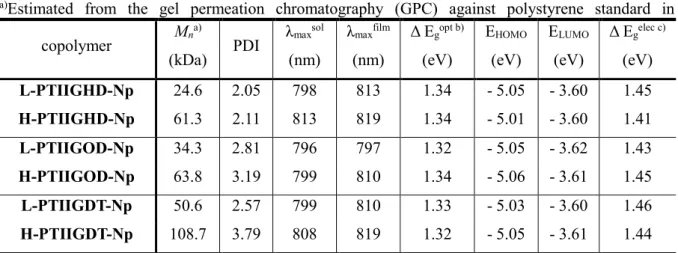
The UV-Vis absorption spectra of the polymers are measured both in chloroform solution and as thin films. The EHOMO and ELUMO values of all polymers are between -5.06 and -5.02 eV and between -3.62 and -3.60 eV, respectively, indicating that manipulation of the alkyl substituents and Mn of PTIIG-Np- polymers has a negligible effect on their energy levels. As illustrated in Figure 34, all polymer films appear to have a dual texture of side and front crystallites, as judged by the presence of the long-range ordered (h00) and strong - (010) stacking peaks in both outside the plane (qz-axis) and in-plane (qxy-axis) orientations.
Nevertheless, it is evident that in both cases PTIIGOD-Np and PTIIGDT-Np CCL010 values of high Mn. This result suggests that the size of the -stacking crystallites is more likely to depend on Mn variations than on the modified alkyl substituents of the polymers. Full reflection numbers (100) were also used to quantitatively compare the relative degree of bimodal orientation of the polymer films. Figure 35b compares the intensities of the azimuthal angle (χ) 45–135° (Az) and χ 0–45° and 135–180° (Axy) attributed to edge and face crystallites, respectively.
Pole figures extracted from (100) diffraction of PTIIG-Np polymer thin films on the SiO2/Si substrates, indicating that Axy and Az are regions of face-up and edge-up crystallites, respectively (αi = 0.12°, critical angle), where of the integrated intensity of the azimuth angle (χ) of 45–135° (Az) and χ of 0–45° and 135–.
Experimental Section
Conclusion
A Study on PVDF based Graft Copolymers for Triboelectric Nanogenerators
Results and Discussion
- TENG Performance
- Thin Film Mophology Analysis
Synthesis of PVDF-Gn graft copolymers. a) Synthesis of PVDF-Gn graft copolymers and photograph of PVDF and PVDF-G18 NMP solutions, respectively (b) 1H NMR, (c) FT-IR of PVDF and PVDF-Gn. Furthermore, as shown in Figure 36c, the FT-IR spectrum of PVDF-Gn showed the appearance of absorption bands at 1725 cm-1 assigned to the stretching vibrations of the ester carbonyl groups, in contrast to pristine PVDF. Also, as the subsequent gr ratios of PtBA increased, the gradually increased intensity of the carbonyl bands relative to the methylene stretching bands of PVDF at about 1404 cm-1 was observed, which further corroborates the PtBA content determined above. .
We measured the frequency-dependent dielectric properties of PVDF-based films in the frequency range from 102 Hz to 106 Hz at room temperature, which are shown in Figure 38. AFM and SEM images of PVDF-Gn films. a) 3-dimensional AFM images and (b) cross-sectional SEM images for PVDF-based films with different mole percentages of PtBA ranging from 0 to 18%. The decrease in work function in PVDF-G18 can be explained by the microstructural change.
It is generally known that the β phase is formed due to the rotation of CF2 chains upon annealing d.182 The chain mobility is strongly related to the molecular structure, molecular weight t, chain length, etc.183 This means that the increase in molecular weight and steric bulkiness can inhibit the rotation chains in the PVDF-Gn films, so the β phase is unlikely to form.
Experimental Section
Conclusion
Ade, H., High-Efficiency Incomplete Organic Solar Cells: Critical Factors Affecting Complex Multi-Length Scale Morphology and Device Performance. P.; Li, Y., High-efficiency incomplete polymer solar cells with medium-bandgap polymer donors and narrow-bandgap organic semiconductor acceptors. J.; Wang, E., High-performance all-polymer solar cells from the synergistic effects of well-ordered crystallinity and solvent annealing.
M; Nguyen, T.-Q., Effect of leakage current and shunt resistance on the light intensity dependence of organic solar cells. L; Meredith, P., Charge generation pathways in organic solar cells: assessing the contribution of the electron acceptor. Yu, L., High-performance solar cells with a ternary blend of polymers involving both energy transfer and hole relay processes.
Zhang, Z.-G.; Li, Y.; Yang, C., A synergetic effect of molecular weight and fluorine in all-polymer solar cells with improved performance.