Structural Design Lab.(Prof. Ho-Kyung Kim) Dept. of Civil & Environmental Eng.
Seoul National University
457.649 Advanced Structural Analysis
Part VIII:
1. Fundamentals of Stability Theory
▶ Equilibrium at the slightly disturbed with a rotation 𝜽
▶ Small displacement theory
Critical Load for a Simple Spring-Bar System–Equilibrium Approach
" 𝑀! = 0 = 𝑃𝐿 sin 𝜃 − 𝑘𝜃
𝑃"# = 𝑘𝜃 𝐿 sin 𝜃
sin 𝜃 = 𝜃 tan 𝜃 = 𝜃
cos 𝜃 = 1 𝑃"# = 𝑘𝜃
𝐿𝜃 = 𝑘 𝐿
𝑘𝜃 𝜃 𝑃
𝐿 sin 𝜃
𝐿 𝑃
𝑘 𝑘=Spring constant
Undeformed System Deformed System
Unstable
Equilibrium Bifurcation
point at 𝑃!"
stable Equilibrium
𝜃 𝑃
▶ Total potential;
§ 𝑈 = 𝑊% = &'𝑘𝜃'
§ 𝑉( = −𝑊) = −𝑃𝐿 1 − cos 𝜃
§ Π = 𝑈 + 𝑉( = &'𝑘𝜃' − 𝑃𝐿 1 − cos 𝜃
▶ Stationary total potential for equilibrium condition; 𝒅∏𝒅𝜽 = 𝟎
§ -∏
-. = 0 = 𝑘𝜃 − 𝑃𝐿 sin 𝜃
Critical Load for a Simple Spring-Bar System–Energy approach
𝜫 = 𝑼 + 𝑽𝒑
𝑃"# = 𝑘𝜃 𝐿 sin 𝜃
𝜃 𝑃
𝐿−𝐿cos𝜃
𝐿 𝑃
𝑘
▶ Introduce a disturbing moment 𝑴𝟎
▶ Equilibrium approach
Post-Buckling Behavior
" 𝑀! = 0 = 𝑃𝐿 sin 𝜃 + 𝑀1 − 𝑘𝜃 𝑃𝐿
𝑘 = 𝜃 − 𝜃1 sin 𝜃 𝜃1 = 𝑀1
𝑘
𝑘𝜃 𝜃 𝑃
𝐿 sin 𝜃
𝐿 𝑃
𝑘
𝑘𝜃=Restoring Moment 𝑀#=Disturbing moment 𝑘=Spring constant
Undeformed System Deformed System
𝑀# Rigid Bar
▶ Introduce an additional small rotation 𝜽∗
▶ Equilibrium equation
Stability Criteria by an Equilibrium Approach
" 𝑀! = 0 = 𝑃𝐿 sin(𝜃 + 𝜃∗) + 𝑀1 − 𝑘(𝜃 + 𝜃∗) 𝑃𝐿
𝑘 = 𝜃 + 𝜃∗ − 𝜃1
sin(𝜃 + 𝜃∗) = 𝜃 + 𝜃∗ − 𝜃1 sin 𝜃 + 𝜃∗ cos 𝜃 𝜃1 = 𝑀1
𝑘
𝑃𝐿
𝑘 sin 𝜃 − 𝜃 + 𝜃1 + 𝜃∗ 𝑃𝐿
𝑘 cos 𝜃 − 1 = 0
=0 due to equilibrium condition
sin 𝜃 + 𝜃∗ =
sin 𝜃 cos 𝜃∗ + cos 𝜃 sin 𝜃∗ cos 𝜃∗ ≈ 1
sin 𝜃∗ ≈ 𝜃∗
𝑘 𝜃 + 𝜃∗ 𝜃 𝑃
𝐿 sin 𝜃 + 𝜃∗
𝐿 𝑃
𝑘 𝑀#
Rigid Bar
𝜃∗
▶ Locus of points for which 𝜽∗ ≠ 𝟎 while equilibrium is just maintained, that is the equilibrium is neutral:
§ cos 𝜃 < 45 6&⁄ the equilibrium is stable -that is, the bar returns to its original position when 𝜃∗ is removed; energy must be added.
§ cos 𝜃 = 45 6&⁄ the equilibrium is neutral -that is, no force is required to move the bar a small rotation 𝜃∗.
§ cos 𝜃 > 45 6&⁄ the equilibrium is unstable -that is, the configuration will snap from an unstable to a stable shape; energy is released.
Stability Criteria by an Equilibrium Approach
𝑃𝐿
𝑘 cos 𝜃 − 1 = 0
▶ 𝑼 = 𝑾𝒊 = 𝟏𝟐𝒌𝜽𝟐
▶ 𝑽𝒑 = 𝑾𝒆 = −𝑷𝑳 𝟏 − cos 𝜽 − 𝑴𝟎𝜽
▶ 𝚷𝒌 = 𝜽𝟐𝟐 − 𝑷𝑳𝒌 𝟏 − cos 𝜽 − 𝜽𝟎𝜽
▶ For 𝜽𝟎 = 𝟎. 𝟎𝟏 and 𝑷𝑳 𝒌 = 𝟏. 𝟎⁄
Stability Criteria by an Energy Approach
𝑀1 = 𝑘𝜃1
𝜃 𝑃
𝐿−𝐿cos𝜃
𝐿 𝑃
𝑘 𝑀#
▶ 𝚷𝒌 = 𝜽𝟐𝟐 − 𝑷𝑳𝒌 𝟏 − cos 𝜽 − 𝜽𝟎𝜽
§ → total potential
▶ 𝒅 ⁄𝚷 𝒌𝒅𝜽 = 𝜽 − 𝜽𝟎 − 𝑷𝑳𝒌 sin 𝜽 = 𝟎
§ 𝑷𝑳𝒌 = 𝜽?𝜽@AB 𝜽𝟎
§ → Equilibrium
▶ 𝒅𝟐𝒅𝜽𝚷 𝒌⁄𝟐 = 𝟏 − 𝑷𝑳𝒌 cos 𝜽 = 𝟎
§ 𝑷𝑳𝒌 = CD@ 𝜽𝟏
§ → Stability
Stability Criteria by an Energy Approach
•Minimum of 𝛱
•Stable equalibrium
•Energy must be added to change configuration.
𝒅𝟐𝚷
𝒅𝜽𝟐 > 𝟎 Ball in cup can
be disturbed, but it will return to the center.
•Maximum of 𝛱
•Unstable equalibrium
•Energy is released as configuration is changed
𝒅𝟐𝚷
𝒅𝜽𝟐 < 𝟎 Ball will roll
down if disturbed.
•Transition from minimum to maximum
•Neutral equalibrium
•There is no change in energy
𝒅𝟐𝚷
𝒅𝜽𝟐 = 𝟎 Ball is free to
roll.
▶ Equilibrium
§ 𝑘𝑎 sin 𝜃 𝑎 cos 𝜃 − 𝑀1 − 𝑃𝐿 sin 𝜃 = 0
§ 𝜃1 = 𝑀1⁄ 𝑘𝑎'
§ 6E45# = @AB . CD@ .?.$
@AB .
▶ Small deflection-ideal geometry
§ 𝜃1 = 0; sin 𝜃 = 𝜃; cos 𝜃 = 1
§ 𝑃"# = 6E5#
▶ Large deflection-ideal geometry
§ 𝜃1 = 0
§ 𝑃"# = 6E5#cos 𝜃
▶ Load-rotation curves
§ Perfect case of 𝜃1 = 0
§ Imperfect case of 𝜃1 = 0.01
§ Softening - The load is decreased as rotation increases.
§ Theoretical buckling load is upper bound.
Hardening and Softening Behavior in the Post-Buckling
𝑃
𝐿 𝑎
𝑃 𝐿 sin 𝜃
𝜃
𝑀#
𝑎 cos 𝜃 𝑘𝑎 sin 𝜃
▶ Equilibrium equation for an additional small rotation 𝜽∗
▶ In energy approach
§ Total potential: Π = 6 E @AB .' # − 𝑀1𝜃 − 𝑃𝐿 1 − cos 𝜃
§ Equilibrium: FGF. = 𝑘𝑎' sin 𝜃 cos 𝜃 − 𝑀1 − 𝑃𝐿 sin 𝜃 = 0 -> 6E45# = @AB . CD@ .?.$
@AB .
§ Stability: FF.#G# = 𝑘𝑎' 𝑐𝑜𝑠'𝜃 − 𝑠𝑖𝑛'𝜃 − 𝑃𝐿 cos 𝜃 = 0 -> 6E45# = '"HICD@ .#.?&
Stability Criteria for Softening Case
𝑘𝑎 sin 𝜃 + 𝜃∗ 𝑎 cos(𝜃 + 𝜃∗) − 𝑀1 − 𝑃𝐿 sin 𝜃 + 𝜃∗ = 0
𝑃𝐿
𝑘𝑎' = 𝑐𝑜𝑠'𝜃 − 𝑠𝑖𝑛'𝜃
cos 𝜃 = 2𝑐𝑜𝑠'𝜃 − 1 cos 𝜃
=0 due to equilibrium condition sin 𝜃∗ ≈ 𝜃∗ cos 𝜃∗ = 1
sin 𝜃 + 𝜃∗ = sin 𝜃 cos 𝜃∗ + cos 𝜃 sin 𝜃∗ = sin 𝜃 + 𝜃∗cos 𝜃 cos 𝜃 + 𝜃∗ = cos 𝜃 cos 𝜃∗ − sin 𝜃 sin 𝜃∗ = cos 𝜃 −𝜃∗ sin 𝜃 𝑘𝑎 sin 𝜃 cos 𝜃 − 𝑀1 − 𝑃𝐿 sin 𝜃
+𝜃∗ 𝑘𝑎' 𝑐𝑜𝑠'𝜃 − 𝑠𝑖𝑛'𝜃 − 𝑃𝐿 cos 𝜃 − 𝜃∗' 𝑘𝑎' cos 𝜃 sin 𝜃 = 0
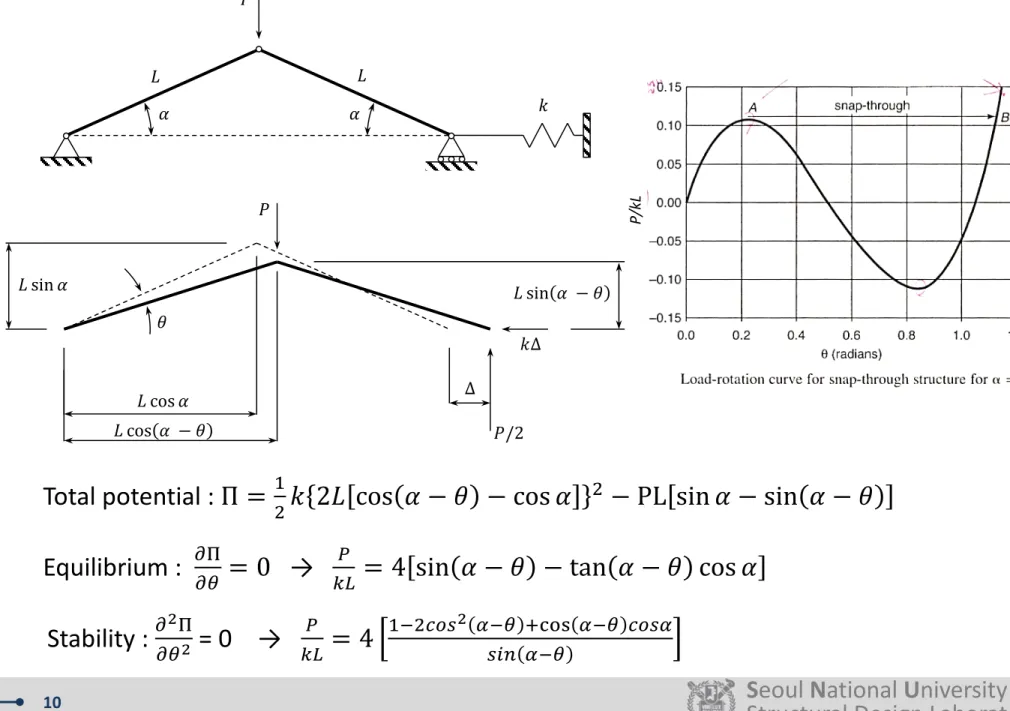
Snap-Through Buckling
그림 1.15
Total potential : Π = &'𝑘 2𝐿 cos 𝛼 − 𝜃 − cos 𝛼 ' − PL sin 𝛼 − sin 𝛼 − 𝜃 Equilibrium : FGF. = 0 → 654 = 4 sin 𝛼 − 𝜃 − tan 𝛼 − 𝜃 cos 𝛼
Stability : F#G = 0
𝐿 𝐿
𝛼 𝛼 𝑘
𝑃
𝜃
𝐿 cos 𝛼 𝐿 cos 𝛼 − 𝜃
𝑃
∆
𝑘∆
𝐿 sin 𝛼 𝐿 sin 𝛼 − 𝜃
𝑃/2
→ 4 = 4 &?'"HI# J?. KCD@ J?. "HIJ
P/kL
Multi-Degree-of-Freedom System
§ ∆&= 𝜓𝐿 and ∆'= 𝜃𝐿
§ ∆%?∆#
5 = 𝛾 = 𝜓 − 𝜃
§ 𝜀N = 𝐿 − 𝐿 cos 𝜃 ≈ 5.'#
§ 𝜀' = 𝜀N + 𝐿 1 − cos 𝜓 − 𝜃 = '5 2𝜃' + 𝜓' − 2𝜓𝜃
§ 𝜀 = 𝜀 + 5O# = 𝐿 𝜃' + 𝜓' − 𝜓𝜃
𝐿 𝐿 𝐿
𝑘 𝑘
Rigid bar Pin
𝑃 𝑃
𝑃 𝑃
∆& ∆'
𝑅& 𝑅'
𝑘∆& 𝑘∆'
1 2
∆& ∆'
𝜀& 𝜀' 𝜀(
Multi-Degree-of-Freedom System
▶ This strain energy equals 𝑈4 = 6' ∆&' + ∆'' = 65'# 𝜓' + 𝜃'
▶ The Potential of the external forces equals 𝑉4 = −𝑃𝜀& = −𝑃𝐿 𝜃' + 𝜓' − 𝜓𝜃
▶ The total potential is then
§ Π = 𝑈 + 𝑉4 = 65'# 𝜓' + 𝜃' − 𝑃𝐿 𝜃' + 𝜓' − 𝜓𝜃
▶ For equilibrium, we take the derivatives with respect to the two angular rotations:
§ FOFG = 0 = 65'# 2𝜓 − 2𝑃𝐿𝜓 + 𝑃𝐿𝜃
§ FG
F. = 0 = 65'# 2𝜃 − 2𝑃𝐿𝜃 + 𝑃𝐿𝜓
▶ Rearranging, we get
§ 𝑘𝐿' − 2𝑃𝐿 𝑃𝐿 𝑃𝐿 𝑘𝐿' − 2𝑃𝐿
𝜓
𝜃 = 0
𝑘 𝑘
∆&= ∆'
𝑘 𝑘
∆&= −∆'
𝑃!"& = 𝑘𝐿 𝑃!"'= 𝑘𝐿
3
Structural Design Lab.(Prof. Ho-Kyung Kim) Dept. of Civil & Environmental Eng.
Seoul National University
457.649 Advanced Structural Analysis
Part VIII:
2. Elastic Buckling of Planar Columns
1. Large-Deflection Solution of an Elastic Column
§ Perfectly straight
§ Elastic
§ Prismatic
§ 𝑀 𝑧 = 𝑃𝜐 = −𝐸𝐼𝜙 (1) 𝜙 = >?>@ ; >A>@ = 𝑠𝑖𝑛𝜃
§ >!?
>@! + 𝑘B𝑠𝑖𝑛𝜃 = 0 (2) 𝑘B = DEC (3)
§ Solution of Eq.(2)
FG
B = ∫H"! JKC>I!@LM!I (4) 𝑃 = 𝑠𝑖𝑛𝜃H
2
𝑃
𝑧
𝑃 𝜃! 𝑠 𝑧
𝜃
𝑑𝑠 𝑑𝑣
𝑑𝑧 𝑃 𝑀 𝑧
𝑃
𝐿
2. Buckling Load
§ Large-deflection solution
§ Post-buckling behavior
§ Hardening type
§ Small-deflection assumption 𝑠𝑖𝑛𝜃 ≈ 𝜃 ; -P-I ≈ 𝜃
𝐸𝐼𝜙 ≈ −𝐸𝐼 𝑑'𝜐 𝑑𝑆'
→𝐸𝐼 --I#P# + 𝑃𝜐 = 0
∴ 𝜐QQ + 𝑘'𝜐 = 0
§ B.C.
𝜐 0 = 0 ; 𝜐 𝐿 = 0
→ 𝐴𝑠𝑖𝑛𝐾𝐿 = 0 ∴ 𝐾𝐿 = 𝜋
§ 𝑃"# = R5##ST
3. Differential Equation of Beam-Column
∑ 𝑀! = 0 ↝ 𝑉 + 𝑃 -U-V − -W-V = 0 (1)
∑ 𝐹X = 0 ↝ -U-V = 𝛼𝜐 − 𝑞 (2)
§ From (1) & (2)
−--V#W# + 𝑃 --V#P# + 𝛼𝜐 = 𝑞 (3)
§ 𝑀 = ∫!#)E 𝜎𝑦 𝑑𝐴 = 𝜙 ∫!#)E 𝐸Y𝑦' 𝑑𝐴 (4) (𝜎 = 𝐸Y𝜖 = 𝐸Y𝜙 l 𝑦)
§ Elastic material and prismatic column 𝐸𝐼Z𝜐QQQQ + 𝑃𝜐QQ + 𝛼𝜐 = 𝑞 (5)
4. Pin-Ended Column
§ 𝛼 = 0 ; 𝑞 = 0 → 𝜐QQQQ + 𝑘'𝜐QQ = 0 (1) 𝜐 = 𝐶&𝑒#% + 𝐶'𝑒## + 𝐶N𝑒#( + 𝐶[𝑒#)
= 𝐶& + 𝐶'𝑧 + 𝐶N𝑒%6V + 𝐶[𝑒?%6V (2)
§ 𝜐 = 𝐴 + 𝐵𝑧 + 𝐶 sin 𝑘𝑧 + 𝐷 cos 𝑘𝑧 (3) 𝜐QQ = −𝐶𝑘' sin 𝑘𝑧 − 𝐷𝑘' cos 𝑘𝑧 (4)
B.C.𝜐 0 = 0 = 𝐴 1 + 𝐵 0 + 𝑐 0 + 𝐷 1
𝜐)) 0 = 0 = 𝐴 0 + 𝐵 0 + 𝐶 0 + 𝐷 𝑘' 𝜐 𝐿 = 0 = 𝐴 1 + 𝐵 𝐿 + 𝐶 sin 𝑘𝑙 + 𝐷 cos 𝑘𝑙
𝜐)) 𝐿 = 0 = 𝐴 0 + 𝐵 0 + 𝐶 −𝑘'sin 𝑘𝐿 + 𝐷(−𝑘'cos 𝑘𝐿)
1 0
0 0 0 1
0 −𝑘'
1 𝐿
0 0 sin 𝐾𝐿 cos 𝑘𝐿
−𝑘' sin 𝑘𝐿 −𝑘' cos 𝑘𝐿 𝐴𝐵 𝐶 𝐷
= 0
𝑃
𝑃
𝑣 𝑧 𝑣
Differential equation:
𝐸𝐼𝑣 " + 𝑃𝑣 = 0
Boundary conditions:
@𝑧 = 0; 𝑣 = 0, 𝑀 = 0
@𝑧 = 𝐿; 𝑣 = 0, 𝑀 = 0
1 0
0 0 0 1
0 −𝑘'
1 𝐿
0 0 sin 𝐾𝐿 cos 𝑘𝐿
−𝑘' sin 𝑘𝐿 −𝑘' cos 𝑘𝐿
= 0
→ 𝐿𝑘[ sin 𝑘𝐿 = 0
∴ 𝐾𝐿 = 𝑃𝐿'
𝐸𝐼 = 𝑛𝜋, 𝑛 = 1,2,3 … 𝑃"#= 𝑛𝜋'𝐸𝐼
𝐿'
𝐴 = 𝐵 = 𝐷 = 0 ↝ 𝜐 = 𝐶 sin𝑛𝜋𝑧 𝐿
5. Eigenvalue Problem
n=1 n=2 n=3
𝜋#𝐸𝐼 𝐿#
𝑣 𝑧 𝑣
𝐿
4𝜋#𝐸𝐼 𝐿#
9𝜋#𝐸𝐼 𝐿#
I. Pined-Pined II. Pined-fixed III. Fixed-fixed IV. Free-fixed
V. Fixed-fixed+sidesway B.C.
A. Pined end : 𝜐 = 𝜐QQ = 0 (1) B. Fixed end : 𝜐 = 𝜐Q = 0 (2)
C. Free end : zero moment ↝ 𝜐QQ = 0 (3)
zero shear ↝ 𝑉 + 𝑃𝜐Q + 𝐸𝐼 -P-V33 = 0
→ 𝑉 = −𝐸𝐼𝜐QQQ − 𝑃𝜐Q = 0
6. Five Fundamental Cases of Column Buckling
𝐼 𝐼𝐼 𝐼𝐼𝐼 𝐼𝑉 𝑉
▶ Deflection Eqs
𝜐 = 𝐴 + 𝐵𝑧 + 𝐶 sin 𝑘𝑧 + 𝐷 cos 𝑘𝑧 𝜐Q = 𝐵 + 𝐶𝑘 cos 𝑘𝑧 − 𝐷𝑘 sin 𝑘𝑧 𝜐QQ = −𝑐𝑘' sin 𝑘𝑧 − 𝐷𝑘' cos 𝑘𝑧 𝜐QQQ = −𝐶𝑘N cos 𝑘𝑧 + D𝑘N sin 𝑘𝑧
7. Five Fundamental Cases of Column Buckling
𝐼 𝐼𝐼 𝐼𝐼𝐼 𝐼𝑉 𝑉
§ 𝑃"# = 4\4# = (\5)R#ST# ; k=effective length factor
8. Effective Buckling Length
𝐿 0.7𝐿
0.5𝐿
2𝐿 𝐿
▶ Small initial crookedness
▶ Small load eccentricity
▶ Small lateral load
9.Effect of Imperfections
𝑃
𝑃
𝑣!
𝑃
𝑃
𝑒 𝑃
𝑃
𝑞
(a) Initial crookedness, 𝑣! (b) Load eccentricity, 𝑒 (c) Lateral load, 𝑞
▶ Half-sine curve
𝒗𝒊=𝒗𝟎𝒔𝒊𝒏𝝅𝒛𝑳
𝑴𝒊𝒏𝒕 = −𝑬𝑰𝒗QQ -(1)
𝑴𝒆𝒙𝒕 = 𝑷(𝒗𝒊 + 𝒗)
∴ 𝑬𝑰𝒗QQ + 𝒑𝒗 = −𝒑𝒗𝒊 -(2)
§ 𝒗QQ + 𝒌𝟐𝒗 = −𝒌𝟐𝒗𝟎𝒔𝒊𝒏𝝅𝒛𝑳 -(3)
▶ B.C 𝒗(0) = 𝒗(L)=0
§ 𝒗𝒕𝒐𝒕𝒂𝒍 = 𝒗𝒊 + 𝒗 = 𝒗𝟎𝒔𝒊𝒏
𝝅𝒛 𝑳
𝟏?𝑷/𝑷𝑬 -(4)
§ 𝒗𝒕𝒐𝒕𝒂𝒍(
𝑳 𝟐)
𝑳 = 𝟏?𝑷/𝑷𝒗𝟎/𝑳
𝑬 -(5)
10.Column with Initial Out-of-Straightness
𝑃
𝑃
𝑣!
(a) Initial crookedness, 𝑣!
▶ Full-sine curve
𝒗𝒊=𝒗𝟎𝒔𝒊𝒏𝟐𝝅𝒛𝑳 -(1) 𝒗=𝒗𝟎𝟒?𝑷/𝑷𝑷/𝑷𝑬
𝑬𝒔𝒊𝒏𝟐𝝅𝒛𝑳 -(2)
or
𝜽 𝟎,𝒕𝒐𝒕𝒂𝒍 = 𝟐𝝅𝒗𝑳 𝟎 𝟏
𝟏? 𝑷
𝟒𝑷𝑬
11.Column with Initial Out-of-Straightness
−𝑬𝑰𝒗QQ = 𝑷(𝒆 + 𝒗)
𝒗QQ + 𝒌𝟐𝒗 = −𝒌𝟐𝒆 → 𝒗 = 𝑨𝒔𝒊𝒏 𝒌𝒛 + 𝑩𝒄𝒐𝒔kz - e B.C 𝒗(0) = 𝒗(L)=0; 𝒌𝟐=𝑬𝑰𝑷
→ 𝒗 = 𝒆(𝒄𝒐𝒔 𝒌𝒛 + 𝟏?𝒄𝒐𝒔 𝒌𝑳𝒔𝒊𝒏 𝒌𝑳 sin kz -1) 𝒗 𝑳
𝟐 = 𝒆(𝒄𝒐𝒔𝒌𝑳
𝟐 + 𝟏 − 𝒄𝒐𝒔 𝒌𝑳
𝒔𝒊𝒏 𝒌𝑳 sin 𝒌𝑳
𝟐 −1)
→2nd order analysis!
𝒗 𝑳
𝟐 𝑏𝑦 1𝑠𝑡 𝑜𝑟𝑑𝑒𝑟 𝑎𝑛𝑎𝑙𝑦𝑠𝑖𝑠 = 𝑴𝑳𝟐
𝟖𝑬𝑰 = 𝑷𝒆𝑳𝟐 𝟖𝑬𝑰
= 𝝅 𝟐 𝟖
𝑷 𝑷𝒆
∴ 𝑴𝑭 = 𝝅𝟐(𝑷/𝑷𝟖
𝒆)
𝟏?𝒄𝒐𝒔𝝅𝟐 𝑷
𝑷𝑬
𝒄𝒐𝒔𝝅𝟐 𝑷
𝑷𝑬
12.Column with Eccentric Load
𝑃
𝑃 𝑒
(b) Load eccentricity, 𝑒
𝒗QQQQ + 𝒌𝟐𝒗QQ = 𝒒 𝑬
→ 𝒗 = 𝒑𝒌𝒒𝟐 𝟏K𝒄𝒐𝒔 𝒌𝑳𝒔𝒊𝒏 𝒌𝑳 𝒔𝒊𝒏𝒌𝒛 + 𝐜𝐨𝐬 𝒌𝒛 +(𝒌𝒛)𝟐 𝟐 −𝒌𝟐𝟐𝑳𝒛 − 𝟏
𝒗 𝟐𝑳 = 𝒑𝒌𝒒𝟐( 𝟏
𝒄𝒐𝒔𝒌𝑳𝟐 − (𝒌𝑳)𝟖 𝟐 − 𝟏) 1st order deflection
:
𝟓𝒒𝑳𝟒𝟑𝟖𝟒𝑬𝑰
∴ 𝑴𝑭 = 𝟑𝟖𝟒𝑬𝑰𝟓𝒌𝟒𝑳𝟒 𝟏
𝒄𝒐𝒔𝒌𝑳𝟐 − (𝒌𝑳)𝟖 𝟐 − 𝟏
13.Column with Distributed Load
𝑃
𝑃
𝑞
(c) Lateral load, 𝑞
▶ 𝑴𝑭 =𝟏?𝑷/𝑷𝟏
𝑬