International Convention for the Suppression of the Financing of Terrorism, adopted on 9 December UNTS 229 (entered into force on 10 April 2002). Report of the Secretary-General on Ways to Establish Specialized Somali Anti-Piracy Courts,” United Nations Security Council, U.N.
UNCLOS United Nations Convention on the Law of the Sea UNCTAD United Nations Conference on Trade and Development UNDP United Nations Development Programme. UNMGSE United Nations Monitoring Group for Somalia and Eritrea UNODC United Nations Office on Drugs and Crime.
OVERVIEW OF PIRACY AND PORT STATE CONTROL
CAUSES, CONSEQUENCES AND CHALLENGES IN
THE USE OF PORT STATE CONTROL TO SUPPRESS PIRACY OFF NIGERIA
Scope of the study
Also, the absence of an obligation for countries to cooperate in combating piracy greatly reduces the effectiveness of the current legal framework for combating piracy. How PSC can be used to increase the effectiveness and efficiency of the fight against piracy off Nigeria.
Objective of the study
Critically examines the application of the PSC in the prevention and suppression of piracy outside Nigeria. It examines how best to enhance the effectiveness and efficiency of the PSC in preventing and suppressing piracy outside Nigeria.
Research methodology
The study further facilitates the full understanding of the merits of using the PSC as a platform for the implementation and enforcement of domestic statutes and maritime security instruments and other related conventions. Chapter 7, “Conclusion”, concludes the study by providing a summary of the research as well as its findings, and reiterating the importance of using PSC to suppress piracy in Nigeria.
Literature review
Such laws would complement the specificity of the crime of piracy and guarantee maritime security.”58. On the other hand, the success achieved in reducing piracy off Somali waters is mainly due to the expansion of the definition of the crime to include acts that took place in Somalia's territorial waters.
Conclusion
This chapter thoroughly examines the definition of piracy under the existing legal regime in line with international law and argues that it is limited, which may affect the fight against the crime in Nigeria. To advance the argument, the paper argued for a review of the definition of piracy to reflect the nature of contemporary acts of piracy.
Overview of piracy Map 1: Maritime zones 89
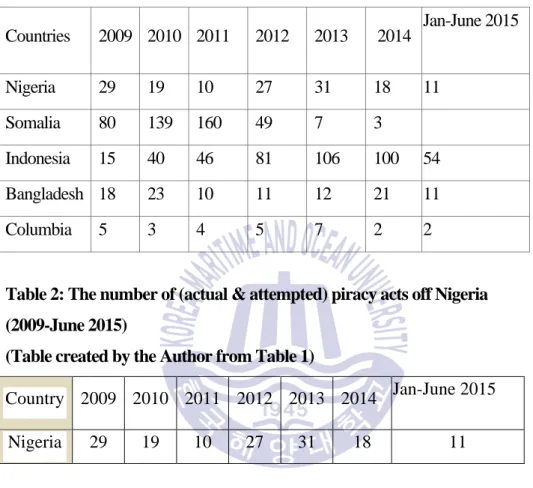
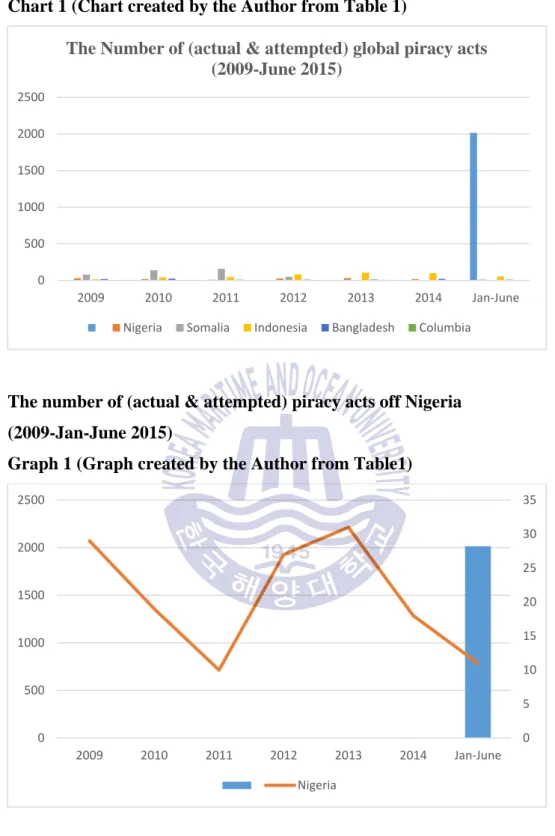
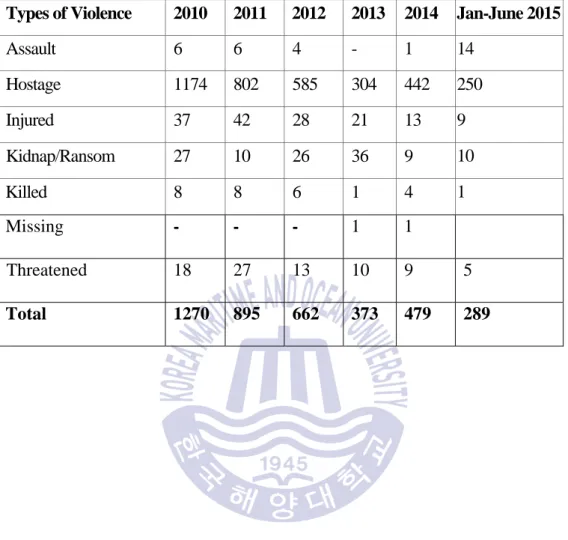
Chart created by the Author from Table 1)
Definition of piracy
In other words, the provisions of the LOSC conclusively demonstrate that the focus of the. Note that three ways have been proposed for expanding the definition of piracy under the LOSC.
Linkages between piracy and other maritime crimes
- Piracy and vandalisation of oil installations
- Piracy and illegal unreported and unregulated (IUU) fishing
- Piracy and drugs, arms and human trafficking
Therefore, there is a link between piracy and other maritime crimes in the country.184 2.4.1 Piracy and oil theft. Another consequence of oil theft is the proliferation of illegal and substandard refineries in the Niger Delta.
Overview of port state control (PSC)
- Meaning of port state control (PSC)
- Historical development of port state control (PSC)
- Critical evaluation of the regime of port state control
Ozcayir, “The Use of Port State Control in the Maritime Industry and Application of the Paris MOU”, (2009) Ocean and Coastal Law Journal, Vol. Scheiber (ed.) Law of the Sea: The Common Heritage and Emerging Challenges (Martinus Nijhoff Publishers: Boston 2000) pp.
Conclusion
Nevertheless, it is often argued that the mere presence of certificates is merely evidence, and not confirmation, that convention standards are being met.266 As a result, some PSC officers are tempted to inspect more than just the ship's certificates while performing routine PSC carry out inspections. 267 Such a comprehensive inspection will go a long way in determining the competency and certification of crews, the standard and seaworthiness of ships and the availability of modern facilities by the ships for the purpose of preventing piracy. PSC will therefore be a real tool to determine whether ships have complied with the safety measures laid down in relevant safety instruments and other treaties.
Introduction
Causes of piracy off Nigeria
Therefore, order and security at sea, considered as a generator and secondary enabler of wealth, is one of the essential pillars for the generation of sustainable wealth in the ocean.269 Unfortunately, order and security at sea have been under constant threat due to acts of ongoing piracy. The Case of Madagascar”, United Nations-Nippon Foundation Fellowship Program Division of Ocean Affairs and Law of the Sea Office of Legal Affairs, United Nations, New York, 2013, p. 1.
Chart prepared by Author from IMB Piracy Report for 2015, p. 10)
Underdevelopment/pollution of the oil producing areas
This has been exacerbated by environmental pollution, such as oil spills, which destroy the agricultural potential (fishing and farming) of the coastal areas.282. In furtherance of the above, the net effect of underdevelopment and pollution of the oil producing communities is the spread of poverty and unemployment.
Corruption and inequality between the ruling class and the masses
292) See generally the Forensic Audit Report; the Senate report; the NEITI report; the Ribadu Report; and the House Report. For detailed reports on the structure, nature, types and economic consequences of corruption in the petroleum industry in Nigeria, see generally the Forensic Audit Report; the Senate report; the NEITI report; the Ribadu Report; and the House Report. . 295).
Weak and compromised maritime regulatory and security institutions
As a result of the above, Tepp believes that "Nigeria is a prime example of insufficient and inadequate security".301 The inability of the Nigerian government to adequately fund and train officers of the Nigerian Maritime Administration and Security Agency (NIMASA) , the Nigerian Navy and the Nigerian Police have led to a situation where the readiness and effectiveness of these regulatory and maritime security institutions are low. Regarding the negligence of the security and regulatory institutions in the maritime sector in the fight against piracy, Dogarawa thinks that "there is also the apparent negligence of the maritime police, which happens to be more civilian than the navy, in the task of fighting piracy in 303 Unfortunately, it is further alleged that the maritime regulatory and security institutions in Nigeria sometimes collude with pirates in the hijacking of tankers laden with crude oil.304.
Lack of regional stability and cooperation
Furthermore, connections “to corruption, organized crime and insurgent groups have provided the opportunity and market availability for organized piracy…”309 in the Gulf of Guinea. In addition to the above, almost all countries in the Gulf of Guinea are oil producers or have begun to explore oil and gas, which has led to disputes over maritime boundaries between some countries.
Existence of illegal unreported and unregulated (IUU) fishing and organised crime
West African waters are estimated to have the highest levels of IUU fishing in the world, accounting for up to 37 percent of the region's catch. Furthermore, the continued IUU fishing activities in the Gulf of Guinea, as witnessed in Nigeria, have led to the existence of FOCs due to the absence of regulatory and enforcement institutions and the existence of organized crime.
Consequences of piracy in Nigeria
- Economic consequences
- Humanitarian consequences
- Health consequences
- Socio-political consequences
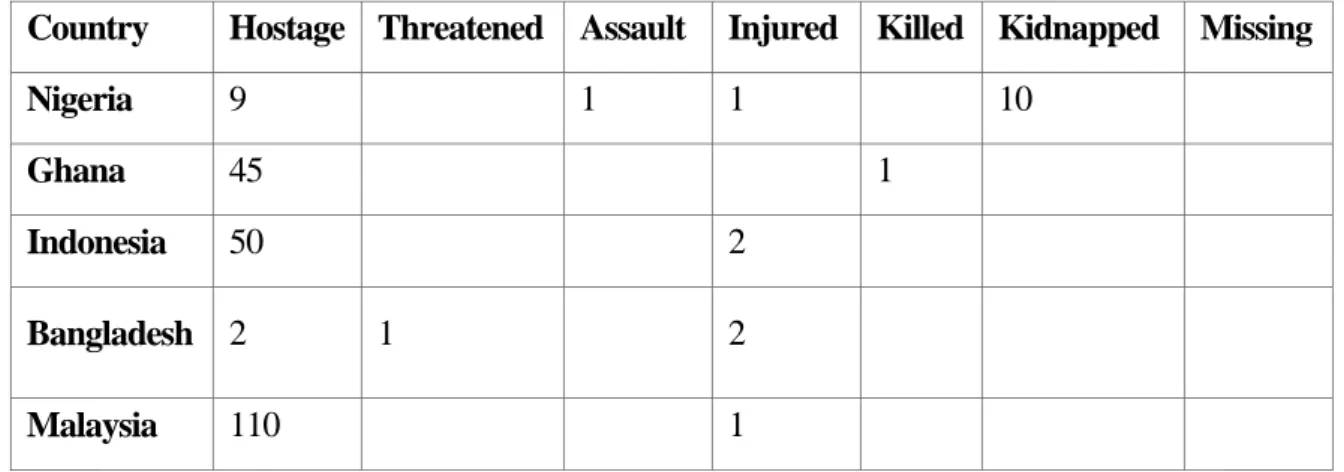
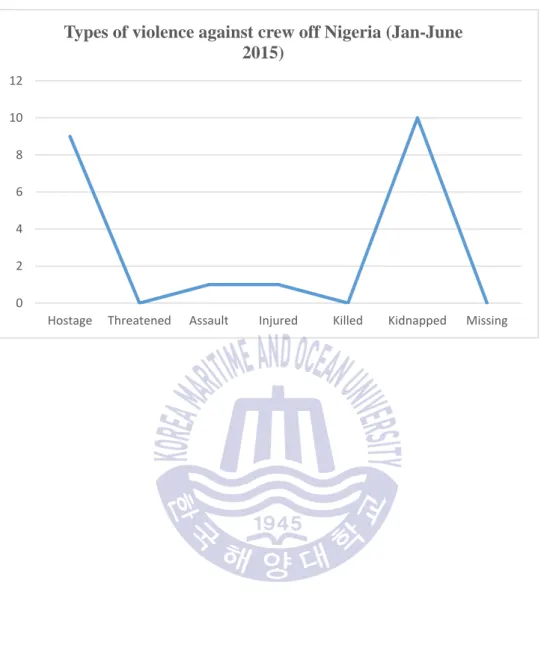
In addition to the above, pirate attacks on fishing vessels lead to humanitarian consequences when pirates shoot, maim and kill crew members. For details of the study on the psychological impact of piracy on seafarers, see “Study on the psychological impact of piracy on seafarers”.
Challenges in suppressing piracy off Nigeria
- Lack of political will by government
- Inadequate legal regime
- Inefficient and compromised maritime regulatory and security institutions
- Corruption
- Absence of regional cooperation
There is no doubt that the criminalization of piracy in accordance with the provisions of the LOSC,371 of the SUA Convention and various UN Security Council resolutions372 is the first step towards the suppression of global piracy. The maritime sector of the Nigerian economy has its fair share of corrupt practices in the performance of many statutory functions.
Conclusion
Introduction
International legal framework for suppressing piracy off Nigeria Under this sub-heading, various conventions on piracy and security of
The Law of the Sea Convention (LOSC) 1982
In continuation of the above, LOSC413 encourages States to cooperate to the fullest extent possible in the fight against piracy on the high seas or anywhere else outside their jurisdiction. Many writers state that Article 105 of the LOSC confers universal jurisdiction in the suppression of piracy,418 other writers, . 415) Yaron Gottlieb, “Combating Maritime Piracy: Interdisciplinary Collaboration and Information Sharing” (2013).
The Convention for the Suppression of Unlawful Acts of Violence against the Safety of Maritime Navigation (SUA Convention) 1988
which softens the SUA Convention, indicates that it provides for acts that are similar to piracy. 2005 Protocol to the Convention for the Suppression of Unlawful Acts against the Safety of Maritime Navigation, hereinafter referred to as the "SUA Convention Protocol".
The United Nations Convention against Transnational Organised Crime (Palermo Convention) 2000
In addition to the above, the Palermo Convention promotes international cooperation in almost the same areas as the LOSC, but places more emphasis on cooperation in relation to the judicial process, such as the confiscation of proceeds of crime or property used in the commission of crime. 442 and their destruction.443 Also included: extradition of the perpetrators of the law,444 cooperation in law enforcement,445 mutual legal assistance,446 joint investigations,447 transfer of convicted persons,448 and collection, exchange and analysis of information .449 This research suggests that effective implementation of the provisions of this convention will greatly reduce the activities of pirates who need corrupt officials to thrive.
- Contracting Governments
- Ships
- Shipping companies
- Port facilities
- Certifications and documentary requirements
Another task that the ISPS Code imposes on the contracting states is the issuance of the International Ship Security Certificate -ISSC. Note that in 2015, the ports in Nigeria were not fully compliant with the provisions of the ISPS Code.
United Nations Security Council Resolutions (UNSCRs)
The objectives of the PSC include the appointment of an inspection officer whose duty it is to board a vessel for the purpose of inspecting foreign-flagged ships in national ports to verify that the condition of the ship and its equipment consistently meet the requirements of international regulations. On the other hand, analyzing this provision of the resolution, it is argued that the phrase "all necessary means", which authorized the use of force by States against pirates, should be implemented in conjunction with the Transitional Federal Government of Somalia (TFG) in accordance with existing international law .
Regional legal framework for suppressing piracy off Nigeria
The ISC aims to promote close cooperation in the collection, collection, analysis and rapid flow of information and intelligence regarding incidents of piracy and armed robbery against ships among Contracting Parties.499. Other regional organizations aimed at maintaining maritime security, particularly in the Gulf of Guinea region, include the Maritime Organization of West and Central Africa (MOWCA), which has its own sub-regional coast guard network, the Economic Community of West African States (ECOWAS). ), the Economic Community of Central African States (ECCAS) and the Gulf of Guinea Commission (GGC).
Domestic legal framework for suppressing piracy off Nigeria
- The 1999 Constitution of the Federal Republic of Nigeria
- The Nigerian Maritime Administration and Safety Agency (NIMASA) Act 2007
- Piracy and Other Unlawful Acts at Sea (and Other Related Offences) Bill 2008
- Other supporting legislations
It is important to emphasize that Section 12 of the 1999 Constitution of Nigeria provides for the procedures for the domestication of treaties and conventions. Similarly, the implementation of the law's provisions can facilitate the prevention and combating of piracy beyond South Korea.
Soft laws for suppressing off Nigeria
- Best management practices (BMP) for the protection of ships against pirates
- Guidelines for the use of privately contracted armed security personnel (PCASP) on board ships
Below are some of the relevant soft laws that can contribute to the suppression of piracy off the coast of Nigeria. In fact, the effectiveness of the use of these soft laws can be effectively monitored under the PSC regime.
Conclusion
Introduction
Analysis of Abuja Memorandum of Understanding (AMOU) data According to the press release by NPA, the total number of ocean going
In other words, it lends credence to the argument that the use of the PSC can facilitate the reduction of piracy off Nigeria. Furthermore, a detailed analysis of the above inspection statistics also shows that the number of inspections in general and the number of detailed inspections in particular is very low compared to the total number of vessels that called at Nigerian ports in 2014.
Overview of the Abuja Memorandum of Understanding (AMOU) In the context of suppressing piracy, the MOUs 555 invoke international
Abuja MOU Annual Report 2013. . laid down in the relevant instruments listed in paragraph 2.560. In fact, it is Nigeria's responsibility to ensure that the equipment, crew, operations and condition of the ships are in compliance with existing international rules and regulations.561. Furthermore, ships without state-of-the-art security facilities and radio communications equipment can easily be hijacked by pirates.
Overview of Nigeria’s port state jurisdiction