arXiv:1705.02007v1 [astro-ph.IM] 2 May 2017
Scott F. Daniel1 and Eric V. Linder2,3
1Department of Astronomy, University of Washington, Seattle, WA
2Berkeley Center for Cosmological Physics & Berkeley Lab, University of California, Berkeley, CA 94720
3Energetic Cosmos Laboratory, Nazarbayev University, Astana, Kazakhstan 010000 May 8, 2017
ABSTRACT
We consider methods for improving the estimation of constraints on a high- dimensional parameter space with a computationally expensive likelihood function.
In such cases Markov chain Monte Carlo (MCMC) can take a long time to converge and concentrates on finding the maxima rather than the often-desired confidence con- tours for accurate error estimation. We employ DALEχ (Direct Analysis of Limits via the Exterior of χ2) for determining confidence contours by minimizing a cost function parametrized to incentivize points in parameter space which are both on the confidence limit and far from previously sampled points. We compare DALEχ to the nested sam- pling algorithm implemented in MultiNest on a toy likelihood function that is highly non-Gaussian and non-linear in the mapping between parameter values and χ2. We find that in high-dimensional cases DALEχ finds the same confidence limit as Multi- Nest using roughly an order of magnitude fewer evaluations of the likelihood function.
DALEχ is open-source and available at https://github.com/danielsf/Dalex.git.
1. Introduction
When confronting a model with data, determining the best fit parameters is only one element of the result. For informative comparison one must have a robust estimation of the confidence intervals for the parameters, and indeed the full multidimensional confidence contours. This will become increasingly important with future big data experiments where as we strive to achieve precision and accurate cosmology we 1) need to employ numerous foreground, calibration, or other systematics parameters, raising the dimensionality of the fitting space, and 2) combine data from multiple probes and experiments, requiring knowledge of the full multidimensional posterior probability distribution.
Thus, one wants to optimize the likelihood function on some parameter space and also char- acterize the behavior of the likelihood function in the parameter space region surrounding that optimum. For a frequentist confidence limit (see the appendix ofDaniel et al. (2014)), this means we wish to find all combinations of parameter values that result in χ2 ≤χ2lim where χ2lim is set by
theoretical considerations (e.g. a certain ∆χ2 above χ2min). For a Bayesian credible limit, we wish to find the region of parameter space that maximizes the posterior probability distribution and then integrate that distribution over parameter space until we have a contour that contains some percentage of the total posterior probability.
Numerous techniques exist for carrying out this process. The most direct is evaluating the likelihood throughout the parameter space, but a grid-based approach rapidly becomes intractable as the dimension of the space increases. Sampling methods select various points at which to carry out an evaluation, and move through parameter space according to some algorithm. The most common such technique in cosmological applications is Markov chain Monte Carlo (MCMC). This works moderately well (though increasingly slowly) as the dimensionality increases but focuses on finding the maximum of the posterior probability; the confidence contours are a byproduct estimated by integrating the distribution of sampled points over the parameter space.
Often we are most interested in the joint confidence intervals for the parameters, and MCMC can sometimes be slow at converging on these since the algorithm is more interested in the interior of the contour rather than its boundary. Moreover, MCMC slows down significantly when confronted with highly degenerate likelihood surfaces. Other sampling techniques such as nested sampling, with MultiNest (Feroz and Hobson 2008;Feroz et al. 2009,2013) an implementation popular for cosmological applications, can alleviate those issues, but still do not focus on the confidence interval.
One alternative to these sampling algorithms is Active Parameter Search. Active Parameter Search (APS) is designed specifically to go after confidence intervals (Bryan et al. 2007; Bryan 2007;Daniel et al. 2014). APS uses a combination of function optimization and Gaussian Processes (Rasmussen and Williams 2006) to specifically sample points on theχ2 =χ2limconfidence limit. In this work, we adopt the philosophy of APS (targeted sampling ofχ2 =χ2limpoints), but increase its robustness and speed of convergence by several improvements and new, focused search strategies.
These are implemented using a Nelder-Mead simplex (Nelder and Mead 1965) to minimize a cost function of the form
F(~θ) = χ2(~θ)−N(~θ)×E(χ2)× χ2lim−χ2min
(1)
E(χ2(~θ)) =
exph
χ2lim−χ2(~θ) /ℓi
, if χ2(~θ)> χ2lim
1, otherwise
where ~θ is the position in parameter space, N(~θ) is the neighbor function, and E(χ2(~θ)) is the exterior function. The parameter ℓ controls how much optimizations of F are allowed to explore outside of χ2 ≤ χ2lim, and N(~θ) is given by the harmonic mean of the parameter space distances between~θand the previously-sampled points such that χ2 ≤χ2lim. Minimizing this function drives the Nelder-Mead simplex to discover points that are both within the confidence contour and far from previously sampled points, increasing the likelihood that our algorithm will discover previously unknown regions tracing the true confidence contour. We refer to this algorithm as DALEχ(Direct Analysis of Limits via the Exterior of χ2) . We find that in problems with complicated, high-
dimension likelihood surfaces, DALEχ achieves convergent, accurate parameter estimation more rapidly than MCMC and MultiNest.
In Sec. 2 we briefly review the methods employed by MCMC, MultiNest, and conventional APS. We introduce and discuss the strategies of DALEχ in Sec. 3, with their motivations and implementations. Section 4 introduces the cartoon likelihood function, incorporating aspects of high-dimensionality, non-Gaussianity, and degeneracy, on which we test DALEχ. Section5carries out the comparison of parameter estimation between the techniques. We conclude in Sec. 6.
Open-source C++ code implementing DALEχ is available at the GitHub repository https://github.com/danielsf/Dalex.git . This software depends on the publicly available software libraries BLAS, LAPACK (available from www.netlib.org), and ARPACK (available from www.caam.rice.edu/software/ARPACK). DALEχ also relies on the KD-Tree algorithm de- scribed by Bentley (1975), which we use to store the history of parameter-space points explored by DALEχ , and the random number generator described by Marsaglia (2003). Those inter- ested in using DALEχ for their own research should not hesitate to either contact the authors at [email protected] or open an issue on the GitHub repository should they have any questions.
2. Parameter Estimation Methods 2.1. Markov Chain Monte Carlo
MCMC uses chains of samples to evaluate the posterior probability of the data having a good fit to a point in parameter space, calculated through a likelihood function and priors on the parameter distribution. In the commonly used Metropolis-Hastings algorithm, a point is evaluated to check if it has a higher probability than the previous point, and accepted or rejected according to a probability criterion. The Markov chain part of the algorithm indicates that only the preceding point affects the next point, while the Monte Carlo part denotes the random selection of candidate points and the integration of the probability over the parameter space to determine the confidence contours.
Note that MCMC per se is only trying to find the maximum; points defining the confidence contours are in some sense incidental.
DALEχas discussed below is designed to guide the selection of desirable points by using all the information already collected, rather than only the previous point, taking a more global view, and also to accelerate the robust estimation of the confidence intervals by focusing on points informing this result and tracing contours rather than concentrating points near the probability maximum.
2.2. Nested Sampling (MultiNest)
Nested sampling (Skilling 2004) is a Monte Carlo technique for sweeping through the parame- ter space by comparing a new point with the likelihood of all previous points, and accepting it if its likelihood is higher than some of them (the lowest of which is then abandoned). Thus the sample moves through nested shells of probability. MultiNest breaks the volume of sampling points into ellipsoidal subvolumes and carries out the nested sampling within their union, but samples within one ellipsoid at a time. This concentrates the evaluation in a more likely viable region of parameter space while allowing for multi-modal distributions.
MultiNest exhibits accelerated convergence relative to MCMC, and better treatment of multi- modal probabilities. However, MultiNest is still designed to integrate the entire Bayesian posterior over all of parameter space. Credible limit contours on this posterior are derived as a side-effect, rather than being intentionally mapped out in detail. One result of this, which we present in Sec- tion5.2, is that MultiNest spends considerable amount of time evaluatingχ2at points in parameter space well outside of the credible limit contour. Such evaluations are important when trying to find the full Bayesian evidence of a model, but are not very helpful if all one is interested in are the multi-dimensional credible limit contours. We designed DALEχ for those situations where we want to accurately map out the confidence intervals of parameters, rather than characterize the full Bayesian posterior across all of parameter space.
2.3. Active Parameter Search
MCMC and MultiNest are both sampling algorithms. They attempt to find Bayesian credible limits by drawing random samples from parameter space in such a way that the distribution of the samples accurately characterizes the Bayesian posterior probability distribution on the parameter space. This strategy directly carries out theoptimize step described in the introduction – drawing samples with a frequency determined by their posterior Bayesian probability ensures that the maximum likelihood point in parameter space has a high probability of being found – and only incidentally carries out thecharacterize step.
The APS algorithm (Bryan 2007; Bryan et al. 2007; Daniel et al. 2014), was designed to separately optimize and characterize the χ2 function on parameter space. Separate searches are implemented to find local minima in χ2 – this is the optimization – and then to locate points about those minima such thatχ2=χ2lim, whereχ2limdefines the desired frequentist confidence limit (for example in two dimensions the 95% CL is χ2lim =χ2min+ 6.0). Daniel et al. (2014) present a way of translating these into Bayesian credible limits (see their Section 2.4). These latter searches represent the characterization.
Though APS improved over MCMC in accurately characterizing complex probability surfaces, and its convergence properties were comparable, it remains desirable to speed up parameter es- timation. Indeed, as mentioned in the previous subsection, nested sampling techniques such as
MultiNest can also deal well with multimodal distributions and run faster than MCMC. Motivated by the desire for speed, while retaining and improving APS’ ability to efficiently characterize con- fidence intervals, even for complex probability surfaces, we present an algorithm (DALEχ ) with accelerated convergence in mapping the likelihood.
3. DALEχ (Direct Analysis of Limits via the Exterior of χ2)
Like APS, DALEχ operates by trying to find points directly on the χ2 =χ2lim contour, rather than by inferring that contour from samples drawn from the posterior. This requires accurate knowledge of the value ofχ2lim,which, as discussed in Section4.1below, requires accurate knowledge of the value ofχ2min. Thus, before beginning thecharacterizationof theχ2contour, we mustoptimize by findingχ2min.
In the descriptions below, for each subsection we first give a short qualitative description to provide the key flavor of the subroutine, then a more quantitative description of its implementation, and finally any detailed treatments of computational subtleties. According to the readers’ interest, they can go into whatever depth they want. The summary of the overall algorithm is given in Section3.2.5.
3.1. Optimization in DALEχ
The optimization carried out by DALEχ is based on the simplex searching algorithm of Nelder and Mead (1965). It is well known that the simplex search is not robust against func- tions with multiple disconnected local minima. We therefore augment the simplex with a Monte Carlo component designed to allow DALEχto dig itself out of false χ2 minima.
Qualitatively, the algorithm described below involves exploring the parameter space along diverse directions, detecting local minima, finding absolute minima, and checking for multimodality.
In detail, for a parameter space of dimension D, initialize 2×(D+ 1) +D/2 points on an ellipsoid whose axis in each direction is the span of the full parameter space to be searched. As will be seen below, this initial search culminates by using two independent Nelder-Mead simplexes to try to find the global χ2min. The number of points initialized is chosen to be enough to initialize these simplexes (the Nelder-Mead simplex is driven by the motion ofD+ 1 ‘particles’ in parameter space) plus a little extra. Each of these initial 2×(D+ 1) +D/2 particles will take 100×D steps driven by a Metropolis-Hastings MCMC algorithm with Gibbs sampling (Casella and George 1992) and simulated annealing (Kirkpatrick et al. 1983).
That is to say: at each step for each particle, randomly choose a basis vector (i.e. direc- tion in basis parameter space) along which to step. Select a value r from a normal distribution with mean zero and standard deviation unity. Step from the particle’s current position along the chosen basis vector a distance r×ni where ni is the difference between the maximum and min-
imum particle coordinate value along the chosen basis vector. Accept the step with probability exp
−0.5×(χ2new−χ2old)/T
where the “temperature”T is initialized at unity and adjusted every 10×D steps. When adjusted, T is set to that value which would have caused half of the steps taken since the last T-adjustment to be accepted. Every 4×D steps, select a new set of random basis vectors and adjust the ni values accordingly. Keep track of both the absolute χ2 minimum and the recentχ2 minimum (to be defined momentarily) encountered by each particle. This is not necessarily the particle’s current position, as theT term in the acceptance probability is designed to cause the particles to jump out of local minima in search of other local minima. If ever a par- ticle goes 10×D steps without updating its recent minimum, assume that it has settled into a local minimum from which it will not escape. Move the particle back onto the ellipsoid where the particles where initialized. Set the particle’s recentχ2minimum (but not its absolute) to the value at its new location (which will almost certainly not be a local minimum) and resume walking.
After each particle has taken its 100×D steps, choose the D+ 1 smallest absolute minima encountered by the particles, and use them to seed a simplex minimization search. After that search, choose theD+ 1 smallest absolute minima which are not connected to the absolute minimum with the lowest χ2 value and use them to seed another simplex search, in case the first simplex search converged to a false minimum. The connectedness of two absolute minima is judged by evaluating χ2 at the point directly between the two minima. If χ2 at this midpoint is less than the larger of the two χ2 absolute minima, then it assumed that there is a valley inχ2 connecting the two, and they are deemed “connected.” If not, it is assumed that there is a barrier of high χ2 cutting the two off from each other, and they are deemed “disconnected.”
This is a fairly weighty algorithm, requiring a number of χ2 evaluations that scales as D2. However, in the case of highly complex likelihood surfaces, we find that this is necessary for accuracy in the search for the absolute minimum as well as multimodality. In addition it increases efficiency in that it keeps DALEχ from wasting time characterizing theχ2 contour around a false minimum.
We have tested this algorithm on several multi-dimensional toyχ2functions, running the algorithm many times on each function, each time with a different random number seed. We find that the current algorithm with its values tuned (100×D steps per particle, 4×D steps before resetting the bases, 10×D steps before adjusting T, etc.) consistently finds the global χ2min or a point reasonably close to it. In fact we find in Sec.5that it frequently finds a lowerχ2minthan MultiNest.
That being said, we are open to the possibility that a more efficient means of robustly optimizing χ2 exists and would welcome its incorporation into DALEχ . The algorithm described above is implemented in the filesinclude/dalex initializer.handsrc/dalex/dalex initializer.cpp in our codebase, for anyone wishing to inspect it further.
3.2. Characterization in DALEχ
Once DALEχ has foundχ2min, it can begin to characterize the shape of the χ2 ≤χ2lim contour surrounding that minimum. This is achieved via successive minimizations of the cost function
introduced in equation (1). Equation (1) is designed to drive DALEχ to find points that are both inside the desired contour and far from points previously discovered. The neighbor function N(~θ) increases as DALEχgets farther from previously known points. The exterior function E(χ2) exponentially decays with χ2 once DALEχ leaves the confines of χ2 ≤ χ2lim. The parameter ℓ in E(χ2) can be tuned to allow DALEχ to take circuitous routes through parameter space, swerving in and out of χ2 ≤χ2lim in search of the minimum of equation (1). We implement equation (1) as a C++ class cost fn defined in the files include/cost fn.h and src/dalex/cost fn.cpp in our codebase. We describe that class below.
3.2.1. The cost function
In order to evaluate equation (1), one requires a set of knownχ2≤χ2lim points from which to calculate the distances N. Select a set of previously discoveredχ2≤χ2min points {A}~ to represent the already explored region of the confidence contour. {A}~ will not always necessarily be all of the χ2 ≤ χ2lim points previously discovered by DALEχ . If the full set of χ2 ≤ χ2lim points is large, it may be helpful to thin them, taking, for instance, every third point and adding it to {A}, to prevent calculations of~ N(~θ) from taking too much time. There may also be geometric considerations involved in what goes into {A}, which we will discuss below. Upon instantiation,~ cost fn loops through all of the points in {A}, finding the range of~ {A}~ in each of the cardinal basis directions. Choose one of these ranges, either the minimum or median as described below, as the normalizing factor s. When evaluating equation (1) at a point ~θ, the value of N(~θ) is the harmonic mean of the parameter space distances
dA= v u u t
D
X
i
θi−θA,i
s 2
(2)
for all of the points ~θAin{A}.~
The purpose of the N term in equation (1) is to drive simplex minimizations towards points in χ2 ≤ χ2lim that are far from previously explored regions of parameter space. The effectiveness of our search, however, will still depend on where the simplex search is initialized. Do we start the simplex close to χ2min and hope that the repulsive properties of N(~θ) will drive DALEχ away from already explored points? Or should we start the simplex far outside of χ2 ≤χ2lim, and use the interplay between the χ2 and N(~θ) dependences of F(~θ) to approach unexplored regions of χ2 ≤χ2lim from without. DALEχ uses both approaches complementarily, seeding the former with the results of the latter as described below.
3.2.2. Refining χ2min
First though, we add one refinement to the previous section. Since the utility of equation (1) involves correctly specifying χ2lim, DALEχ ’s performance depends on efficiently finding the true χ2min (this will be demonstrated in Section 4.1 below). Unfortunately, we sometimes find that in highly curved likelihood cases even the elaborate function minimization scheme described in Section 3.1 is insufficient to find the true minimum χ2 value. We therefore supplement Section 3.1 with the following extra algorithm to refine χ2min.
Initialize a set of 2×D MCMC chains. Take 4×Dsteps in each of these chains, driving the MCMC with F(~θ) in place of χ2. Use simulated annealing (Kirkpatrick et al. 1983) to keep the acceptance rate near 0.5. After taking the 4×D steps, randomly chooseD of these particles. Use the chosen particles and the currentχ2minpoint to seed a simplex minimization of χ2. If a newχ2min is found, repeat the process, remembering the positions of the MCMC particles between iterations.
Once no newχ2minis found, the refinement is considered complete. This is found to work very well;
as mentioned previously, in difficult cases DALEχ routinely finds lowerχ2min than MultiNest does.
3.2.3. Exploring χ2≤χ2lim from without
With the χ2min found, we are ready to characterize the confidence contour. The exploratory search described below is implemented by the method find tendril candidates()defined in the filesrc/dalex/dalex.cppin our code base.
Our far-reaching simplex minimization ofF(~θ) works as follows. Fit a D-dimensional ellipsoid to all of the χ2 ≤ χ2lim points discovered thus far, using the algorithm described in Appendix A.
Initialize a cost function using all of the χ2 ≤ χ2lim points discovered so far as {A}. If more than~ 20,000 χ2 ≤ χ2lim points have been discovered so far, thin {A}~ so that it contains between 20,000 and 40,000 points; this is to make calculations of N(~θ) tractable. Set ℓ = 0.25×(χ2lim−χ2min) (minimum of ℓ= 2.0) so that simplex minimization of F(~θ) is free to use the region of parameter space just outside ofχ2≤χ2limto avoid evaluating χ2 near already discovered regions ofχ2 ≤χ2lim. Setsequal to the minimum range in the cardinal spans of {A}~ so that N(~θ) is dominant and will drive the simplex towards the far edges of χ2 ≤χ2lim asF(~θ) is minimized. For each of theDaxes of the ellipsoid above:
• (1E) Select a point 3×rfrom the center of the ellipsoid, wherer is the length of the semi-axis of the ellipsoid in the chosen direction.
• (2E) SelectDother points centered on the point chosen in (1E). These points will be 0.1×ri
away from the point chosen in (1E) along the otherDaxes of the ellipsoid.
• (3E) Use these D+ 1 points to seed a simplex and minimize F(~θ) from those points. Add any χ2 ≤χ2lim points discovered to {A}.~
• (4E) Repeat steps (1E)-(3E) for the point −3×r away from the ellipsoid’s center.
In principle, this search begins by surroundingχ2 ≤χ2lim at a great distance (the initial seed points at ±3×r distance away from the center of the ellipsoid) and closing in on the χ2 ≤χ2lim contour, hopefully finding the most distant corners of the contour under the influence of N(~θ).
Because the initialization of the cost function for this search requires χ2 ≤ χ2lim points to populate {A}, we initialize DALEχ~ by running this search once with the initial seeds selected at
±r instead of ±3×r. This search is then immediately run again with the usual seeds at ±3×r.
3.2.4. Exploring the cost function from within
Though the algorithm described in Section3.2.3 is effective at finding the extremities ofχ2≤ χ2lim, it has no mechanism for filling in the complete contour. Indeed, if F(~θ) behaves the way it is designed to behave, we should hope that the end result of Section 3.2.3 is small clusters of χ2 ≤χ2lim points widely spread from each other in parameter space with few evaluated points connecting them. Therefore, in addition to the exploratory search of Section3.2.3, DALEχruns the following search to trace out the contour. We refer to this search as the “tendril search,” since it is designed to behave like a vine creeping across a wall. A tendril search is actually a series of simplex minimizations concatenated in such a way as to force DALEχ to fully explore any non-Gaussian wings present in the likelihood function. A single DALEχ will perform several independent tendril searches over the course of its lifetime. We refer to the individual simplex minimizations making up a single tendril search as ‘legs’ below.
A tendril search is performed as follows. After concluding the exploratory search described in Section3.2.3, take the 2×D end points of the simplex searches and rank them according to their cost function values, using the cost function from Section 3.2.3. Save only the D/2 points with the lowest cost function values. These will be the potential seeds for the tendril search. When the time comes to perform a tendril search, initialize a new cost function. Use every χ2 ≤χ2lim point so far discovered, except those discovered in the course of the search described in Section 3.2.3 to populate {A}. Set~ ℓ= 1.0 and use the median cardinal span of {A}~ as the normalizing factor s.
Rank the D/2 seed candidates chosen above according to their values in the new cost function.
Choose the candidate with the lowest cost function value, so long as that candidate is not inside any of the exclusion ellipsoids {X}(“exclusion ellipsoids” will be defined below; the first time the tendril search is run, {X} is empty). If no candidates remain that are outside of {X}, re-run the search from Section 3.2.3. In this way, DALEχ alternates between trying to fill in the χ2 ≤χ2lim with a tendril search, and trying to expand the boundaries ofχ2≤χ2limwith the exploratory search of Section 3.2.3.
Every leg of a tendril search has an origin point~γ, from which it will start, and a meta-origin point~o. The meta-origin~oof the current leg is the origin~γ of the previous leg. We use the vector
~γ−~o to impose structure on the seeds of the simplex underlying the leg and thus try to keep the
legs in a tendril search moving in the same general direction and prevent them from turning around before they have thoroughly explored their present region of parameter space, assuming this still keeps them within χ2 ≤ χ2lim. In the case of the first leg in a tendril search, ~o is set to the χ2min point.
Set the candidate selected from the end points of Section 3.2.3 as ~γ and build a simplex minimizer around it. The seeds for this simplex are found by fitting an ellipsoid to all of the χ2 ≤χ2lim points discovered by every tendril search performed by DALEχ thus far that are judged to be “connected” to ~γ (if this is the first tendril search, simply use all of the χ2 ≤ χ2lim points discovered thus far). Use bisection to find χ2 = χ2lim points centered on ~γ but displaced from it along the directions~e+~bwhere~e are the axial directions of the ellipsoid fit to theχ2≤χ2limpoints and~b is the unit vector pointing parallel to~γ−~o. Choose as seeds the Dpoints midway between
~γ and the χ2 = χ2lim points discovered by bisection. The D+ 1th seed point is ~γ+β~b where β is the average distance from the first D seed points to ~γ. Use these D+ 1 seed points to seed a simplex minimization of the cost function initialized above. Once the simplex minimization has converged, set ~γ → ~o and set the endpoint of the simplex search to be ~γ for the next leg of the tendril search. Rebuild the cost function adding any newly discoveredχ2 ≤χ2limpoints to{A}, and~ repeat the process above. In this way, DALEχ concatenates successive simplex minimizations of F(~θ), expanding the set of points used to calculateN(~θ) as it goes, hopefully filling in theχ2 ≤χ2lim contour as it proceeds. This process is repeated until convergence, which we will define below, at which point a new candidate is chosen from those discovered in Section 3.2.3, and a new tendril search is begun.
There are a few hitherto unmentioned subtleties in the tendril search as described above.
The ellipsoid whose axial directions are used to find the seeds for the simplex is fit to all of the χ2 ≤χ2lim points deemed “connected” to~γ. We defined one use of the word “connected” in Section 3.1: evaluateχ2 at the point halfway between~γ and~θi. Ifχ2 ≤χ2lim,θ~iis connected to~γ. They are disconnected otherwise. If this were really what DALEχ did to judge the connection between each point evaluated in each tendril search, DALEχ would quickly blow its budget of χ2 evaluations on judging connectivity. Therefore, as the tendril search progresses, we keep a look up table associating each discoveredχ2 ≤χ2limpoint with a “key point” in parameter space. For each individual leg of a tendril search, the “key points” are its origin, its end, and its midpoint. Eachχ2 ≤χ2lim discovered during the search is associated with the key point that is closest to it in parameter space. To determine if a ~γ is connected to a point previously discovered by tendril searching, it is deemed sufficient to determine if ~γ is connected to the associated key point. This limits the number of uniqueχ2 calls used to judge connectivity.
While the tendril search as described thus far does a better job of filling in the χ2 ≤ χ2lim contour than does the purely exploratory search of Section 3.2.3, it is still focused on reaching out into uncharted regions of parameter space. As such, it can sometime miss the breadth of the χ2 ≤χ2lim contour perpendicular to the~γ−~o direction. We therefore supplement the tendril search with the following search meant to fill in the breadth of the contour regions discovered by pure
tendril searching.
After minimizing F(~θ), find the vector ~g pointing from ~γ to the endpoint of the simplex minimization. Let G be the parameter space L2 norm of ~g. Select D random normal vectors ~pi
perpendicular to~g. For each of the vectorsp~i, construct a parameter space direction
~c=~g/G+ǫ~pi (3)
whereǫis a random number between 0 and 1. Normalize~c. Sampleχ2 at the points~γ+δ~c, where δ steps from 0.1×G to Gin 0.1×G increments, thus constructing aD-dimensional cone with its vertex at~γ and opening towards the end point of the simplex minimization. In this way, DALEχ tries to fill in the full volume of the region ofχ2≤χ2limdiscovered by the tendril search. This search is performed after each leg of each tendril search (i.e. after each individual simplex minimization for a specific [~γ, ~o] pair).
We said above that DALEχruns the tendril search “until convergence”. Convergence is a tricky concept in Bayesian samplers. It is even trickier in DALEχ . Because DALEχ is not attempting to sample a posterior probability distribution, there is no summary statistic analogous to Gelman and Rubin’sR metric for MCMC (Gelman and Rubin 1992;Brooks and Gelman 1998) that will tell us that DALEχ has found everything it is going to find. We therefore adopt the heuristic convergence metric that as long as DALEχ is exploring previously undiscovered parameter space volumes withχ2 ≤χ2lim, DALEχ has not converged. The onus is thus placed on us to determine in a way that can be easily encoded which volumes in parameter space have already been discovered.
In AppendixA we describe an algorithm for taking a set of parameter space points {P~} and finding an approximately minimal D-dimensional ellipsoid containing those points. Each time DALEχ runs a tendril search as described in the previous paragraphs, we amass the χ2 ≤ χ2lim points discovered into a set{T}~ and fit an ellipsoid to that set as described in AppendixA. While running the tendril search, DALEχkeeps track of the end point of each individual leg of the search.
If the simplex search ends in a point that is contained in one of the ellipsoids resulting from a previous tendril search (the set of “exclusion ellipsoids”{X}referenced earlier), the simplex search is considered to be doubling back on a previously discovered region of parameter space and a
“strike” (analogous to what happens when a batter in baseball swings at the ball and misses) is recorded. Similarly, if the simplex point ends inside of the ellipsoid constructed from the points {T~} discovered by the previous legs comprising the current tendril search (and the volume of that ellipsoid has not expanded due to the current simplex) a “strike” is recorded.
Each time a “strike” is recorded, the tendril search backs up and starts from the last acceptable simplex end point, adopting the corresponding~γand~o. If ever three “strikes” in a row are recorded, the tendril is deemed to have converged (or, to continue the baseball analogy, to have “struck out”).
An ellipsoid is fit to theχ2 ≤χ2limpoints{T~}discovered by the entire tendril search. This ellipsoid is added to the set{X} of previously discovered “exclusion ellipsoids.” By refusing to start a new tendril search in any of the previously discovered exclusion ellipsoids, we increase the likelihood that each successive sequence of tendril searches will discover a previously unknown region ofχ2 ≤χ2lim.
We find that in practice (see Section5) the “three strikes and you’re out” rule works well in both computational efficiency and completeness in characterization – often better than MCMC and MultiNest algorithms that have declared convergence.
3.2.5. Final algorithm
We have described three search modes in addition to the initial optimization of Section 3.1.
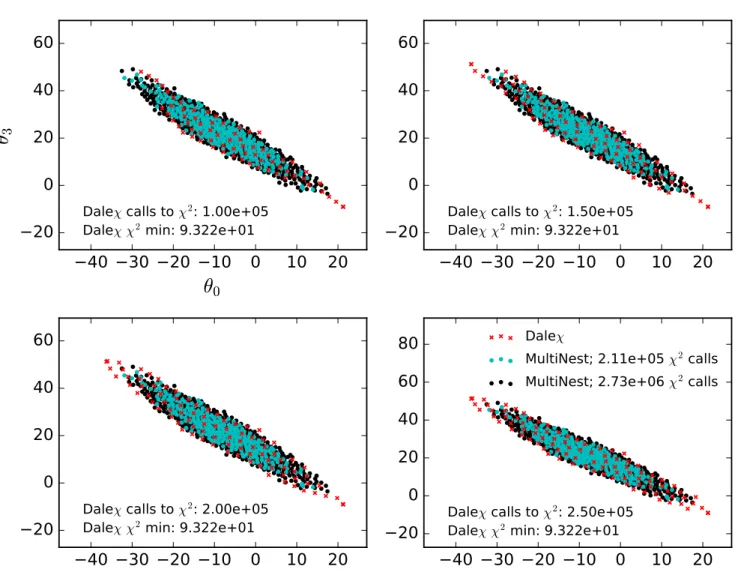
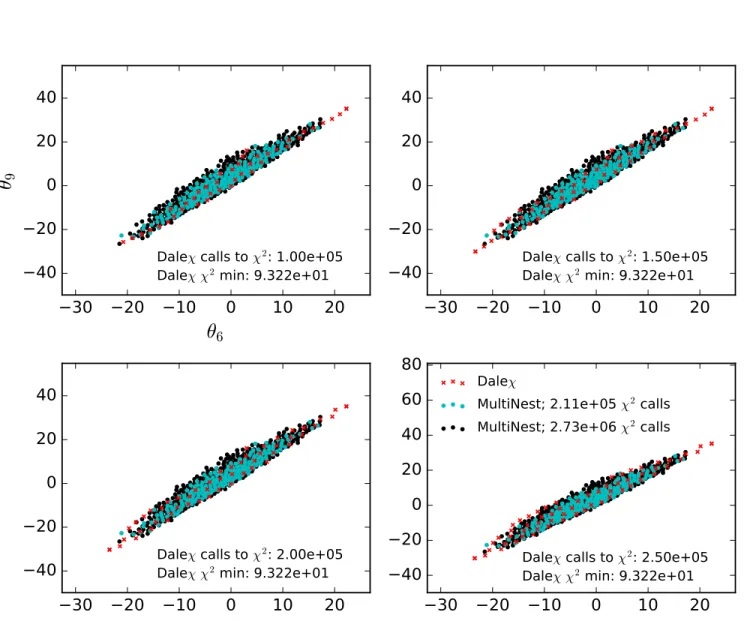
Section 3.2.2 describes an algorithm that takes steps which are clustered around χ2min, trying to ensure that DALEχ has found the true value of χ2min. Section 3.2.3 describes an algorithm that searches for χ2 ≤χ2lim regions by closing in on them from theχ2 > χ2lim parameter space. Section 3.2.4 explores theχ2 ≤χ2lim contour from within, focusing on regions of parameter space that may not have been explored yet. We find that the diversity of optimization and characterization steps is well suited, and indeed crucial, to dealing with complicated likelihood surfaces, with degener- ate/highly curved/non-Gaussian or multimodal properties. Equally important, in high-dimensional cases, DALEχ converges in a number of χ2 evaluations significantly lower than required by Multi- Nest while finding regions of parameter space ignored by MultiNest (and indeed often values of χ2min lower than MultiNest).
We combine these three search modes into the following master algorithm for DALEχ .
• (1) Run theoptimization algorithm from Section 3.1.
• (2) Perform the χ2min-refining search of Section3.2.2.
• (3) Perform a single sequence of tendril searches as described in Section 3.2.4 (recall that if no viable candidates for a tendril search starting point exist, we will perform the search in Section3.2.3 to find some).
• (4) Alternate steps (2) and (3) until convergence.
As stated before, “convergence” is not a well-defined formal concept for DALEχ . Presently, we have no global convergence condition. DALEχ runs until it has made a user-specified number of calls to χ2. Operationally, our local criterion works quite well, as shown in the next sections.
Future work will explore development of a global convergence criterion.
4. A Cartoon Likelihood Function
Algorithms such as MCMC, MultiNest, and DALEχ are designed for use in characterizing likelihood functions complex enough that evaluating them the ≈100D times necessary to evaluate them directly on a well-sampled grid in parameter space would take too much time to be feasible.
In many cases, such functions are so complex that even evaluating them the (comparatively) few
number of times necessary for the algorithms under consideration to converge can take hours or, in the worst cases, days. To facilitate more rapid testing during the development of DALEχ , we designed a cartoon likelihood function which mimicked the non-linear, non-Gaussian behavior of realistic multi-dimensional likelihood functions, but which could be evaluated almost instanta- neously on personal computers. These functions are made available in our code via the header file include/exampleLikelihoods.h. The likelihood functions do depend on other compiled ob- jects from our code base. Users should consult theMakefile, specifically the example executables curved 4d, curved 12d, and ellipse 12d, for examples how to compile software using our toy likelihoods.
In order to understand how we have constructed our cartoon likelihood function, it is useful to consider an example from nature. Since the authors are cosmologists, the example we choose is using the cosmic microwave background (CMB) anisotropy spectrum as measured by an experiment such as Planck (Planck Collaboration 2013) to constrain the values of cosmological parameters.
The CMB likelihood function is, in the simplest case, defined on a 6-dimensional parameter space {Ωm,Ωb, h, τ, ns, As}. (In reality there can be a dozen or more non-cosmological parameters as well.) Each combination of these 6 parameters implies a different spectrum of anisotropy for the CMB. This anisotropy is defined in terms of the Cℓ power coefficients of the multipole-moment ℓ decomposition of the full CMB temperature distribution on the sky. Typical CMB experiments mea- sure a few thousand of theseCℓ coefficients (in the temperature-temperature correlation function).
To compute a likelihood value for any combination of cosmological parameters, the parameters are converted into their predicted Cℓ spectrum and this Cℓ spectrum is compared to the actual measurement. In other words, there is an unknown, non-linear function g(~θ, ℓ) such that
g({Ωm,Ωb, h, τ, ns, As}, ℓ) =Cℓ (4) To find the likelihood of any given combination of cosmological parameters, one must first evaluate g(~θ, ℓ) to get a test set of Cℓ’s and then compare this set to the actual measured Cℓ’s, taking into account the appropriate covariance matrix.
To mimic this behavior, we construct our cartoon likelihood functions in three steps.
• (1) A function ˜f(~θ) =~µmaps the cardinal parameters~θ into auxiliary parameters~µ.
• (2) A second function ˜g(~µ, ~x) = ~y(~x) maps the parameters ~µ and an independent variable~x (analogous toℓin the cosmological case (4) above) to a dependent value~y (analogous toCℓ).
• (3) A noisy cartoon data set (~x, ~y0, σ~y,0) is constructed by evaluating
~
ymean= ˜g f˜
~θ0 , ~x
(5) at 100 values of x. At each of these values of (x, ~ymean), 100 samples are drawn from a Gaussian distribution centered on~ymean. (A Gaussian distribution is chosen as a simplification of experiment noise properties for the purposes of rapid testing.) ~y0 is the mean of these 100 samples andσ~y,0 is the standard deviation of these samples.
To evaluateχ2 at a test value ofθ, one simply evaluates~
~ytest = ˜g f˜
~θtest , x
(6) and compares
χ2
~θtest
=
100
X
i
(~ytest,i−~y0,i)/σ~y,0,i
2
(7)
4.1. Confidence versus Credible Limits: How to Set χ2lim
Before proceeding, we have to define exactly what contours we are searching for. (The reader more interested in a direct comparison of results from different algorithms can skip to Section5.) A significant philosophical difference between the sampling algorithms (MCMC and MultiNest) and the search algorithms (APS and DALEχ ) is in how each defines the desired boundary in param- eter space (the “confidence limit” in frequentist terminology; the “credible limit” for Bayesians).
Sampling algorithms learn the definition boundary as they go. They draw samples from the pos- terior probability distribution and, after convergence has been achieved, declare the limit to be the region of parameter space containing the desired fraction of that total distribution. Search algorithms require the user to specify some χ2lim defining the desired limit a priori. This can be done either by setting an absolute value of χ2lim or by demanding that χ2 be within some ∆χ2 of the discovered χ2min, i.e. χ2lim =χ2min+ ∆χ2. These two approaches are not wholly irreconcilable.
Wilks’ Theorem (Wilks 1938) states that, for approximately Gaussian likelihood functions, the Bayesian credible limit (i.e. the contour bounding (1−α)% of the total posterior probability) in a D-dimensional parameter space is equivalent to the contour containing all points corresponding to χ2 ≤ χ2min+χ2(1−α)% where χ2(1−α)% is the value of χ2 bounding the desired probability for a χ2 probability distribution withD degrees of freedom. Even given this result, there remains some ambiguity in how one setsχ2(1−α)%. Namely: one must choose the correct value ofDfor the degrees of freedom. Traditionally, credible and confidence limits are plotted in 2-dimensional sub-spaces of the full parameter space. The limits that are plotted are either marginalized or projected down to two dimensions. In the case of marginalization, the Wilks’-theorem equivalence between confidence and credible limits holds for D= 2 degrees of freedom and ∆χ2 = 6.0 for the 95% contour. In the case of projections, D is equal to the full dimensionality of the parameter space. We argue and demonstrate below that the preferred choice, with the most robust results, is projection with D equal to the full dimensionality of the parameter space being considered. We illustrate this with a toy example.
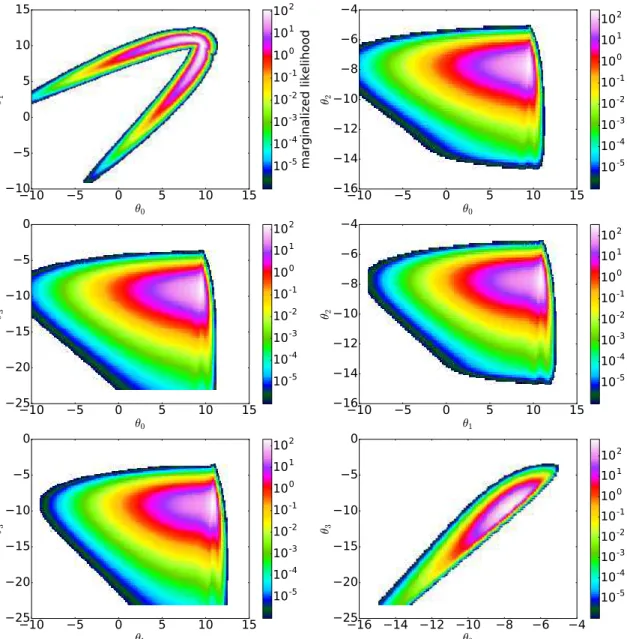
In order to compare different definitions of confidence and credible limits, we construct a car- toon likelihood function on 4 parameters. Choosing such a low-dimensional parameter space allows us to grid the full space and directly integrate the Bayesian credible limits without requiring unrea- sonable computational resources. Figure1 shows the marginalized likelihood of our 4-dimensional cartoon likelihood function in each of the 2-dimensional parameter sub-spaces. As one can see,
we have constructed our cartoon likelihood function to have a severely curved degeneracy in the {θ0, θ1} parameter sub-space and significantly non-Gaussian contours in the other five sub-spaces.
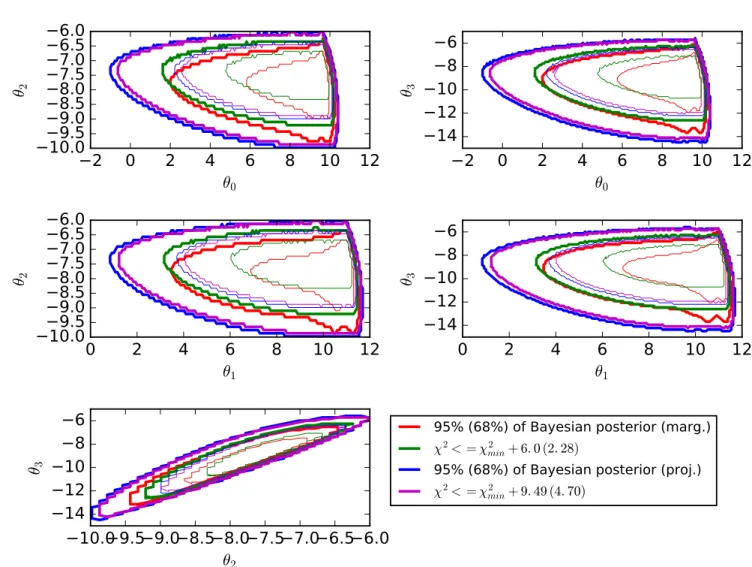
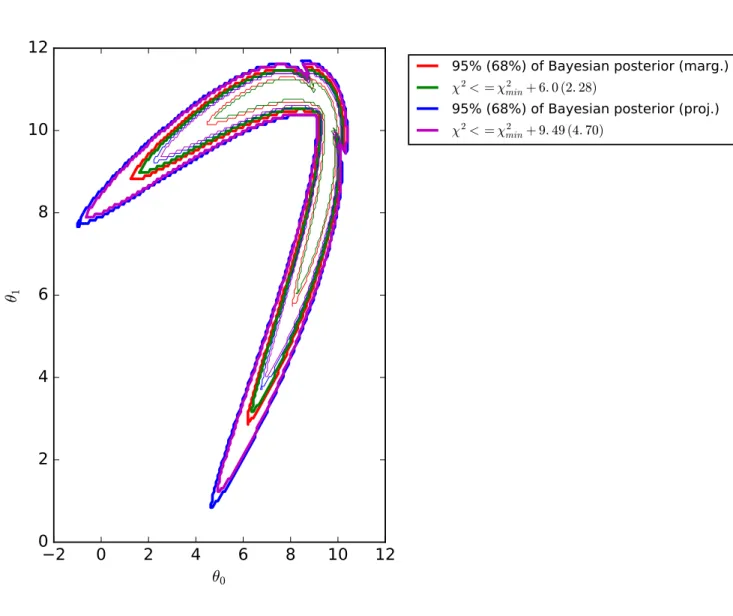
In Figures2 and3, we show the confidence and credible limits of our 4-dimensional toy likeli- hood function computed in several ways. The red contours show the marginalized Bayesian cred- ible limits. These are the contours enclosing 95% (68%) of the marginalized likelihood shown in Figure 1. The green contours are the projections of the 4-dimensional contours enclosing χ2 ≤ χ2min + 6.0 (2.28), i.e. they were generated by finding all of the points in 4-dimensional space satisfyingχ2 ≤χ2min+ 6.0 (2.28), converting those points into a scatter-plot in each of the 2- dimensional sub-spaces, and then drawing a contour around those scatter plots. Naively, one would expect these contours to be equivalent to the marginalized Bayesian contours, since 6.0 (2.28) is the 95% (68%) limit for aχ2 distribution with two degrees of freedom. (Note that the 95.4% and 68.3%
limits, i.e. 2σ and 1σ in Gaussian probability, would have ∆χ2= 6.17 and 2.30.) This, however, is clearly not the case. The non-Gaussian nature of our toy likelihood prevents Wilks’ theorem from applying in the marginalized case. While you can integrate awayddimensions of a D-dimensional multivariate Gaussian and come up with a D−dmultivariate Gaussian, no such guarantee exists for arbitrary, non-Gaussian functions.
The blue contours in Figure2and3show theprojected Bayesian credible limits of our cartoon function. These were constructed by assembling all of the points in 4-dimensional space that contained 95% (68%) of the total likelihood, converting those points to a scatter plot in the 2- dimensional sub-spaces, and drawing a contour around the scatter plots. The purple contours show the similarly projected contours containing all of the points for whichχ2≤χ2min+ 9.49 (4.70), with 9.49 (4.70) being the 95% (68%) limit for aχ2 distribution with four degrees of freedom. We refer to these contours as the “full-dimensional LRT (likelihood ratio test)” contours. We see remarkably good agreement between the projected Bayesian and full-dimensional LRT contours in both the 95% and the 68% limit, in accordance with Wilks’ theorem (since we have not marginalized away any of the 4 parameters in our parameter space, Wilks’ theorem still appears to hold).
In the rest of this paper, we will examine likelihood functions based on their projected Bayesian and full-dimensional LRT contours. Though it is traditional to consider marginalized contours in 2-dimensional sub-spaces, we note concerns that this may discard important information about the actual extent of parameter space considered reasonable by the likelihood function. In all cases in Figures2 and 3, the projected Bayesian and full-dimensional LRT contours were larger than their 2-dimensional marginalized counterparts. This should not be surprising. The projected Bayesian and full-dimensional LRT contours contain all of the pixels in the full 4-dimensional space that fall within the desired credible limit. The marginalized counterparts take those full 4-dimensional contours and then weight them by the amount of marginalized parameter space volume they contain.
The final marginalized contour thus represents an amalgam of the raw likelihood function and its extent in parameter space. It is not obvious that this is necessarily what one wants when inferring parameter constraints from a data set.
If a point in parameter space falls within the projected Bayesian or full-dimensional LRT
−10 −5 0 5 10 15
θ0
−10
−5 0 5 10 15
θ1
10
-510
-410
-310
-210
-110
010
110
2ma rgi na liz ed lik eli ho od
−10 −5 0 5 10 15
θ0
−16
−14
−12
−10
−8
−6
−4
θ2
10
-510
-410
-310
-210
-110
010
110
2−10 −5 0 5 10 15
θ0
−25
−20
−15
−10
−5 0
θ3
10
-510
-410
-310
-210
-110
010
110
2−10 −5 0 5 10 15
θ1
−16
−14
−12
−10
−8
−6
−4
θ2
10
-510
-410
-310
-210
-110
010
110
2−10 −5 0 5 10 15
θ1
−25
−20
−15
−10
−5 0
θ3
10
-510
-410
-310
-210
-110
010
110
2−16 −14 −12 −10 −8 −6 −4
θ2
−25
−20
−15
−10
−5 0
θ3
10
-510
-410
-310
-210
-110
010
110
2Fig. 1.— The marginalized likelihood in all of the 2-D sub-spaces of our 4-D cartoon likelihood function is shown, with the color bar indicating the marginalized likelihood. Note: the apparent discontinuity in the shape of the confidence contour near the bend in the{θ0, θ1} sub-space is an actual feature of our likelihood function, resulting from how the function is implemented in C++.
contour, it means that the fit to the data provided by that combination of parameters is, by some metric, reasonable. This is somewhat a matter of taste, but if one is really interested in all of the parameter combinations that give reasonable fits to the data, the conservative approach would be to keep all such combinations, rather than throwing out some, simply because they include rare – but fully accepted by the data – combinations of, say, {θ1, θ3} (in the case of the gap between the marginalized and projected Bayesian contours in the {θ0, θ2} plot in Figure 2). For this reason, we proceed1, comparing the performance of DALEχ with MultiNest by examining the projected Bayesian and full-dimensional LRT contours.
We acknowledge that there are some applications for which the approximate equivalence of χ2 ≤ χ2lim with a Bayesian credible limit for which we have argued above is insufficient. If a likelihood function is sufficiently non-Gaussian or a data set is sufficiently noisy, the two will not be equivalent. Indeed, in Figures 2 and 3, the blue and purple contours are not identical, but merely approximately the same. In cases where only the Bayesian credible limit is acceptable, we still believe that there is a use for DALEχ . Bayesian sampling algorithms generally get bogged down during “burn-in”, the period of time at the beginning of the sampling run during which the algorithm is simply learning where the minimum χ2 point is and what the degeneracy directions of the contour are without efficiently sampling from the posterior. We show below that DALEχ converges to its confidence limits, with the same χ2min and degeneracy directions as the Bayesian credible limit, irrespective of one’s opinion of Bayesian versus frequentist statistical interpretations, after an order of magnitude fewer calls to χ2 than required by MultiNest. If one does not feel inclined to trust the full confidence limits returned by DALEχ , one should be able to achieve a significant speed-up in Bayesian sampling algorithms by using DALEχ as pre-burner: defining the region of parameter space to be sampled before sampling commences.
5. Comparison of Techniques
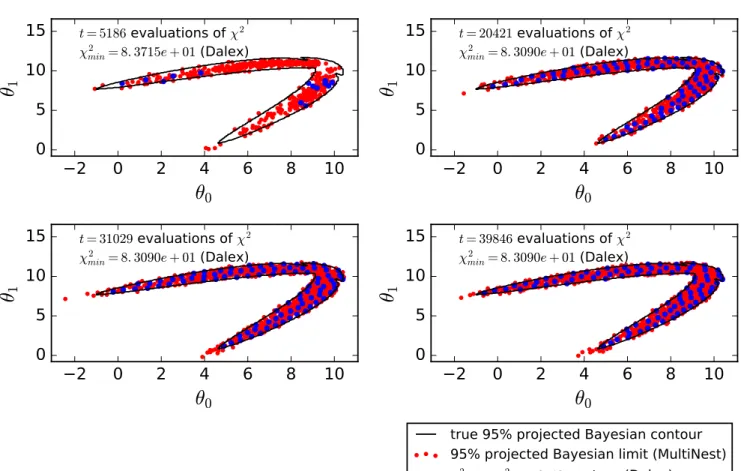
As a proof of concept, we begin by comparing the performance of MultiNest and DALEχ on the 4-dimensional likelihood function presented in Figure 1. As said before, four is an extremely low dimensionality and we find that MultiNest converges thoroughly and much more rapidly than DALEχ (though MultiNest does include some spurious points compared to exact, brute force calculation, unlike DALEχ , i.e. it has lower purity). Later, we will see that DALEχ out-performs MultiNest on higher-dimension likelihood functions. The purpose of this current discussion is to demonstrate that DALEχ does, in fact, find the limits expected from Figures2 and 3.
Comparing MultiNest and DALEχrequires defining how long each should run. Because Multi-
1 We do not consider useful the strictly frequentist perspective that, since our cartoon likelihood function “mea- sures”~y(x) at 100 values ofx, the confidence limit limit should therefore be set according to theχ2distribution with 100 degrees of freedom. This would set the 95% confidence limit atχ2 = 124.35. Note that sinceχ2min for our toy likelihood function ended up being 83.12, such frequentist confidence limit contours would be significantly larger than anything shown in Figures2and3. Such large contours seem unlikely to be useful.
−2 0 2 4 6 8 10 12
θ
0−10.0 −9.5 −9.0 −8.5 −8.0 −7.5 −7.0 −6.5 −6.0
θ
2−2 0 2 4 6 8 10 12
θ
0−14 −12
−10 −8 −6
θ
30 2 4 6 8 10 12
θ
1−10.0 −9.5 −9.0 −8.5 −8.0 −7.5 −7.0 −6.5 −6.0
θ
20 2 4 6 8 10 12
θ
1−14 −12
−10 −8 −6
θ
3−10.0−9.5−9.0−8.5−8.0−7.5−7.0−6.5−6.0
θ
2−14 −12
−10 −8 −6
θ
395% (68%) of Bayesian posterior (marg.) χ
2<
=χ
min + 62.
0 (2.
28)95% (68%) of Bayesian posterior (proj.) χ
2<
=χ
min + 92.
49 (4.
70)Fig. 2.— Comparison of the different confidence and credible limits are shown for the likelihood function introduced in Figure 1. The projected Bayesian credible limit agrees much better with the frequentist full dimensional likelihood ratio test (χ2) confidence limit than the marginalized Bayesian credible limit. Thick contours are the 95% limit; thin contours are the 68% limit. The {θ0, θ1} parameter sub-space is shown in Figure 3.
−2 0 2 4 6 8 10 12
θ
00 2 4 6 8 10 12
θ
195% (68%) of Bayesian posterior (marg.) χ
2<
=χ
min + 62.
0 (2.
28)95% (68%) of Bayesian posterior (proj.) χ
2<
=χ
min + 92.
49 (4.
70)Fig. 3.— As Figure2 but for theθ0-θ1 subspace. Due to the better Gaussianity in this subspace, both the projected and marginalized Bayesian credible limits agree with the likelihood ratio test.
Nest is a sampling algorithm designed to integrate the posterior distribution, it has a well defined convergence criterion: when the Bayesian evidence integrated over parameter space ceases to grow, the sampling is done. DALEχdoes not have any analogous global convergence criterion. Individual tendril searches within DALEχ can be said to converge when they “strike out” (see Section 3.2.4) but this says nothing about the overall convergence of DALEχ. It is up to the user to specify how many χ2 evaluations they wish DALEχ to make. In Figure 4 below, we wish to show the conver- gence of MultiNest and DALEχas a function of “time” (time being measured in the number of χ2 evaluations being made). To do this, we initialized several MultiNest runs, each with a different number of “live” points. MultiNest instances with more live points took longer to converge (but can be expected to evaluate the posterior distribution more accurately). We then ran a single instance of DALEχand asked it to quit after 40,000 χ2 evaluations. In Figure4, we compare the MultiNest runs with the progress made by DALEχafter it had evaluatedχ2as many times as it took MultiNest to converge. The red points are the 2-dimensional projections of the points discovered by MultiNest to be in the 95% Bayesian credible limit. The blue points are theχ2 ≤χ2min+ 9.49 points discov- ered by DALEχ at the equivalent point in time. As stated, DALEχ does indeed find the correct χ2 ≤χ2lim contour while MultiNest is faster forD= 4 and somewhat impure. We show below that, in higher-dimensional cases, DALEχcharacterizes the contour much more robustly than MultiNest.
We used version 3.9 of MultiNest here and throughout this paper. The most up-to-date version of MultiNest can be downloaded from https://ccpforge.cse.rl.ac.uk/gf/project/multinest/
5.1. Comparison on 12-dimensional case
We showed above that DALEχfound similar confidence limits, but took much longer to con- verge than did MultiNest on a 4-dimensional likelihood function. Now we compare DALEχ to MultiNest on a 12-dimensional cartoon likelihood function. Here we find that DALEχ converges an order of magnitude faster than MultiNest.
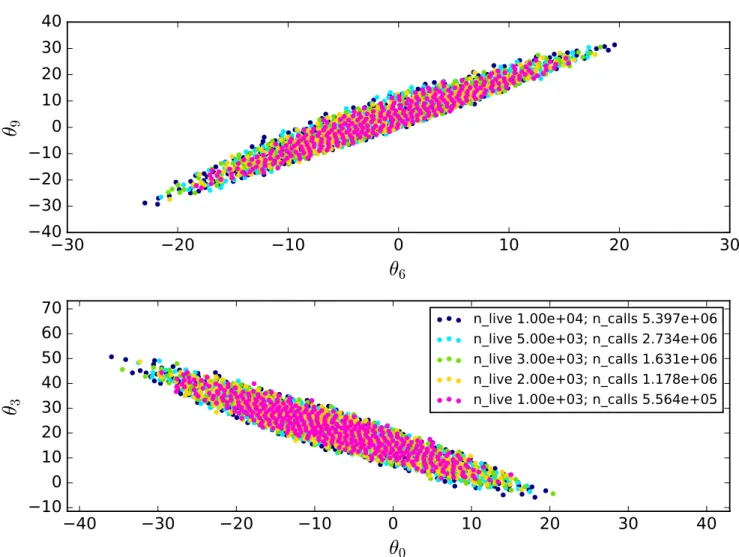
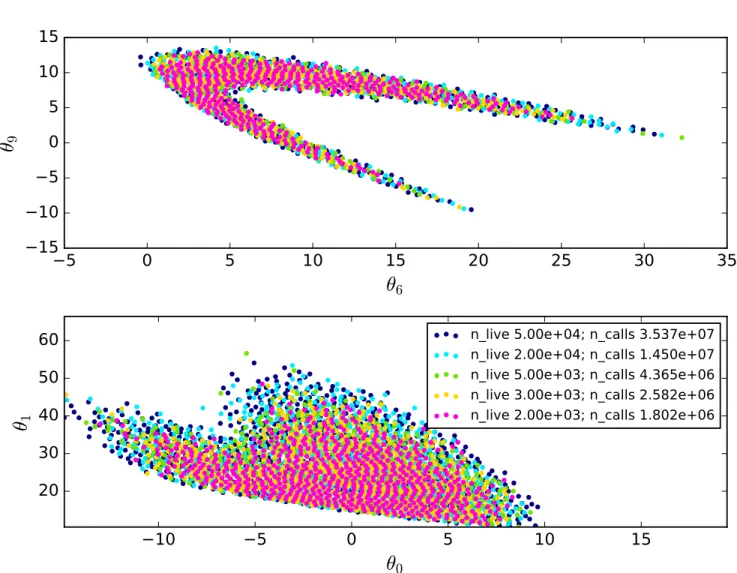
Before we show the direct comparison between DALEχ and MultiNest, we must be careful to define what we are comparing. MultiNest involves several user-determined parameters that control how the sampling is done. One in particular, the number of ‘live’ points, which is somewhat analogous to the number of independent chains run in an MCMC, has a profound effect both on how fast MultiNest converges and what limit it finds when it does converge. We created two 12- dimensional instantiations of our cartoon likelihood function, one with a very curved parameter space degeneracy, one without, and ran several instantiations of MultiNest with different numbers of ‘live’ points on those functions. Figures 5 and 6 show the projected Bayesian 95% credible limits found by MultiNest in two 2-dimensional sub-spaces for each of those likelihood functions as a function of the number of ‘live’ points. The figures also note how many evaluations of the likelihood function were necessary before MultiNest declared convergence. Not only does increasing the number of ‘live’ points increase the number of likelihood evaluations necessary for MultiNest to converge, it also expands the discovered credible limits. We interpret this to mean that running MultiNest with a small number of ‘live’ points results in convergence to an incomplete credible
−2 0 2 4 6 8 10
θ
00 5 10 15
θ
1t
= 5186evaluations of χ
2χ
2min = 8.
3715e
+ 01(Dalex)
−2 0 2 4 6 8 10
θ
00 5 10 15
θ
1t
= 20421evaluations of χ
2χ
2min = 8.
3090e
+ 01(Dalex)
−2 0 2 4 6 8 10
θ
00 5 10 15
θ
1t
= 31029evaluations of χ
2χ
2min = 8.
3090e
+ 01(Dalex)
−2 0 2 4 6 8 10
θ
00 5 10 15
θ
1t
= 39846evaluations of χ
2χ
2min = 8.
3090e
+ 01(Dalex)
true 95% projected Bayesian contour 95% projected Bayesian limit (MultiNest) χ
2<
=χ
min + 92.
49contour (Dalex)
Fig. 4.— We demonstrate the convergence properties of MultiNest and DALEχ on the 4- dimensional likelihood function from Figure 1. The black contour represents the true projected 95% Bayesian credible limit. The red points represent the points in the projected 95% Bayesian credible limit discovered by MultiNest. The blue points represent the χ2 ≤ χ2min+ 9.49 points discovered by DALEχ . Each panel represents a different MultiNest run, which took t points to converge. The blue points are all drawn from a single run of DALEχat the point during its history at which it had evaluated χ2 ttimes.