THE ACADEMY OF PUBLIC ADMINISTRATION UNDER THE PRESIDENT OF THE REPUBLIC OF KAZAKHSTAN
Institute of Diplomacy Manuscript copyright
MUSSABEKOVA DARIYA
KAZAKHSTAN'S FOREING INVESTMENT POLICY IN THE MIDDLE EAST: DEVELOPMENT AND PROSPECTS
Educational program «7M03111 - International relations»
in the direction of training «7M031 Social sciences»
Master's project for a master’s degree in International Relations
Scientific advisor: Elmira Joldybayeva, PhD, Associate Professor ______________
Director of the Institute of Diplomacy: Alexey Volkov _______________________
The project is approved for defense: «______» _________________________2023
Astana, 2023
CONTENT
Normative references……….………3
Acronyms and abbreviations……….4
Introduction………...5
Literature review………...7
Research methodology………10
1. HISTORICAL AND CONCEPTUAL PERSPECTIVES OF THE STUDY OF FOREIGN INVESTMENT POLICY………..…11
1.1 The concept and significance of foreign investment policy………..11
1.2 Regulatory instruments and methods of foreign investment policy…………..15
2. INVESTMENT POLICY OF THE MIDDLE EAST IN KAZAKHSTAN…..20
2.1. Attractiveness of the investment policy of Kazakhstan ………20
2.2. Development of the investment policy of the Middle East in Kazakhstan…26 2.3. Prospects for attracting investments from the Middle East to Kazakhstan…34 Conclusion………...38
References………...…40
Normative references
In this project, references made to the following standards:
• Order of the Government of the Republic of Kazakhstan dated July 15, 2022 No.
482 «About approval of the Concept of Investment policy of the Republic of Kazakhstan till 2026»
• Code of the Republic of Kazakhstan dated December 25, 2017 No. 120-VI SAM
«On taxes and other mandatory payments to the budget (Tax Code)»
• Code of the Republic of Kazakhstan dated October 29, 2015 No. 375-V ZRK
«Entrepreneurial Code of the Republic of Kazakhstan»
• Decree of the President of the Republic of Kazakhstan dated March 6, 2020 No.
280 «Concept of Foreign Policy of the Republic of Kazakhstan for 2020-2030»
• Order Acting of the Minister for Investment and Development of the Republic of Kazakhstan dated December 30, 2015 No. 1281 «On approval of the Rules for acceptance, registration and consideration of applications for investment preferences»
• Law of the Republic of Kazakhstan dated February 28, 1997 No. 75-1 «On State support of direct investments»
• Order of the Government of the Republic of Kazakhstan dated August 13, 2019 No. 585 «On approval of the Rules for organization of «One window» for investors, and also order go interaction in case of investment attraction»
• Order of the Republic of Kazakhstan dated July 30, 2019 No. 548 «On approval of the Roadmap for further attracting investments to the Republic of Kazakhstan».
Acronyms and abbreviations
RK – Republic of Kazakhstan UAE – United Arab Emirates TR – Republic of Turkey
FDI – Foreign direct investment IGC – Global Competitiveness Index IIF – Islamic Investment Fund
OBOR – One Belt One Road
OECD – Organization for Economic Co-operation and Development AIFC – Astana International Financial Centre
EAEU – Eurasian Economic Union
Introduction
After gaining independence in 1991, Kazakhstan similar to other post-soviet countries, was faced with the challenging task of nation building in the rapidly changing global space. At the same time due to the end of Cold War, the international relations were also witnessing multiple transformations and concepts such as soft power and globalization which led to establishment of truly new global system. One of the most noticeable aspects in this new reality was the significance of economics as countries realized the potential of economic strength in the post-cold war world.
Kazakhstan as similar to all the other countries had to adopt certain significant economic policies along with its process of nation building.
As time went by Kazakhstan’s growth in all areas became significant as the country eventually became known as a key player in the Central Asia region. The abundant natural resources and ambitious regional cooperation further contributed to the growing robust economy of the country. Kazakhstan also began to look for potential investment opportunities which lead to implementation of an astute investment policy aimed at fostering mutually beneficial partnerships.
Middle East is a region that has long been a focal point for economic activities and global investments due to its strategic location, emerging markets and vast natural resources. As nations across the globe seek to diversify their portfolios and tap into new opportunities, Kazakhstan also leveraged its economic strengths in the Middle East. Countries such as United Arab Emirates (UAE), the Republic of Turkey (TR) and Qatar became important for Kazakhstan as it started to build bilateral relations and later investment cooperation with these countries while stimulating opportunities of foreign direct investments (FDI) into the growing economy of the country.
The implementation of investment policy is one of the primary forces behind economic changes intended to guarantee rapid economic growth rates and enhance the effectiveness of the economy in Kazakhstan at the current stage of development, which has finally shifted to market relations. The state develops the structure of the economy with the aid of foreign investments, updating fixed assets, training specialists and labourers and digitally upgrading businesses and also by introducing innovations.
The relevance of the research topic is primarily due to the increasing participation of the Middle East countries such as UAE, Qatar and Turkey in the movement of capital in the form of investment opportunities in Kazakhstan. The gradual growth of Kazakhstan's role in this direction creates the need to understand both internal and external processes that determine the investment policies of the country. Moreover, it is also significant to consider and evaluate the success of the
investment policy, as it is a direct indicator of what changes the volume of both attracted and carried investments by economic entities.
According to the foreign policy concept of the Republic of Kazakhstan for the period 2020 to 2030, the development of investment partnerships within bilateral and multilateral diplomacy are considered as priorities due to the growing demand of economic developments.
The main goal of the project is to explore and explain the prospects and conditions for attracting foreign direct investment from Middle East in Kazakhstan. To achieve this goal the project sets the following tasks:
• Consider the theoretical and methodological foundations of the specifics of interstate cooperation between the Republic of Kazakhstan and the Middle Eastern countries;
• Study the levels of mutual investment cooperation between the Republic of Kazakhstan and the Middle Eastern countries;
• Analyse the present situation and the future projections for Kazakhstan’s investment activities
• Formulate pragmatic recommendations for attracting foreign investments into Kazakhstan’s economy.
Scientific novelty – this master's project conducted a study of the investment activities of the UAE, Turkey and Qatar in Kazakhstan, which allowed us to obtain the following results:
-
Establishment of diplomatic and political relations between Kazakhstan and Middle Eastern countries, specifically UAE, Turley and Qatar.-
Recommendations for further development of investment cooperation between Kazakhstan and the Middle Eastern countries.Practical significance. The practical significance of this project is that it is an addition to the literature and sources which can be used in the development of policies and projects in the economic and political sphere of Kazakhstan and Middle Eastern countries. Also, this project can be a source of necessary knowledge for students and it can also be used for the development of textbooks for teachers of higher educational institutions.
Literature review
The study of the essence and content of the Kazakhstan’s investment policy has always been the focus of attention not only in economic, but also in historical science.
This is mostly because the investments have an impact on socioeconomic sphere’s most fundamental principles which determines the country’s overall economic growth process which ultimately affects people’s wellbeing.
The government of Kazakhstan puts great emphasis on the problems and prospects of Kazakhstan's investment policy, as well as its cooperation with Middle Eastern countries like the UAE, Turkey and Qatar which are potential investors in Kazakhstan.
With accordance to the project, the works of domestic and foreign specialists are divided into two groups. The first group consists of studies done by Kazakhstani authors that focus on the advancement of Kazakhstan's foreign investment strategy and its diplomatic and commercial ties with the Middle Eastern countries. Researchers from Turkey, Russia, and the Arab world who examine various facets of the formulation and evolution of investment policy between these countries and Kazakhstan make up the second category.
Kazakhstani professionals have made a significant contribution to the study of attracting foreign investments and the development of the country's investment policy.
V.Y. Dodonov's monograph published in 2019 known as “International investment cooperation of Kazakhstan: trends, factors, prospects” is specialised to the investment activity of the country, including the analysis of the process of international investment flows. The work also considers the best countries in absolute positions in the rating of
«Institutes» of the IGC, among them are the countries UAE, Turkey and Qatar [3].
Analyzing the research of Kazakhstani professionals revealing the issues of investment attractiveness of Kazakhstan, we can consider the works of A.M.
Dzhumabayeva, D.M. Turekulova, G.M. Niyazova, A.K. Urazbekov, A.U. Abishova, G.Zh. Urazbaeva and Sh.Zh. Kydyrova, D.R. Akhmetova and Zh.A. Bekbaeva [4-9].
The important role of investment policy in the economic development of the country is presented in the works of A. Zhaksybergenov, G.M. Aubakirov, A.S. Kuatov and P.D. Tregubov, G.A. Kurmanbekova [10-12]. According to G.A. Kurmanbekova, the role of investment policy in the state economy is to create certain conditions for improving the investment climate in the country, ensuring optimal investment of such objects as private capital, reducing investment risks and increasing the level of investment reliability; insurance funds, as well as the necessary infrastructure and
leading industries that contribute to the accelerated development of the country's economy as a whole [12, 175].
Scientists A.M. Esdauletova and N.B. Demeuov, V. Dodonov, A.K. Kozha- Akhmet devoted their works to the general problems of forming investment policy and reducing the volume of net investment inflows [13-15].
There was also a review of the scientific article “The current state and structure of foreign direct investment in the Republic of Kazakhstan” by A.M. Esdauletova and N.B. Demeuov. This article examines the present state of investment activity with regard to economic sectors of Kazakhstan. The authors believe that investment flows to Kazakhstan have a rather narrow focus, determined by the preferences of investors in obtaining a quick income from the sale of raw materials. In this context, it is significant to implement a set of actions intended to structurally change the direction of FDI from extractive industries to manufacturing with the production of high value- added competitive goods [16].
The author of the dissertation research, A.N. Turekulova, argues that despite the generally attractive investment climate, there are serious obstacles in Kazakhstan in the form of bureaucratic barriers, financial risks, shortcomings in tax legislation and administration, which negatively affects the process of inflow of foreign capital and investment. The investment activities of domestic companies need serious reform [17].
It is also significant to highlight the multiple works done by Kazakhstani professionals which are concentrated towards the problems in the relations between Kazakhstan and Middle Eastern countries. Among these works, the article “New priorities of Kazakhstan’s foreign policy: The Arab direction” written by A.B.
Amantayeva is noteworthy as she highlights the growing importance of developing economic and trade ties with Middle Eastern growing economies. [18].
Moreover, another article on the topic “On the issue of Kazakhstan's Foreign Policy: countries of the Muslim world” written by Z. Jalilova analyzes the increasing interest of Kazakhstan in the development of economic and trade relations with the countries of the Middle East [19].
Zh. Tanatarova, B. Mustafayeva, S. Nurdavletova and L. Nursultanova’s article titled “Cooperation of the Republic of Kazakhstan with the countries of the Near and Middle East in the investment sphere: problems and prospects” states in detail the prospects of mutually beneficial investment cooperation of Kazakhstan with Turkey, the UAE and Qatar and also with other Middle Eastern countries [20].
J.S. Bereshev’s article on “Problems and prospects of development of Islamic investment funds in the Republic of Kazakhstan” analyzes the important role of the Islamic investment funds in attracting investment capital from the Middle East [21].
Furthermore, the article “Kazakhstan’s policy in the Middle East and Kazakh- Egyptian relations” by S.G. Azerbayev analyzes the stages of establishing diplomatic relations of the Republic of Kazakhstan with the Middle Eastern countries in association with rapidly changing geopolitical situation of the international arena. [22].
G.B. Rakhmanova, L.J. Abzhaparova and A.E. Toiganbayeva in their article
“Trade and economic cooperation is an important component of bilateral cooperation
between Kazakhstan and Turkey” consider the dynamics of important areas of economic cooperation between the two countries [23].
In foreign historiography, the project has aimed to analyze the works of Turkish, Russian and Arab professionals. Among them, Serdar Yilmaz in his research focuses on the participation of Azerbaijan, Turkey and Kazakhstan in the One Belt, One Road (OBOR) initiative. It also attempts to find a solution to the problem of why these countries are important to China in its OBOR initiative and the possible financial dependence of these three countries on China within the framework of the OBOR initiative [24].
E. Kaigyn, E. Topchuoglu and S.Ozkes in their article “Obstacles on the way to relations between Turkey and Kazakhstan” discuss the possible impact of transport routes between Kazakhstan and Turkey on their relations, specifically the trade relations between the two countries [25].
It is also important to evaluate the article by I. Salih Ebrem on the topic
“Studying relations between Turkey and Kazakhstan from the point of view of data on foreign trade and organizations” as it analyzes the trade between these two countries in the period of 2008-2013 [26].
D. Kuriszhan and H. Altyntas in their work considered trade and economic relations between Kazakhstan and Turkey. The authors claim that the continuous growth of trade turnover between the two countries is largely due to the correct analysis of their strong relations by the authorities of both countries [27].
Dissertation research written by H. Togach which is titles as “Incentives for foreign Direct investment: Comparison of Turkey and Kazakhstan” aims to provide a comparative analysis of the progress of foreign direct investment in Turkey and Kazakhstan and the laws adopted in relation to FDI, as well as methods and incentives [28].
Ya. Delige in his dissertation research “Structural analysis of Kazakhstan's foreign trade” discusses the mobility of Kazakhstan's foreign trade carried out by regional and global powers, which affects Turkey's trade with Kazakhstan. It also analyzes the Turkish investors' investments in Kazakhstan [29].
The collective monograph of Russian researchers known as “The countries of the East by 2050: population, energy, food, investment climate” is aimed to make projections for Asian countries in their development in vulnerable areas and also it further analyzes the investment climate of Turkey [30]. Another noteworthy work on the topic “The Middle East: the view of young researchers” states the common problems in socio-economic development, history, religion, and foreign policy of the Middle Eastern countries [31].
The third chapter of the collection of scientific papers “The Middle East in the focus of political analytic” analyzes the socio-economic problems of the region [32].
Some issues in the foreign policy course of the current President K.K. Tokayev is touched upon in the article “Kazakhstan on the path of reforms” written by E. Ionova [33].
Organization for Economic Cooperation and Development (OECD) in its report titled “Investments in the Middle East and North Africa region during the coronavirus”
examines the problems of attracting foreign direct investment to the region during the pandemic [34].
S. Maalul in the study examined the reasons for the decline in foreign aid and international credit flows in Arab countries. It also provides recommendations on ensuring an appropriate investment climate capable of attracting foreign investment flows [35].
However, despite the availability of these works, there are no specific scientific works done by professionals from the United Arab Emirates and Qatar on the topic under consideration, and investment ties between states are also not covered.
The main sources of bilateral relations are diplomatic documents, the international legal framework, official websites of governments, as well as news sites of domestic and foreign mass media such as Kazakhstanskaya Pravda, Economykz, Al Jazeera, Dohanews, TRT world, and Emirates News Agency.
Research methodology
The research method of this project is qualitative that is analytical, descriptive and explanatory. It also encompasses comparative and theoretical research methods.
The theoretical analysis allowed to study the necessary literature on the topic. The project has mostly relied on secondary data which was gathered from sources such as journal articles, reports, dissertations, blogs and internet websites. Moreover, secondary data analysis was used when working with statistical data, ratings and results obtained during content analysis, while traditional document analysis was used when working with documents of state authorities and regulatory acts. The project began in 2022 October and took approximately 9 months to be completed.
1 HISTORICAL AND CONCEPTUAL PERSPECTIVES OF THE STUDY OF FOREIGN INVESTMENT POLICY
1. The concept and significance of foreign investment policy
The development of the economic sector of a country largely depends on a strategically planned and developed investment policy based on trends witnessed in the development of the world economy, regional and resource specifics of the country, and the vision of the country's future.
The term investment has become more extensive in scientific circulation, which has led to its widespread use in regulatory and government documents. Investments were, however, typically associated with capital investments. A system of economic relations related to the movement of value advanced to fixed assets from the moment of fund mobilization to the moment of their reimbursement was considered as part of the two perspectives on investments: as a process reflecting the movement of value during the reproduction of fixed assets and as an economic category.
There is no consensus among scientists regarding the very concept of investment. Generally speaking, investments are funds invested in the economy, in economic facilities and projects designed to ensure the production of economic resources in the future. If we give a full definition, then investments are any available funds designed to meet future needs, for which they are diverted from current use and invested in a certain direction that brings benefits. If we are talking about real investments, then these are long-term investments in enterprises of various economic sectors of the country.
The definition of investment was included in the Law of the Republic of Kazakhstan of January 8, 2003, No. 373 titles as “On Investments”. According to this law which was in force until 2015, investments are all types of property (aside from goods for personal consumption) that are put into an investor's authorized capital of a legal entity, an increase in fixed assets used for business purposes, the implementation of a public-private partnership project, including a concession project, or financial leasing items from the time the leasing agreement is signed [36].
In addition, the Law of the Republic of Kazakhstan on Foreign Investments dated December 27, 1994 No. 266-XIII states foreign investments as investments made as a part of the Republic of Kazakhstan's legal entities' authorized capital, as well as loans (advances) given to those entities, in which foreign investors have the right to influence decisions made by those entities, and the provision of goods for leasing under the conditions outlined by the Republic of Kazakhstan's leasing legislation [37].
There are numerous definitions of investment policy in the published scientific literature. This is mostly due to the fact that this concept is interpreted by scientists and professionals in different ways, depending on the level of the subject of activity in investment, its strategic goals and also the specifics of the implementation mechanisms.
The etymological analysis of the concept of investment policy involves consideration of the economic content of two components: investment (from the latin investre — to clothe) and «politics» (Greek: πολιτική — «the art of management» of the state, community, inter-state relations).
Thus, investment policy can be interpreted as a set of rules that determine the possibilities of long-term capital investment in order to ensure economic growth, generate current income and solve social problems. Its main elements are the directions, sources and mechanisms of investment, methods of evaluating the effectiveness of investment decisions.
The concept of investment policy means in order to create the structure and volume of investments, the directions in which they should be used, and the sources from which they will be funded, firms and the government must take into account the need to update fixed assets [38].
Investment policy is an important part of the country’s economic policy as the amount, structure, and direction of capital investments are all governed by the country’s investment policy. It promotes and controls investment activity and fosters conditions for long-term socioeconomic growth of the nation, region, industry, and economy as a whole
According to a modern economic dictionary, the primary definition of investment policy is a fundamental component of economic policy, a framework of measures that determines the quantity, structure, and course of capital investments, the increase of fixed assets, and their renewal on the basis of the most significant accomplishments of science and technology. [39, 683-684 p.]. The definition provided in the earlier economic dictionary, which is of interest from the perspective of this concept's evolution, reads as follows “Investment policy is a set of economic decisions that determine the main directions of capital investments, measures to concentrate them on crucial areas, on which the achievement of planned rates of development of social production, balance and efficiency of the economy, obtaining the highest priority of products depend and national income” [40, 86 p.].
The market economy's idea of investment policy, which is defined as the cost of production, the build-up of productive assets, and an increase in inventories, is not covered in the economics dictionary [41].
Moreover, investments in certain sectors of the economy can be long term investments. These sectors include environmental protections both within the country and internationally, social programs and infrastructure development. In the market economies of modern day, an important part of the investments are mostly financial.
Investments, in turn, are significant on both a macro and micro level. They determine the course of the nation as a whole, the future of each particular company, and also the economic growth of the entire country. Real investments have been on the decline in recent years, which has negatively affected the growth of the entire national economic complex as well as the acceleration of scientific and technological advancement.
The definitions mentioned above include both one-time (capital) and ongoing (operational) expenditures. In the project, the issues surrounding capital investments are the main emphasis when evaluating investment policy as a tool for managing reproduction processes in the area under the circumstances of the reorganization of the city-forming industry. The following theoretical and methodological guidelines are crucial at the same time.
The term "investments" started to appear in more official and regulatory papers in the following time frame as it gained scientific credibility. Investments were, however, typically associated with capital investments. Investments (capital investments) were viewed from two perspectives: as a process that reflected the movement of value during the reproduction of fixed assets, and as an economic category that represented a system of economic relations associated with the movement of value advanced to fixed assets from the point at which funds were mobilized to the point at which they were repaid.
The investment strategy is seen as a crucial component of economic state planning, as L. Igonina points out. The investment policy is created with the intention of restarting investment activity, therefore, making the environment as appealing as possible for the depositors of funds. The macroeconomic level is where the state investment policy is being examined, which should ultimately enhance the nation's economic status and thus greatly raise citizens' standards of life [42].
The country’s investment policy is a crucial component of the socioeconomic policy that expresses the country’s attitude toward investment activity. It establishes objectives, specifies directions, and specifies the ways in which the state will govern investment activity in the nation.
The state investment policy, according to T.M. Aminov, consists of a set of production relations between the government and businesses that are based on the trading, distributing, and consuming of finite investment resources. There are two categories: external and internal. The structure and scope of both foreign direct investment in the domestic economy and domestic investor investments abroad are determined by the foreign investment policy, which is a component of the state's overall foreign economic policy [43].
According to A.A. Balyasova, an investment policy is a collection of measures used by public authorities to accomplish a specific objective. These measures include both efforts to attract investments for regional development and their subsequent wise application for regional growth [44].
Investment policy, according to D.A. Yendovitsky, is general advice on how to create a capital investment program, choose projects to fund, and make financial decisions that support the long-term strengthening of a company's competitive advantages and guarantee the achievement of its objectives [45].
According to Yu.N. Lapygin and A.A. Balakirev, an investment policy is a set of actions intended to foster the conditions for using capital in investments of a specific volume and structure to meet the needs of the machine-building complex, depending on the level of that complex's formation [46].
The different types of investment policies are set out in Table 1.
Table 1. Types of investment policy
Types Specification
Regional investment policy It is a set of objectives, institutions, mechanisms, and tools that determine the course of investments and investment decisions with the goal of ensuring targeted environmental, social, and economic
development of regions and their internal economic entities in the mode of expanded reproduction, subject to an increase in the share of private and external investments as well as equity savings in their national facility, in the context of market conditions.
Industry investment policy 1) Choosing support for priority industries;
2) Implementation of country’s structural policy to finance investments in low profit sectors
3) To accelerate the development of new technologies and methods of labor organization, as well as to advance science and technology.
Investment policy of economic entities
It is related with looking for sources of funding, using those funds wisely to build new manufacturing facilities, fix and expand those that already exist, and reaping the rewards of those investments. The enterprise's investment activity is directly influenced by governmental economic policy, which includes investment policy. The amount of production, the evolution of the social production structure, and the resolution of several social issues can all be directly influenced by the state with its assistance.
Note - Developed by the author according to the source [10]
State investment policy, which expresses the state's stance on investment activities, is a crucial component of socioeconomic policy. It outlines the objectives, directions, and modes of state administration for the state's investment activities.
The main directions of investment policy:
- Determination of priorities in investment activities. Priority is placed on expenditures in social infrastructure, state-targeted programs, the extension and modernization of fixed assets in existing production facilities, and, to a lesser extent, new facility building. The focus is switched from new construction to technical re- equipment and organization (business) rebuilding;
- Optimization of the expenses associated with government investment initiatives while taking into account the actual status of the economy. The budget's allocation of subsidies to key economic sectors;
- Expanding the rights of enterprises-investors in investing funds deducted from profits and depreciation deductions;
- Reduction of budget financing of investments and, accordingly, an increase in the sphere of non-state investment. One method of putting state investment programs into action is through using state orders for capital projects;
- Decreasing the payback period and increasing the efficiency of capital investments. Start by making investments in products that have a quicker payback.
The goal is to maximize national income and output growth for every ruble spent on costs. The collapse of the investment complex's manageability has a detrimental effect on the economic restructuring process, the growth of the agricultural, light, and food industries [47].
Based on the analysis carried out, the definition of investment policy can be given in the following formulation: Investment policy is the state's initiative to locate funding sources and choose wise applications for them. The creation of a market environment that will aid in attracting and improving the utilization of investment resources for the socioeconomic development of society is the primary goal of the government's investment policy.
1.2 Regulatory instruments and methods of foreign investment policy
Investments are significant in the development of the state, since the effective attraction and rational use of attracted investments ensures stable economic growth not only of the national economy. It is through attracting investments that scientific and technological progress, budget replenishment, human resources development, an increase in employment, and economic restructuring are ensured.
At the same time, the success of attracting investments depends entirely on government policy, or rather investment policy. It is the state that is able to stimulate the growth of investment attractiveness by its actions or, on the contrary, slow down, and not only investment attractiveness, but also the development of the region as a whole.
Investment policy is a fundamental part of the economic policy of the country.
The investment policy of the country is understood as a set of targeted measures to create promising conditions for all subjects in order to boost the economy, revive investment activity, solve social problems and increase production efficiency. The
main objective of the investment policy is to create optimal conditions for the activation of investment potential. The main directions of the investment policy are measures to organise a favourable regime for the activities of domestic and foreign investors, increase profitability and minimise risks in favour of stable economic and social development, improve the people’s living standard. The result of the implementation of the investment policy is evaluated depending on the quantity of investment resources involved in the development of the economy.
Investment policy cannot be implemented without an implementation mechanism: Determining the timing of implementation, choosing the organizations in charge of carrying out investment policy, establishing the regulatory framework required for the operation of the investment market, and establishing favorable conditions for investment are all steps in the investment process.
Many challenges of the formation of the investment process in modern conditions are due to the lack of a clearly developed system of principles of investment policy. The system of principles of investment policy is the core of economic development, ensuring effective interaction at all levels, starting from enterprises and covering authorities at all levels.
The primary goal of the government's investment strategy is to foster an environment that encourages investment and increases the effectiveness of using investment resources for the growth of the economy and the social environment.
The investment policy is concentrated on:
-
Determining the amount of investments necessary for each time period and how they should be structured: sectorally, industrially, technologically, territorially, and according to ownership types;-
Choosing priorities;-
Improving the efficiency of investments.The core of the investment policy is to maintain the investment flow at a level that guarantees a return on investment that will be sufficient to achieve low-inflationary economic development. It is also accompanied by a decrease in the unemployment rate, an increase in aggregate demand, stable growth in production, as well as the repayment of sharp fluctuations in the economic situation and a decrease in the severity of antisocial manifestations.
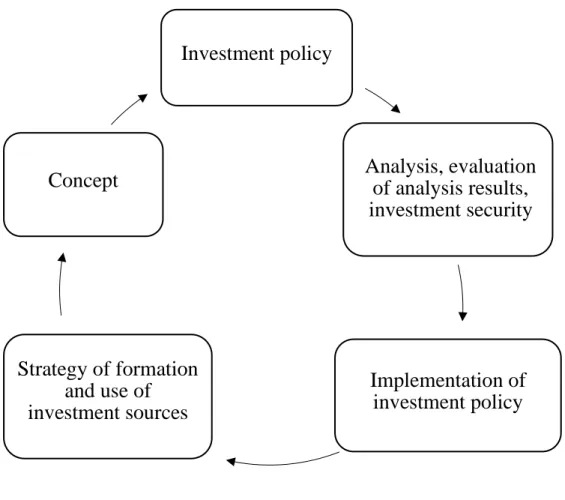
The components of the mechanism for the formation and implementation of investment policy is presented in the form of a diagram below (Figure 1).
Figure 1: Components of the mechanism of formation and implementation of investment policy.
Note - Developed by the author from the source
The whole set of investment sources can be divided into two groups: internal and external. Internal investments include real investments, which are reflected in Kazakh statistics as capital investments. External sources of financing can be in the form of foreign investments and also in the form of loans from foreign banks, loans from international banks, foreign direct investment. Attracting foreign capital is inherent in any economic system.
The development of investment policy is largely determined by the
macroeconomic state of the national economy and, of course, the size of investment resources, i.e. investment potential.
The possibilities of attracting investments largely depend on what conditions have been created in the host country for the activities of foreign investors, and how favourable its investment climate is. The degree and methods of state intervention in the economy, the effectiveness of the state apparatus, the openness of the economy, the quality of the tax system and the level of tax burden, macroeconomic stability, and the country's participation in the system of international treaties and traditions of their observance all have a significant impact on the investment climate. It should be
Investment policy
Analysis, evaluation of analysis results, investment security
Implementation of investment policy Strategy of formation
and use of investment sources
Concept
mentioned that creating a favourable regional business climate is crucial for attracting foreign investment.
The investment climate and investment policy are closely related. Investment policy is a series of organizational and economic impact measurements taken by government agencies at the level of a nation, region, city, or firm with the goal of fostering the best possible investment climate.
The impact of investment policy is focused on the investment environment. It establishes the foundational elements for the creation of investment policy, and it also influences its outcome [48, p. 22].
As a rule, there are three methods of analyzing the investment climate, which is presented in Table 2.
Methods Characteristic
Narrowed It is based on an evaluation of the dynamics of GDP, national income, and production volumes; the dynamics of national income distribution, consumption, and saving rates; the progress of privatization processes; and the development of individual investment markets, such as the stock and currency markets..
Extended It is based on the assessment of a complete set of factors, including:
-
characteristics of economic potential (accessibility of labour and energy resources, development of technical and scientific potential and infrastructure);-
maturity of the market environment (emergence of a competitive environment, sales market capacity, export opportunities, presence of foreign capital, inflation and its effects on investment activity);-
political factors (the level of social stability, the relationship between the various levels of government, and the public's confidence in the government);-
social and socio-cultural factors (the population's standard of living, the crime rate, the effect of immigration on the investment process, and the attitude of the authorities toward foreign entrepreneurs);-
organizational and legal (compliance with legislation, effectiveness of decision-making and enterprise registration, information accessibility, and effectiveness of law enforcement authorities);-
Financial (budget revenues, credit availability, bank interest rate, percentage of unprofitable businesses, and growth of interbank cooperation).Risks This strategy's proponents take into account the two factors of investment potential and investment risks. Macroeconomic factors are used to evaluate investment potential, while investment risks are evaluated in terms of the likelihood of losing investment income.
Table 2: Methods of analyzing the investment climate Note - Developed by the author from the source [49].
2 INVESTMENT POLICY OF THE MIDDLE EAST IN KAZAKHSTAN
2.1. Attractiveness of the investment policy of Kazakhstan
The Republic of Kazakhstan has had to find resources to facilitate the change from a planned, controlled economy to a market economy ever since it gained independence.
A set of socioeconomic, political, and financial characteristics that influence the attractiveness of the stock market and the level of investment risk, therefore, an advantageous investment climate—had to be found and developed. This mission was completed in a reasonable amount of time, and as a result solid foreign investment flows in Kazakhstan's primary extractive sectors established. This had a favourable impact on the rate of economic growth.
Today, the main macroeconomic characteristics that draw in investors are the existence of investment potential, a low level of investment risk, stable legal circumstances, saturation of the territory with natural resources, labour, fixed assets, infrastructure, etc., consumer demand of the population, and other indicators. The majority of these indicators are present in Kazakhstan, hence the pace of increase in investment volumes is strong.
Among the EAEU nations, Kazakhstan's investment climate stands out for its favourable conditions. State preferences are one way that the government supports investments. Investment preferences are benefits of a targeted nature offered in accordance with Kazakhstan law to legal entities of the country carrying out investment projects as well as leasing companies bringing in technological equipment as part of an investment project on the basis of a financial leasing agreement for a legal entity of the country carrying out investment projects.
In accordance with the Decree of the Government of the Republic of Kazakhstan dated January 14, 2016 No. 13, The List of priority activities for carrying out investment projects includes the production of gaseous fuel and electricity. RES projects fall into the category of investment projects in this context, and within that framework, investors are given the following investment preferences:
Exemption from customs duties:
• when importing technological equipment and components for the duration of the investment contract, but not more than 5 years from the date of registration of the investment contract;
• when importing raw materials and materials for technological equipment, for a period of up to 5 years, depending on the volume of investments in fixed assets and in case the investment project complies with the list of priority activities;
Exemption from value added tax on imports, provided that:
• Raw materials are covered by Order No. 140 of the Minister of Investment and Development of the Republic of Kazakhstan dated February 27, 2018, and imports of raw materials must be completed with the proper documentation in accordance with Eurasian Economic Union and/or Republic of Kazakhstan
customs laws; imported raw materials will only be used to carry out the investment contract's specified activities;
• state grants-in-kind for the following items (land parcels, buildings, structures, machinery and equipment, computer equipment, measuring and regulating devices, and vehicles) under the following conditions: The grant-in-kind portion of the investment in fixed assets should not be more than 30% of the total; a document attesting to the prior approval of the regional Executive body is required.
In the process of creating a favorable climate for investment, the legislative framework was developed in particular with the Laws “On Foreign Investment” [37],
“On State support for direct Investment” [51], “On Investment” (36), and the Entrepreneurial Code of the Republic of Kazakhstan [52]. These laws were mostly adopted in order to accelerate the development of production of goods and services in economic sectors that are considered as priority sectors. This legislative framework provides assurances for direct investment, insurance against political risks, establishes means of providing state support, a system of preferences and benefits, therefore, it creates a positive climate for investment while taking into account the goals of the strategic development of the country.
The Law on “Foreign Investments” provided a legal and economic basis for attracting foreign investment. The adoption of this law was an important step to reduce the political risks of foreign investors in Kazakhstan and create a more beneficial climate for investment in the country. The most significant provisions of the law provided foreign investors with guarantees and the right to protection in accordance with Kazakh legislation. This law specifically offered protections against legislative changes that worsened the investor's situation within ten years of the investment date, protections against expropriation and the unlawful acts of state bodies and officials, and the right to compensation for harm brought on by armed conflict, the free use of investment income, and dispute resolution in Kazakhstani courts or international arbitration courts. This law also established foreign investors as receiving preferential treatment over domestic ones.
Table 3 describes the stages of attracting foreign investment to Kazakhstan
Date Description
1992-1993 One of the concrete steps to attract foreign capital was the transfer of enterprises to the management of foreign firms. As a result, valuable experience was gained through trial and error. All enterprises transferred to foreign management paid off salary arrears in a timely manner, contributed funds to the pension fund, repaid debts to power engineers, transport workers and other related parties. Nearly a billion dollars' worth of resources have been attracted by foreign companies. The repurchased businesses employed approximately 200 thousand people by 1996. According to official statistics, over the course of 1994–1995, Kazakhstan's economy received more than 3 billion US dollars in official aid, loans, and export credits from foreign state financial institutions and private businesses. In the background of the deterioration of the socioeconomic situation brought on by the effects of the former Soviet economy, market reforms in the early 1990s were difficult despite the considerable steps taken to strengthen the economy.
1994-1997 As a result of economic liberalization, it has become easier for foreign investors to gain access to crucial areas of. Foreign direct investment has increased rapidly in the metallurgical complex since 1995. Investments in this sector surged by more than 100 times between 1994 and 1996.
1998-2008 Several significant corporations were privatized for investment projects during this period. According to the Investment Agency, international businesses, banks, and other lenders raised more than
$10 billion in total in 2004. The complex of mineral resources made up 65% of the investment structure, while 208 projects involving hydrocarbon raw materials were put into action. The development of more than 40 oil fields with the participation of foreign investors was included in the action program of the Government of the Republic of Kazakhstan for the years 2004 to 2006. The non-ferrous metallurgy (22.8%), fuel and energy industry (4.3%), and ferrous metallurgy (4.1%) earned the following three spots in terms of the percentage of foreign investment after the oil and gas sector.
2010-2017 The Republic of Kazakhstan saw an increase in FDI inflows of 7.3% ($19.8 billion) in 2010 compared to 2009. At the same time, the growth in 2009 ($18.5 billion) over 2008 ($10.6 billion)
represented a 73% increase. Negative trends were reversed in 2016 despite the drop in investment since 2013. As a result, investment growth returned in 2016 and FDI inflows climbed by approximately 40% on a gross basis.
Note - Developed by the author from the source [53]
In the early years of the state building, the investment policy was designed at maximizing the attraction of foreign investors, taking into account their interests and encouraging investments in the country's raw materials sectors. It was important for the young state to attract as much foreign investment as possible to restore the mineral resource base, which has become a source of ensuring reforms in the socio-economic sphere for many years. Thanks to the attraction of foreign investments, Kazakhstan has gained the opportunity to increase its industrial potential, develop financial and banking systems, and strengthen the national currency.
Today Kazakhstan remains an investment-attractive country for foreign capital.
Thus, according to the availability of its natural resources, Kazakhstan is among the top ten countries in terms of coal, iron, and gold reserves. In terms of copper reserves, it ranks 5th place in the world, in terms of manganese reserves – 3rd place, in terms of chromium, lead, zinc reserves – 2nd place. The Republic is the leading producer of uranium in the world. The republic has a well-developed transport infrastructure. 70%
of all transit land traffic between China and Europe passes through the territory of Kazakhstan. As per the official data, the republic has the best telecommunications infrastructure among Central Asian countries with an extensive 4G network, Internet availability is 77%. Kazakhstan provides a visa-free regime for citizens of more than 55 countries of the world. The country is also ranked 31st among nations having a high level of human capital development. [54].
According to the World Bank's report on "Doing Business 2020" rating, Kazakhstan was in the 25th position in the world in terms of ease of doing business, rising by three positions in a year (2018 – 28th) and by 11 positions over the past two years. According to the rating published by the Global Competitiveness Index, Kazakhstan ranked 55th in 2019, improving its position by four points (2018 – 59 m.) out of 140 countries of the world. Despite the decline in investment activity in the world, Kazakhstan has remained the leader in attracted investments in Central Asia for several years in a row. Thus, compared to the same time in 2018, the gross inflow of foreign investment increased by 4.8% in the first nine months of 2019 to reach $18.4 billion [55].
According to the 2022 results, the gross inflow of foreign direct investment to Kazakhstan amounted to $28 billion, which is 17.7% more than the results of 2021 ($23.8 billion). This is a record figure for the last 10 years – in 2012, the volume of FDI reached $28.9 billion. Thus, thanks to the actions of the Government and regional municipalties (akimats) over the past year, the intermediate target indicators of the concept of Investment Policy of Kazakhstan until 2026 were over fulfilled by 14.3%
(the plan is $24 billion) [56].
The struggle for investment has been more intense in recent years as a result of the global economic crisis phenomenon. Therefore, it is crucial to maintain the state's active investment strategy in order to continue attracting foreign capital to the country and to assure structural changes to the economy in light of the country's limited domestic funding sources.
In this regard, the Kazakhstan government is actively working persistently to improve the investment climate and create satisfactory conditions for doing business, taking into consideration the recommendations by Organization for Economic Cooperation and Development (OECD).
The Council for Improving the Investment Climate under the Prime Minister of the Republic of Kazakhstan and the Council of Foreign Investors under the President of the Republic of Kazakhstan are two active dialogue platforms that are intended to swiftly resolve problematic issues that arise during investment activities in Kazakhstan.
The concept of "one window" for investors (over 300 public services) was introduced as one of the innovations in the framework for enhancing the investment climate of the nation. Investors' "one window" is more than just a system. The regulations were created to enhance the Republic of Kazakhstan's investment climate by enhancing the effectiveness of attracting, assisting, and offering government and other services to investors at the external, central, and regional levels [57].
National Company «KAZAKH INVEST» JSC was established on March 1, 2017. The company's goal is to encourage the Republic of Kazakhstan's sustainable socioeconomic growth by attracting foreign capital into key economic sectors and providing all-encompassing support for investment initiatives. [58].
“KAZAKHSTAN INVEST” offers the following roles:
-
A single channel of access to the system of public services, implementation of investment projects;-
Solving problematic issues of investors;-
Signing of an investment contract;-
Unified Negotiator on behalf of the Kazakhstan government-
Negotiations with investors-
Investor support.Additionally, Kazakhstan's Ministry of Foreign Affairs has an Investment Committee. It is the organization that carries out regulatory, implementation, and control tasks as well as taking part in the strategic functions of the Ministry in putting state policy to work to attract investment.
The main activities of the Committee are:
-
Investor’s dialogue with the state;-
Investment preferences;-
Investment cooperation;-
Issuance of an application for an investor visa;-
Cooperation with the OECD;-
International legal framework in the field of investments;-
Investment climate [59].In 2019, a set of measures was adopted to increase the investment attractiveness of Kazakhstan, aimed at the final demolition of barriers preventing the influx of foreign capital into our country. One of the key changes was building relationships with each investor both in the center and in the regions. Working with regional akims allows a more pragmatic and systematic approach to identifying new projects and investors.
Also, since 2019, the Astana International Financial Center (AIFC) has been assigned a significant role in attracting investments. From now on, the center is a single coordinator for attracting foreign investment. The “Roadmap” adopted by the government on further attraction of investments to the Republic of Kazakhstan will contribute to this [60].
Within the framework of the Roadmap, the tasks of the AIFC are as of;
-
The development of a methodology for the selection, evaluation and promotion of investment projects;-
Elaboration of the issue of unification of tax benefits in the AIFC, the International Technopark of IT Start-ups «Astana Hub», JSC «NC» Astana EXPO-2017» and JSC«Nazarbayev University»;
-
Active involvement of development institutions in attracting direct and portfolio foreign investments.The “Roadmap” includes the most promising steps that the Government intends to take in the near future. These are issues related to the development of a methodology for the selection, evaluation and promotion of investment projects, the formation and promotion of a single pool of such projects, the liberalization of visa and migration legislation, the expansion of direct flights between cities of Kazakhstan and international financial centers, as well as the prospects for the IPO on the AIFC exchange of participants in the program “Competitiveness Leaders - National Champions 2.0” [61].
In order to combat the negative effects of the economic crisis, structural changes in the economy, technological advancement, and expanding economic activity at the micro and macro levels, radical investment policy is therefore the most significant lever in modern times.
One of the most efficient mechanisms of socio-economic transformations is the activation of the investment process on the basis of the state investment policy. The expansion of the economy and the rising demand for money and technology necessitate additional institutional reforms in order to improve Kazakhstan's investment climate and protect investors' rights.
As the first CIS nation to receive an investment country rating, Kazakhstan is now acknowledged as a state with a market economy by the international community.
While foreign investors primarily focus on Kazakhstan's investment climate, which is determined by independent experts and serves to indicate the effectiveness of investments in a particular country, the World Bank has listed Kazakhstan among the 20 nations in the world most attractive for investment inflows.
2.2. Development of the investment policy of the Middle East in Kazakhstan In the early 90s, Kazakhstan began to build economic relations with many foreign countries, including the United Arab Emirates, Qatar and the Republic of Turkey.
Kazakhstan seeks to use the potential of the listed countries of the Middle East to ensure economic and foreign policy security, attract investment, etc.
Agreements between the Republic of Kazakhstan and the countries of the Middle East in various sectors, contracts in the field of transport and communications made it possible for our country to modernize the economy, including the regional one. The leaders of the countries of the Middle East highly appreciate the policy of Kazakhstan to attract investment.
An analysis of the most important areas of cooperation between Kazakhstan and the countries of the Middle East is of considerable practical importance. This allows us to understand the essence of multilateral relations in the trade, economic and investment spheres.
Kazakhstan, within the framework of the new industrial program, is actively working with the United Arab Emirates, Turkey, Qatar, which made it possible to create new industries and jobs, reduce unemployment, and solve social problems. For many years, on mutually beneficial terms, has been cooperating with the Organization of Islamic Cooperation, the Islamic Development Bank, the World Islamic League.
It should be noted that, according to the experts of the Islamic Development Bank, Kazakhstan in the field of Islamic finance is the undisputed leader in the Central Asian region. The development of Islamic banking is supported at the state level, the legal basis for the activities of Islamic banks has been created [21,339].
According to the political scientist Dosym Satpayev, one of the reasons for Kazakhstan's increased attention to the development of trade and economic cooperation with the countries of the Muslim East was the full realization that the center of the world economy will gradually shift to the countries of the East and that in the future this trend will increasingly gain strength [ 19.6].
Investment cooperation between Kazakhstan and the countries of the Middle East began in 1992.
The flow of investments from Middle Eastern countries to Kazakhstan has been developing differently for the past 32 years. According to the data of the National Bank of Kazakhstan, among the countries of the Middle East, the Republic of Turkey ranks first in the volume of investment in the country's economy. In 1992, the first investment amount was 30 million amounting to 6.3 billion US dollars in the last 31 years. reached US dollars. In 1997, the first deposit amount of the UAE was in second place, amounting to 300 thousand US dollars. 632.6 million during the last 25 years. reached
US dollars. In third place is the state of Qatar, the first investment in 2015 is 30 million USD 44 million in the last seven years. reached US dollars.
A contract of strategic importance has been established between Kazakhstan and the countries of the Middle East in the field of investment cooperation. Accordingly, the capital of Turkey, UAE, and Qatar is actively used in many areas of the country's economy.
We present our analysis in accordance with the chronology of the establishment of cooperation between the Republic of Kazakhstan and the countries of the Middle East.
In 1991, the Republic of Turkey became the first country in the Middle East to officially recognize the independence of the Republic of Kazakhstan.
Trade and economic relations between Turkey and Kazakhstan began immediately after Kazakhstan gained independence and today have reached a very important level. Economic relations and investments between Kazakhstan and Turkey are based on the Agreement on Mutual Promotion and Protection of Investments. In 2010, a memorandum of understanding on cooperation was signed between the National Export and Investment Agency of Kazakhstan and DEIK (Dis Economic Iliskiler Kurulu) [67].
Turkish investments in Kazakhstan are in first place among foreign investments in the country, in addition to oil. Turkish entrepreneurs are active in almost all areas such as telecommunications, banking, financial leasing, building contracts, publishing, education, transport, automotive, manufacturing, oil and service industries.
Also, Turkey was one of the first to organize joint ventures and joint-stock companies in Kazakhstan. The Kazfen joint venture, created by the Turkish company Tekfen, the Kazakhstani company Kazakhstanneftegazstroy and the Japanese corporation Mitsubishi, has started construction of the Kenkiyak-Kumkol oil pipeline with a length of 765 km. The issue of the participation of the Kazfen JV in the reconstruction of the Astrakhan-Mangistau water pipeline, the Zhetybai-Uzen oil pipeline, and the construction of protective dams at the oil fields of the Caspian Sea coast was also studied [20].
Despite the lack of funding in the field of economic relations, branches of Turkish banks were opened, partner banks were established, one or more projects in the field of energy were involved, and a wide range of production capacities were created, especially in the production of consumer goods. The contract sector was the area of economic cooperation between Turkey and Kazakhstan that showed the fastest slowdown. In the period 1992-2000, contractors in Kazakhstan carried out projects totaling $2.5 billion. 9.2% of the total $27.1 billion project carried out by Turkish contractors around the world during the same period was implemented in Kazakhstan [68].
With the adoption of the Law on Foreign Direct Investment (FDI) in Kazakhstan on January 1, 1995 and its entry into force, the volume of foreign direct investment from Turkey to Kazakhstan has increased significantly. Between 1990 and 2000, these investments reached $8.2 billion and amounted to 5.6% of the country's annual GDP (EUI Country Report, 2001). FDI investment in 2001 was directed to the ferrous and non-ferrous metallurgy, especially the oil sector. While the US ranks first in FDI with
$3.2 billion, South Korea ranks second, the UK third, and Turkey fourth with about
$1.5 billion in foreign direct investment billion dollars [68].
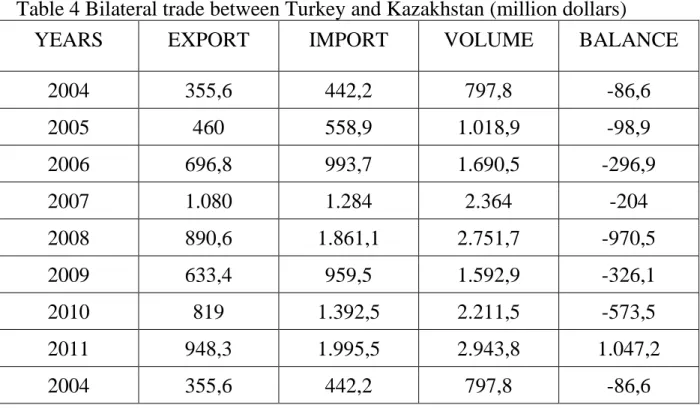
In fact, the mutual trade turnover, which was $30 million in 1992, when economic relations were just beginning, exceeded the $1 billion limit in 2005. In 2008, the volume of Turkish-Kazakh trade increased by 36.3 per cent compared to the previous year and reached $3.2 billion. it can be seen that in 2009 this figure decreased and amounted to 1.7 billion dollars. It is believed that this development is parallel to the reduction in the total trade volume of both countries and is caused by the global economic crisis, in fact, there are no negative factors that would lead to a reduction in foreign trade between Turkey and Kazakhstan under normal conditions.
Table 4 Bilateral trade between Turkey and Kazakhstan (million dollars)
YEARS EXPORT IMPORT VOLUME BALANCE
2004 355,6 442,2 797,8 -86,6
2005 460 558,9 1.018,9 -98,9
2006 696,8 993,7 1.690,5 -296,9
2007 1.080 1.284 2.364 -204
2008 890,6 1.861,1 2.751,7 -970,5
2009 633,4 959,5 1.592,9 -326,1
2010 819 1.392,5 2.211,5 -573,5
2011 948,3 1.995,5 2.943,8 1.047,2
2004 355,6 442,2 797,8 -86,6
Note - source [69]
As the effects of the crisis ease, the estimate that mutual trade will also exceed 2008 levels and that the $5 billion target will be reached in the short term is accurate.
In the framework of investment cooperation between Kazakhstan and Turkey, the participation of Turkish firms and companies in the infrastructure work of Kazakhstan can be noted as the most important measures.
Okan Holding, one of the first foreign investors to come to our country after Kazakhstan gained independence, has invested $350 million to date and is signing new agreements to invest in construction and the agri-food sector. Okan, as a group of 25 companies in Turkey, has become a well-known brand in Kazakhstan through its investments in the food, construction, tourism, marketing and banking sectors. The
$280 million complex overlooking the Presidential Palace and the $120 million five- star Okan Intercontinental Hotel is the group's first investment in Astana.
Other Turkish firms were also active in Kazakhstan, including Entas, Burch, Ahsel, Fintraco, Emsash and others. Relations were actively developing in agriculture,
food and light industry. Production has been set up and 14 joint ventures have been set up to process leather raw materials and leather production waste with further production of consumer goods.
The Kazakh company Borusan Makina holds more than 50% of the market for special equipment in the mining industry, about 60% in the generator market for the oil and gas sector, which is very important for Kazakhstan, and about 30% in the segment of excavators for the construction industry. These are very high figures, even by world standards. And the main reason for this success is that the company is actively investing in the development of its business in Kazakhstan. The company has built a Component Recovery Center (CRC) in Karaganda.
Despite the pandemic, Turkish firms invested $362.4 million in Kazakhstan in 2020, up 1.3 percent from 2019, a 30-year record in the country.
The largest number of Turkish investments in Kazakhstan since independence was in 2007 - $347.6 million and in 2019 - $357.8 million.
According to data published by the National Bank of Kazakhstan, the volume of foreign direct investment in the country in the first half of this year increased by 30 percent compared to the same period in 2020.
During this period, Türkiye has invested in Kazakhstan in the amount of $388.7 million. Thus, compared to last year, Turkey's investments in Kazakhstan increased by 79.9 percent. According to this, Turkey is the third country that has increased its investments in Kazakhstan the most after the USA and Switzerland [70].
A report from the Turkish Ministry of Commerce states that Kazakhstan, which has risen to the 14th place among the most attractive countries for Turkish companies over the past 4 years, already has investments from many Turkish companies, such as Yıldız Holding, Yıldırım Holding, YDA Holding, Abdi Ibrahim, Aselsan, TAV Airports Holding, Anadolu Group and Ülker Holding [71]. The Yildirim holding is currently building a plant for the production of soda ash in the Sarysu district of the Zhambyl region in the amount of $400 million. In addition, they are working on the implementation of an investment project for the extraction and production of chromium concentrate at the Voskhod deposit in the Aktobe region, as well as joint work with Kazgeology JSC on the exploration of solid minerals in a number of regions of the country. Anadolu Group, a beverage company, has invested more than $700 million in Kazakhstan's economy and employed 2,400 people.
In 2021, a record level of foreign direct investment from Turkey into the economy of Kazakhstan reached $680 million.
In January-February 2022, trade with the Republic of Turkey in agricultural products amounted to about $37 million, which is 62% more than in the same period in 2021 ($22.7 million). Exports increased by 55% and amounted to $19.5 million.
Imports increased by 69% and amounted to $17.1 million.
In May 2022, the heads of Kazakhstan and Turkey held talks on the most important issues. One of the goals of the talks was to increase the trade turnover between the two countries from 5 to 10 billion dollars.
Pharmaceutical company Nobel Ilac plans to invest an additional $55 million to modernize and expand its existing production, as well as to build a second