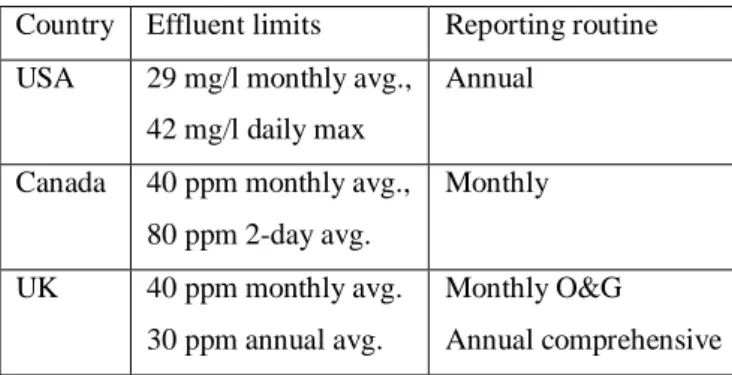
Produced water is a waste of great concern due to the large volume produced each day and its complex chemical composition. To comply with environmental regulations and standards, various techniques can be used to treat produced water. This work first summarizes the composition of the produced water, its associated environmental impact, regulations and standards, as well as a possible combination of different treatment techniques.
The work aims to develop a generic framework for a risk-based approach to produced water management. The proposed methodology takes into account the integration of environmental, technical and economic risks into the decision-making process for produced water management. To integrate all risk values, acceptable risk levels are determined and compared with the calculated risk values.
A case study of produced water treatment at the Thunder Horse oil field is presented to demonstrate the application of the proposed framework. Last but not least, I would like to give special thanks to my family for the tremendous support they have shown me all these years.
Introduction
- Background of the research problem
- Aims and objectives
- Thesis structure
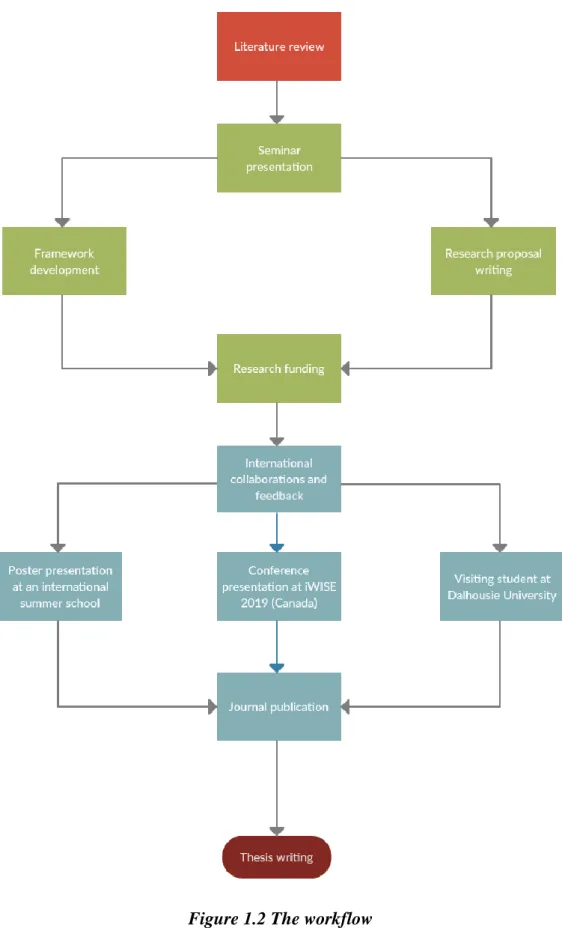
- Scientific contribution and the workflow of the study
In offshore oil and gas operations, produced water is mostly released directly into the ocean after meeting environmental regulations and standards using treatment technologies. Minimal work was done on the integrated risk assessment of produced water and the consideration of risks in the decision-making process. A risk-based approach can be used as a framework for selecting and designing an effective produced water management strategy (a combination of treatment and reuse techniques).
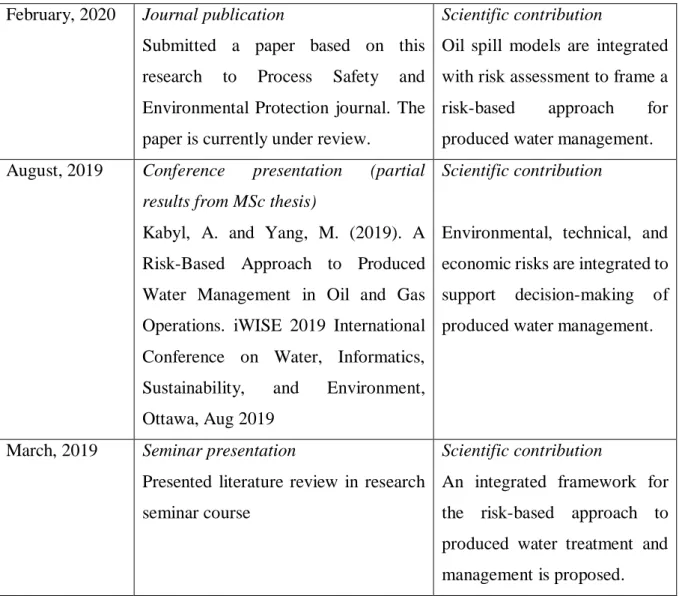
There is a minimal amount of research into developing a systemic approach to produced water management. Develop an approach to assess integrated risks (environmental, technological and economic risks) associated with the treatment and reuse of produced water; And. Oil spill models are integrated with risk assessment to frame a risk-based approach to produced water management.
Environmental, technical and economic risks are integrated to support decision-making on produced water management. An integrated framework for the risk-based approach to produced water treatment and management is proposed.
Literature Review
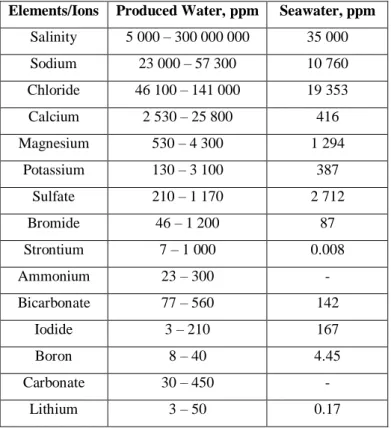
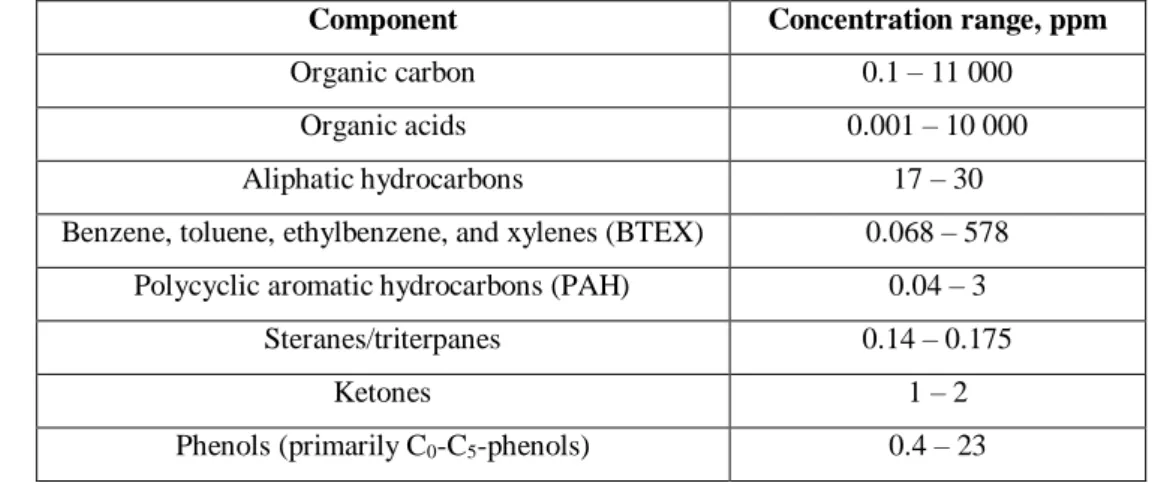
- The composition of produced water
- Salts and inorganic ions
- Organic compounds
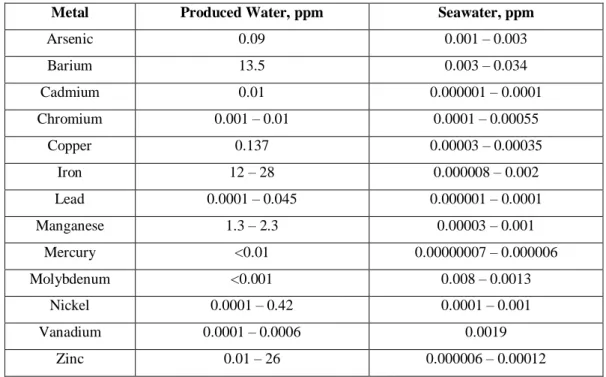
- Metals
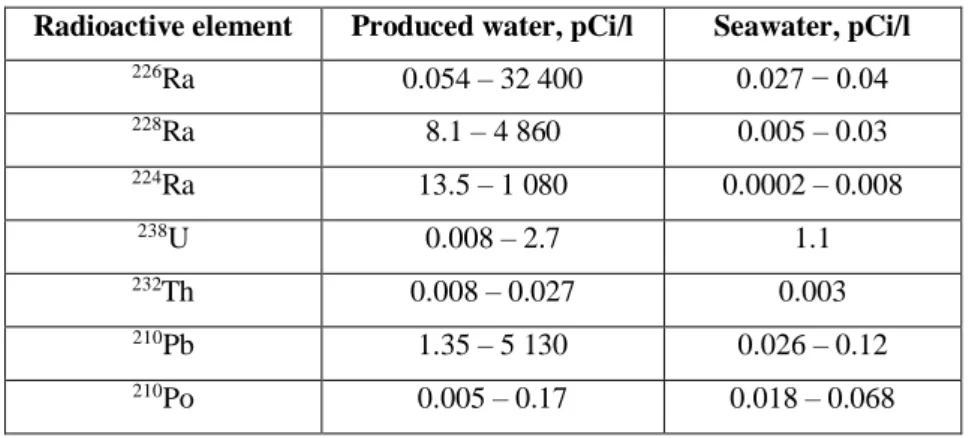
- Naturally occurring radioactive materials (NORM)
- Produced water treatment and reuse technologies
- Primary and secondary physicochemical oil removal
- Biological purification
- Tertiary treatment
- Comparison of the selected produced water treatment technologies
- Produced water reuse technologies
The organic acids in produced water are mainly low molecular weight acids such as formic acid and propionic acid. Produced water contains several metals and varies depending on the region where it is produced. NORM can be found in produced water and radium-226, and radium-228 are by far the most common among them.
The primary oil separation process for produced water is generally performed using an artificial gravity process. It can reduce oil concentration in produced water to 5 ppm and can be used for complete oil removal. Before removing various metals from produced water with a sand filter, the pretreatment process should be considered.
Activated sludge can then be used to treat produced water and further reduce oil and hydrocarbon concentration. In the areas, where there is a scarcity of water, produced water can satisfy the water demand for many industrial applications.
Methodology
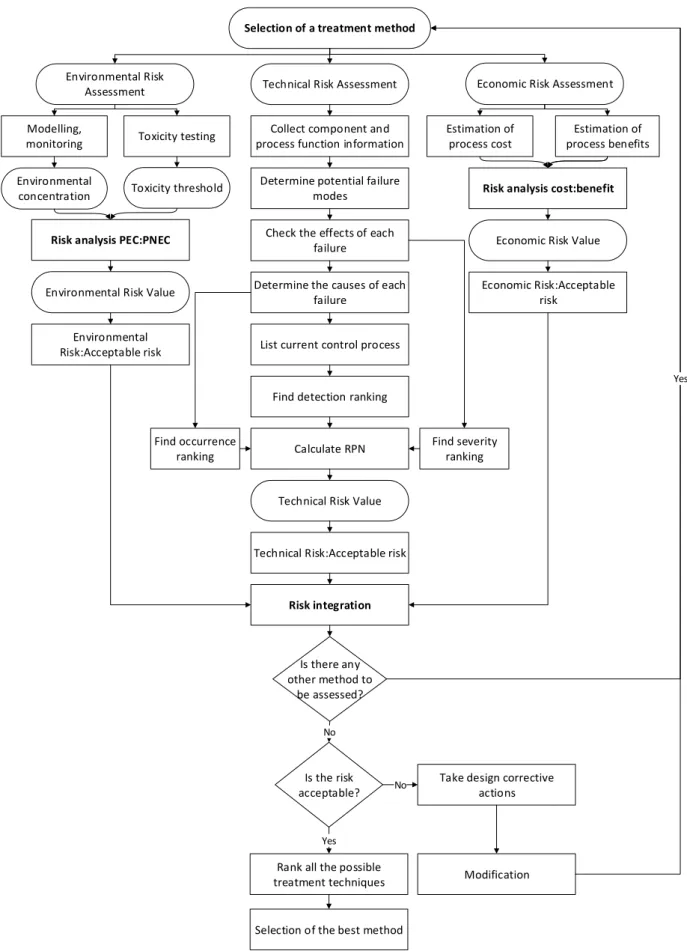
- A risk-based framework to produced water management
- Environmental Risk Assessment by using Dose-related Risk and Effects
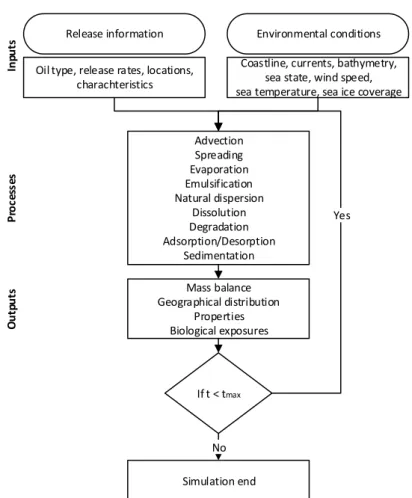
- Physical-chemical fate modeling
- From PEC/PNEC to Risk
- Validation
- Sensitivity analysis
- Technical Risk Assessment: Failure Mode and Effects Analysis (FMEA)
- Economic Risk Assessment
- Risk integration
- Selection of optimum treatment and reuse techniques
The predicted environmental concentration (PEC) is a basis for risk assessment in DREAM and can be calculated by simulating the transport and fate of the pollutants in the environment. Pollutants close to the sea surface can evaporate into the atmosphere. It is believed that the toxic and chemical properties of the substances in one group are similar.
It is assumed that the PNEC corresponds to the 5th percentile of the SSD, which means that the PNEC value corresponds to 5%. In the DREAM model, experimental validation studies, a model sensitivity analysis, and external scientific evaluation are performed in the validation process (Smit et al., 2003). The goal of the approach is to prioritize system failure modes to focus on the most serious risk.
Design control does not detect a possible cause of failure or subsequent failure mode, or there is no design control. Very unlikely The chance that the design check will detect a possible cause of the failure or subsequent failure mode is very low. Remote Low chance that the design check will detect a possible cause of the failure or subsequent failure mode.
Very low. Very little chance that design control will detect a potential cause of failure or a subsequent failure mode. Low A low probability that design control will detect a potential cause of failure or a subsequent failure mode. Moderate Moderate chance that design control will detect a potential cause of failure or subsequent failure mode.
High High probability that the design check will detect a possible cause of failure or subsequent failure mode. Almost certainly Design control will almost certainly detect a possible cause of failure or subsequent failure mode. The sum of the multiplied weighting factors to the final risk values gives us the integrated risk value of the treatment or reuse method.
During the selection of the optimal treatment and recycling technique, two scenarios can be considered. The integrated risk is equal to or lower than one, i.e. the integrated risk is equal to or below the acceptable level of risk, therefore the chosen process meets the standards and this implies that the process is desirable.
Case Study
Application of the Developed Framework: Case Study
All information about the download location and physical environment is shown in the script parameters. The Marine Environmental Modeling Workbench (MEMW) used in this study has been enhanced with Plume3D - a new near-field module that can support various launch sites. When Plume3D is selected, the diameter and positioning of the launch pipe must be specified (see Table 4.1).
All size parameters (minimum size, maximum size, characteristic size, droplet size parameter) are disabled and evaluated by the attached modules. The droplet size is calculated from the Rosin-Rammler size distribution function defined by the size parameters.

Results and Discussion
- Environmental Risk Assessment
- Technical Risk Assessment
- Economic Risk Assessment
- Risk Integration
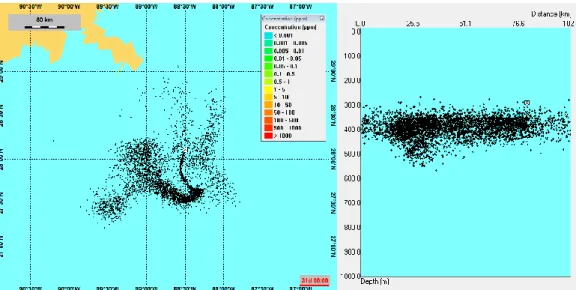
On closer inspection, it can be observed that the risk values are higher in the areas closer to the discharge point. The contribution of each chemical used in the simulation is shown in the pie chart. The decision maker should be more focused on the removal technologies of the contaminants with the greatest impact of the discharge.
According to the mass balance, it can be seen that approximately 52% of the total mass was biodegraded and the remaining 48% remained in the water column. Because BTEX is not persistent and evaporates quickly from the water, just over half of the mass of the mixture is removed from the water column. From the time evolution graph of the mass balance, we can see that in the first days of the simulation, the evaporation rate of BTEX is not so high, but after the fifth day it was almost completely evaporated (Fig. 5.8).
After applying the treatment methods proposed in the study (EPCON, activated sludge and sand filters), the risk value was reassessed as explained in the next section. With the ratio of the obtained risk to the environment to an acceptable level, we can get a final value of 0.086. In the technical risk assessment of the selected treatment plan, the following values were assigned (average numbers of responses received were taken into account) as explained in Table 5.1.
In the case of no treatment, because the produced water is directly discharged from the offshore platform, the RPN is 1 (occurrence is 1, severity is 1, detectability is 1). The value of the economic risk in the case of the selected treatment design is 0.028, and without treatment it is 35.115. In this case study, hypothetical values were assigned in the questionnaire, which were designed to incorporate environmental, technical and economic risks.
To calculate weighting factors of the matrix, the geometric mean of each risk must be divided by its total, and this results in 63.525% for environmental risk, 9.74% for technical risk and 23.735% for economic risk based on the regulators' responses ( average of two regulators). The results of the operators' answers gave the weighting factors of 9.12% for environmental risk, 24.635% for technical risk and 66.245% for economic risk (average of two operators). In the case of the proposed treatment design, the integrated risk is 0.29, which is below one, and this means that the selected treatment design is a proper alternative that can be applied.
The procedures and results explained in the case study confirm the applicability of the developed framework for handling different alternatives for discharging the produced water to the marine environment. This framework can also be used as a tool to compare the efficiency of the treatment process of different treatment systems in order to choose the optimal alternative in the specific environmental and operating conditions.
Conclusions
Future work will be devoted to the further development of more advanced methods for assessing the environmental, technical and economic risks of produced water treatment strategies. For example, future work can investigate a) how to handle uncertainties in a risk-based approach, b) the possibility of incorporating optimization models into a risk-based approach. Environmental impacts of produced water and drilling waste discharges from the Norwegian offshore oil industry.
SPE International Conference on Health, Safety and Environment in Oil and Gas Exploration and Production. Improving oil separation from produced water using a new compact flotation unit design, in: SPE Production and Operations Symposium. Produced Water: Overview of Composition, Fate, and Effects, Produced Water: Environmental Risks and Advances in Mitigation Technologies.
DREAM: A Dose-Dependent Exposure Assessment Model, Technical Description of Physicochemical Fate Components, in: SPE International Conference on Health, Safety and the Environment in Oil and Gas Exploration and Production. From PEC_PNEC Ratio to Quantitative Risk Level Using Species Susceptibility Distribution; The methodology used in the environmental impact factor. Outline of the DREAM project and development of an environmental impact factor for produced water discharges.
Performance Evaluation of an Activated Sludge System for the Removal of Petroleum Hydrocarbons from Oilfield Produced Water.