ýpLA YSI
W
ýN
ýIM AS
Faculty of Cognitive Sciences and Human Development
ARE WOMEN BETTER LEADERS? : THE PERSPECTIVES OF EMPLOYEES
Nur Saleeza Binti Mohamad Saleh
Bachelor of Science with Honours
UNIVERSITI MALAYSIA SAWARAK
Grade:
Please tick (1)
Final Year Project Report Masters
PhD
DECLARATION OF ORIGINAL WORK This declaration is made on the ... day of... 2012.
I
vi
i
Student's Declar tion:
lLL1? A ß l
_ 1 fiK2-MP - ---
S°P L-- 004-
(PLEASE --- ---
INDICATE STUDENT'S NAME, MATRIC NO. AND FACULTY) hereby declare that the work entitled, h---- Ifid
--- is my original work. I have not copied from any other students' work or from any other sources except where due reference or acknowledgement is made explicitly in the text, nor has any part been written for me by another person.
aq t5 )-olq
Date submitted Name of the student (Matric No. )
Supervisor's Declaration:
bRý _
I--- ; ---A---OUPERVISOR'S NAME) hereby certifies that the work entitled, -- ----(TITLE) was prepared by the above named student, and was submitted to the "FACULTY" as a * partial/full fulfillment for the conferment of _ ht? r--ý K''`! n
---
9-MA (A (PLEASE INDICATE THE DEGREE),
and the aforementioned work, to the best of my knowledge, is the said student's work
Received for examination by: Date:
I declare this Project/Thesis is classified as (Please tick (I)):
Q CONFIDENTIAL (Contains confidential information under the Official Secret Act 1972)*
[]RESTRICTED (Contains restricted information as specified by the organisation where OPEN ACCESS
research was done)*
Validation of Project/Thesis
I therefore duly affirmed with free consent and willingness declared that this said Project/Thesis shall be placed officially in the Centre for Academic Information Services with the abide interest and rights as follows:
" This Project/Thesis is the sole legal property of Universiti Malaysia Sarawak (UNIMAS).
" The Centre for Academic Information Services has the lawful right to make copies for the purpose of academic and research only and not for other purpose.
" The Centre for Academic Information Services has the lawful right to digitise the content to for the Local Content Database.
" The Centre for Academic Information Services has the lawful right to make copies of the Project/Thesis for academic exchange between Higher Learning Institute.
" No dispute or any claim shall arise from the student itself neither third party on this Project/Thesis once it becomes sole property of UNIMAS.
" This Project/Thesis or any material, data and information related to it shall not be distributed, published or disclosed to any party by the student except with UNIMAS permission.
Student's signature Anm= Supervisor's signature:
(Date) (D
Current Address: b
/1 %7,0(1"
ZINGKRt 4--a6$-l)Arl
ý Q, LOK 61 fA5A 11, PMtNT Iq
, 6. '; 2 - ýr'o, Pu-[KAaA'Y. A /
Notes: * If the Project/Thesis is CONFIDENTIAL or RESTRICTED, please attach together as annexure a letter from the organisation with the period and reasons of confidentiality and restriction.
[The instrument was duly prepared by The Centre for Academic Information Services]
ARE WOMEN BETTER LEADERS? : THE PERSPECTIVES OF EMPLOYEES
Nur Saleeza Binti Mohamad Saleh
This project is submitted in partial fulfilment of the requirements for a Bachelor of
Science with Honours (Human Resource Development)
2019
Faculty of Cognitive Science and Human Development UNIVERSITY MALAYSIA SARAWAK
2019
The project entitled Are Women Better Leaders? The Perspective of Employees was prepared by Nur Saleeza Binti Mohamad Saleh and submitted to the Faculty of Cognitive Sciences and Human Development in partial fulfillment of the requirements for a Bachelor of Science with Honours (Human Resource Development)
Received for examination by:
c
ýý.
(Name of Supervisor)
Date:
----ý- S ßl- _
Gred
R
ACKNOWLEDGEMENT
First and foremost, praises and thanks to the God, the Almighty, for His showers of blessings throughout my research work to complete the research successfully. I would like to express my deep and sincere gratitude to my research supervisor, Dr. Hana Hamidi, for giving me the opportunity to do research and providing invaluable guidance throughout this research. Her dynamism, vision, sincerity and motivation have deeply inspired me. She has taught me the methodology to carry out the research and to present the research works as clearly as possible. It was a great privilege and honour to work and study under her guidance.
I am extremely grateful to my parents for their love, prayers, caring and sacrifices for educating and preparing me for my future. I am very much thankful to my friends for their love, understanding, prayers and continuing support to complete this research work, for the keen interest shown to complete this thesis successfully.
Finally, my thanks go to all the people who have supported me to complete the research work directly or indirectly.
iii
TABLE OF CONTENTS LIST OF TABLES
... vi LIST OF FIGURES
... vii ABSTRACT.... ... Viii """
CHAPTER ONE : INTRODUCTION
1.1 Background of Study ... 1 1.2 Problem Statement
... 2 1.3 Objective
1.3.1 General Objective
... 3 1.3.2 Specific Objectives
... 3 1.4 Research Questions
... 3 1.5 Definition of Terms
1.5.1 Leadership
... 3 1.5.2 Employee
... 4 1.5.3 Perspective
... 4 CHAPTER TWO : LITERATURE REVIEW
2.1 Introduction
... 5 2.2 Leadership Effectiveness
... 5 2.3 Social Role Theory
... 7 2.4 Differences between Male and Female Leadership Style
... 7 2.5 Percentages of Women in Higher Position ... 8 2.6 Barriers and Challenges Faced By Women Leaders
2.6.1 Discrimination
... 8 2.6.2 Work-family Issues
... 9 2.6.3 Lack of Mentoring Program ... 10 2.7 Research Framework
... 11 2.8 Benefits of Female Leaders ... 11
CHAPTER 3: RESEARCH METHODOLOGY 3.1 Introduction
... 12 3.2 Research Design
... 12 3.3 Research Population and Sample and Sampling Techniques
... 12 3.4 Research Instruments
... 13 3.5 Credibility and Confirmability ... 13 3.6 Ethics of Study ... 14 3.7 Pilot Study
... 15 3.8 Data Collection Methods
... 16 3.9 Data Analysis Methods
... 18 CHAPTER 4: RESULTS AND FINDINGS
4.0 Introduction
... 19 4.1 Informant' Demography
... 19 4.2 Research Findings Based on Objectives
4.2.1 Research Question 1: What is the acceptance of employees towards the female leadership?
... 21
4.2.2 Research Question 2: How do employees perceive the advantages of having female leaders? ... 24
4.2.3 Research Question 3: How do employees view the effectiveness of women leadership in the organisation ... 28
4.3 Discussion ... 30
CHAPTER 5: CONCLUSION AND RECOMMENDATION 5.0 Introduction ... 33
5.1 Summary of Findings ... 33
5.2 Significant of Study ... 34
5.3 Limitation of Study ... 35
5.4 Recommendation ... 36
5.5 Conclusion ... 37
REFERENCES ... 38
APPENDIX ... 40
V
LIST OF FIGURES
Figure 1 : Overall leadership effectiveness by gender by position... 6 Figure 2 : Differences in overall leadership effectiveness ... 7 Figure 3 : Position by gender ... 7 Figure 4: Data Collection Methods
... 17 Figure 5 Acceptance of employees toward female leadership
... 21 Figure 6: Employees perceive the advantages of having female leader... 24 Figure 7: Effectiveness of women leadership in organisation ... 28
LIST OF TABLES
Table 1: Barriers to Women"sand Men"s Advancement
... 10 Table 2: Informants' Demography
... 19
vii
ABSTRACT
This study aimed to explore the perception of employees towards women leadership in an organisation. This study was done in two departments in University Malaysia Sarawak (UNIMAS) which are human resources and bursary department. The objectives of this study is to explore the acceptance of employees' on having a female leader. Other than that, this study also aimed to identify employees' perception towards the advantages that they gain from having a female leader and to analyse their perception towards the effect of female leadership style towards theirs and organisation performances. This study managed to get seven informants through purposive and snow ball sampling. Research instrument used in this study is semi-structured interview questions. Findings within this research have been supported by previous past research that related to this topic. Based on the data collected and the research findings, several recommendations have been proposed to the organisation, women leaders and future researchers. Organisation should take the perception of employees towards women leadership a serious matter so that the organisation can be run smoothly. The women leaders should consider the comments from employees so that they can improve their leadership style.
For future researchers, they should conduct this kind on research by using mix method so that it could enhance the quality of findings.
ABSTRAK
Kajian mi bertujuan untuk meneroka persepsi pekerja terhadap kepimpinan wanita dalam sesebuah organisasi. Kajian ini dijalankan di dua jabatan di Universiti Malaysia Sarawak (UNIMAS) jabatan sumber manusia clan jabatan bendahari. Objektif kajian ini adalah untuk meneroka penerimaan pekerja untuk mempunyai seorang pemimpin wanita. Selain daripada
itu, kajian ini juga bertujuan untuk mengenal pasti persepsi pekerja terhadap kelebihan yang mereka perolehi daripada mempunyai pemimpin wanita dan untuk menganalisis persepsi mereka terhadap kesan gaya kepimpinan wanita terhadap persembahan mereka dan organisasi.
Kajian ini berjaya mendapatkan tujuh pemberi maklumat melalui persampelan snowball dan purposive. Instrumen kajian yang digunakan dalam kajian ini adalah soalan temu bual separa berstruktur. Penemuan dalam kajian ini telah disokong oleh penyelidikan sejarah sebelumnya yang berkaitan dengan topik ini. Berdasarkan data yang dikumpul dan hasil kajian, beberapa cadangan telah dicadangkan untuk organisasi, pemimpin wanita dan pengamal sumber manusia. Organisasi perlu mengambil persepsi pekerja terhadap kepimpinan wanita satu perkara yang serius supaya pengurusan organisasi dapat dijalankan dengan lancar. Pemimpin wanita perlu mengambil kira komen daripada para pekerja supaya mereka boleh meningkatkan gaya kepimpinan mereka. Untuk penyelidik masa depan, mereka perlu menjalankan jenis ini penyelidikan dengan menggunakan kaedah campuran supaya ia boleh meningkatkan kualiti dapatan kajiarº.
ix
CHAPTER ONE : INTRODUCTION 1.1 Background of Study
Research related to women"s leadership is not new and has been broadly studied. (Shaya
& A. Khait, 2017). Some researchers believe that there is no relationship between gender and leadership style as it depends on which leadership style that every leader tend to use. As mention by Nahavandi (2011), leadership practices can be considered as effective if there is successful gathering execution, adherents' fulfilment, and a huge scale change in association. Leadership effectiveness is determined by the characteristics of leader, situation, and followers; whether in general leadership practices or in public sector leadership practices (Aziz et al., 2012). Saleem and Speece (2016), mention that reviews of research on gender and executive style indicate that abundance research shows women are more familiar to utilise transformational leadership styles, highlighting relationships, whereas men are more familiar to utilise transactional
"command and control" styles. Women are seen as those who take care, men seen as those who take charge, and leaders are usually known as those who take charge which displayed by male leader.
For these recent decades, the number of women involves in leadership either as managers, board directors or CEO itself has been closely monitored. In the Eleventh Malaysia Plan, Datuk Seri Najib Tun Razak said the government will continue to implement policies that determine the involvement of women in managerial and decision-makers at the rate of 30 per cent in the public and private sectors (Eleventh Malaysia Plan) whose rate is increased from 18.8 per cent in 2014. According to Ahmad-Zulaki and Nurwati, 2012, the proportion of women in the senior officials and managers category increased from 4.8 per cent in 2000 to 5.4 per cent in 2005. However, the percentage is still low to represent 50 per cent of total female workers. The lower percentage of female directors and managers demonstrate that there are deliberate concerns that females are under-represented at the upper
management level. (Ahmad-Zulaki & Nurwati, 2012). In fact, more men were given opportunity to hold the higher position compared to women because mostly women are always burdened by family pressures or commitments outside of work (CFO Innovation Asia, 2016).
However, there also a few researches that mention the benefits of having female leaders in organisation. From a research from CFO Innovation Asia, 2016, 55% of their informant believed that there are performed female leaders within their organizations that they can look up to as role models. Datuk Seri Najib bin Abdul Razak also mention in his speech of Eleventh Malaysia Plan that for the women, their role is not only limited to the creation of a happy family but also contribute to the socioeconomic development.
1.2 Problem of Statement
A research by Zenger Folkman Company in 2015 had concluded that women leaders are more effective compared to male leaders. Amale (2018) mention that, female leaders alter the way global solutions are produced because they bring skills, different viewpoints and structural and cultural differences to initiate viable outcomes. Another research done by CFO Innovation Asia in 2016 stated that 55 per cent of their informants believe that there are strong female leaders within their organisations that they can look up as role models. However, the numbers of women holding the higher position are still low globally and the percentage decline from 25 per cent in 2017 to 24 per cent in 2018 (Grant Thornton, 2018). The statistics by Grant Thornton also mention that among 25 per cent of business across the world, there is no woman in senior management role. This shows that those positions are dominated by men. If studies show that women leadership is more effective, but the numbers of women leaders are still low at the higher position something must be done to understand these phenomena. The purpose of this study is to explore if women truly are better leaders than men?
2
1.3 Objectives
1.3.1 General objectives
The primary objective of this study is to explore the perception of employees towards the women leadership in the organisation.
1.3.2 Specific objectives
1. To explore the acceptance of employees on having a female leader.
2. To identify employees' perception towards the advantages that they gain from having a female leader
3. To analyse their perception towards the effect of female leadership style towards theirs and organisation performances.
1.4 Research Questions
1. What is the acceptance of the employees towards the female leadership?
2. How do the employees perceive the advantages of having woman leader?
3. How do employees view the effectiveness of woman leadership in the organisation?
1.5 Definition of Term 1.6.1 Leadership Conceptual Definition
The ability to influence a group toward the achievement of goals and the latter with the use of authority inherent in designated formal rank to obtain compliance from organizational members. (Evans, 2014)
Operational Definition
In this study, leadership give a meaning of the tendency of women leaders influencing the employees in the means to achieve employees' and organisation's goals.
1.6.2 Employee Conceptual definition
According to Employment Act 1955, employee means any person or class of person carried out work in any occupation.
Operational Definition
In this research, employee means worker that being supervised by female leader.
1.6.3 Perspective Conceptual Definition
Perspective is a cognitive process that involves recognizing differences and making inferences about how others view a situation (Epley, 2014, Galinsky and Moskowitz, 2000, Parker and Axtell, 2001, Piaget, 1932, Todd et al., 2011)
Operational Definition
For this research's context, perspectives give a meaning of employees" view and thought about the female leader.
4
CHAPTER 2: LITERATURE REVIEW 2.1 Introduction
This chapter consist of various defmition and ideas about the leadership, related theories of leadership and issues on women leadership. This chapter also will be further discussed on effectiveness of women leadership.
2.2 Leadership Effectiveness
Leadership is one area of study carried out continuously by many researchers since the 19th century. Despite the many studies that have been done, but the findings have not been terribly effective in explaining the true meaning of leadership (Porterfield & Kleiner, 2005).
Previously, leadership consisted of the leader's ability, behaviours, style and charisma. In this current era, leadership has adopted a different dimension, which includes collaborative efforts among group members or in other words, leadership nowadays looking on two-ways interaction instead of one-way.
In the twenty fast century, the involvement of women as a leader in an organization becomes familiar. In fact, their number is increasing every year. However, their number is still low to represent the total number of women workers in Malaysia, namely by 50%. One cause of this problem is stereotype among workers against workers, especially women in male- dominated industry. Like male leaders, female leaders also bring advantages to the organisations.
Amale (2018) has briefly explained the advantages of having female leaders from the global perspective. Female leaders change the way global solutions are produced because they bring the skills, different viewpoints and structural and cultural difference to initiate effective outcomes. She also mentions that, involvement of female leaders in politics and the boardroom is fundamental because it alter the standards about who can lead and what features are crucial
in leadership. When women are in leadership roles, it breaks down cultural and structural barriers and improves leadership thus demonstrating the competency of women.
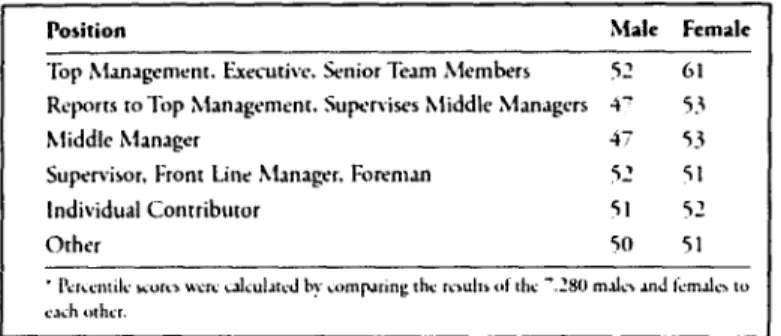
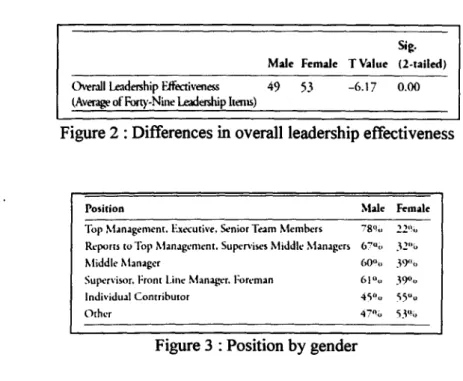
In another research that have been done by Zenger Folkman Company in 2015, based on the survey that they did in their organisation, they conclude that women leaders have the better effectiveness in leadership compare to the men (Figure 1) (Figure 2). In that article, Jack Zenger, CEO and co-founder of Zenger Folkman, stated: "It is a well-known fact that women are underrepresented at senior levels of management (Figure 3). Yet the data suggests that by adding more women the overall effectiveness of the leadership team would go up. "
Position Male Female
Top Management. Executive. Senior learn Members 52 61 Reports to lop Management. Supervises Middle Managers 47 53
Middle Manager 47 53
Supervisor, Front Line Manager, Foreman 52 SI
Individual Contributor 51 52
Other 50 51
Pcr. cntik e. uro were aculated by comparing the rciuhs of the "80 male and fcmalc to each other.
Figure 1 : Overall leadership effectiveness by gender by position
Sig.
Male Female T Value (2-tailed) Overall Leadership Effectiveness 49 53 -6.17 0.00 (Average of Forty-Nine Leadership Items)
Figure 2 : Differences in overall leadership effectiveness
Position Male Female
lop Management. Executive, Senior Team Members '8Q 22'? b Reports to lop Management. Supervises Middle Managers 67u6 32"o
Middle Manager 60% 39%
Supervisor. Front Line Manager. Foreman 611" 39°"
Individual Contributor 450" 55""
Other 47% 53%
Figure 3 : Position by gender
6
2.3 Social Role Theory
Social Role Theory represented the norms that portray by each individual in the society.
Eagly (1987) created her social role theory on the basis that people have different outlooks about how people should behave based on their gender. For example, women are usually correlated with roles at home while men are responsible on aiding the family. This perception is aligning with the Islamic believe where the responsibilities of women is to take care of their children and husband. According to the Family and Medical Leave 1993, United States due to the nature of the roles of men and women in our society, the constitutional obligation for family caretaking often befall on women, and it affects the working lives of women more than it affects the working lives of men. Despite of that, women are the person who always responsible as the caregiver of the families, it would be difficult for them to work for a long hours and work on the weekend. This gender role stereotype made most of married women underrepresented at senior levels of management.
2.4 Differences between Male and Female Leadership Style
There are various leadership styles that being implemented in the organisation. The most popular leadership styles which have been mention by many researchers are transformational and transactional leadership style. Eagly and Johnson"s (1990) meta-analysis described women to be transformational and men transactional in their leadership styles as mention by Carless (1998, p. 888). Transformational leadership style practitioners are more recognize on being the best role model, inspiring others, strategic thinking, innovation, and mentoring and developing others in the organization (Eagly and Johannesen-Schmidt, 2001;
Eagly, Johannesen-Schmidt, and van Engen 2003). Contrast with transactional leadership which more focus on rewards and performance (Kaminski & Yakura, 2008).
Women in leadership have been looking more preferable compared to men as their characteristics as a leader are usually consist inclusiveness, empathy, benevolence and
responsiveness, and a more open and inclusive negotiation style. Other than that, women also familiar as a deep thinker and wise before deciding on particular action which it is quite beneficial toward the employees and organisation. The other leadership styles that can be related are, women tend to intrinsically have a more interpersonal and democratic leadership style while men are autocratic (Evans, 2010). Democratic leadership style allows the leader to be more open to the suggestion and criticism of the other subordinates.
2.5 Percentages of Women in Higher Position
In India, only 20 per cent of women holding senior roles in 2018 while 2017, in senior management levels which consist of CEO and Managing Director, only 7 per cent are women.
In Japan, for private companies, only 18.6 per cent of section chief and 10.3 per cent of director position are hold by women. In Canada, 34.6 per cent of all managers are hold by women but only 28.9 per cent of them are senior managers. In United Kingdom, statistics by Grant Thornton mention that 22 per cent of women holding senior roles but it still considered as low.
In United States, even though the percentages of women in labour force are nearly half which is 46.9 per cent, however the number of women as manager is only 39.8 per cent while for the businesses companies in US, the percentages of women holding senior roles decreases from 23 per cent to 21 per cent (Grant Thornton, 2018).
2.6 Barriers and Challenges Faced by Women Leaders 2.6.1 Discrimination
Bahiru et. al (2018) has conducted a research to analyse the challenges faced by women leaders in Ethiopia. The result of the research show that the people in the organisation including the people in higher position, always comparing the capabilities of women leaders with men"s.
Their superior tends to believe that the women leaders have the low capability to accomplish the 8
given task properly. The lack of superior"s support and opposition on handing certain affair cause the women hard to advancing their career (Shahtalebi, 2012). This makes the women leaders in the organisation need to work hard to meet the standards that desired by the superior.
It also becomes a challenge when they have men as her subordinates as they often neglect their women leaders. The other discrimination that faced by female leaders is their ideas and voice are not being heard (Bahiru et. al, 2018) and ignoring them during decision making about their related work (Al Adayleh, 1998). In the same research, it mentions that the women ideas are less important and their orders and guideline are not being followed even though they are at the higher position. This also mention by Izmayani in her research, where most decision making roles are always dominant to men. As in Malaysia, a research regarding women barrier on managerial position in Malaysia Government Link Companies (GLC) stated that men are given opportunities to show their capabilities through challenging task that makes them look as an outstanding candidate before being elected to the higher position (Izmayani et. al, 2015).
2.6.2 Work-family Issues
Women are always known as a care taker. The concept of "nature of women in home"
is being utilized by most countries across the world including United States, Ethiopia, Jordan and Malaysia for the past few decades and the norms are still implemented until now. It had been a challenge for a working mother to balance their primary responsibility at home and the other responsibility at work (Al Maaitah, 2012) (Bahiru et al., 2018) and it always become a barrier for a working mother to climb to the higher position when they priorities family over work because work-life balance is often related to the career advancement. This statement supported by the survey conducted by Evans (2014) which stated that 69 per cent of women informant agreed that commitment to personal and family responsibilities have become the barrier to their career advance. The effect of not being able balancing family and work responsibility and lacks of support from family members (Al Maaitah, 2012) plus lack of
consideration from the company about the employees" home responsibility (Bahiru et al, 2018) may lead to stress. As for issue, social supports from family members are crucial in order for them to effectively separated work and family.
2.6.3 Lack of Mentoring Program
One of the barriers that faced by female to hold leader position because of lack of women in top management position that they can seek as a mentor. Evans (2014) in his research statistics stated that 70 per cent of his informant agreed that lack of mentoring opportunities is one of the barriers for career advancement. Everbach (2014) suggested that, male is often being groom by male managers to advance but women lack of it. Women found that many male superiors do not have any interest in mentoring women. Unwillingness of male managers and deficient number of female managers to mentor female employees, it would affect the number of women in leadership (Sanchez, 2019).
Table 1 : Barriers to women"s and men"s advancement
Women Men
Lack of mentoring opportunities 70% 38%
Commitment to personal and family responsibilities 69% 53%
Exclusion from informal networks of communication 67% 25%
Lack of women role model 65% 35%
Failure of senior leadership to assume accountability 62% 22%
for women's advancement
Stereotyping and perceptions of women's role and 61% 27%
abilities
Lack of opportunities to take on visible/or challenging 54% 12%
assignments
Lack of significant general management or lice 51% 47%
experience
10
2.7 Research Framework
Male employees" perceptions
ý
Advantages1 \
Acceptance " Employees" performance
" Organisation" performances
Women leadership
2.8 The Benefits of Female Leaders
Leadership style
" Transformational
" democratic
'po,
If
Researches show that women have a good attribute to become a leader. Evans (2014) suggested that women have the better ability to priorities things when facing a few situations at once where it came from how they handle family and work. He also mentions that, women are excelled in communication, active listening, motivating others and producing high quality of work which makes them a better leader man. Besides, a test on emotional intelligence had been conducted on men and women by Mayer and Geher in 1996. The results indicate that women have higher emotional intelligence than men. It shows that women are better in managing their emotion and the emotion of others. Compared to men, female managers tend to motivate her subordinate to have a high self-esteem and pride, encourage follower to plan future goals, mentoring them and try to attempt their individuals" needs (Hoyt & Kennedy, 2018).
CHAPTER 3: RESEARCH METHODOLOGY
3.1 Introduction
Research methodology refers to the process of data collection that was used in order to complete the research and result finding. The process starts with the data collection until analysis. This includes also the research design, population, sample, instrumentation and data analysis.
3.2 Research design
This is a qualitative research by the mean where to further explore about the female leadership. In this study, phenomenological research have been conducted in order to study more the perception, thought, assumption and experience of the target sample in the deeper meaning. This research design would allow the researcher to explore deeper about the employees' perspective toward the female leaders. This approach requires that the researcher' centres on the attempt to achieve a sense of the meaning that others give to their own situations"
(Smith, 2005, p. 12).
3.3 Research Population, Sample and Sampling Technique
This research has been conducted at two departments in University Malaysia Sarawak (UNIMAS) located in Kota Samarahan, Sarawak. There are a few departments in UNIMAS that having women holding the higher position including these two department which are department of bursary and human resources. These two departments consist approximately 30 to 40 workforces respectively. The target sample for this research is around seven informants where two informants from human resources department and the other five informants are from bursary department. These departments have been chosen because they have the higher position held by women. All the 7 informants are purposely sampled and the informants from each department are consisting of male and female employees. The selection of the informant is
12