ýpLA YSI
w 99C
N
ý
G
lý ý
(. ý ýT $
1ý/
I M
Faculty of Cognitive Sciences and Human Development
THE EFFECT OF INTERNET COMMUNICATION TECHNOLOGY AND MODERATOR TO JOB SATISFACTION
Ivan Tan Thuan Wen
Bachelor of Science with Honours (Human Resource Development)
2019
UNIVERSITI MALAYSIA SAWARAK
Grade:
Please tick ('1)
Final Year Project Report Masters
PhD I
DECLARATION OF ORIGINAL WORK
This declaration is made on the ... 1.... day of.... MMI...
201q.
Student's Declaration:
FCSHD---
r7l ý ý
(PLEASE INDICATE ST D NT'S NAM TIC NQ. A FACUL hereby declare that the work entitled,
ý-SýuNý11ý4
_C1ýNdit_! ýtbýdf! M is my original work. I have not copied from any other students' work or from any other sources except where due reference or acknowledgement is made explicitly in the text, nor has any part been written for me by another person.
hi
2ý`1Mlol°I LyAn -lay, Am 1N1e+l
6DUSZDate submitted Name of the student (Matric No. )
Supervisor's Declaration:
- - ---(SUPERVISOR'S NAME) hereby certifies that the I---AdV--
ý
work entitled, ---(TITLE) was prepared by the above named student, and was s tted to thee"FACU TY" as a * artiatwL fulfillment for the conferment of
2ccz--C8sJ---(PLEASE
INDICATE THE DEGREE), and the aforementioned work, to the best of my knowledge, is the said student's work
ABDUL HALIM BIN HASHIM Pensyarah
Enkulti Sains Kognitif dan Pembangunan Manusta S
Received for examination Date: -qP
I declare this Project/Thesis is classified as (Please tick (SI)):
Q CONFIDENTIAL (Contains confidential information under the Official Secret Act 1972)*
QRESTRICTED (Contains restricted information as specified by the organisation where research was done)*
OPEN ACCESS
Validation of Project/Thesis
I therefore duly affirmed with free consent and willingness declared that this said Project/Thesis shall be placed officially in the Centre for Academic Information Services with the abide interest and rights as follows:
" This Project/Thesis is the sole legal property of Universiti Malaysia Sarawak (UNIMAS).
" The Centre for Academic Information Services has the lawful right to make copies for the purpose of academic and research only and not for other purpose.
" The Centre for Academic Information Services has the lawful right to digitise the content to for the Local Content Database.
" The Centre for Academic Information Services has the lawful right to make copies of the Project/Thesis for academic exchange between Higher Learning Institute.
" No dispute or any claim shall arise from the student itself neither third party on this Project/Thesis once it becomes sole property of UNIMAS.
" This Project/Thesis or any material, data and information related to it shall not be distributed, published or disclosed to any party by the student except with UNIMAS permission.
Student's signature
Ma
1VI Supervisor's signature:41.
(Date) '/ (Date)
ABDUL HALIM BIN HASHIM Pensyarah
Current Address:
(. '1
Fakulti Sains Kogniti/dan Pembangunan Manus#8 11Uýý
Rýpý holm
X, ý 14, Pvý, )ýI1: ý1ý1ý ýý>ý(ýýý1(ýtlYwº ý1ý(ý UNIVERSITIMALAYSIA SARAWAKNotes: * If the Project/Thesis is CONFIDENTIAL or RESTRICTED, please attach together as annexure a letter from the organisation with the period and reasons of confidentiality and restriction.
[The instrument was duly prepared by The Centre for Academic Information Services]
THE EFFECT OF INTERNET COMMUNICATION TECHNOLOGY AND MODERATOR TO JOB SATISFACTION
IVAN TAN THUAN WEN
This project is submitted in
partial fulfilment of the requirements for a Bachelor of Science with Honours
(Human Resource Development)
Faculty of Cognitive Sciences and Human Development UNIVERSITI MALAYSIA SARAWAK
Projek bertajuk'[Kesan teknologi komunikasi dan pengguna internet untuk kepuasan kerja]' telah disediakan oleh [Ivan Tan Thuan Wen] dan telah diserahkan kepada Fakulti Sains Kognitif dan Pembangunan Manusia sebagai memenuhi syarat untuk Ijazah Sarjana Muda Sains dengan Kepujian (Pembangunan Sumber Manusia)
Diterima untuk diperiksa oleh:
41P
EýýýýUWjýW
Pensyarah
Fakulti Sains Kognitif dan Pembangunan Manusiia UNIVERSITI MALAYSIAjS"
Q - s^
-- ý j
---
Gred
The project entitled `[The effect of internet communication technology and moderator to job satisfaction]' was prepared by [Ivan Tan Thuan Wen] and submitted to the Faculty of Cognitive Sciences and Human Development in partial fulfillment of the requirements for a Bachelor of Science with Honours (Human Resource Development)
Received for examination by:
Abdul Halim Hashim)
ABDUL HALIM BIN HASHIM Pensyarah
Fakulti Sains Kognitif dan Pembangunan Manusia UNIVERSITI MALAYSIA SAPM
:
---
ACKNOWLEDGEMENTS
I thank God for bringing me to complete my work, for giving me strength when I feel weak. I am grateful that I am given the confidence to ask about information that I do not understand.
I would like to thank my supervisor, Mr. Abdul Halim Hashim for guiding me throughout this journey of doing my final year project. I appreciate the time, effort and guidance that you have invested in me throughout the semesters. I thank you for believing in me that I will finish this project.
To my parents, Sim Moi Choo and Tan Kay Joo, thank you for your unfailing love and support when I am doing my project. To my friends and church family, I appreciate your prayers and word of encouragement that encouraged me to finish my project. The completion of my bachelor's degree is possible because of your love for me.
TABLE OF CONTENTS
List of Tables ... vi
List of Figures ... vi
ABSTRACT ... vii
... viii
ABSTRAK CHAPTER 1: ... I 1.0 Introduction ... 1
1.1 Background of the Study ... 1
1.2 Problem Statement ... 2
1.3 Research Objectives ... 4
1.3.1 General Objective ... 4
1.3.2 Specific Objectives ... 4
1.4 Research Hypotheses ... 4
1.5 Conceptual Framework ... 5
1.6 Significance of study ... 6
1.7 Limitation of study ... 6
1.8 Definition of terms ... 7
1.8.1 Job Satisfaction ... 7
1.8.2 ICT ... 7
1.8.3 Self-Efficacy ... 8
1.9 Conclusion ... 8
CHAPTER 2
... 9
2.0 Introduction ... 9
2.1 Research Context ... 9
2.1.1 Job Satisfaction concept and definition ... 9
2.1.2 Information and Communication Technology ... 10
2.2 Related Theories and Models ... 11
2.2.1 Herzberg Motivation Theory ... 11
2.2.2 Self-Efficacy Theory ... 12
2.3 Previous studies ... 13
2.3.1 Self-efficacy and Job Satisfaction ... 13
2.3.2 Job Satisfaction and Information and Communication Technology ... 13
2.4 Conclusion ... 15
CHAPTER 3: ... 16
3.0 Introduction ... 16
3.1 Research Design ... 16
3.2 Research location, population and sample ... 17
3.3 Research Instruments ... 17
3.3.1 Section A ... 18
3.3.2 Section B ... 18
3.3.3 Section C ... 19
3.5 Pilot study/test ... 20
3.6 Data Collection ... 20
ii
3.6.1 Respondent-completed ... 20 3.6.2 Time period for respondents to respond or return the questionnaire ... 20 3.7 Data Analysis
... 20 3.7.1 Data Preparation
... 20 3.7.2 Types of statistical techniques ... 21 3.7.2.1 Inferential Analysis
... 21 3.7.2.2 Moderation Analysis
... 21 3.7.3 Data Analysis Procedure ... 21 3.8 Conclusion
... 22 CHAPTER 4:
... 23 4.0 Introduction
... 23 4.1 Cronbach's Alpha
... 23 4.2 Normal Q-Q Plot ... 23 4.3 Test of Normality ... 26 4.4 Bivariate Analysis
... 27 4.4.1 To find out if the level of employees' ICT utilization affects their job satisfaction.
... 27 4.4.2 To identify the degree of perceived ease of ICT usage affect their job satisfaction 27 4.4.3 To identify how ICT self-efficacy relates to job satisfaction ... 28 4.5 Moderation Analysis ...:... 29
4.5.1 To find out if ICT self-efficacy moderates the relationship between ICT utilization and job satisfaction ... 29
4.5.2 To find out if ICT self-efficacy moderates the relationship between perceived ease
of ICT usage and job satisfaction ... 31
4.6 Conclusion ... 33
CHAPTER 5: ... 34
5.0 Introduction ... 34
5.1 Summary of findings ... 34
5.2 Discussion on main findings ... 36
5.2.1 To find out if the level of employees' ICT utilization affects their job satisfaction. 36 5.2.2 To identify the degree of perceived ease of ICT usage affect their job satisfaction 37 5.2.3 To identify how ICT self-efficacy relates to job satisfaction ... 37
5.2.4 To find out if ICT self-efficacy moderates the relationship between ICT utilization and job satisfaction ... 38
5.2.5 To find out if ICT self-efficacy moderates the relationship between perceived ease of ICT usage and job satisfaction ... 38
5.3 Contribution of the study ... 38
5.3.1 Contribution towards knowledge ... 38
5.3.2 Contribution towards methodology ... 39
5.3.3 Contribution towards stakeholders ... 39
5.4 Limitations of Study ... 39
5.4.1 Topical Limitation ... 39
5.4.2 Methodological Limitation ... 39
IV
5.4.3 Field Limitation
... 40 5.5 Recommendation
... 40 5.5.1 Organizational management ... 40 5.5.2 Future researcher ... 40 5.6 Conclusion
... 41 Reference :... 42 Appendix A
... 48 Appendix B
... 54
List of Tables
Table 3.1: 5-point Likert scale table ... 18
Table 3.2: Cronbach's Alpha for pilot test ... 19
Table 3.3: Data Analysis Framework ... 21
Table 4.1: Cronbach's Alpha Coefficient of Questionnaire ... 23
Table 5.1 Table of summary of findings ... 34
List of Figures Figure 1.1: Conceptual Framework ... 5
Figure 4. 2: Q-Q plot of ICT Utilization ... 24
Figure 4. 3: Q-Q plot of Perceived Usage of ICT ... 24
Figure 4.4: Q-Q plot of Job Satisfaction ... 25
Figure 4. 5: Q-Q plot of ICT Self-Efficacy ... 25
Figure 4. 6:: Graph plot for moderation analysis 1 ... 30
Figure 4. 7: Graph plot for moderation analysis 2 ... 32
VI
ABSTRACT
This study investigates the effects of information and communication technologies (ICTs) on job satisfaction and whether ICT self-efficacy moderates the relationship between ICT and job satisfaction. Based on previous research, the author proposed that these effects could be
moderated by ICT self-efficacy. The results from 100 employees that was analysed by using spearman correlation and moderation analysis which show that individuals who feel that they are able to understand and operate information and communication technology in their workplace experience a higher ICT self-efficacy, this leads to them having a higher job satisfaction. On the other hand, the effect of information and communication technology does positively affect the employees job satisfaction. Employees' who experience low ICT self- efficacy will find it hard to utilize ICT in their workplace and they will have a negative perception over the ease of ICT usage for their work. The present study provides further clarification on the effects of ICT on job satisfaction.
Keywords: ICT, ICT self-efficacy, job satisfaction.
ABSTRAK
Kajian ini mengkaji kesan teknologi maklumat dan komunikasi (ICT) mengenai kepuasan kerja dan apakah keberkesanan ICT sendiri menyederhanakan hubungan antara ICT dan kepuasan kerja. Berdasarkan kajian terdahulu, penulis mencadangkan kesan ini dapat
dimoderasikan oleh keberkesanan diri ICT. Hasil daripada 100 pekerja yang dianalisis dengan menggunakan korelasi spearman dan analisis kesederhanaan yang menunjukkan bahawa individu yang merasakan bahawa mereka dapat memahami dan mengendalikan teknologi maklumat dan komunikasi di tempat kerja mereka mengalami kemajuan diri ICT yang tinggi, ini menyebabkan mereka mempunyai kepuasan kerja yang lebih tinggi. Sebaliknya, kesan teknologi maklumat dan komunikasi memberi kesan positif kepada kepuasan kerja pekerja.
Pekerja yang mengalami kecekapan kendiri ICT yang rendah akan mendapati sukar untuk menggunakan ICT di tempat kerja mereka dan mereka akan mempunyai persepsi negatif terhadap kemudahan penggunaan ICT untuk kerja mereka. Kajian ini menyediakan penjelasan lanjut tentang kesan ICT terhadap kepuasan kerja.
Kata kunci: ICT, kecekapan diri ICT, kepuasan kerja.
VIII
CHAPTER 1:
INTRODUCTION 1.0 Introduction
The purpose of this chapter is to introduce the research outline study of the moderating effect of ICT self-efficacy on effect of ICT on job satisfaction. This chapter consist of eight sections. The first section is the background of this study. The second section discusses the problem statement. Third section list the research objectives. The following section is the conceptual framework. Followed by the significance and the limitations including the scope of the study. The sixth section will be the definition of relevant terms. The chapter ends with a summary.
1.1 Background of the Study
Information and Communication Technology (ICT) has been growing rapidly in the recent years, being integrated into business and corporations. The reason being that
companies are globalizing their own business to other part of the world with the help of ICT.
Hence, the companies can maintain their competitive edge among their competitors including the Small and Medium-sized Enterprise, who are also taking up and employ ICT into their business (Shanmugam, 2016). The importance of ICT has resulted in a higher demand for ICT competent workers to effectively use ICT.
On the topic of being efficient and the effectiveness of employees of any business organization, job satisfaction will always be an important factor to be taken into account. As a matter of fact, a good sign for importance for job satisfaction would be that employees are given proper treatment and are viewed as a human being with their own desire and goals in any modern companies. The reasoning is that a joyful employee can lead to them being satisfied with the company and being successful (Aziri, 2011). According to Kacherki and
Kannur (2011), their study shown that job satisfaction is affected by Information and Communication Technology in a library setting. However, the results showed a low job satisfaction from the librarian in the ICT environment due to them having low orientation in technology.
ICT and job satisfaction have become one of the issues when introducing newer and more advanced technology since most, if not all companies and organizations requires ICT competent personnel in every organizational level to handle their daily tasks (Zhao &
Alexander, 2002). However, there has been little studies done to show the connection of self- efficacy and how does it affect the relationship between ICT and job satisfaction. As Bandura (1977) has stated, an individual's perception on their own potential and their belief that they can achieve something is called self-efficacy.
A study done by Hatlevik (2017), has shown a positive relationship between self- efficacy in ICT through teaching practices of teachers in Scadinavia. In addition, Caprara, Barbaranelli, Steca, & Malone (2006) also found connections between self-efficacy and job satisfaction. In their study, self-efficacious teachers who are gather together will result in higher job satisfaction as compared to mixing with teachers who are not confident in their own capabilities. Hence, this study aims to find the impact of ICT on job satisfaction with self-efficacy as the moderating factor.
1.2 Problem Statement
Job satisfaction is a concept that progressed much over the decades. In spite of
everything, it is still an important concept that have expanded by many researchers from one perspective into several different perspective (Zhu, 2012). According to Korunka and Vitouch (1999), there have been both astonishingly negative and positive possibilities in create
2
changes for job satisfaction with the adoption of IT. Since then, many studies have been done in an attempt to understand the connection between ICT and job satisfaction.
Through the adoption of ICT, there are positive and negative effect on work outcome of employee in the organization (Day et al, 2012). From the study conducted by Kacherki and Kannur (2011), they found that ICT have a negative impact on job satisfaction as employees find it complicated and difficult to find the information using the system of their organization.
In Mondal (2014) study, he found a positive reaction to job satisfaction when professionals are working with ICT. Through decades of previous research, it can be confirmed that ICT does significantly affect job satisfaction.
For the moment, Limbu et al (2014) argued that ICT does impact job satisfaction, but it is not significant to the until the moderating factor of technology orientation is implemented.
Then they found that employees who have higher orientation in technology have higher job satisfaction when adopting ICT as compared to those who have lower technology orientation.
In another research by Jiang (2014), the result was that the mediating factor of knowledge sharing positive affect job satisfaction through ICT. As employee continue to persistently use ICT, they are more oriented with technology which would lead to positive job outcome such as job satisfaction. From these researches, it is shown that there is more moderating factor to be considered when studying ICT and job satisfaction. Thus, there becomes a need to conduct a research and encourage others to use different moderator in future research.
Conclusion, this study aims to examine the moderating factor of ICT self-efficacy on the impact of ICT on job satisfaction to identify if the self-efficacy can moderate the relationship between ICT and job satisfaction. This study will be done in a quantitative method.
13 Research Objectives
The objectives of this study are categorized into general objective and specific objectives
1.3.1 General Objective
This study is to study the impact of ICT on job satisfaction and whether ICT self- efficacy moderates the relationship between ICT and job satisfaction.
1.3.2 Specific Objectives
1. To find out if the level of employees' ICT utilization affects their job satisfaction.
2. To identify the degree of perceived ease of ICT usage affect their job satisfaction 3. To identify how ICT self-efficacy relates to job satisfaction.
4. To find out if ICT self-efficacy moderates the relationship between ICT utilization and job satisfaction.
5. To find out if ICT self-efficacy moderates the relationship between perceived ease of ICT usage and job satisfaction.
1.4 Research Hypotheses 1.4.1 General Hypothesis
ICT Self-efficacy significantly moderates the relationship between ICT and Job satisfaction.
1.4.2 Specific Hypotheses
Hol There is no significant relationship between ICT utilization and job satisfaction.
4
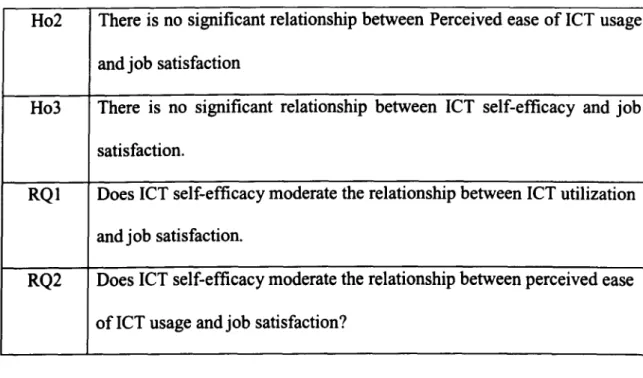
Ho2 There is no significant relationship between Perceived ease of ICT usage and job satisfaction
Ho3 There is no significant relationship between ICT self-efficacy and job satisfaction.
RQI Does ICT self efficacy moderate the relationship between ICT utilization and job satisfaction.
RQ2 Does ICT self-efficacy moderate the relationship between perceived ease of ICT usage and job satisfaction?
1.5 Conceptual Framework
As shown in Figure 1, the conceptual framework developed according to literature of ICT and job satisfaction. This framework focus on the outcome of the independent variable (e. g., ICT Utilization and perceived ease of ICT usage), is indirectly influenced by the ming variable (e. g., Self-efficacy), on the dependent variable (e. g., Job Satisfaction).
i I
Moderating Factor:ICT SELF-EFFICACY Independent Variable 1:
ICT Utilization
Dependent variable:
Job Satisfaction l Independent Variable 2:
Perceived Ease of ICT Usage
Figure 1.1: Conceptual Framework UP"
Adapted and modified from: Jiang, Z (2014)
1.6 Significance of study
1.6.1 Significance to Future Research
This study will help to provide more support for future research to use different moderator for their studies on the effect of ICT on job satisfaction. This is because this research is using a moderator that is rarely used in the studies of ICT and how it affects job satisfaction, which is self-efficacy. Other researchers may use this study to improve upon by using different factors in both independent variables and dependent variables to produce different result.
1.6.2 Significance to Organization
When introducing newer ICT into their organization, management will be able to understand how employee's self-efficacy affects their job satisfaction when it comes to using organization's newer technology related to ICT. This study may be able to aid in helping organization find ways to improve their current ICT to adapt with different type of employees who have different perception in their own ICT self-efficacy to help them achieve job
satisfaction.
1.7 Limitation of study
This study is only using one moderator in studying the effect of ICT on job satisfaction.
Due to time restrain on this study, only one moderator can be used in this research. Therefore, only one moderator was tested and studied in this research. Neglecting the fact that other moderator could have been used in this study.
Secondly, this study is done in quantitative research. This quantitative research relies on questionnaires which are easy to be distributed and easy to analyse once collected. In contrast,
6
the moderating factor could be better explained through qualitative research when it comes to ICT and job satisfaction.
Thirdly, only the two variable of ICT factors are studied in this research. The two factors are ICT utilization and perceived ease of ICT usage. There are other factors to be explored when it comes to how it affects job satisfaction.
1.8 Definition of terms
The relevant terms used in this study are defined both conceptually and operationally as follows:
1.8.1 Job Satisfaction
Conceptual Definition
According to Aziri (2011), Job satisfaction is regarded as an emotion that develops when an individual perceives that his job fulfils his emotional and material requirement.
Operational Definition
In this study, job satisfaction refers to the extent in which employees are satisfied or dissatisfied with their current job and the emotions about the work that they are doing.
1.8.2 ICT
Conceptual Definition
Christensson (2010), explains that Internet and Communication Technology as technologies that gives entry to information via telecommunications.
Operational Definition
For this study, ICT relates to an employee's degree of ICT utilization and their perceived ease of usage of ICT in their general workplace.
1.8.3 Self-Efficacy
Conceptual Definition
A person's judgment regarding his or her ability in using the computer and the Internet (Aesaert et al., 2017).
Operational Definition
The operational definition used for self-efficacy for this study relates to an employee's ability to perceive their own potential to be able to handle ICT.
1.9 Conclusion
Altogether, the background of study, problem statement, objective of this research, research hypotheses, conceptual framework development, significance of study, limitation of study and the definition of terms has been discussed in this chapter. The next chapter would touch on the literature review.
8
CHAPTER 2 LITERATURE REVIEW 2.0 Introduction
This chapter will discuss in detail on the context of research in this study, the related theories and model, previous studies related to the study and the conclusion.
2.1 Research Context
2.1.1 Job Satisfaction concept and definition
Although it is a concept widely used by most researchers when studying job outcomes, there have been no universal definition on job satisfaction, as each other studying it have their own individual idea and methods to give it a proper definition. Below are the definition that are regularly cited.
Fisher and Hanna (1931) gave the first formal definition for job satisfaction from the numbers of case studies during their research. They defined job satisfaction as: "a product of non-regulatory mood tendency. " While in Hoppock's research he gave job satisfaction a definition in which it combines three circumstances that are psychological, physiological and environmental that would lead an individual to honestly say that they are satisfied with their job (Hoppock, 1935). From this, job satisfaction can be affected by a lot of external factors.
Later, in 1976, Study of Fisher on job satisfaction have been refined by Locke (1976), suggested job satisfaction as a pleasurable state, that constantly re-evaluates job experience of an employee. Further on, Spector's job satisfaction definition is continuously cited by many.
He describes it as an individual's emotion regarding their job along with different facets, in which they love or despise their work (Spector, 1997). As a result, there creates satisfaction or dissatisfaction in one's given job.