ACCEPTANCE LEVEL OF ISLAMIC BANKING PRODUCTS AND SERVICES: A CASE STUDY
OF PESHAWAR, PAKISTAN
NAQEEB ULLAH
ASIA e UNIVERSITY
2023
ACCEPTANCE LEVEL OF ISLAMIC BANKING PRODUCTS AND SERVICES: A CASE STUDY OF PESHAWAR, PAKISTAN
NAQEEB ULLAH
A Thesis Submitted to Asia e University in Fulfilment of the Requirements for the
Doctor of Philosophy
April 2023
ii ABSTRACT
This study explores the consumer acceptance of Islamic banking products and services (IBP&S) in Peshawar, Pakistan, considering the moderating role of religious motivation. The deductive approach is employed, utilizing awareness of IBP&S, understanding of Islamic banking products and services, socio-political factors, and the 4Ps of marketing as independent variables. The dependent variable is customer acceptance of Islamic banking, and Bank Alfalah Islamic, Bank Islami Pakistan, MCB Islamic Bank, Soneri Mustaqeem Islamic Bank, and HBL Islamic Bank are considered.
Data from 400 clients were collected through primary sources with verbal consent.
The findings reveal that awareness, knowledge and socio-political factors of Islamic banking products and services have an insignificant effect on consumer acceptance.
However, the 4Ps of marketing significantly influence customer acceptance. Religious motivation does not significantly moderate the relationships. The study concludes that consumer acceptances are influenced by various factors, and marketing plays a crucial role in enhancing customer satisfaction and the adoption of Islamic banking services.
The lack of awareness and the presence of alternative choices affect the adoption rate.
Future research should conduct in-depth interviews for further analysis. Islamic banks should focus on marketing practices, profitability, community service, unique services, and religion to attract customers. Policymakers in Pakistan should consider the cultural, economic, and social factors that impact banking service adoption, customizing measures to suit Peshawar's unique characteristics and increase residents' comfort in using financial services. Policy implications highlight the importance of policymakers understanding the cultural and social aspects that influence the adoption of banking services. Further research can help policymakers customize measures for Peshawar's urban environment, facilitating increased comfort and usage of financial services among its residents.
Keywords: Islamic Banking, Traditional Banking, Shariah, 4Ps of Marketing, Socio- political factors, Religious Motivation, Consumer Awareness, Consumer Acceptance, Religion, Knowledge
iii APPROVAL
This is to certify that this thesis conforms to acceptable standards of scholarly presentation and is fully adequate, in quality and scope, for the fulfilment of the requirements for the degree of Doctor of Philosophy.
The student has been supervised by: Professor Dr. Mohamad Hanapi The thesis has been examined and endorsed by:
Professor Dr. Juhary Ali Asia e University
Examiner 1
Associate Professor Dr. Zakaria Bahari Universiti Sains Malaysia
Examiner 2
This thesis was submitted to Asia e University and is accepted as fulfilment of the requirements for the degree of Doctor of Philosophy.
Professor Dr Siow Heng Loke Asia e University
Chairman, Examination Committee [17 April 2023]
iv DECLARATION
I hereby declare that the thesis submitted in fulfilment of the PhD degree is my own work and that all contributions from any other persons or sources are properly and duly cited. I further declare that the material has not been submitted either in whole or in part, for a degree at this or any other university. In making this declaration, I understand and acknowledge any breaches in this declaration constitute academic misconduct, which may result in my expulsion from the programme and/or exclusion from the award of the degree.
Name: Naqeeb Ullah
Signature of Candidate: Date: 17 April 2023
v Copyright by Asia e University
vi ACKNOWLEDGEMENTS
I would like to express my deepest gratitude to all those who have contributed to the completion of this thesis. Their support, encouragement, and guidance have been instrumental in shaping my research journey.
First and foremost, I would like to extend my heartfelt appreciation to my supervisor, Professor Dr. Mohamad Hanapi, for their invaluable guidance and expertise throughout this endeavor. Their constant encouragement, insightful feedback, and patience have been crucial in refining my ideas and methodologies.
I am grateful to the faculty members of School of Graduate Studies, whose knowledge and expertise have greatly enriched my understanding of the subject matter.
Their lectures, discussions, and constructive criticism have played a significant role in shaping the direction of my research.
I would like to acknowledge the participants of my study, whose willingness to share their experiences and insights has been vital to the success of this research. Their contribution has provided valuable data and perspectives, without which this work would not have been possible.
I am indebted to my family and friends for their unwavering support, understanding, and motivation throughout this journey. Their belief in me, encouragement during challenging times, and patience with my absence have been invaluable.
Lastly, I extend my gratitude to all the individuals who have provided assistance, whether directly or indirectly, during the course of this study. Your contributions, be it in the form of research materials, technical support, or encouragement, have been deeply appreciated.
vii Completing this thesis would not have been possible without the collective support and encouragement of these individuals. I am truly grateful for their guidance, understanding, and unwavering belief in my abilities.
viii TABLE OF CONTENTS
ABSTRACT ii
APPROVAL iii
DECLARATION iv
ACKNOWLEDGEMENTS vi
TABLE OF CONTENTS viii
LIST OF TABLES xii
LIST OF FIGURES xv
LIST OF ABBREVIATION xvi
CHAPTER 1 INTRODUCTION 1
Background of the study 1
1.1.1 Issues in Islamic banking from global perspective 2
1.1.2 Regional issues in Islamic banking 4
1.1.3 Issues in Islamic banking of Pakistan 6
Problem statement 6
Aims and objectives 10
Research questions 11
Research hypotheses 12
Justifications and significance of the study 12
Definition of key terms 15
1.7.1 Consumer awareness and knowledge 15
1.7.2 Religious motivation 15
1.7.3 Consumer acceptance 16
Research structure and summary 16
CHAPTER 2 REVIEW OF LITERATURE 18
Introduction 18
Conceptualising Islamic banking system 18
2.2.1 Products of Islamic banks in different countries 18 2.2.2 Services provided by the banking sector 20 2.2.3 Intranet banking products and services 22 2.2.4 Differences in conventional and Islamic banking sector 23 2.2.5 Trends of Islamic banking finances and services 31 2.2.6 Service products offered by Islamic banks in Pakistan and
perceived by customers 38
2.2.7 Features of Islamic banking 41
Independent variables(s) 46
2.3.1 Consumer awareness on Islamic banking products and
services 46
2.3.2 Consumer knowledge on Islamic banking products and
services 51
2.3.3 Socio-politics 52
2.3.4 Marketing mix 56
Moderating variable: Religious motivation 61
2.4.1 Impact of religious motivation towards Islamic banking
products and services 61
2.4.2 Influence of religious motivation on consumer acceptance
on Islamic banking 64
ix
Dependent variable: Customer acceptance 66
2.5.1 Consumers acceptance of Islamic banking 67 2.5.2 Relationship between Islamic banking products, services
and customer acceptance 69
2.5.3 Factors, attributes and domain that influence the acceptance of customers on products and services of
Islamic banks 74
Consumer behaviour on Islamic banking’s products and services 76 2.6.1 Customer experience from the products and services of
Islamic banking 76
2.6.2 Consumer acceptance of Islamic banking products and
services 78
2.6.3 Factors affecting consumer motivation for using Islamic
banking services 79
Factors affecting customer acceptance and acceptance level of
Islamic banking in Pakistan 83
2.7.1 Religiosity 83
2.7.2 Consumer awareness about Islamic banking services and
products 86
2.7.3 Innovation and technology 87
The aspects about the knowledge and awareness created in
consumers related to Islamic banking 89
Push and pull factors affecting consumer knowledge on Islamic
banking products and services 91
2.9.1 Pull factors 91
2.9.2 Push factors 92
Impact of Islamic banking products and services on customer
acceptance in Peshawar, Pakistan 94
Types of variables and constructs or models relevant to Islamic
finance 96
Theoretical framework 97
2.12.1 Theory of planned behaviour 97
2.12.2 Theory of reasoned action 98
2.12.3 Theory of technology acceptance 98
Conceptual framework 102
Literature gap 103
Chapter summary 103
CHAPTER 3 METHODOLOGY 105
Introduction 105
Operational definitions 107
Scope of the study 108
Research approach 109
Instrumentation 111
Permissions, ethics clearance and informed consent 111
3.6.1 Permissions 111
3.6.2 Ethics clearance 112
3.6.3 Informed consent 113
Data collection 113
3.7.1 Translation 113
x
3.7.2 Content validity 113
3.7.3 Stability of measures 114
3.7.4 Data collection process 114
3.7.5 Questionnaire development process 116
Data analysis 117
3.8.1 Population 117
3.8.2 Sample 118
3.8.3 Coding the data 120
3.8.4 Internal consistency of measure 121
3.8.5 Data validity 121
3.8.6 Method of analysis 122
Findings of the pilot study 125
Chapter summary 131
CHAPTER 4 RESULTS AND DISCUSSION 135
Introduction to the Chapter 135
Number of participants and response rates 136
Demographic data of participants 137
Frequency 139
4.4.1 Statement 1 140
4.4.2 Statement 2 141
4.4.3 Statement 3 142
4.4.4 Statement 4 143
4.4.5 Statement 5 144
4.4.6 Statement 6 145
4.4.7 Statement 7 146
4.4.8 Statement 8 147
4.4.9 Statement 9 148
4.4.10 Statement 10 149
4.4.11 Statement 11 150
4.4.12 Statement 12 151
4.4.13 Statement 13 152
4.4.14 Statement 14 152
4.4.15 Statement 15 153
4.4.16 Statement 16 154
4.4.17 Statement 17 155
4.4.18 Statement 18 157
4.4.19 Statement 19 158
4.4.20 Statement 20 159
4.4.21 Statement 21 160
4.4.22 Statement 22 161
4.4.23 Statement 23 162
4.4.24 Statement 24 163
4.4.25 Statement 25 164
4.4.26 Statement 26 165
4.4.27 Statement 27 166
4.4.28 Statement 28 167
4.4.29 Statement 29 168
4.4.30 Statement 30 169
4.4.31 Statement 31 170
xi
4.4.32 Statement 32 171
4.4.33 Statement 33 172
4.4.34 Statement 34 173
4.4.35 Statement 35 174
4.4.36 Statement 36 175
Descriptive Statistics 176
PLS-SEM 178
4.6.1 Factor Loadings and Construct Reliability & Validity 178
4.6.2 Discriminant Validity 181
4.6.3 Multicollinarity 183
4.6.4 Model Specification 184
4.6.5 Path Coefficients Analysis 185
4.6.6 Moderator Regression Analysis 186
Discussion 188
4.7.1 Different factors affect the Acceptance of Consumers of Islamic Banking Products and Services 188 4.7.2 Religious motivation in affecting consumer's acceptance
on IBP&S in Peshawar 194
4.7.3 Consumer knowledge and awareness effect on their
acceptance of using IBP&S within Peshawar 201 4.7.4 Socio-politics (gender, domicile, education) effect the
consumer's acceptance on IBP&S in Peshawar 211 4.7.5 Marketing mix (product, price, place, and promotion)
influence the consumer's acceptance of IBP&S in
Peshawar, Pakistan 215
Chapter Summary 223
CHAPTER 5 CONCLUSION AND RECOMMENDATIONS 225 Discussion on finding relating to previous studies 225
Acceptance of Consumers of IBP&S 225
5.2.1 Religious Motivation 227
5.2.2 Consumer knowledge and its impact on their acceptance
of IBP&S 230
5.2.3 Impact of socio-political factors on the consumer’s
acceptance of IBP&S 233
5.2.4 Impact of Marketing Mix on the consumer’s acceptance
of IBP&S 235
5.2.5 Policy Implications 240
Research contribution 242
Research Limitations 242
Further Research Suggestions 244
Conclusion 246
Theoretical contributions 257
Contribution to methodology 257
Summary of Findings 258
Chapter Summary 259
REFERENCES 261
APPENDICES 287
Appendix A 287
Appendix B 294
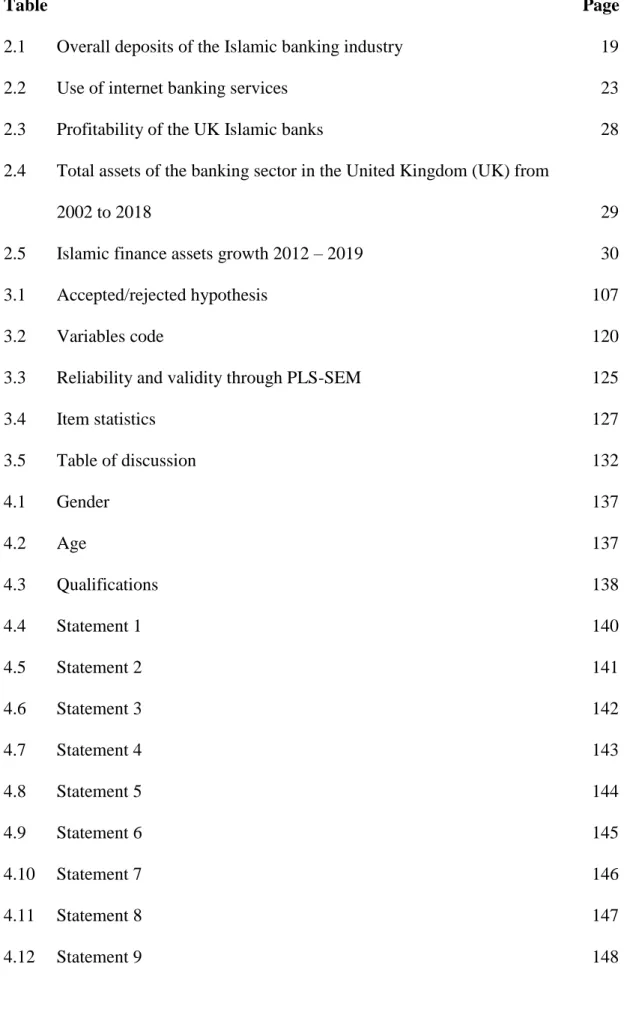
xii LIST OF TABLES
Table Page
2.1 Overall deposits of the Islamic banking industry 19
2.2 Use of internet banking services 23
2.3 Profitability of the UK Islamic banks 28
2.4 Total assets of the banking sector in the United Kingdom (UK) from
2002 to 2018 29
2.5 Islamic finance assets growth 2012 – 2019 30
3.1 Accepted/rejected hypothesis 107
3.2 Variables code 120
3.3 Reliability and validity through PLS-SEM 125
3.4 Item statistics 127
3.5 Table of discussion 132
4.1 Gender 137
4.2 Age 137
4.3 Qualifications 138
4.4 Statement 1 140
4.5 Statement 2 141
4.6 Statement 3 142
4.7 Statement 4 143
4.8 Statement 5 144
4.9 Statement 6 145
4.10 Statement 7 146
4.11 Statement 8 147
4.12 Statement 9 148
xiii
4.13 Statement 10 149
4.14 Statement 11 150
4.15 Statement 12 151
4.16 Statement 14 153
4.17 Statement 15 154
4.18 Statement 16 154
4.19 Statement 17 155
4.20 Statement 18 156
4.21 Statement 18 157
4.22 Statement 19 158
4.23 Statement 21 160
4.24 Statement 22 161
4.25 Statement 23 162
4.26 Statement 24 163
4.27 Statement 25 164
4.28 Statement 26 165
4.29 Statement 27 166
4.30 Statement 28 167
4.31 Statement 29 168
4.32 Statement 30 169
4.33 Statement 31 170
4.34 Statement 32 171
4.35 Statement 33 172
4.36 Statement 34 173
4.37 Statement 35 174
xiv
4.38 Statement 36 175
4.39 Descriptive Statistics 176
4.40 Factor Loadings 179
4.41 Discriminant Validity 182
4.42 Multicollinarity 183
4.43 Model Specification 185
4.44 Path Coefficients 186
4.45 Coefficients 187
5.1 Conclusion 252
xv LIST OF FIGURES
Figure Page
2.1 The rise in global assets of the Islamic fund assets 26
2.2 Islamic banking progress in Pakistan 27
2.3 Asset value of Islamic banks in Malaysia 28
2.4 Financial ratios of the conventional vs Islamic banking 31
2.5 Islamic banking industry 2016-2020 37
2.6 The acceptance of consumer regarding Islamic banking products and
services 71
2.7 Acceptance of consumer presented through use of the services and
products 72
2.8 Consumer acceptance about Islamic banking in Pakistan 73 2.9 Acceptance of non-muslims on conflict in religious beliefs with
Islamic banking in Malaysia 84
2.10 Correlation of the included sample portraying the effects of religiosity 85 2.11 Aspects required for the knowledge and awareness created in
consumers related to Islamic banking 90
2.12 Conceptual framework (self-made) 102
3.1 Model of analysis 106
3.2 Breakdown of Respondents by Bank 110
4.1 Breakdown of Respondents by Bank 136
xvi LIST OF ABBREVIATION
US United State
UK United Kingdom
MENA Middle East and North Africa
SECP Securities and Exchange Commission of Pakistan IBP&S Islamic Banking Products & Services
IFSB Islamic Financial Services Board IIFM International Islamic Financial Market
IFIAAO Islamic Financial Institutions Accounting and Auditing Organisation
MCR Minimum Capital Requirements
ROA Return On Asset
NIM Net Interest Margin
ROE Return On Equity
ROCE Return On Capital Employed
UAE United Arab Emirates
TQM Total Quality Management
GDP Gross Domestic Product
TPB Theory of Planned Behaviour
TRA Theory of Reasoned Action
TAM Technological Acceptance Model TAM3 Technology Acceptance Model 3
UTAUT Unified Theory of Acceptance and Use of Technology
1 CHAPTER 1
INTRODUCTION
Background of the study
Islamic Banking is a form of banking that adheres to the principles of Islamic law (Sharia) and guided by Islamic economics. It provides financial services to customers while avoiding activities such as interest-based transactions, speculation, and gambling. The core principles of Islamic Banking are based on the concept of risk- sharing rather than risk-transferring. It ensures fairness in transactions through profit sharing and loss bearing between the customer and the bank (Visser, 2019). According to Alam, Gupta & Shanmugam (2017), it is a type of banking that complies with Sharia law. This means that all transactions must adhere to Islamic principles, such as bans on Riba (usury) and Gharar (uncertainty). Islamic banking also often includes a profit- sharing component, in which the bank shares in the profits of the business it is financing.
The key distinction between Islamic banking and traditional or conventional banking is that Islamic banking must adhere to Sharia regulations, whilst conventional banks do not. Conventional banks charge interest (Riba), and they are often associated with trade of Shariah-prohibited components such as alcohol, pork, and so on, as well as elements such as Gharar (uncertainty) or Maysir (Gambling) (Todorof, 2018).
Islamic banking is founded on Shariah Law principles. Interest is forbidden in Islamic banking; instead, it is asset-based finance in which ownership of actual assets is transferred from one party to another. Conventional banks only offer one type of loan financing, but Islamic banks offer several types of financing, including Murabaha, Mudaraba, Musharaka, Ijara, and Salam. Islamic banking is also considered as more
2 economic friendly and sustainable, because it encourages people to make modest loans rather than large ones (Arshed, Yasmin & Gulzar, 2020).
Islamic banking has seen tremendous growth over the past few decades, becoming an increasingly popular alternative to traditional banking. This is due to the increasing demand for financial services that are compliant with Islamic law. As a result, many countries have developed policies and regulations to support Islamic banking and its development. This is due to the fact that Islamic banking is based on the principles of fairness and honesty, which are attractive to many consumers in this sector. There has been a lot of development in the Islamic banking industry, and it is now one of the fastest growing industries in the world. Islamic banks are also utilizing latest technologies such as Big data, IoT and A.I to further improve the quality of their products and services (Belkhaoui et al., 2020). For this purpose, the study relied in quantitative research and collected data through respondent from various bank and survey questionnaire was used to collect data.
1.1.1 Issues in Islamic banking from global perspective
According to Haseeb (2018), Islamic banking and finance growth has generated excessive interest from the past few years. The concept of Islamic banking was highly encouraged in different areas of the world. However, as per the study of Yas et al.
(2020), one of the major issues of Islamic banking in the world is related to less effort in the industry for helping small organisations and trade. The Islamic banking industry is not able to deal with the inflation rates, late payment, lack of currencies, and funds for liquidity. Furthermore, a study conducted by Ishak (2019) stated that the compliance of Sharia includes different challenges of regulatory and prudential aspects. In addition to this, it also leads towards various misconception in the western
3 society in regard to the banking philosophies, lack of money, Islamic financial instrument and privacy aspect. The recent position of the Islamic banking is that there are more than 200 Islamic financial institutes around the world which has investment funds of around $250 billion. In the words of Rehma et al. (2020), the growth of Islamic banking industry is 16% annually. However, in some Muslim countries such as Pakistan faced many challenges related to accounting aspect. In addition to this, there is a need to develop financial instrument which includes the number of practical stages of banking level is reduced to minimum which are required by the Sharia.
Haseeb (2018) stated that Islamic banking is facing financial and non-financial risk. It has been further stated by the author that the financial risk includes credit, liquidity and market risk whereas non-financial risk incorporates with the operational, regulatory, business, legal and banking risk factors. It has been claimed by some countries around the world which include Malaysia, Pakistan and vice versa that the Islamic banking is just a modernised name of conventional banking. In addition to this, they argue that the interest rate under conventional banking is just altered to the profit rates in the Islamic banking aspects. As demonstrated by Yas et al. (2020) the growth factors for increasing the values of Islamic banking includes population, time interval, and economic parameters. The author further demonstrated that there are some aspects which customers demand from Islamic banking such as deposits, financial services and investments. Furthermore, the aim of the study is to identity the Islamic banking, financial product &services and knowledge & acceptance of consumers in Pakistan especially in Peshawar. The main reason of selecting Peshawar from Pakistan was that the Islamic banking industry was not able to satisfy their customers and operate in an effective manner. However, there were very limited studies conducted on this area.
Therefore, there was a need to address this issue (Rehma et al., 2020).
4 1.1.2 Regional issues in Islamic banking
The Islamic finance sector's regional span, as well as the diversity of goods it offers, has been quickly growing as the sector's essential growth factors propel the business forward in numerous locations (Sudarsono, Tumewang & Kholid, 2021). With the onset of the worldwide economic crisis that took place during the year 2008 to 2009 along with the European sovereign debt crisis in 2011–2012, which had a significant influence on prominent mainstream financial firms while leaving the Islamic banking system mostly unharmed, the practice received more popularity (Burgess, Yaoyuneyong & Gibbs, 2014). Considering the fact that Pakistan belongs to Asian region along with premise of this research centred on assessing the awareness or acceptance of consumers on Islamic banking product and service (IBP&S) in Peshawar, the regional issues pertinent to Islamic banking in Asia is discussed in the following section.
Malaysia is a regional leader in Islamic banking in several aspects. Pakistan, Indonesia, Bangladesh, and Brunei are other prominent industries. As of December 2019, Malaysian Islamic banking assets were USD 254 billion, with total money deposited with Islamic banks accounting for 38.0% of total banking sector deposits, accompanied by Indonesia (10.8%), Bangladesh (5.4%), Pakistan (4.9%), and Brunei (4.9%) (Ishak, 2019). Nevertheless, since the Islamic banking industry is still modest in comparison to the traditional financial industry, it has the capacity to penetrate these nations' local marketplaces significantly (Arshed, Yasmin & Gulzar, 2020). Islamic financial resources, for instance, accounted up 20.8% of overall financial sector holdings in Malaysia, 21.1% in Bangladesh, 9.5% in Pakistan, and 4.9% in Indonesia in the past few years (Global Financial Integrity., 2019). Aside from Islamic financial system, there has been tremendous growth in the Islamic investment administration
5 and Sukuk businesses, while Takaful is expanding at a moderate pace but with a bigger diffusion capability. At both the foremost and intermediate market segments, Asia – particularly Malaysia – is by far the largest developed economy for Sukuk (Farah Hanan Muhamad et al., 2021). Malaysia was accountable for USD148 billion in- unsettled Sukuk, accounting for 60.4% of the entire world valuation. Indonesia, Pakistan, Singapore, and Brunei are among the Asian countries with significant Sukuk lenders. Indonesia contributed for 7.0% of worldwide financings in past few years, while Pakistan represented for 1.5% (Pitchay et al., 2019).
In the Middle East and North Africa (MENA) sector, Islamic banking has expanded significantly over the past decade. About five hundred Islamic financial institutions are currently operating in the sector, and Islamic banks in the region have expanded in number and scope (Sidlo, 2017). In 2017, it was predicted that the MENA area accounted for about thirty-five percent of the worldwide Islamic financial sector;
in the coming years, this percentage is anticipated to increase (Alamgir et al., 2020).
The MENA region is also home to a number of Islamic financial hubs, notably Dubai, the biggest and most advanced Islamic business district in the globe. The Monetary Authority and municipalities in every country the MENA region along with Central bank and local banks usually oversee the financial system (Hanieh, 2020). The Islamic banking business in the area is governed similar to conventional banking, with certain extra Islamic banking-specific laws and regulations. Islamic banks in the region provide a variety of financial services, including checking and savings accounts, investments, mortgages, and financing. Islamic banks have been effective in delivering Sharia-compliant financial services to people and companies (Khavarinezhad &
Biancone, 2019).
6 1.1.3 Issues in Islamic banking of Pakistan
Pakistan is aiming to grow its Islamic financial industry even further. The unveiling of the Islamic financial strategic framework, which intends to raise Islamic financial industry's proportion of overall banking holdings to 20 percent by the end of 2018, raising from 10 percent of the year 2014 within Pakistan (Shaikh, 2020). The state passed measures in recent years to abolish interest by offering a 2% tax refund for Shariah-compliant production enterprises. The Securities and Exchange Commission of Pakistan (SECP) also announced the 2015 release of Sukuk guidelines, which are likely to speed up Sukuk issuing in Pakistan (Shaikh & Shah, 2019). SECP also formed an Islamic financial unit with a specific duty to publish Shariah rules, conduct research on Shariah conformity, offer new Shariah compatible commodities, and enhance market knowledge. The Sharia'ah legislative framework for Islamic financial institutions was also released by the State Bank of Pakistan in 2015, with the principal goal of improving the entire Shari'ah compliance ecosystem (Salman et al., 2018).
However, during 2011 and 2020, Pakistan has to contribute up to $165.2 billion in construction. Given the government's insufficient funds to meet this demand, Islamic investments might be a viable solution to bridge the infrastructural funding shortfall (Saqib, Farooq & Zafar, 2016). With one of the world's largest Muslim demographics and roughly 7.2 percent of Pakistan's senior populace staying unbanked for religious considerations, Islamic finance has the potential to expand financial inclusiveness by offering banking services to this overlooked segment of the nation (Tara et al., 2014).
Problem statement
The research of Louhichi and Boujelbene (2017) represented that there are two different types of banks working in the developing country of Pakistan. These banking
7 structures include the conventional and the Islamic banking sector. Similarly, Asadullah (2017) comprehended that the Pakistani Islamic banking sector stimulates the services and products such as deposits and investment projects. Despite being a Muslim state, there has been close competition between the conventional and the Islamic banking sector. The two banking sectors as per the identification of Butt et al.
(2018) have been in a rivalry for attaining a large number of customers as the means of maximisation of profitability through offering high-quality contributions that equate to or surpass consumer standards. As a result of this competition, Islamic banking in the country of Pakistan irrespective of its introduction in 1985, continues to remain insignificant which has obstructed the broadening of the current financial network.
Salman et al. (2018) in their research presented that due to the recent rise in the financial institutions which include both Islamic and non-Islamic banks, the banks provide their services and products to both Muslims and non-Muslims. This is done by influencing the selection of the consumers regarding their banking products and service. However, there are differences that are present between the two banking sectors which are present in the market, Sharia supervisory board, the tax rate in Islamic banking (Ayyub et al., 2019). This difference has led to no prominent success for the Islamic banking sector in developing countries such as Pakistan. In contrast to this, Islamic banking has shown rapid growth in Iran whereas, further deterioration has been observed in the Islamic financial system performance in Peshawar (Shaikh &
Shah, 2019). Study of Loo (2010) was pertinent in this case, since it examined the viability of Islamic banking system among Muslims and non-Muslims.
In the context of Malaysia, it showed that non-Muslims usually perceive this system as relevant to the Muslims. However, it also indicated positive acceptance of Islamic banking among X-generation of non-Muslims compared to baby boomers.