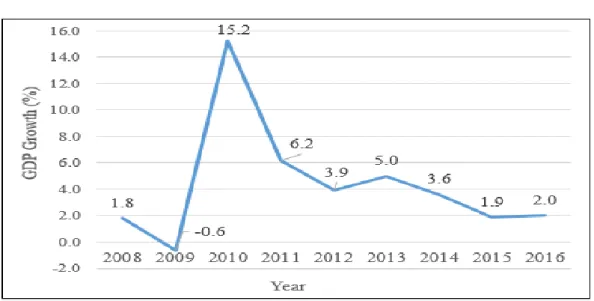
INTRODUCTION
Research Background
- Malaysia
- Singapore
The topic of this research is "The Impact of Bilateral Trade and Foreign Direct Investment on the Economic Growth of Malaysia: The Role of Singapore". Trade accounts for approximately 60.0 percent of Singapore's gross domestic product (GDP) and half of employment during the same period (WTO, 2016).

Problem Statement
Research Questions
Research Objectives
The results show that imports are significantly related to economic growth in the long run. This means that Singapore's Malaysian Foreign Direct Investment (InCR) has no significant relationship with Malaysia's economic growth. The negative impact of outward FDI in Singapore on the economic growth of Malaysia could be because.
On the other hand, Malaysia's inward foreign direct investment from Singapore (InCR) and Malaysia's imports from Singapore (InIM) have no causal relationship with Malaysia's economic growth (InGDP). While Malaysia's imports from Singapore and foreign direct investment from Singapore do not affect Malaysia's economic growth. The results also show that foreign direct investment is important for economic growth in the long run.
In addition, the results show the negative impact of foreign direct investment by Singapore on Malaysia's economic growth. Foreign direct investment in Bangladesh's power and energy sector: implications for economic growth.
Significance of the Study
Chapter Layout
Conclusion
Therefore, the research objectives are also included in this chapter and the answer to this research question and problem statement can provide insights for Malaysian government policy makers and domestic firms in making strategic decisions. Findings revealed by other researchers will be presented in this chapter and they are used to support the development of the conceptual framework in this study.
Review of Relevant Theoretical Model
- Neoclassical Model with Endogenous Growth
- Other relevant Theoretical Model
Cobb-Douglas production functions are one of the neoclassical production functions that determine the technological progress can help to improve economic growth. Finally, foreign direct investment (FDI), exports and imports are an important factor in promoting economic growth.
Review of the Literature
- Economic Growth
- Exports
- Imports
- Inward Foreign Direct Investment (IFDI) …
- Outward Foreign Direct Investment (OFDI)
Different countries will have different impact of export on economic growth due to varying trade policy (Krasniqi & Topxhiu, 2017). The spillover effects embodied in the management skills and the technology transfer can increase the country's economic growth.
Review of Journal
However, the positive or negative impact of OFDI on local economic growth depends on its role in the domestic market. The OFDI can reduce economic growth when domestic firms continue to move out of the home country. Iqbal and Sami (2017) conducted a research paper on the impact of bilateral trade between India and the United States (USA) on the economic growth of the respective countries in a period of 30 years from 1985 to 2015.
Rahman and Shahbaz (2013) investigated the impacts of imports and foreign capital inflows on Pakistan's economic growth from 1990 to 2010.
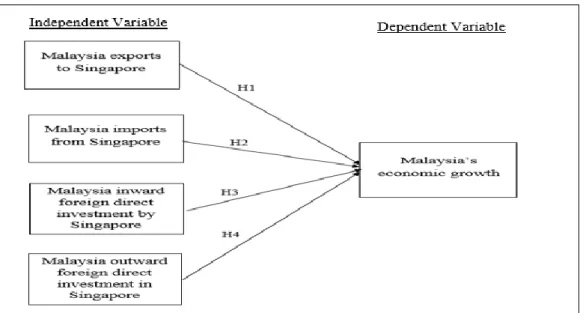
Proposed Conceptual Framework
In case the 𝑢𝑡 is correlated in the equation of DF-GLS test, ADF is performed by 'supplementing' the equations by including the lagged values of the dependent variable ∆𝑌𝑡 to eliminate autocorrelation. The empirical results support the theoretical hypothesis that Malaysia outward foreign direct investment in Singapore (InDB) has a significant relationship with Malaysia's economic growth. Consequently, it can be concluded that Malaysia's exports to Singapore and Malaysia's foreign direct investment in Singapore will be the cause for Malaysia's economic growth in the long term.
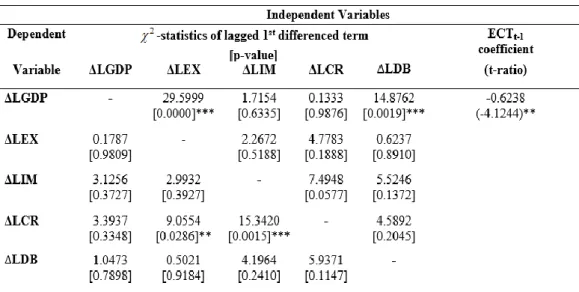
According to the outcome of the vector error correction model (VECM), Malaysian exports to and outgoing foreign direct investment in Singapore have a significant relationship with Malaysia's economic growth.
Hypotheses Development
- Relationship between Exports and Economic Growth
- Relationship between Imports and Economic Growth…28
- Relationship between Outward Foreign Direct Investment
Conclusion
Theoretical models say that exports, imports and FDI are important determinants of economic growth. In this research study, exports, imports, IFDI and OFDI as well as economic growth are discussed between Malaysia and Singapore. Despite the overwhelming assumption that exports, imports, IFDI and OFDI are important to economic growth, it has not necessarily contributed to Malaysia's economic growth as the relationship with Singapore is perhaps more complex.
The research methodologies include the conceptual framework, data collection method, data processing and data analysis.
Conceptual Framework
CR = Malaysian inward foreign direct investment from Singapore DB = Malaysian outward foreign direct investment in Singapore 𝜀𝑡 = Error correction term. The variables of InGDP, InEX and InIM are adopted from the research study of Iqbal and Sami (2017), the variable of InCR is taken from Rahman and Shahbaz (2013), while the variable of InDB is adopted from Herzer (2008).
Data Collection Methods
- Secondary Data
Data Processing
Data Analysis
- Ordinary Least Square Method
- Unit Root Test
- Dicker-Fuller GLS unit root test (DF-GLS) …
- Augmented Dicker-Fuller (ADF)
- Phillips-Perron (PP) test
- Johansen and JuseliusCointegration Test
- Vector Error Correction Model (VECM) …
- VECM Granger Causality Test
- Impulse Response Function
- Variance Decomposition
- Stability Diagnostics
- Cumulative Sum (CUSUM) Test
- Cumulative Sum of Squares (CUSUMSQ) Test
- Residual Diagnostics
- Normality Test …
- Autocorrelation Test …
- Heteroscedasticity
- Multicollinearity Test
There is no heteroskedasticity in the error term. f) There is no perfect multicollinearity among the explanatory variables. g). Normality tests are used to find out whether the error term in the model is normally distributed. It can be concluded that the error term is not normally distributed and vice versa.
When the error term is heteroskedasticity, the variance of the error term is not constant.
Conclusion
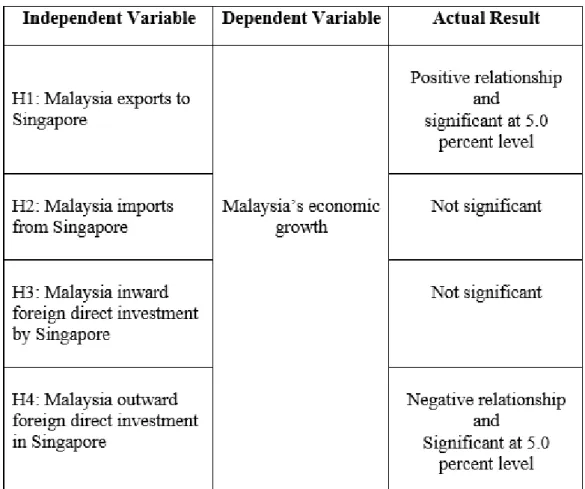
The results also show positive relationship between Malaysia exports to Singapore and Malaysia's economic growth. Malaysia outward foreign direct investment will also affect Malaysia's economic growth due to the economic liberalization and the globalization of production pattern. Both imports and inward foreign direct investment are not significant and negative for Malaysia's economic growth.
This can be said that Malaysia's imports from Singapore and Malaysia's inward foreign direct investment from Singapore do not contribute to increasing Malaysia's economic growth. The long-run effect of inward and outward foreign direct investment on economic growth: Evidence from developing economies. The effects of foreign direct investment and imports on economic growth: A comparative analysis of Thailand and the Philippines.
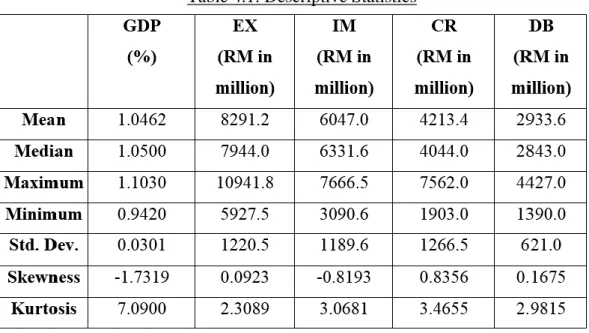
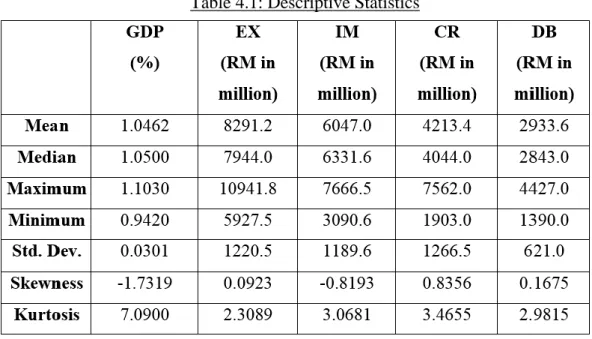
Descriptive Analysis
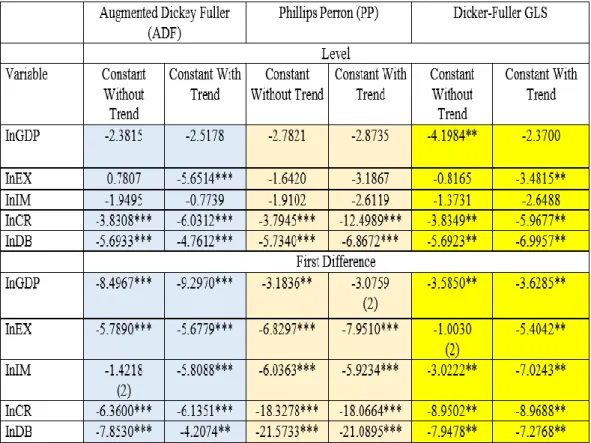
Unit Root Test
GLS test concludes that lnEX has no root of unity at level when the variable is constant with the trend. All three tests show that the variable lnIM is not stationary or has a root of unity level because the 𝜌 value is more than 0.05 significant level. In the first difference, ADF shows that lnIM has root of unity when the variable is constant with no trend.
There is sufficient evidence to state that lnIM is stationary and has no root of unity at the first difference.
Johansen and JuseliusCointegration Test
To determine the number of cointegrating vectors (r) between time series variables, the trace test and the maximum eigenvalue test are used in this study. While the maximum eigenvalue test is rejected at 𝐻0: r = 2 at 0.05 significant level, which means that the variables are cointegrated at r = 3. In short, this study has 3 cointegrating vectors between variables with a lag length of 3.
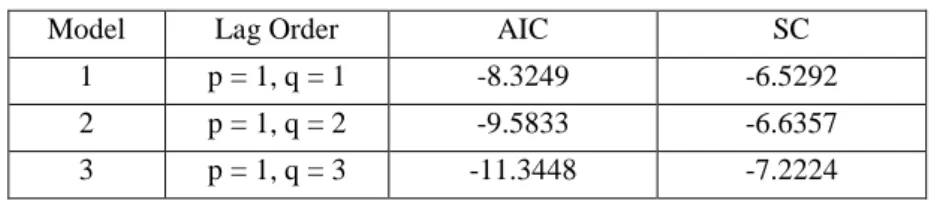
Vector Error Correction Model (VECM)
Thus, the empirical result is that Malaysian imports from Singapore (InIM) have no significant relationship to Malaysia's economic growth. The results of a non-significant relationship between inward FDI into Malaysia by Singapore and Malaysia's economic growth are the same as noted by Adams and Klobodu (2017), Abbes, Mostefa, Seghir and Zakarya (2015) and Alvarado et al. In addition, a 1.0 percent increase in FDI by Singapore will decrease Malaysia's GDP by 0.0246 percent.
Therefore, Malaysia's economy has negative growth when Singapore's inward foreign direct investment increases.
VECM Granger Causality Test
In addition, the Granger causality results show that there is a unidirectional causality running from InEX and InIM to InCR. In other words, when Malaysia exports and imports to Singapore for a long time, Singapore companies will eventually make foreign direct investment in Malaysia. The unidirectional causality running from exports and imports to inward foreign direct investment is also evidenced by Ekanayake, Richard, and Veeramacheneni (2003) and Ahmed, Cheng, and Messinis (2011), respectively.
Impulse Response Function
Variance Decomposition
Stability Diagnostic
Residual Diagnostic
As a general rule, if the variance inflation factor (VIF) of the variables is greater than 10, the variables are considered to be highly collinear with each other. Since the VIF of all variables is less than 10, we can conclude that there is no multicollinearity between the explanatory variables. Since the error term is uncorrelated, homoscedasticity, normally distributed, and the variables are not collinear due to different tests, we assume that the regression model is linear, the error term has a zero population mean, and all explanatory variables are uncorrelated with the error term.
The ordinary least square (OLS) method is considered the best linear unbiased estimator (BLUE) and our results have been proven to be accurate.

Conclusion
The results of the CUSUM and the CUSUMSQ test prove that this empirical model is stable with no structural break in the residuals. The results of this regression model are accurate because it met all the assumptions of a BLUE, since the error term is uncorrelated, homoscedasticity, normally distributed, the variables are not collinear with each other, the regression model is linear, the error term has zero population mean, and all explanatory variables are uncorrelated with the error term. Finally, this chapter presents all empirical results and findings in the form of a figure and a table.
The findings and implications of the entire study, limitations and suggestions will be discussed in Chapter 5.
Discussion of Major Findings
Because of this, Malaysia cannot bring back its own technology or talent that captures value for Malaysia, therefore outward foreign direct investment from Malaysia to Singapore has a negative relationship with Malaysia's economic growth. Explanatory variables such as exports, imports, inward foreign direct investment and outward foreign direct investment are used in this study to determine Malaysia's economic growth. For future research, researchers can study the impact of exports, imports, inward foreign direct investment, outward foreign direct investment on the economic growth of Malaysia and Singapore respectively.
The results show that only Malaysian exports to Singapore have a significant and positive relationship with Malaysia's economic growth. Economic openness and growth: Empirical evidence on the relationship between output, domestic FDI and trade. Dynamics of financial development, imports, foreign direct investment and economic growth: Cointegration and causality analysis in Pakistan.
Implications of the Study
Limitations of the Study
Recommendation for Future Research
The researchers can compare the results and study the role of macroeconomics in each country, as different countries have different results. In addition, future research should include moderating or intermediary variables to examine the impact of independent variables on economic growth. Financial institutions, market size, geographic distance and capacity to absorb technology can be included as controlling variables to make the research more interesting.
Last but not least, researchers should use longer time period to analyze data to obtain sufficient lag order.
Conclusion
Thus, it can be concluded that Malaysia's economic growth has increased by exporting to Singapore. Economic growth in Latin American countries: Is it based on export-led or import-led growth. Imports, Remittances, Foreign Direct Investment and Economic Growth in the Republic of Fiji Islands: An Empirical Analysis Using the ARDL Approach.
Trade openness, foreign aid and economic growth in post-liberalization Ghana: An application of ARDL bound test.