The result of this study indicates that there is a significant difference between the role of employees as participation for effective business management in private sectors. However, the result indicates that there is insignificance between the role of employees as transparency, accountability, responsibility, loyalty and consensus oriented for effective corporate governance in private sectors.
- Introduction
- Problem Statement
- Research Questions
- Research Objectives
- Conclusion
Malaysia introduced the Malaysian Corporate Governance Codes (MCCG) in 2000 to improve principles, guidelines, governance practices and requirements of the Malaysian Stock Exchange (Bursa Malaysia) within the market to avoid such crises repeatedly and it led to initiatives to improve the Malaysian corporate sector (MCCG, 2007). This research is about focusing on ethics and the role of employees for effective corporate governance in Malaysian private sectors.
- Introduction
- Corporate Governance
- Ethics
- Corporate Governance and Ethics
- Corporate Governance Theories
- Stakeholder Theory
- Conceptual Framework
- Transparency
- Accountability
- Responsibility
- Loyalty
- Consensus Oriented
- Participation
- Conclusions
Therefore, the board of directors should be responsible for improving the ethical culture among employees to increase the effectiveness of corporate governance. Implementing a code of ethics can create a strong ethical culture and prevent unethical behavior among employees, which helps increase the effectiveness of corporate governance in business (Merchant & White 2017; Garegnani, Merlotti & Russo, 2015). All these measures are implemented to achieve an ethical culture, which, according to the new definition of corporate governance, is one of the elements of ethics.
This study therefore seeks to explore about ethics and employees' role for effective corporate governance in Malaysian private sectors. In the past, many studies have been conducted to investigate how ethics impact the effectiveness of corporate governance. This section will focus on the relationship between ethics and employee role for effective corporate governance in Malaysian private sectors.
Stakeholder theory is one of the well-known theories of corporate governance as discussed in section 2.4.

- Introduction
- Research Design
- Data Collection Methods
- Primary Data
- Population of the Study
- Sampling Elements
- Sampling Techniques
- Research Instrument for Data Collection
- Structured Questionnaire
- SPSS Analysis
- Scale measurement
- Nominal Scale
- Ordinal Scale
- Data Analysis
- Descriptive Analysis
- Reliability Test
- Validity Test
- Inferential Analysis
- Pearson’s Correlation Analysis
- Multiple Regression Analysis
Therefore, a convenience sampling known as one of non-probability sampling will be used for this study. I will use a quantitative method for this study. Prior to the actual data collection, participants were informed about the purpose of the study and their role as a participant. The structure of the questions was developed according to the objective of the study and used the right instrument for the sample.
Therefore, SPSS was adopted to identify and analyze the information obtained by distributing the questionnaire to help determine the ethics and role of employees for effective corporate governance in Malaysian private sectors. This study, Cronbach's alpha will be a suitable tool to analyze the correlation of variables. The purpose of the validity test is to determine the reasonableness of the research components.
The findings of the statistical analyzes will be analyzed, interpreted and discussed together in the next chapter.
Introduction
Response Rate
In this research study, a total number of 160 sets of questionnaires were distributed via Google Forms, an online survey tool, to the private sector employees in Malaysia, especially in Klang Valley. Meanwhile, 150 sets of questionnaires were obtained from the 160 distributed sets indicating a response rate of 94%.
Descriptive Analysis
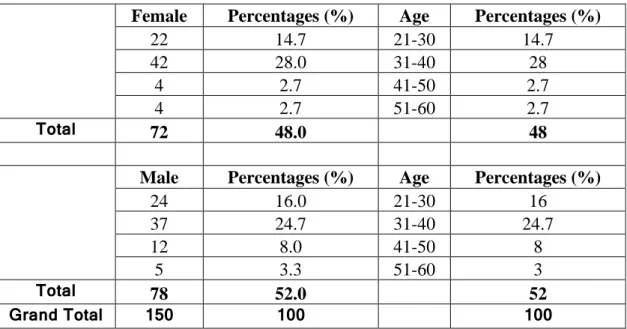
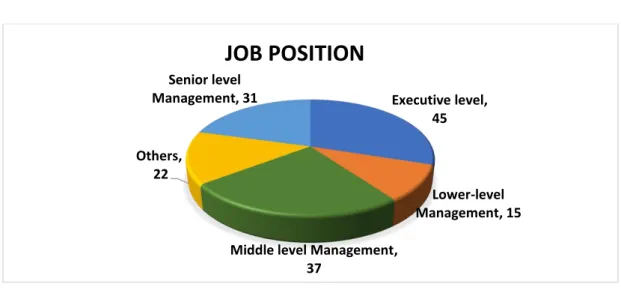
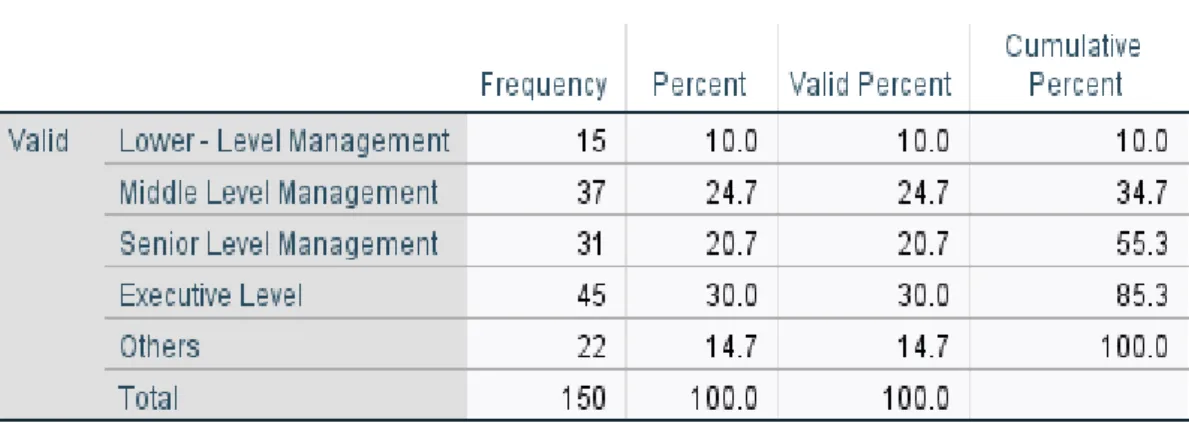
As shown in table 4.2 and figure 4.1, the participation of male respondents in the survey constituted the largest part which is 52% (78 respondents). In addition, the majority of male respondents participated in this survey from the age group between 31 and 40 years old which is 37 male respondents (24.7%) and followed by 24 male respondents (16%) participated under the age category between 21 to 30 years old. Based on the table 4.2 illustrated above, the highest respondents are from Executive level position which is represented by 45 respondents (45%) from private sector employees followed by Middle Management with 37 respondents (24.7%) .
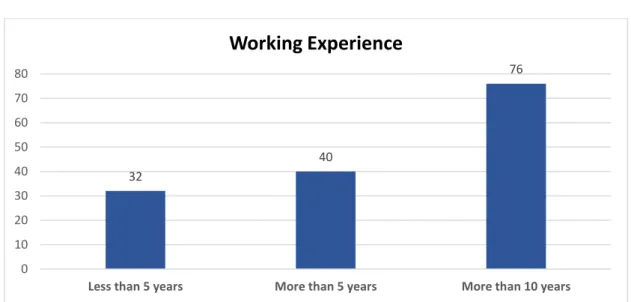
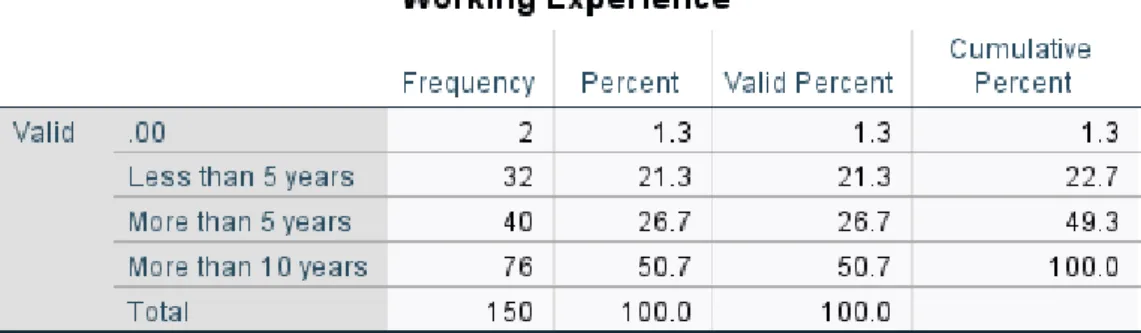
Ultimately, only 22 respondents and 15 respondents from other positions and lower level management participated in this survey. According to figure 4.3 as illustrated above, most of the respondents obtained from the survey are working more than 10 years which consisted of 76 respondents (50.7%) followed by 40 respondents (26.7%) who participated in this survey, working more than 5 years. Based on figure 4.4 indicates that respondents in the survey majority from Klang Valley that from Kuala Lumpur and Selangor.
According to Table 4.6 and Figure 4.5, 51 respondents (34%) are currently employed by Multinational Corporation (MNC) as this survey mainly focuses on Malaysian private sector employees, followed by 44 respondents (29.3%) in other types of companies.

Reliability Test
- Findings from the Survey
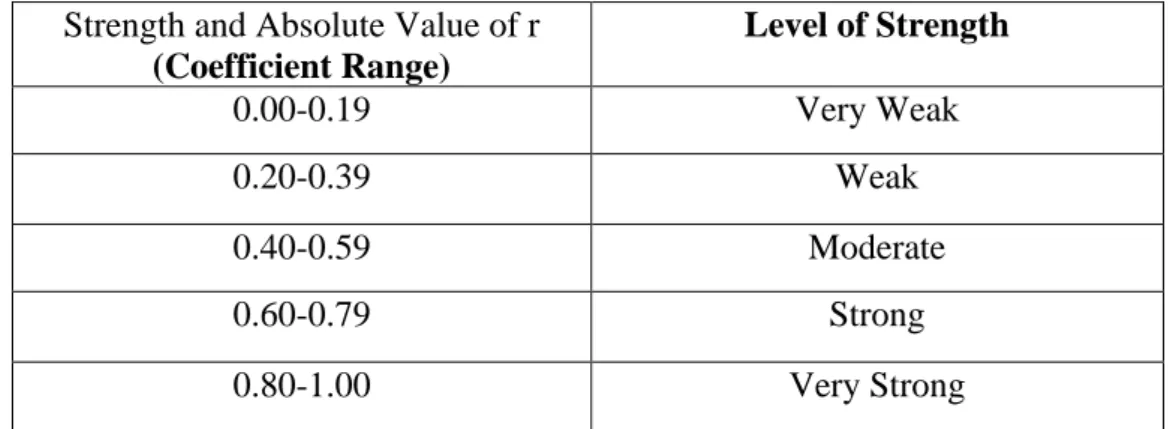
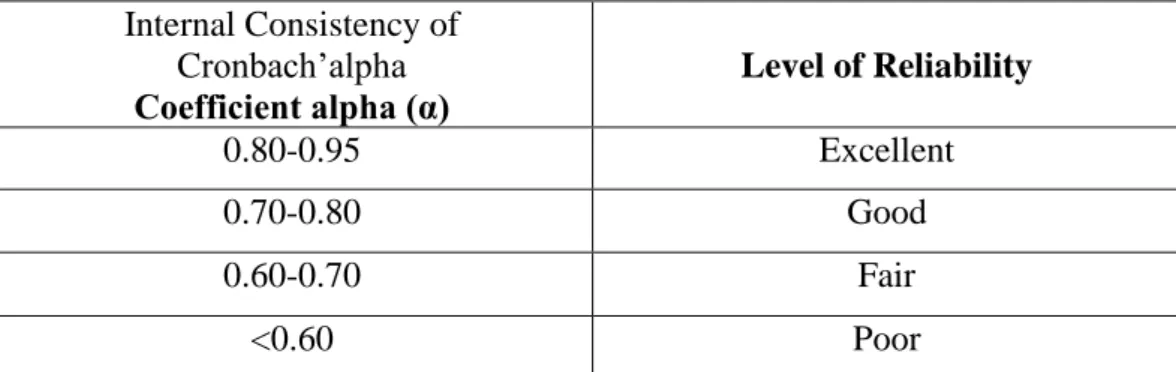
According to Table 4.7, a reliability test was conducted on the data collected from 150 survey responses to measure the reliability of the items of the variable. Based on the alpha score, 7 variables show good to excellent reliability factors according to Table 3.1. Cronbach's alpha of transparency, accountability and consensus is excellent with a range of 0.80 to 0.90.
The overall Cronbach's Alpha value is excellent with 0.951 including independent and dependent variables with the 33 number of items.
Factor Analysis
- Kaiser-Meyer-Olkin (KMO) and Barlett’s
- Communalities
- Total Variance Explained
My organization is open to criticism from its employees. I am directly accountable to my organization for my My organization ensures fairness/equality and non-discriminatory treatment among the employees of my company. My organization maintains the high level of morality, fairness and honesty in business and other affairs of life.
My organization maintains the balance between the interests of different stakeholders and rights of employees of the firm. To prevent misconduct within my organization, there are ethical training programs among employees to improve corporate governance. My organization has training programs that effectively communicate ethical standards and policies to create awareness among employees.
There should be a specific code of corporate governance (CGC) which meets the needs of the private sectors in Malaysia.
Inferential Analysis
- Pearson’s Correlation Analysis
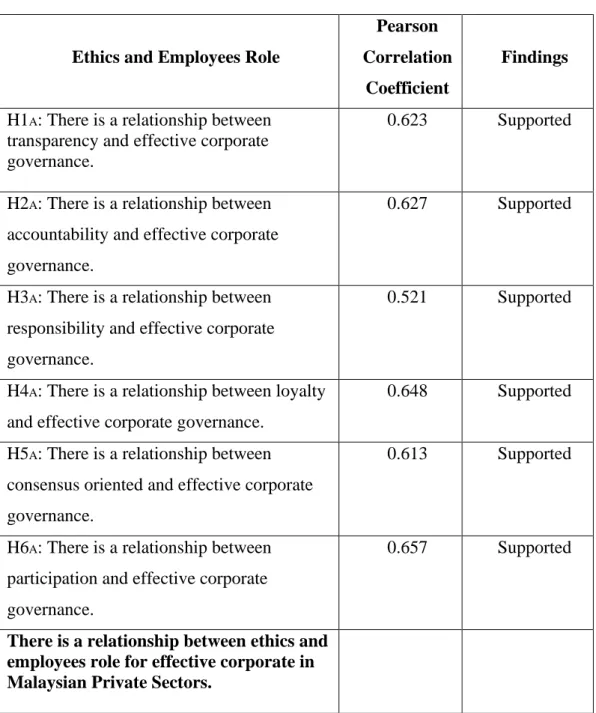
According to the Pearson's Correlation Coefficient presented in the table of 4.11, all variables appear to be greater than 0.50. From the above result, it concludes that employees are aware of their role and implementing ethics through transparency, accountability, accountability, loyalty, consensus orientation and their participation to strengthen the effectiveness of corporate governance practices in Malaysian private sectors. Found on the basis of table 4.11 that the relationship between the independent variables and effective corporate governance is significant at the level of α 0.01 based on the table provided.
In summary, the hypothesis of the above findings shows that transparency, accountability, accountability, loyalty, consensus orientation and employee participation significantly influence the effectiveness of corporate governance in Malaysian private sectors. There is a link between ethics and the role of employees for effective business in Malaysian private sectors. In summary, the dependent variable, namely effective corporate governance, is positively associated with the independent variables according to the findings obtained.
Furthermore, the responses from the respondents who participated in the study gave positive answers to the questionnaires on the relationship between the independent variables on effective corporate governance in the Malaysian private sectors.
Multi Regression Analysis
To put it simply, the model used for this study is valid and can be accepted. Based on Table 4.14, the relationship between employee participation and effective corporate governance has a t-statistic value of 3.338, which is greater than 1.96, and a p-value of 0.001, which is less than the suggested value of 0.05. From the finding, it can be concluded that H6 is significant and supported for this study, so do not reject it.
However, transparency (H1), accountability (H2), responsibility (H3), loyalty (H4) and consensus-oriented (H5) are insignificant because the proposed value was not achieved. Participation has an unstandardized coefficient ß value of 0.271 and it meant that every single unit increase in participation of employees will lead to 0.271 increases the effectiveness of corporate governance in private sectors. Nevertheless, participation is identified as predictor variable because it contributes the greatest changes to effective corporate governance because the standardized coefficient β value is 0.291, which is the highest among other variables.
To simplify, when other variables in the model remain constant, employee participation makes the strongest and highest contribution to determining the effectiveness of corporate governance in private sectors.
Discussion on Findings
H6: There is a significant relationship between ethics and the role of employees as a participation for effective corporate governance in Malaysian private sectors. The findings of this study showed that effective corporate governance in Malaysian private sectors has a positive relationship with employee participation. A change in the effectiveness of corporate governance will be influenced and influenced by employee participation.
Thus, the participation (H6) of employees in private sectors is considered as an important determinant to identify relationships for effective corporate governance. In addition, transparency, accountability, loyalty, responsibility and consensus oriented have a positive correlation to effective corporate governance. However, these 5 variables have an insignificant result where it can be concluded that the ethics and role of employees do not influence or determine the relationship for effective corporate governance in private sectors.
While the findings indicated that the transparency, accountability, accountability, loyalty, consensus orientation and participation accounted for 56.50% of the changes for effective corporate governance among workers in Malaysian private sectors.
CONCLUSIONS
- Introduction
- Summary from the Result
- Contribution of the Study
- Limitation and Recommendation
Furthermore, the employer from the private sector should practice the mentioned variables to increase the effectiveness of corporate governance in daily business operations to increase the company's performance. Based on the above findings, it can be assumed that the importance of ethics and employees play a major role in the effectiveness of corporate governance. Thus, private sectors should focus on improving corporate governance to achieve the strong goal and objective of maximizing profits in the ethical approach.
In addition, the researcher may consider measuring the effectiveness of corporate governance in the private sector using different types of independent variables and dependent variables or using different tools to measure. Third, future research could also be directed by comparing listed companies and private companies and comparing the effectiveness of corporate governance in both types of companies. Board independence, employee relations and corporate governance harmonization: empirical evidence from Russian listed companies.
Corporate governance and the performance of county governments in Kenya (Doctoral dissertation, USA-Africa International University). At this point, I am conducting a research on “ethics and the role of employees for effective corporate governance in Malaysian private sectors”. The main objective of this study will be to help employees in Malaysian private sectors to understand their role in business management and how to behave ethically for the success of the organization.