Experimental Characterization of Solid Biomass- Coal Mixture Combustion
By
Chan Wei Shin
Dissertation submitted in partial fulfilment of the requirements for the
Bachelor of Engineering (Hons) (Mechanical Engineering)
MAY20ll
Universiti Teknologi PETRONAS Bandar Seri Iskandar
31750 Tronoh
Perak Darul Ridzuan
CERTIFICATION OF APPROVAL
Experimental Characterization of Solid Biomass- Coal Mixture Combustion
Approved by,
By
Chan Wei Shin
A project dissertation submitted to the Mechanical Engineering Programme
Universiti Teknologi PETRONAS in partial fulfilment of the requirement for the
BACHELOR OF ENGINEERING (Hons) (MECHANICAL ENGINEERING)
(AP Dr. Hussain H Al-Kayiem) Supervisor
UNIVERSITI TEKNOLOGI PETRONAS TRONOH, PERAK
May2011
CERTIFICATION OF ORIGINALITY
This is to certifY that I am responsible for the work submitted in this project, that the original work is my own except as specified in the references and acknowledgements, and that the original work contained herein have not been undertaken or done by unspecified sources or persons.
CHAN WEI SHIN
Acknowledgements
The author will like to acknowledge and thank his project supervisor, AP. Dr Hussain H. Al- Kayiem for diligently supervising the works and progress of the project, and Dr Murni Melati Bt Ahmad for co-supervising. The author is also grateful for the contribution of Ms Chin Y ee Sing in the literature review and also for her efforts in assisting in the understanding of the project. The author will also like to acknowledge Soraya Abd Rahman, Elfy Salwa binti Ahdull Yamin, Mohd Azuan bin Mohamad Nor and also Mohammad Sollehuddin Sabtn for their contribution through their works. The author is also thankful for all the assistance he has obtained from lab technicians from both the Mechanical and Chemical Engineering departments for his experimentation works. The author also recognizes the assistance obtained from Mohd Fadhil Karim and Ir. Dr. Shaharin Anwar Sulaiman in obtaining samples for experimentation.
Without all the assistance, the author certainly could not have completed his project successfully. Therefore, the author is grateful to all the persons above, and to others whose names was perhaps overlooked and have assisted, both directly and indirectly in making the project a success.
Abstract
This report describes the work for characterizing biomass and coal mixture combustion experimentation. The author starts with a simple introduction to the background of the field and states the problem statement, objectives and the scope of work throughout the entire final year project dumtion, followed by a litemture review on related works done. The objectives of the project is firstly to select a number of suitable potential solid waste samples which can be used as solid fuel and by using experimentation method, discover the thermal properties and characteristics of each of the potential solid waste samples. Another objective is also to investigate the effect of different added percentage of the solid fuel to the thermal and burning characteristics of coal during combustion process. The scope of work is firstly to do background litemture review on the topic, then select the materials and characterize their thermal and burning properties through combustion experimentation. A certain percentage s also then added to coal and the mixture's thermal and burning properties are also examined through the experimentation method. The author then explains the methodology of the experiment by including the process flow and Gantt chart to measure the progress of the entire project throughout the duration of 2 semesters of this project. Then, the results of all the experimentation from the Energy Content, Ultimate Analysis, Proximate Analysis and Gas Analysis are tabled and presented for comparison. All the results are discussed as well. The author concludes the report with a conclusion and recommendation for future progress.
Table of Contents
Abstract ... ... 1 Table of Contents ... 2 List of Figures ... 3 Chapter 1: Introduction
Background on Topic ....••.•.••..••....•.••••••••••••••••.••••.•••• 4 - 5
Problem Statement ••...•.•...••.•.•••..••.•...••••..•..•..•..•.•.•.
6Objectives •..••..•••••.•••.•..••.•••••••••••.••••••.•••••.••.••••...•••..
6Scope of Work ••••••..•....•.••••••••.•••••••••••••••••••••••••••••.••.• 6
Chapter 2: Literature Review ...•... 7- 19 Chapter 3: Methodology
Analysis Technique ...•..•..•...•...•...•.. 20
Tools Required ...•...•.•...••.•.•.••..•...•.. 20
Execution Flowchart •...•••... 21
Gantt Chart •...•...••.• 22 - 23
Chapter 4: Results ... 24-32
Chapter 5: Conclusion ... 33
Chapter 6: Recommendation ... 34
References ... 35 - 36
Appendices ... ... 37 - 44
List of Figures
Figure 1: Different Types of Biomass ... 4
Figure 2: Coal Plant in Bergheim, Germany ... 5
Figure 3: Coal Dust for Coal Firing Process ... 7
Figure 4: Sample ofEucalyptus Tree Chips ... 8
Figure 5: A Palm Oil Tree ... 12
Figure 6: Leaf of a Palm Oil Tree ... 13
Figure 7: Palm Oil Trunk ... 13
Figure 8: A Palm Oil Empty Fruit Brunch ... 14
Figure 9: A Bomb Calorimeter ... 16
Figure 10: A Thermo Gravimetric Analyser. ... 17
Figure 11: A CHNS Analyser. . . 18
Figure 12: A Portable Gas Analyser ... 18
Figure 13: Project Execution Flow Chart ... 21
List Of Tables Table 1: Element Composition of Coal and Biomass ... 7
Table 2: illtimate Analysis of Fuel.. ... 10
Table 3: Effects of Fuel on Boiler Efficiency ... 10
Table 4: Combustion Rate and Energy Released by Different Types of Briquettes ... 11
Table 5: Gantt Chart for FYP
!.. ...22
Table 6: Gantt Chart for FYP 2 ... 23
Chapter 1: Introduction
1.1 Background On Topic
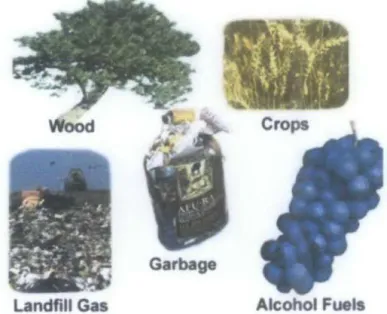
Biomass is defined as any type of organic matter, and when is used either directly as a source of fuel, or converted to another form to be used in the combustion process is called biofuel. Biomass consists of a wide range of materials, ranging from agricultural waste, domestic waste and animal wastes. Examples include plants and its parts, municipal organic waste and also the wastes generated by animals.
Specifically in Malaysia, where palm oil is of abundance, the opportunity of use of palm oil as type of biomass is wide open.
Garbage
Landfill Gas Alcohol Fuels
Figure 1: Different types of biomass which can be used convert to fuel.
On the other hand, coal is a type of fossil fuel which is sourced from rocks. Coal is primarily composed of carbon along with other elements such as sulphur, hydrogen, oxygen and nitrogen. Normally, this element is extracted straight from the ground either using underground mines or in open pits.
Coal is a huge resource of energy provided to the world currently, as there are many plants running all around the world to produce electricity, which are using coal as
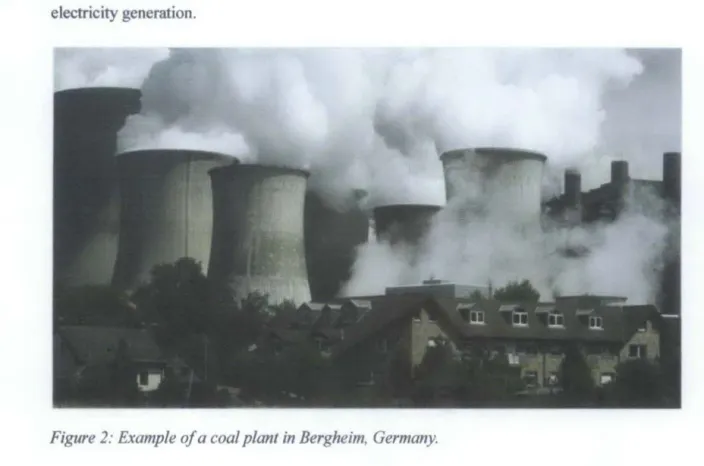
their primary source of fuel. Normally, when coal is combusted for electricity generation, the matter is pulverised first to increase the surface area for ease of combustion. The heat is then used to convert water to steam to run steam turbines for electricity generation.
Figure 2: Example of a coal plant in Bergheim, Germany.
The process of com busting coal with a certain percentage of solid biomass is called co-firing. This process has a number of advantages to the power generation industry as it provides the most effective means of reducing the net C02, S02 and NOx emissions compared to the power plants that solely bum coal, because it has much Lower concentrations of sulphur and nitrogen. Also, since biomass is relatively inexpensive, it will be cost saving to co-frre biomass along with coal as the amount of coal needed would be significantly less.
Benefits of co-firing don't stop there. Compared to power plants that use only biomass, the process allows the combustion in large scale industries and power plants and brings up the efficiencies of the plant to a much higher level. This implies that biomass combustion efficiency to electricity would be close to 33% to 37%
when co-fired with coal.
1.2 Problem Statement
A team from Japan under the supervision of Professor U mera is doing a research proposal on the utilization of solid wastes as solid fuels for JAICA. The team sees the need for the utilization of solid wastes to be incorporated with coal to be used in coal power plants for power generation by co-firing of two different materials, namely coal and biomass in a certain fixed percentage to achieve a higher overall efficiency for the plant. Therefore, this project is to identify the different characteristics of the biomass-coal mixture at different mixture percentages.
1.3 Objectives
I. To identify and select a suitable potential type of solid waste that can be used as solid fuel and experiment its thermal and burning characteristics.
2. To investigate the effect of added percentage of the selected solid fuels on the thermal and burning characteristics of coal.
1.4 Scope Of Work
The following are the scope of work that I intend to accomplish throughout the project period.
l. Research on the background of co-frring coal and biomass mixture in the industry, especially in the power generation industry.
2. Select and source for biomass materials which are abundantly available and are suitable to be mixed with coal for the co-firing process to be used as experimentation specimens.
3. Conduct experimentation on the specimens by combustion and collecting data using analysis equipments such as Bomb Calorimeter, Thermo Gravimetric Analyser, Carbon, Hydrogen, Nitrogen and Sulphur (CHNS) analyser and Smoke Analyser.
4. Analyse the data to obtain the characteristics of each type of biomass.
5. Mix a fixed percentage of each biomass specimen with coal for combustion and data measured using the same equipments.
6. Analysing the data to characterize and compare relatively all the specimens tested.
Chapter 2: Literature Review
The existing process of burning coal to generate power, or coal firing is widely used as it provides a cheap and vast source of power. The general process of coal firing starts from the pulverization of the coal, which means the coal is crushed into powder and then is fed into the furnace or combustion chamber together with a specified amount of air to be burnt. Then the heat produced is used to heat up water to be turned into steam which then drives a steam turbine to generate the power required.
Figure 3: Coal Dust for the coal firing process.
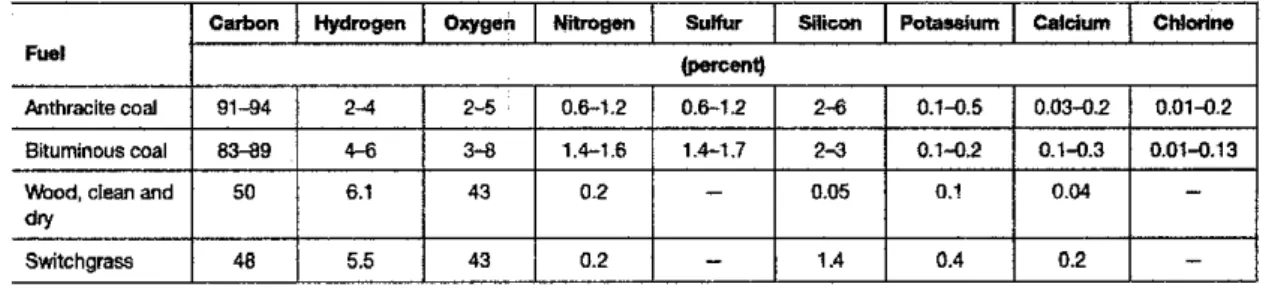
On the other hand, co-firing process is the process of mixing a certain percentage of biomass with coal and combusting it to produce power. The types of biomass are important in the co-firing process and they must be chosen properly. Overall, biomass consists of different chemical compositions compared to coal. It has a higher fraction of hydrogen and oxygen, and less carbon content. Also, the composition of the biomass consists of more volatile matter, which causes it to have a more flaming combustion and less char combustion. Overall, the typical element composition of different biomass and coal is as follows:
Table 1: Element composition of different tvoes of coal and biomass
Cubon
I
Hydrogen Oxygen Nitrogen Sulfur Silicon PotassiumI
Calcium j ChlorineFuel (J>ercen~
Anthracite coal 91-94 2-4 2-5 0.6-1.2 0.6-12 2-6 0.1--0.5 0.03--0.2 0.01-0.2
Bituminous coal 83-89 4-6 3-B 1.4-1.6 1.4-1.7 2-3 0.1-0.2 0.1-0.3 O.Q1-0.13
Wood, clean and 50 6.1 43 0.2 - 0.05 0.1 0.04 -
doy
Switch grass 48 5.5 43 0.2 - 1.4 0.4 0.2 -
Therefore, to strike a balance of having a higher calorific value of the fuel to produce more energy per quantity of fuel burnt and releasing less amount of pollutants such as sulphur dioxide and nitrogen oxide, co-firing is essential and is being widely researched currently.
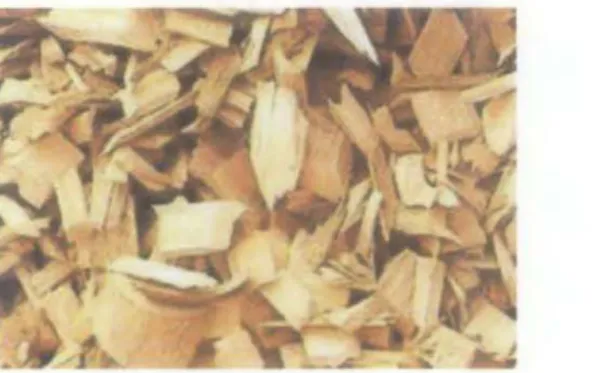
Many studies and experimentation works have been done on co-firing for the benefit of the industry. An example of experimentation is the partnership of Common Purpose Institute, University of Florida and the U.S. Department of Environment conducted an experimental biomass co-firing research at the Lakeland Electric Mcintosh Unit #3 in Florida. For this experiment, the technique is to directly inject shredded wood fiber material into the pulverized coal ftred furnace. They have used approximately 125 tons of shredded/chipped eucalyptus trees co-frred over a continuous 6 hour period. Below is the sample of the eucalyptus tree chips fed into the furnace alongside coal.
Figure 4: Sample of Eucalyptus Tree Chips used for Biomass Fuel
A research (Study on energy conversion technology for Biomass, (Rfl'E, 1998-2000)) states that throughout the world, Asia has the most abundant biomass resources, namely the plantation sector which has an equivalent of 39EJ of energy, an equivalent to approximately 1.03 billion kl- petroleum, the agricultural waste of an equivalent of 23EI or 0.608 billion kl - petroleum, and the animal waste consisting 18EJ or 0.476 billion kl- petroleum.
[Note: IEJ
=
2.6 x 10⁷ k£- petroleum]It is to note that the firing of biomass of waste in the industry of power generation is promoted in order to:
I. Reduce greenhouse gases (C02 and CH4) emissions and byproducts such as ash and residues.
2. Reduction of taxes on energy, fuel and emissions.
3. Promotion of sustainable energy
4. As an alternative option to waste management strategy (other than recycling)
The reasons for co-ftring biomass with coal rather than biomass alone then is for I. Technical reasons, being to obtain a higher thermodynamic efficiency
2. Not necessitating a continuous supply of biomass, meaning in the case of lack of biomass, coal can still be used.
3. More economic to retroftt existing power plants with co-ftring systems.
4. Uses fuel which is more readily available and at a cheaper price in the case of having biomass sources in the vicinity or close to the plant.
On the other hand, the co-ftring of biomass and coal has an effect on the operations and reliability of the power plant components which must be taken into consideration, depending on each plant. The components to be noted are:
I. Steam generator or boiler
• Fuel storage and handling system, and boiler might contain slaggingffouling and also corrosion. This might affect the performance and the integrity of the boiler at high temperatures.
2. Flue gas cleaning
• Catalysts and dust precipitators might contain huge amount of deposits or residue which need to be cleared frequently.
3. Excessive amounts of dangerous gas emissions
• Ntrogen Oxide (NOx) emission in the fuel mix
• Carbon Monoxide (CO) emission
Therefore, depending on each country and governments, the legislation governing the use of co-ftring biomass differs, as well as the type and quantity of biomass allowed to be used.
A research done by W R Livingston for Mitsui Babcock on the 2004 status of biomass-coal co-firing situation in existing power stations in Britain states that generally the biomass ratio is less than I 0% currently using the pre-blending approach due to th.e behaviour of the biomass during combustion in the plant.
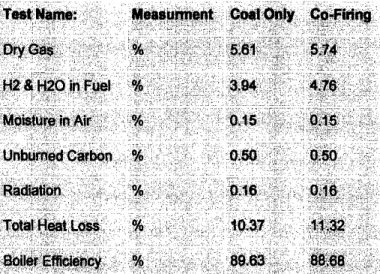
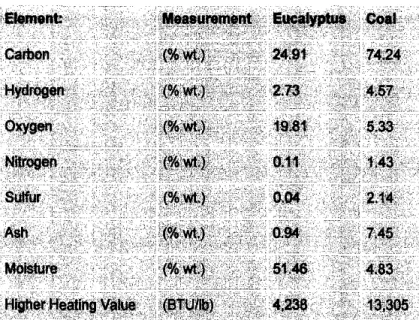
The analysis of the elements in the fuel and the efficiency of the boiler for both coal only and co-firing are as follows:
Table 2: Analysis of Ultimate Fuel Properties
Table 3: Effects by Fuel on Boiler Efficiency
~~~~~IF.,~~ ~~- .,g,~tf~~~
,-·.-_-:-.::::-·-· ... ,j
!%t<
> 'l>li'l'~ci 'f,<.'$',(.f ::;·
''"•• ;·._.· ;, -·,_ .:,'o_',_,;- -'·' •'l;'CC ""f'- .,
. '-.-.•. · -·a·... ·' .
4.·._-:'!s·· : ; -• · - ;,.,.; .
..,,
--~,--,
·-~~~binff~' l :
~i#i~in~!r'; - % · · · · i ·6it5 •• ,: ~j~j; ; -
l.lnb~mi!r:tClir~o _---.,".4>'- •
R~~-<
();5!1 g~>
-- . . ; i,
Q_ ••_._•._-_·_-.~_'_·•_•_
. . _ :.-._·-_ :_-:JU6- __
-·~th "7 •.
-•.:~
__ -_t_-._:_-·_--_•_._-,._·_,._._•_· __ . , -___ -_ -_. __ ._-.··--•--.I
"'"' < . ,..,
' .. _-.,,,.,,,' -' '
il'ota;~~i h!l!S'
'. : ; ':" ,-_ '-:(::/ -,.'· ,.,'," ;·-.-· .. _'
s(j.aa_:- · -j~ijq
It is to be noted that the efficiency drops a little as there is a relatively high amount of moisture in the eucalyptus tree chips (52.46% wt in this experiment) which does affuct the burning rate of the furnace.
A study done by Ms Chin Yee Sing of the UTP's Mechanical Engineering department concludes that the energy released and combustion rate differs with palm waste briquettes and bio briquettes (consists of 50% coal and 50% biomass). In my study, I will assume the combustion at full air flow rate for standardization, and also the briquettes combusted was at a weight totalling I OOg.
Table 4: Combustion Rate and Energy Released by Different Types of Briguettes
Briguette TyJ!e Enem Released {M} Combustion Rate O!J./s}
Palm Waste Briquette 400.85 0.1591
Bio Briquette 605.83 0.1803
Therefore, as in Table 4, we can note that the briquette with coal content combusts at a higher rate and releases significantly more energy for the same weight of briquette combusted. This cau be concluded to show that coal releases a significantly higher amount of energy per weight combusted compared to palm waste. Therefore, in my project, if I were to use palm waste together with coal for co-firing, I can expect the energy released per weight of fuel combusted to be lower than that of coal itself.
2.1 Analysis on potential wastes for Biomass fuel
A few types of biomass are being identified and some literature review is being done to for characterization. The characteristics chosen to compare different biomass' properties such as calorific value, moisture content, ash content and Carbon Dioxide (C02) content. A high calorific value, low moisture, ash and C02 content is optimum. This is so that the combustion process can occur easily and the amount of energy produced is significantly high with least effect to the environment. The samples reviewed are:
1. Palm Oil Fruit Fibre
2. PaJm Oil Fruit SheJI 3. Palm Oil Fronds 4. Palm Oil Trunk
5. Palm Oil Empty Fruit Brunch (EFB) 6. Palm Oil Leaf
7. Chicken Waste Palm Oil
Palm Oil is found abundantly in countries such as Malaysia. It is a type of plant oil derived from the pulp of the fruits of palm trees. PaJm Oil can be used for many purposes, mainly for cooking and also as biomass fuel.
Figure 5: A Palm Oil Tree
As one of the main emerging market leader, Malaysia is starting to promote the use of biomass fuel by opening a biodiesel plant to produce fuel with palm oil content.
Many parts of the palm oil tree and fruit can be used to produce biomass fuel, namely the shell, leaves, trunk and fruits itself. Specific components of the paJm oil is the fibre which is from the fruit of the palm oil, the shell of the fruits, the fronds from the leaves of the tree, the trunk of the tree, the empty fruit brunch and also the effluent produced from the fruit brunch during processing.
Palm Oil Fruit Fibre-Palm Oil fruit fibre is a non hazardous biodegradable material which is extracted from the fruit of the Palm Oil through processes after the fruit is
extracted for its oil. The fibre obtained is dried and is ready to be com busted.
Palm Oil Fruit Shell - The shell is also obtained from the fruit of the palm oil and it is being removed of its other unwanted parts. The shell is also dried before combusted.
Palm Oil Fronds- Palm oil fronds are generally from the leaves of the palm
oil trees. The fronds are readily available all year round as the palm trees are often pruned of their leaves during the harvesting of fresh fruit brunches. The tree leaves are reduced to fronds to ease the burning of them.
Figure 6: The leaf of a palm oil tree.
Palm OiJ Trunk - The trunk is the backbone of the palm oil tree and it is big. Therefore, the potential energy for combustion that can be produced is large.
Figure 7: Oil Palm Trunks
Palm Oil Empty Fruit Brunch - The Empty Fruit Brunch (EFB) of the palm oil can also be used as a source for biomass combustion. It is suitable as it is produced in large quantities, meaning that there is no short of supply for EFB. When the fruit is being extracted, the empty fruit brunch is left and instead of being thrown, it can be used as a fuel source.
Figure 8: Palm Oil Empty Fruit Brunch (EFB)
Palm Oil Leaf-The Palm Oil Leaf is the large section extended from the trunk before the fronds.
Currently, the materiaJs can be obtained through different sources. The palm oil fruit fibre and shell can be obtained through an oil palm estate, FELCRA Nasaruddin which is located near Bandar Sri Iskandar. Other samples, such as the palm oil tree trunk, leaf and fronds can be obtained in UTP. However, palm oil Empty Fruit Brunch (EFB) and has to be obtained through a palm oil mill.
Chicken Waste
Chicken waste is relevant as it is easy to obtain samples in Malaysia because of the sheer number of chickens being bred for human consumption. The animals will surely produce a substantial amount of waste which is sufficient for sampling.
However, the waste has to be obtained in a form of raw sludge which comes from wastewater treatment process which is highly hydrated to approximately 99%.
Therefore, before the experimentation can be done, the samples will have to be dried and dewatered through pressing and filtering process. Then only the dried samples can be used for experimentation. The samples are proposed to be obtained through chicken farms surrounding Tronoh.
Therefore, different types of potential samples are characterized with the said criteria in mind.
Experimentation will be conducted on all samples and they will be mixed with coal.
2.2 Experimentation Eguipments Review 1. Bomb Calorimeter
A type of constant-volume calorimeter used to measure heat of combustion of a sample. The calorimeter works by using electrical energy to ignite the sample and allows it to bum. As the sample is burning, it produces the heat to heat up the surrounding air inside the bomb. The air then heats up the water between the bomb and the vessel. The change of temperature in the water is used to measure the amount of heat produced by the combustion or burning process. With this, the calorific value of the sample can be determined. The equipment is located at the UTP's Academic Complex at the Chemical Engineering Block.
Figure 9: A Bomb Calorimeter
2. Thermo Gravimetric Analyser (TGA)
It is an analyser which heats up a sample and measures and determines the change in weight in relation to the change in temperature. It constantly measures precisely three variables which are the weight of the sample, the current temperature and the change in temperature. With that the effect of the temperature to the change in weight can be determined, and at which point the weight loss is most apparent This equipment is used as a proximate analysis to obtain the biomass' thermal decomposition characteristics.
The analyser consists of a pan which the sample is placed on and is being heated in a built in electric oven with a smaU thermocouple to ensure accurate temperature reading. The temperature is then raised gradually and the weight percentage at that particular time is also being recorded. There TGA is located at block J 7.
Figure 10: A Thermo Gravimetric Analyser
3. Carbon, Hydrogen, Nitrogen, Sulphur (CHNS) Analyser
The analyser is used for ultimate analysis of the material. It determines the elemental compositions ofthe material, which are carbon, hydrogen, nitrogen
and sulphur. The analyser measures the percentage of each of the elements in the material. This analyser also uses the same process as the thermo gravimetric analyser, which is the combustion process to break down the substances to simple compounds which are then measured.
The analyser works by having a sample in a capsule, which is then com busted in a reactor at very high temperatures, close to about I 000°C.
Then, a flash combustion will occur in the compartment which is temporarily enriched with oxygen. The products of the combustion, which are C~, S~,
and N~ are carried away by a constant flow of carrier gas such as helium that passes through a glass column packed with an oxidation catalyst (tungsten trioxide, W03) and a copper reducer, which is maintained at the combustion temperature. Here, the oxides are reduced to their elemental compositions. They then can be measured of their content.
Figure 11: A CHNS Analyser
4. Gas Analyser
The gas analyser is used in the analysis of gas produced as the result of combustion of the biomass and coal. The analyser is able to measure levels of gases' existence such as carbon monoxide (CO), carbon dioxide (C02),
oxygen (~), hydrocarbon (HC), air fuel ratio and more, depending on the type of analyser used. The analyser's detector is placed at the exit where the gases from the combustion go out. The detector will detect the levels of each different type of gas and display the measurements of it
Figure 12: A Portable Handheld Gas Analyser
The working of the equipment is as follows:
I. The analyser is set up and its components installed correctly.
2. The unit is switched on and the analyser will automatically calibrate its sensors to ensure accurate measurements.
3. Once the analyser is correctly set up, the equipment is ready to be used and the probe is set into the exhaust of the fuel burner. The pump will suck gases to its sensors and the values of the measurements will appear but will change as the content of gas changes. Therefore, to print or obtain a result, a HOLD button is pressed and the readings are obtained.
4. Once finished, the equipment is then left on, and the probe is removed and allowed to be cooled. When readings return to ambient levels, the analyser is then switched off.
Chapter 3: Methodology
3.1 Analysis Technique
For this project, I will be using the experimentation method where the characteristics of each type of biomass will be detennined through an experiment for each of the sample selected. There will be 7 different types of samples chosen for the analysis.
Then, the samples chosen are mixed with coal according to a preset amount (2%, 5%, I 0% and 15% of biomass for each sample). The selected biomass samples will be combusted in a controlled environment and all the necessary data recorded. The data includes the heat of combustion (or calorie content of the fuel), properties of the smoke produced such as carbon content, the moisture content, ash content and volatile matter quantity.
The reason for the gap in the increment of biomass percentage to the coal is so that the difference is significant enough for analysing of results. Also, since the current practice generally uses less than 10% of biomass into coal, the effect of the relatively higher biomass percentage on the combustion characteristics of coal can be known as well. For each experiment, the data required will be noted down.
3.2 Tools Required I. Bomb Calorimeter
2. Thermo Gravimetric Analyzer (TGA) 3. Oven/Dryer
4. Gas Analyzer
3.3 Execution Flow
Books, Journals, Websites
Bomb Calorimeter, Thermo graphical Analyzer, Furnace, Solid
Fuel Burner, Smoke Analyzer
Bomb Calorimeter, Thermo graphical Analyzer. Furnace. Solid
Fuel Burner, Smoke Analyzer
START
Literature Review
Acquisition of Raw Material
Material Combustion and Data Recording ~---.
No Results Consistent?
> - - - '
Interpret Results
Combine fixed percentage of biomass with coal
Mixture Combustion and Data Recording
Interpret Results
Characterize Properties of Biomass
Identify Most Suitable Mixture for Industrial Use
Conclusion
No
3.4 Gantt Chart .EXl.!
4
I
Sourcing5 6
Biomass Types
20 Aug 2010
FYP2
Softbound 8
9
Dissertation
Report 1
22 August 2011
Chapter 4: Results
Experimentation is being conducted, with the results being recorded down. The results are as follows:
4.1. Bomb Calorimeter (Energy Content Analysis)
The results are represented graphically in weight percentages to compare the calorific value for different samples with the same amount of biomass percentage.
Coal has a calorific value of 25863 kJ/kg.
The calorific value for all the materials are categorised to different percentages for ease of comparison.
2% Biomass
~---···--· - - - - - - - · - · · · · - · - ·
Calorific Value (2% Biomass)
25.5 . , - - - · - - - -
i
25 +---~·~ 0 24.5
+ - - - -
f. 0
.,
24"
iii 23.5
>
!E
~ 23a
0 22.522
Palm Oil Palm Oil Palm Oil Palm Oil Palm Oil Palm Oil Chicken Trunk Fruit Shell Fruit Fibre EFB leaf Fronds Waste
5%Biomass
I Calorific Value (5% Biomass)
1_25~~---
1
~ 24.5
:;z 0 24
+---'
0
E 23.5
~ 01 23
> u
5 22.5
.2 a
2221.5
10% Biomass
Palm Oil Palm Oil Palm Oil Palm Oil Palm Oil Palm Oil Chicken Trunk Fruit Shell Fruit Fibre EFB leaf Fronds Waste
~~--~~··--·-~~___)
~-
25
·-·
-C-a-lo-r-if-ic_V_a-lue-f~~%-Bi_o_m~-s-s-) - -
1
-24.5 +---~
~
24+ - - - -
0 23.5 +---~
~ 23
!!I 22.5
~ 22
~ 21.5 .!! ;:: 21
a
2o.s20
Palm Oil Palm Oil Palm Oil Palm Oil Palm Oil Palm Oil Chicken Trunk Fruit Shell Fruit Fibre EFB leaf Fronds Waste
15% Biomass
-~---
Calorific Value (15% Biomass)
2 6 , - - - - ji25
+---
...
::i224 T - - - -
e g ..
::s 23 T-==---1i 22
>
~ 21
~ .:!) 20 19
Palm Oil Palm Oil Palm Oil Palm Oil Palm Oil Palm Oil Chicken Trunk Fruit Shell Fruit Fibre EFB leaf Fronds Waste
100% Biomass
Calorific Value (100% Biomass)
30 , - - - -
i2s +---
~
g 20
+---
e !l
15 1i ~ 10~ ,g 5
a
0
Palm Oil Palm Oil Palm Oil Palm Oil Palm Oil Palm Oil Chicken Coal Trunk Fruit Fruit EFB leaf Fronds Waste
Shell Fibre
From the charts we can conclude that the Palm Oil Empty Fruit Brunch, upon mixture produces the most amount of energy (highest Calorific Value) compared to the rest, especially at low biomass levels (2% 5% biomass content). However, it is to note that the Palm Oil Fruit Shell provides a higher calorific value as the biomass content increases. This means that the higher the biomass weight percentage in the mixture, the higher the energy content of the mixture. This is especially proven when
biomass-coal mixture is at 15%-85%. Palm oil leaf exhibits the least energy content throughout the different mixture percentages.
Upon comparison of all pure biomass content, the Palm Oil Fruit Shell shows the most potential to be co-fired with coal. AJthough it has less calorific value than pure coal and cannot replace it, this still is the most plausible to be used as a co-firing biomass.
4.2. CHNS Analyzer (Ultimate Analysis)
For coal, the carbon content is 73.37%, Hydrogen of 6.032%, Nitrogen with 8.450%
and a sulphur content of 1.222%.
The pure biomass and biomass-coal mixture are aJso graphicaJiy represented m different weight percentages to facilitate comparison.
2% Biomass
l
100%
90%
80%
1:
s
70% 60%• 50%
A.
~40%
-r
30%~ 20%
10%
0%
Elemental ComPOsition of 2% Biomass Content
F ..
Palm Oil Palm Oil Palm Oil Palm Oil Palm Oil Palm Oil Chicken Trunk Fruit Fruit EFB Leaf Fronds Waste
Shell Fibre
Others
•Sulphur Nitrogen
• Hydrogen Carbon
So/o Biomass
l
100% 90%-
Elemental Composition of 5% Biomass Contentl ..
c: 80% 70%.,
60%u
...
SO%
II D.
..
40%.s:.
!}#
.,
30%~ 20%
10%
0%
Palm Oil Palm Oil Palm Oil Palm Oil Palm Oil Palm Oil Chicken Trunk Fruit Fruit EFB Leaf Fronds Waste
Shell Fibre
10% Biomass
I
100% 90% Elemental Composition of 10% Biomass Contentl ..
c: 80% 70%~ 60%
...
SO%D.
.,
..
.s:. 40%
!II
.,
30%~ 20%
10%
0%
Palm Oil Palm Oil Palm Oil Palm Oil Palm Oil Palm Oil Chicken Trunk Fruit Fruit EFB Leaf Fronds Waste
Shell Fibre
• Others
• Sulphur Nitrogen
• Hydrogen Carbon
• Others
• Sulphur Nitrogen
• Hydrogen Carbon
15% Biomass
Elemental Composition of 15% Biomass Content
100%
90%
~
..
c: 80% 70%60%
II u
...
50%A. II
..
~ 40%
1:111
"i 30%
~ 20%
10%
0%
.,
Palm Oil Palm Oil Palm Oil Palm Oil Palm Oil Palm Oil Chicken Trunk Fruit Fruit EFB Leaf Fronds Waste
Shell Fibre
100% Biomass
Elemental Composition of 100% Biomass Content
100%
90%
~
..
c: 80% 70%.,
60%u
...
.,
50%A.
..
40%~ ~
30%
~ II 20%
10%
0%
Palm Palm Palm Palm Palm Palm Chicken Coal Oil Oil FruitOil Fruit Oil EFB Oil leaf Oil Waste
Trunk Shell Fibre Fronds
Others
•Sulphur Nitrogen
• Hydrogen carbon
Others
•Sulphur
Nitrogen
• Hydrogen Carbon
From the charts, it can be seen that the main elemental components in aJJ of the samples are Carbon content. and 'Others' (such as sugars and other trace elements).
The main concern here is the coal content. and also nitrogen content. This is because the carbon and nitrogen content in the samples play a large role in detennining the amount of Carbon Dioxide (C02) and Nitrogen Oxide (NOx) released to the atmosphere.
Compared with coal, whose carbon content is staggeringly high at approximately 73%, even a little (2%) biomass changes the carbon content to the range of 50-60%.
Further biomass introduction reduces the carbon content per unit mass only a little.
However, when looking at the pure biomass content comparison, it is noted that the Palm Oil Fruit Shell contains a large amount of carbon content compared to other types of biomass. This means that similar to coal, the Palm Oil Fruit Shell will produce a higher amount of Carbon Dioxide compared to other biomass types.
4.3. Thermal Gravimetric Analysis
The analysis is done on all pure samples only due to time constraint. Also, due to equipment constraints (Thermal Gravimetric Analyser could not reach a temperature high enough to completely combust coal), this analysis is only done on the palm oil wastes and chicken manure only.
However, from study (Coal Gasification
:zW
Edition bt Chris Higman and Maarten van der Burgt, Gulf Professional Publishers, 2008), the sub bituminous coal contains a total of 10.5% moisture, 34.7% Volatile Matter, 43.6% Fixed Carbon and 11.2% Ash. (all percentages are in weight percentages, wt%), and the degradation temperature is rated to be approximately 260"C (from proximate analysis). With that, the other biomass samples' proximate analysis properties are as such:Overall, we can summarize the important points in the analysis.
Sample Moisture Volatile Fixed Ash Degradation
Content Matter Carbon Content (wt Temperature (wt"lo) (wt"/o) (wt"/o) %) ("C)
Coal 10.5 34.7 43.6 11.2 260
Palm Oil 9 49 25.55 16.45 200
Leaf
Palm Oil 10 48.62 17.44 23.94 250
Trunk
Palm Oil 7 50.8 21.46 20.74 180
Fruit Fibre
Palm Oil 9.2 50.5 19.75 20.55 230
Fronds
Palm Oil 7.1 55.1 31.2 6.6 222 EFB
Palm Oil 2.75 55.31 15.66 26.28 280
Fruit Shell
Chicken 4.2 49.44 16.77 29.59 270
Manure
Graphically, the weight percentages are shown as follows:
60
Weight Percentage of Elements in Materials
50
10
0
Moisture Content (wt%) Volatile Matter (wt%) Fixed Carbon (wt%)
• coal
• Palm Oil Fronds
• Palm Oil Leaf Palm Oil EFB
• Palm Oil Trunk Chicken Manure
Ash Content (wt %)
• Palm Oil Fruit Fibre Palm Oil Fruit Shell
From the results we can note the difference between each characteristic of each different sample. Firstly, the moisture content is very low in both the PaJm Oil Fruit Shell and also Chicken Manure. This is also reflected in their Degradation Temperature. This means that it is more difficult (higher temperature needed} to combust these materials, but once combusted, they produce a larger amount of energy.
Palm Oil Fruit Shell, and Palm Oil Empty Fruit Brunch (EFB} bas among the highest amount of volatile matter (mainly hydrocarbons} and this is the part where the combustion is at its greatest and most energy is produced at this stage. Following that, the carbon left after volatile matters are driven off are called the fixed carbon.
Generally the amount of fixed carbon is lesser than volatile matter and this part is where the combustion slows. However, we can see that the Palm Oil EFB has a surprisingly large amount of Fixed Carbon compared to other sample types.
Also, the ash content, which is the leftover of the combustion process, in the Palm Oil Fruit Shell and Chicken Manure is slightly higher than the other samples, whereas the Palm Oil EFB as a very low ash content. It is to note that biomass combustion produces relatively low quality ash compared to that of coal. Therefore, it is important to control the amount of biomass to be co-fired with coal to maintain the ash quality, as good ash from combustion can be sold to the construction industry (roofmg and concrete addition).
Chapter 5: Conclusion
Overall, this project stands to be an interesting one. Throughout the experimentation process, I believe I bave achieved good progress. Also, with the guidance of my FYP supervisor and co-supervisor, I am glad to have embarked on this project and conduct my part well for the UTP's research.
The biomass - coal co-firing concept is starting to be used by several coal firing plants around the world. This shows that biomass is capable of supplementing the use of coal, thus reducing costs and the emitting of dangerous gases. Some fmdings from the research that I have conducted can give an idea on the properties of each different type of biomass, including the energy content, elemental properties and emission properties.
From the findings, we can see that the mainly the palm oil empty fruit brunch (EFB) and palm oil fruit shell produces a high amount of energy and carbon content, and also highest amount of volatile matter. Even upon mixture with coal they show these properties consistently. These are properties showing a good candidate for energy generation. In other words, these are the two materials that should be studied further for their benefits for the use of energy generation.
Other parts of the palm oil such as the palm oil leaf and trunk shows a much less amount of energy content, and for the palm oil leaf, a low carbon content as well.
These materials are more suitable to be used in applications requiring lower energy content but produce low emission levels. Other samples of mixtures include the palm oil fruit fibre, fronds and chicken waste can also be used for energy generation, but in a smaller scale application since their energy content is still considerably lower than parts such as the palm oil EFB and fruit shell.
With that, I hope that this project and all its findings will be of great assistance and reference for future researchers and those requiring the information.
Chapter 6: Recommendation
I would like to recommend that further experimentation to be done through gas analysis to fmd out the emission gas released by each of the sample types as this is detrimental to the feasibility of mixtures to be used for energy generation since a huge importance is placed in the amount of pollutant gases released. Aside from that, the Proximate Analysis (fGA) should be done on all different mixture percentages to add on to the pure samples only done so far. This is so that a better picture of the different mixture's degradation and ash properties can be obtained and the different mixtures better characterized.
More analysis should also be done to verify the extent of benefits of the palm oil EFB and fruit shell and its exact optimum percentage of mixture to obtain an overall balance between the amount of energy generated per biomass weight com busted and also the amount of pollutant emissions released per biomass weight combusted.
Also, further studies can be made on the feasibility of each biomass type to be used in the co-frred power plants, including cost and returns calculations. This will determine the feasibility of the biomass and coal mixture economically.
References
1. "Biomass Co-firing: A Renewable Alternative for Utilities" by the National Renewable Energy Laboratory for the U.S. Department of Energy (DOE)
2. "Biomass - Coal Co-combustion: Opportunity for Affordable Renewable Energy" by Larry Baxter, Brigham Young University, Provo, UT84601, USA.
3. "Renewable and Alternative Energy Factsheet by Daniel Ciolkosz, extension associate for Pennsylvania State University, 2010.
4. "Preparation and Characterization of Bio Fuel from Industrial Waste by M.N Abinayah Shree, K. lyappan, N. Balasubramaniam and C. Srinivasakanam under the Journal of Sustainable Development, Canadian Centre of Science and Education (CCSE), Canada.
5. The New York Times, Article titled "Europe Turns Back To Coal, Raising Climate Fears by Elisabeth Rosentha~ published 23rd April 2008, credited to Ralph Orlowski/Getty Images.
6. "Characterization of Activated Carbon Prepared from Chicken Waste and Coal" by Yan Zhang, Hong Cui, Riko Ozao, Yan Cao, Bobby 1.-T. Chen, Chia-Wei Wang and Wei-Ping Pan in collaboration with the Institute of Combustion Science and Environmental Technology, Western Kentucky University, SONY Institute of Higher Education and Mingchi University of Technology, Taipei, Taiwan
7. Presentation of "Biofuel Production Technology from Non-Edible Biomass Resources at the National Institute of Advanced Industrial Science and Technology (AIST) for Sustainable Biomass-Asia Strategy" by Kinya
Sakanishi from the Biomass Technology Research Center (BTRC), AIST, Hiroshima, Japan.
8. Chris Higman and Maarten van der Burgt (2008). Coal Gasification, 2nd Edition. Gulf Professional Publishers. (ISBN 0-7506-8528-X), through (http://en.citizendium.org/wiki/Coal)
9. Organization for Economic Co-Operation and Development Glossary of Statistical Terms (http://stats.oecdorglglossaryldetail.asp? ID=4603)
10. Electricity From Biomass" by GreenBizCafe (http://www.greenbizcaje.com.aul?p=33)
II. Metallurgical Carbon Products by Essen Industries
( http:llwww.indiamart.com/carbon-productslmetallurgical-carbon.html)
12. Bomb Calorimeter by Wikipedia (http://en.wikipedia.org/wiki/Calorimeter)
13. CM Fiber Processing Sdn Bhd (http://oilpalmfiber.com/)
14. Department of Veterinary Services, Perak Darul Ridzuan 's article on Oil
Palm Fronds
(http://www.jpvpk.gov.my/index.php?aptian=com_cantent&view=article&id=253:o il-palm-fronds&catid=36:pasture&lang=en)
15. The Effects of Biomass Co-Firing in Coal Fired Plants by Power Generation Worldwide
{http://www.pawerqenwarldwide.com/index/displayjarticledisplav/336382/article s/pawer-enqineerinq-internatianal/va/ume-16/issue-6/features/direct-iniectian- advances-biamass-co-firinq-in-larae-coal-fired-plants.htm/}
APPENDIX
Appendix 1: Calorific Value of Biomass-Coal Mixture
Pure material
No. Material Wei11ht (,) Euel"2Y Content (J/e:)
I Coal 0.9191 25863
2 Palm Oil Trunk 0.5473 15411
3 Palm Oil Fruit Shell 1.0657 20764
4 Palm Oil Fruit Fibre 0.6800 18091
5 Palm Oil EFB 0.4215 19424
6 Palm Oil Leaf 0.5115 17630
7 Palm Oil Frond 0.5615 19604
8 Chicken Waste 0.7730 18064
Mixture
No. Material Biomass Content Weight(&} Eneml: Content {J/~:}
{_o/!!}
I Palm Oil Trunk 2 1.0750 23956
5 1.2247 23462
10 1.0316 23042
15 1.0088 22820
2 Palm Oil Fruit Shell 2 1.0241 24249
5 1.0314 24587
10 1.0959 24615
15 1.0120 24950
3 Palm Oil Fruit Fibre 2 1.0454 24002
5 1.0700 23717
10 1.0590 23423
15 1.0414 23433
4 PalmOilEFB 2 1.0493 24996
5 1.0850 24659
10 1.033 I 24472
15 1.0401 24210
5 Palm Oil Leaf 2 1.0247 23025
5 1.0411 22683
10 1.0467 21761
15 1.0647 21485
6 Palm Oil Fronds 2 1.0569 24378
5 1.0913 24282
10 1.0396 24176
15 1.0567 23985
7 Chicken Waste 2 1.0329 25145
5 0.7487 23022
10 0.7583 22878
15 1.0423 23031
Appendix 2: Ultimate Analysis of Biomass-Coal Mixture
Pure material
N!!:.
Material Wel&ht Percent Percent Percent PercentLm.Jtl
Carbon(%) Hvdrol!en (%) Nitrol!en (%) Sulobnr(%)I Coal 1.974 73.37 6.032 8.450 1.222
2 Palm Oil 1.573 44.81 4.609 1.689 0.136
Trunk
3 Palm Oil 1.880 65.57 4.91 2.877 0.624
Fruit Shell
4 Palm Oil 1.931 45.97 5.086 2.475 0.587
Fruit Fibre
5 Palm Oil 1.679 45.66 5.208 2.364 0.086
EFB
6 Palm Oil 1.694 41.41 4.562 1.718 0.027
Leaf
7 Palm Oil 1.920 44.23 4.952 3.684 0.058
Frond
8 Chicken 1.603 43.07 3.956 4.949 0.581
Waste
Mixture
No. Material Biomass Wei~:ht Percent Percent Percent Percent Content {!!W. Carbon Hidro~:en Nitro~:en Snlnhur
(%}
Lo/.J
(o/4!} (o/4!}Lo/.J
_L Palm Oil 2 1.632 56.48 5.277 1.110 0.612
Trunk 5 1.923 55.37 5.073 1.200 0.319
- 10 1.727 54.36 4.837 1.021 0.473
- 15 1.978 52.26 4,637 1.074 0.602
2 Palm Oil 2 1.859 48.89 3.999 0.993 0.347
- Fruit Shell 5 1.609 52.60 4.445 1.079 0.289
-
10 1.816 58.64 4.461 1.181 0.561- 15 1.832 58.72 4.867 1.020 0.286
,....L
Palm Oil 2 1.821 56.74 6.099 1.158 0.535Fruit 5 1.829 52.67 5.332 1.042 0.444
1 - -
Fibre 10 1.945 49.59 5.069 0.995 0.446
1-- 15 1.896 47.89 4.713 1.014 0.322
r-i-
Palm Oil EFB 2 1.801 57.31 4.151 I.l27 0.4885 1.564 50.21 4.795 1.1787 0.092
1-- 10 1.766 52.01 5.055 1.010 0.484
1 - -
15 1.720 50.72 4.847 1.069 0.468
~ Palm Oil 2 1.614 49.94 43.53 0.948 0.472
Leaf 5 1.799 49.04 4.625 0.913 0.504
,___
10 1.685 47.48 4.438 0.783 0.329
~
15 1.709 50.29 4.578 0.833 0.403
~ Palm Oil 2 1.834 48.73 4.435 1.057 0.261
Fronds 5 1.919 48.59 4.486 1.081 0.310
-
10 1.995 48.99 3.919 1.832 0.456~
15 1.911 46.66 4.677 0.920 0.190
7 Chicken 2 1.758 55.22 4.315 1.187 0.377
r - Waste
..___
5 1.716 54.10 4.436 l.l88 0.38310 1.935 54.59 3.251 1.644 0.685
~
15 1.829 54.01 4.781 2.501 0.582
Appendix 3: Proximate Analysis of Biomass-Coal Mixture (%Weight vs Temperature)
Palm Oil Leaf
"'1
,,
IVolatile Matter
Fixed Carbon
"' j
Ash Content12~~----~~~~~~---~----
'""
Palm Oil Trunk
"1
I
ro ~lro
t
$
f"',
"j
!"'1
! I~j
:<-.) !~
:-818
""
Moisture Content
Volatile Matter
Fixed carbon
...
<OO '00
"'"
Palm Oil Fruit Fibre
I"'
I ,.,
VolatileLoj
Matter
1 .
, wJ
I
'
wj
"1
! Fixed CarbonI
'"
Ash ContentT61'!l
"~
'" "" ""
Palm Oil Fronds
Moisture Content
I"'
I '"
l ~.,
f I
'"1
"'1
Volatile Matter
Fixed carbon
"" ,.,
"" "" ''"
T('""tcf.t;re I~C:J
'"
,,~~----~~~A~s~huC~o~nwt~eanut ____________________ ~---~---
'" "' "'
Palm Oil Shell
Moisture Content
Volatile Matter
Fixed Carbon
Chicken Manure
~ }(!
;
f..,J
J
Volatile Matter
Fixed Carbon
S€-1:
~00~---~~A~s~h~C~o~n~t~e~nt~---
"" ""'
4((• T~f>t'l~:o"e~~ 5o::'"'
Palm Oil Empty Fruit Brunch (EFB)
t04B tOO
.,
..
20
"
1.342 Z7.7
~I I I
I!
I
I
'
-
I - tOO
1 Moistu Content
""'
I I
VOfatJ e
\I
\
Matter
-f\\-
1-
I"-.
Fixed Ca on
1
I
I-Ash Co tent !
200
I
I I
i I T
I
~
-- -
I
' I
I
I
i
I
I
~-- - -
I
I
-±
' II
' I
~
I -~~ I
I ' I
400 " " 600 800 847~
r~an.e("C)