FACTORS INFLUENCING THE TRENDING HALAL FOOD CONSUMPTION AMONG CONSUMERS IN
MALAYSIA
AINNUR INSYIRAH BINTI AINOR JAMARAHMAN
AMEERA BINTI MD DAUD AMIRAH ANISAH BINTI MUHAMMAD IQBAL
FIRDAUSI AMIRAH SYAHIRAH BINTI KHAIRUL FAIZI
DEGREE OF BUSINESS ADMINISTRATION (ISLAMIC BANKING AND FINANCE) WITH HONOURS
2023
FKP
FKP
Factors Influencing The Trending Halal Food Consumption Among Consumers In Malaysia
by
Ainnur Insyirah Binti Ainor Jamarahaman Ameera Binti Md Daud
Amirah Anisah Binti Muhamad Iqbal Firdausi Amirah Syahirah Binti Khairul Faizi
A thesis submitted in fulfillment of the requirements for the degree of BACHELOR OF BUSINESS ADMINISTRATION (ISLAMIC BANKING
AND FINANCE) WITH HONOURS
Faculty of Entrepreneurship and Business UNIVERSITI MALAYSIA KELANTAN
2023
FKP
THESIS DECLARATION
I hereby certify that the work embodied in this thesis is the result of the original research and has not been submitted for a higher degree to any other University or Institution.
OPEN ACCESS I agree that my thesis is to be made immediately available as hardcopy or on-line open access (full text).
EMBARGOES I agree that my thesis is to be made available as hardcopy or on-line (full text) for a period approved by the Post Graduate Committee.
Dated from until .
CONFIDENTIAL (Contain confidential information under the Official Secret Act 1972)*
RESTRICTED (Contains restricted information as specified by the organization where research was done)*
I acknowledge that Universiti Malaysia Kelantan reserves the right as follows:
1. The thesis is the property of Universiti Malaysia Kelantan.
2. The library of Universiti Malaysia Kelantan has the right to make copies for the purpose of research only.
3. The library has the right to make copies of the thesis for academic exchange.
AINNUR
SIGNATURE SIGNATURE OF SUPERVISOR
AINNUR INSYIRAH BINTI AINOR JAMARAHMAN DR NADZIRAH BINTI MOHD SAID Date:
MEERA SIGNATURE
AMEERA BINTI MD DAUD
MIYA
SIGNATURE
AMIRAH ANISAH BINTI MUHAMAD IQBAL FIRDAUSI
MIRA
SIGNATURE
AMIRAH SYAHIRAH BINTI KHAIRUL FAIZI
FKP
ACKNOWLEDGEMENT
First and foremost, praises and thanks to Allah, the Almighty, for His showers of blessings throughout our research work to complete the research successfully.
We would like to express our deep and sincere gratitude to our supervisor, Dr. Nadzirah Binti Mohd Said providing invaluable guidance throughout this assignment. Her dynamism, vision, sincerity, and motivation have deeply inspired us. She has taught us the final year research project 1 to carry out the assignment and to present the assignment works as clearly as possible. She always gives us support and guides us patiently until we understand the thing, we should know on to do our assignment in purpose to produce a good outcome from the data we have find. It was a great privilege and honor to study under her guidance. We are extremely grateful for what she has offered to us. We would also like to thank her for her friendly, empathy, and great sense of humor.
In addition, we also thank to the University Malaysia Kelantan for consent to include copyrighted pictures as a part of our paper. We are also extremely grateful to our parents for their love, prayers, caring and sacrifices for educating and preparing us for our future.
Many people, especially our classmates and team members itself, have made valuable comment suggestions on this proposal which gave us an inspiration to improve our assignment.
We thank all the people for their help directly and indirectly to complete our assignment.
Finally, we give our special thanks to all the people who have supported us to complete the assignment work directly or indirectly to complete our assignment.
FKP
TABLE OF CONTENTS
ITEMS PAGE
Cover page Title Page
Thesis Declaration
Acknowledgment i
Table of Contents ii-v
List of Tables vi
List of Figures vii
Abstrak viii
Abstract ix
CHAPTER 1: INTRODUCTION
1.1 Background of the Study 1 – 2
1.2 Problem Statement 3 – 4
1.3 Research Objectives 5
1.4 Research Questions 5
1.5 Scope of the Study 5 – 6
1.6 Significance of the Study 6 – 7
1.7 Definition of Term 7 – 8
1.8 Organization of the Proposal 8
FKP
CHAPTER 2: LITERATURE REVIEW
2.1 Introduction 9
2.2 Underpinning Theory 10 – 12
2.3 Previous Studies 13 – 17
2.4 Hypothesis Statement 18
2.5 Conceptual Framework 19 – 20
2.6 Summary / Conclusion 20 – 21
CHAPTER 3: RESEARCH METHODS
3.1 Introduction 22
3.2 Research Design 23
3.3 Data Collection Methods 24
3.4 Study Population 25
3.5 Sample Size 25 – 26
3.6 Sampling Techniques 26 – 27
3.7 Research Instruments Development 27 – 28
3.8 Measurement of the Variables 28 – 30
3.9 Procedure for Data Analysis 30 – 34
3.10 Summary / Conclusion 35 – 36
CHAPTER 4: DATA ANALYSIS AND FINDINGS
4.1 Introduction 37
FKP
4.2 Preliminary Analysis 37 – 39
4.3 Demographic Profile of Respondents 40 – 41
4.4 Descriptive Analysis 41 – 46
4.5 Validity and Reliability Test 47 – 49
4.6 Normality Test 49 – 51
4.7 Hypotheses Testing 51 – 55
4.7.1 Hypothesis 1 51 – 52
4.7.2 Hypothesis 2 52
4.7.3 Hypothesis 3 53
4.7.4 Hypothesis 4 54 – 55
4.8 Summary / Conclusion 55
CHAPTER 5: DISCUSSION AND CONCLUSION
5.1 Introduction 56
5.2 Key Findings 57 – 58
5.3 Discussion 58 – 60
5.3.1 Hypothesis 1 58 – 59
5.3.2. Hypothesis 2 59
5.3.3 Hypothesis 3 59 – 60
5.4 Implications of the Study 60 – 61
5.5 Limitations of the Study 61 – 62
5.6 Recommendations / Suggestion for Future Research 62
FKP
5.7 Overall Conclusion of the Study 63
REFERENCES 64 – 69
APPENDIX A – DRAFT OF QUESTIONNAIRE 70 – 75
APPENDIX B – GANTT CHART 76 – 77
APPENDIX C – RESULT OF TURNITIN 78 – 80
APPENDIX D – RUBRICS 81 – 83
FKP
LIST OF TABLES
Table Title Page
Table 3.1 Table for Determining Sample Size of a Know Population (Krejcie And Morgan 1970)
26
Table 3.2 The Relationship between Research Objectives, Research Questions and Research Methodology
34
Table 4.1 The Rule of Thumb on Cronbach’s Alpha 38
Table 4.2 Summary of Reliability Analysis for Pilot Test 38
Table 4.3 Respondents Demographic Profile 40
Table 4.4 The Overall Mean Score on Each Variable and Dimension 42
Table 4.5 Descriptive Analysis of Price Factor 43
Table 4.6 Descriptive Analysis of Peer Influence Factor 44
Table 4.7 Descriptive Analysis of Attitude Factor 45
Table 4.8 Descriptive Analysis of the Trending Halal Food 46
Table 4.9 Correlations 48
Table 4.10 Reliability Coefficient for Each Section of the Questionnaire 49
Table 4.11 Test of Normality 50
Table 4.12 Pearson Correlation of Price 51
Table 4.13 Pearson Correlation of Attitude 52
Table 4.14 Pearson Correlation of Peer Influence 53
Table 4.15 Coefficients 54
Table 5.1 Findings of the Results 57 – 58
FKP
LIST OF FIGURES
Figures Title Page
Figure 2.1 Research Framework for the Factors Influencing the Trending Halal Food Consumption among Consumers in Malaysia
19
Figure 3.1 Research Procedure 33
FKP
ABSTRAK
Pada masa kini, makanan halal semakin diterima oleh semua golongan masyarakat di negara ini iaitu Malaysia tanpa mengira bangsa dan agama. Objektif utama kajian ini adalah untuk menentukan hubungan antara harga, sikap dan pengaruh rakan sebaya dengan faktor-faktor yang mempengaruhi trend pengambilan makanan Halal dalam kalangan pengguna di Malaysia. Ia juga mengenal pasti dan membuktikan faktor-faktor yang mempengaruhi trend pengambilan makanan Halal dalam kalangan pengguna di Malaysia. Sebanyak 228 responden soal selidik yang diedarkan telah dikumpul. Selain itu, menggunakan alat SPSS untuk mendapatkan hasil seperti Ujian Kebolehpercayaan dan Kesahan, Ujian Deskriptif, Korelasi dan Regresi Linear Berganda. Hasil kajian menunjukkan tahap atau hubungan yang signifikan antara harga, sikap dan pengaruh rakan sebaya dengan faktor-faktor yang mempengaruhi trend pengambilan makanan Halal dalam kalangan pengguna di Malaysia. Kesimpulannya, dapatan kajian ini membuktikan bahawa harga, sikap dan pengaruh rakan sebaya merupakan faktor yang mempengaruhi trend pengambilan makanan Halal dalam kalangan pengguna di Malaysia. Implikasi kajian ini adalah kepada pengguna perniagaan dan individu di Malaysia. Makanan Halal yang menjadi trending mendapat penerimaan tinggi daripada pelbagai kaum dan agama yang menganggap kualiti dan kebersihan sesuatu makanan.
Kata kunci: trend penggunaan makanan Halal dalam kalangan pengguna di Malaysia, harga, sikap, pengaruh rakan sebaya.
FKP
ABSTRACT
Nowadays, Halal food is increasingly accepted by all groups of people in this country which is Malaysia regardless of race or religion. The main objective of this study is to determine the relationship between price, attitude and peer influence with factors influencing the trending Halal food consumption among consumers in Malaysia. It also identifies and proves the factors influencing the trending Halal food consumption among consumers in Malaysia. A total 228 respondents of questionnaires distributed were collected. Additionally, using SPSS tools to get results like Reliability and Validity Test, Descriptive Testing, Correlations and Multiple Linear Regressions. The results shows the significant level or relationship between price, attitude and peer influence with factors influencing the trending Halal food consumption among consumers in Malaysia. To sum up, this study's findings proved that price, attitude, and peer influence are the factors influencing the trending Halal food consumption among consumers in Malaysia. The implications of this study are for business and individual consumers in Malaysia. The trending Halal food gets high acceptance from various races and religions that consider the quality and cleanliness of a food.
Keywords: the trending Halal food consumption among consumers in Malaysia, price, attitude, peer influence.
FKP
CHAPTER 1: INTRODUCTION 1.1 BACKGROUND OF THE STUDY
Halal items have a large and fast expanding worldwide market. Aside from religious responsibility and obedience, halal has become the preferred standard of choice for Muslims and non-Muslims alike throughout the globe. Non-Muslims don't seem to care about the Halal idea, even though Muslims have to adhere to rigorous religious guidelines. Muslims and non-Muslims may prefer halal cuisine for various reasons, but little is known about these factors. Marketers may learn more about consumers' preferences for halal goods and brands by analyzing their thoughts and actions.
Food plays a vital role in maintaining sacred rites and beliefs for many faiths. Food is any substance that provides nutritional support to the body to generate energy, maintain life, or encourage development. It carries good health as a preventative measure and a cure. Many people believe that food has a significant influence on the development of civilization and religion. Food choices are heavily influenced by religion in most countries. According to this research, consumers are more likely to purchase a new product if it does not violate or contradict their religious beliefs. Religious beliefs influence buying choices and eating habits. Food consumption is influenced by religious beliefs and the degree to which people adhere to and interpret such thoughts. Pork and beef are banned in almost every religion, save Christianity. This includes Judaism as well as other Abrahamic faiths like Hinduism.
Muslims, in particular, may be influenced by their religious beliefs in their purchasing decision. Halal (permissible) and haram (impermissible) are terms used in Islam to describe food (prohibited). Demand for "Halal" food has risen due to Muslim concerns about the food they consume
FKP
and the substances they contain. At least 500 million non-Muslims ingest halal cuisine throughout the globe. Halal is no longer only about religion. Halal is the thorough examination of a subject, particularly regarding economic and scientific considerations. Health, cleanliness, taste, environmental friendliness, animal welfare, and social problems all play a role in halal consumption (such as religious identity and level of culture). Non- Muslim customers are increasingly turning to Halal goods owing to ethical concerns about the treatment of animals and a general belief that Halal foods are better for you. According to recent research from the Islamic Food and Nutrition Council of America (2009), customers are already willing to pay a premium price for organic food in the United States and Europe. Therefore an emphasis on healthy foods gives excellent chances to sell Halal foods as a lifestyle option. As a result, many non-Muslims have already decided to consume Halal cuisine. Health-conscious markets are projected to see an upsurge in Halal food consumption over the next five years. Muslims and non-Muslims alike may learn from the religion's principles and apply them. Religion has a profound impact on a person's inner life, influencing a variety of rituals and actions. In order to demonstrate respect and meet the needs of individuals from diverse religious groups, it is essential to recognize the significance food plays in cultural and religious activities.
FKP
1.2 PROBLEM STATEMENT
Different psychological and sociological factors, as well as food-related government restrictions, affect consumers' dietary choices. According to research, consumers' attitudes about food are influenced by a number of variables (Nardi et al., 2019; Vermeir & Verbeke, 2006, 2008).
Taste, texture, affordability, accessibility, style of lodging, and psychological and ecological aspects all have a role in people's eating choices (Boesveldt et al., 2018). Several studies, such as Delener (1994), claim that religious beliefs impact consumer buying decisions. Religion and eating choices are also discussed in depth in Dindyal and Dindyal (2003). This research reveals that religion has a significant impact on a variety of societal structures (Dindyal & Dindyal, 2003). It needs to be clarified how religion and Halal food alternatives are linked due to a paucity of studies on religion's role in influencing consumer food preferences (Delener, 1994).
The halal sector is multiplying and is considered a worldwide business. More than 60% of the halal trade's worldwide market value is said to come from the sale of halal food products.
Economic development is expected to be a significant factor in Malaysia's quest to become a halal center. Religion significantly impacts the thoughts and actions of the general public. Throughout history, religion has played a crucial role in determining what people buy and how they consume.
Religious teachings and society's understanding of religion strongly impacts dietary habits. Among all faiths, according to Regenstein et al. (2003), Islam provides specific standards for dietary choices and lifestyle.
Muslims are obligated to consume only Halal (permitted or halal) and Tayyib (clean) food items while refraining from Haram (prohibited or haram) foods, according to these dietary requirements (Regenstein et al., 2003). Since its inception in 1970, the meaning of the term "halal"
FKP
has developed in Muslim and non-Muslim nations alike. Halal is a concept based on Islamic principles encompassing everything from food safety and cleanliness to nutrition and goodness, as well as the production, development, pre-production process, trustworthiness, honesty, and the management of food and other resources. A Halal food manufacturing factory must be completely devoid of pork-based products, alcoholic beverages, and other synthetic substances. The religious idea that Halal cuisine is tastier, healthier, and cleaner than Haram food is a major factor in its acceptability and appeal (Al-Harran & Low, 2008). Halal food's ethical and certification norms are also relevant to this recognition (Hanzaee & Ramezani, 2011).
Additionally, Halal principles restrict commodities such as stationery, toiletries, medicines and cosmetics and sectors such as finance, insurance, and banking. According to Rezai et al. (2012) and Haque et al. (2015), 38.7 percent of Malaysia's non-Muslim population agreed with the dietary principles regulating Halal food production and consumption. Non-Muslim customers of halal cuisine have a favourable reaction, according to Mathew (2014) and Haque et al. (2015). Studies have shown that non-Muslims' acceptance of halal cuisine is connected to the meal's safety, nutritional value, and quality (Aziz & Chok, 2013; Haque et al., 2015; Latif et al., 2014; Mathew, 2014; Rezai et al., 2012). Increasingly, people are concerned about the nutritional and ethical criteria that govern food items, such as sanitation and nutrition as well as quality, provenance and animal welfare (Latif et al., 2014; Mathew, 2014).
FKP
1.3 RESEARCH QUESTION
1. Is there any relationship between price and the trending Halal food consumption among consumers in Malaysia?
2. Is there any relationship between attitude and the trending Halal food consumption among consumers in Malaysia?
3. Is there any relationship between peer influence and the trending Halal food consumption among consumers in Malaysia?
1.4 RESEARCH OBJECTIVES
1. To examine the relationship between price and the trending Halal food consumption among consumers in Malaysia.
2. To examine the relationship between attitude and the trending Halal food consumption among consumers in Malaysia.
3. To examine the relationship between peer influence and the trending Halal food consumption among consumers in Malaysia.
1.5 SCOPE OF THE STUDY
This study will determine the level of consumers' influence in trying and selecting the trending Halal foods. This study will also discover factors influencing consumers' selection of Halal foods that are trending nowadays. It is because some people like to follow the current trend without thinking and do not care about the ingredients used in a portion of food, whether it is Halal to eat or otherwise. Therefore, this issue should not be taken lightly because it involves adherence to Islam,
FKP
which forbids eating forbidden foods. Also, it will affect the construction of a Muslim’s personality.
In addition, this study will be done by focusing on consumers in Malaysia who are known for their culture that are easily influenced by trending things. Besides, the survey or online questionnaires will be distributed and asked to consumers in Malaysia who are more focused on adolescence to adulthood to collect the data for this quantitative data. It means the data will help in knowing the main factors of consumers in Malaysia in the selection of trending Halal foods. Also, for this study to be successful, time will be taken to collect, analyze, interpret, and evaluate the data carefully until the end of this study.
1.6 SIGNIFICANCE OF STUDY
This study is significant because it involves Halal foods that everyone can eat, whether Muslims or not. However, Muslim users should not eat food that has prohibited ingredients used. Also, this study can give awareness to Malaysia's consumers in carefully selecting trending Halal foods to avoid being easily fooled by the trending things.
Next, this study will give the main benefits for the users in Malaysia, especially for Muslim consumers. It can maintain the good name of religion and self in societies by choosing the trending Halal foods. Muslims with good personalities will get a positive response from the communities and indirectly can increase awareness in choosing the best Halal foods for long-lasting health. As stated in Quran (2:168), Allah says, ‘O humanity! Eat from what is lawful and good on the earth and do not follow Satan’s footsteps. He is truly your sworn enemy’.
FKP
Last but not least, this study can also benefit consumers in Malaysia to know the advantages of selecting and choosing Halal foods. For example, Halal food is a clean food utilizing proper slaughter, known as a portion of healthy food and free from disease and is a quality food. So, the trending Halal food selection is highly recommended among consumers in Malaysia because it will positively impact ourselves, religion, and society.
1.7 DEFINITION OF TERM 1.7.2 TRENDING
"Trending" means "to appear as a popular trend." And something is frequently discussed on social media, in newspapers, and elsewhere. Chef Amar, for example, is trending and becoming the buzz of Malaysians on Twitter, Facebook, and Instagram since he has a large following and sells high-quality products.
1.7.2 HALAL FOOD
To possibly understand halal food, we must first identify food and the meaning of the term halal. Food is derived from the Arabic phrase at ta'am or Al-atimah, which means "to eat food."
Swallowing food into one's body to maintain one's physical and mental well-being is referred to as eating. Food is anything that humans can eat or consume, whether it comes from animals or plants, which can satisfy hunger and provide energy to the human body. (Rosalia,2016)
There are a few rules to follow when establishing what constitutes halal food. It goes like this:
a) Does not contain or consist of any part or thing of animals that Muslims are prohibited from eating under Islamic law or have not been slaughtered according to Islamic law.
FKP
b) It does not contain anything punished as excrement under Syariah regulations.
c) According to Islamic law, no tool should be used to prepare, process, or manufacture food containing unclean objects.
d) It is not in contact with or close to any food that does not fulfill the standards of guidelines a, b, and or anything punishable as feces under Islamic law while preparing, processing, or storing it. (Rahman, 2007).
1.8 ORGANIZATION OF THE PROPOSAL 1.8.1 CHAPTER 1: INTRODUCTION
In chapter 1, we review the background of the study, problem statement, research question, research objectives, the scope of the study, the significance of the study, the definition of the term, and the organization of the proposal.
1.8.2 CHAPTER 2: LITERATURE REVIEW
Chapter 2 will present the introduction, underpinning theory, previous studies, hypotheses statement, conceptual framework, and conclusions about the literature review.
1.8.3 CHAPTER 3: RESEARCH METHOD
Chapter 3 will explain the introduction, research design, data collection methods, study population, sample size, sampling techniques, research instrument development, measurement of the variables, the procedure for data analysis, and summary. Chapter 3 will explain the introduction, research design, data collection methods, study population, sample size, sampling techniques, research instrument development, variables' measurement, data analysis procedure, and summary.
FKP
CHAPTER 2: LITERATURE REVIEW 2.1 INTRODUCTION
This literature review aims to provide the readers with general information or an overview of the factors influencing consumers in selecting Halal foods that are trending nowadays. This study is significant because people nowadays do not care about the food they eat daily, predominantly Muslim users. So, this chapter will provide some previous studies about the factors in the selection of trending Halal foods sharing. Moreover, it also presents the primary framework for this study, which will be discussed in detail in this research paper.
This halal food is the best food for consumers because it has a low rate of counterfeiting, contamination and impurity in the food provided (Billah, Rahman, & Hossain, 2020). It is because in Islam, hygiene is essential in every aspect including in the preparation of Halal food. So, in this study, price, attitude and peer influence are critical factors in selecting the trending Halal foods among users in Malaysia. As a result, the Halal food industry grew rapidly by 2.9 percent in a year (Adzharuddin &
Yusoff, 2018). Hence, this can prove that there is a high demand for Halal food among consumers in Malaysia.
Thus, this study contributes some knowledge about potential factors influencing the selection of trending Halal food in Malaysia. This can facilitate the researchers in finding knowledge related to this topic. It is because the researchers can analyze the data provided that obtain meaningful insights on the factors influencing the selection intention toward Halal foods.
FKP
2.2 UNDERPINNING THEORY
The theory relates to speculative thinking and includes observing, contemplating, or investigating. The phrase evolved to mean a collection of fundamental ideas for a specific issue, intended to offer an overview of some element of reality. This is a collection of hypotheses. The first theory of conjecture can be derived from two types of ideas: if observation, the belief does not support the assumption: is supported by a verifiable statement. Even so, the view might be incorrect. When the theory must be changed or discarded to meet the observation when this happens hypothetical practice is the second. Only when a set of knowledge descriptions has a substantial empirical basis is it labeled a theory in science. In contrast to this practice, a scientific theory is a theoretical aspect of science. These are logical systems made up of observations, concepts, and hypotheses or postulates, and they all aim to describe an inevitable occurrence. Chaos theory, Communication theory, Knowledge theory, Evolution theory, Game theory, Relativity theory, and Quantum physics theory are examples of scientific theories.
A theory exists in all areas of academic study, from philosophy to literature to the social sciences, not just in the basic sciences and exact sciences. The theory is frequently used as a model of reality. The hypothesis must be verified. Many scientists claim that religious ideas are unprovable and hence are a question of faith rather than a theory. Popularly, the theory is a word used to refer to a group of abstract ideas to explain an event, even allowing us to make predictions about that event.
It is also used to describe something difficult to achieve in practice; for example, “the idea of improving the country’s state is pure theory. The term ‘theoretical’ or ‘in theory’ indicates the difference between the data obtained from the model concerning phenomena observable in experience or reality experiments. This often shows that theory has predicted a particular outcome but has not been observed.
FKP
This qualitative study aimed to identify and evaluate the elements influencing consumption behaviors. Intentions control actions, but not all choices are carried out; some are abandoned entirely, while others are amended to accommodate changing circumstances. The current chapter looks at the links between intentions and actions, including how objectives and plans shape behavior and what causes people to change their minds or prevent them from carrying out their dreams. The first section of the chapter focuses on the prediction and explanation of conduct that is primarily under the control of the individual. The author describes a theory of reasoned action that traces the causal relationships from beliefs through attitudes and intentions to actual efforts (Ajzen, I.1971). TPB Ajzen (1985) and Ajzen (1991) are expansions of reasoned action theory (TRA) (Ajzen & Fishbein, 1970) to overcome TRA's inability to detect non-willful behavior. The degree to which an individual can engage in conduct and attitude spontaneously is revealed by will control (Blackwell et al., 2006). Although TRA (Bagozzi et al., 2000) cannot account for voluntary activities, TPB can. According to models, individual-specific personality traits are primarily influenced by healthcare contributions to do those acts. Individual attitudes or methods, subjective norms, and perceived control of the conduct can influence the intention behind attempting to engage in such activity; actual behavior is governed by varied mixtures of these three factors (Hagger et al., 2002). TPB considers the subjective values and behaviors that influence a person's decision to buy halal food; it also reveals that consumer purchasing goals and behaviors are influenced by perceived behavioral control (Haro, 2016). Certain circumstances can interact with purchasing intentions, making them less accurate predictors of behavior (Hughes, 2013). On the other hand, the behavioral intention might represent a person's views, making it more helpful in forecasting consumer behavior.
More so than TRA, TPB considers perceived behavioral control (Alam & Sayuti, 2011); TPB believes that attitudes about the target behavior and subjective norms about engaging in the conduct
FKP
influence intention halal food purchase behavior, and TPB also believes that perceived behavior control over engaging in the behavior influences intention and purchasing behavior. Beliefs inform perceived behavioral control about the individual's ownership of the opportunities and resources required to engage in the conduct (Ajzen, 1991). And it also made it suitable for empirical studies on socio-psychological factors impacting food consumption (Ajzen, 1991; Taylor & Todd, 1997).
Several major models for food-related sector TPBs have been developed (Honkanen et al., 2005;
Verbeke & vermeil, 2004) and food-related behaviors (Cook et al., 2000; Sparks et al., 1995). The case of concerning the purchase of Halal food in France, it was discovered that controlling perceptions, social norms, and attitudes had a substantial impact on purchasing intentions for halal-certified meat products. The halal meat industry is evolving to meet new customer demands such as animal welfare and cooking and eating convenience (Bonne and Verbeke, 2006). Major shops like Carrefour and Albert Heijn are increasingly experimenting with halal meat in their offerings. Previous initiatives in the retail setting have typically failed due to a lack of understanding of Muslim food consumption habits. Varied definitions of halal meat and different quality certifications are the main issues that arise. Many European countries expect these challenges to become key food policy issues shortly (Bergeaud-Blackler, 2004a). As a result, TPB is being used to explore halal food buying habits in this study. Attitudes, attitudes toward the behavior, and social norms are described in the next section of TPB.
FKP
2.3 PREVIOUS STUDIES 2.3.1 PRICE
Price is essential to buying and selling or a memorandum of understanding between two parties, producer and consumer. It denotes what the buyer can and should makeover towards the seller to obtain what was put forward (Ejye, 1997). Price and purchasing habits are influenced by the option selected.
Other elements, such as testimonials, price sensitivity, and others, can impact the outcome of a company's lack of desire to be famous (Story & Hess, 2006). Sales promotion strategies influence consumers before deciding; the user evaluates whether a promotion is available to help select which product to buy when two products are equally appealing (Alvarez & Casielles, 2005). According to DelVecchio et al. (2007), pricing frames influence consumers' promotional price perceptions and worth. Bring it in at a discounted price. Previous studies have proven that price affects consumer purchasing behavior (Al-Salamin & Al-Hassan, 2016; Aschemann-Witzel, Jensen, Jensen, &
Kulikovskaja, 2017; Huck & Wallace, 2015; Waheed et al., 2017).
Various factors come into play when customers evaluate food and make purchasing decisions in stores. These include physiological aspects like hunger and desires when shopping and sociological effects, including significant others' ideas about what to buy and how to choose food goods (Shephchoose Raats, 2006). Last but not least, the individual's household makeup and socioeconomic situation are critical contextual influences. The perceived relationship between price and quality is significant for low-cost substandard food. The price level is frequently used to imply quality (Völckner
& Hofmann, 2007), which also applies to food (Grunert, 2007). The importance of 'price' as a determinant is controlled by a person's purchase behavior, which is influenced by factors such as income story (Ailawadi et al., 2001; Mägi & Julander, 2005) and may thus affect price awareness level
FKP
(Gaston-Breton & Raghubir, 2013).
Price is a provocative and emotional aspect determining a customer's purchase intention.
According to an April 2012 Amazon.com listing for a Hewlett Packard color laser printer, manufactured toner shotgun shells cost between US $ 60 and US $ 80. In contrast, recycled devices cost between US $ 17 and US $ 35. So, how do customers decide whether to buy a trademarked or reprocessed cartridge? "Purchasing decisions are based on how customers evaluate prices and what they perceive as current actual pricing," according to Kotler and Keller (2006, p.434). As a result, the role of pricing in the market is to produce value and income by (a) identifying organizational innovation activities, (b) studying and researching future value creation, and (c) profiting from organizational activities (Sutera, 2006). "Consumers are price takers and receive prices at face value,"
according to (Kotler & Keller, 2006), and "price has operated as a fundamental predictor of consumer choice" (p.432). As a result, pricing is a significant and complicated issue influencing customers’
perceptions and behavior.
2.3.2 ATTITUDE
Morris Fishbein, a physician, defines attitudes as "judgments of humans, goods, and things."
(Fishbein& Ajzen, 1975). Estimates are formed over time and are based on an individual's experiences. As previously said, their development is shaped and molded by observation, psychology, encouragement and expertise. People's attitudes are influenced by various factors, including friends, family, the media, colleagues, and others. It may influence how someone thinks and behaves when applied to a particular setting, such as a school, shop, or workplace. With attitudes, buyers can easily find the products or services they want without putting in much effort on their own.
FKP
How someone views a specific behavior reflects his or her own beliefs about what could happen if it is carried out (Hill & Lynchehaun, 2002). A person's expectation of the consequences of an activity is influenced by their attitude toward it (Ajzen, 2011). For business sectors in various cultures, the link between attitudes and behavioral intentions is important (Mostafa, 2007). Consumer attitudes on food consumption are the topic of this study, representing a buyer's mental evaluation of products or services (Ajibola & Njogo, 2012; Bonne et al., 2007b; Eagly & Chaiken, 1995).
An attitude community with a lower thickness indicates that related evaluative reflexes form compact subgroups, are linked by "cut-throughs" and influence each other more strongly than other nodes in the network. CAN models (Dalege et al., 2016). Clusters are created to ensure that people's views are consistent and accurate. For better accuracy, clustering enables the separation of closely linked evaluative responses into discrete groups (Dalege et al., 2017; Dalege et al., 2016).
Convenient, lightweight, and suited for packing are just a few of the advantages of plastic that make it a good choice for packaging.
Our behaviors are influenced by factors other than our thoughts and feelings behavioral intention was developed by Martin Fishbein and Izek Ajzen (Ajzen, 1991; Fishbein & Ajzen, 1975) to highlight the influence of three primary variables on the attitude-behavior relationship: attitude toward the behavior (the more robust, the better), subjective norms (the support of those we value), and behavioral intention (the extent to which we believe we can perform the behavior). Our actual conduct is predicted by combining these three factors, which forecast our desire to participate in a particular activity.
FKP
2.3.3 PEER INFLUENCE
Basically, this peer influence will affect a person’s mind, thinking and behavior (Esmail Alekam, 2018). Nowadays, the young generations are always influenced by their peers to make some life decisions. Peer influence can be either positive or otherwise, so we as a person with sanity in thinking must think deeply in making a decision that peers influence. Also, to keep following the trend which is eating the trending Halal food is one factor influenced by peers who do not want to be outdated. This shows that peer influence is vital in deciding what product to purchase (Bona, 2018).
In addition, the findings show that peer influence is one of the positive connections in deciding to eat Halal meat (Kawata, Htay, & Salman, 2018). It is because the freshness and cleanliness in the process of making the food are highly guaranteed with no doubt. It means there is no need to worry about the selection of trending Halal food in Malaysia because it is a portion of quality food, safe and healthy for the body. However, some people in Malaysia like to gather or hang out with friends is also one of the factors that can cause the influence of peers in shaping lifestyle.
Through peer influence, they will choose and buy the product that meets their interests (Bona, 2018).
Thus, peer influence is the most decisive influence affecting persons’ financial behavior (Jamal, Ramlan, Karim, & Osman, 2015). It means peer influences can affect or change a person’s lifestyle.
2.3.4 THE TRENDING HALAL FOOD CONSUMPTION
Halal means lawful or permitted, hence Halal food is permissible to eat confidently with no doubt (Mathew, 2014). Nowadays, Halal foods is very familiar among users in Malaysia especially for the Muslim users because it is very quality and safety product to be eaten with the high hygiene
FKP
and freshness provided in the process of preparation the foods. Generally, the logo Halal is important thing that can affect the intention of the users to purchase the Halal foods which according to Islamic requirements. It is because it shows as a quality and safety symbol in the food provided (Quantaniah, Noreina, & Syakinah, 2013). On the other hand, for the non-Muslim users believe that the logo Halal have a most hygienic food and clean to be consumed (Mathew, 2014).
From an Islamic viewpoint, the Quran and the Prophet Muhammad SAW are quite clear in defining the specifics of halal food consumption (Khalek & Ismail, 2015). In Quran mention about this topic in Surah Al-An’am, verse 145, said; "I do not find within that which was revealed to me [anything] forbidden to one who would eat it unless it be a dead animal or blood spilled out or the flesh of swine - for indeed, it is impure - or it be [that slaughtered in] disobedience, dedicated to other than Allah. But whoever is forced [by necessity], neither desiring [it] nor transgressing [its limit], then indeed, your Lord is Forgiving and Merciful.”
In addition, Halal food is not only free from pork or alcohol, but it is also seen in terms of preparation which is not from the methods prohibited in Islam such as stealing, robbery or corruption (Adzharuddin & Yusoff, 2018). Muslim consumers must evaluate their consumption, such as the ingredients of any specific foods and beverages, and then make an informed choice (Hashim & Othman, 2011). In Islam, it emphasizes the question of halal and haram because it will have an impact on daily life. That is why non-Muslim can believe and confident to try the trending Halal food in Malaysia with a quality and safety food.
FKP
2.4 HYPOTHESIS STATEMENT
According to the theories and research backdrop, there seems to be a link between food consumption factor and the trending halal food consumption among consumers in Malaysia.
Nevertheless, no actual research has been done on the integrated link between these variables. As a result, the goal of this study is to put the relationship between these variables to the test.
This study focuses on the food consumption factors and the trending halal food consumption among consumers. The following assumptions are derive based on the characteristics that influence the consumer halal food consumption:
H1: There is a significant relationship between Price and the trending Halal food consumption among consumers in Malaysia.
H2: There is a significant relationship between Attitude and the trending Halal food consumption among consumers in Malaysia.
H3: There is a significant relationship between Peer Influence and the trending Halal food consumption among consumers in Malaysia.
FKP
2.5 CONCEPTUAL FRAMEWORK
The figure 2.1 below show the research framework that illustrated for this research based on the previous studies and discussion on this research.
Figure 2.1: Research Framework for the Factors Influencing the Trending Halal Food Consumption among Consumers in Malaysia.
Based on Figure 2.1, three themes from prior studies are summarized and investigated: price, attitude and peer influence, which are related to the trending halal food consumption among consumers in Malaysia. Firstly, the framework above explains to study the price. Nowadays, consumers do take all seriously about the pricing. The trending halal food price is usually affordable so that anyone can buy them but this is not valid for those willing to spend their money on something with a higher price.
Secondly, attitude influences the trending Halal food consumption among consumers in Malaysia. This is because a person's attitude reflects how they will spend all their money effectively on trending halal food. Lastly, peer influence is the last independent variable towards the dependent variable which is trending Halal food consumption among consumers in Malaysia. This explains
Independent Variable Dependent Variable
The Trending Halal Food Consumption
Price
Attitude
Peer Influence
FKP
how one’s attitude and behaviors in consuming trending halal food are affected by those around them. Therefore, researchers will explore these three independent variables which are price, attitude and peer influence that will influence trending Halal food consumption among consumers in Malaysia.
2.6 CONCLUSION
In conclusion, this study attempts to contribute some knowledge about some of the potential factors influencing the selection of trending Halal food in Malaysia which can facilitate the researchers in finding knowledge related to this topic more widely. This literature review aims to provide the readers with general information or an overview of the factors influencing consumers in selecting Halal foods that are trending nowadays. So, in this study we believe that price, attitude and peer influence are some of the critical factors in selecting the trending Halal foods among users in Malaysia.
A theory exists in all areas of academic study, from philosophy to literature to the social sciences, not just in the primary and exact sciences. In contrast to this practice, a scientific theory is a theoretical aspect of science. Many scientists claim that religious ideas are unprovable and are a question of faith rather than a theory. Only when a set of knowledge descriptions has a substantial empirical basis is it labeled a theory in science. It is also used to describe something difficult to achieve in practice; for example, “the idea of improving the country’s state is pure theory. This often shows that theory has predicted a particular outcome but has not been observed.
The first for the previous studies is price. The importance of 'price' as a determinant is controlled by a person's purchase behavior, which is influenced by factors such as income. The Second is attitude.
This research focuses on consumer attitudes around food consumption, representing a buyer's mental assessment of goods or services. Third is peer influence. This shows that peer influence is vital in what
FKP
product to consume or purchase. Basically, this peer influence will affect a person’s mind, thinking and behavior. Peer influence can be either positive or otherwise, so we as a person with sanity in thinking must think deeply in making decisions influenced by peers.
Last but not least, halal food. Nowadays, Halal foods are very familiar among users in Malaysia, especially Muslim users, because it is a very quality and safe product to be eaten with high hygiene and freshness provided in the process of preparing the foods. On the other hand, non-Muslim users
believe that the logo Halal has the most hygienic food and is clean to be consumed.
FKP
CHAPTER 3: RESEARCH METHODS 3.1 INTRODUCTION
Research methods are the strategies, procedures, or methods used in the gathering of information or proof for analysis in order to gain new knowledge or a more profound comprehension of a subject.
The research process is systematic and follows defined frameworks and principles for handling data and communicating findings. Researchers can use the frameworks and recommendations to help them choose what to include in their research, how to conduct it, and what conclusions are likely to be drawn from the data (Williams, 2007). Additionally, researchers need to be aware of the underlying presuppositions of particular methodologies and the standards by which they might decide which approaches and processes are appropriate for particular contexts and which are not. (Kothari, 2004).
This chapter will discuss the research design that enables research to be as efficient as possible, resulting in the most information possible. The purpose of research design is to allow for the acquisition of meaningful evidence with the least amount of money spent (Kothari, 2004). Besides, this chapter will discuss the data collection method to ensure that it is correct, accurate, and relevant to the topic at hand. In addition, this chapter will study the population, sample size and sampling techniques. It will help the study become easier to get the best information with good techniques. Also, the research tools used to collect, measure, and analyze data pertinent to your research objectives are typically chosen by the researcher and coordinated with the study approach.
Additionally, an instrument can be used to measure the variables. The size of the variable being measured significantly impacts the analytical processes that may be applied to the data and the conclusions that can be drawn from the data. The four different categories of measurement scales are nominal, ordinal, interval, and ratio scales. Lastly, the data analysis process, which involves cleaning, processing, and analyzing raw data to produce useful, pertinent information that can help businesses
FKP
make informed decisions, will also be covered in this chapter.
3.2 RESEARCH DESIGN
The descriptive research design will be used for this study. It focuses on gathering data to better comprehend the state of the world today. The behavior of a group of people can be described through descriptive research. Data must be gathered, analyzed, and presented as part of a theory-based design process. This gives a researcher the ability to describe the goals and methods of their research. Others can better understand the need for the research with the aid of descriptive design. The three main goals of descriptive research are to describe, explain, and validate the results. This study will use the primary data collection methods, quantitative data through surveys or questionnaires, to gain all the data. The method analyzes the factors influencing halal food consumption among consumers in Malaysia.
Analyzing a numerical result is referred to as "quantitative analysis." In a survey, respondents are questioned to elicit information on trends, preferences, activities, viewpoints, and any other quantifiable element. Quantitative data-gathering techniques are popular because they are simple to utilize. Researchers use these strategies to acquire facts and numbers by asking questions. Quantitative data is quantifiable and may be stated numerically. Also, the primary defense for using the quantitative approach is that it is typically less expensive and time-consuming than other research techniques.
(Esmail Alekam, 2018). Researchers can ask closed-ended questions with various potential answers in quantitative surveys. Because they can select from a list of possibilities, respondents will find this method more convenient. It is the ideal replacement for more extensive studies that can become unmanageable when using the type of open-ended questions for which qualitative surveys are famous.
The questionnaires will assist the researchers in gathering accurate data from respondents regarding the variables influencing the consumption of halal cuisine among consumers in Malaysia.
FKP
3.3 DATA COLLECTION METHODS
Data collection is the process of gathering, calculating, and analyzing accurate information for a study using defined, approved protocols. A researcher may assess their hypothesis in light of the data gathered. Primary data and secondary data are the two categories of data collection techniques.
3.3.1 PRIMARY DATA
Information that has never been seen before is called primary data. The term "primary data"
refers to the study's initial results. Primary data gathering and analysis frequently need more time and effort than secondary data analysis. It is original data collected for specific goals, using procedures that fit the research problem (Hox & Boeije, 2005). Before deciding on a data collection source, it is also necessary to figure out the research's goal and the target population. So, the questionnaire will be distributed to several informants in Malaysia with lists of questions related to this study about the factors influencing halal food consumption among consumers in Malaysia.
The researchers randomly chose clients in Malaysia, consumers among students, working people, families and others to collect and acquire the information in detail, accurately and precisely by using this collection method. In providing understanding to the respondents, a brief explanation will be provided related to the people's views on halal foods and the rampant consumption of halal food in Malaysia. This questionnaire will save time and less expense in obtaining the necessary information and will facilitate both parties, the respondents and the researcher, in analyzing the data obtained.
FKP
3.4 STUDY POPULATION
The term "population" refers to the entire group of individuals, events, or other exciting things the researcher desires to examine (Sekaran & Bougie, 2009). In order to collect statistics, the respondent population figures are needed. When doing research, it is essential to consider the entire population and the sample. As of Saturday, June 4, 2022, Malaysia will have a population of 33,160,944, according to the latest recent United Nations population projections. The official religion of Malaysia is Islam. However, the country is multicultural and multi-confessional. 63.5 percent of the population adheres to Islam, 18.7 percent adhere to Buddhism, 9.1 percent adhere to Christianity, 6.1 percent adhere to Hinduism, and 2.7 percent adhere to another religion or lack information. As a result, 110 Malaysian Muslims and 110 Malaysian non-Muslims were chosen for this study. The research objective was to examine the factors influencing the trending halal food consumption among consumers in Malaysia in choosing foods that are trending in Malaysia. The purpose of the study was to evaluate the factors influencing halal food consumption among customers in Malaysia and the intake of halal meals, which are popular in the country.
3.5 SAMPLE SIZE
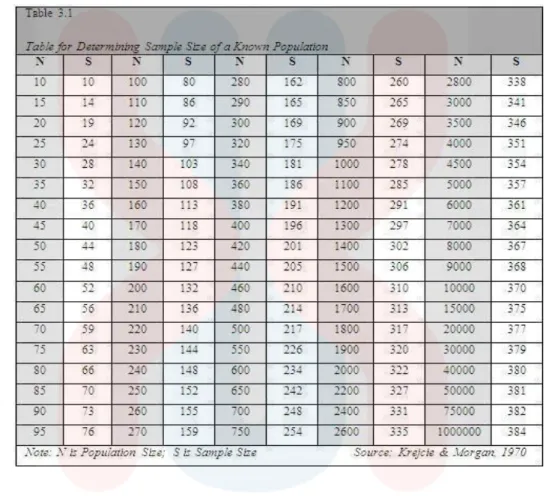
The number of people who take part in the survey and are included in the sample is known as the sample size. In this study, the sample of this study looked at the factors that influence the consumption of halal cuisine among consumers in Malaysia. A sample size of at least 120 Muslims and non-Muslims from Malaysia is required for this investigation. As a consequence of this, the total number of 120 respondents will be selected using the Krejcie & Morgan table (Krejcie and Morgan 1970), which may be found below.
FKP
Table 3.1: Table for Determining Sample Size of a Know Population (Krejcie and Morgan 1970)
3.6 SAMPLING TECHNIQUES
The probability that the researchers can collect data from all situations to answer the research question is improbable. To combat this, a sample is selected for data collection. The set of cases from which the research sample is selected is called population (Taherdoost, 2016). In the scope of statistical analysis, sampling is the selection process for several observations from a larger population that had already been predetermined. The methods that will be utilized to sample from the broad population depend on the types of analysis performed, including simple random or systematic sampling.
FKP
The sample group is determined from the population by utilizing sampling techniques.
Generally, there are two types of sampling techniques: probability sampling and non-probability sampling. Probability sampling ensures equality in the chance for each item in the population to be selected. In this research, probability sampling is used.
Researchers select simple random sampling due to a lack of bias. The reason behind this is that simple random sampling should eliminate the probability of bias from occurring. Subsets of a larger group are made up of randomly chosen individuals, ensuring all members of the population have an equal chance of being selected. A balanced subset that presents the best probability of a broad group representation is achieved in most cases.
The simplicity of this sampling technique is another reason behind the selection. Compared to another, simple random sampling is much easier to produce than using other approaches. Consistent output can be produced as this procedure does not require specific abilities. This reason differentiates itself from other sampling techniques like stratified random sampling, which breaks down a large group into smaller ones known as strata. This method is categorized into groups depending on their common characteristics. The individuals in this method’s subset are also chosen randomly, and it does not conduct any additional actions.
3.7 RESEARCH INSTRUMENT DEVELOPMENT
This refers to the methods used in information gathering. Readings, interviews, questionnaires, and observations are some methods implemented. The researcher must ensure that the chosen instrument is genuine and reliable (Munir, 2017). The validity and reliability of an instrument are significantly impacted by its appropriateness and suitability in any research study. A rigorous
FKP
analysis must be undertaken on methods used for data collection to produce desirable findings.
For this research, the instruments are required to meet the need of this research and are related to Malaysian consumption of halal foods. When the researchers ask one or more general and open questions, the participants must write down their honest responses based on the question. Both the researchers and participants can determine if there is a need for additional points and steer the direction of the interview as required. Questionnaires are used to understand consumer behavior better and make well-informed decisions. Depending on the study's goal, it can be considered a standalone study approach with various strategies. The researcher will give the students and workers a variety of questions related to halal food consumption and will dig further into the answers to the questions posed to the participants to gather more information from the interviews. Questionnaires are carried out to gather complete results and difficulties in discovery. This strategy will let the researcher understand the subject’s experience, opinion, and feelings. Apart from that, researchers can also utilize the data to gather more data from individuals. Data gathering is usually conducted using a standard method to ensure equality between respondents and prevent biased perspectives from influencing the outcome. This is to make sure that the data collected from the instruments can be used to identify this study.
3.8 MEASUREMENT OF THE VARIABLES
An instrument, gadget, or computer may be used to measure a variable. What inferences may be taken from a given dataset depends greatly on the magnitude of the variables being monitored, as well as what analytical tools can be used. Among the many different types of measurements available are those based on nominal, ordinal, interval, and ratio scales, to name a few. Nominal scale data carry
FKP
the least amount of information, whereas ratio scale data include the most amount of information.
3.8.1 NOMINAL SCALE
Rather of a numerical representation, the nominal scale uses a single label to identify or express the worth of each object. Because of this, it is easy to give a numerical value to an item when it is used for identification. In contrast, when the number given to an item acts as a tag for classifying or grouping objects in a class, the nominal scale is utilized. A person may be classified as either male or female based on gender scales, for example. For example, if all men are the number 1, all females might be the number 2. Please keep in mind that the nominal is merely for the sake of calculation.
3.8.2 ORDINAL SCALE
The Ordinal Scale is listed 2nd in four ‘Levels of Measurement’, as described by S.S. Stevens.
Ordinal scales include statistical data types in which variables are in order or position but without the degree of difference between categories. The ordinal scale contains qualitative data; ‘ordinal’ means
‘order’. It puts variables in order/position, only allowing to measure values as higher or lower scales.
The scale is unable to produce an accurate comparison between the two categories.
3.8.3 INTERVAL SCALE
An interval scale is a quantitative measuring scale in which there is an arrangement, the difference between the two variables is meaningful and equal, and the existence of zero is arbitrary. It measures variables that occur along the typical scale at the same interval. The measurements used to determine the distances between variables are fairly dependable. The interval scale is the third measuring level after the nominal scale and ordinal scale. Understanding the first two phases will help you identify the size of the interval. Nominal scales are used when the variables have no natural order or position. You may input numbered or non-numbered variables, but frequent survey examples
FKP
include gender, location, political party, pets, and so on.
3.8.4 RATIO SCALE
A ratio scale is a sort of variable measuring scale that is quantitative. It enables any researcher to compare interval or difference. The ratio scale is the 4th measuring level and has a zero point or original character. This is the distinctive property of this scale. The ratio scale is the most informative scale since it tends to tell about the order and quantity of items between the values of the scale. The most frequent example of this scale includes height, money, age, weight etc. Regarding the consumption of halal food among consumers in Malaysia, frequent instances seen include sales, pricing, number of clients, market share and so on.
3.9 PROCEDURE FOR DATA ANALYSIS
An inductive or deductive approach to content analysis may be used for both types of data, as stated by Elo and Kyngäs (2007). When it comes to qualitative content analysis, little is known about the method and many research books give a cursory introduction. With content analysis, researchers can build models that help researchers make sense of the world. The first three steps in the both inductive and deductive analysis are preparation, compilation, and reporting. The setup procedures for both methods are almost identical. Concepts may be derived from data via the application of inductive content analysis. Deductive content analysis analyzes data using a framework that relies on past knowledge.
In addition, inductive content analysis is employed when no prior research has been conducted on the phenomena or fragmentation. The deductive technique may be helpful if the overarching objective is to test earlier assumptions in various circumstances or to compare categories across time.
FKP
Deductive approaches will be used in this investigation. Re-examining old data in a new context necessitates deductive content analysis (Catanzaro, 1988). Categories, ideas, models, and hypotheses may be examined as part of this study.
In order to link deductive categories to the text, Mayring (2000) claims that the previous section of the theoretical derivative analysis is used. Text passages must be categorized and methodologically controlled during the qualitative phase of analysis. The phase is implemented in numerous text analysis techniques. However, it needs to be better defined. For each deductive category, the primary purpose is to give definitions, examples, and particular coding criteria for the text passages that fall into that category. The definitions of the category are combined using a coding agenda.
Other data analysis strategies included creating and running code by the researchers in their study. An encoding process is just a means of classifying data, according to Dudovskiy (2019b). Short phrases or words may be used in this kind of coding. All codes should have descriptive names and themes. It is possible to encode events, behaviors, activities, and meanings, among other things. Data may be coded qualitatively or quantitatively using software like NVivo or ATLAS.i or HyperRESEARCH 2.8 or Max QDA, or even just by hand.
They are thus keen to employ interviews with informants to satisfy the study requirements for data collection and analysis and to relate the findings with Muslims 'perceptions of the topic. During this interview session, the researcher presents a comprehensive, open-ended question to one or more participants and notes their responses. This is an in-depth interview when a professional researcher meets with a research informant one-on-one. An in-depth interview is comparable to a psychological or clinical interview, although it is used differently in each case. The researcher will ask various questions and then follow up on each response from the informants with more studies to get more
FKP
information about the particular issues offered to the informants. Researchers plan to conduct more data-gathering methods such as questionnaires and open-ended surveys, which will help them get more relevant and relevant data for this study.
ATLAS.ti software, a computer program used primarily, but not exclusively, in qualitative research or qualitative data analysis, is also desired by researchers. With this program, researchers may locate outcomes in primary data; encode and annotate them; quantify and evaluate their significance;
illustrate the frequently intricate connections between them. Anthropologists, architects, communicators, criminologists, economists, educationalists and technologists, as well as researchers and practitioners in the fields of anthropology and anthropology, utilize ATLAS.ti.
ATLAS.ti keeps researchers focused on the data, regardless of the subject matter. Analysis and visualization technologies may also offer fresh interpretations of material in the form of new visualizations. In addition, the researcher used primary data, such as the words and phrases that informants used during interviews and surveys, to interpret the data analysis and to discover the differences between primary and secondary data.
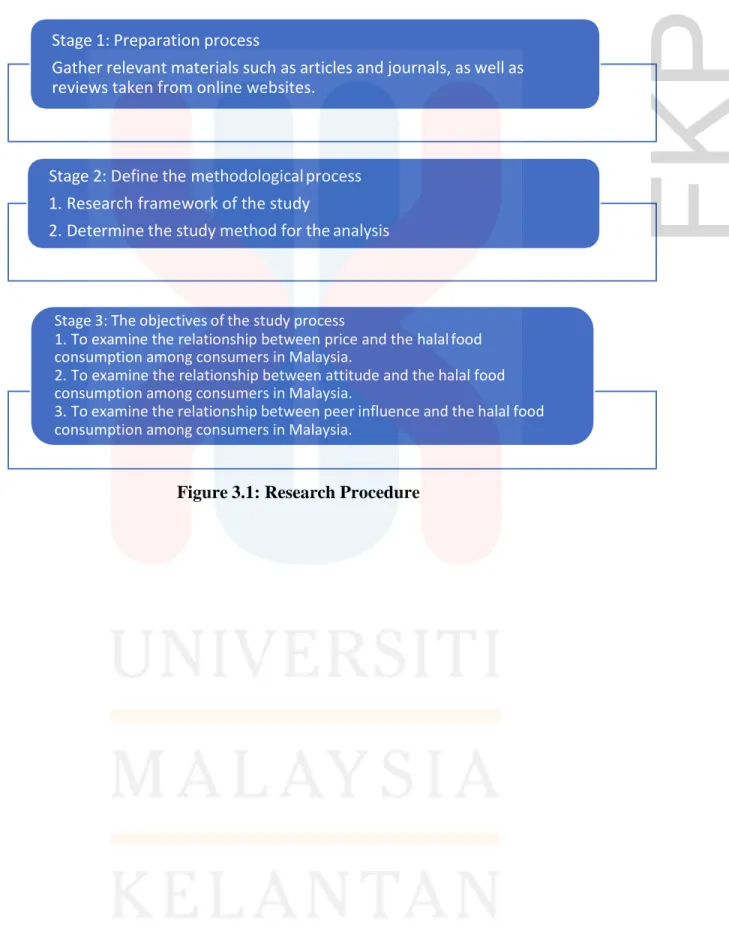
For data analysis, researchers attempt to summarize their findings. Because of this, the study's results have been related to the study's goals and objectives. Consequently, researchers can better examine data and information and better forecast data analysis findings. Consequently, the procedure shown in Figure 3.1 below serve as a brief demonstration and application of this study’s methodology.
FKP
Figure 3.1: Research Procedure Stage 1: Preparation process
Gather relevant materials such as articles and journals, as well as reviews taken from online websites.
Stage 2: Define the methodological process 1. Research framework of the study
2. Determine the study method for the analysis
Stage 3: The objectives of the study process
1. To examine the relationship between price and the halal food consumption among consumers in Malaysia.
2. To examine the relationship between attitude and the halal food consumption among consumers in Malaysia.
3. To examine the relationship between peer influence and the halal food consumption among consumers in Malaysia.
FKP
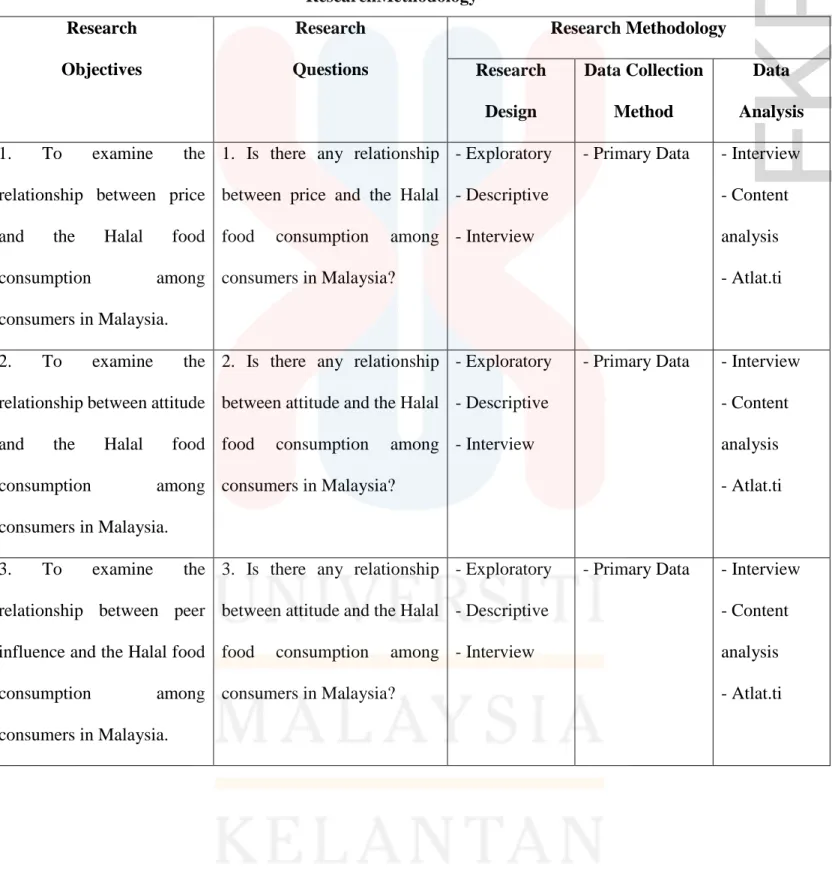
Table 3.2: The relationship between Research Objectives, Research Questions and Research Methodology
Research Objectives
Research Questions
Research Methodology Research
Design
Data Collection Method
Data Analysis 1. To examine the
relationship between price and the Halal food consumption among consumers in Malaysia.
1. Is there any relationship between price and the Halal food consumption among consumers in Malaysia?
- Exploratory - Descriptive - Interview
- Primary Data - Interview - Content analysis - Atlat.ti
2. To examine the relationship between attitude and the Halal food consumption among consumers in Malaysia.
2. Is there any relationship between attitude and the Halal food consumption among consumers in Malaysia?
- Exploratory - Descriptive - Interview
- Primary Data - Interview - Content analysis - Atlat.ti
3. To examine the relationship between peer influence and the Halal food consumption among consumers in Malaysia.
3. Is there any relationship between attitude and the Halal food consumption among consumers in Malaysia?
- Exploratory - Descriptive - Interview
- Primary Data - Interview - Content analysis - Atlat.ti