Java Interactive Application for Teaching Long Division to Kids
by
Nur Fadillah Binti Alias
Dissertation submitted in partial fulfilment of the requirements for the
Bachelor ofTechnology (Hons) (Business Information System)
SEPTEMBER 2011
Universiti Teknologi PETRONAS Bandar Seri Iskandar
31750 Tronoh Perak Darul Ridznan
CERTIFICATION OF APPROVAL
Java Interactive Application for Teaching Long Division to Kids By
Nur Fadillah Binti Alias
A project dissertation submitted to the Business Information System Programme
Universiti Teknologi PETRONAS in partial fulfilment of the requirement for the
BACHELOR OF TECHNOLOGY (Hons) (BUSINESS INFORMATION SYSTEM)
UNIVERSITI TEKNOLOGI PETRONAS TRONOH, PERAK
CERTIFICATION OF ORIGINALITY
This is to certizy that I am responsible for the work submitted in this project, that the original work is my own except as specified in the references and acknowledgements, and that the original work contained herein have not been undertaken or done by unspecified sources or persons.
NURFADILLAH ALIAS
ABSTRACT
Java Interactive Application for Teaching Long Division to Kids is an application that specially built for Standard three until Standard six pupils. This application is a Java applet application. The development of this project had been chosen because the lack of courseware which is specifically for these range ages of students. Besides, the existing courseware that are available in the market are too general and common. For primary school, long division contains in the syllabus of Mathematics starting from Standard two until six. Long division is chosen in development of the application because majority students in this range of age are weak on Mathematics especially in this topic. This is because they did not able to understand the basic concepts of the problem solving.
Actually, if they know the basic of the mathematic problem solving, the subject can be mastered. That is why an effort to help this level of students was come out. This application takes advantages of written text and interactive simulations to help students understand more the basics concepts.
ACKNOWLEDGEMENTS
There were many people's involved throughout completing this Final Year Project, which has contributed to give help, guidance, assistance, motivate, advice, supports, and also supervise. I would like to express my appreciation and highest gratitude to the individual that have taken the time and effort to assist me in completing the project.
Without the cooperation and some motivation of these individuals, no doubt I would have to face some problem throughout the course.
Special thanks go my supervisor, Dr. Mohamed Nordin Bin Zakaria. Without his guidance, assistance and motivation, I would face a lot of obstacle. Regardless thanks to my parents, Alias Bin Ismail and Norzakiah Bt Abd Jalil for raising me until I became who am I now. This Final Year Project is specially presented to my parents as they are my backbone of my project and they are the most important person to me and have supported me all this time.
TABLE OF CONTENTS
CERTIFICATION ... 1
ABSTRACT ... II ACKNOWLEDGEMENT ... iii
CHAPTER!: INTRODUCTION ... l 1.1 Background of Study ... .1
1.2 Problem Statement. ... 2
1.3 Objectives ... 3
1.4 Scope of Study ... 3
CHAPTER2: LITERATURE REVIEW ... 4
2.1 Learning and teaching theories ... ..4
2.2 Mathematics and Long Division ... 6
2.3 Interactive Application for Communicating Matbematics.8 2.4 Current Courwares and Its Limitations ... 9
CHAPTER3: METHODOLOGY ... 14
3.1 Prototyping-based Methodology ... 14
3.2 Project Milestone ... 21
CHAPTER4: PROJECT ACTIVITY ... 22
4.1 Flow Chart ... 22
4.2 Use Case Diagram ... 23
4.3 Survey ... 24
4.4 User Interface Prototype ... 29
CHAPTERS: DISCUSSION & RECOMMENDATION ... 33
CHAPTER6:
REFERENCES APPENDICES
LIST OF FIGURES
5.2 Recommendation ... .34
CONCLUSION ... 36
...... 37
...... 39
Figure 2.1: A typical Honey and Mumford 'kite' ... 5
Figure 2.2: Coolmath's Long Division Lessons ... 9
Figure 2.3: Coolmath's Long Division Test.. ... 10
Figure 2.4: Snork's Long Division Game ... . 11
Figure 2.5: Selection Screen for Draggable Division ... _ ... _ ... 12
Figure 2.6: Draggable Division Work Space ... __ ... 13
Figure 3.1: Prototyping-based Methodology ... .14
Figure 3.2: Milestone of the Project ... ... 21
Figure 4.1: Flow Chart Diagram ... _ ... _ ... 22
Figure 4.2: Use Case Diagram ... __ ... 23
Figure 4.3: Way to Learn Long Division Chart ... _ ... 24
Figure 4.4: Understanding on the Topic Chart ... _ ... 25
Figure 4.5: Implementation ofJava Interactive Application Chart ... 26
Figure 4.6: Implementation Level of the System Chart ... _ ... _ ... _ ... .27
Figure 4.7: Student Understanding on Java Interactive Application Chart ... _ ... ___ .... 28
CHAPTER!
INTRODUCTION
1.1 Background
Students should be exposed in computer application other than only in class learning.
There are a lot of advantages through computer application. Some of the advantages are to provide a training which can be used 24 hours a day. Mathematics teacher can also use this courseware during the class. There is no need to use textbooks and it can provide easy navigation and interaction throughout the content and testing. Although there is a lot of web-based courseware in the internet, but this is only few of the courseware allocated for the standard three to six kids. Even ifthere are any, only few questions and information are provided and it is not enough to make students understand.
In handling those problems, a Java interactive application is developed. Courseware is computer software designed to provide instruction or training. In this courseware, the mathematical concept that will be included is long division. This courseware is fully developed for standard three to standard six students. This courseware will provide the training in understanding mathematical operation that contains long division.
1.2 Problem Statement
Mathematics is a subject that is not easy for students to master if the student did not really understand the basic concepts. According to Learning mathematical concepts such as fraction and division can be quite challenging for students due to several reasons. In the study of fraction, it is difficult for students because it "inherently" has some powerful properties, which no other numbers can even come close when comparing to fraction (Ho, & Ho, 2009). Thus, with the help that provided by this courseware can help the kids to trace the logic for that operations.
The main reason resulted in developing this project is because the mathematics courseware provided for standard four students is limited in the market. Most of coursewares that available in market are usually for kids around five-years-old.
1.3 Objectives
The objectives of this project are:
•:• to have an interactive application that help
•:• primary school students to learn
•:• teachers and parents to educate that support learning for long division logic.
1.4 Scope of Study
In order to complete this system, several scope of study is in need to achieve. The major scopes are discussed as follows:
I. To get information and proper understanding in
a. How is the perspective of 10-years- old kids thinking and their progress in learning mathematics
b. Current system used in school
2. Suitable development platform
a. JAVA progranuning language will be used as the main development platform
3. Design of the interfilce to the user
a. The good user interfilce should be considered in this system
b. All GUI are based on research and will make the user feel comfortable to use the system
CHAPTER2
LITERATURE REVIEW
2.1 Learning and teaching theories
Each person has different learning styles and it is not a fixed traits of an indivudual.
According to Alan (2009), learning style is defined as habits, strategies, or regular mental behaviors concerning learning, particularly deliberate educational learning, that an individual displays. Honey and Mmnford (1986) suggest a person need to be able to adopt one of four different styles in order to complete any learning task satisfactory. The four styles described in the Honey-Mmnford Model are:
• Activists
• Reflectors
• Theorists
• Pragmatists
Activist 20
20 20
Pragmatist-+-+-t---t--t-7--1- Reflector
Theorist
Figure 2.1: A typical Honey and Mumford 'kite·
Cognitive psychology is the scientific stndy of mental processes such as learning, perceiving, remembering, using language, reasoning and solving problems. While the cognitivist definition of learning is a relatively permanent change in mental associations as a result of experience (Alan, 2009).
Wray and Lewis ( 1997) single out four aspects of constructivist learning theory which they consider to be very importance:
• Learning is process of interaction between what is known and what is to be learnt.
• Learning is a social process.
• Learning is sitnated process.
• Learning is metacognitive process.
From these four aspects of constructivist learning theory, Wray and Lewis go on to formulate four principles for teaching:
• Learners need enough previous knowledge and understanding to enable them to learn new things.
• Provision should be made for social interaction and discussion in groups of varying sizes, both with and without the teacher.
• Meaningful contexts for learning are very important; it must remembered that what is meaningful for a teacher is not necessarily meaningful for the child.
• Children's awareness of their own thought processes should be promoted.
In the act of teaching, there are two parties (the teacher and the taught) who work together in some program. Pedagogy is study of teaching methods, including the aims of education and the ways in which such goals may be achieved. The field relies heavily on educational psychology, or theories about the way in which learning takes place (pedagogy, 2011). Effective teachers need pedagogical content knowledge rather than knowledge of a particular subject matter. Pedagogical content knowledge (PCK) is knowledge about how to teach in particular disciplines.
2.2 Mathematics and Long Division
Mathematics is the language of the universe and starts with the most basic concept and expands to the most complex. Each concept scaffolds one upon the next and once understood and mastered allows the learner to progress further (Sawyer, 2008). For students to be successful in math, it is important that they have a clear understanding of the basic math concepts, before progressing to more complex and challenging material.
Once a student understands some of the simpler rules of math, they will feel more confident and able to combine mathematical concepts to be used in more advanced
problems. To learn any mathematic concept, students need to practice and apply the concepts regularly and in a setting that exemplifies the practical use of the concept.
Perry & Dockett (2008) said many teachers of young children do not have a sound understanding of the mathematics that they are expected to teach nor of where this mathematics might lead. (p.97) This situation may make the children to feel incompetent even fearful about mathematics and then they may try to avoid activities related to mathematics.
According to research developed by NRICH Team Project, division is the most difficult topic as compared to others basic mathematical operation, addition, subtraction and multiplication. The difficulties oflong division process are because involves inherent in the process, it requires control of subtraction, multiplication and addition and the student needs to remember the multiplication table (Holland 1942). The inherent process in long division sometimes make student confused to put where and to write which number first.
Plus, the student really need to know the others operation; addition, subtraction and multiplication in order to master long division. Based on Wagaman, strategies are really needed for teaching simple and long division which will help turn a complex math idea into a simple math problem to solve (2008).
According to Curriculum Development Centre (MOE), division included in Integrated Curriculum for Primary Schools (KBSR) syllabus (2003). Long division is started to introduce for Standard two kids (Othman, Zakaria & Md. !sa, 2004). In Standard two syllabus, the basic long division is introduce to give them exposure on how long division is worked before move to the next more challenge long division. Starting from 2011, Ministry of Education has introduced Standard Curriculum for Primary Schools (KSSR) which they started to implement it for Standard one pupil.
2.3 Interactive Application for Communicating Mathematics
Regarding to Sain Haruzuan & Yen (2008), most of teachers in our country have yet to integrate computer-based learning into their teaching. Some do not apply technological teaching aids in their teaching due negative attitudes while others due to the lack of computer-based learning tools such as education softwares. Researches has been made and showed that most schools lack sufficient electronic teaching aids such as education softwares and computers to help teachers in their teaching. This has also led to computer illiteracy amongst some students. More efforts should be done to improve the computer literacy rate in school and improve the teaching and learning process in the school. A unique feature of effective computer-based learning envirorunents as compared to other types oflearning materials is their intrinsically cognitive character (Bishop, 1996).
With the use of technology and the power of mathematical concept, computer-based learning is the best tools to make the job easier for teachers and parents and make the students become more eager and keen to learn mathematics. Computer technology (Perry, & Dockett, 2008) is also seen to have great value in young children's learning through aspects such as social and cognitive gains, children interacting within an individually appropriate learning envirorunent over which they have some control, a sense of mastery, the development of representational competence and encouraging children to create and explore in a variety of ways not otherwise possible. Kortenkarnp (2002) said, "I would like to call mathematicians all over the world to participate in the process of creating better communication tools for communicating mathematics. It is our chance to change the way mathematics is perceived by non-mathematicians or early students, it is the chance to teach more and understand more" (Borwein, Morales, Polthier, & Rodrigues, 2002). The implementation of complex mathematical concepts courseware for kids is good for the development of their potential and needs.
2.4 Current Courwares and Its Limitations
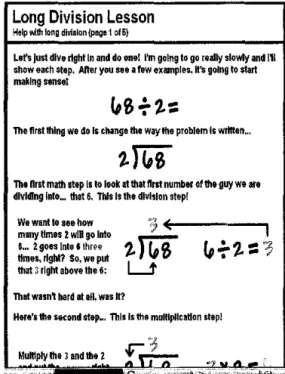
There are quite a lot of coursewares available online that teach mathematics. But there are only a few that focus on long division topic. In coolmath4kids.com, it contains the long division lesson. Coolmath4kids.com has several examples with each step explained and some practice problems with solutions. Based on figure 2.1, it seems hard for beginners to understand the steps because it explains in long sentences. Besides, the user needs to wait for the next page when the first page is done. The dividend and divisor also cannot be determined by the user.
Long Division Lesson
Help with long dlvlslon(poge 1 of6)
Lat'5 just dive right In and do one! I'm going to go really slowly and 111 show each step. After you see a few examples, H's going to $Wt making sensei
Tlle first thing we do Is cltange the way the problem Is written ...
111e Drst math step Is to look at that nrstnumber otthe guy we are dividing Into ... that 6. This Is the division step!
We want to see how j - - - ,
many times 2 wiD go Into
M
6 ... 2goestnto•three
2.
1.4 '-+~:::,?times, right? So, we put \1 f1 \1
that 3 right above the 6: LJ
TlJat wasn, hard at all. was H?
Here's the second step... This Is the mulllpllcaHon stepl
Figure 2.2: Coo/math's Long Division Lessons
*source: www.coolmath4kids.com
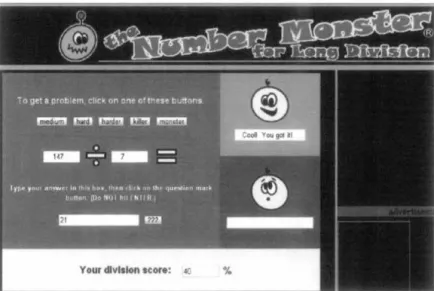
Based on figure 2.2, coolmath4kids.com also provides the platfonn for kids to test their understanding in long division. But the problem with this website is it does not provide the spaces for the kids to calculate their answer. It only provides the answer box.
Your clvltlon tcOfe: 40 ".4
Figure 2.3: Coo/math's Long D1v1sion Test
•,·ource: www.coolmath./krd.'i.COm
The online mathematics tutorial, kidsnumbers.com also provides long division operation.
Based on figure 2.3, they show a good example as they guide the user to solve the question step by step. But the background sound is quite loud and did not have mute button which it can disturb the kid concentration to solve the problem. This game also not contains the basic example thus it focuses more in rugher level of long division operation. Besides, if the kid does not manage to answer the question, there is no other way they can get the answer. It will proceed to the next step if only the user enters the right number at the right time.
Frgure 2. -1. Snork 's Lon~ Drvrswn Game
*source. www.krdsnumbers com
Draggable Math is one of the most popular applications on MrNussbaum.com.
Draggable Division is one of the applications under Draggable Math. In thls application, the user can choose the number of problems they want to solve, number of digits for dividend and number of digits for divisor. Besides, the user can also choose whether to solve the question with remainder or not. It also user friendly because the user can enters their name.
DRAGGABLE DIVISION
S.lo<JN ~-"'"'"""""""'"'*""'""'" I -: c "-""'-"'" d ""'~ 1~:
~MI"'•m~f"blrol •kw.livt~U~ I :
-
F1gure 2.5: Selection Screen for Draggable DIVISIOn
•source: www.mmusshaum. com
In this application, the user needs to drag the answer tn the space provided. It 1s troublesome for the kids to use the mouse to do drag and drop things as they just newly learnt to use computer. Besides, the work sheet and results column are no tally with each other. lf answer in the work sheet is not same with the results, this application cannot detect it. The calculator provided at the right side will make the kids not Jearn much because it can depends on the calculator to get the multiplication answer instead of remember the multiplication table.
DRAGGABLE DIVISION
0
1 2
J 1
r
54 5 6 7 8 9
6 0
fa della
0
c
6 7 8 - 3 4 5 0 1 2 =
F1gure 2.6: Draggable D1v1s1on Work Space
*source: www.mrnussbaum.com
CHAPTERJ
METHODOLOGY
3.1 Prototyping-based methodology
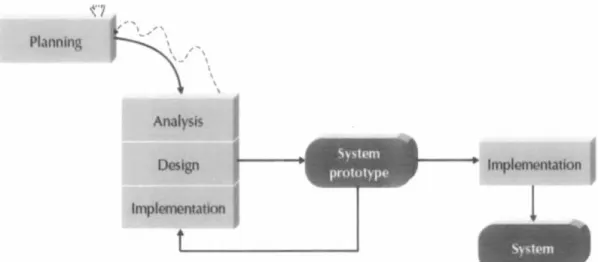
This project is using prototyping-based methodology to develop the application. Since this project timeline is short, prototyping-based methodology ts the best system development life cycle (SDLC). By using prototyping-based methodology (Dennis, Wixom, & Tegarden, 2010), it can quickly provtdes a system with which the users can interact, even it is not ready for widespread organizational to use it first.
Pl~nnlng
\
\ I
Analysis
\
\
\
'''"'01
pr otoh JW
Figure 3.1: Prototyping-based Methodology
3.1.1 Phase 1: Planning
This first phase is research phase to get the suitable title for the project. In this phase, problems and opportunities are listed. After the title of the project has been decided, feasibility analysis conducted to analyze technical, economic and organizational feasibility before get approval from FYP1 committee. This project has been approved and a Gantt chart on the project schedule was prepared (attached in appendix).
3.1.2 Phase 2: Analysis
The second phase is analysis phase. The analysis of the project involves investigation that needs to be conducted on current courseware(s) available, current system use and collect valuable infurmation from mathematics teachers in primary school The result and discussion of the interview session will be discussed in the following topic.
3.1.2.1 Interview result
An interview was done to clarify the current scenario in primary schools in Malaysia. 6 questions was setup for the interview session. The interview was conducted between standard four mathematics teacher, Ms Siti Haslina and I. Ms Siti Haslina is a teacher at Taman Teknologi Primary School. She has ahuost 10 years experience in teaching mathematics to kids. Before start the interview, Ms Siti Haslina was briefed about the purpose and the objective of the interview. The objective of the interview session is to get know the kids behavior during learning long division, analyze and identify any methods that being used in teaching process and also to seek any suggestion and opinion to improve this project. The interview has been documented as below.
Did you teach your students the long division topic?
Yes, we do.
From what age and when you start to teach your students about long division?
We start teaching the basic long division from Standard two kids but we must teach about multiplication first before move on long division topic. Standard two long division syllabuses only involve multiplication table from two to five only.
Did you find any difficulties to teach them?
Compared to other basic mathematics concepts; addition, subtraction and multiplication, division is the most difficult topic to teach and to make them understand.
They must have first understand the concept of multiplication and remember the multiplication table.
How do you teach this topic? Is there any teaching methods or materials did you used while teaching this topic?
For the basic division, we use the sharing and grouping concepts. But when it comes to long division, the students must remember the multiplication table beforehand Then, when teaching in the class, we must write down the multiplication table beside the question, like the example as follows;
6~36
1X6 =6 2X6 = 12 3X6 = 18 4X6= 24 5X6 = 30 6X6 = 36
Now, students can know how many times does 6 go into 36.
Do you agree if an interactive application will help the children to understand better this topic?
Yes, I do agree because it is about technology and the advancement of what we have now. But the application must really contain and teach the basic things before move on to the more complicated level. Interactive application can be the medium to attract the attention of the students to learn and become interested in learning mathematics.
This are some the examples of cu"ent application available online. Do you have any suggestion to improve the application that will be developed so that it can help these children in learning long division?
Comments on Snark's Long Division Game - the student actually cannot really understand when the first step (How many times does 8 go into 2J?). And for the worst case,
if
the students do not know to answer, there is no possible wcy for the students to get the answer.Comments on Coo/math's Long Division Lesson - It is definitely not the good way to teach the kids. The kids hate to read the long sentences and it makes harder to them.
Comments on Draggable Division - It has a good introduction as the students can choose the dividend and the divisor to work with, but when it comes to the draggable numbers, it becomes hard to kids because they just learn how to use computer, and use the mouse to drag the number is tidiest thing to do.
From this interview, the application available online will helps the teachers to make students understand the topic better but some of the weaknesses have to overcome. With the interactive learning environment, it will make the children enjoy learning this topic and make them eager to learn more.
3.1.3 Phase 3: Design and Development
The third phase is designing and developing phase. This project is currently in this phase which in designing the user interfaces, workflow and system architecture of this application. During this phase, the system need to establish to show the conceptual design that defines the structure and behavior of the system. The development of the application also starts in this phase.
3,1.3.1 Interface Design (Basic Sketch)
Long Division
1. The first thing that needs to be done is to appear a blank Java user interface.
! ~
'
li
Long Division
2. Draw the long division line in Java interface.
Long Division
I I J
3. Add text box for user input.
Long Division
5 -'.} 102
102
1
4. Enable the textbox for user to insert the input and display the input in the work area.
Long Division
5~ 102
D
5. Add four buttons (start, previous, next and finish) and work area to display the steps and direction to the user.
3.1.4 Phase 4: Implementation
The final phase is implementation phase. The delivery of this phase is the prototype of the system. The prototype will be delivered to end user and the system will be tested to ensure it performs as per designed. It will be reviewed if any amendments needs to be made as requested from them. Testing is one of the most critical stages during implementation phase. For this final year project, the final prototype will be combined all the desirable functionalities of the system.
3.2 Milestone
F1gure 3.2: Milestone of the Pro;ect
CHAPTER4
PROJECT ACTIVITY
4.1 Flow Chart
,~ ~'- ~ -~ ~-~ ~~.
..
Show hint
Figure .J. 1: Flow Chart DIGgram
..
I. . I
Show the steps and explanations
Flow chart above show the user's sequance ofthe application. At the first interface, the user need to enter their name, then they need to choose the languange that they preferred. After clicking the "Let's Start" button, the second interface will appear. The user now can enter the question (a dividend and a divisor) that they wanted to get the steps and explanation. User can choose whether to show the hint or not. The hint consist of multiplicatton table of the divisor Each step wtll be explain when the "Next Step"
button is clicked. If the user still not understand the explanation on the question, user can chck on "Refresh" button to repeat the steps. User can clear all the fields by clicking
"Clear" button.
4.2 Use Case Diagram
Java Interactive Application
ll<:Pr
F1gure -1.2: Use Case D~agram
The diagram above shows the interaction of the user with the application. First of all, the user can enter their name and have to choose the language preferred. The user also can enter the question. The user needs to click "Show Step", "Start" and "Next Step" buttons to get the steps and explanations until the answer is displayed.
4.3 Survey
A survey was done to clarify the patents of the current scenario at a primary school in Tronoh, Malaysia. 5 questions was setup to capture the acceptance level of the users towards the new system that is going to be introduced Within them. Sample sizes of 35 pupils were collected to clarify the requirements and user preference of the system to be developed. Questionnaires were distributed to pupils from Year Three to Year Six to identify the different preferences and requirement if there is any.
Way to Learn Long Division
11100"-' in class
Ill n class + tuition
U In class+ tutorial at home
8 1n class+ using application or courseware
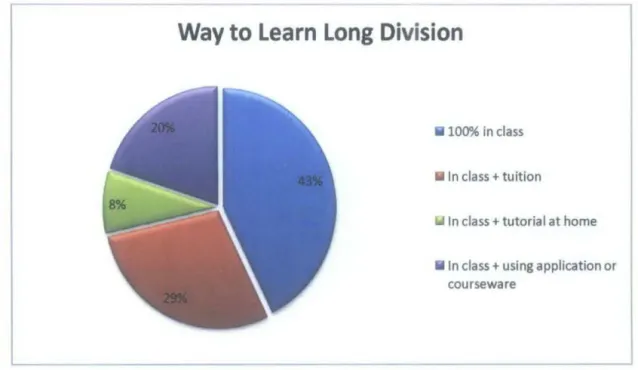
Figure 4.3: Way to Learn Long D1v1s1on Chart
The first graph shows how the trends of students learn about long division. Through this chart, it is plotted that about 43% of the students only focus in class to learn about this topic and about 20% using the application or courseware. From the result above the usage of application or courseware are still not widely used and the implementation of
the new system can be implemented on a strong foundation that is to enable the efficiency and effectiveness of the way to learn on long division.
/ 16 14 12 10 8
6 4 2 0
100"-' in class
Understandin g on the topic
In class+ In class+ In class+ using tuition tutorial at application or
home courseware
Figure -1.-1: Understanding on the Topic Chart
8 Not Understand
• Understand
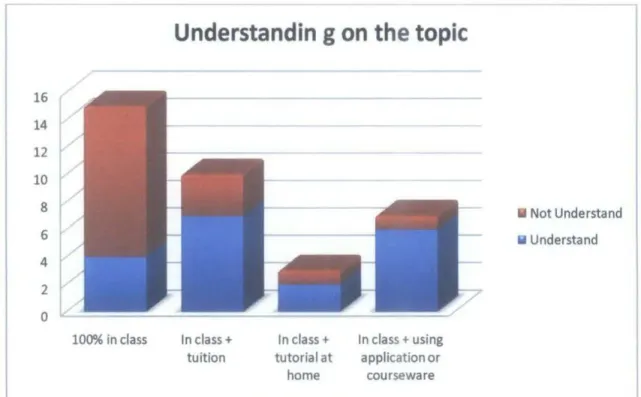
The second question asked whether they can understand the topic or not based on the way of their learning. The relevancy of testifying this question is to see the chance of getting new user for to-be-system and the understanding of students using the available application and courseware. By collecting this information from the questionnaire, it can ease the process of capturing their experience.
Implementation of Java Interactive Application
Figure 4. 5: Implementation of Java Interactive Application Chart
35
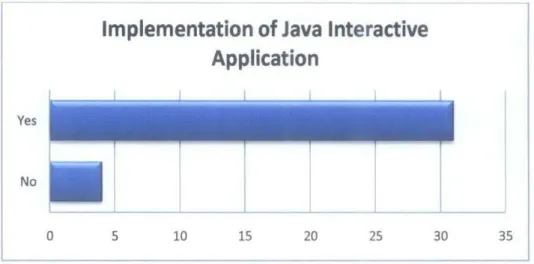
User acceptance of a Java interactive application implementation is also collected. This is to ensure that the new system implementation is widely accepted and does not go to waste. Based on the survey conducted, up to 89% of the people took the survey would like the Java interactive application to be implemented in their way of learning. This result really supports the acceptance test of the system. Therefore this result can strengthen the feasibility analysis of the system.
Implementation Level of the System
II In class
• Computer lab At home II None of above
Figure 4. 6: Implementation Level of the System Chart
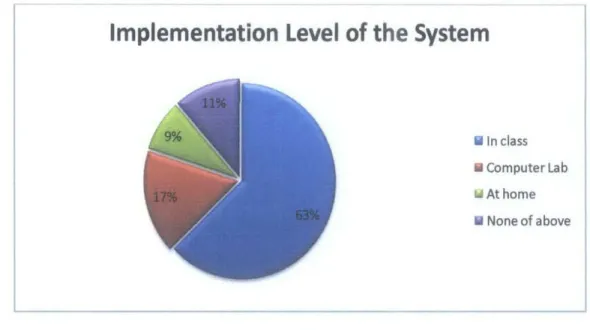
The above chart on the other hand is to retrieve the response on where the application should be implemented. The percentage seems good where more than 50% are really open to accept the new system implementation. Through the survey result, 63% of the students really want the application to be implemented in the class altogether with the as-is-system (learn from teacher). Only 11% is not accepting the system implementation.
12 10 8
6 4 2 0
Student understanding on Java Interactive Application
In class only Java Interactive Application only
In class+ Java Interactive Application
Figure .f. 7: Student Understanding on Java lnteracllve Application Chart
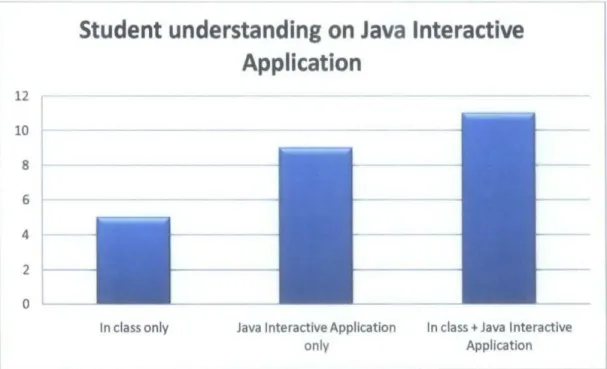
The understanding of student on the toptc using Java Interactive Application was also part of the survey question. Based on the result, the most efficient way to deliver this topic to student is combine lesson in class and give the student learn using Java Interactive Application.
4.4 User Interface Prototype
The system prototype is named Java Long Division . The system user is specially for student in Year Three until Year Six that involves no decimal places, just remainder. All users have the same level of access within the system. The system will capture the user's name. The system provided two language for the user; English and Bahasa Melayu, they can choose which languange they are prefered to use. Each user needs to enter the option before start to use the system.
----
"~-~-~I
Lor•.-nI
The user will enter to the main page of the application. Firstly, the user need to enter the question that they wanted to learn. This system able to detect the error that is made by the user. The user can just enter numbers and the dividend must be between one to twelve. After pressing 'Show steps' button, if there is no errors, the number/question will appear on the work sheet.
The user can choose to enable the sound or not. The sound will explain the steps that to the user, other than just display on the explanation pane. Once the user press 'Start' button, the steps will start to appear in the explanation pane. The user need to think over the explanation given.
...- ~
·-- ~
...
11".~1·. . . 01 . . .
-
-
If the user have any problem especially did not remember the multiplication table, the user can click on 'Hint' button to get the hint ofthe question ·Hint' button will show the multiplication table of the dividend.
o -- l.id ~
...
~.•
...
_,
- 1
Wll'PIJCATlON T..U
1
tXl• J 2.0•1 lll•l
<4lJ• 1.2
~-0•1~
Ill• 11 71)•21
••3•24
Once the user understands the first step, the user can click on 'Next Step' to move to the next step of the question. Keep on pressing on 'Next Step' until get the answer of the question. The 'Restart' button will clear all the steps, using the same question entered by the user, the steps will be replay 'Clear' button is to clear all fields and the application is ready for the next question.
c --
12
07
·•
~-.-
12fl)mt"t81ft17
.,. ... 1 2 .
ft~1
II\A.lW'IJC4TlON
! .
T*r
UhJ 21l·t Jll•t 413 ~ , ,
!ll• 1~
Ill• 11 713•2'1 lll•2•
- · - i I
' j
Currently, the project progress is still at the early of system testing stage. This state of the project is still within the timeline planned based on the gantt chart. The system will be enhancing based on the user preferences.
CHAPTERS
DISCUSSION & RECOMMENDATION 5.1 Discussion
Based on the result of the survey, user requirement collected is quiet helpful in the system development process. Some feature might need to be altered to the user requirement. This is to ensure that the system suits the behavior of student's learning.
Through this new framework, it does not only benefit the students but also the teachers and parents. This is because the system enables the student to learn and practice by their selves on the topic long division. This will reduce the time needed for the student to understand the topic.
In developing the system, the developer may need to consult with the more experts other than teachers concerning the behavior and understanding of the student on the topic. The consultation may include the major concepts in the development part of the system. This is to ensure that the concept implemented is correct and can influence the efficiency and effectiveness of the system.
5.2 Recommendation
In this section, some recommendation will be discussed for the ongoing system development. User preferences will also be taken into consideration in developing the system. To ensure this is taken into count, the result of the survey will also be considered as part of the system requirement.
The original plan of the system was to develop a system that only show steps in English only, and without any audio. Based on the students respondent it showed impressive result on the development of the system if the system also provided in Bahasa Melayu and altogether with the audio. This respond is actually impressive and brilliant in terms of the acceptance level as well as their openness towards a new introductory system.
Finally the prototype of the Java Interactive Application for Long Division will need to be enhancing by making the learning in the class more efficient and effective through the usage of application.
A Graphical animation also should be use to attract student more to learn. Kids mind are more attracted to colored and animated design. The buttons should also be reduced to so that the student will not confuse which button should they click. The system should also provide more option such as 'Test' to measure the understanding of the student after learning using the system.
These recommendations are to be enhanced in future for the betterment of the system function. Further advancement on the graphing element of the system is also needed to
be enhances. Better quality and concept of the graphing technique to be implemented to gain better value of the system.
CHAPTER6
CONCLUSION
As the conclusion, this project will be developed to help kids master the long division concept and make them really understand how long division works before they move on to the next higher level topics. This application will be served as a learning tool for the kids which can be use either in the home or at the class.
The project duration is going according to schedule with good prospect to be able to make the system available before the FYP duration ends. This is due to many opinions and help in making this system a success. The acceptance of the users towards the new system is also tremendous seen from their feedbacks and their requirement as well as their preferences towards the planned framework.
The application will be very useful for kids because it contains a lot of interesting and interactive information. In addition, the design and development of the system allows learner from different levels of ability and knowledge to use the system. The main contribution of this project is it can show that Information Technology and System is developing in our COliDtry.
The project has a large scope of expansion. This can be listed by introducing the framework to other primary schools and tuition centre. This seems to be possible because in Malaysia, the syllabus teach in schools is synchronized and being set by Ministry of Education.
References
[1] Ho, Frank, & Ho, Amanda. (209, December). Why fraction is so difficult?.
Retrieved from http://www.kidsmathblog.com/why-fraction-is-so-difficult/
[2] Sain Haruzuan, Nihra, & Yen, Siow Ching. (2008). Development of a cd-rom based learning courseware for physics form 4, chapter 5 light by using tutorial strategy.
[3] Sawyer, Heath. (2008). Tips to help children understand math concepts. Learning Styles & Skills, 3-14. Retrieved from http://www.helium.com/items/1150444- math-learning -children-concepts-understanding-number -numeracy
[4] Bishop, Alan J. (1996). International handbook of mathematics education [pp.
469-501]. Retrieved from http://books.google.com.my/books?hl=en&lr=&id=OTC- CYCHoPUC&oi=fnd&pg=P A469&dq=computer+based+learning&ots=HHLQs62 oxk&sig=VzBkBz-
qLohlZ4ihHMIObRB83NU#v=onepage&q=computer%20based%20learning&t=fa lse
[5] Perry, Bob, & Dockett, Sue. (Ed.). (2008). Young children's access to powerfUl mathemathical ideas. Madison Ave, New York: Routledge.
[6] Dennis, Alan, Wixom, Barbara Haley, & Tegarden, David. (2010). System analysis and design with uml - an object-oriented approach. Asia: John Wiley & Sons (Asia) Pte Ltd.
[7] Borwein, Jonathan, Morales, Maria H., Polthier, Konrad, & Rodrigues, Jose F.
(2002). Multimedia tools for communicating mathematics. New York: Springer-
[8] Rabanal, Micheal. (2010). Development of interactive science and mathematics courseware for elementary ans secondary level schools. Learning has now become an adventure, 1-15.
[9] Hoon, Teoh Sian. (2006). The effectiveness of an interactive courseware using three different strategies in the learning of matrices. 1-41.
[10] Moari( Shad. (2009). The five stages of math achievement. 1-10.
[11] Ali, Bushro, & Zaman, Halimah Badioze. (2006). Proceedings of the 2nd imt-gt regional conference on mathematics, statistics and applications.Framework for Adaptive Multimedia Courseware, 1-7.
[12] pedagogy. (2011 ). In Encyclopcedia Britannica. Retrieved
from http://www.britannica.com/EBchecked/topic/448410/pedagogy
Appendix
ID Task Name Jan I Feb IMar IApr IMay IJun !July IAug ISept I OCt I Nov IDee Complex Mathematical COncepts
Courseware for Kids
1 Stage 1 - Proposal & Approval
1.1 SUbmit project proposal
D
1.2 Gain approva I on the project topic
D
2 Stage 2 - Research & Development
2.1 Phase 1- Planning
D
2.1.1 Preliminary research on topic
-
2.1.2 Specify scope
2.1.3 Feasibllty analysis 2.2 Phase 2 - Analysis
2.2.1 Requirement gathering
2.2.2 System Analysis
2.2.3 System proposal
-
2.2.4 2.3 Phase 3 - Design High level of initial design
-
2.3.1 Design & development 2A Phase 4 - Implementation
2A.1 Testing
2A.2 Implementation
~
3 Stage 3 - Submission 3.1 System Delivery
Gantt chart