This research is dedicated to the individuals who attempted to set fire (figuratively) to the author's life in an attempt to extinguish it. Additionally, the author would like to thank the individuals who have contributed countless amounts of kites to her (they told me to 'fly a kite') as it has been used as fuel to push the author when she begins to doubt her abilities. Finally, the author would like to sincerely thank the kind individuals who have taken the time and effort to support the author by allowing the author to talk his ears off and make jokes as cold as the Kelvin scale says 0 K (which means OK).
Author's note; The landfill is used not in a degrading way, but a point of reference for the food project of Payatas where the author is actively involved. As such, the author was intrigued by the success of Hero Supermarket and hopes that her study of the retail industry from a Malaysian perspective will be able to facilitate organizations in replicating such successes locally.
INTRODUCTION
- Introduction
- Research Background
- Problem Statement
- Research Objectives
- General Objectives
- Significance of the study
- Chapter Layout
- Conclusion
This reflects that the trade sector (wholesale and retail sector) is an important segment of the economy. Even so, there is limited discussion on the human resource relationship dealing with this industry – as it is an important segment related to the growth of the Malaysian economy, this research was conducted to provide some insight into how the retail industry maintains industrial harmony. By doing so, members of the. economic community will be part of a highly competitive region with free movement of goods and services, investment as well as a more relaxed flow of capital and skills.
This chapter is a preliminary chapter which presents the industrial relations partnership of the retail sector and their relationship with trade unions in Malaysia. The importance of the study and the overall presentation of the research project chapter will be emphasized.
LITERATURE REVIEW
Introduction
At the beginning of this chapter, we will talk about labor relations and their definitions. Then we will look at social dialogue and learn how it relates to the practice of industrial relations, as well as looking at the intensity of social dialogue, the steps of social dialogue, as well as the typology and many different ways social dialogue is practiced.
Literature Review
- Industrial Relations 7
This reflects the diversity within each country through the different ways each culture practices social dialogue through their own set of processes and practices. Therefore, the general idea of social dialogue can be defined as any form of negotiation, consultation or any exchange of information between representatives of governments, employers and workers on issues of common interest in negotiations. Social dialogue is an essential part of industrial relations, because social dialogue is the method of communication between parties who want to build a strong industrial relationship with each other.
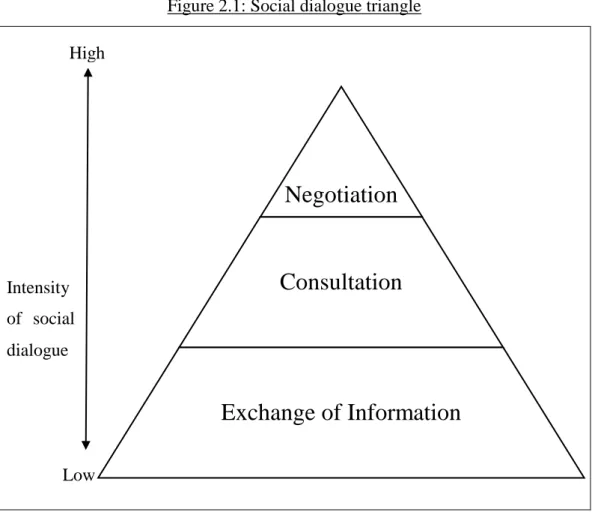
The International Labor Organization defines social dialogue as; “a bipartite direct relationship between labor and management where government is informally involved or not, or a tripartite process where government is recognized as an official party to the dialogue. The ILO illustrates the social dialogue in the form of a triangle with different levels of intensity. Within the triangle, at the bottom is the information exchange where the start of a social dialogue takes place.
Note that while no real discussion takes place here, it is still a crucial step as it represents the starting point of a more substantial social dialogue. Therefore, Trebilcock (1995) considers tripartite policy coordination (also known as social coordination) as the full flowering of social dialogue, because the ability to execute would mean that employers, workers' representatives and governments are able to act in a coordinated multilateral way in addressing all national economic and social policy issues through consensus. Therefore, the only difference between the ILO, the European Commission and other definitions of social dialogue is that Visser clearly distinguishes between social dialogue and negotiation.
Social dialogue can take many different forms and has been classified as such by Casey and Gold (2000) and Berger and Compston (2002). The first quadrant, 'narrow social dialogue' shows a tripartite or bipartite representation involved in discussing issues of working conditions. The second quadrant, representing "broad social dialogue", is usually represented in a tripartite or bipartite fashion, where topics commonly discussed are: broader economic and social issues.
Conclusion
METHODOLOGY
Introduction
Research Design
Data Collection Methods
Sampling Design
- Target Population
- Sampling Frame and Sampling Location
- Sampling Elements
- Sampling Technique
- Sampling Size
Research Instrument
Conclusion
DATA ANALYSIS
Introduction
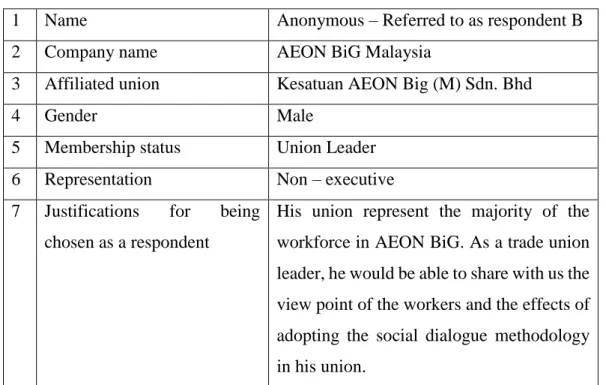
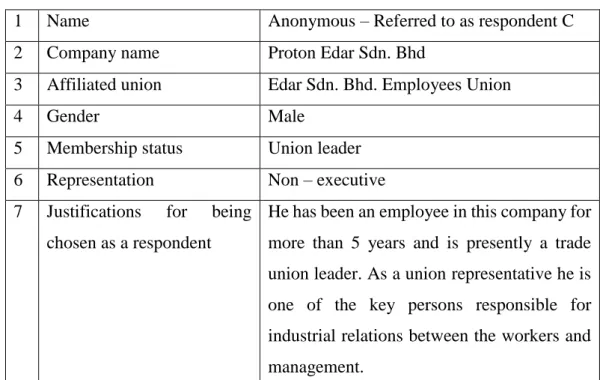
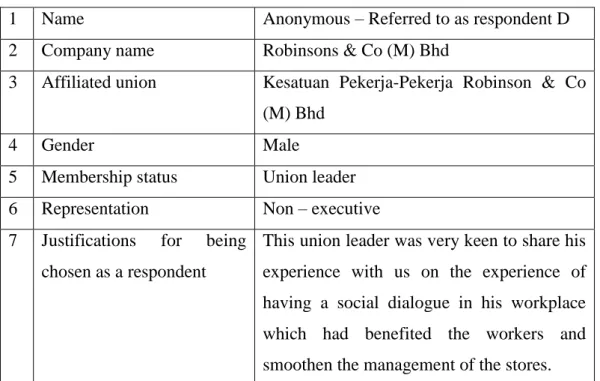
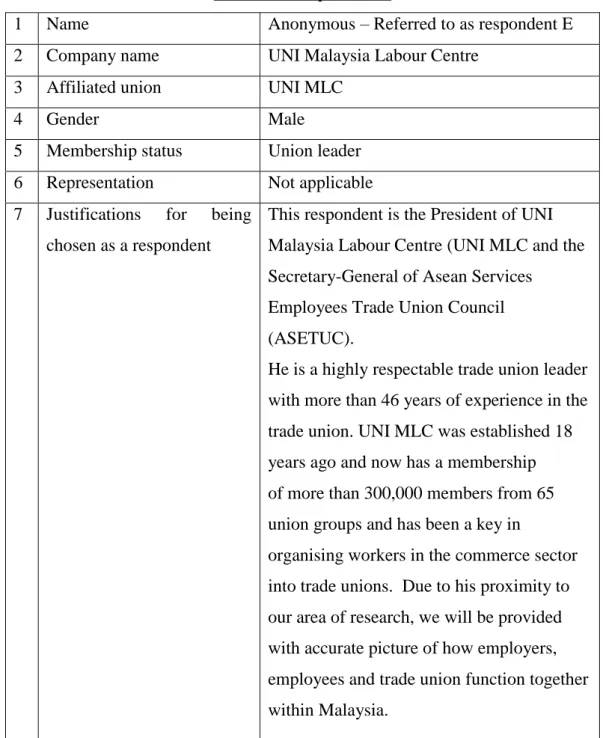
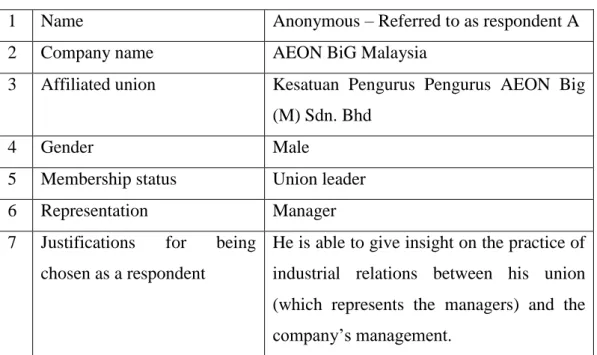
We will first start by defining the reasons for the questions we included in the questionnaire, followed by the answers of our respondents. The last part of this chapter will be a list of the backgrounds of all of our respondents, along with why they were selected to participate in our survey.
Descriptive Analysis
- Respondent Demographic Profile
Respondent E states that trust between both parties is the most important factor that he assesses whether a successful social dialogue has taken place. This is to find out how effective companies are in encouraging employee participation as well as the effectiveness of the social dialogues that take place. We then asked questions exploring how changes were communicated to stakeholders, as well as access to how stakeholders rate the difficulty of raising issues through social dialogues.
Respondent C's company is an example of a lack of intention as their company was not given a mandate by shareholders to implement and develop social dialogues in the past. Respondents A, B and D stated that the government has no participation in the social dialogue with them, while respondent C stated little participation. All our respondents state that the main leaders of the trade unions as well as company representatives are active partners in the development of social dialogue.
Our respondents said that stakeholders are usually notified of changes arising from social dialogues, usually through oral or written notices. Respondents B, C and D stated that it was easy to raise issues using social dialogues, while respondent A stated the difficulty as quite easy. Respondents E and F state that the difficulties in raising issues will largely depend on the strength of social dialogues which rely heavily on the relationships and trust of both parties involved and whether they see each other as partners.
Then, the questions seek to understand problems that arose after the implementation of social dialogues and steps were taken to solve these problems. In addition, the interviewer also tries to find out current issues being addressed as well as how stakeholders perceive the relationship to addressing issues within the company – note that this is different from question 2 because it only refers to raising issues within the company and not during social dialogues. This question is set to find out the level of social dialogue in which the interviewee's company is engaged in order to access the intensity of social dialogues that had taken place.
Conclusion
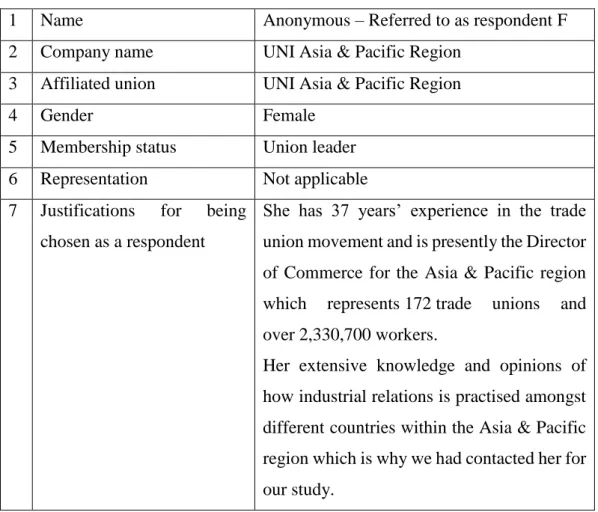
She has 37 years of experience in the trade union movement and is currently the Director of Trade for the Asia Pacific region representing 172 unions and over 2,330,700 workers. Her extensive knowledge and opinions of how industrial relations are practiced between different countries in the Asia Pacific region is why we contacted her for our study.
DISCUSSION, CONCLUSION AND IMPLICATION
- Introduction
- Discussion of Major Findings
- Implication of the Study
- Limitations of the Study
- Recommendations for Future Research
- Conclusion
The power of social dialogues, which includes mutual respect, trust and the sharing of a common goal and vision, helps to add value in sustainable long-term relations between employers and employees, which benefits both sides - employers and stakeholders, when it comes to reaching consensus and cooperation. In addition, this research was intended to get the opinions of the government and policy makers, but they were not able to do so as it takes more than 6 months to schedule meetings and get approval from senior positions (on their part). Most of the mentioned studies are from foreign studies and journals, as there are not enough studies on this topic.
In addition, with respect to this research paper, we hope that future studies will employ the use of quantitative methods to examine the accuracy of the views in this article to examine whether they are representative of the population. It would also be interesting if future studies could cover not only the views of the government, but also the views of the management in relation to the companies involved, as these are the aspects we have omitted in this study. To increase the participation of union workers in relation to the Malaysian government, we would like to recommend the use of behavioral 'nudges' throughout the Malaysian workforce.
Employers can take it a step further by integrating stakeholders into a part of the business plan, where they can offer stakeholders bonuses in terms of company stock. This allows them to have a sense of belonging within the business as they are shareholders of the company they are working for – so they will work hard to improve themselves for the overall betterment of the business, resulting in a closer fit in the shared objectives between employers and stakeholders. We hope that this research has been successful in creating awareness of the importance of educating more people about industrial harmony which can be achieved through the use of social dialogue.
Therefore, we hope that stakeholders will actively seek out the use of social dialogues instead of being forced by law to enter. In conclusion, the strength demonstrated by social dialogues of mutual respect between employers and workers, trust among themselves and share a clear goal of adding value in sustainable long-term working relationships that will certainly benefit both parties as long as consensus is created and the involvement of the main stakeholders. I am undertaking a research project entitled "Partnership Industrial Relations of the Retail Sector and their Relationship with Trade Unions in Malaysia".
What are the problems faced during the process of implementation and successful development of social dialogue. Please tick the box to suggest which of the following union companies you represent.