DEVELOPMENT OF PROTOTYPE WEB-BASED EDUCATIONAL SYSTEM FOR LOW VOLUME RURAL ROAD DESIGN
NUR ARDILLA BINTI SHAZALI
Bachelor of Engineering with Honors (Civil Engineering)
2019
Faculty of Engineering
UNIVERSITI MALAYSIA SARAWAK
DECLARATION OF ORIGINAL WORK
This declaration is made on the 14 day of June 2019.
Student’s Declaration:
I, NUR ARDILLA BINTI SHAZALI (50758), DEPT. OF CIVIL ENGINEERING, FACULTY OF ENGINEERING hereby declare that the work entitled, DEVELOPMENT OF PROTOTYPE WEB-BASED EDUCATIONAL SYSTEM FOR LOW VOLUME RURAL ROAD DESIGN is my original work. I have not copied from any other students’ work or from any other sources except where due reference or acknowledgement is made explicitly in the text, nor has any part been written for me by another person.
14 JUNE 2019 NUR ARDILLA BINTI SHAZALI (50758) Date submitted Name of the student (Matric No.)
Lecturer’s Declaration:
I RON ALDRINO CHAN @ RON BUKING hereby certifies that the work entitled, DEVELOPMENT OF PROTOTYPE WEB-BASED EDUCATIONAL SYSTEM FOR LOW VOLUME RURAL ROAD DESIGN was prepared by the above named student, and was submitted to the “FACULTY” as a * partial KNs 4254 Final Year Project fulfilment for the conferment of BACHELOR OF ENGINEERING WITH HONOURS (CIVIL ENGINEERING), and the aforementioned work, to the best of my knowledge, is the said student’s work
Received for examination by: RON ALDRINO CHAN @ RON BUKING Date: 14 JUNE 2019 (Name of the Supervisor)
I declare this Report is classified as (Please tick (√)):
CONFIDENTIAL (Contains confidential information under the Official Secret Act 1972)*
RESTRICTED (Contains restricted information as specified by the organization where research was done) *
√ OPEN ACCESS Validation of Report
I therefore duly affirmed with free consent and willingness declared that this said Report shall be placed officially in Department of Civil Engineering with the abide interest and rights as follows:
• This Report is the sole legal property of Department of Civil Engineering, Universiti Malaysia Sarawak (UNIMAS).
• The Department of Civil Engineering has the lawful right to make copies for the purpose of academic and research only and not for other purpose.
• The Department of Civil Engineering has the lawful right to digitise the content to for the Local Content Database.
• The Department of Civil Engineering has the lawful right to make copies of the Report for academic exchange between Higher Learning Institute.
• No dispute or any claim shall arise from the student itself neither third party on this Report once it becomes sole property of Department of Civil Engineering, Universiti Malaysia Sarawak (UNIMAS).
• This Report or any material, data and information related to it shall not be distributed, published or disclosed to any party by the student except with Department of Civil Engineering, Universiti Malaysia Sarawak (UNIMAS) permission.
Student’s signature: ___________________ Supervisor’s signature: ___________________
(14 JUNE 2019) (14 JUNE 2019)
Current Address:
NO 63D, LORONG CAHYA MAJU 2, BANDAR BARU SAMARIANG, 93050, KUCHING, SARAWAK.
Notes: * If the Report is CONFIDENTIAL or RESTRICTED, please attach as annexure a letter from the organization with the period and reasons of confidentiality and restriction.
APPROVAL SHEET
This Final Year Project report which entitled “Development of Prototype Web-Based Educational System for Low Volume Rural Road Design” was prepared by Nur Ardilla binti Shazali as a partial KNS 4254 Final Year Project course fulfilment for the Degree of Bachelor in Civil Engineering is hereby read and approved by:
_____________________________________________
RON ALDRINO CHAN @ RON BUKING (Final Year Project Supervisor)
14 JUNE 2019 DATE
i
DEVELOPMENT OF PROTOYPE WEB-BASED EDUCATIONAL SYSTEM ON LOW VOLUME RURAL ROAD DESIGN
NUR ARDILLA BINTI SHAZALI
Report is submitted to
Faculty of Engineering, University Malaysia Sarawak
In Partial KNS 4254 Final Year Project Fulfillment of the Requirements for the Degree of Bachelor of Engineering with Honors
(Civil Engineering) 2019
ii
Dedicated to my beloved parents, who always bestow me sustainable motivations and encouragements
iii
ACKNOWLEDGEMENT
In the name of Allah, the most beneficent and merciful. Alhamdulillah, my humble and highest gratitude to ALLH S.W.T for blessing me with His mercifulness of granting me abundance of health, strength and life throughout my living. With the help and permission of ALLAH, a lot of efforts and self-confidence in doing this project, I was granted the opportunity to accomplish this final year project.
It is my radiant sentiment to place on record of my best regards to my dearest supervisor, Sir Ron Aldrino Chan @ Ron Buking who took time out to hear, supervise and guide me in completing my Final Year Project despite his hectic schedules.
Aside from that, I would like to express my heartiest gratitude to my mother, Mdm Masni binti Zaidi and my family who have never failed to support me throughout my study years.
By using this opportunity, I wish to express my deepest thanks to Mohamad Salihazwan, and Hasrol Hisyam for assisting me in developing the system and continuous motivation through the process of writing the thesis.
iv
ABSTRACT
Road design is very closely related to the use of authorities’ guidelines to meet the needs and ensure safe and economical roads are constructed. However, calculation provided in guidelines usually involved complex and complicated formulae that require more time. Therefore, a Prototype Web-Based Educational System for Designing Low Volume Rural Roads (LVRRs) was developed. The main objective of this study is the developing prototype of a web-based expert system to determine the appropriate design and solutions for flexible pavement. This system is a knowledge-based system which may assist or use as reference by novice engineers, technicians, students and other potential users who interested in studying pavement design. The proposed system contains a knowledge base, descriptions and solutions which is shown as draft calculation and uses the latest manual based on the 1st Edition of Guidelines of the Design Low Volume Rural Road by JKR Research Centre for the prototype. In this research, there are two (2) kind of information collected which are primary data and secondary data which is standard guideline and questionnaire respectively. Questionnaire was used to assist in verifying and validating the system. There are two phases in collecting the responses from targeted populations. The first phase evaluation was done during Workshop on New Guidelines of Low Volume Rural Road by JKR to validate the web-based system is needed. Then, questionnaire for second phase evaluation is distributed by online (Google Form) to experts to verify and validate the system. Tabulation of analysis of results is evaluated using Microsoft Excel and Analysis of Variance (ANOVA). The results obtained shows that the web-based system very much important as a tool for references and comparison.
v
ABSTRAK
Rekabentuk jalan sangat berkait rapat dengan penggunaan garis panduan pihak berkuasa untuk memenuhi keperluan dan memastikan jalan yang berkos rendah dibina. Akan tetapi, langkah pengiraan yang disediakan dalam garis panduan selalunya melibatkan perumusan yang kompleks dan rumit yang memakan masa yang banyak. Oleh itu, Prototaip Sistem Pendidikan Berasaskan Web untuk Rekabentuk Jalan Luar Bandar telah dibangunkan. Objektif utama kajian ini adalah untuk membangunkan prototaip sistem pakar berasaskan web untuk menentukan rekabentuk yang sesuai dan penyelesaian untuk turapan fleksibel. Sistem ini adalah satu sistem berasaskan pengetahuan yang boleh membantu atau digunakan sebagai bahan rujukan oleh jurutera muda, juruteknik, para pelajar dan pengguna lain yang berminat untuk belajar tentang rekabentuk jalan. Sistem yang dicadangkan ini mengandungi asas pengetahuan, deskripsi dan penyelesaian yang ditunjukkan sebagai pengiraan draf berpandukan Garis Panduan Merekabentuk Jalan Luar Bandar edisi pertama yang dihasilkan oleh Jabatan Kerja Raya (JKR). Dalam kajian ini, terdapat dua jenis maklumat digunakan iaitu data primer dan data sekunder. Data primer yang digunakan ialah garis panduan manakala data sekunder ialah soal selidik.
Kajian soal selidik dipilih untuk membantu dalam mengesahkan sistem ini. Terdapat dua fasa untuk mengumpul respon daripada penduduk sasaran. Fasa pertama dilakukan di bengkel tentang garis panduan baru untuk merekabentuk jalan luar bandar oleh pihak JKR untuk mengesahkan keperluan sistem tersebut pada masa kini. Soal selidik untuk fasa kedua telah diedarkan melalui atas talian (borang Google) kepada pakar untuk mengesahkan sistem ini. Tabulasi analisis keputusan soal selidik dinilai menggunakan Microsoft Excel dan analisis varians. Keputusan yang didapati menunjukkan bahawa sistem berasaskan web amatlah penting sebagai alat rujukan dan untuk perbandingan.
vi
TABLE OF CONTENTS
Page
Title Page i
Dedication ii
Acknowledgement iii
Abstract iv
Abstrak v
Table of Contents vi - viii
List of Tables ix
List of Figures x – xi
List of Abbreviations xii
Chapter 1 INTRODUCTION
1.1 General 1 – 2
1.2 Problem Statement 2
1.3 Objectives 2 – 3
1.4 Scope of Study 3
1.5 Significant of Study 3
1.6 Thesis Structure 3 – 4
Chapter 2 LITERATURE REVIEW
2.1 Introduction 5
2.2 Low Volume Rural Roads 5 – 7
2.2.1 LVRR in Other Countries 8
2.3 LVRR Design Criteria
2.3.1 Traffic Volume 9
2.3.2 Traffic Composition 10
2.3.3 Terrain Factor 10 – 11
2.3.4 Traffic Loading 11
2.4 Web-Based Education System 11 – 12
2.4.1 Needs of Web-Based System 12
vii
2.4.2 Reviews on Existing Systems
2.4.2.1 FPS 21 12 – 14
2.4.2.2 ESTAMPSYS 14 – 15
2.4.3 Summary of Existing Systems 16 – 18
2.4.4 Rule of System 18
2.5 Surveys 19
2.5.1 Questionnaire 19 – 20
2.5.2 Survey Sample Size 20
2.5.3 Verification and Validation 21
Chapter 3 METHODOLOGY
3.1 Introduction 22
3.2 Process Flow Chart 23
3.3 Data Collection 24
3.3.1 Primary Data 24 – 25
3.3.1.1 Design Procedures 25 – 27 3.3.1.2 Pavement Composition 27 – 31 3.3.2 Secondary Data
3.3.2.1 Surveys 31 – 33
3.3.2.2 Data Analysis 33
3.4 System Development
3.4.1 Prototype Web-Based System 34
3.4.2 Architecture of System 34
3.4.3 Rule of System 35 – 37
3.5 Verification and Validation 38
Chapter 4 RESULT & DISCUSSION
4.1 Introduction 39
4.2 Needs of the System 39 – 40
4.3 Web Application 41 – 49
4.4 Verification of the Prototype Web-based Educational System
4.4.1 Design Consideration 50 – 51
viii
4.4.2 System Information 51 – 52
4.5 Validation of the Prototype Web-based Educational System
52 – 53
Chapter 5 CONCLUSION & RECOMMENDATIONS
5.1 Conclusion 54 – 55
5.2 Recommendations 56
REFERENCES 57 – 59
APPENDIX A – SAMPLE QUESTIONNAIRE
APPENDIX B – LIST OF QUESTIONNAIRE RESPONSE APPENDIX C – SUMMARY OF RESPONSE
APPENDIX D – CALCULATION OF ANOVA APPENDIX E – F DISTRIBUTION TABLE
ix
LIST OF TABLES
Table Page
2.1 Rural Road Classes in Malaysia 6
2.2 List of International LVRR Classifications 8
2.3 Selection of Design Standard 9
2.4a Terrain Classification 10
2.4b Terrain Factor 11
2.5 Equivalent Standard Axle Loads (ESAL) for Low Volume Road Pavement
11
2.6 Comparison of the Existing Systems 16 – 18
3.1 List of Guidelines by Relevant Authorities used in Pavement Design
24
3.2 Axle configuration and Load Equivalence Factors (LEF) based on Traffic Categories used by Malaysian Highway Planning Unit (HPU)
26
3.3 Lane Distribution Factor 26
3.4 Terrain Factor 27
3.5 Outline of Function and Materials Used for Pavement Structure 28 – 29 3.6 Combination of Alternative Pavement Structures 30 – 31 3.7 Lists of Software Required for Development of the Web-Based
System
37
4.1 Result of Questionnaire for Needs of the System 39 – 40
4.2 ANOVA analysis on Needs of System 40
4.3 Result of Questionnaire for System Information 51
4.4 ANOVA analysis on system information 52
4.5 Result of Questionnaire for Validation of System 52 – 53
4.6 ANOVA analysis on system quality 53
x
LIST OF FIGURES
Figure Page
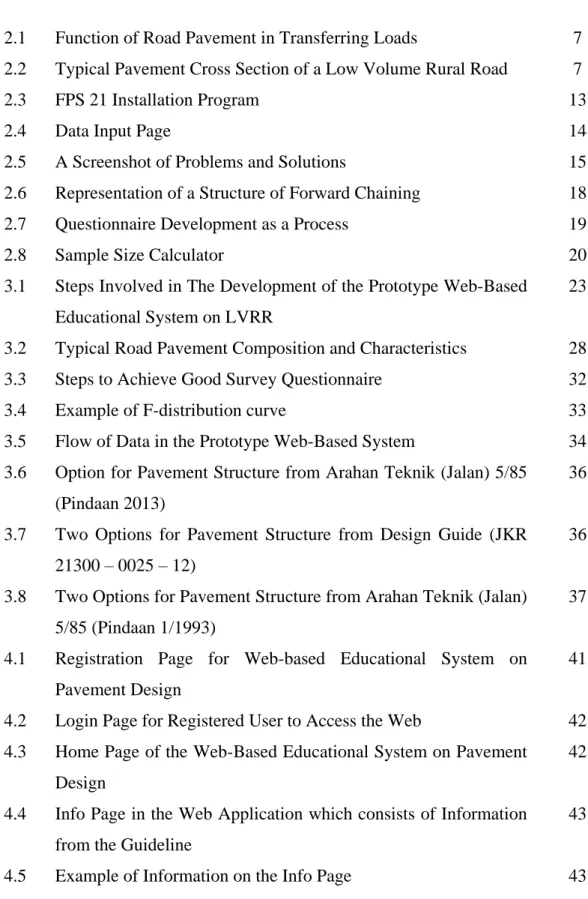
2.1 Function of Road Pavement in Transferring Loads 7 2.2 Typical Pavement Cross Section of a Low Volume Rural Road 7
2.3 FPS 21 Installation Program 13
2.4 Data Input Page 14
2.5 A Screenshot of Problems and Solutions 15
2.6 Representation of a Structure of Forward Chaining 18
2.7 Questionnaire Development as a Process 19
2.8 Sample Size Calculator 20
3.1 Steps Involved in The Development of the Prototype Web-Based Educational System on LVRR
23
3.2 Typical Road Pavement Composition and Characteristics 28
3.3 Steps to Achieve Good Survey Questionnaire 32
3.4 Example of F-distribution curve 33
3.5 Flow of Data in the Prototype Web-Based System 34 3.6 Option for Pavement Structure from Arahan Teknik (Jalan) 5/85
(Pindaan 2013)
36
3.7 Two Options for Pavement Structure from Design Guide (JKR 21300 – 0025 – 12)
36
3.8 Two Options for Pavement Structure from Arahan Teknik (Jalan) 5/85 (Pindaan 1/1993)
37
4.1 Registration Page for Web-based Educational System on Pavement Design
41
4.2 Login Page for Registered User to Access the Web 42 4.3 Home Page of the Web-Based Educational System on Pavement
Design
42
4.4 Info Page in the Web Application which consists of Information from the Guideline
43
4.5 Example of Information on the Info Page 43
xi
4.6 Forum Page showing the Topic Owner and Discussion Shared 44 4.7 Quiz Page showing Random Questions on Basic Knowledge of
Roads with the Submit Button
44
4.8 The Page Showing the Result from the Quiz Answered by User 44
4.9 Screenshot of Design from in Design Page 45
4.10 Screenshot of Design Form in Design Page 46
4.11 Screenshot of Design Form in Design Page 46
4.12 Output Page Resulting from the Data Input in the Design Form 47 4.13 Output Page Resulting from the Data Input in the Design Form 48 4.14 Output Page Resulting from the Data Input in the Design Form 49
4.15 Advantages of Using Web-Based System 50
4.16 Challenges in Using Manual Guidelines 50
4.17 Use of System Information 50
xii
LIST OF ABBREVIATIONS
AASHTO American Association of State Highway and Transportation Officials
ADT Average Daily Traffic
ANOVA Analysis of Variance
CBR California Bearing Ratio
CSS Cascading Style Sheet
HPU Highway Planning Unit
HTML Hypertext Markup Language
JKR Jabatan Kerja Raya
LEF Lane Distribution Factor
LVRRs Low Volume Rural Roads
REAM Roads of Engineering Association Malaysia UNEPSA Union of National European Paediatric Societies and
Associations
UNIMAS Universiti Malaysia Sarawak
1
CHAPTER 1
INTRODUCTION
1.1 General
Rural infrastructure is a major development priority due to social and environmental benefits. According to the Ministry of Infrastructure and Communication and Public Works Department of Sarawak in 2014, Sarawak still requires about 9253 kilometers of rural roads to connect existing kampongs to the main roads by upgrading existing or construction access roads. Providing rural road connectivity is important to enhance economic development especially for agriculture as well as social benefits with easier access to kampongs facilities such as hospitals, schools, and others. Moreover, time to travel from one place to another place can be saved because of the better and maybe shorter routes.
Designing roads should be simplified yet still economically feasible. However, the process of designing rural road is problematic since engineers need to refer to guidelines and standards provided by relevant authorities to get exact data and precise steps of calculation. Meticulous works are needed which required more time to complete a design as rural roads designed must be safe to be used by road users.
Prototype Web-Based Educational System for Designing Low Volume Rural Road (LVRR) is a knowledge-based system produced for novice engineers, technicians, students and other potential users who interested in studying pavement design. Guideline used in producing this prototype system is the 1st Edition of Guidelines for The Design of Low-Volume Rural Roads (LVRRs) from Jabatan Kerja Raya (JKR) Sarawak Research Centre in collaboration with Universiti Malaysia Sarawak (UNIMAS). The guidelines fit all requirements of existing Roads of Engineering Association (REAM) and Arahan
2
Teknik for JKR R1 and R2 road standards. The web-based system will provide reference and guidance for all targeted users especially students. There is a quiz section filled with questions related to road field and some related information that can improve users’
knowledge on pavement design.
1.2 Problem Statement
Road design is very closely related to the use of authorities’ guidelines to meet the needs and ensure safe and economical roads are constructed. However, calculation provided in guidelines usually involved complex and complicated formulae that require more time. Also, the information in guidelines are difficult for the understanding of readers because there are plenty of figures, tables, graphs and others that need to be referred. Thus, the reader may confuse to use which graphs or tables to get the data for each parameter needed. Then, other situations commonly faced by students where lack of availability of data related to low volume rural road pavement design on Internet and other search engine causing students having difficulties in getting guidelines information.
1.3 Objectives
The aim of this research is to develop a prototype web-based educational system for the pavement design on low volume rural. The proposed system contains a knowledge base, descriptions and solutions which is shown as draft calculation. In arrange to attain the point of this research, the objectives are set as follow;
• To identify and validate the need for the proposed system through literature review and a questionnaire survey with engineers.
• To develop a prototype web-based educational system for pavement design on low volume rural roads (LVRR) that contains a knowledge base which incorporate the acquired knowledge in the forms of rules, compiling each data, formulae and options related in designing rural roads which contributes in easier calculations process and better understanding for each design options provided.
3
• To verify and validate the developed prototype web-based educational system through testing and user feedback.
1.4 Scope of Study
This study focuses on developing a prototype web-based educational system that can be used for students and young engineers to design, gain knowledge and information regarding pavement design for low volume rural roads. The system concerned only on the flexible pavement design and uses the latest manual based on the 1st Edition of Guidelines of the Design Low Volume Rural Road by JKR Research Centre. This study excludes the pavement design using American Association of State Highway and Transportation Officials (AASHTO) procedures.
1.5 Significant of Study
The present study covers the preliminary of development of a prototype web- based educational system for pavement design to be used by potential users such as engineers, students, technicians and others as references and basic understanding as well as the concept of pavement design. Furthermore, the system can assist users in pavement design in a short period of time which can be accessed by everyone with an Internet connection.
1.6 Thesis Structure
Chapter 1 includes a general description of the study, issues and objectives that need to be achieved at the end of the study. Moreover, scope, significant and thesis structure also furtherly explained.
Chapter 2 presents literature reviews regarding components of this study. The literature includes past researches related to low volume rural roads, web-based system, questionnaires survey and verification and validation of expert system are presented in this chapter.
4
Chapter 3 touches on methods used to complete this study. Methods used involve data collection method, guidelines used, details of every data and formulae used for calculation and explanation of the web-system. The questionnaire survey sample is also attached in this chapter as well as a method of verification and validation of the prototype system.
Chapter 4 discussed the Results and Discussion which presents the result and analysis of the questionnaire which is clarified with several graphs and charts.
Chapter 5 presents the conclusion for the study comprising achievements of the objectives and some recommendations for future studies.
5
CHAPTER 2
LITERATURE REVIEW
2.1 Introduction
A literature review is depicted as use of ideas in the writing to justify the specific way to deal with the topic, the choice of techniques and ventures to conduct and confirmation that the latest research brings some newest ideas for improvement (Hart as cited by Levy & Ellis, 2006). This chapter will furtherly explain fundamental knowledge of components in low volume rural road design in various countries and methods to conduct and validate the research.
2.2 Low Volume Rural Roads
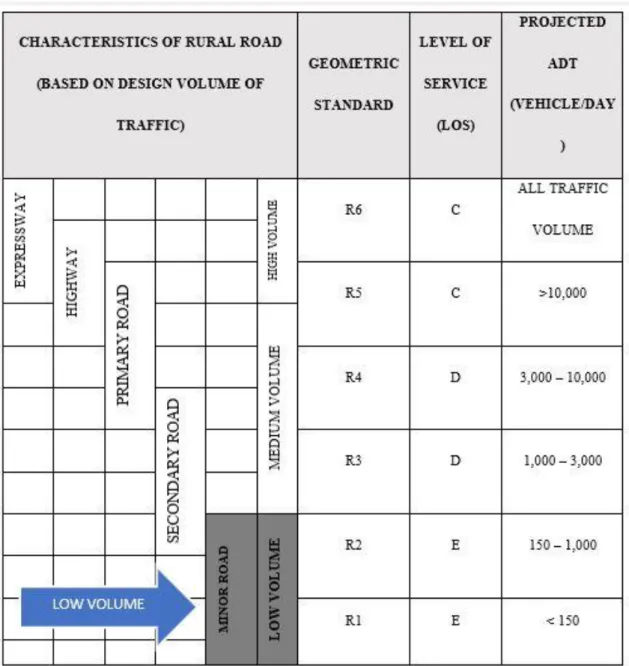
Based on “A Guide on Geometric Design of Roads, REAM – GL 2/2002”, the rural roads are classified into six (6) groups of the design standards; R6, R5, R4, R3, R2
& R1. Moreover, general functions of rural roads are branched into five (5) groups such as Expressway, Highway, Primary Road, Secondary Road and Minor Road as shown in Table 2.1 below. However, only R1 and R2 standards are applicable for the category of Minor Road which structure the basic network within a land scheme, serve mainly local traffic with less trip length with no access control. Projected ADT for R1 and R2 are less than 150 vehicles per day and from 150 to 1000 vehicles per day respectively.
6
Table 2.1 Rural Road Classes in Malaysia
Source: REAM – GL 2/2002
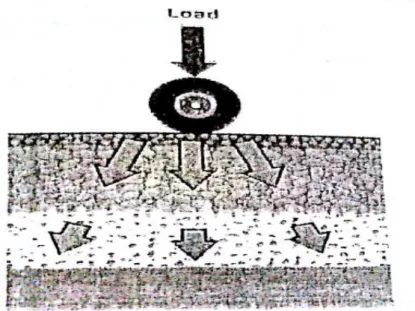
Design of flexible pavement comprising different layers such as sub-grade, sub-base, base and wearing course. The pavement structure made from favourable quality materials transfer forces coming from traffic loads in order to make sure the foundation of pavement is protected from overloading and structure must be safe for all road users (JKR, 2015).
Figure 2.1 shows function of road pavement in transferring loads. Materials used for pavement of Low Volume Rural Road (LVRR) such as bitumen, crushed and natural aggregates or stabilised soils and thickness for every layer of pavement can be determined
7
through few main factors; expected traffic loading, location availability of local materials and cost. Common pavement cross section of a LVRR can be referred from Figure 2.2.
Figure 2.1 Function of Road Pavement in Transferring Loads (JKR, 2015)
Figure 2.2 Typical Pavement Cross Section of a Low Volume Rural Road (JKR, 2015)
8 2.2.1 LVRR in Other Countries
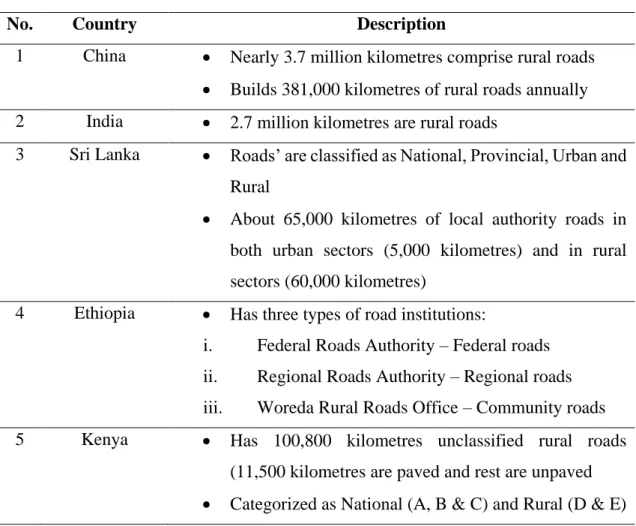
About eighty-five (85) percent of 33.8 million kilometres of roads in this world are classified as low volume rural road with average traffic of below 1000 vehicles per day.
Fifty-nine (95) percent of these roads belong to USA, China, India, Brazil, Japan, Canada, France and Russia (Bhandari, 2013). Table 2.2 below discussed some features of rural roads in different countries.
Table 2.2 Description of Rural Roads in Different Countries
No. Country Description
1 China • Nearly 3.7 million kilometres comprise rural roads
• Builds 381,000 kilometres of rural roads annually 2 India • 2.7 million kilometres are rural roads
3 Sri Lanka • Roads’ are classified as National, Provincial, Urban and Rural
• About 65,000 kilometres of local authority roads in both urban sectors (5,000 kilometres) and in rural sectors (60,000 kilometres)
4 Ethiopia • Has three types of road institutions:
i. Federal Roads Authority – Federal roads ii. Regional Roads Authority – Regional roads iii. Woreda Rural Roads Office – Community roads 5 Kenya • Has 100,800 kilometres unclassified rural roads
(11,500 kilometres are paved and rest are unpaved
• Categorized as National (A, B & C) and Rural (D & E) Source: Bhandari, 2013