1 FACULTY OF APPLIED AND CREATIVE ARTS
GKP 3226
RESEARCH AND FINAL YEAR PROJECT
The Relationship between Ticket Price, Location and Quality of Musical Performance
PREPARED BY CHUAH EE TING (35799)
PREPARED FOR
EN. MOHD FAHMI BIN YAHAYA
28TH April 2015
2 ACKNOWLEDGEMENT
Firstly, I would like to extend thanks to my supervisor, En. Mohd Fahmi Bin Yahaya for giving me full guidance, freedom and support in completing my research paper. He had led me well and provided me a clear guideline in this research. I would like to thank him for always spending his precious time for me regarding the study. Beside this, he showed his support, cares, and patience when I encounter difficultly in completing this research. For example, he always listening and accepting my idea without giving me a frustrated word over.
Next, I am grateful to have so many supports from my family members. I have experience a lot of stress and difficulty when conducting this study. However, my parents especially my mother has show her supports and encouragement all the way made me to have the spirit to go on with this research paper.
Lastly, I would like to thank all my caring friends who continuing giving me encouragement and idea in completing this research paper. They help me a lot when conducting this research paper. I would also like to thank other lecturers for giving me assistance during this study.
I hope that this research paper can provide some idea and benefit for all the readers. Once again, I am grateful to all who have provided me ideas and support to make this research a success.
Thank you.
3 Abstract
The purpose of this research is to identify the relationship between ticket price, location, and quality of a musical performance. Most of consumers considered the higher the price, the greater the quality of a performance. Therefore, researcher tends to find out the relationship between pricing-quality and performing arts. A set of self-administered questionnaire were handed out to 200 respondents who attended live musical performance at several venues. By using the data collected from the respondents, the relationship between ticket price, location and quality of musical performance were tested using Pearson’s correlation coefficient and regression analysis.
Prior to that, confirmatory factor analysis, using structural equation model was used to assess the measurement model. The results revealed that there is a strong positive relationship between the ticket price and performance quality and that location helps strengthen the relationship of the main effect.
Keywords: Arts Marketing, Ticket Price, Location, Quality, Musical Performance
4 Table of Contents
CHAPTER Page
1. INTRODUCTION
1.1 Background of Study 6
1.2 Problem Statement 7
1.3 Research Questions 8
1.4 Research Objectives 8
1.5 Significant of study 8
1.6 Organization of the thesis 9
2. LITERATURE REVIEW
2.1 Arts Performance 11
2.2 Pricing 12
2.3 Quality of Arts Performance 14
2.4 Location 15
2.5 Relationship between Pricing, Location and Quality of Arts Performance
2.5.1 Relationship of Pricing-Quality 16
2.5.2 Effect of Location on the Relationship of Pricing-Quality 17
2.6 Research Framework 18
2.7 Hypotheses Development 19
3. METHODOLOGY
3.1 Research Design 21
3.2 Sampling Method 21
3.3 Data Collection Methods 22
3.4 Question Design 23
3.5 Development of the Questionnaire
3.5.1 Pricing 24
3.5.2 Quality of Arts Performance 25
3.5.3 Location of Arts Performance 26
3.6 Plan for Data Analysis 26
5
4. RESEARCH FINDING
4.1 Introduction 28
4.2 Sampling Results
4.2.1 Profile of the Respondents 28
4.3 Reliability Test 30
4.4 Correlational Analysis 30
4.5 Regression Analysis 31
5. DISCUSSION AND CONCLUSION
5.1 Introduction 33
5.2 Recapulation of study 33
5.3 Discussion and Finding
5.3.1 Relationship between Pricing-Quality 34
5.3.2 The Effect of Location Between Pricing-Quality Relationship 35 5.4 Limitation and Suggestion for Future Research 36
5.5 Conclusion 37
REFERENCE 39
APPENDIX A 48
APPENDIX B 52
6 CHAPTER 1
INTRODUCTION
1.1 BACKGROUND OF STUDY
In an artistic environment, products were offered in various forms. While galleries and museums offer tangible product, performing arts core benefits were translated in experiential contexts. Along with other variables, price has proven to be one of important determinants of quality. An expensive product often perceived as a quality product. Question arises as to does audiences perceive quality of a performance based on ticket price as customers would perceive quality of a product.
Hede, Jago and Derry (2004) stated successful performing arts can be measured by
“storyline of the performance”, “service at the performance”, “value of money”, “stage work”,
“venue of the performance” and “vision from the seat”. Therefore, a manager is required to gain as much knowledge and benefits about the market through various segments to find the right and appropriate consumers.
The notable difference has lead researcher to hypothesize that the price of ticket is directly proportional to quality of performance. In addition, it is also assumed that performance location can moderate the relationship between the main construct. Location here refers to the ease of parking services, travel distance and indoor or outdoor performance. Thus, there are two main objectives of this study. Firstly is to strive to understand the interconnection between the pricing and quality of a musical performance and secondly is to investigate the moderating effect of a
7 location as reflected by the performance on the predicted relationships between ticket pricing and performance quality.
1.2 RESEARCH ISSUES/PROBLEM STATEMENT
Local arts organization, practitioners and scholars fail to understand the difference between artistic offerings. Confusingly, managers adopt existing management and marketing theories into the creative industry hoping to yield impressive result. Studies pertaining to what motivate our audience, buying decision process or even audiences profile had never been conducted.
Setting of a strategic location could motivate audiences to purchase its tickets. Audiences will consider the distance (where to go) of the venue before making their decision and most of the audiences prefer to go for a performance which is situated closer to them as well as provided parking facilities. Thus, managers should have a strategic thinking regarding the location in order to convenient the audiences.
For instance, a question of should the managers charge a different price for the same concert in two different markets or should the managers charge different prices for two seats located in different areas in the same venue?
This research may lead readers to a better understanding of audience view on performance ticket pricing, satisfaction and their overall experience.
8 1.3 RESEARCH QUESTION
The research questions of this paper are:
1. What is the relationship between the prices of ticket and quality of performance attended by audiences?
2. What is the relationship between the location and the quality of a performance when customers purchase tickets?
1.4 RESEARCH OBJECTIVE
The objectives of this paper are:
1. To identify the relationship between ticket prices and the quality of musical performance.
2. To identify the effect of location on the relationship between price tickets and quality of musical performance.
1.5 SIGNIFICANT OF STUDY
The result of this current study is expected to provide a significant relationship between the prices of ticket, location of arts performance and the quality management of the performing arts.
Audiences will attend the performing arts held with a reasonable price as well as equal quality of arts performance. Specifically, the audiences will compare his or her actual service experience with expectations of how the service should have performed.
9 In addition, this research is to determine the relationship between the ticket price and the quality of performance. Audiences are willing to purchase a higher value worth of tickets for a high quality of performance to reach the greatest satisfaction.
According to Kolb (2005), customers will decide on whether the value of expectations have been achieved or even exceeded, or whether they have been frustrated with the experience. Some of the audience refers to prices as an indicator of product quality as their experiences usually give them an impression that an expensive product tends to possess higher quality.
This study attempts to reveal the relationship between ticket price and quality of musical performance and how location affects the relationship between pricing tickets and quality of arts performance. By using statistical analysis, the relationship between the variables can be analyzed in detailed. The result of this study is used to prove that price-quality relationship is important in audiences’ decision making. Audiences’ will purchase a ticket depending on the price, the quality of arts performance as well as the location.
1.6 ORGANISATION OF THE RESEARCH PAPER
This thesis is prepared and organized in five chapters. Chapter 1 provides an introduction to the study and a brief summary of the theoretical framework of this research paper. This chapter discusses the background of the research study, objectives, research question, problem statement, design as well as the propositions, definitions of terms and significance of study.
In chapter 2, researcher provides a literature review which discuss about the relationship between price ticket, location and the quality of performance. In this chapter, pricing-quality
10 relationship is being pointed up, so is the location which could affects audiences’ decision making followed by a research conceptual framework and research hypotheses.
In chapter 3, researcher outlined the method and results of the studies, which include research design, sampling method, data collection method, question design, development of the questionnaire and plans of data collection.
Chapter 4 comprises of the results from data analysis by showing the sampling results, data screening, descriptive statistics, and test of hypotheses by using correlational analysis and regression analysis. Chapter 5 discusses the findings of this study as well as the implications of the findings from managerial and theoretical perspectives. Finally, this chapter is concluded with some directions for future research recommended.
11 CHAPTER 2
LITERATURE REVIEW AND RESEARCH MODEL
2.1 MUSICAL PERFORMANCE
The study on performance is not something new and it is an important tool for modern business in the marketing and communication sectors. According to Getz (2007), live performances can be defined as a powerful communication tool in which they are always special and give audiences a feeling that they are fully enjoy the whole experience, since it will be a lost opportunity once you have missed it.
Performance can be referred to special events which play an important role in tourism.
Special events can be stated as major one-time or recurring events of limited duration which are mainly use to increase awareness, appeal and profitability of a tourism place in a short or long term (Ritchie, 1984).
In a short-term rise, organizing a special live performance such as festivals, concerts, sport events and etc has been recognized as an important strategy. Apart from this, hosting a special event also unconsciously improves the image and branding for sustainable development (Getz, 1997; Hall, 1992; Jago et al., 2010; Prentice and Andersen, 2003; Ritchie, 1984). According to Chalip and Costa (2005), they found that event such as sports events played an important role in branding with different commitments, opportunities and risks; they also analyzed how sports events had been used to build their brand and reach the goals.
12 Besides, based on Crompton and Love (1995), an event goes successfully because performance acts as the most valid predictor in the event. In addition, Getz (1998; 2005) also defined that a live performance can be viewed from perspective of management and planning.
Event planning is the creation of human which is meaningful and generally categorized as “non- routing” and “uniqueness” (Shone and Parry, 2004). However, Goldblatt (2008) had stated that audience is just like a tourist who participated in the events and they gain experience which is different from “normal day of living”.
Mathiassen (1984) said that performance can be viewed as a process that normally related to change. For example, performance is actually a short period process. The participants such as human beings, technology and other artifacts are involved in performances (Baekgaard, 2001;
Poels et al., 2007; Alspaugh and Anto’n, 2008).
2.2 PRICING
The element of “price” can be used in different way such as measuring the ratio between total revenue and total tickets sold. Price can be defined as the total of money charged for a good and service (Kotler, Bowen, and Makin, 2003).
Pricing usually is applied as an instrument to be paid at the point of entry or exiting. The price can be set at different range based on the variety of performance, type of audiences and so on (Frey and Steiner, 2010)
Price acts not only as a determinant in choosing a product but in an economic perspective, price is used as a function to balance demand and supply (Berry and Yadav 1996). Therefore, a
13 central role in the functioning of the economic system (Backman 1965) is known as price mechanism.
Based on Nagle, Thomas and Holden (1995), managers who managed theater will set their initial pricing where the price ticket should be the sum of the consumer’s reference price which is related to their experiences.
From marketing point of view, price is the value placed on what is exchanged (Rowley, 1993). The flexible nature of price (Diamantopoulo, 1991) nominates it as the most important element in marketing mix (Nagle and Holden, 1995).
According to Phelps and Winter (1970), price is an important tool to attract and preserve customers interest which is suggested by existing theories. Therefore, firm used the price as main instrument to attract the audiences (Burdett and Coles, 1997).
Arts marketers formulate pricing strategies by including three factors such as organizational costs, cost to audiences and pricing objectives (Kolter and Scheff, 1997).
Ticket price can be purchase anywhere (Leslie, 2001) and normally, the price of tickets remains unchanged and do not fluctuate over time after the tour of performance is announced (Courty and Pagliero, 2012).
Researcher found that prices influence audience to purchase ticket and it can be clearly seen when there is a discount on purchasing the tickets to multiple performances. Newman and Danny (1977) defined that audiences are able to attend the performance without fear of sellouts and is able to choose their seat location earlier if they bought the ticket in advance. People such as
14 seniors’ citizens or collage students also get the chance to purchase the ticket at a discounted price.
2.3 QUALITY OF MUSICAL PERFORMANCE
Quality is an intangible and imprecise construct which is not easily articulated by audiences.
Customers often think that quality is an adjective like “luxury, or goodness, or shininess, or weight” (Crosby, 1979; Takeuchi and Quelch, 1983).
Zeithaml (1988) concluded that audiences judge the quality of performance based on service’s excellence. Similar to a product, audience evaluates a performance based on their overall joyful experience (Axelsen and Swan 2010). Hence, quality can be defined as the elements of the performance provided by the event or festival which is manipulated by the event promoters (Baker and Crompton, 2000; Crompton 2003; Crompton and Love, 1995).
According to Baker and Crompton (2000), event quality and performance is subjective as it depends on the perceptions of attendee. As different event offers different performance attribute, quality rest on respective.
Quality can be noted as “service” (Throsby, 1994) or “value” (Feigenbaum, 1951). In measuring quality of a performing arts, Crompton (2003) stated that it includes others;
infrastructure, parking and information services. The elements such as services cape, quality of the sound system and musician’s ability and creativity were also found (Minor et al., 2004).
Quality is used to evaluate the artistic of performing arts (Lukas, 1994) and also acts as an indicator for the performance (Schwarzmann, 2000). Auvinen (2001) divides performance quality
15 into three aspects which is dramatic, musical and visual. However, Fabel (1998) differentiate it based on dramatic and visual aspect.
2.4 LOCATION
Based on the research report of National Endowment for the Arts, location can be defined as a venue which is familiar and welcoming the audience in a public place. For example, some of the performing arts can transform the public space into arts venue; however, these spaces retained their sense of openness.
Location can be defined as geographic area to stabilize the relationship between stakeholder and resources and it needs some development strategic to remain audience’s attraction (Raich, 2006). For instance, the increasing of location management can be seen especially the locations where tourism plays a major role.
In addition, location is always under consideration in setting up a live performance.
Performing arts are always held at the location where the limited resources can be used optimally;
enable exchanging of information, broadening the advantages of regional proximity and intermediation (Sydow et al., 2003).
Besides, based on Sauvage (2014), location can be described as a geographical venue where the product (quality of musical performance) will be marketed and sold. Therefore, in order to make the most effective decision based on location, knowledge of demographic is required to make the product access easier to the target audiences.
16 2.5 RELATIONSHIP BETWEEN PRICING, LOCATION AND QUALITY OF
MUSICAL PERFORMANCE
2.5.1 Relationship of Pricing-quality
A manager plays an important role during the organization of a performance as they are required to sell tickets at a reasonable price for a good performance. According to Volckner and Hofmann (2007), price can be used as an indicator towards the quality of product based on audience’s perception and experience, the more expensive the product, the better the quality.
High quality products are said to possess higher prices (Brucks et al., 2000).
Based on Kotler and Armstrong (2010), price is the total amount paid by the audiences or customers for any quality or service. Therefore, Urbany (1986) mentioned that audiences should have the knowledge of price levels which could prevent them to be overcharged for the products or services. He argued that consumers may have concrete knowledge about pricing for major purchases.
According to Monroe (1973), customer uses an expected price to be compared to store prices as a reference point before making any purchase decisions. Audiences will compare his or her actual service experience with whether they are satisfied with the quality that is performed.
Customer satisfaction will be achieved if the providers are giving better quality services or
17 providing a reasonable price because price fairness is the main significant concern that leads toward satisfaction (Martin et al., 2007).
In addition, Ciavolino & Dahlgaard (2007) suggested that money has its value of quality compared to the price paid for a product or service. Cronin & Taylor (1992) pointed out that price is not the only criteria that affect customer satisfaction, but the quality of customer services also affects customer’s satisfaction.
According to Hoch, Stephen and Young-Won ha (1986), theater performance can be categorized into experience goods and consumed the products before they can evaluated its accuracy. Price could affect customer’s satisfaction. This problem is faced by audiences when they cannot value a theater performance until they had purchased tickets in advance and attending the performance.
Consumer should have a value of experience towards the theater performance before making a decision to purchase the ticket. Brucks, Merrie and Zeithaml (1991) defined that the price will influence the perception of consumer towards the quality of the performance. For instance, audiences have mindset of the higher ticket prices are always perceived by many people as high quality performance.
Furthermore, it is clearly stated that audiences purchase ticket when there is a difference in value and price. For instance, theater performance offers different prices for different shows as a prediction in consumer demand. This is quite challenging since factors such as quality, popularity and reputation create differences in value between shows and they are difficult to measure (Levy- Garboua, Louis and Montmarquette, 1996).
18 2.5.2 Effect of location on the relationship between pricing and quality of arts performance
Location can be described as venue with the number and type of seat categories that are existing for each performance and once the venue is chosen, tickets are sold depend on the quality of the performance (Courty, 2000).
Location of performing arts is important to audiences’ decision making on purchasing a ticket. According to Sauvage (2014), in a performing arts industry, theaters facing difficulty to price the tickets as consumer perceived value based on difference factors such as the quality of performance, location of the performance, knowledge of the performance and reputation of the theatre.
A researcher from National Endowment for the Arts stated that location can be used as an effect between pricing and quality of musical performance. Most of the performing arts held outdoor are free of charge (free entrance ticket) and some are even offered promotional discounted tickets. However, although the price is low, audiences will still be more satisfied with the performing arts if high-quality of arts is achieved in the public area.
When organizing a performance, peripheral service such as the location of the performance could influence the quality of the performance. For example, the services cape factors which are not found inside the theater such as the waiting area, places to contact personal, cloaking, signposting, tickets queues, parking lots, and public transport are provided (Hume et al., 2006).
According to a previous researcher of National Endowment for the Arts, the arts activities such as performing arts which held in public spaces could make arts (quality of the performing arts) to be more valuable and accessible among the audience.
19 2.6 RESEARCH FRAMEWORK
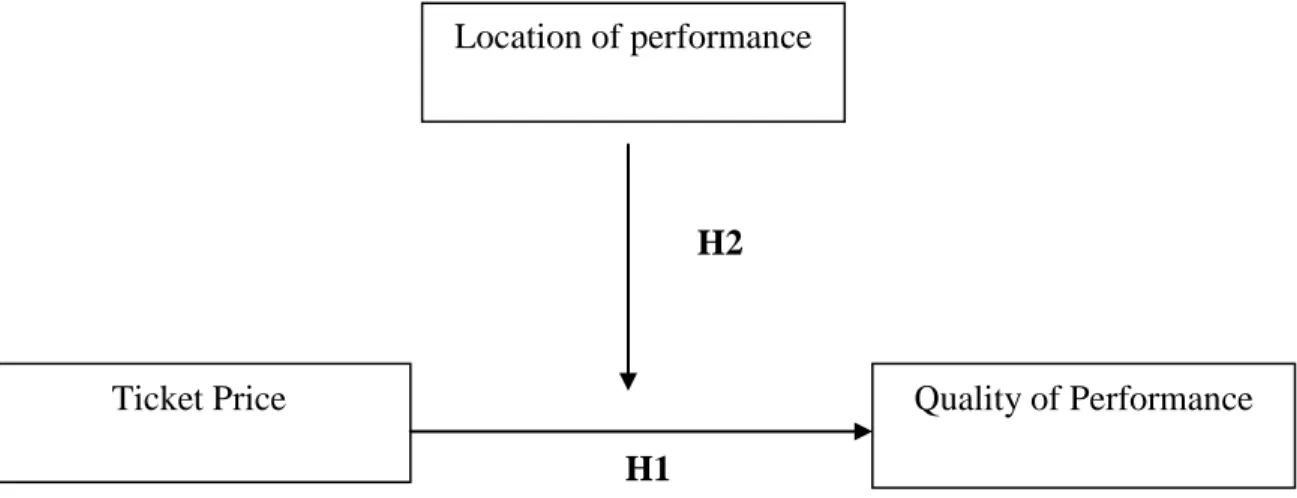
Figure 6 showed the conceptual framework for the study. The dependent variable in this model is the quality of performance and the independent variable is the pricing of tickets.
However, the moderating variable in this study is location of the performance.
H2
H1
Figure 2.6.1: Conceptual Framework
2.7 HYPOTHESIS DEVELOPMENT
The hypothesis has been developed for the study based on dependent and independent variables had given below:
Based on previous research, audiences or customers may use price to indicate a product quality (Rao and Monroe, 1988). It also shows that there is a connection between pricing and quality of the products when it comes to customer decision making (Dodds et al., 1991; Rao and Monroe, 1989). According to Oxenfeldt (1950), price-quality relationship shows that a relatively higher pricing will result in higher quality performance, while cheaper product possesses lower quality.
Location of performance
Quality of Performance Ticket Price
20 H1: Pricing of ticket has a positive effect on quality of performance.
However, according to Hume et al., (2006), he states that in performing arts, location have effects on the quality of the performance. Audiences purchase intention depends on the venue quality such as parking lots, public transport and so on.
H2: Location has a positive effect of quality of the performance when audiences making decision to purchase the ticket.
21 CHAPTER 3
RESEARCH METHOD
3.1 RESEARCH DESIGN
According to Creswell (2003) and Robson (2011), research design can be divided into three approaches which are quantitative, qualitative and mixed. Saunders et al (2000) stated that quantitative normally possible to predict the time schedules accuracy because it take less time to complete. However, qualitative research can be more prolonged. And in my overall research, researcher used quantitative approach in this research.
While methods to implement quantitative approach include survey and experiment, thus survey is the method of conducting research by distributing the questionnaire to the respondent to get accurate data. In this research, quantitative approach focuses on collecting data and measures the personal of background. However, according to Fowler (2002), quantitative research consists of 3 components: such as sampling, data collection and question design.
3.2 SAMPLING METHOD
Sampling method is used where a part of population representing the whole population is selected. And the people selected will mainly focus on consumers, audiences and also art lovers.
This is because these people are interested in arts and are able to provide more information, comments and feedback. This will ensure us to control and lead the performance to a more successful level. Thus, the data obtained will be more valuable and trustworthy.
22 The two different ways of sampling include probability sampling and non-probability sampling. I have chosen the non-probability sampling to be used in my research because it is based on the convenience of it. This means that those people who are more approachable are going to be in the sample (Doris, 2012). The targeted group will be the audiences who are attending this performance and those art lovers. Information which are provided by the people may be valuable for my research.
3.3 DATA COLLECTION METHOD
First of all, researcher had selected a title which is The Relationship between Pricing, Location and Quality of Arts Performance. To continue with this research paper, researcher had to find more books and journals to support all the statement.
Next, to gain more information from the respondents, a set of questionnaire which consists of two sections was created and printed then answered by the respondents. Section A consists of variable measurement which concerns about the pricing, quality of live performance and the location of live performance. Where else, section B includes personal background such as gender, age group, education level and number of attending live performance in a year.
Each respondent was expected to complete the questionnaire within a period of 10 minutes.
Beside, the researcher is allowed to introduce the research topic and motivate the respondents to offer their frank answer. The data collection was carried from 18th of January 2015 to 28th of February 2015.
Researcher had to analyze all the collected data using SPSS Statistics 19.0 for Windows and last but not least, researcher had to come out with a conclusion for this research paper.
23 3.4 QUESTION DESIGN
According to Doris (2012), several researchers said that there are two basic ways to carry out a survey: questionnaire and interview. Questionnaires are standardized where the questions as well as the sequence of the questions and the answer possibilities are predetermined by the researcher. Thus, questionnaire is chosen in conducting my research.
The advantage of this method is that the data collected are easy to compare and evaluated because the respondents answer to the same questions and have the same choice of answer possibilities. On the other hand, the disadvantage of this method is that the chance of having a low response rate is high.
Questionnaires prepared for my research is to measure “The relationship between pricing, location and the quality of arts performance”. The questionnaires consist of 2 sections are short, clear and simple. The questionnaire will be distributed to the participants who are familiar and closely related to Arts. This is to ensure that the feedbacks obtain are more valuable, accountable and accurate in the questionnaire.
Before distributing the questionnaires to the respondents, pretesting and piloting can help to identify the questions which literally don’t make any sense to participants that might eventually lead to biased answers. The pilot test will be distributed to 10 people who are representative of my target group. The participants are given time to complete the survey and leave a comment or feedback in the form. The comment or feedback will contribute to the improvement of my final questionnaire.