59 Journal of Design and Built Environment, Vol. 23(1), pp. 59-80, 2023 Razia et al.
Measuring Social Sustainability for Socially Sustainable Urban Development: A Preliminary Study in Dhaka City, Bangladesh
Sultana Razia1, & Siti Hajar Binti Abu Bakar Ah1 *
1Department of Social Administration and Justice, Faculty of Arts and Social Sciences, Universiti Malaya, Malaysia
*Corresponding author: [email protected] https://doi.org/10.22452/jdbe.vol23no1.5 Abstract
Social sustainability in socially sustainable urban development is an escalating global concern to ensure the well- being of urban society. Uncontrolled and rapid urbanization has transformed Dhaka into one of the world's largest megacities, leading to severe social problems. Therefore, it influences the city's social sustainability. Due to the lack of attention to social sustainability, especially in cities of developing countries, this study aims to measure the current status of social sustainability in Dhaka city for socially sustainable urban development. A structured questionnaire survey was conducted among residents of Dhaka. Results revealed that Dhaka city residents have low satisfaction levels regarding social sustainability conditions. They are not getting adequate facilities related to social sustainability for socially sustainable urban development. The results provide empirical evidence of the current status of social sustainability to policymakers, urban planners, and implementing agencies in Dhaka city that can assist in formulating appropriate socially sustainable planning, policy formulation, and practical implementation. The study might also help researchers in developing countries expand their thinking about other cities encountering similar problems.
Keywords: Social Sustainability; Socially Sustainable Urban Development; Developing Countries; Dhaka City;
Bangladesh
60 Journal of Design and Built Environment, Vol. 23(1), pp. 59-80, 2023 Razia et al.
1. INTRODUCTION
Over the past 35 years, sustainable development has been introduced into the global arena as a key concept. Sustainable urban development evolves from the concept of sustainable development, which has also been receiving high attention among academics, urban planners, and policymakers recently (Wang et al., 2019; Larimian et al., 2020).
United Nations Report of the World Commission on Environment and Development: Our Common Future stated that sustainable development depends on three dimensions, namely environment, economics, and social (United Nations, 1987).
These three dimensions are also equally vital for sustainable urban development (Rafieian &
Mirzakhalili, 2014; Baffoe & Mutisya, 2015).
Despite the equal importance of the three dimensions in the sustainability agenda, social sustainability is constantly receiving less attention in academic literature (Haji Rasouli & Kumarasuriyar, 2016; Akan & Selam, 2018; Kumar & Anbanandam, 2019). Though social sustainability has become highly associated with sustainable urban development issues (Ali et al., 2019).
Recently, the socially sustainable urban development concept is gaining widespread attention in the literature with a greater emphasis on social aspects (Cho et al., 2015; Shirazi & Keivani, 2019a; Ring et al., 2021; Wrangsten et al., 2022).
However, implementing social sustainability for socially sustainable urban development is challenging due to the growing trend of rapid urbanization. The world’s population is growing significantly in urban areas. More than 76 per cent of urban people live in developing countries; it is forecast to be more than 83 per cent in 2050, while only about 16 per cent will live in developed countries (United Nations, 2019). Notably, the rapid urban expansion will decrease in developed countries and increase in developing countries.
Rapid urbanization in most developing countries leads to severe social problems within urban areas (Zhang, 2016; Ghalib et al., 2017). Therefore, it is essential to reveal the social sustainability status for socially sustainable urban development in the cities of developing countries.
The context of Dhaka, as a city in a developing country, is also facing excessive urban expansion in the last few decades. In the previous 40 years, uncontrolled and rapid urbanization has made Dhaka one of the world’s megacities with experienced massive population growth (Roy et al., 2018). Due
to rapid urbanization, the urban community of Dhaka is immensely struggling with social problems, including standard housing, urban poverty, health facility, women empowerment, public transport, sanitation, shelter, illiteracy, slums, corruption, and open spaces (Satu & Chiu, 2019;
Yasmin, 2019; Barai, 2020). The Theory of Urbanism also explained that rapid and unplanned urbanization creates extreme urban social problems (Wirth, 1938). The social problems are responsible for ensuring social sustainability that hinders sustainable urban development for city dwellers (Woodcraft, 2012; Ali et al., 2019). Hence, social sustainability requires adequate attention for socially sustainable urban development, which cannot be ignored, especially in cities in developing countries.
In the last two decades, many social scientists have worked on urban social sustainability. They emphasized some specific issues, such as ‘socially sustainable urban design (Timmerman et al., 2019)’,
‘urban neighborhood (Dave, 2011; NEAMŢU, 2012; Woodcraft, 2012; Rafieian & Mirzakhalili, 2014; Neilagh & Ghafourian, 2018; Wang & Shaw, 2018; Shirazi & Keivani, 2019b; Shrivastava &
Singh, 2019),’ ‘social sustainability of urban regeneration (Glasson & Wood, 2009; Chan et al., 2019)’, and ‘effects of urban form on social sustainability (Bramley et al., 2006; Bramley et al., 2009; Bramley & Power, 2009; Landorf, 2011;
Dempsey et al., 2012; Kyttä et al., 2016; Ali et al., 2019)’. Furthermore, comprehensive literature suggests that most authors discussed the role of social sustainability in the urban context as it is essential for making sustainable cities (Deviren, 2010; Weingaertner & Moberg, 2014; Hemani et al., 2017; Chan et al., 2019). In the meantime, a group of social scientists concentrated on definitions and conceptualizing social sustainability as an emerging issue rather than its practical outcomes (McKenzie, 2004; Vallance et al., 2011; Haji Rasouli &
Kumarasuriyar, 2016; De Fine Licht & Folland, 2019). However, measuring current status of social sustainability is essential in cities of developing countries to build a city socially sustainable. To fill the gaps in the existing literature, this study aims to measure the current status of social sustainability in Dhaka city.
The present study is evidence-based research that contributes in a specific way to the existing literature. First, this is the first attempt to measure the current status of social sustainability in the
61 Journal of Design and Built Environment, Vol. 23(1), pp. 59-80, 2023 Razia et al.
context of Dhaka city based on the highest to lowest ranks of social sustainability themes. Previous studies focused on the assessment of social sustainability, but none of the studies specifically revealed the highest to the lowest rank of social sustainability themes. Therefore, this study contributes to this body of knowledge by obtaining concrete empirical evidence about the current status of social sustainability in Dhaka city that helps the government, policymakers, urban planners, urban municipalities, and implementing agencies in making appropriate plans, policy formulation, and practical implementation for a socially sustainable Dhaka city. Likewise, it helps them identify which social sustainability themes need to be addressed immediately. Second, this study is useful for those cities in developing countries facing the same problem as substantial urban social problems by rapid urbanization. Rapid urbanization is not only a concerning issue for Dhaka city but also, many other cities are facing the same situation, such as Kolkata, Delhi, Shanghai, Beijing, Mumbai, Osaka, Beijing, Cairo, and so on (United Nations, 2014). Third, this study also helps to achieve Sustainable Development Goals (SDG-11) titled “Sustainable Cities and Communities”.
2. LITERATURE REVIEW 2.1. Social Sustainability Concept
In the late 1990s, social sustainability was a fundamental aspect of the sustainability agenda (Haji Rasouli & Kumarasuriyar, 2016). However, considering so far, there are five specific reasons why social sustainability is getting less priority.
First, some theoretical arguments for defining social sustainability and even limited literature focus on this subject (Dempsey et al., 2011). Second, social sustainability still overlaps with the other two pillars of environmental and economic sustainability (Vallance et al., 2011). Third, social sustainability is often not considered due to its qualitative nature, which makes it challenging to evaluate and implement (Al-Dahmashawi et al., 2014). Fourth, some literature still covers social sustainability as social capital, social cohesion, social inclusion, and exclusion (Dempsey et al., 2011). Fifth, it is hard to conceptualize and provide an integrated framework, mainly in sustainability studies (Al-Dahmashawi et al., 2014).
Meanwhile, the definition of social sustainability creates some debate in the
development world (Weingaertner & Moberg, 2014). The acceptable definition of social sustainability is somewhat complicated due to overlapping with other subjects (De Fine Licht &
Folland, 2019). From the beginning, the focus was on a sustainable environment, while limited literature paid less attention to social sustainability (Haji Rasouli & Kumarasuriyar, 2016; Rocak et al., 2016). Thus, there was no definite definition of social sustainability in academic literature (Weingaertner & Moberg, 2014).
However, the social sustainability focus has increased in recent years with the number of authors’
contributions to this area, who have developed its conceptual definition and integrated it into broader sustainability theory and practice. Thus, the meaning of social sustainability is more specific than ever in the academic literature (Partridge, 2014; McGuinn et al., 2020). Sachs (1999) defines social sustainability as human needs such as equitable incomes, access to goods, services, employment, human rights, and the importance of democracy.
McKenzie (2004, p. 12) illustrates that “Social sustainability is a life-enhancing condition within communities and a process within communities that can achieve that condition”. Ali et al. (2019) describe social sustainability as achieving a better quality of life through the participation and interaction of community members. Therefore, social sustainability can be defined as a favorable condition for a society where every individual can achieve a quality of life by ensuring human needs that help create a healthy and livable community for the current and future generations.
Since 1990, sustainable development has been associated with 'sustainable cities' or 'sustainable urban development' (Hemani & Das, 2016).
Thereby, socially sustainable urban development has gained growing attention in the world.
According to Enyedi and Kovács (2006), the concept of socially sustainable urban development is different from sustainable urban development, with more emphasis on social aspects. Socially sustainable urban development is accomplished when social aspects such as community involvement, social cohesion, solidarity, fairness, equity, participation, empowerment, and access are ensured in urban areas (Ogunsola, 2016). Therefore, socially sustainable urban development can be defined as a society and an urban condition where social aspects are gaining importance and being ensured in sustainable urban development.
62 Journal of Design and Built Environment, Vol. 23(1), pp. 59-80, 2023 Razia et al.
2.2. Nexus Between Theory of Urbanism and Socially Sustainable Urban Development In developing countries, rapid urbanization has created social problems that influence social sustainability and challenge building socially sustainable urban development (Woodcraft, 2012;
Hemani et al., 2017; Ali et al., 2019; Khatun, 2019).
In 1938, the Theory of Urbanism focused on how a city has grown with large population size, density, and heterogeneity due to rapid urbanization, leading to urban social problems. According to Wirth (1938), urbanisation in modern times makes extreme changes in almost every phase of urban social life.
Consequently, he also mentioned that the rapid urbanization in the United States creates the intensity of urban problems. Eventually, urban social problems influence social sustainability (Hemani et al., 2017; Ali et al., 2019). In the context of cities in developing countries, ensuring the quality of life for the citizens becomes a severe issue for the city authorities as Wirth (1938) explained that rapid urbanization creates extra pressure on social life and increases the demand-pull of human needs. Therefore, social sustainability is crucial for ensuring socially sustainable urban development (Randeree & Ahmed, 2018; Timmerman et al., 2019; Saleem et al., 2020; Larimian & Sadeghi, 2021).
Before ensuring socially sustainable urban, measuring the current status of social sustainability for socially sustainable urban development in developing countries is essential. Measuring the current status of social sustainability helps to find out its actual conditions which assist city authorities to build socially sustainable cities. Considering this issue, this study intends to measure the current status of social sustainability for socially sustainable urban development in the context of Dhaka, as a city of developing countries.
2.3. Urban Social Sustainability in Dhaka City, Bangladesh
Urbanization is an effective process for global economic growth. Undoubtedly, urbanization brings economic benefits to a country, but adverse effects of rapid urbanization occur, especially in developing countries like Bangladesh. The urbanization pattern of Bangladesh has changed rapidly due to rural- urban migration (General Economic Division, 2016- 2020). However, the pattern of urbanization was quite different for Bangladesh in 1950; 4.28 per cent
of the population was living in urban areas, whereas the number of people in rural areas was 95.71 per cent. United Nations (2018b) forecasted that around 60 per cent urban population will live in 2050, whereas the rural population will be 40 per cent.
Dhaka is the capital city of Bangladesh. The urbanization process in Dhaka city has become a megacity and suffering from the extensive growth of the population in recent decades. RAJUK (2015) stated that Dhaka's population increased by 63 per cent of the city's total growth due to migration, whereas only 37 per cent of growth happened from the natural increase. The trend of rural-urban migration in Dhaka creates a large population responsible for rapid urbanization.
The population and density growth started in Dhaka in 1971 (Roy et al., 2019). In terms of the total population living in urban areas, Dhaka ranked 9th out of 10 top cities in 2018 and is forecasted to rank 4th in 2030 (United Nations, 2018a). Dhaka has a population density of 41,000 per square kilometre, ranked 1st among the world cities to build urban areas by population density per square mile (Demographia, 2019). The city has grown with large population size, density, and heterogeneity, leading to urban social problems. As a result, Dhaka is struggling with high population density through rapid urbanization, which creates social problems and affects the status of social sustainability (Rahman, 2014; Roy et al., 2021; Khatun, 2019).
Currently, the sustainability issue in Dhaka city is getting significant concern to the city planner and the government (RAJUK, 2015). Due to this fact, it becomes difficult for city management authorities to ensure the quality of life for the citizens of Dhaka city (Degert et al., 2016; Wang & Sarker, 2020).
Indeed, building a sustainable urban requires serious attention to social problems to ensure social sustainability (Ali et al., 2019). In 2019, the ‘Safe Cities Index’ depicted the nature of urban safety based on four indicators: digital, infrastructure, health, and personal safety; Dhaka ranked 56th out of 60 cities, which stands as the 5th least safe city (The Economist Intelligence Unit, 2019). Numbeo (2021) presents the quality-of-life index based on the cost of living, housing affordance, crime rate, health system, traffic, and pollution, where Dhaka ranks 238th out of 241 cities. Thus, measuring the current status of social sustainability is a prime issue for socially sustainable urban development in Dhaka city.
63 Journal of Design and Built Environment, Vol. 23(1), pp. 59-80, 2023 Razia et al.
3. RESEARCH METHODOLOGY
3.1. Study Area
The study considered Dhaka city as a study area.
Dhaka city is located at 23°42′ to 23o52’ latitude in the north and the 90°22′ to 90o 32’ longitude in the east (Roy et al., 2018). The total coverage area of this city is 302.92 square kilometers (Bangladesh Bureau of Statistics, 2013). Dhaka City Corporation has a self-governing system called the local government to manage the megacity. Dhaka City Corporation is divided into two city corporations:
Dhaka North City Corporation (DNCC) and Dhaka South City Corporation (DSCC).
3.2. Population and Sample of the Study
According to the constitution of Bangladesh, when a citizen reaches the age of 18, they can
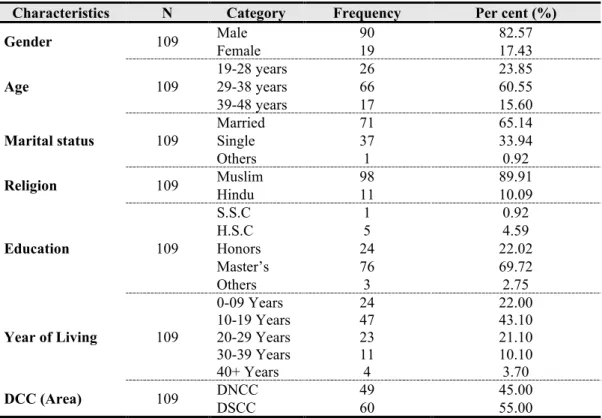
participate in important decision-making events like national elections. Accordingly, this study sets the criteria for voters of Dhaka city to participate in the online survey by providing feedback. Likewise, voters have living experiences that help to provide insightful opinions about social sustainability in Dhaka. The study considers all Dhaka city residents as a population; only the voters are considered a target population. Due to the large population and financial and time limitations, a manageable sample size is required as it is difficult for the researcher to collect data from each voter. Johanson and Brooks (2010) suggest that 30 samples from the target population are reasonable for a pilot study. Finally, the researcher collected 109 responses from residents of two city corporations in Dhaka through an online survey for a pilot study.
Table 1. Demographic Profile of Pilot Study
Characteristics N Category Frequency Per cent (%)
Gender 109 Male 90 82.57
Female 19 17.43
Age 109 19-28 years 26 23.85
29-38 years 66 60.55
39-48 years 17 15.60
Marital status 109 Married 71 65.14
Single 37 33.94
Others 1 0.92
Religion 109 Muslim 98 89.91
Hindu 11 10.09
Education 109
S.S.C 1 0.92
H.S.C 5 4.59
Honors 24 22.02
Master’s 76 69.72
Others 3 2.75
Year of Living 109
0-09 Years 24 22.00
10-19 Years 47 43.10
20-29 Years 23 21.10
30-39 Years 11 10.10
40+ Years 4 3.70
DCC (Area) 109 DNCC 49 45.00
DSCC 60 55.00
Note: N=Number of Respondents, DCC=Dhaka City Corporation, DNCC=Dhaka North City Corporation, DSCC=Dhaka South City Corporation.
3.3. Sampling Technique
This study adopted the multi-stage sampling technique to select its respondents. In the first stage, this study used the purposive sampling technique to select voters for participating in this online survey.
In the second stage, this study also used the
systematic sampling technique where we chose 06 wards from each city corporation to ensure the heterogeneity of the respondents' opinions. In the third stage, this study used a systematic sampling strategy to select the target respondents' houses, specifically for voters by collecting voters’
information from the respective ward
64 Journal of Design and Built Environment, Vol. 23(1), pp. 59-80, 2023 Razia et al.
commissioner’s office and the Bangladesh Election Commission. Hence, we excluded 11 responses to ensure voters’ status from the 120 responses.
Finally, this study selected 109 respondents for the pilot study.
3.4. Data Collection Processes
A survey technique was used for this study to collect primary data through a structured questionnaire. We distributed well-prepared leaflets to selected wards of two city corporations to participate in the online survey through Google Docs.
3.5. Research Instrument
The study developed a measuring framework of social sustainability based on the comprehensive literature review, Commission on Sustainable Development Framework, Sustainable Development Goal-11, and National Urban Sector Policy for Bangladesh. Initially, 64 indicators were selected under 11 social sustainability themes, namely 1) Health Facilities, 2) Gender Equality and Women’s Empowerment, 3) Urban poverty and Slums Improvement, 4) Urban children, aged, the disabled, and the scavengers, 5) Transportation Availability, 6) Satisfied with Space, 7) Open Space, 8) Social Capital, 9) Safety, 10) Social Justice, and 11) Education Facilities. A five-point Likert scale (i.e., 5-Strongly agree, 4-Agree, 3-Neither agree nor disagree, 2-Disagree, 1-Strongly disagree)1 was used in the survey questionnaire where respondents were required to respond to the items.
A pre-testing procedure needs to be conducted to develop a survey questionnaire or confirm the variables' measurability (Hilton, 2017; Ikart, 2019).
This study followed the pre-testing procedure by measuring the content validity of the survey questionnaire (see details in Appendix A). To check the content validity for the individual item (I-CVI) and overall scale (S-CVI) scores, a structural questionnaire was placed on 06 experts who are highly experienced and top authorities, including Directors of Urban Planning and Development, City Planners, Consultants, and Program Analysts from
national and international platforms with four scale degrees of relevance (consistency, representative of concepts, relevance to concepts, and clarity in terms). As per experts’ suggestions, 01 items have to be merged with other existing items, and 02 items were suggested to be rearranged. Finally, based on experts’ comments and relevance ratings, 62 items were selected under 11 variables for the pilot study (variables and items are shown in Appendix A).
Skewness and kurtosis explicate the normal distribution of a dataset (Hair et al., 2022). This pilot study performed a normality test by checking skewness and kurtosis values (see details in Appendix B). All the skewness and kurtosis values were within the threshold level (±2), except in Open Space (OS). As per the kurtosis values, three items, i.e., OS1 (public space availability), OS2 (use of public space), and OS4 (satisfaction level of public space), exceeded the threshold level (± 2). However, the skewness values for OS2 and OS4 were within the threshold level range (± 2). Only the skewness and kurtosis values exceeded the threshold level for OS1. Only 01 (OS1) out of 62 items exceeded the threshold for skewness and kurtosis values. Though it is not significant, the assumption of normality based on the results of skewness and kurtosis implies that the data is not normally distributed.
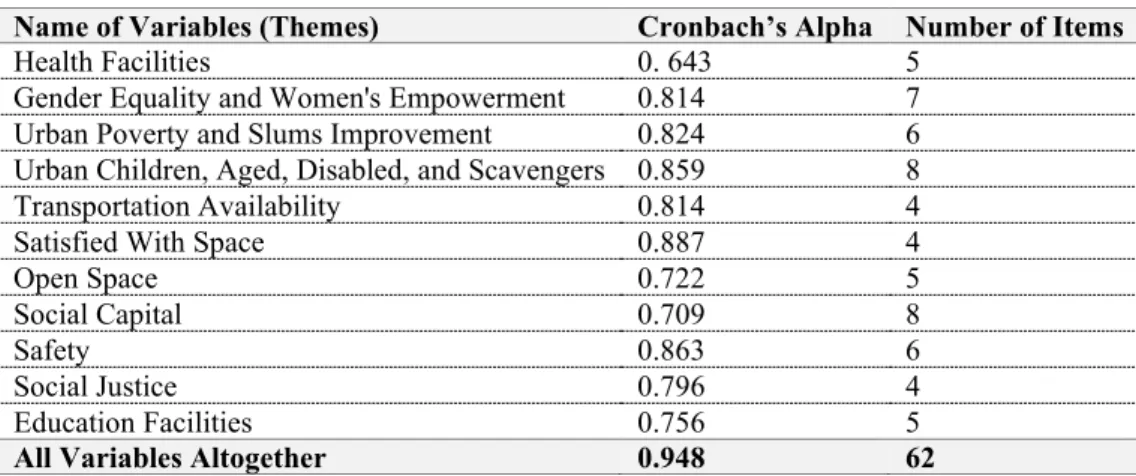
The reliability of the adopted items was measured using Cronbach’s Alpha to examine the quality of the research instruments. Straub et al.
(2004) have suggested that reliability results should be considered equal to or above 0.60 for a pilot study. Table 2 demonstrates the result of the reliability analysis of the pilot study. The overall Cronbach’s Alpha value was 0.948 with 62 items.
Likewise, variable-wise, Cronbach’s Alpha was also calculated to ensure the reliability of this pilot study.
Cronbach’s Alpha values for all individual variables ranged from 0.643 to 0.887, revealing that 10 out of 11 variables were obtained greater than 0.70, indicating significantly higher reliability. Only 01 out of 11 attained Cronbach’s Alpha values greater than .60, which is considered acceptable. Therefore, all the measuring variables meet the required threshold value of Cronbach’s Alpha which is adequate, valid, and reliable for this study.
1Strongly disagree-experience and judgment are strongly not in favor of this aspect, Disagree-experience and judgment are not in favour of one over the other, neither agree nor Disagree-I have no
experience, or I have experience, but my judgment is indifferent, Agree-experience and judgment are in favour of one over the other, and Strongly agree-experience and judgment strongly favour. For details-(Saaty, 1990; Coyle, 2004).
65 Journal of Design and Built Environment, Vol. 23(1), pp. 59-80, 2023 Razia et al.
Table 2. Reliability Analysis of Pilot Study
Name of Variables (Themes) Cronbach’s Alpha Number of Items
Health Facilities 0. 643 5
Gender Equality and Women's Empowerment 0.814 7
Urban Poverty and Slums Improvement 0.824 6
Urban Children, Aged, Disabled, and Scavengers 0.859 8
Transportation Availability 0.814 4
Satisfied With Space 0.887 4
Open Space 0.722 5
Social Capital 0.709 8
Safety 0.863 6
Social Justice 0.796 4
Education Facilities 0.756 5
All Variables Altogether 0.948 62
3.6. Data Analysis
This study used the Social Package for Social Science (SPSS) and MS Excel to analyze data. To check the content validity, this study calculated I- CVI and S-CVI scores. Reliability was measured to assess the internal consistency of items, and Skewness and Kurtosis values were tested to check the assumption of normality for an individual variable. We used frequency distribution to get an overview of respondents’ demographic profiles and descriptive statistics like Mean and Standard Deviation to analyze all variables and items.
Likewise, the Kruskal-Wallis H test was used as a
supplementary analysis to examine possible differences between respondents’ age, gender, education, living area, living years, and all the items of social sustainability (see details in Appendix C and D).
4. RESULTS
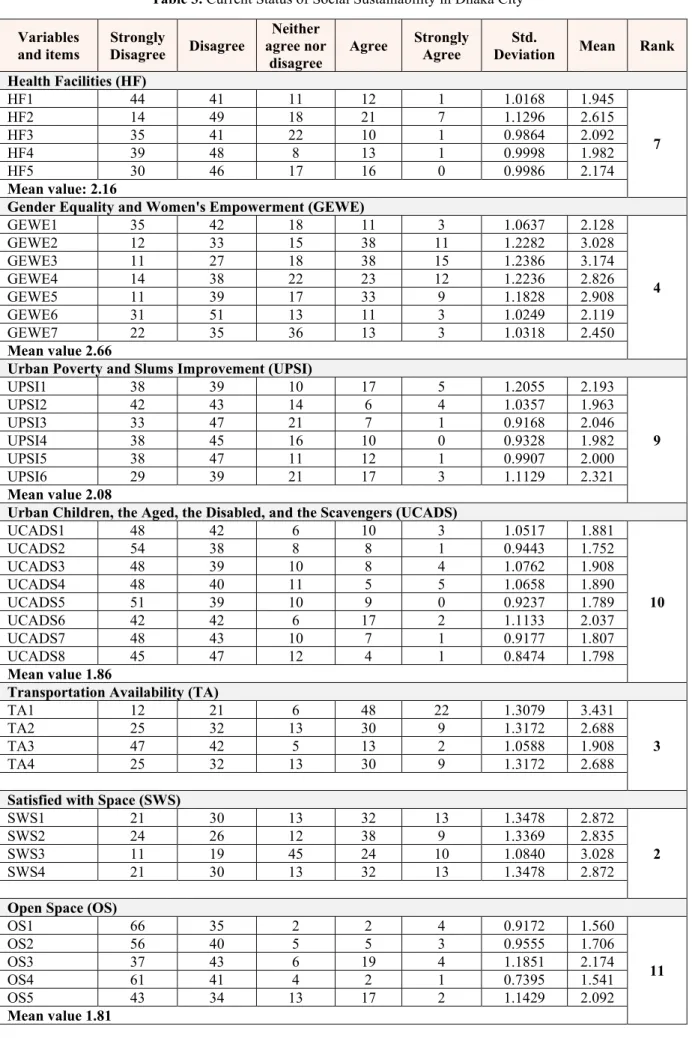
This preliminary study measured the current status of social sustainability in the context of Dhaka city using 62 indicators. The individual mean of items (see Table 3) and the overall mean of each theme were calculated, illustrated in Figure 1.
_____________________________________________________________________________________
Note: The mean of each theme is shown at the top of the ‘3D Glass Chart (3DGC)’, rank paced within the 3DGC.
Figure 1. Current Status of Social Sustainability in Dhaka City
As shown in Figure 1, the social sustainability themes were ranked 1 to 11 based on the largest to lowest mean scores. The overall mean of 62 indicators was 2.35, representing the current status of social sustainability in Dhaka (see Table 3). The
overall mean score implies ‘Disagree’ points on the Likert scale. The individual mean score of social sustainability themes (see detail Table 3) was discussed in the following paragraphs.
2.16 2.66 2.08 1.86 2.68 2.90 1.81 2.22 2.29 2.09 3.05
HF GEWE UPSI UCADS TA SWS OS SC SF SJ EF
3
7 4
9 10 2 11 6 5 8
1
66 Journal of Design and Built Environment, Vol. 23(1), pp. 59-80, 2023 Razia et al.
Table 3. Current Status of Social Sustainability in Dhaka City Variables
and items Strongly
Disagree Disagree
Neither agree nor
disagree Agree Strongly
Agree Std.
Deviation Mean Rank Health Facilities (HF)
HF1 44 41 11 12 1 1.0168 1.945
7
HF2 14 49 18 21 7 1.1296 2.615
HF3 35 41 22 10 1 0.9864 2.092
HF4 39 48 8 13 1 0.9998 1.982
HF5 30 46 17 16 0 0.9986 2.174
Mean value: 2.16
Gender Equality and Women's Empowerment (GEWE)
GEWE1 35 42 18 11 3 1.0637 2.128
4
GEWE2 12 33 15 38 11 1.2282 3.028
GEWE3 11 27 18 38 15 1.2386 3.174
GEWE4 14 38 22 23 12 1.2236 2.826
GEWE5 11 39 17 33 9 1.1828 2.908
GEWE6 31 51 13 11 3 1.0249 2.119
GEWE7 22 35 36 13 3 1.0318 2.450
Mean value 2.66
Urban Poverty and Slums Improvement (UPSI)
UPSI1 38 39 10 17 5 1.2055 2.193
9
UPSI2 42 43 14 6 4 1.0357 1.963
UPSI3 33 47 21 7 1 0.9168 2.046
UPSI4 38 45 16 10 0 0.9328 1.982
UPSI5 38 47 11 12 1 0.9907 2.000
UPSI6 29 39 21 17 3 1.1129 2.321
Mean value 2.08
Urban Children, the Aged, the Disabled, and the Scavengers (UCADS)
UCADS1 48 42 6 10 3 1.0517 1.881
10
UCADS2 54 38 8 8 1 0.9443 1.752
UCADS3 48 39 10 8 4 1.0762 1.908
UCADS4 48 40 11 5 5 1.0658 1.890
UCADS5 51 39 10 9 0 0.9237 1.789
UCADS6 42 42 6 17 2 1.1133 2.037
UCADS7 48 43 10 7 1 0.9177 1.807
UCADS8 45 47 12 4 1 0.8474 1.798
Mean value 1.86
Transportation Availability (TA)
TA1 12 21 6 48 22 1.3079 3.431
TA2 25 32 13 30 9 1.3172 2.688 3
TA3 47 42 5 13 2 1.0588 1.908
TA4 25 32 13 30 9 1.3172 2.688
Satisfied with Space (SWS)
SWS1 21 30 13 32 13 1.3478 2.872
SWS2 24 26 12 38 9 1.3369 2.835 2
SWS3 11 19 45 24 10 1.0840 3.028
SWS4 21 30 13 32 13 1.3478 2.872
Open Space (OS)
OS1 66 35 2 2 4 0.9172 1.560
11
OS2 56 40 5 5 3 0.9555 1.706
OS3 37 43 6 19 4 1.1851 2.174
OS4 61 41 4 2 1 0.7395 1.541
OS5 43 34 13 17 2 1.1429 2.092
Mean value 1.81
67 Journal of Design and Built Environment, Vol. 23(1), pp. 59-80, 2023 Razia et al.
Social Capital (SC)
SC1 24 39 34 11 1 0.9611 2.321
6
SC2 24 32 16 30 7 1.2697 2.670
SC3 10 24 16 45 14 1.2068 3.266
SC4 34 48 15 11 1 0.9703 2.055
SC5 34 48 15 11 1 0.9703 2.055
SC6 41 55 12 1 0 0.6825 1.752
SC7 26 74 9 0 0 0.5473 1.844
SC8 39 56 13 1 0 0.6853 1.780
Mean value 2.22 Safety (SF)
SF1 18 36 15 32 8 1.2424 2.780
5
SF2 64 29 9 6 1 0.9195 1.633
SF3 39 35 11 17 7 1.2704 2.248
SF4 35 50 12 8 4 1.0309 2.046
SF5 39 35 11 17 7 1.2704 2.248
SF6 18 36 15 32 8 1.2424 2.780
Mean value 2.29 Social Justice (SJ)
SJ1 38 36 15 9 11 1.2939 2.257
SJ2 48 40 11 8 2 0.9951 1.862 8
SJ3 41 46 9 9 4 1.0627 1.982
SJ4 31 41 18 18 1 1.0706 2.239
Mean value 2.09
Education Facilities (EF)
EF1 12 17 13 47 20 1.2641 3.422
EF2 9 19 14 44 23 1.2369 3.486 1
EF3 16 37 36 18 2 0.9941 2.569
EF4 16 36 24 28 5 1.1375 2.725
EF5 13 23 29 36 8 1.1504 3.028
Mean value 3.05
All Variables Altogether 2.35
Rank 1: ‘Education Facilities (EF)’ were measured by 05 items with a mean score of 3.05, ranking 1st in Dhaka city’s current social sustainability status. The mean score of education facilities indicated a ‘Neither agree nor disagree’
point on the Likert scale. According to the result, items EF2 (free secondary education for girls) and EF3 (specific educational zones) had the highest and lowest mean score of 3.49 and 2.57, respectively.
Although EF achieved the highest rank, the residents' overall opinion was indifferent about Dhaka city's current educational facilities. Notably, the residents of Dhaka city are moderately satisfied with 03 items, i.e., EF1 (free and compulsory education at the primary level), EF2 (free secondary education for girls), and EF5 (awareness and advocacy programs) whereas EF3 (specific educational zones) and EF4 (arrangement of primary, non-formal, and vocational education) need to focus on ensuring adequate educational facilities within Dhaka city.
Rank 2: ‘Satisfied with Space (SWS)’ ranks 2nd with a mean score of 2.90; there were 04 measurement items. The mean value of satisfied with space showed the ‘Disagree’ stance of the Likert scale. The result shows that the items SWS3 (climatic comfort of my house during summer) had the highest mean value of 3.03, whereas SWS1 (spatial organization of the house), SWS2 (size of the house), and SWS4 (climatic comfort of the house during winter) received the lowest mean scores of 2.87, 2.84, and 2.87, respectively. It means residents are relatively satisfied with the ‘climatic comfort of the house during summer (SWS3)’. Moreover, city authorities and urban planners’ attention should be paid to ‘spatial organization of the house (SWS1)’,
‘size of the house (SWS2)’, and ‘climatic comfort of the house during winter (SWS4)’ to ensure/implement satisfied with space for the residents of Dhaka city.
68 Journal of Design and Built Environment, Vol. 23(1), pp. 59-80, 2023 Razia et al.
Rank 3: To measure the current status of
‘Transport Availability (TA)’ in Dhaka city, 04 measuring items were used, ranking 3rd with a mean score of 2.68. The findings revealed that item TA1 (reaching to bus stop easily from my home) received a higher mean value of 3.43 whilst TA3 (satisfaction level of public transportation) got a lower mean value of 1.91. The current condition of TA3 was not satisfactory among the residents of Dhaka city. Still, item TA1 was at a moderately satisfying level. To make a socially sustainable Dhaka, it is necessary to pay attention to all the items of transport availability.
Rank 4: ‘Gender Equality and Women’s Empowerment (GEWE)’ is in 4th rank with a mean score of 2.66, containing 07 measuring items. The items GEWE3 (women's employment opportunities) and GEWE2 (women’s involvement in community development) had the highest mean value of 3.17 and 3.03, respectively, whereas GEWE6 (awareness initiatives for underprivileged women) and GEWE1 (gender-sensitive urban planning and management strategies) had the lowest mean value of 2.12 and 2.13, respectively. Overall, all gender equality and women’s empowerment items except for GEWE3 and GEWE2 were below satisfactory levels, which require close attention from Dhaka city planners and policymakers.
Rank 5: ‘Safety (SF)’ was measured by 06 items with a mean value of 2.29, which ranked 5th in the current status of social sustainability in Dhaka city. The items SF1 (feeling safe walking during the day in Dhaka), SF2 (feeling safe walking during nighttime in Dhaka), SF3 (my house is safe during travel time), SF4 (feeling safe while using public transportation in Dhaka), SF5 (feeling safe in my neighborhood), and SF6 (satisfaction level of safety) have obtained mean values of 2.78, 1.63, 2.25, 2.05, 2.25, and 2.78, respectively. All safety items belong to the lowest satisfaction level among Dhaka city residents. In particular, residents of Dhaka feel that their homes are not safe during travel (SF2). Overall, the current safety status is not satisfactory, which is expecting close attention from the government, and city management/implementation authorities to ensure the safety of all the residents of Dhaka city.
Rank 6: ‘Social Capital (SC)’ was measured by 08 items, ranking 6th with a mean score of 2.22.
Based on the results, SC3 (spending time with a neighbor) got the higher mean value of 3.27, whereas SC4 (chatting with neighbors) and SC5 (practicing social and ethical values) received the same mean value of 2.06. In addition, the mean score
of SC1 (relationship with neighbors), SC2 (trusting neighbors), SC6 (year of residency), SC7 (plan to change their houses), and SC8 (plan to change it in the same neighborhood) were 2.32, 2.67, 1.75, 1.84, and 1.78, respectively. Based on the opinion of the Dhaka city residents, the significant concern is on the items SC6, SC7, and SC8, which are somewhat absent in Dhaka city.
Rank 7: ‘Health Facilities (HF)’ ranked 7th with a mean value of 2.16, measured by 05 items. The highest and lowest mean values for HF2 (hospitals located in the residential areas) and HF1 (free primary healthcare service) items were 2.62 and 1.95, respectively. Free primary healthcare service for women and children (HF1) and arrangements for protecting against transmitted diseases like aids (HF4) indicated lower satisfaction levels among residents. Though, all the items belong to the low level of satisfaction that represents citizens of Dhaka city are not getting adequate health facilities.
Rank 8: The 8th ranked acquired ‘Social Justice (SJ)’ with a mean value of 2.09; measured by 04 items. The items SJ1 (fair distribution of resources), SJ2 (equality of rights), SJ3 (equitable access for all people), and SJ4 (actively participating in communal activities and decision making) had a mean value of 2.26, 1.86, 1.98, and 2.24, respectively. Based on the results, residents believed that social justice has not been adequately implemented in Dhaka. Therefore, government, policymakers, city planners, and city management authorities must emphasize ensuring social justice in Dhaka city as social justice is necessary to make a city socially sustainable.
Rank 9: There were 06 measuring items to measure the condition of ‘Urban Poverty and Slums Improvement (UPSI)’, which ranked 9th with a mean value of 2.08. The mean value for all individual items, i.e., UPSI1 (upgrading and improvement of slums), UPSI2 (slum dwellers' resettlement is implemented), UPSI3 (ensuring tenure security), UPSI4 (special zones for the urban poor), UPSI5 (equal access to the essential urban services), and UPSI6 (supporting informal sector activities) range from 1.96 to 2.32. Additionally, a significant consideration is required in all the items to improve urban poverty and slums.
Rank 10: ‘Urban children, aged, the disabled, and the scavengers (UCADS)’ were measured by 08 items and ranked 10th with a mean value of 1.86. The mean value showed the ‘Strongly Disagree’ stance of the Likert scale. The mean value of all individual
69 Journal of Design and Built Environment, Vol. 23(1), pp. 59-80, 2023 Razia et al.
items, i.e., UCADS1(ensure basic needs for children), UCADS2 (infrastructural designs for the disabled), UCADS3 (safety of children against all forms of abuse), UCADS4 (extend services for the children of working mother), UCADS5 (enforce laws dealing with child labor), UCADS7 (equal access to street children, scavengers, the aged, and disabled people), and UCADS8 (city authority ensures shelter) ranges from 1.75 to 1.91 except for UCADS6 (promote programs to eliminate malnutrition) with the mean value 2.04. The result indicated the least satisfaction among the residents of Dhaka city as they believed that all UCADS items are absent to ensure a socially sustainable urban, which needs serious consideration currently.
Rank 11: ‘Open Space (OS)’ was measured by 05 items with a mean value of 1.81, ranking 11th in terms of social sustainability in Dhaka city. All individual items, i.e., OS1 (public space availability), OS2 (use of public space), OS4 (satisfaction level of public space), mean values ranged from 1.54 to 1.71, except for OS3 (time to reach park) and OS5 (initiatives of recreational facilities for leisure). The result also showed that OS3 and OS5 had the disagreed position, and the remaining items were the least level of satisfaction for getting the facilities from open space in Dhaka city. As every city needs adequate open space for citizens’ healthy livability, Dhaka's present open space condition is just a dream.
5. DISCUSSION
The study has developed a measurement framework for measuring social sustainability conditions in Dhaka city. The overall mean results reflected low levels of social sustainability satisfaction among Dhaka city residents.
Specifically, the citizens of Dhaka city have shown the least level of satisfaction on two variables: urban children, the aged, the disabled, and the scavengers (UCADS) and open space (OS). On the other hand, variables appeared as moderate to low satisfaction levels on urban poverty and slum improvement, social justice, health facilities, safety, social capital, gender equality and women’s empowerment, transportation availability, and satisfaction with space. Besides, education facilities received indifferent results regarding the current status of social sustainability in Dhaka city. Overall, analysis of the results revealed that the current situation of social sustainability is not satisfactory as its aspects
are not getting that level of importance for ensuring socially sustainable urban development.
Since social sustainability is less focused, some studies have empirically measured it but had different purposes than this study. To exemplify, Dogu and Aras (2019) developed a measuring scale of social sustainability for Güzelyurt City, Northern Cyprus. The authors developed a measurement scale based on seven variables of social sustainability such as sense of belonging, social capital, perceived environment, social interactions/security, interaction with space, satisfied with space, voice, and influence. Based on the city of Güzelyurt, the variables of social sustainability were not found at a satisfactory level. Larimian and Sadeghi (2021) assessed social sustainability in Dunedin City, New Zealand’s urban neighborhoods, and determined whether design quality influenced social sustainability. They used seven social sustainability variables, including social interaction, safety and security, social equity, social participation, neighborhood satisfaction, sense of place, and housing satisfaction, which revealed a significant positive relationship between quality of design and overall social sustainability.
Likewise, Ali et al. (2019) evaluated urban form's role in achieving better social sustainability results in Irbid, Jordan. Five features of urban form such as density, land use distribution, building height, type of housing, and accessibility were used to examine their impact on social sustainability variables such as access to services, open spaces, and parks, availability of transportation, job accessibility, social interaction, safety, residential stability, sense of belonging, and neighborhood as a place to live. Their findings revealed that urban form strongly impacted social sustainability as respondents’ satisfaction was moderate to relatively low.
In addition, Yu et al. (2017) developed an assessment system to measure the social sustainability of urban housing demolition in Shanghai, China. They used 22 indicators to measure social sustainability. They found that health and safety, social equality, and adherence to the law must be considered critical in urban housing demolition’s social sustainability. Therefore, this study measures the current status of social sustainability and found an overall low level of satisfaction with experiencing socially sustainable urban development in Dhaka; this city acts as an example of a developing country. The current status
70 Journal of Design and Built Environment, Vol. 23(1), pp. 59-80, 2023 Razia et al.
of social sustainability should be measured by many other cities in developing countries that face the same problems of rapid urbanization.
Nonetheless, the limitations of this study are not to be overlooked. First, this study considered only 109 respondents from Dhaka city for a pilot study.
Second, this study only used a questionnaire survey as a data collection method. Third, this study adopted all variables from the literature to measure the current status of social sustainability for socially sustainable urban development in Dhaka city. From the limitations of this study, there is a scope created for future researchers. For example, developing countries are concentrating less on this field of research. Researchers from developing countries could provide more effort to assess the social sustainability of socially sustainable urban development by including or considering many respondents for the large-scale study. In addition, mixed methods research allows the incorporation of different methods that help researchers to investigate various aspects of urban social sustainability.
Furthermore, index development for social sustainability can be considered based on the city’s culture and basic social needs. Overall, the study might help researchers in developing countries diversify their thinking on social sustainability for socially sustainable urban development.
6. PRACTICAL IMPLICATION AND CONCLUSION
Social sustainability for socially sustainable urban development is a prominent issue worldwide.
Social sustainability is essential to ensure the long- run needs of people in a society. The lack of significance in social sustainability, especially in developing countries, increases the need for each stakeholder to know the current status of social sustainability. It helps to create insightful thinking for a socially sustainable urban for present and future generations.
From the result of the pilot study, all variables of social sustainability performed low satisfaction levels among Dhaka city's citizens. Notably, it appears that the current status of social sustainability is not in a good position for socially sustainable urban development in Dhaka city. Moreover, we empirically tested the framework to measure the current status of social sustainability regarding some demographic characteristics of respondents and found a statistically significant difference in respondents’ age and gender. However, a study
based on large sample size is required to confirm the results of this pilot study.
Based on the citizen’s opinions and expectations on the current status of social sustainability in Dhaka city, it will help policymakers, urban planners, urban municipalities, and implementing agencies formulate specific solutions to make a socially sustainable urban. Moreover, this study can be an example for cities in developing countries where rapid urbanization creates social problems that influence the status of social sustainability. From this point of view, this study opens a further window for those cities facing similar problems that can use this measurement framework to identify the current condition of social sustainability.
Disclosure statement: All authors declare no conflict of interest.
REFERENCES
Akan, M. Ö. A., & Selam, A. A. (2018). Assessment of social sustainability using social society index: A clustering application. European Journal of Sustainable Development, 7(1), 363- 373.
https://doi.org/10.14207/ejsd.2018.v7n1p363 Al-Dahmashawi, D., Hassan, D., Sabry, H., &
Mahmoud, S. (2014). Incorporating social sustainability themes in the built environment.
Journal of American Science, 10(5), 141-151.
https://www.jofamericanscience.org/journals/a m-sci/am1005/019_24593am100514_141_151.pd f
Ali, H. H., Al-Betawi, Y. N., & Al-Qudah, H. S.
(2019). Effects of urban form on social sustainability – a case study of Irbid, Jordan.
International Journal of Urban Sustainable Development, 11(2), 203-222.
https://doi.org/10.1080/19463138.2019.159036 7
Baffoe, G., & Mutisya, E. (2015). Social sustainability: A review of indicators and empirical application. Environmental Management and Sustainable Development, 4(2), 242-262.
https://doi.org/10.5296/emsd.v4i2.8399 Bangladesh Bureau of Statistics. (2013). District
statistics 2011.
http://203.112.218.65:8008/WebTestApplicatio n/userfiles/Image/District%20Statistics/Dhaka.
Barai, M. K. (2020). Conclusion: Bangladesh’s development—challenges to sustainability and the way forward. In Bangladesh's Economic and
71 Journal of Design and Built Environment, Vol. 23(1), pp. 59-80, 2023 Razia et al.
Social Progress: From a Basket Case to a
Development Model, 383.
https://link.springer.com/chapter/10.1007/978- 981-15-1683-2_13
Bramley, G., Dempsey, N., Power, S., & Brown, C.
(2006). What is ‘social sustainability’, and how do our existing urban forms perform in nurturing it. Sustainable Communities and Green Futures’ Conference, Bartlett School of Planning, University College London, London., http://www.city-
form.org/uk/pdfs/Pubs_Bramleyetal06.pdf Bramley, G., Dempsey, N., Power, S., Brown, C., &
Watkins, D. (2009). Social sustainability and urban form: Evidence from five British cities.
Environment and Planning A: Economy and Space, 41(9), 2125-2142.
https://doi.org/10.1068/a4184
Bramley, G., & Power, S. (2009). Urban form and social sustainability: The role of density and housing type. Environment and Planning B:
Planning and Design, 36(1), 30-48.
https://doi.org/10.1068/b33129
Chan, H. H., Hu, T.-S., & Fan, P. (2019). Social sustainability of urban regeneration led by industrial land redevelopment in Taiwan.
European Planning Studies, 27(7), 1245-1269.
https://doi.org/10.1080/09654313.2019.157780 3
Cho, I. S., Heng, C.-K., & Trivic, Z. (2015). Re- framing urban space: Urban design for emerging hybrid and high-density conditions.
Routledge.
https://doi.org/10.4324/9781315725147 Committee on Urban Local Governments. (2011).
National urban sector policy, 2011 (draft) Cuthill, M. (2010). Strengthening the 'social' in
sustainable development: Developing a conceptual framework for social sustainability in a rapid urban growth region in Australia.
Sustainable development, 18(6), 362-373.
https://doi.org/10.1002/sd.397
Dave, S. (2011). Neighbourhood density and social sustainability in cities of developing countries.
Sustainable development, 19(3), 189-205.
https://doi.org/10.1002/sd.433
De Fine Licht, K., & Folland, A. (2019). Defining
“social sustainability”: Towards a sustainable solution to the conceptual confusion. Journal of Applied Ethics, 13(2), 21-39.
https://doi.org/10.5324/eip.v13i2.2913
Degert, I., Parikh, P., & Kabir, R. (2016).
Sustainability assessment of a slum upgrading intervention in bangladesh. Cities, 56, 63-73.
https://doi.org/10.1016/j.cities.2016.03.002
Demographia. (2019). Demographia world urban areas (built up urban areas or world agglomerations) 15th annual edition, April 2019. http://www.demographia.com/db- worldua.pdf
Dempsey, N., Bramley, G., Power, S., & Brown, C.
J. S. d. (2011). The social dimension of sustainable development: Defining urban social sustainability. 19(5), 289-300.
https://doi.org/10.1002/sd.417
Dempsey, N., Brown, C., & Bramley, G. (2012).
The key to sustainable urban development in uk cities? The influence of density on social sustainability. Progress in Planning, 77(3), 89- 141.
https://doi.org/10.1016/j.progress.2012.01.001 Deviren, A. S. (2010). Social sustainability in urban
areas: Communities, connectivity and the urban fabric, edited by Tony Manzi, Karen Lucas, Tiny Lloyd Jones and Judith Allen, London and Washington DC, Earthscan, Urban Research &
Practice, 3(3), 341-343.
https://doi.org/10.1080/17535069.2010.528604 Dogu, F. U., & Aras, L. (2019). Measuring social ssustainability with the developed mcsa model:
Guzelyurt case. Sustainability, 11(9), 2503.
https://doi.org/10.3390/su11092503
Field, A. (2017). Discovering statistics using ibm spss statistics: North american edition (Fifth Edition ed.). SAGE Publications.
https://books.google.com.my/books?id=CPFJD wAAQBAJ
Enyedi, G., & Kovács, Z. (2006). Social changes and social sustainability in historical urban centres: The case of central Europe. Centre for Regional Studies of Hungarian Academy of Sciences.
https://books.google.com.my/books?id=NxLbP AAACAAJ
General Economic Division. (2016-2020). 7th five
year plan FT2016.
https://policy.asiapacificenergy.org/node/2443 Ghalib, A., Qadir, A., & Ahmad, S. R. (2017).
Evaluation of developmental progress in some cities of punjab, pakistan, using urban sustainability indicators. Sustainability, 9(8), 1473. https://doi.org/10.3390/su9081473 Glasson, J., & Wood, G. (2009). Urban regeneration
and impact assessment for social sustainability.
Impact Assessment and Project Appraisal, 27(4), 283-290.
https://doi.org/10.3152/146155109X480358 Hair, J. F., Babin, B. J., Anderson, R. E., & Black,
W. C. (2022). Multivariate data analysis.
Cengage Learning.
72 Journal of Design and Built Environment, Vol. 23(1), pp. 59-80, 2023 Razia et al.
https://books.google.com.my/books?id=PONX EAAAQBAJ
Haji Rasouli, A., & Kumarasuriyar, A. (2016). The social dimention of sustainability: Towards some definitions and analysis. Journal of Social Science for Policy Implications, 4(2), 23-34.
https://doi.org/10.15640/jsspi.v4n2a3
Hemani, S., & Das, A. K. (2016). Humanising urban development in india: Call for a more comprehensive approach to social sustainability in the urban policy and design context.
International Journal of Urban Sustainable Development, 8(2), 144-173.
https://doi.org/10.1080/19463138.2015.107458 0
Hemani, S., Das, A. K., & Chowdhury, A. (2017).
Influence of urban forms on social sustainability: A case of guwahati, assam.
Urban Design International, 22(2), 168-194.
https://doi.org/10.1057/s41289-016-0012-x Hilton, C. E. (2017). The importance of pretesting
questionnaires: A field research example of cognitive pretesting the exercise referral quality of life scale (ER-QLS). International Journal of Social Research Methodology, 20(1), 21-34.
https://doi.org/10.1080/13645579.2015.109164 0
Ikart, E. M. (2019). Survey questionnaire survey pretesting method: An evaluation of survey questionnaire via expert reviews technique.
Asian Journal of Social Science Studies, 4(2), 1- 17. https://doi.org/10.20849/ajsss.v4i2.565 Johanson, G. A., & Brooks, G. P. (2010). Initial
scale development: Sample size for pilot studies. Educational and psychological measurement, 70(3), 394-400.
https://doi.org/10.1177/0013164409355692 Khatun, F. (2019). Dhaka: A sustainable city? The
Daily Star. https://www.thedailystar.net/op- ed/politics/dhaka-sustainable-city-139009 Krajter Ostoić, S., Konijnendijk van den Bosch, C.
C., Vuletić, D., Stevanov, M., Živojinović, I., Mutabdžija-Bećirović, S., Lazarević, J., Stojanova, B., Blagojević, D., Stojanovska, M., Nevenić, R., & Pezdevšek Malovrh, Š. (2017).
Citizens’ perception of and satisfaction with urban forests and green space: Results from selected southeast european cities. Urban Forestry & Urban Greening, 23, 93-103.
https://doi.org/10.1016/j.ufug.2017.02.005 Kumar, A., & Anbanandam, R. (2019).
Development of social sustainability index for freight transportation system. Journal of Cleaner Production, 210, 77-92.
https://doi.org/10.1016/j.jclepro.2018.10.353
Kyttä, M., Broberg, A., Haybatollahi, M., &
Schmidt-Thomé, K. (2016). Urban happiness:
Context-sensitive study of the social sustainability of urban settings. Environment and Planning B: Planning and Design, 43(1), 34-57.
https://doi.org/10.1177/0265813515600121 Landorf, C. (2011). Evaluating social sustainability
in historic urban environments. International Journal of Heritage Studies, 17(5), 463-477.
https://doi.org/10.1080/13527258.2011.563788 Larimian, T., Freeman, C., Palaiologou, F., &
Sadeghi, N. (2020). Urban social sustainability at the neighbourhood scale: Measurement and the impact of physical and personal factors.
Local Environment, 25(10), 747-764.
https://doi.org/10.1080/13549839.2020.182957 5
Larimian, T., & Sadeghi, A. (2021). Measuring urban social sustainability: Scale development and validation. Environment and Planning B:
Urban Analytics and City Science, 48(4), 621- 637.
https://doi.org/10.1177/2399808319882950 McGuinn, J., Fries-Tersch, E., Jones, M., Crepaldi,
C., Masso, M., Kadarik, I., Lodovici, M. S., Drufuca, S., Gancheva, M., & Geny, B. (2020).
Social sustainability: Concepts and benchmarks. European Parliament.
https://policycommons.net/artifacts/1337271/so cial-sustainability/1944961/
McKenzie, S. (2004). Social sustainability: Towards
some definitions.
https://www.unisa.edu.au/siteassets/episerver- 6-files/documents/eass/hri/working-
papers/wp27.pdf
Munira, S., & San Santoso, D. (2017). Examining public perception over outcome indicators of sustainable urban transport in Dhaka city. Case Studies on Transport Policy, 5(2), 169-178.
https://doi.org/10.1016/j.cstp.2017.03.011 NEAMŢU, B. (2012). Measuring the social
sustainability of urban communities: The role of local authorities. Transylvanian Review of Administrative Sciences, 8(37), 112-127.
https://rtsa.ro/tras/index.php/tras/article/view/7 5
Neilagh, Z. M., & Ghafourian, M. (2018).
Evaluation of social sustainability in residential neighborhoods. European Journal of Sustainable Development, 7(1), 209-217.
https://doi.org/10.14207/ejsd.2018.v7n1p209 Numbeo. (2021). Current quality of life index.
https://www.numbeo.com/quality-of- life/rankings_current.jsp
73 Journal of Design and Built Environment, Vol. 23(1), pp. 59-80, 2023 Razia et al.
Ogunsola, S. A. (2016). Social sustainability:
guidelines for urban development and practice in Abuja City, Nigeria. Nottingham Trent University (United Kingdom).
http://irep.ntu.ac.uk/id/eprint/30381/1/Segun.O gunsola-2016.pdf
Partridge, E. (2014). Social sustainability. Springer.
Rafieian, M., & Mirzakhalili, M. (2014). Evaluation of social sustainability in urban neighbourhoods of Karaj city. International Journal of Architectural Engineering & Urban Planning, 24(2), 121-129.
http://ijaup.iust.ac.ir/browse.php?a_code=A- 11-426-
1&sid=1&slc_lang=en&ftxt=1&pure_pdf=1 Rahman, H. Z. (2014). Urbanization in Bangladesh:
challenges and priorities. In The First Bangladesh Economists Forum Conference. 1- 8. https://www.academia.edu/34152366/Urbaniza tion_in_Bangladesh_Challenges_and_Priorities RAJUK. (2015). Dhaka structure plan 2016-2035.
Ministry of Housing and Public Works.
Randeree, K., & Ahmed, N. (2018). The social imperative in sustainable urban development:
The case of masdar city in the United Arab Emirates. Smart and Sustainable Built Environment, 8(2), 138-149.
https://www.emerald.com/insight/content/doi/1 0.1108/SASBE-11-2017-0064/full/html Ring, Z., Damyanovic, D., & Reinwald, F. (2021).
Green and open space factor vienna: A steering and evaluation tool for urban green infrastructure. Urban Forestry & Urban
Greening, 62, 127131.
https://doi.org/10.1016/j.ufug.2021.127131 Rocak, M., Hospers, G. J., & Reverda, N. (2016).
Searching for social sustainability: The case of the shrinking city of Heerlen, The Netherlands.
Sustainability, 8(4), 382.
https://doi.org/10.3390/su8040382
Roy, S., Sowgat, T., Ahmed, M. U., Islam, S. T., Anjum, N., Mondal, J., & Rahman, M. M.
(2018). Bangladesh: National urban policies and city profiles for Dhaka and Khulna.
http://www.centreforsustainablecities.ac.uk/wp -content/uploads/2018/06/Research-Report- Bangladesh-National-Urban-Policies-and-City- Profiles-for-Dhaka-and-Khulna.pdf
Roy, S., Sowgat, T., Islam, S. T., & Anjum, N.
(2021). Sustainability challenges for sprawling Dhaka. Environment and Urbanization Asia,
12(1 suppl), S59-S84.
https://doi.org/10.1177/0975425321997995
Roy, S., Sowgat, T., & Mondal, J. (2019). City profile: Dhaka, Bangladesh. Environment and Urbanization Asia, 10(2), 216-232.
https://doi.org/10.1177/0975425319859126 Sachs, I. (1999). Social sustainability and whole
development: Exploring the dimensions of sustainable development. Zed Books.
Saleem, H. M. N., Imran, S. M., Javed, T., Shabbir, M. F., Sharif, M. S., & Kazmi, S. M. A. (2020).
Determinants of urban social sustainable development: A case study of Bahawalpur city.
Journal of Archaeology of Egypt/Egyptology, 17(11), 473-479.
https://archives.palarch.nl/index.php/jae/article/
view/7964
Satu, S. A., & Chiu, R. L. H. (2019). Livability in dense residential neighbourhoods of Dhaka.
Housing Studies, 34(3), 538-559.
https://doi.org/10.1080/02673037.2017.136471 1
Schieman, S. (2005). Residential stability and the social impact of neighborhood disadvantage: A study of gender-and race-contingent effects.
Social Forces, 83(3), 1031-1064.
https://doi.org/10.1353/sof.2005.0045
Shirazi, M. R., & Keivani, R. (2019a). Urban social sustainability: Theory, policy and practice.
Taylor & Francis.
https://books.google.com.my/books?id=09mE DwAAQBAJ
Shirazi, M. R., & Keivani, R. (2019b). The triad of social sustainability: Defining and measuring social sustainability of urban neighbourhoods.
Urban Research & Practice, 12(4), 448-471.
https://doi.org/10.1080/17535069.2018.146903 9
Shrivastava, V., & Singh, J. (2019). Social sustainability of residential neighbourhood: A conceptual exploration. International Journal of Emerging Technologies, 10(2), 427-434.
Straub, D., Boudreau, M.-C., & Gefen, D. (2004).
Validation guidelines for IS positivist research.
Communications of the Association for Information Systems, 13(1), 24.
https://doi.org/10.17705/1CAIS.01324
Taylor, L., & Hochuli, D. F. (2017). Defining greenspace: Multiple uses across multiple disciplines. Landscape and urban Planning, 158, 25-38.
https://doi.org/10.1016/j.landurbplan.2016.09.0 24
The Economist Intelligence Unit. (2019). Safe cities index 2019.
https://safecities.economist.com/safe-cities- index-2019/
74 Journal of Design and Built Environment, Vol. 23(1), pp. 59-80, 2023 Razia et al.
Timmerman, R., Marshall, S., & Zhang, Y. (2019).
Towards socially sustainable urban design:
Analysing actor–area relations linking micro- morphology and micro-democracy.
International Journal of Sustainable Development and Planning, 14(1), 20-30.
https://doi.org/10.2495/SDP-V14-N1-20-30 United Nations. (1987). Report of the world
commission on environment and development:
"Our common future".
United Nations. (2001). Indicators of sustainable development: Guidelines and methodologies.
https://sustainabledevelopment.un.org/index.ph p?page=view&type=400&nr=111&menu=151 5
United Nations. (2014). World urbanization prospects, the 2014 revision.
https://population.un.org/wup/publications/files /wup2014-report.pdf
United Nations. (2018a). The world’s cities in 2018.
https://www.un.org/en/development/desa/popul ation/publications/pdf/urbanization/the_worlds _cities_in_2018_data_booklet.pdf
United Nations. (2018b). World urbanization prospects 2018.
https://population.un.org/wup/Country- Profiles/
United Nations. (2019). World urbanization prospects: The 2018 revision.
(ST/ESA/SER.A/420).
https://population.un.org/wup/Publications/File s/WUP2018-Report.pdf
Vallance, S., Perkins, H. C., & Dixon, J. E. (2011).
What is social sustainability? A clarification of concepts. Geoforum, 42(3), 342-348.
https://doi.org/10.1016/j.geoforum.2011.01.00 2
Wang, L. & Sarker, P. K. (2020). Analyzing urban sprawl and sustainable development in Dhaka, Bangladesh. Journal of Economics and Sustainable Development 11(6), 2222-1700.
https://doi.org/10.7176/JESD/11-6-02
Wang, M. H., Ho, Y. S., & Fu, H. Z. (2019). Global performance and development on sustainable city based on natural science and social science
research: A bibliometric analysis. Science of the Total Environment, 666, 1245-1254.
https://doi.org/10.1016/j.scitotenv.2019.02.139 Wang, Y., & Shaw, D. (2018). The complexity of high-density neighbourhood development in china: Intensification, deregulation and social sustainability challenges. Sustainable cities and society, 43, 578-586.
https://doi.org/10.1016/j.scs.2018.08.024 Weingaertner, C., & Moberg, Å. (2014). Exploring
social sustainability: Learning from perspectives on urban development and companies and products. Sustainable development, 22(2), 122-133.
https://doi.org/10.1002/sd.536
Wirth, L. (1938). Urbanism as a way of life. The American Journal of Sociology, 44(1).
https://doi.org/10.1086/217913
Woodcraft, S. (2012). Social sustainability and new communities: Moving from concept to practice in the uk. Procedia - Social and Behavioral Sciences, 68, 29-42.
https://doi.org/10.1016/j.sbspro.2012.12.204 Wrangsten, C., Ferlander, S., & Borgström, S.
(2022). Feminist urban living labs and social sustainability: Lessons from Sweden. Urban Transformations, 4(1), Article 5, 1-22.
https://doi.org/10.1186/s42854-022-00034-8 Yasmin, F. (2019). Identification of the existing
social problems and proposing a sustainable social business model: Bangladesh perspective.
International Journal of Economics and Finance, 11(9), 1-81.
https://doi.org/doi.org/10.5539/ijef.v11n9p81 Yu, T., Shen, G. Q. P., Shi, Q., Zheng, H. W., Wang,
G., & Xu, K. X. (2017). Evaluating social sustainability of urban housing demolition in Shanghai, China. Journal of Cleaner Production, 153, 26-40.
https://doi.org/10.1016/j.jclepro.2017.03.005 Zhang, X. Q. (2016). The trends, promises and
challenges of urbanisation in the world. Habitat International, 54(3), 241-252.
https://doi.org/10.1016/j.habitatint.2015.11.018
75 Journal of Design and Built Environment, Vol. 23(1), pp. 59-80, 2023 Razia et al.
APPENDIX
Appendix A: The relevance ratings on the item scale by six experts
Items (Social sustainability)
Expert 1 Expert 2 Expert 3 Expert 4 Expert 5 Expert 6 Experts in
Agreement I-CVI UA
HF1 1 1 1 1 1 1 6 1.00 1
HF2 1 1 1 1 1 1 6 1.00 1
HF3 1 1 1 1 1 1 6 1.00 1
HF4 1 1 1 1 1 1 6 1.00 1
HF5 1 1 1 1 1 1 6 1.00 1
GEWE1 1 1 1 1 1 1 6 1.00 1
GEWE2 1 1 1 1 1 1 6 1.00 1
GEWE3 1 1 1 1 1 1 6 1.00 1
GEWE4 1 1 1 1 1 1 6 1.00 1
GEWE5 1 1 1 1 1 1 6 1.00 1
GEWE6 1 1 1 1 1 1 6 1.00 1
GEWE7 1 1 1 1 1 1 6 1.00 1
UPSI1 1 1 1 1 1 1 6 1.00 1
UPSI2 1 1 1 1 1 1 6 1.00 1
UPSI3 1 1 1 1 1 1 6 1.00 1
UPSI4 1 1 1 1 1 1 6 1.00 1
UPSI5 1 1 1 1 1 1 6 1.00 1
UPSI6 1 1 1 1 1 1 6 1.00 1
UCADS1 1 1 1 1 1 1 6 1.00 1
UCADS2 1 1 1 1 1 1 6 1.00 1
UCADS3 1 1 1 1 1 1 6 1.00 1
UCADS4 1 1 1 1 1 1 6 1.00 1
UCADS5 1 0 1 1 1 1 5 0.83 0
UCADS6 1 1 1 1 1 1 6 1.00 1
UCADS7 1 1 1 1 1 1 6 1.00 1
UCADS8 1 1 1 1 1 1 6 1.00 1
TA1 1 1 1 1 1 1 6 1.00 1
TA2 1 1 1 1 1 1 6 1.00 1
TA3 1 1 1 1 1 1 6 1.00 1
TA4 1 1 1 1 1 1 6 1.00 1
SWS1 1 1 1 1 1 1 6 1.00 1
SWS2 1 1 1 0 1 1 5 0.83 0
SWS3 0 1 1 1 1 1 5 0.83 0
SWS4 0 1 1 1 1 1 5 0.83 0
OS1 1 1 0 1 1 1 5 0.83 0
OS2 1 1 1 1 1 1 6 1.00 1
OS3 1 1 1 1 1 1 6 1.00 1
OS4 1 1 1 1 1 1 6 1.00 1
OS5 1 1 1 1 1 1 6 1.00 1
SC1 1 1 1 1 1 1 6 1.00 1
SC2 1 1 1 1 1 1 6 1.00 1
SC3 1 1 1 1 1 1 6 1.00 1
SC4 1 1 1 1 1 1 6 1.00 1
SC5 1 1 1 1 1 1 6 1.00 1
SC6 1 1 1 1 1 1 6 1.00 1
SC7 1 1 1 1 1 1 6 1.00 1
SC8 1 1 1 1 1 1 6 1.00 1
SF1 1 1 0 1 1 1 5 0.83 0
SF2 1 1 1 1 1 1 6 1.00 1
SF3 1 1 1 1 1 1 6 1.00 1
SF4 1 1 1 1 1 1 6 1.00 1
SF5 1 1 1 1 1 1 6 1.00 1
SF6 1 1 1 1 1 1 6 1.00 1
SJ1 1 1 1 1 1 1 6 1.00 1